
TL;DR: AI website builders in 2026 let anyone launch a live site in under an hour. Rocket.new goes further, combining building, research, and competitor intelligence in one platform.
Can you really go from a blank screen to a live, working website in under sixty minutes?
Short answer: yes and in 2026, the tools to do it are better than they have ever been.
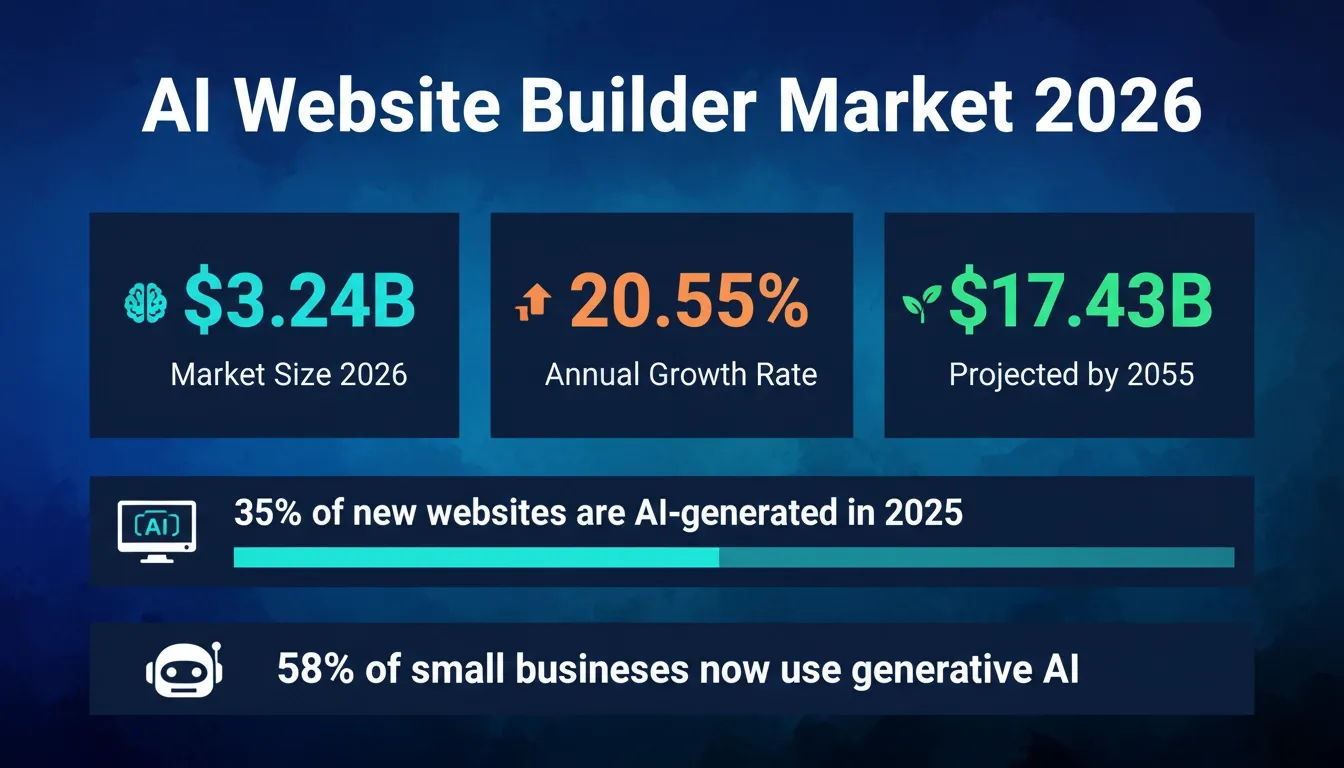
The global AI website builder market is projected to reach $3.24 billion in 2026, up from $2.69 billion in 2025, and is on track to hit $17.43 billion by 2035 - growing at a 20.55% CAGR (Precedence Research via Hostinger). That kind of growth does not happen unless people are actually getting results.
So let's walk through what that looks like in practice and why Rocket.new is the platform that makes it real.
Why the AI Website Builder Market Exploded in 2026
Not long ago, building a website meant one of three things: hiring a developer, spending weeks learning WordPress, or settling for a generic drag-and-drop template that looked like everyone else's site.
 That equation has changed. Fast.
By mid-2025, 35% of all newly published websites were AI-generated or AI-assisted, up from essentially zero before late 2022. That is not a niche trend. That is a structural shift in how the web gets built.
A few things drove this shift:
-
Natural language prompts replaced blank canvases. You describe what you want in plain language, and the AI builds a working draft.
-
AI handles the heavy lifting on design. Layout, color, typography, content structure, all generated from your input.
-
Publishing went from days to hours. Platforms like Hostinger Horizons now average 0.8 days from first prompt to live site, down from 6.6 days in late 2024.
58% of small businesses now use generative AI, up from just 23% in 2023. And nearly 1 in 3 small businesses still operate without any website at all, meaning the opportunity ahead is still enormous.
The global AI website builder market is projected to reach \$3.24 billion in 2026, up from \$2.69 billion in 2025, and is on track to hit \$17.43 billion by 2035, growing at a 20.55% CAGR.
What Most AI Builders Get Right and Where They Fall Short
What They Get Right
Most modern AI website builders do a solid job at the basics:
-
Generating a starting layout from a text prompt
-
Offering a visual editor for tweaks and editing
-
Providing templates across common categories
-
Connecting a custom domain
-
Handling basic hosting and setup
For a simple landing page or one-page website, tools like Wix AI, Hostinger AI, and Squarespace AI can get you something presentable in under an hour. Most AI builders are good at getting you started. The question is what happens after that.
Where Most AI Builders Fall Short
Most AI builders are still, at their core, template personalization engines. They take an existing structure, swap in your content, and call it an AI generated website. The steep learning curve that most AI builders claim to remove often just moves somewhere else: into their settings, their pricing page, their locked features.
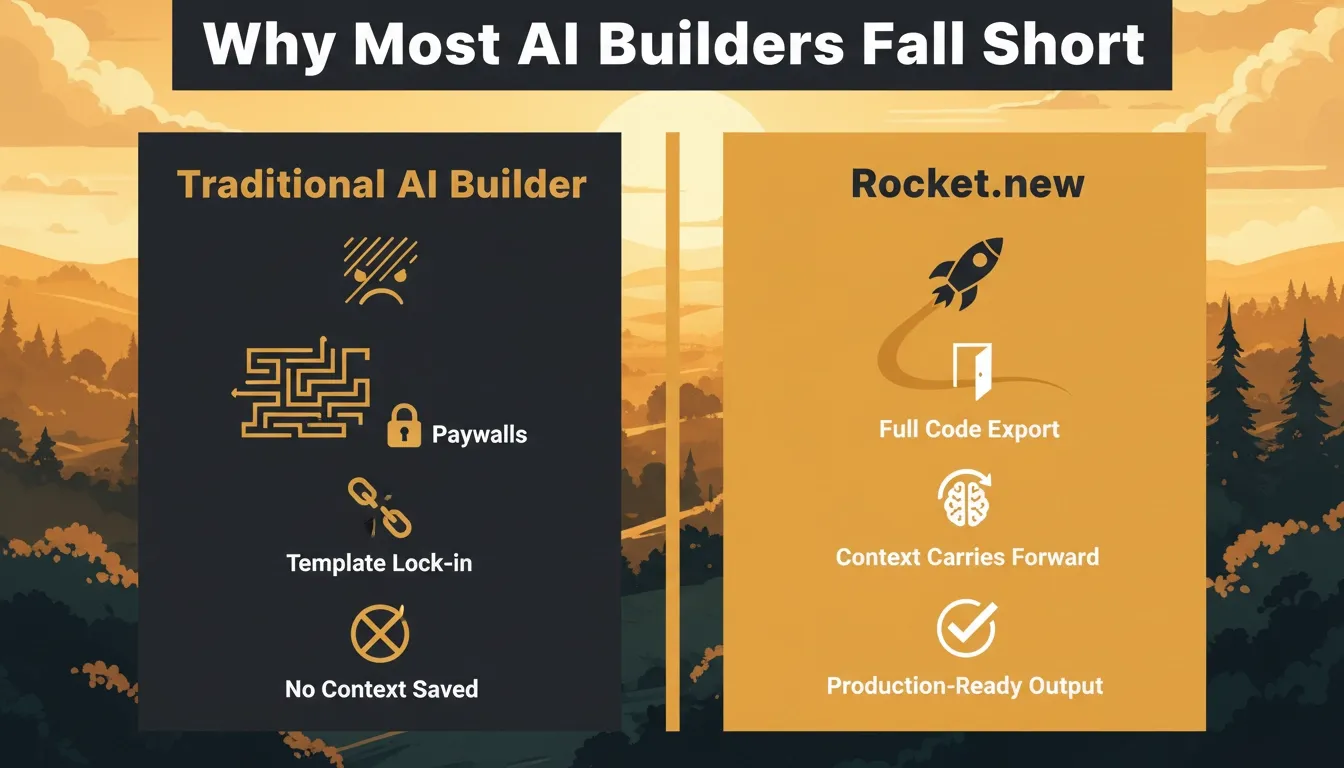 You start free, hit a wall, and end up paying for things that should have been included from the start. Customization is limited, export options are restricted, and building anything beyond a basic website requires significant workarounds. That pattern repeats across most AI site builder platforms in 2026.
Feature Comparison: Traditional AI Builders vs. Rocket.new
| Feature | Traditional AI Builders | Rocket.new |
|---|---|---|
| Site generation | Template-based | Prompt-to-production from scratch |
| Web apps and dashboards | Not supported | Fully supported |
| Mobile apps | Not supported | Supported |
| Internal tools | Not supported | Supported |
| Market research before build | Not included | Built-in (Solve) |
| Competitor intelligence | Not included | Built-in (Intelligence) |
| Staging and production deploy | Varies | One-click, always included |
| Custom domain | Add-on or paid tier | Included |
| Code export | Limited | Full code ownership |
| Context across sessions | Starts fresh each time | Shared context carries forward |
| Ecommerce / online store | Basic or add-on | Fully supported |
| Hosting | Separate setup required | Included, no configuration |
The Real Speed Equation: From Idea to Live Site
Let's be specific about what "an hour" actually means when building with a modern AI website builder. The flow looks simple on paper, but the reality depends entirely on the platform.
With most AI builders, the middle steps involve a lot of back-and-forth. You tweak a section, the layout breaks. You try to add a form, you hit a paywall. You want a second page, you need to upgrade your plan. The promised speed disappears into friction.
Website development is 90% faster with low-code and AI platforms, and companies can cut development costs by up to 70%. With Rocket.new, the flow is genuinely linear: describe what you want, the AI builds it from scratch, you review it, and you deploy with one click.
The Rocket.new Build Flow
Step-by-step:
-
Describe your site in plain language: what it is, who it is for, what it should do
-
AI generates the full site structure, layout, and content from scratch, not from a template
-
Review and adjust in the staging environment
-
Connect your custom domain
-
One-click deploy to production: site is live
If you want to see what production-grade actually means, Rocket.new's Build page walks through every capability in detail.
What Rocket.new Actually Builds
Rocket.new is not just an AI website builder. It is the world's first Vibe Solutioning platform, a system that covers the full arc from thinking to building to tracking, all in one place with shared context that carries forward across every step.
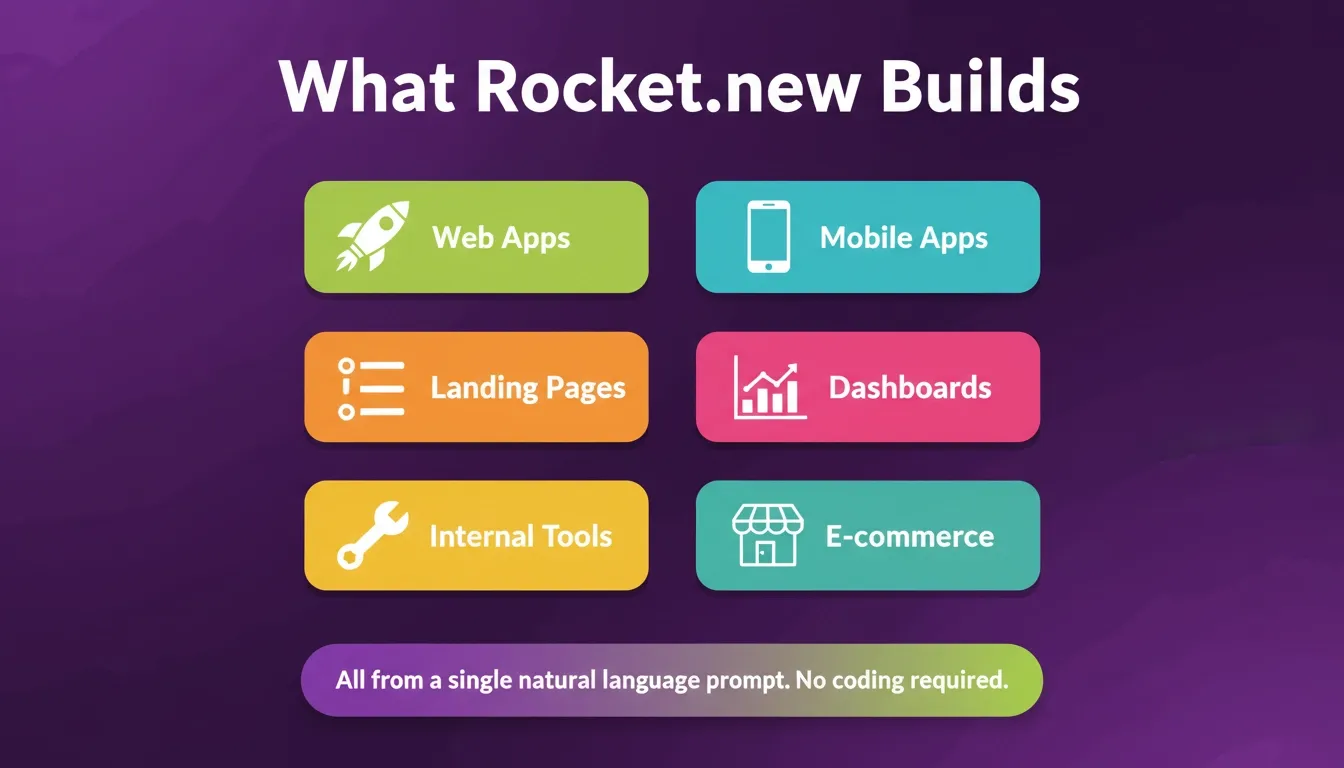 Most AI builders treat each session as a fresh start. You describe your idea again, re-upload your brand, re-explain your audience. Rocket.new remembers. The context from your research and decisions flows directly into the build, and continues into competitive intelligence after launch.
Build: Production-Ready Output from First Prompt
Rocket.new builds web apps, mobile apps (Flutter), SaaS products, internal tools, dashboards, customer portals, knowledge portals, and prototypes, all from a natural language prompt, a Figma file, an existing Next.js codebase, or even an existing live website. No coding skills required. The output is production-ready code, not a template skin.
Every build ships with SEO-ready structure, WCAG accessibility compliance, GDPR coverage, performance optimisation, and built-in analytics, all on by default, not locked behind an enterprise plan. You can read more about how Rocket.new handles competitive intelligence and what that means for your post-launch strategy.
Solve: The Thinking Before the Build
Before you build anything, Rocket.new's Solve feature helps you figure out what to build. Describe a market problem or opportunity, and it returns research, evidence, and a clear recommendation ready to present or take straight into the build.
This is the feature most AI builders do not have at all. Wix AI, Hostinger AI, and Squarespace AI start at the template stage. Rocket.new starts at the strategy stage. The Solve research depth adapts to the stakes of your decision: low-stakes questions get fast answers, high-stakes strategy gets deep analysis.
Intelligence: Know What Your Competition Just Did
After your site goes live, Rocket.new's Intelligence feature keeps watching. It monitors competitors across 10 pillars, interprets signal clusters into daily briefs, and connects intelligence directly to product building and strategy. Most AI builders end at publish. Rocket.new continues after.
It replaces standalone tools like Crayon, Klue, and Kompyte with one shared-context system. If you want to understand who it is built for, the GTM teams using Rocket Intelligence in 2026 post breaks it down clearly.
One-Click Deploy with Staging and Production
Every project gets a staging environment and a production environment. You test in staging, deploy to production with one click. Custom domain connection is included. No separate hosting setup required. No configuration headaches.
25,000+ Templates as Starting Points
If you want a head start, Rocket.new has over 25,000 templates across every use case. Pick one that is close to what you need, and the AI adapts it to your brand, stack, and goals. Or skip the templates entirely and build from scratch with a prompt, without writing a single line of code.
Integrations Built In
Rocket.new connects natively with Stripe, Supabase, Google Analytics, PayPal, Anthropic, OpenAI, Gemini, Notion, Airtable, Mailchimp, Typeform, Calendly, and more. You do not need to configure a separate integration layer. It is all part of the build.
Who Uses Rocket.new
-
Solo founders who want to ship an MVP without hiring a developer
-
Small businesses that need a professional business website without a steep learning curve
-
Product teams building internal tools, internal apps, and dashboards
-
Marketers creating high-converting pages for campaigns. See the Rocket.new Landing Page Playbook for the full strategy
-
Designers who want to go from a Figma file to a live site without writing code
-
Technical teams who want production-ready output they can own, export, and extend via 2-way GitHub sync
A Community Take on AI Website Builders in 2026
The builder market has no shortage of opinions.
Here is one that captures the current mood well:
"I've been trying out every no-code AI website/app builder you can think of for months, and Rocket is 100x better than anything else." — Solopr11, via Rocket.new
And from Mia Williams (@miatravls):
"I just one shotted a prompt using @rocketdotnew and I can't put into words how astronomically better it is than any other no code AI tool. Actually made me question why I ever paid for Bolt, Lovable, V0, a0 etc when this tool puts them all to shame. Incredibly impressed, wow." — @miatravls on X
Rocket.new has been used by 1.5 million people across 180 countries. The feedback pattern is consistent: people who have tried the alternatives find Rocket.new in a different category entirely.
How Rocket.new Compares to Wix AI and Hostinger AI
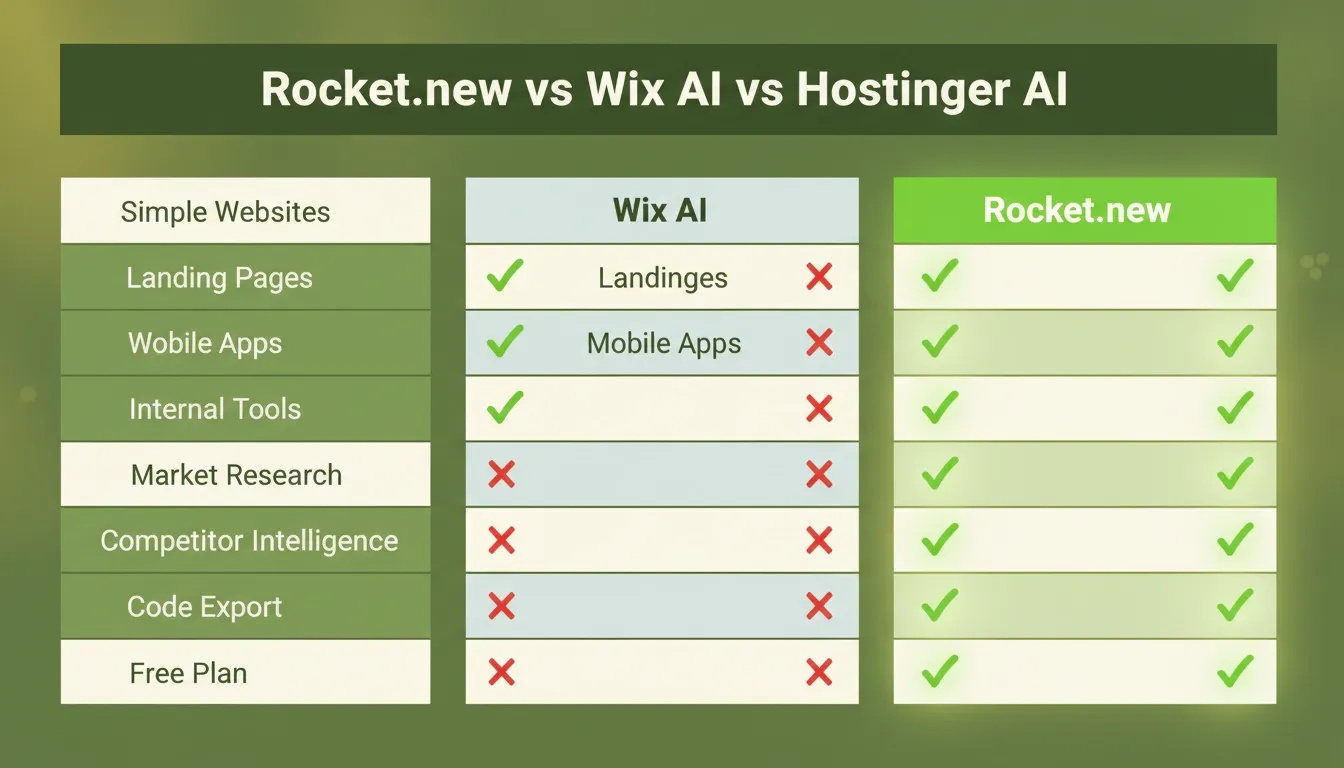
Both Wix AI and Hostinger AI are solid tools for simple sites. Wix powers 4.3% of all websites globally and has a mature drag-and-drop editor with a large template library. Hostinger AI (Horizons) has impressive adoption data: 93-95% of its users are first-time builders, and it gets people live in under a day.
 But both tools have clear ceilings:
-
Wix AI is strong for small business sites and ecommerce, but it locks you into the Wix ecosystem. Exporting your code is not straightforward, and building anything beyond a standard website requires significant workarounds.
-
Hostinger AI is fast and accessible, but it is primarily a website builder. It does not support web apps, internal tools, or mobile apps. It does not include market research or competitor intelligence.
Rocket.new does not have those ceilings. It builds the same landing pages and small business sites, but it also builds the web apps, dashboards, and internal tools that growing businesses eventually need. You do not have to switch platforms as your needs grow.
Rocket.new vs. Wix AI vs. Hostinger AI: At a Glance
| Capability | Wix AI | Hostinger AI | Rocket.new |
|---|---|---|---|
| Simple websites | ✅ | ✅ | ✅ |
| Landing pages | ✅ | ✅ | ✅ |
| Web apps | ❌ | ❌ | ✅ |
| Mobile apps | ❌ | ❌ | ✅ |
| Internal tools | ❌ | ❌ | ✅ |
| Market research (pre-build) | ❌ | ❌ | ✅ |
| Competitor intelligence | ❌ | ❌ | ✅ |
| Code export | Limited | Limited | Full ownership |
| Free plan | ✅ | ✅ | ✅ |
| Ecommerce / online store | ✅ | ✅ | ✅ |
| Production-ready deployments | ❌ | ❌ | ✅ |
| 2-way GitHub sync | ❌ | ❌ | ✅ |
If you are coming from WordPress and want to understand why founders are making the switch, the WordPress landing page alternative breakdown is worth reading.
The Bottom Line on AI Website Builders in 2026
The AI website builder category in 2026 is not short on options. The problem is that most tools stop at the website. They get you to published, and then they leave you there: no context about what to build next, no visibility into what your competitors are doing, and no path to building anything more complex than a standard site.
Rocket.new is built around a different belief: the work is only as good as the thinking before it. That is why it combines research, building, and competitive intelligence in one system, so the context you build up in one step carries into the next.
Ready to go from idea to live site in under an hour? Start building for free on Rocket.new no credit card required, no coding needed. Whether you are launching a business website, a web app, or a full SaaS product, Rocket.new is the AI builder that gets you there faster and keeps building with you after launch.
Table of contents
- -Why the AI Website Builder Market Exploded in 2026
- -What Most AI Builders Get Right and Where They Fall Short
- -What They Get Right
- -Where Most AI Builders Fall Short
- -Feature Comparison: Traditional AI Builders vs. Rocket.new
- -The Real Speed Equation: From Idea to Live Site
- -The Rocket.new Build Flow
- -What Rocket.new Actually Builds
- -Build: Production-Ready Output from First Prompt
- -Solve: The Thinking Before the Build
- -Intelligence: Know What Your Competition Just Did
- -One-Click Deploy with Staging and Production
- -25,000+ Templates as Starting Points
- -Integrations Built In
- -Who Uses Rocket.new
- -A Community Take on AI Website Builders in 2026
- -How Rocket.new Compares to Wix AI and Hostinger AI
- -Rocket.new vs. Wix AI vs. Hostinger AI: At a Glance
- -The Bottom Line on AI Website Builders in 2026