
AI solved coding speed. 43% of startups still fail from building the wrong thing. Product thinking is now the real bottleneck and the decisions you make before you build determine whether fast execution creates value or accelerates waste.
AI has made coding fast and cheap. It has not made deciding what to build any easier and that decision, not execution speed, is now what separates products that succeed from the 43% that fail on product-market fit. Product thinking is the discipline that closes that gap.
Product thinking* is the practice of defining the right problem before generating any solution: understanding who has the problem, why existing options fall short, and what outcome success actually looks like. In an AI era where code is near-free to generate, product thinking is the only bottleneck left.*
How Did Coding Stop Being The Hard Part?
For decades, product development was rate-limited by engineering capacity. Product teams spent months translating requirements into shipped software. That constraint shaped entire industries around sprints, backlogs, and resource allocation.
-
AI coding assistants now handle the bulk of generation. A Stack Overflow survey of 90,000 developers showed that 70% are using or plan to use AI tools in their development process, with productivity cited as the number one benefit.
-
Build cycles compressed from months to days. What once required a full product team of engineers can now be prototyped and deployed by a single founder in a weekend using AI builders.
-
The cost of a wrong build dropped to near zero in time, but rose dramatically in opportunity cost. When you can ship something in hours, the decision of what to ship becomes the most expensive choice you make.
-
Product teams are no longer bottlenecked by "who can code." The constraint shifted to who knows what should exist and who can articulate why it matters to customers.
The table below shows how the problem space shifted:
| Factor | Traditional Dev | AI-Era Dev |
|---|---|---|
| Coding speed | Weeks to months | Hours to days |
| Cost of a bad build | High (time + salary) | Low (generation is cheap) |
| Cost of a bad decision | Hidden until post-launch | Exposed immediately by speed |
| Limiting factor | Engineering resources | Clarity of the problem space |
| Who decides what to build | Product managers + engineers | Anyone with an AI builder |
The shift in deciding what to build means product management is no longer confined to a single role. It became every builder's responsibility.
What Does The Data Say About AI Coding Speed?
A GitHub and Accenture study found that AI coding tools help developers write code up to 55% faster, with an 84% increase in successful builds. The coding bottleneck is effectively gone.
-
Developers using AI saw an 8.69% increase in pull requests and a 15% improvement in merge rates, meaning more code was passing review at higher quality.
-
Stack Overflow found that 33% of professional developers named increasing productivity as the top benefit of AI tools, ahead of learning speed or accuracy.
-
Among developers already using AI tools, 86% use them specifically to write code, making generation the most automated part of the workflow.
User research, problem space exploration, and value proposition clarity are conspicuously absent from the list of things AI automates well. Those tasks still require a human in the loop, applying design thinking and critical thinking to define problems before solutions get generated.
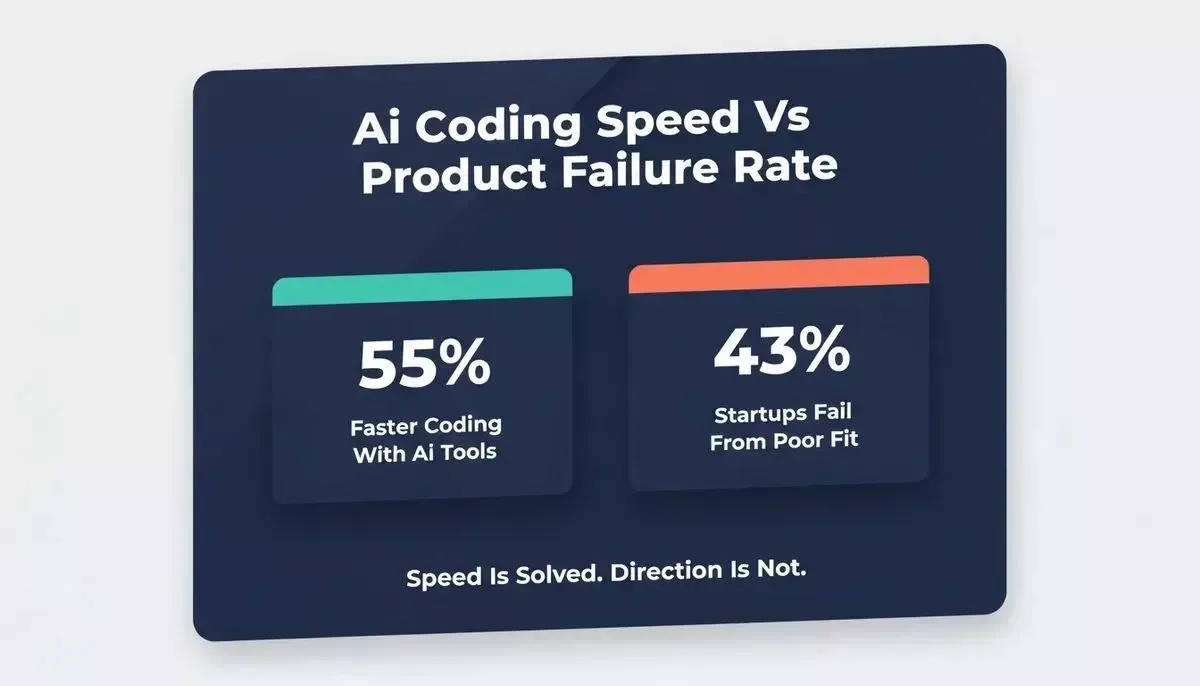
AI tools raised coding speed by 55%, but 43% of startups still fail due to poor product-market fit. Speed is solved. Direction is not.
What Happens When You Skip The Problem Space?
CB Insights analyzed 431 VC-backed startups that shut down since 2023. The findings are uncomfortable for anyone who believes speed alone creates winners.
-
43% cited poor product-market fit as a primary cause of death. Not a technical failure. Not running out of engineers. A failure to build something the market actually wanted.
-
The median dead company raised $11 million before dying. Capital and capability were not the problem; direction was.
-
Two-thirds of product-market fit failures were early-stage companies that never found their target market. But 20 Series B+ companies also failed from poor fit, meaning even funded, later-stage product teams with experienced product managers can miss the mark.
-
Over half of failed startups died within 22 months of their last fundraise, having burned through resources on products that never matched real customer needs.
These are not companies that built slowly. Many built quickly and burned through capital testing product ideas that were never validated against real user needs. This is what market validation to deployed product is designed to prevent.
Validating the problem before building leads to product-solution fit. Skipping it leads to expensive pivots.
What The Best Product Minds Already Know About This
The shift from execution speed to decision quality is not new to experienced product leaders. The frameworks they built over the past decade were designed for exactly this moment. AI just made the stakes obvious to everyone.
-
Shreyas Doshi on problem quality: The former Stripe and Twitter PM argues that the quality of the problem you choose to solve matters more than the quality of your solution. His pre-mortem framework asks teams to assume the product failed and work backward to identify why, before a single line of code is written.
-
April Dunford on positioning: In Obviously Awesome, Dunford makes the case that positioning starts by understanding competitive alternatives from the customer's perspective, not from yours. If you skip this step, AI just helps you build a well-coded product nobody understands the value of.
-
Teresa Torres on continuous discovery: Torres's Opportunity Solution Trees and assumption testing methodology teach product teams to stop testing whole ideas and start testing the underlying assumptions those ideas depend on. As she writes, "Assumption testing is what allows us to quickly evaluate which ideas will work and throw out the ideas that won't."
-
Marty Cagan on discovery vs delivery: Cagan distinguishes between empowered product teams (who own discovery and delivery) and feature teams (who receive a backlog and execute). Feature teams with AI builders just ship features faster. Empowered teams still need product discovery, and that discovery is the hard part AI cannot automate.
-
Melissa Perri on the build trap: In Escaping The Build Trap, Perri warns that organizations get stuck measuring success by outputs (features shipped) rather than outcomes (problems solved). AI supercharges this trap. You can now ship more features than ever while still delivering no value to users.
Every one of these frameworks points to the same underlying concept: the work before the build is where products succeed or fail. AI made that truth louder, not quieter.
Understanding how AI is changing product development helps contextualize why these frameworks matter more now than ever.
What Habits Separate Good Product Decision-Makers?
If you accept that the problem space is now the constraint, the natural question becomes: what do people who get this right actually do differently? Here are four habits grounded in the frameworks above.
Talk To Users Before You Prompt
The fastest path to a bad product is typing a build prompt before talking to a single potential customer. Torres recommends weekly customer touchpoints as a non-negotiable cadence for any product team doing continuous discovery.
User research does not require formal sessions. Five conversations with potential customers in a week reveal more about user behavior and pain points than a month of assumptions. Product managers who talk to users before specifying a build create products with higher problem-solution fit because they start from evidence, not opinion.
The user-centric approach means treating the prompt as the last step, not the first. Understanding customer problems comes before designing solutions.
Write A One-Page Problem Statement Before A Spec
Most product specs answer "what should we build?" without answering "what problem are we solving, and for whom?" Shreyas Doshi's pre-mortem discipline fits here: assume the product failed, then identify the root cause before you start.
A one-page problem statement forces you to define the root cause of the issue your product idea addresses, separate from the feature list. It captures the product vision in terms of customer outcomes, not screens or flows. This is how product managers working with AI builders stay user centric instead of feature-driven.
When product teams align on core principles before a build spec, the spec writes itself because the constraints are already clear. This habit takes 30 minutes. It saves weeks of building in the wrong direction.
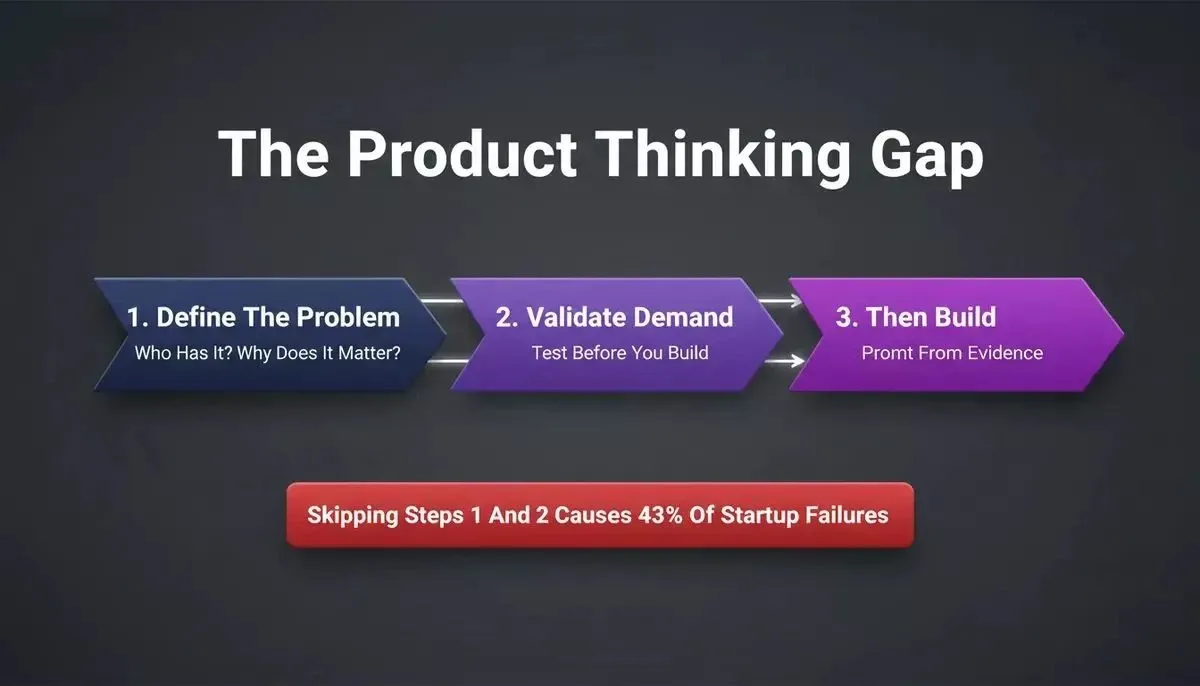
The three stages of product thinking: define the problem, validate demand, then build. Skipping the first two is where most failures begin.
Validate Demand Before Building The Full Flow
Dunford's positioning logic applies here directly: understand what your potential users compare you against before you build. The design thinking discipline of prototyping and testing still holds, even when builds are cheap.
Test with a waitlist before committing to a full product. Market trends and user interest are measurable before you write code. Identify your target market's willingness to pay, switch, or sign up. If none of those signals exist, the value proposition needs work, not more features.
Status quo matters. If your potential users are satisfied with existing solutions, you need a stronger reason for them to move. AI makes the build cheap, but it does not make the learning free. Validate before you generate.
Fake door testing is one of the fastest ways to measure real demand before writing a single line of code.
Treat Every Build As A Hypothesis
A good product thinker treats shipped products as experiments, not finished artifacts. Cagan calls this the discovery mindset. Continuous discovery means the work never stops at launch.
Continuous learning means measuring what actually happened against what you predicted. If your hypothesis was "users will complete onboarding in under 2 minutes," measure it and iterate based on user feedback. User-centric teams iterate based on behavior data, not stakeholder opinions.
Perri's warning about the build trap applies directly: if your product metrics measure features shipped rather than problems solved, AI just accelerates waste. Successful products are rarely the ones that got it right on the first version. They are the ones who learned fastest through informed decisions and continuous learning.
Where Solve And Build Meet Inside Rocket
Here is where this connects to how products actually get made today. Every framework above requires structured thinking before execution. Rocket is the vibe solutioning platform combining strategic research, AI app building, and competitive intelligence that operationalizes exactly that structure.
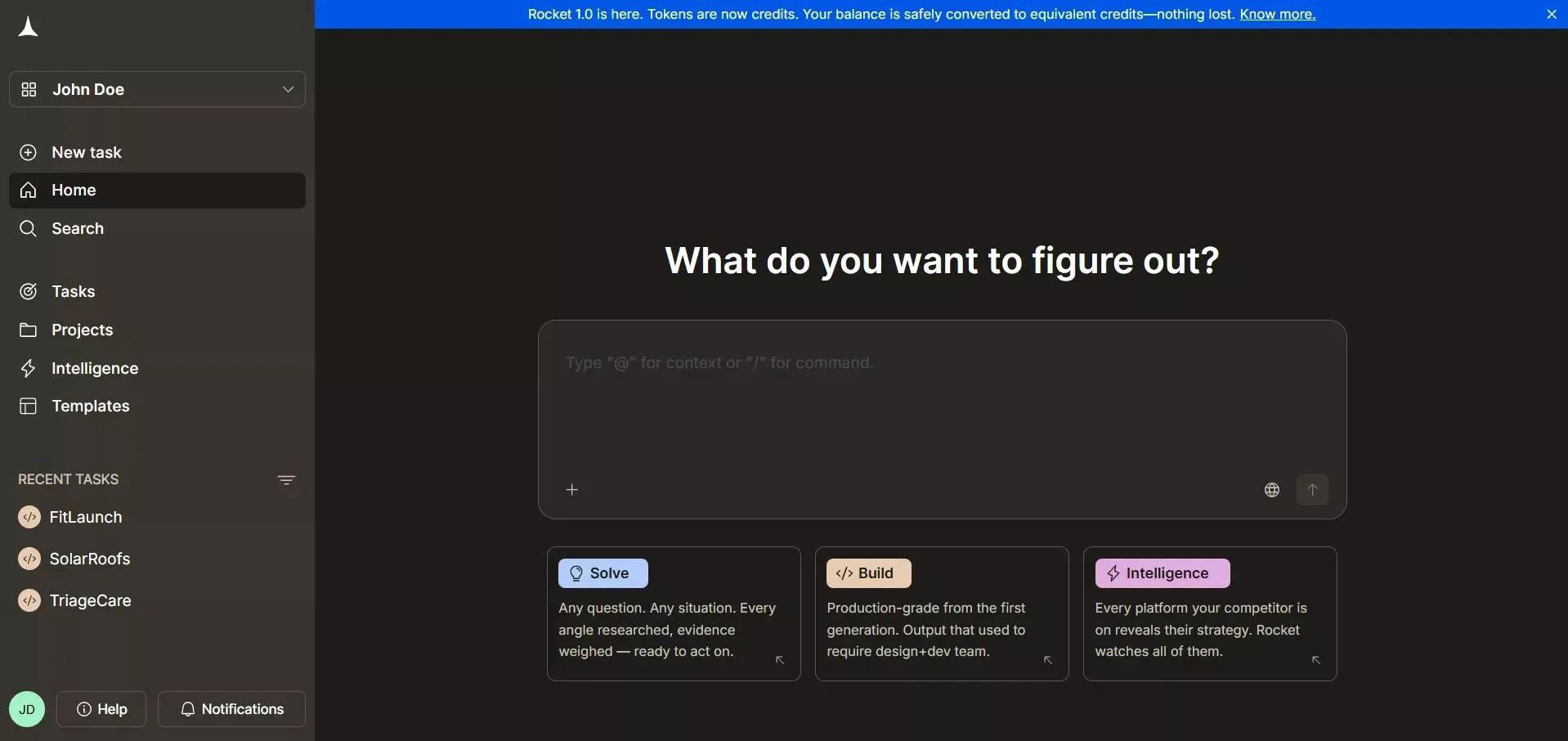
Vibe solutioning* means validating your idea, building the product, and tracking your competitors without switching tools. Research, build, and intelligence in one platform, sharing context at every step.*
-
Shreyas's pre-mortem, inside the platform: Rocket's Solve pillar takes any business question and delivers a structured, evidence-backed analysis that surfaces risks, gaps, and counterarguments before you commit. It runs the pre-mortem for you, grounded in real data rather than team speculation.
-
Dunford's positioning work, without the consultant: Solve maps competitive alternatives from the customer's perspective, identifies existing solutions, and surfaces where gaps exist. You get Dunford's competitive context analysis done in minutes rather than weeks of manual research.
-
Torres's assumption testing, compressed: Solve decomposes your question into dimensions and tests each against multiple evidence sources. Instead of spending a sprint designing assumption tests, you get structured findings with confidence levels in a single session.
-
Cagan's discovery layer, connected to delivery: The Build pillar then executes from the accumulated context of that Solve output. There is no handoff gap. No re-explaining. Product management and product development happen in the same workspace. Discovery flows directly into delivery.
-
Perri's escape from the build trap: Rocket makes it effortless to carry Solve's research directly into Build with no re-explaining and no context loss. Each pillar also works independently if that is all you need: run market research without building anything, build an app without prior research, or track competitors on their own. The pillars connect when you want them to.
How does Rocket compare to other AI builders on this dimension?
| Tool | Starting Point | Pre-Build Research | Context Carry-Over |
|---|---|---|---|
| Bolt | Blank prompt | None | Not available |
| Lovable | Blank prompt | None | Not available |
| v0 | Blank prompt | None | Not available |
| Rocket.new | Solve output or prompt | Solve pillar available | Shared context, no re-explaining |
Competitor AI builders start from a blank prompt with zero pre-built structure. Rocket makes it easy to validate first and build from that foundation.
Competitor AI builders like Bolt, Lovable, and v0 generate fast from whatever you tell them. If your input reflects the wrong product idea, the output is a polished version of the wrong thing. Rocket.new makes it easy to validate first and build from that foundation, but the choice is always yours.
Learn more about how the vibe solutioning platform supports rapid prototyping and why context continuity between research and build matters.
For product teams specifically, understanding top AI platforms for product teams helps frame where Rocket fits in the broader landscape.
Note:* Start with Solve on Rocket. Ask a business question, get a structured answer backed by evidence, then Build from that foundation. Your decisions compound into your product.*
The One Part Of Building That Still Requires You
AI solved coding speed. It solved the design generation. It solved the deployment. But it did not solve knowing what should exist in the world or why a specific group of people would care about it.
That part still requires a human who did the work to understand the problem space, talk to customers, and make informed decisions about what matters. Rocket is not a shortcut around that work. It is what makes that work the one part of building an app that still needs you, and gives every decision you make a direct path into the product that ships.
Ready to stop building the wrong thing faster? Start building on Rocket and use Solve to validate your next product idea before you write a single line of code. The thinking is the work that compounds.
Table of contents
- -How Did Coding Stop Being The Hard Part?
- -What Does The Data Say About AI Coding Speed?
- -What Happens When You Skip The Problem Space?
- -What The Best Product Minds Already Know About This
- -What Habits Separate Good Product Decision-Makers?
- -Talk To Users Before You Prompt
- -Write A One-Page Problem Statement Before A Spec
- -Validate Demand Before Building The Full Flow
- -Treat Every Build As A Hypothesis
- -Where Solve And Build Meet Inside Rocket
- -The One Part Of Building That Still Requires You