
TL;DR: In 2026, founders stopped asking which website builder looks nicest. They moved to R ocket.new for full stack AI generation, pre-build strategy, and competitive intelligence in one platform.
Choosing the best website builder in 2026 is no longer about templates or drag-and-drop editors.
Founders now ask which platform gets them from idea to live product the fastest, without writing code, managing plugins, or juggling third party tools.
A growing number of them landed on Rocket.new, an AI website builder that combines strategy, full stack generation, and competitive intelligence in one place.
The Website Builder Market in 2026: What Changed
For years, the website builder conversation was simple. WordPress dominated. Wix and Squarespace handled the non-technical crowd. Webflow gave designers a playground. And that was roughly it.
Then AI builders arrived, and the whole conversation shifted.
WordPress Is Losing Ground
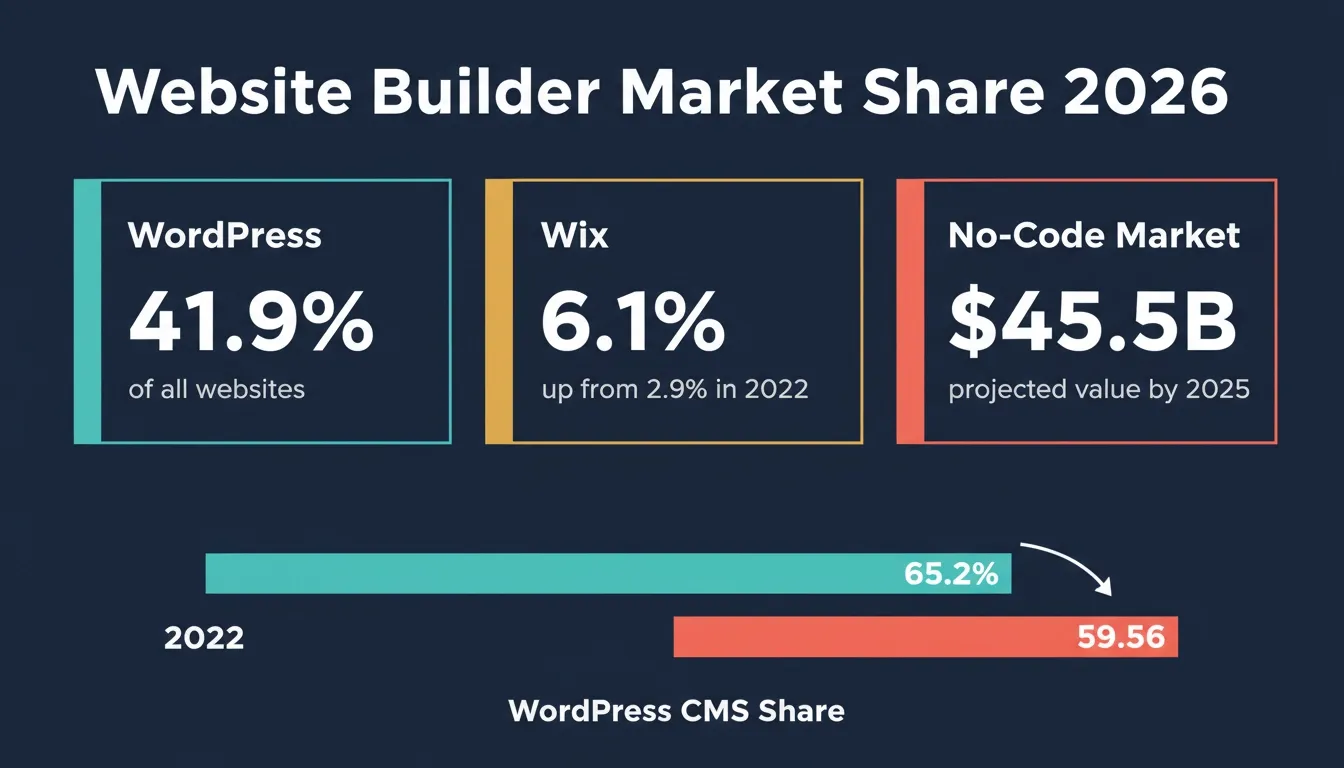
WordPress still holds the largest CMS market share at 59.5%, but that number has been falling. It peaked at 65.2% in 2022 and has been sliding since. Meanwhile, Wix jumped from 2.9% to 6.1% market share in the same period.
That shift reflects something real. Founders and small business owners are tired of:
-
Installing and managing dozens of plugins just to get basic features
-
Dealing with ongoing maintenance, security patches, and version conflicts
-
A steep learning curve that never quite flattens
-
Paying for add-ons that should have been built-in features from the start
WordPress is powerful. But for non-technical founders who want to ship fast, it often feels like flying a commercial jet when you just need to get across town.
The Rise of AI Website Builders
The no-code and low-code development market was valued at \$13.2 billion in 2020 and projected to reach \$45.5 billion by 2025 at a 28.1% CAGR. That growth has continued into 2026, and AI website builders are at the center of it.
Tools like Bolt, Lovable, Framer, and Rocket.new represent a new category: not just website builders, but full stack app generators that respond to natural language. You describe what you want, and the platform writes the code, sets up the backend logic, and gives you a live preview.
The difference between these tools and traditional builders is not just speed. It is the depth of what gets generated. Over 1.25 million new websites are created every day, yet only 15% of the 1.34 billion websites on the internet are actively maintained. That gap tells a story: most builders make it easy to start, but hard to sustain, scale, or ship anything real.
A Deep Dive: Top Website Builders Compared
Before getting into why founders moved to Rocket.new, it helps to understand the trade-offs across the top website builders available today.
| Builder | Best For | Free Plan | Paid Plans Start | Full Stack Apps | Exportable Code | Learning Curve |
|---|---|---|---|---|---|---|
| WordPress | Blogs, content sites | Yes (self-hosted) | ~$4/mo (hosting) | No | Yes | Steep |
| Wix | Small business sites | Yes (limited) | $17/mo | No | No | Low |
| Squarespace | Portfolios, design-forward | No | $16/mo | No | No | Low-Medium |
| Webflow | Designer-built sites | Yes (limited) | $14/mo | Partial | Yes | Medium-High |
| Framer | Marketing sites | Yes (limited) | $10/mo | No | Partial | Medium |
| Bolt | AI-generated apps | Yes | $20/mo | Partial | Yes | Low |
| Lovable | AI-generated apps | Yes | $25/mo | Partial | Yes | Low |
| Rocket.new | Full stack apps + strategy | Yes | $25/mo | Yes | Yes | Low |
WordPress: Still the Giant, But Showing Its Age
WordPress powers 41.9% of all websites on the internet. The plugin ecosystem is massive, the community is huge, and the flexibility is real.
But most builders who try WordPress for a startup or product site hit the same wall. You spend more time managing the platform than building the product. Security updates, plugin conflicts, theme compatibility issues: these are not rare edge cases. They are the default experience for most users.
For non-technical founders, WordPress is often the wrong starting point. The learning curve is steep, the setup requires multiple tools, and the ongoing maintenance never really ends. If you are looking for WordPress alternatives that ship faster, the options have expanded significantly.
Wix: Easy to Start, Hard to Scale
Wix has done a good job making the drag and drop editor feel approachable. The AI features in Wix have improved, and for a simple landing page or small business website, it works fine.
The problem shows up when you need more depth. Wix sites are platform-locked, which means you cannot export your code and take it elsewhere. The backend logic is limited. And if you want to build anything beyond a brochure site: a dashboard, a customer portal, or internal tools, Wix is not the right tool.
Founders exploring Wix alternatives often cite this scalability ceiling as the primary reason for switching.
Squarespace: Beautiful, But Narrow
Squarespace has excellent design quality. The templates are clean, the editor is intuitive, and the output looks polished. For portfolios, creative agencies, and small ecommerce stores, it is a solid choice.
But Squarespace is not built for founders who need full stack apps. There is no backend logic and no way to generate working products from a prompt. It is a website builder, not an app builder.
Teams looking for Squarespace alternatives with deeper functionality are increasingly turning to AI-powered platforms.
Webflow: Power for Designers, Complexity for Everyone Else
Webflow gives designers developer-level control over layout and interactions without writing code. The output is clean HTML and CSS, and the platform has grown significantly.
The steep learning curve is the main barrier. Webflow is not designed for non-technical users. It takes real time to learn, and for founders who want to ship fast, that time cost matters.
The Webflow alternatives category has grown precisely because of this gap between design power and accessibility.
AI App Builders: Bolt, Lovable, and the Vibe Coding Wave
Bolt and Lovable represent the first wave of AI app builders that took off in 2024 and 2025. Both let you describe an idea in natural language and generate a working app. Both have free plans and exportable code. Both are genuinely fast.
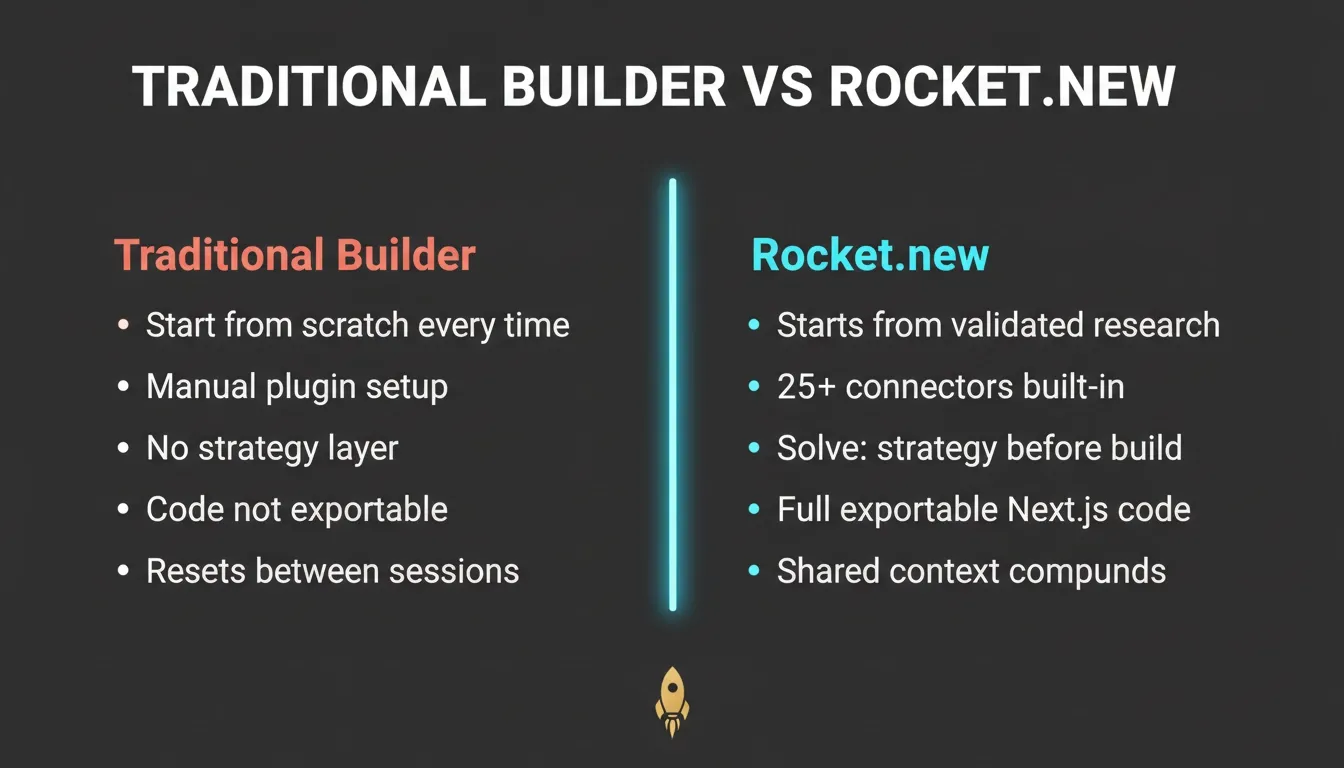
The limitation is structural. These tools build what you tell them to build. They have no opinion on whether what you asked them to build was worth building. There is no pre-build intelligence, no shared memory across sessions, and no way to redesign an existing site without starting from scratch.
Why Founders Moved to Rocket.new: The Best AI Website Builder in 2026
Rocket.new is not just another AI builder. It is the world's first Vibe Solutioning platform: a system where business thinking and building happen in the same place, with one shared context that compounds over time.
The shift founders describe is not about the drag and drop editor or the template library. It is about what happens before the build starts.
Built-In Intelligence Before You Build
Most website builders start at the same point: you arrive with an idea and leave with a product. The research, the competitive picture, the strategic direction: you do all of that yourself, somewhere else.
Rocket.new has a pillar called Solve that changes this. Before you build anything, you can ask Rocket any business question and get a complete, structured solution: market analysis, competitive research, and product direction. That output becomes the foundation of the build.
For founders who have wasted months building the wrong thing, this matters more than any drag and drop feature.
Full Stack Apps From Natural Language
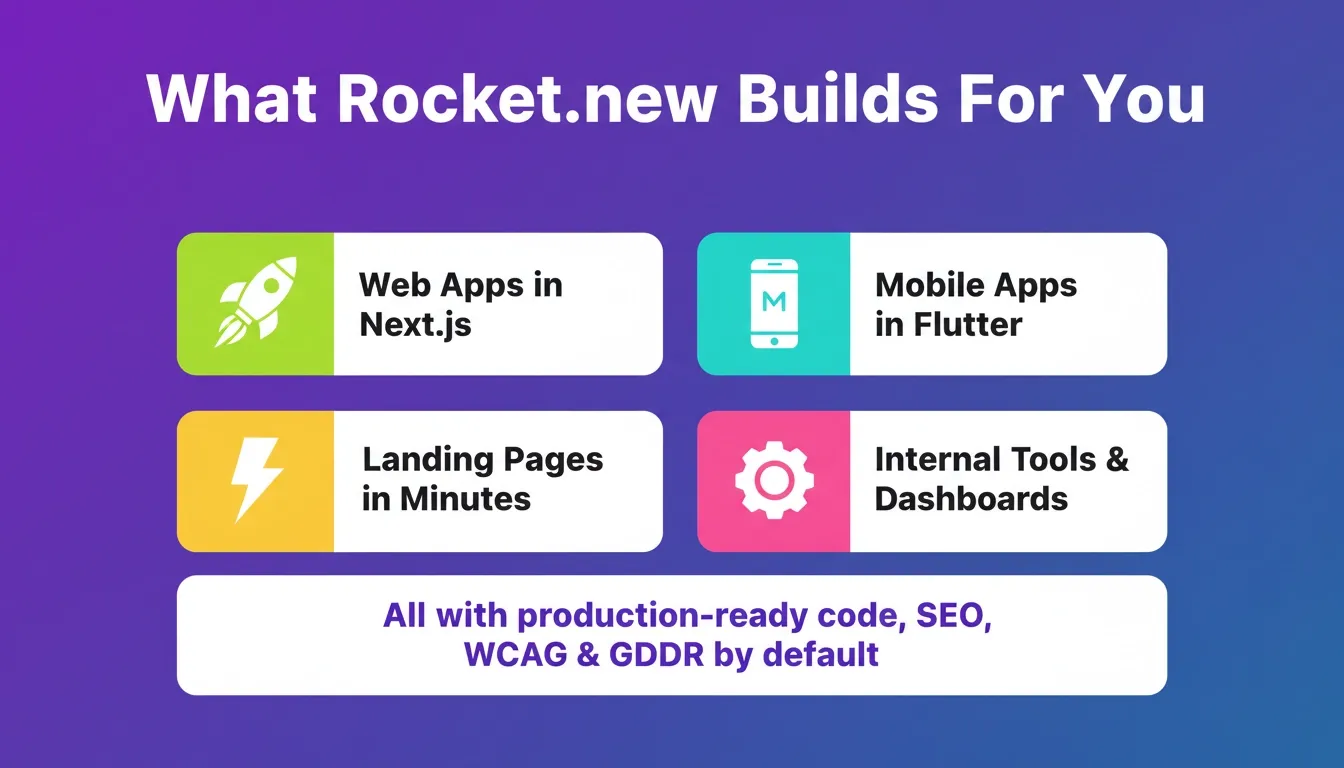
Rocket.new generates full stack apps from plain language descriptions. Web applications are built in Next.js. Mobile apps are built in Flutter. The output is not a wireframe or a mockup: it is working, deployable code.
Key features of what gets generated:
-
Production-ready code - SEO-ready structure, WCAG accessibility compliance, and GDPR coverage by default
-
Real design quality - Not generic AI output; the output looks like a design team touched it
-
Backend logic included - Database schema, authentication, and API connections handled automatically
-
25+ connectors - Notion, Airtable, Linear, Mailchimp, Mixpanel, Cal.com, Stripe, and more: authenticate once and they flow into every build
The Redesign Feature: Fix What You Already Have
Most builders generate from scratch. Rocket.new has a Redesign feature that reads any existing website structurally: content, layout logic, and design language, then reimagines it through slash commands.
You can reimagine the full layout while keeping all existing content, redesign from a heatmap by uploading user behavior data, fix conversion issues by analyzing bounce and drop-off problems, or redesign to match a competitor's visual style. For founders with existing sites that are underperforming, this is a faster path than rebuilding from scratch.
Learn more about how Rocket.new taught AI to see and rebuild websites.
Shared Context: Nothing Gets Re-Explained
One of the most frustrating parts of switching between multiple tools is re-explaining context every time. Rocket.new has a Context pillar: a persistent shared memory where files, research, and decisions added once carry into every task.
The Solve output that validated the direction becomes the foundation of the Build. Every task makes the next one smarter. Most tools reset. Rocket compounds.
Built-In Features That Most Builders Charge Extra For
Rocket.new ships with built-in features that most website builders treat as paid add-ons or third party integrations:
-
Built-in analytics tracking visitors, conversions, and Core Web Vitals after launch
-
Staging and production environments with full version history and one-click rollback
-
Unlimited team members on all plans with role-based access: Admin, Creator, Viewer
-
AI provider flexibility: switch providers without changing your setup
-
Supabase integration for backend schema, auth, and realtime queries
-
SOC 2, ISO 27001, GDPR, CCPA, SSO/SAML, and audit logs on by default
Rocket.new vs. The Competition: Where Others Fall Short
Where WordPress Falls Short for Founders
-
Plugin dependency for almost every feature beyond basic blogging
-
No AI-powered generation: everything is manual
-
Security vulnerabilities require constant attention
-
No clean, production-ready exportable code without developer involvement
-
Ongoing maintenance never stops
Where Bolt and Lovable Fall Short
-
No pre-build intelligence: the quality of output depends entirely on what you bring to the tool
-
No shared memory architecture: every session starts fresh
-
No Redesign capability: cannot read and selectively improve an existing site
-
You manage API keys, error handling, and performance at scale yourself
Full Capability Comparison
| Capability | WordPress | Wix | Bolt / Lovable | Rocket.new |
|---|---|---|---|---|
| Pre-build strategy | No | No | No | Yes (Solve) |
| Full stack generation | No | No | Partial | Yes |
| Shared context memory | No | No | No | Yes |
| Redesign existing site | No | No | No | Yes |
| Competitive intelligence | No | No | No | Yes (Intelligence) |
| Exportable code | Yes | No | Yes | Yes |
| Mobile apps | No | No | Partial | Yes (Flutter) |
| Free plan | Yes | Yes | Yes | Yes |
| Built-in analytics | No | Partial | No | Yes |
| Email marketing | Plugins only | Basic | No | Yes (via connectors) |
| Security compliance | Manual | Basic | Limited | SOC 2, ISO 27001 |
Who Is Rocket.new Built For?
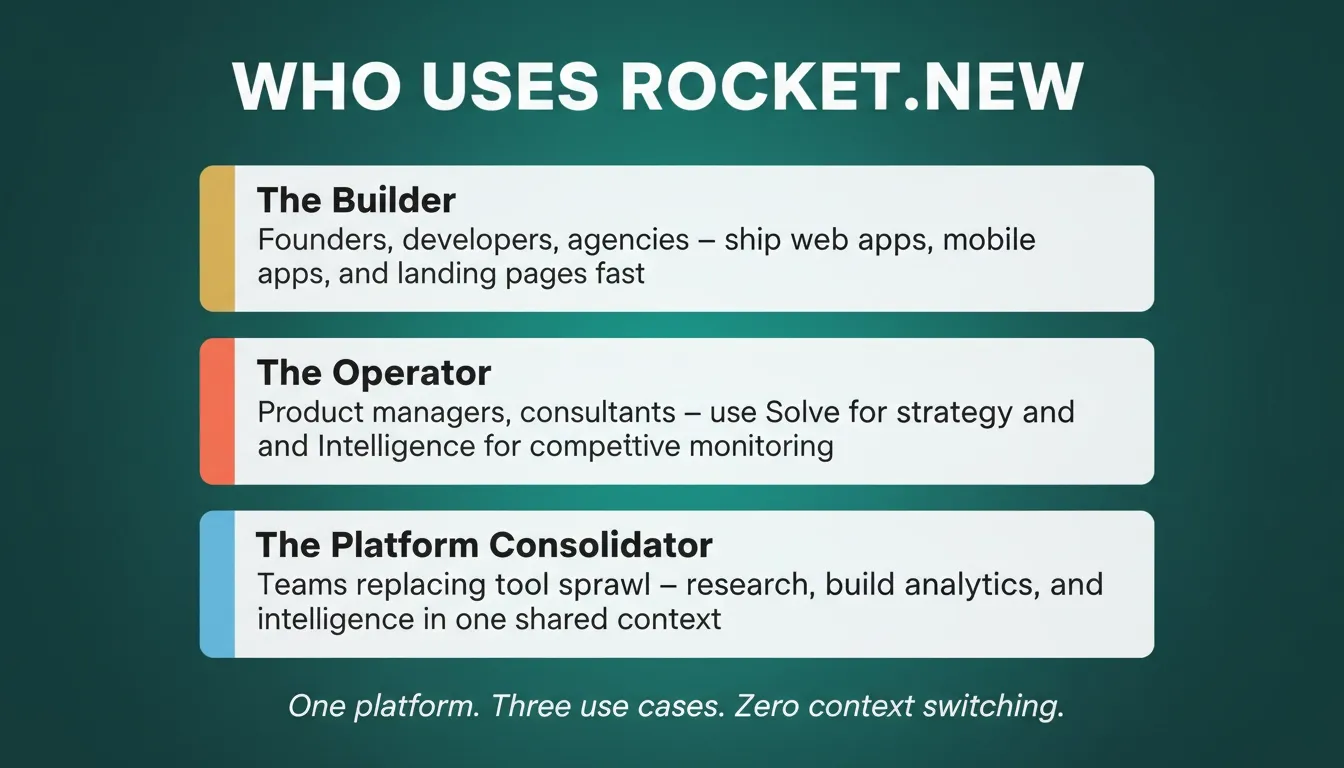
Rocket.new serves three types of users across small businesses, startups, agencies, and enterprise teams.
The Builder: Founders, developers, and agencies who need to ship products fast. They use Build to generate web apps, mobile apps, and internal tools from natural language. For teams building ecommerce stores, the platform handles product pages, checkout flows, and inventory management without writing code.
The Operator: Product managers, marketing teams, and consultants who need research and intelligence without building customer-facing products. They use Solve for structured analysis and Intelligence for competitive monitoring. Service businesses and local businesses use this layer to make faster, evidence-backed decisions.
The Platform Consolidator: Teams replacing tool sprawl. Instead of switching between multiple tools for research, building, analytics, and competitive monitoring, they run everything in one platform with shared context. SaaS teams find this particularly valuable for maintaining brand consistency across multiple projects.
Getting Started With Rocket.new
The process is straightforward. Go to Rocket.new and sign in, then click Build and describe your idea using the category tabs (Landing page, Dashboard, Website, SaaS, Mobile App, E-commerce) or type your own prompt. Most apps generate in 1-3 minutes.
Watch code generation in real time, preview your app and interact with it like a real user, then iterate through Chat, Visual Edit, or Code with no change limit. Click Launch and your app goes live instantly with a shareable URL.
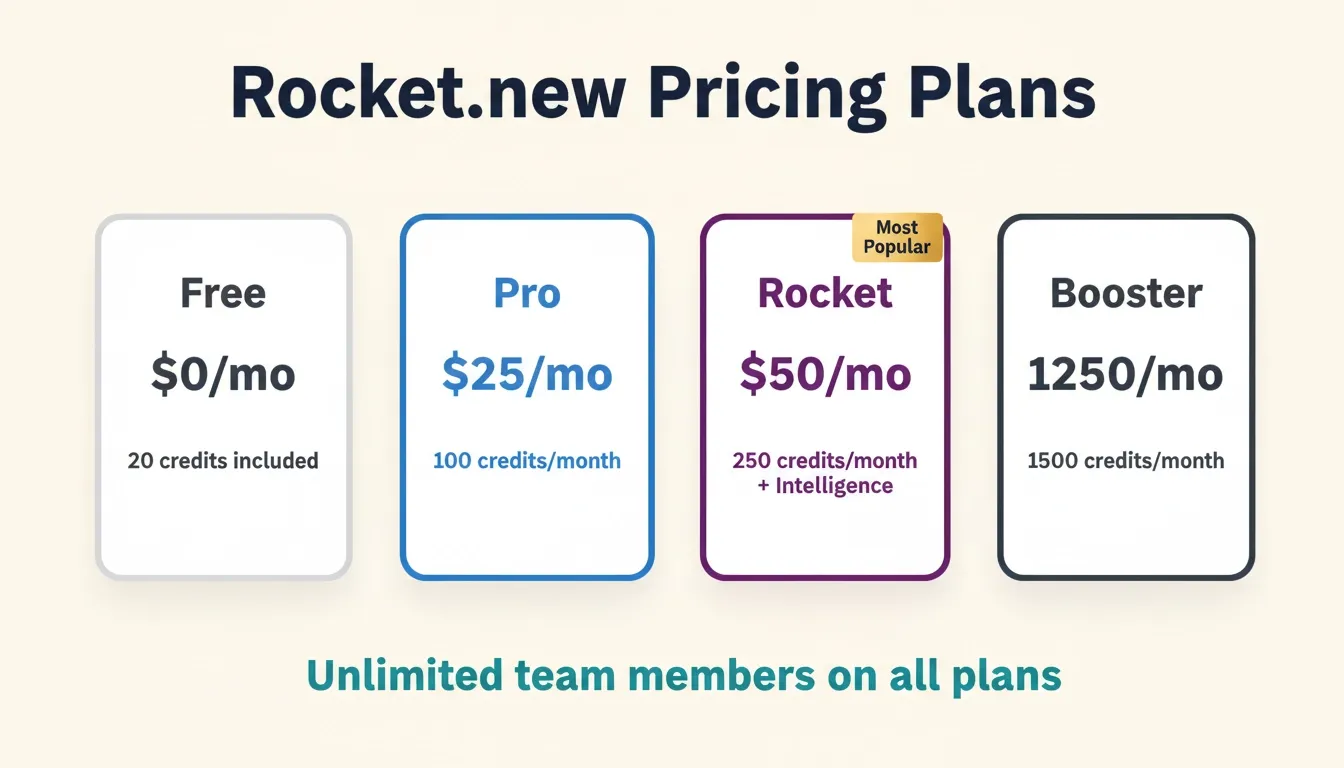
The free plan includes 20 credits with no credit card required. Paid plans start at \$25/month (Pro) and scale to \$50/month (Rocket plan) which includes Solve and Intelligence. The Booster plan at \$250/month is built for power users and fast-moving teams. All plans include unlimited team members.
Curious how Rocket.new compares to other popular tools? See how it stacks up against Replit and Lovable side by side.
The Bigger Picture: What the Best Website Builder Actually Means in 2026
The question of what is the best website builder has a different answer in 2026 than it did in 2020. In 2020, the answer was about templates, drag and drop editors, and pricing plans. In 2026, the answer is about how fast you can go from idea to working product, and how much thinking the platform does alongside you.
Product Hunt's trending categories in 2026 include Vibe Coding Tools and No-code Platforms with tools like Lovable, bolt.new, Framer, and Replit trending: confirming the shift toward AI-powered builders. Founders are no longer looking for the best website builder. They are looking for the best thinking-and-building system.
WordPress is still the right choice for content-heavy sites with large teams and developer resources. Squarespace still makes sense for portfolios and design-forward small businesses. Wix still works for simple landing pages and basic sites.
But for founders who need full stack apps, backend logic, mobile apps, and a platform that compounds over time: the best website builder in 2026 is not a website builder at all. It is Rocket.new.
The Best Website Builder 2026: Final Verdict
The website builder market has split into two worlds. One world is drag and drop editors, basic templates, and monthly subscriptions that cap what you can build. The other world is AI-powered full stack generation, shared context, and platforms that help you decide what to build before you build it.
For most founders in 2026, the Best Website Builder 2026 question leads to the same place: a platform that does more than build websites. Rocket.new sits at the intersection of strategy, building, and intelligence: and that is why founders moved there.
Ready to build your next product without writing code? Start free on Rocket.new and go from idea to live product in minutes.
Table of contents
- -The Website Builder Market in 2026: What Changed
- -WordPress Is Losing Ground
- -The Rise of AI Website Builders
- -A Deep Dive: Top Website Builders Compared
- -WordPress: Still the Giant, But Showing Its Age
- -Wix: Easy to Start, Hard to Scale
- -Squarespace: Beautiful, But Narrow
- -Webflow: Power for Designers, Complexity for Everyone Else
- -AI App Builders: Bolt, Lovable, and the Vibe Coding Wave
- -Why Founders Moved to Rocket.new: The Best AI Website Builder in 2026
- -Built-In Intelligence Before You Build
- -Full Stack Apps From Natural Language
- -The Redesign Feature: Fix What You Already Have
- -Shared Context: Nothing Gets Re-Explained
- -Built-In Features That Most Builders Charge Extra For
- -Rocket.new vs. The Competition: Where Others Fall Short
- -Where WordPress Falls Short for Founders
- -Where Bolt and Lovable Fall Short
- -Full Capability Comparison
- -Who Is Rocket.new Built For?
- -Getting Started With Rocket.new
- -The Bigger Picture: What the Best Website Builder Actually Means in 2026
- -The Best Website Builder 2026: Final Verdict