Brand monitoring tracks your company's mentions, sentiment, and share of voice across social media, news, reviews, and forums. It catches reputation risks early and turns competitor signals into strategy. This blog covers what to track, which tools to use, and how to combine brand and competitor monitoring in one daily view.
Who's talking about your brand right now?
Every day, customers leave reviews on G2, post complaints on Reddit, and mention your company in LinkedIn comments without tagging you. Most brands miss these conversations entirely. Brand monitoring gives you full visibility across every channel where your brand appears.
It covers social media platforms, news sites, review platforms, online forums, and blogs. You track mentions in real time, measure sentiment trends, and calculate your share of voice against competitors.
Sprout Social research shows nearly three-quarters of consumers expect a brand to respond within 24 hours. Miss that window and silence becomes the story.
This blog covers what to track, which tools work best, and how to turn raw monitoring data into competitive strategy.
What Does Tracking Your Brand Actually Cover?
Brand monitoring goes well beyond checking your social media notifications. It spans every digital surface where your company is discussed including channels most teams never think to monitor. Understanding the full scope is the first step to setting it up right.
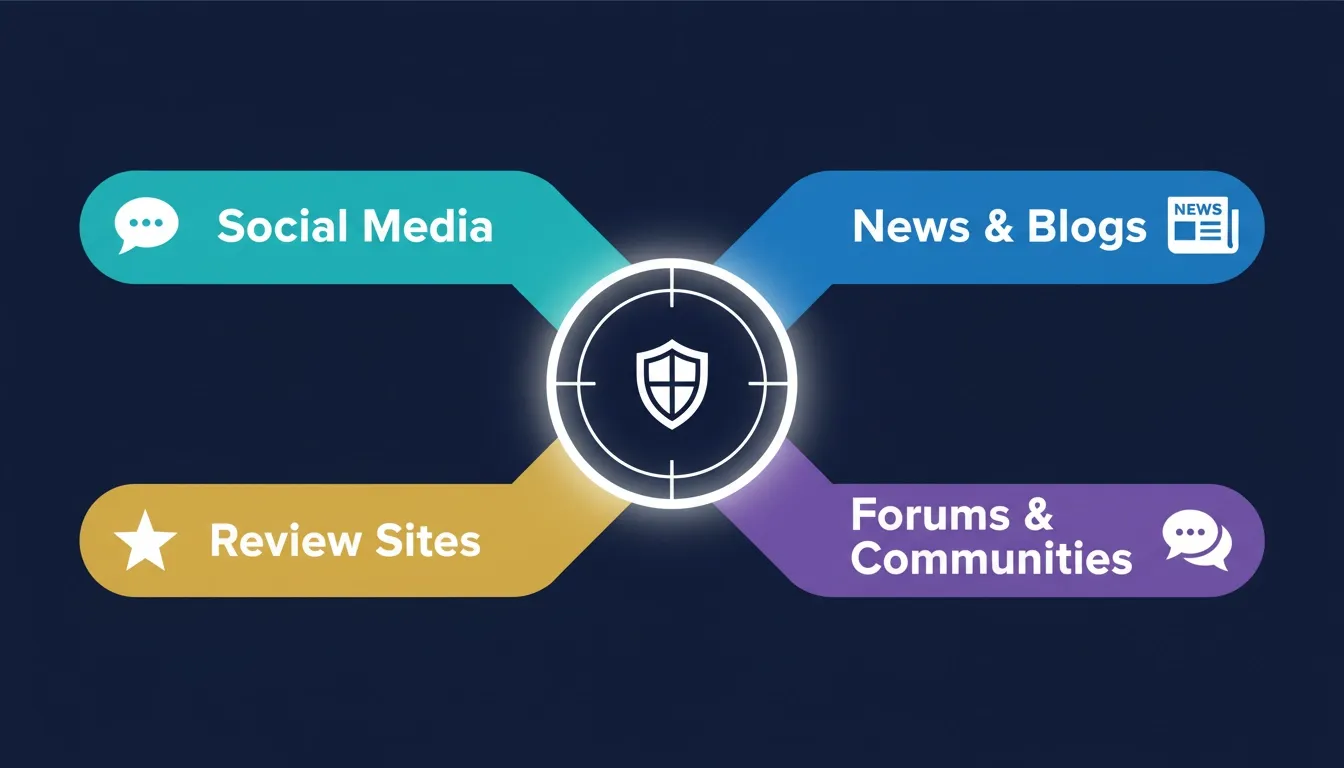 Brand monitoring pulls signals from every channel where your audience talks about you.
A Working Definition
Brand monitoring involves tracking mentions of your company, products, executives, and related keywords across digital channels. The core goal is not just knowing when someone mentions you. It is understanding the context, tone, and volume so you can act.
-
Scans: news sites, social media platforms, review platforms, online forums, blogs, and podcasts
-
What brand monitoring involves: setting up the right sources, keywords, and alerts so nothing slips past
-
Key outcome: turning scattered brand conversations into structured, actionable data
Why It Matters for Your Business
Your brand's reputation is shaped by conversations you are not part of. A frustrated customer on Reddit, a glowing review on G2, or a critical LinkedIn post all shape how buyers perceive you before they reach your homepage.
-
When you track brand mentions consistently, you catch reputation issues early and gather real customer feedback
-
Brand monitoring answers important questions like "why did sentiment shift?" with data, not guesswork
-
The result: faster crisis response, sharper competitive positioning, and better-informed marketing campaigns
What Brand Tracking Actually Covers
Many marketing teams focus only on social media monitoring and miss half the picture. Full brand tracking spans a much wider set of channels.
-
Social media channels: Instagram, X, LinkedIn, TikTok
-
News sites, industry blogs, and trade publications
-
Review platforms: G2, Trustpilot, Google Reviews
-
Online forums and communities including Reddit and Quora
-
Podcasts and video platforms
-
Media monitoring across all of these gives you a complete picture social monitoring alone does not
Brand Tracking vs. Social Listening
Social media monitoring is one component of brand tracking, not a substitute for it. Social listening watches social platforms; brand monitoring software covers every channel where your business is discussed.
-
Social listening = one lens; brand monitoring software = the complete camera system
-
According to Meltwater's brand monitoring guide, the practice spans print, broadcast, social, news, podcasts, and increasingly large language models
-
The channels that matter most for your brand's reputation may not be social platforms at all
Brand conversations happen in unexpected places. Substack newsletters, niche forum threads, and trade publications are all active surfaces. Full media monitoring coverage is the only way to catch all of it.
What Should You Be Tracking?
A solid monitoring setup covers more than your brand name. The most actionable signals come from tracking mentions, sentiment, share of voice, reviews, campaigns, and competitors together. Each signal type reveals a different layer of how people perceive your brand.
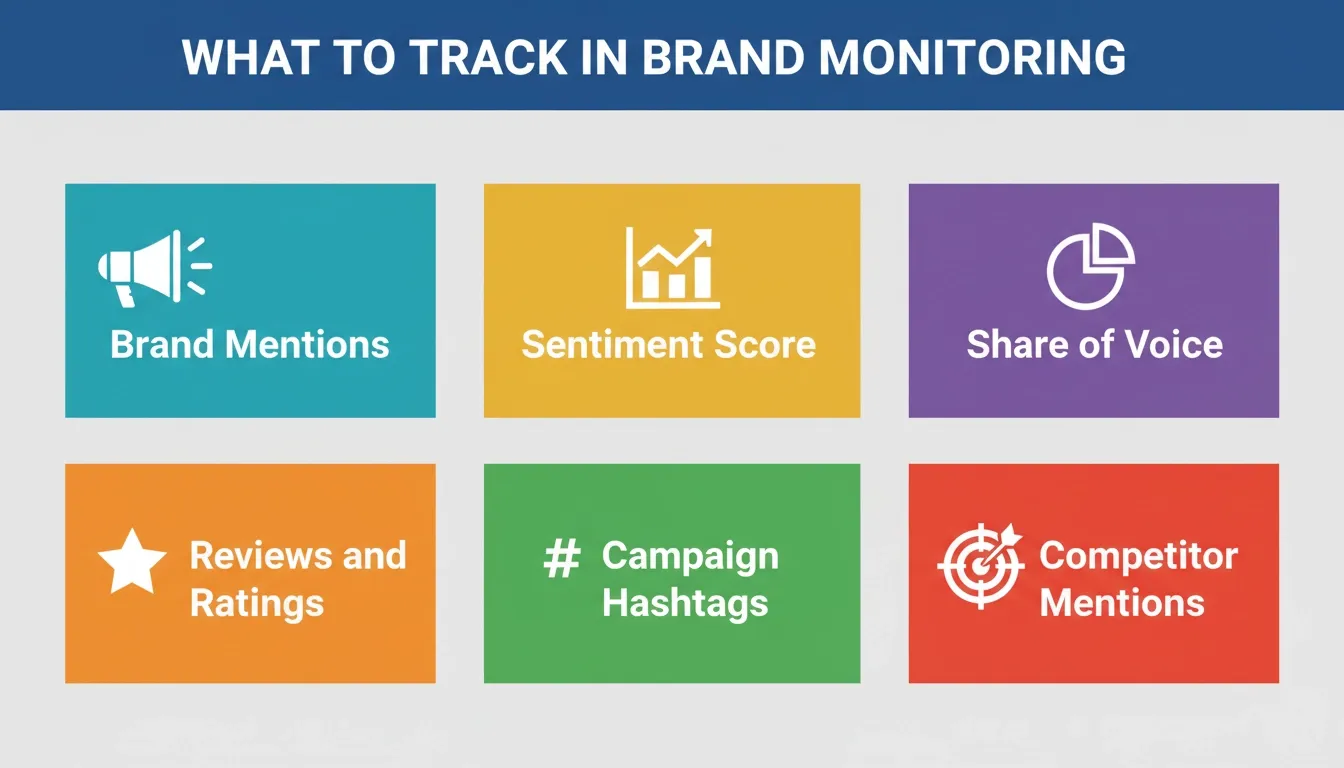 Track all six signal types to get a complete picture of your brand health and competitive position.
Brand Mentions Across Every Channel
At the foundation, you need every variation of your brand name and related terms. People don't always spell your name correctly and they rarely tag you.
-
Your exact brand name and common misspellings or abbreviations
-
Each major product name and associated keywords
-
Executive and spokesperson names
-
Campaign hashtags and branded keywords
-
Build your keyword list to cover every variation. The majority of brand mentions online are untagged
Is Sentiment Analysis Worth Tracking?
Volume tells you how much people are talking. Sentiment analysis tells you how they feel, and that is where the strategic value lives.
-
Modern online brand monitoring tools use AI to classify each mention as positive, neutral, or negative
-
AI-powered sentiment analysis detects nuances: frustration, enthusiasm, sarcasm
-
Tracking brand sentiment over time tells you whether campaigns are working or messaging needs to change
Share of Voice: How Much of the Conversation Do You Own?
Share of voice measures your brand's presence in a conversation relative to competitors. Track it monthly to see whether your marketing campaigns are growing your presence or competitors are pulling ahead.
-
Formula: Share of Voice (%) = Your Brand Mentions / Total Mentions Across All Brands x 100
-
If your brand has 400 mentions and the total is 2,000, your share of voice is 20%
-
A declining share of voice is an early signal that competitors are gaining ground before you feel it in revenue
Reviews and Star Ratings: The Reputation Layer
Online reviews are a direct signal of brand health. According to BrightLocal's Local Consumer Review Survey 2026, 97% of consumers read reviews before choosing a business, and 85% say positive reviews make them more likely to use a company.
-
Review sites are not just feedback channels. They are acquisition channels
-
Track review platforms with the same rigor you apply to social media channels
-
Sentiment shifts on review sites are often the earliest indicator of a product or service issue
Campaign Hashtags and Marketing Campaigns
When you launch a campaign, you need to know whether it lands. Track your campaign hashtags and branded terms across social media posts and news sites.
-
High reach with negative brand sentiment = messaging is off
-
High engagement with strong positive sentiment = something worth amplifying into future marketing campaigns
-
Campaign analysis through monitoring tells you exactly which messages move people
Your Competitors' Mentions Too
Monitoring your competitors' brand mentions reveals where they are winning, where customers are frustrated with them, and where openings exist for you. Pairing this with a structured competitive intelligence roadmap turns raw monitoring data into a strategic planning advantage.
| What to Track | Where to Monitor | What to Measure |
|---|---|---|
| Brand name and variations | Social, news, forums, reviews | Volume, sentiment, reach |
| Product names | Review sites, app stores | Rating trends, complaints |
| Campaign hashtags | Social media channels | Engagement, share of voice |
| Competitor mentions | All of the above | Gaps, pain points, positioning |
| Executive names | News sites, LinkedIn | Reputation, thought leadership |
| Industry keywords | Blogs, news, forums | Trends, emerging topics |
Start with your brand name and key product terms, then expand as you discover new ways people discuss your business. The most useful competitive intelligence often lives in conversations that never mention your name directly.
Choosing the Right Monitoring Tools for Your Needs
Not all monitoring tools cover the same ground. The right choice depends on how many channels you need to cover, how fast you need alerts, and whether you require competitor benchmarking. The gap between free and paid tools is significant.
Free vs. Paid: Where Does Google Alerts Stop Working?
Google Alerts is the natural starting point for basic coverage. It is free, simple, and useful for low-volume monitoring of indexed web pages.
-
Covers indexed web pages only. Misses social platforms, paywalled content, online forums, and review sites
-
No sentiment analysis, no share of voice tracking, no real-time alerts
-
For businesses that take reputation management seriously, Google Alerts is a floor, not a ceiling
Social-Only Tools and Why They Miss Half the Picture
Many social media monitoring tools track social conversations well and stop there. A negative article in an industry publication or a complaint thread gaining traction on Reddit stays completely invisible.
-
Brand monitoring software that covers news sites, blogs, and review platforms gives a more accurate picture of actual brand perception
-
Online brand monitoring tools that span all digital channels are worth the investment at any meaningful scale
-
The key question: does this tool cover the channels where your audience actually talks about you?
AI-Powered Tools: What They Actually Add
Modern brand monitoring tools use machine learning and AI-powered sentiment analysis to go past simple keyword matching. They surface patterns human review would miss.
-
Classify tone automatically across thousands of brand mentions in real time
-
Detect anomalies in mention volume and surface key influencers
-
Flag early warning signs before a minor complaint becomes public backlash
-
Modern brand monitoring tools that use AI also catch image recognition opportunities. Brand logos in user-generated content with no accompanying text become visible signals
Key Features to Prioritize in a Monitoring Tool
When comparing options, focus on what matters most to your specific monitoring goals.
-
Coverage: scans social media channels, news sites, review sites, forums, and video platforms
-
Sentiment analysis: classifies tone accurately in your industry's specific language
-
Real-time alerts: notifies you fast enough to respond before issues escalate
-
Share of voice tracking: benchmarks your presence against competitors
-
Analytics and reporting: surfaces insights your team can act on, not just raw data
A Quick Tier-by-Tier Tool Comparison
| Tier | Example Tools | Coverage | Sentiment | SOV Tracking | Best For |
|---|---|---|---|---|---|
| Free | Google Alerts | Indexed web only | None | No | Early-stage, basic coverage |
| Mid-range | Mention, Awario | Social and web | Basic | Limited | Small teams, single brand |
| Full-stack | Sprout Social, Brand24 | Social, news, reviews | AI-powered | Yes | Marketing teams, agencies |
| Enterprise | Meltwater, Sprinklr | All channels including broadcast | Advanced AI | Yes | Enterprise, PR teams |
The right monitoring tool matches your coverage needs, alert speed, and budget. Choose the tier that fits your current scale, and plan to upgrade as your competitive intelligence demands grow.
How Does Your Monitoring Data Become a Competitive Edge?
An alert is just a notification. The real value of monitoring comes from building a workflow that turns raw mentions into decisions, from crisis detection all the way to competitive strategy. Here is how that workflow takes shape.
From Alerts to Analysis: Reading the Signals
Not all spikes in brand mentions mean the same thing. The first question when you see a spike: what triggered it?
-
A viral post and a complaint thread both cause volume spikes but require completely different responses
-
Teams that get the most from their brand monitoring efforts build a regular review cadence
-
Daily review for active campaigns and potential crises; weekly analysis for trend movements and competitive intelligence
Crisis Detection: Catching Issues Before They Escalate
Most brand crises do not appear fully formed. They start as a small cluster of negative conversations on a forum or social platform.
-
Brand monitoring software with real-time alerts catches early warning signs hours before they reach mainstream news outlets
-
Early detection is the difference between a brief PR response and a full brand health emergency
-
Setting custom alert thresholds for negative sentiment spikes is standard practice for effective crisis management
Using Sentiment Trends to Fine-Tune Your Messaging
If brand sentiment trends negative after a product launch, that is a messaging problem, not just a PR issue. Monitoring data tells you exactly where to start.
-
Track brand sentiment week-over-week across your key channels
-
Look at the specific language: frustrated with pricing? Confused about a feature? Comparing you to a competitor?
-
Each signal points to a specific fix. Brand perception shifts that go untracked become strategic liabilities
Competitive Monitoring: Watching What Your Rivals Are Doing
Monitoring your competitors is one of the highest-leverage uses of tracking data. When a competitor's customer sentiment drops after a product launch, that is a signal worth acting on immediately.
-
As Rocket covers in their post on how monitoring surfaces competitor customer complaints, competitor review data can reveal strategic gaps months before any official announcement
-
Andy McCotter-Bicknell, competitive intelligence lead at Apollo.io, noted on LinkedIn: "I strongly believe every Competitive Intel program should start with a newsletter. It forces you to learn what different departments actually care about."
-
Distribution of your monitoring findings determines their real-world impact
Tying Monitoring Back to Your Marketing Strategy
Every piece of monitoring data should connect to a decision. Higher negative brand sentiment in a specific segment points to a messaging gap.
-
A competitor losing share of voice after a product update signals an opening
-
Tracking brand mentions around your campaigns tells you which messages actually land
-
A solid brand monitoring strategy creates a weekly action loop: collect mentions, analyze sentiment, identify patterns, update campaigns
Here is how the signal-to-action flow works in practice:
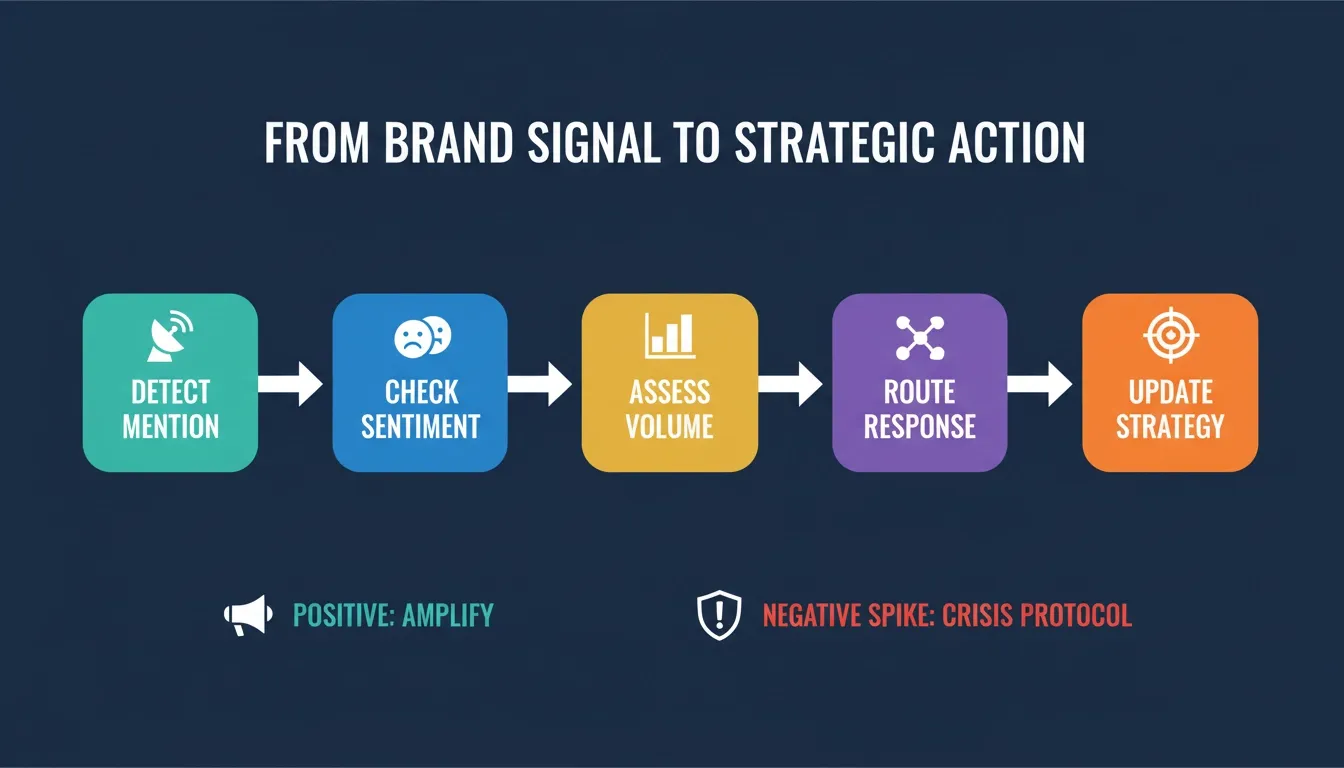 Every brand mention follows a clear path from detection to strategic action.
The teams that turn monitoring data into a weekly action loop pull ahead of the teams that only react. Online brand monitoring that connects directly to your marketing strategy separates reactive brands from strategic ones.
How Rocket Intelligence Puts Your Brand and Rivals in One View
Most monitoring platforms watch only your own brand and stop at sending alerts. Rocket Intelligence goes further. It monitors your brand alongside every competitor, connects signal clusters, and interprets what those signals mean for your specific market position. That is the shift from monitoring to intelligence.
Your Brand and Your Competitors in the Same Daily Brief
Rocket Intelligence monitors every public platform your competitors operate on: social media, news, reviews, hiring activity, and product updates. It delivers a daily brief that connects all of it.
-
Rocket watches competitor websites for messaging shifts, social media channels for campaign strategy, review platforms like G2 and Glassdoor for customer sentiment, and news sites for press coverage
-
Every signal is interpreted in context. Not just flagged, but explained with a recommended action
-
This unified platform approach is what alert-only monitoring tools cannot replicate
Six Signal Categories: What Rocket Actually Watches
Rocket tracks six categories for every entity you follow, giving you a complete view of any competitor's public activity.
-
Website: page changes, pricing updates, messaging pivots
-
Social Media: campaigns, engagement patterns, and content themes across LinkedIn, X, Instagram, Reddit, and more
-
News and Web Presence: press coverage, blogs, mentions, and executive interviews
-
Reviews and Reputation: G2, Glassdoor, Capterra, and app stores with brand sentiment shifts tracked over time
-
People: headcount changes, hiring velocity, and open positions by department
-
Performance Marketing: ad activity across LinkedIn, Meta, and TikTok
Where Competitors Actually Leave Clues
When a competitor starts hiring heavily in enterprise sales, shifts social posts toward security messaging, and turns defensive on G2 review responses, those are not three separate signals. That is one clear strategic move.
-
A pricing page change in isolation is just a change
-
That same change alongside enterprise-focused job postings and defensive review responses is a coordinated strategic signal
-
Competitor strategies rarely announce themselves as single events. They surface as signal clusters that most tools miss entirely
Understanding this is why Rocket is built as an interpretation layer, not just a monitoring dashboard. It connects the dots so your team can act, not just observe.
What Most Monitoring Platforms Miss
Most monitoring platforms stop at alerts. They tell you something happened, not what it means or what to do next.
-
Traditional approach: track brand mentions, send real-time alerts, report sentiment scores
-
Rocket Intelligence: monitor brand and competitors together, connect signal clusters, deliver daily briefs with specific recommended actions
-
The difference is between brand monitoring software that informs and a system that drives real business decisions
How to Get Started
Getting started with Rocket Intelligence takes minutes, not weeks.
-
Visit Rocket.new and follow any company by name or URL
-
Your first brief arrives within hours
-
No complex setup required. Start free, no credit card needed
Rocket Intelligence turns the daily brief into a strategic asset. It compounds advantage over time rather than sitting in a separate dashboard nobody checks.
Wrapping It Up
Knowing what people say about your business shapes every decision you make in marketing, product, and positioning. Start with a solid keyword list covering your brand name, product names, common misspellings, campaign terms, and key competitor names. Layer in social listening, review tracking, and news site alerts so nothing important slips past.
Then go past the alerts. Look at trends, sentiment shifts, share of voice movements, and the competitive clues sitting in plain sight across public platforms. That is how monitoring turns into strategy, and the difference between brands that shape their narrative and brands that only respond to it.
Rocket makes this the easiest part of your week. Follow your brand and every competitor in one place, get a daily brief that tells you what changed and why it matters, and start free in minutes. Try Rocket today and turn your brand monitoring into a real competitive advantage.
Table of contents
- -What Does Tracking Your Brand Actually Cover?
- -A Working Definition
- -Why It Matters for Your Business
- -What Brand Tracking Actually Covers
- -Brand Tracking vs. Social Listening
- -What Should You Be Tracking?
- -Brand Mentions Across Every Channel
- -Is Sentiment Analysis Worth Tracking?
- -Share of Voice: How Much of the Conversation Do You Own?
- -Reviews and Star Ratings: The Reputation Layer
- -Campaign Hashtags and Marketing Campaigns
- -Your Competitors' Mentions Too
- -Choosing the Right Monitoring Tools for Your Needs
- -Free vs. Paid: Where Does Google Alerts Stop Working?
- -Social-Only Tools and Why They Miss Half the Picture
- -AI-Powered Tools: What They Actually Add
- -Key Features to Prioritize in a Monitoring Tool
- -A Quick Tier-by-Tier Tool Comparison
- -How Does Your Monitoring Data Become a Competitive Edge?
- -From Alerts to Analysis: Reading the Signals
- -Crisis Detection: Catching Issues Before They Escalate
- -Using Sentiment Trends to Fine-Tune Your Messaging
- -Competitive Monitoring: Watching What Your Rivals Are Doing
- -Tying Monitoring Back to Your Marketing Strategy
- -How Rocket Intelligence Puts Your Brand and Rivals in One View
- -Your Brand and Your Competitors in the Same Daily Brief
- -Six Signal Categories: What Rocket Actually Watches
- -Where Competitors Actually Leave Clues
- -What Most Monitoring Platforms Miss
- -How to Get Started
- -Wrapping It Up