Rocket's Intelligence feature continuously monitors G2, Glassdoor, Trustpilot, Reddit, and app stores to surface what a competitor's customers are complaining about, with daily AI-interpreted briefs before your team thinks to check.
You open Monday with a sales call in two hours. Your prospect just left a competitor. Do you know why?
The answer lives in public places, G2 reviews, app store ratings, Reddit threads, Glassdoor feedback, but only if someone is actually watching them. According to Zendesk, 56% of consumers who have a bad customer experience say nothing and quietly switch to a competitor. That means the complaints that do surface on review platforms represent the visible edge of something much bigger.
Rocket’s Intelligence feature monitors those complaints continuously. It tracks what a competitor’s customers say on review platforms and pairs that data with signals from social posts, hiring activity, and website changes. Your team gets a daily brief that connects the dots without anyone needing to pull the data manually.
What Does "Surfacing Competitor Complaints" Actually Mean?
When a competitor’s customer writes a three-star G2 review about slow support response times, that is one signal. When ten people say the same thing in six weeks, that is a pattern. When the pattern continues while the competitor’s Glassdoor reviews mention staff cuts in the customer success team, that is a strategic opening.
Surfacing competitor complaints means Rocket.new identifies them in real time by continuously scanning over 150 public data sources, early enough to act on them, not just observe them. Most teams miss this entirely. They check G2 once a quarter, catch individual reviews, and never see the shape of what is building. By the time a pattern becomes obvious, the window has already started closing.
That is why this kind of competitor analysis matters: unsolicited, unstructured customer feedback is often more honest and detailed than structured forms.
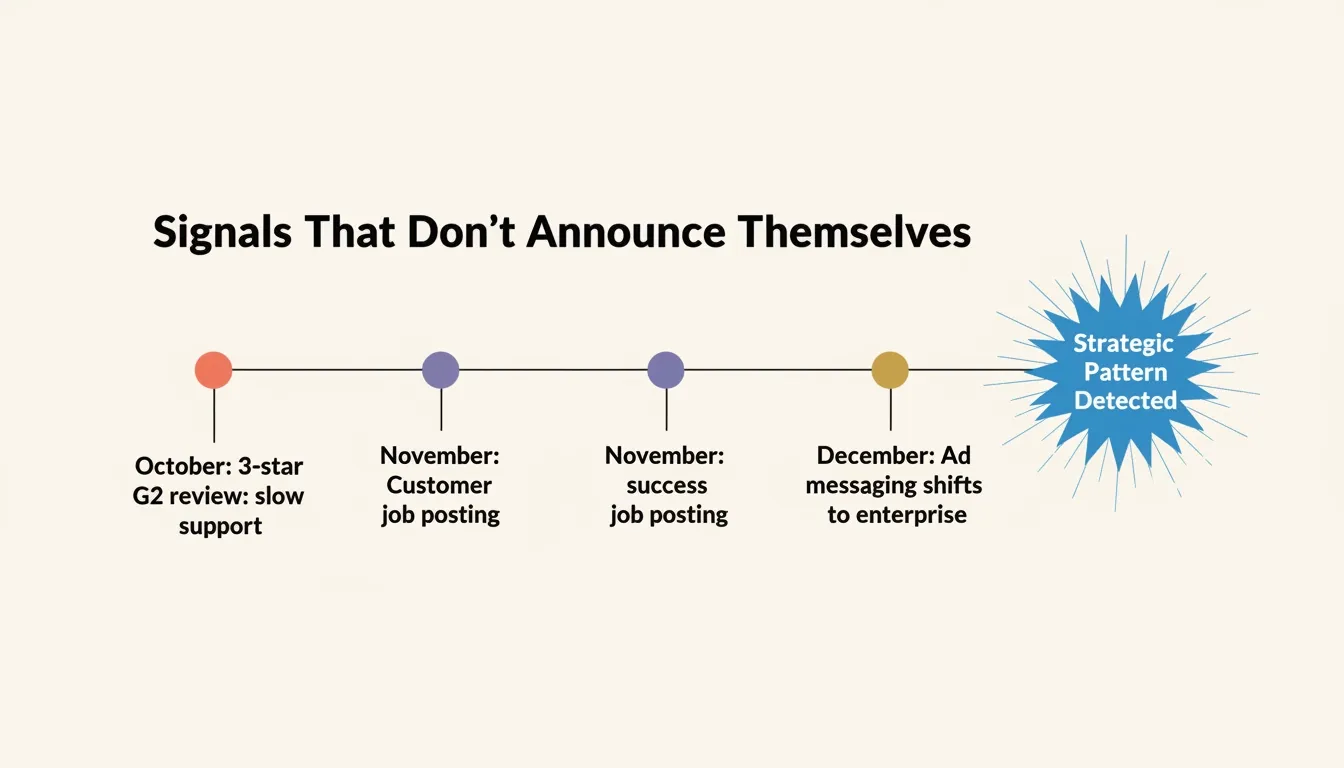 Competitor signals accumulate quietly across months before they form a visible strategic pattern.
How Does Rocket Know What a Competitor's Customers Are Saying?
Rocket’s Intelligence feature monitors every public platform a competitor operates on across six signal categories: website changes, social media activity, news and web presence, reviews and reputation, people data, including headcount and hiring, and advertising activity. The system runs continuously, so your team receives insights whether or not anyone remembered to check.
Initial data collection takes one to three hours after setup. From that point, monitoring runs automatically with no ongoing manual effort required.
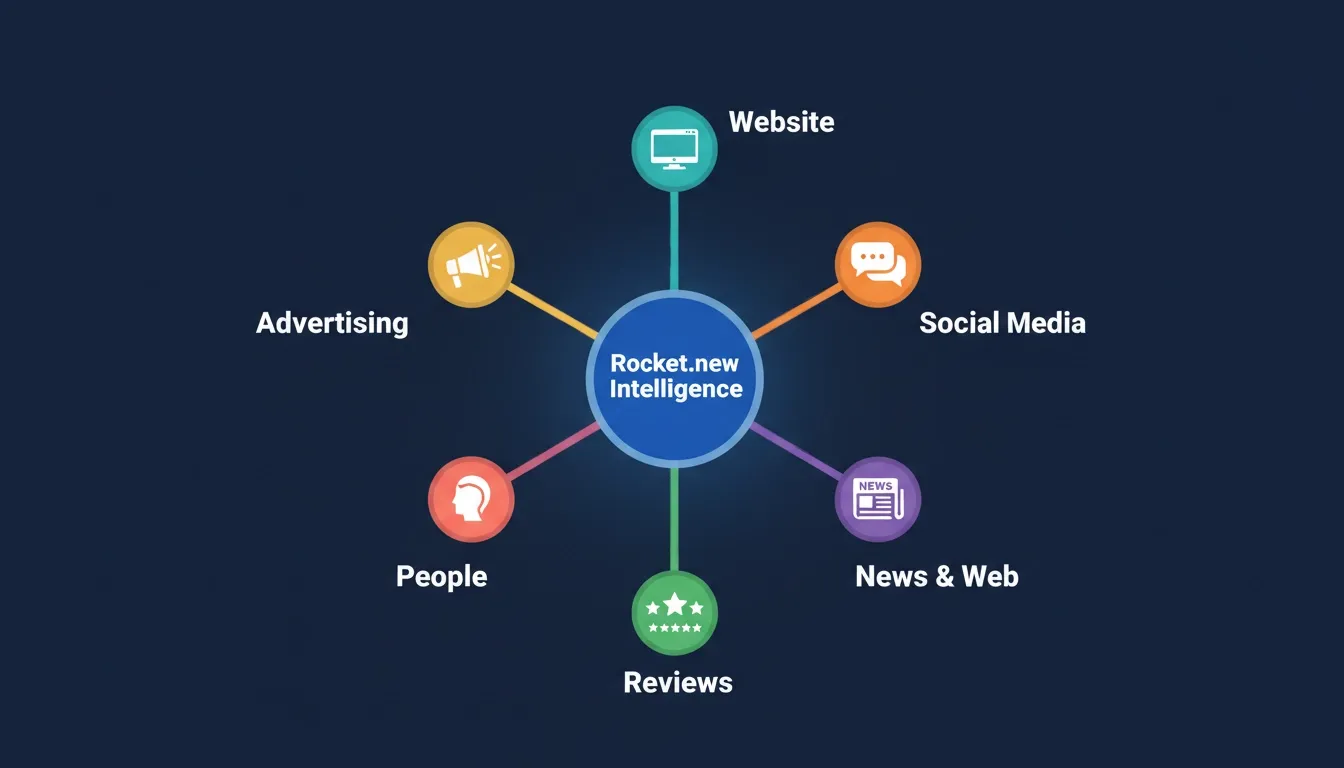 Rocket.new Intelligence maps six signal categories into a single daily brief — no manual research required.
The Six Signal Categories: Intelligence Monitors
| Signal Category | What Gets Tracked | Why It Matters |
|---|---|---|
| Website | Page changes, pricing updates, feature announcements | Catches positioning shifts early |
| Social Media | Posts and engagement across LinkedIn, X, Reddit, TikTok | Shows what they are emphasizing right now |
| News and Web | Press coverage, partnerships, executive interviews | Tracks momentum and narrative direction |
| Reviews and Reputation | G2, Glassdoor, Capterra, Trustpilot, app stores | Shows what customers are actually saying |
| People | Hiring patterns, exits, headcount changes | Predicts where they are investing next |
| Advertising | Ad copy and activity on LinkedIn, Meta, TikTok | Shows how they are positioning to buyers |
The Customers Tab: Where Customer Feedback and Complaint Patterns Concentrate
Each competitor profile inside Rocket has a Customers tab that shows review platform ratings, a sentiment trend chart over time, and individual review text from G2, Trustpilot, Google Play, and the App Store.
Instead of opening four different tabs to piece together what people are saying, you see it in one place, with unfiltered opinions, bug complaints from third-party platforms, and the trend already drawn from raw data and customer feedback.
If a competitor’s average G2 score dropped from 4.2 to 3.8 over six weeks while app store complaints spiked around their onboarding flow, you see both data points in the same view. You don’t need to connect them manually. The platform does it. It clusters signals across 15 separate sources to confirm when complaints point to a systemic issue rather than an isolated review.
Why Does This Matter Before You Think to Ask?
Here is what makes Rocket’s approach different from a manual review check: it runs before you know you should be checking. Research shows that by the time teams see a visible pattern in customer dissatisfaction, months have already passed since the first signals appeared.
As Jonah Lopin, then VP of Services at HubSpot, noted in a Harvard Business Review piece on customer churn: “By the time you see an increase in your churn rate, it is six or eight months after the point in time when you actually failed the customer.” The same delay applies to competitor intelligence. The complaints exist before your team knows to search for them.
Rocket’s daily brief arrives before the first meeting of the day. It includes a synthesis of what moved across all tracked competitors, what patterns are emerging, and what your business should do. That brief arrives whether or not anyone prompted it.
“I strongly believe every Competitive Intel program should start with a newsletter. It forces you to learn what different departments need.” — Andy McCotter-Bicknell, Head of Competitive Intelligence at Apollo.io
Competitive intelligence without distribution is just data sitting in a tool that no one checks. Rocket handles both the collection and the daily delivery in one place.
How Does Rocket Compare to Manual Research?
Most teams piece together competitor insight from a fragmented setup: one person tracks G2, another scans LinkedIn, and a third reads competitor newsletters. The result is partial, delayed, and dependent on whoever has time that week.
Where traditional approaches catch individual data points, Rocket reads signal clusters. A pricing page change alone is just a change. That same change, paired with negative G2 reviews about price, new enterprise-focused job postings, and a shift in ad copy targeting enterprise buyers, is a coordinated strategic signal. Intelligence reads all of them together and tells your team what the cluster means in plain language, turning scattered inputs into market analysis your team can use against the competition.
Here is how the approaches differ:
-
Alert-only tools flag individual changes. No interpretation, no recommendations, no connection to what your team is doing.
-
Quarterly reports are outdated by the time they arrive. Competitor strategy shifts faster than quarterly cycles.
-
Manual review monitoring works when someone remembers to do it. Most weeks, nobody has time.
-
Rocket Intelligence monitors continuously, reads signal clusters, and delivers daily briefs connected to your project context, so teams can make better strategic decisions by anticipating market changes earlier.
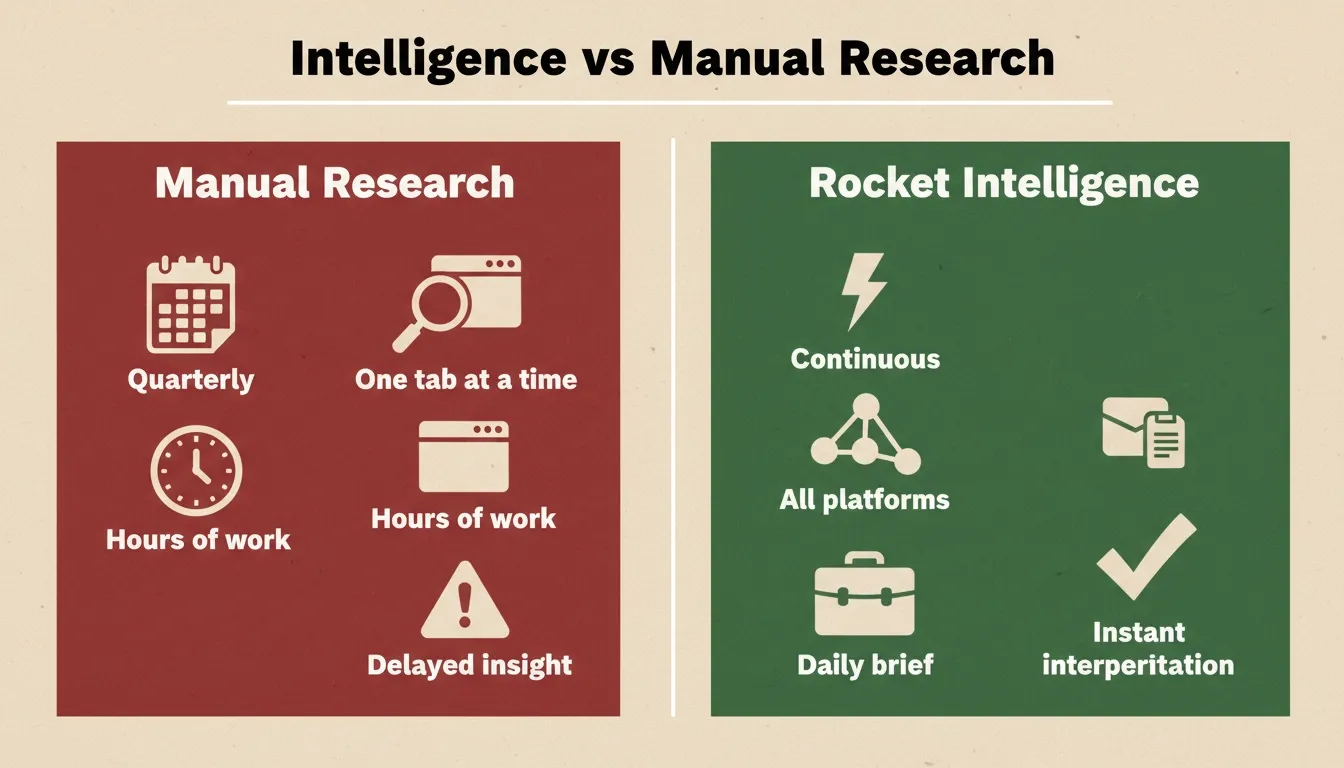
Manual research catches individual data points. Rocket Intelligence reads clusters and delivers interpretation.
Where Competing Platforms and Competitor Weaknesses Fall Short
Tools like Klue and Crayon alert you when things change. That has value. But most of them stop there. You get a notification that a competitor updated their pricing page. You don’t get an explanation of what that change signals for your positioning, your active deals, or your next quarter’s roadmap. A pricing page change alone is just a change, but small pricing updates can signal a bigger strategic shift, like moving from per-seat to usage-based pricing, which changes how the market reads their positioning.
Rocket describes Intelligence as an interpretation system, not an alerting system. The difference matters in practice. Alerts create noise. Interpretation creates decisions through ongoing competitor analysis, turning signal clusters into broader market analysis instead of isolated alerts. That gives teams a clearer solution for deciding what matters across sales and marketing, where to push for more deals, and how to adjust the product roadmap.
There is another gap that most competitive intelligence tools share: they run separately from where work actually happens. They don’t know what your sales team is currently pitching, what your product is building, or what your last strategy session concluded.
Rocket’s Intelligence lives inside a project with shared context. The signal from Monday’s brief is present when a product manager opens a planning session on Wednesday. Nothing needs to be re-explained between steps. You can explore how Solve and Intelligence work together to turn competitive signals into structured decisions inside the same workspace.
How Sales, Product, and Marketing Teams Use Competitor Complaint Data
The sales, marketing, and product teams that get the most from Intelligence are the ones who treat the daily brief as a standing input, not a tool they open when they remember to.
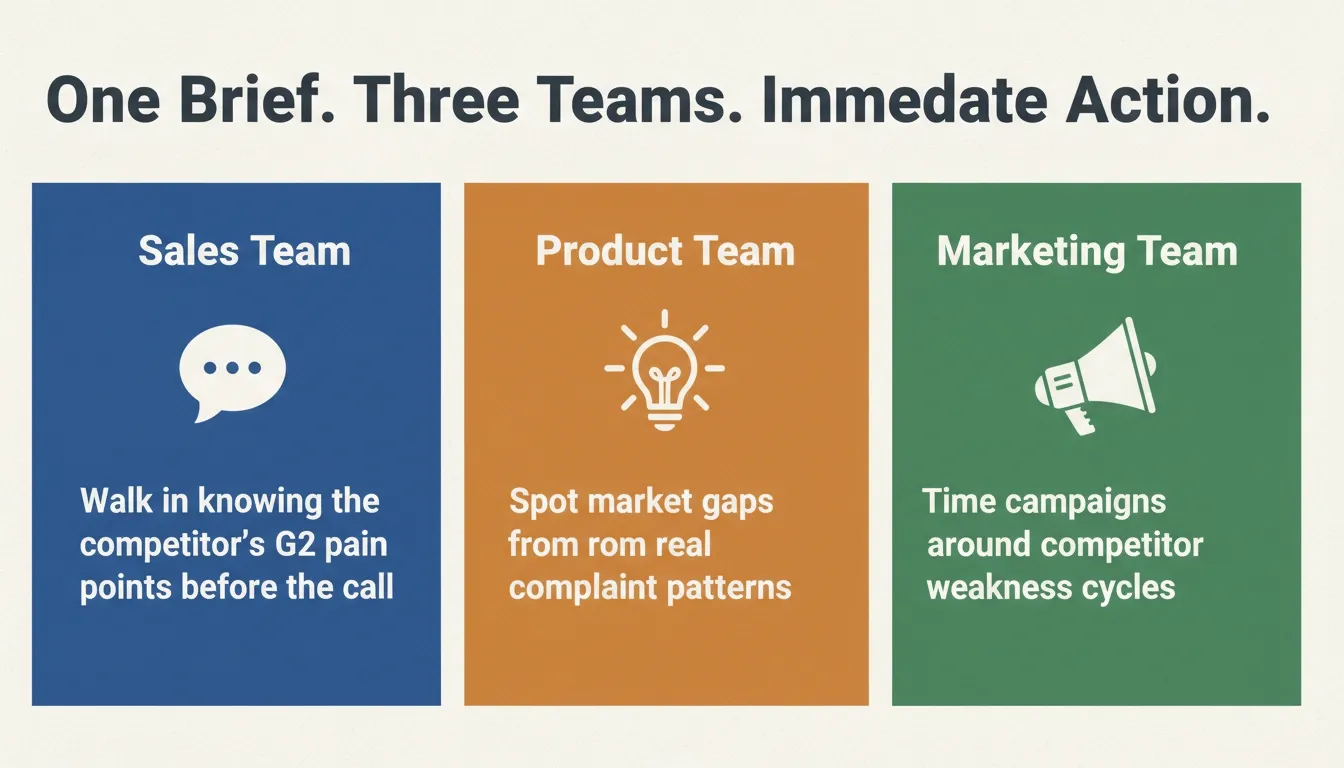 Sales, product, and marketing teams each extract different strategic value from the same Intelligence brief.
Sales Teams and the Sales Process
Sales teams get deal-specific competitive briefs from Rocket as part of an ongoing process. If a prospect currently uses a competitor whose G2 reviews show a consistent pattern of complaints around support response times, a sales rep can walk into that conversation knowing the specific frustration and use it to lead with what matters to similar clients before they purchase.
Not because they researched it that morning or treated it like a tool they open when they remember to, but because it helps them focus on action instead of manual monitoring. Because Intelligence flagged it in the daily brief days earlier, giving them a sharper context on how to sell.
According to BrightLocal, 77% of consumers say negative reviews deter them from using a business. Your prospects are already reading competitor reviews before they talk to you. Knowing what those reviews say puts your sales team in the conversation with real context, not just talking points. Explore how teams use this for enterprise sales preparation.
Product Teams
Product teams use competitor complaint data to spot market gaps before committing to a build, so the rep walks in ready to lead the conversation with context from complaints about a competitor's product.
When a competitor’s customers consistently flag a missing new feature across G2, Reddit, and app store reviews over multiple weeks, that is a validated market signal, not a guess.
Product decisions grounded in real complaint patterns give product managers a clear benefit because the gap between shipped it and users actually needing it is much shorter, and they are not stuck answering the same question after launch.
Rocket also surfaces what competitors are building next by reading hiring signals, which also helps sales teams better sell to prospects and clients by understanding what buyers are seeing before they make a purchase decision. When a competitor posts ten new roles in the security engineering team, that is a product direction signal that shows up in the People category before any announcement ever lands. Real-time data enrichment is associated with 25% faster decision-making and 30% higher revenue growth, according to the Competitive Intelligence Alliance.
Marketing Teams
Marketing teams can time campaigns around competitor weakness cycles. When complaint patterns point to a missing feature in a competitor’s product, product managers can use that signal to answer the same prioritization question more consistently and get clearer prioritization around a validated new feature gap, not just anecdotal requests.
When a competitor’s support reviews drop sharply after a major product launch, their customers are often most open to looking around at alternatives and may not get the service levels they expect. Knowing that timing in advance, rather than months later, changes how campaigns get shaped and when they go live.
Rocket also tracks competitor ad activity across LinkedIn, Meta, and TikTok. When a company starts running ads that emphasize a specific feature or buyer segment, that new messaging shows up in Intelligence before your team would typically notice it through casual observation.
Specialized AI agents can also use absence detection to flag stagnation in a competitor’s product updates. Teams using social media monitoring alongside Intelligence get a fuller picture of competitor weaknesses in real time, including signs a rival may be losing customers.
The Data Behind Why This Matters
Complaint patterns accumulate across platforms over weeks before competitor weaknesses revealed by those complaints become visible to teams checking manually, and after a disappointing launch, customers may already expect alternatives.
56% of dissatisfied customers say nothing and quietly switch, which means the reviews that do appear on G2 and Glassdoor represent only the loudest fraction of actual dissatisfaction. Most people inside a company overestimate how much they already see, but the real signal sits out in the world, and most companies struggle to process that volume fast enough. Teams that wait for quarterly reviews to catch these signals are already months behind. The window for competitive action closes long before the pattern becomes obvious.
Rocket’s Intelligence reads the visible fraction continuously and connects it to hiring data, ad shifts that can reveal new messaging when a company may be losing customers, and website changes, giving your team the full picture, not just the loudest complaints. For teams building competitive intelligence into roadmap planning, this continuous signal layer replaces the need for separate monitoring tools entirely.
Getting the Full Picture with Rocket Competitive Intelligence
The reason how does Rocket surface what a competitor’s customers are complaining about before you think to ask them has such a direct answer is that the system was built around one clear assumption: the most valuable competitive signals don’t announce themselves.
They show up as a three-star review in October, a customer success team job posting in November, and a shift in competitor ad messaging in December. Nobody connects them manually across three tools and two weeks of different team members’ attention. Rocket reads them as a cluster and tells your team what it means in plain language, before the next meeting starts.
Rocket’s competitive intelligence system sets up once per workspace and runs automatically from that point forward. AI adoption in competitive intelligence grew 76% year over year, and 60% of teams now use AI tools daily because most companies and most people cannot monitor this manually. AI-powered competitive intelligence tools are projected to grow from $557.6 million in 2026 to $1.28 billion by 2033 as teams need faster signal detection than human analysts can provide.
A single competitor can generate more signals than a person can realistically track, and Rocket extends that coverage across multiple competitors without adding manual work. Every competitor your business tracks gets continuous coverage across all six signal categories. The daily brief arrives before your first meeting. What was invisible before, the slow accumulation of customer dissatisfaction at a competitor's, becomes something your team can act on today.
Because Intelligence lives inside Rocket’s shared context architecture, the insight from a competitor’s G2 complaints flows directly into the next planning session, product decision, and campaign brief. It compounds over time rather than sitting in a separate dashboard nobody opens.
Stop guessing what a competitor’s customers are unhappy about and start knowing it before your next meeting. Rocket.new monitors every public platform your competitors operate on, continuously, and delivers the interpretation your team needs to act.
Start using Rocket for free and set up your first competitor profile in minutes.
Table of contents
- -What Does "Surfacing Competitor Complaints" Actually Mean?
- -How Does Rocket Know What a Competitor's Customers Are Saying?
- -The Six Signal Categories: Intelligence Monitors
- -The Customers Tab: Where Customer Feedback and Complaint Patterns Concentrate
- -Why Does This Matter Before You Think to Ask?
- -How Does Rocket Compare to Manual Research?
- -Where Competing Platforms and Competitor Weaknesses Fall Short
- -How Sales, Product, and Marketing Teams Use Competitor Complaint Data
- -Sales Teams and the Sales Process
- -Product Teams
- -Marketing Teams
- -The Data Behind Why This Matters
- -Getting the Full Picture with Rocket Competitive Intelligence