Most agencies bleed time and revenue across disconnected tools. A unified workspace for agency projects fixes that by keeping briefs, feedback, approvals, and deliverables in one place your whole team can actually use.
How much of your agency's week goes to chasing information instead of producing work?
Most agencies run client projects across a stack of disconnected tools. One handles tasks, another stores files, a third manages approvals, and email threads everything together. The result is a coordination tax your team pays every single week.
A unified workspace for agency projects eliminates that overhead and keeps every brief, asset, revision, and sign-off in one place.
Why Agency Projects Fall Apart Across Disconnected Tools
Creative agencies juggle multiple clients, timelines, and teams at once. When project management, file storage, client communication, and scheduling all live in separate systems, coordination becomes a full-time job. That overhead slows delivery, strains client relationships, and quietly eats into your margins.
-
Context gets lost at every handoff. Briefs start in one place, feedback arrives in another, and approvals get buried in messages nobody finds six weeks later.
-
Status updates eat billable time. Agency teams consistently spend more time chasing information than producing deliverables.
-
Client relationships suffer when updates are slow. Every client expects fast, clear communication. When workflows depend on manual data reconciliation, response times slip.
-
New client onboarding drags on. Without a central workspace, onboarding means recreating folders, reconnecting tools, and re-explaining processes from scratch every time.
These problems scale with headcount. They also compound when agencies work across departments, time zones, and multiple views of the same project data.
How Many Tools Does the Average Agency Actually Use?
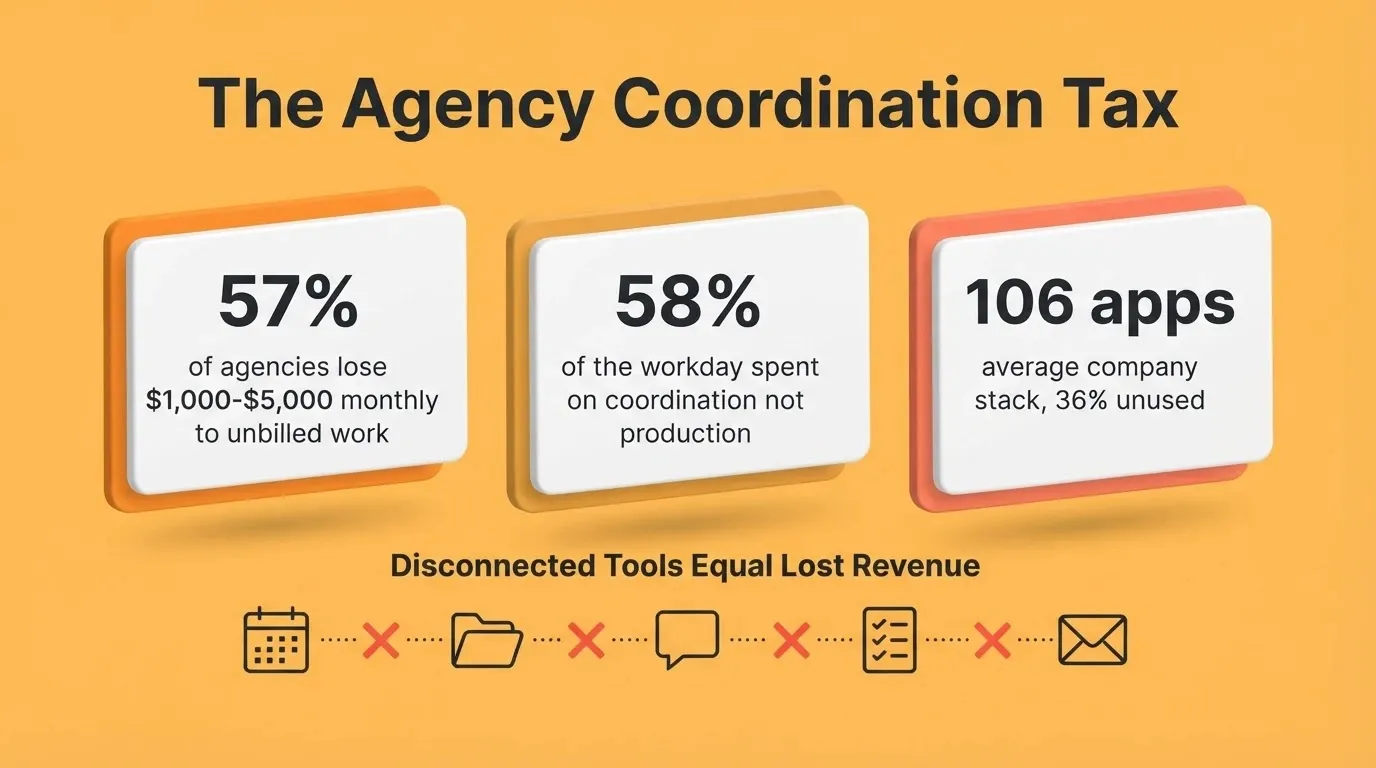
The numbers are striking. AgencyPro's 2026 technology benchmarks report that the average company runs 106 SaaS apps. On top of that, 36% of those licenses go completely unused. Agency-specific stacks are leaner, but even a 15-tool environment creates serious friction.
-
Average SaaS spend: $4,830 per employee per year. That budget covers tools that overlap, tools nobody opens, and tools that exist only to bridge two other tools.
-
78% of IT leaders saw unexpected SaaS charges tied to consumption-based or AI-powered tools in 2025.
-
The real cost is not the subscription total. It is the hours your team spends keeping everything synchronized across tools and projects.
Agency owners who look at these numbers often realize the coordination tax is the most expensive line item that never appears on an invoice.
Where Does Agency Time Actually Go Each Week?
Research from Asana found that knowledge workers spend 58% of their day on work about work. That includes status meetings, searching for information, and switching between tools. For creative teams running client projects, more than half the week goes to coordination instead of production.
-
Meeting overload drains creative capacity. Agency leaders report spending roughly 69% of their time in meetings rather than on billable or strategic tasks.
-
Late timesheets cause unbilled work. Only 33% of agency staff submit time entries on time. As a result, hours fall through the cracks and never reach an invoice.
-
Repetitive handoff tasks add zero client value. Copying updates between tools, reformatting deliverables for review, and chasing approvals through email are all coordination work, not production work.
A 2026 report from Breeze.pm found that 57% of agencies lose between $1,000 and $5,000 each month to unbilled work. That number grows when you add the hours spent reconciling project data across separate tools.
What a Unified Agency Workspace Actually Needs
A real agency workspace is not just a project management tool with a new label. It needs to hold the complete lifecycle of every client project in one place. Every team member and every client should access it at the right level, from the initial brief through final delivery.
Briefs, Assets, and Deliverables in One Place
The first requirement is a single space where briefs, visual assets, strategy documents, and final deliverables all live together.
-
Briefs belong inside the project, not buried in email. When the brief lives alongside every file and every task, there is no ambiguity about what was agreed at the start.
-
An asset library tied to specific projects eliminates the "which version is latest?" conversation that happens on every agency team at least weekly.
-
Deliverables should flow from tasks to client review without a manual export. When a completed deliverable is ready, the client reviews it in the same workspace where the project was tracked.
For agencies that want to go further, building a smarter feedback center for agency clients gives every client real-time visibility into their work without exposing your internal operations.
Role-Based Access: Clients See What They Need, Nothing More
Client feedback should happen inside the workspace. A parallel channel only creates duplicate threads and lost context. Fortunately, role-based access solves this cleanly.
-
A Viewer role gives clients a professional experience while keeping agency-side planning, resource allocation, and margin data private.
-
Inline comments keep feedback attached to the work it references. When a client comments on a specific section of a deliverable, the feedback is contextual. There are no more "see the notes I sent Tuesday" conversations.
-
Clients who can track progress stay longer. Agencies that give every client real-time project tracking report stronger relationships and higher retention rates.
As Noloco's analysis on agency tool sprawl puts it: "The only way to give clients real-time visibility is to give them a login to your project management tool. Which means they also see your internal task comments, your team's private notes, and probably some things you'd prefer they didn't. So you don't give them access." Role-based access solves this directly.
Scheduling, Deadlines, and Resource Planning
Agency operations break down when scheduling and resource planning live in a separate spreadsheet from the project tracking system. Keeping everything in one place prevents this problem entirely.
-
Timelines and deadlines should be visible inside each project. When a deadline shifts, every connected task updates in one workspace, not across three tools.
-
Resource planning needs a bird's eye view of capacity. Agency owners juggling multiple clients need to see who is overloaded and who has space, without pulling data from a separate app.
-
Automated reminders reduce missed deadlines without requiring a project manager to manually chase every team member.
-
New client onboarding should use templates. When a client signs on, the agency creates a project from a template, pre-populates tasks and timelines, and starts working within minutes.
The Workspace-Project-Task Structure That Keeps Clients Separated
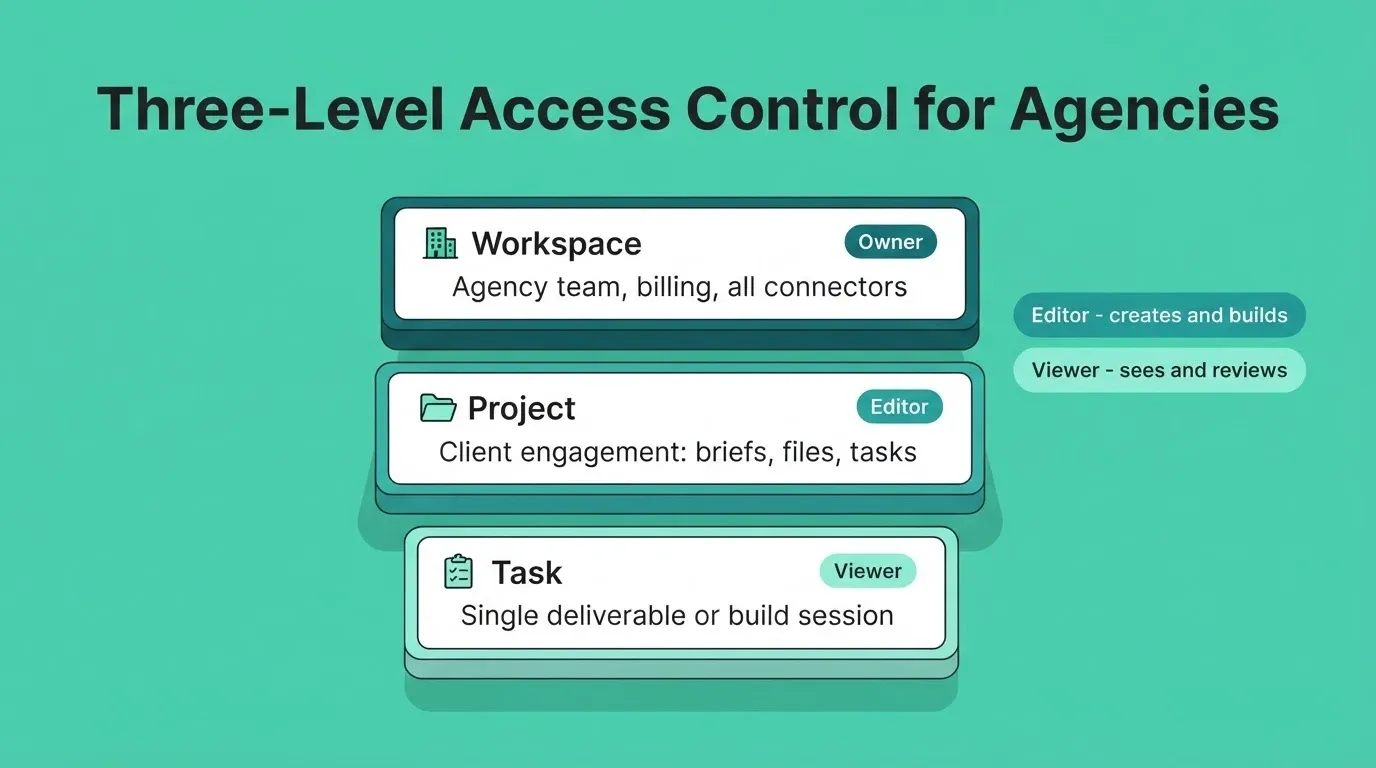
The most effective agency workspaces follow a clear three-level hierarchy. This structure mirrors how agencies actually work and keeps every client's data neatly separated.
| Level | What It Contains | Who Accesses It |
|---|---|---|
| Workspace | All clients, billing, team members, connected services | Core agency team |
| Project | One client engagement: briefs, files, tasks, context | Agency team and client Viewers |
| Task | A single deliverable, research report, or build session | Task owner and assigned collaborators |
This structure keeps client data separated by project. At the same time, it gives the agency team a single workspace to manage billing, members, and integrations. New projects and tasks are not shared automatically. Access is granted deliberately at each level, so clients only ever see what they are supposed to see.
How Approval Trails Protect Your Agency
When a client questions a deliverable decision six months later, the agency that pulls up the approval record in ten seconds wins. The agency digging through email threads and Google Drive comments loses hours and credibility.
An audit trail is not optional for professional agency operations. Every approval, revision request, and sign-off needs to be captured and searchable inside the workspace where the project lives.
What an Approval Trail Needs to Capture
| Element | Why It Matters |
|---|---|
| Who approved and when | Accountability and legal protection |
| What version was approved | Prevents "that is not what we signed off on" disputes |
| Client feedback before approval | Shows the revision history and how concerns were addressed |
| Internal notes and rationale | Helps the team understand past decisions when revisiting projects |
| Document attachments at each stage | Creates a complete record of every deliverable version |
When this data lives in one workspace alongside every other piece of the project, there is no gap between what was decided and what the team can retrieve. Agencies that build an approval and billing portal for their clients report faster turnaround on feedback and fewer lost invoices.
What the Ideal Agency Project Workflow Looks Like
The best agency workflows connect every stage of a client project without manual handoffs. Here is how a unified workspace for agency projects moves work from brief to final delivery.
End-to-End Agency Project Workflow Inside a Unified Workspace
Every task, file, approval, and piece of client feedback is captured in the same project. When the agency starts a new engagement for the same client, the workspace already has the relevant context from previous projects. Whether the agency runs five projects or fifty, the process stays consistent because the structure holds everything together.
How to Build Your Agency Workspace on Rocket
Rocket is a platform where agency teams build the exact client portals, approval tools, and reporting dashboards their workflow requires. You describe what you need in plain language, and Rocket generates the full application without writing any code.
The Workspace-Project-Task Model in Rocket
Rocket's organizational structure maps directly onto how agencies work. Your workspace is your agency. It holds all projects, team members, billing, and connected services in one place. Connect services like Notion, Google Workspace, Airtable, and Figma once at the workspace level. After that, every project you create can use them automatically.
Each client gets their own project. Upload the client brief, brand guidelines, and reference files directly into the project context. This context is available to every task inside that project, so Rocket already knows the client's requirements before you start building.
Roles and Access Control
Rocket uses two roles at every level of the sharing model. Together, they give you precise control over who sees what.
-
Editors create tasks, upload files, connect services, and iterate on work. This is your core agency team.
-
Viewers see task outputs and leave feedback. They cannot create, edit, or connect anything. This is the role for clients.
Roles apply independently at each level. A workspace Editor can receive Viewer access on a specific client project. This keeps internal agency work private while giving that client full visibility into their deliverables. Viewers are never assigned a credit limit, so adding clients to a project costs nothing extra.
What You Can Build for Client Projects
Rocket's Build capability generates production-ready Next.js web apps and Flutter mobile apps from natural language. For agencies, this means building the exact tools your workflow requires rather than adapting a generic product to fit your process.
-
Client portals with branded interfaces. Describe what you need in chat, and Rocket generates the full application.
-
Approval forms with automated routing. When a deliverable is ready, an automated workflow routes it to the right client stakeholder with clear options: approve, request changes, or leave feedback.
-
Project dashboards that track deadlines, budgets, and progress in real time. Your team sees exactly the data that matters for each client, without pulling from three separate tools.
-
Reporting tools that generate client-facing summaries. Rocket's AI agents produce automated reporting from project data and save hours of manual compilation each month.
Agencies that have already built a client portal with AI report faster feedback cycles and fewer "just checking in" emails from clients.
Connected Services That Flow Into Every Project
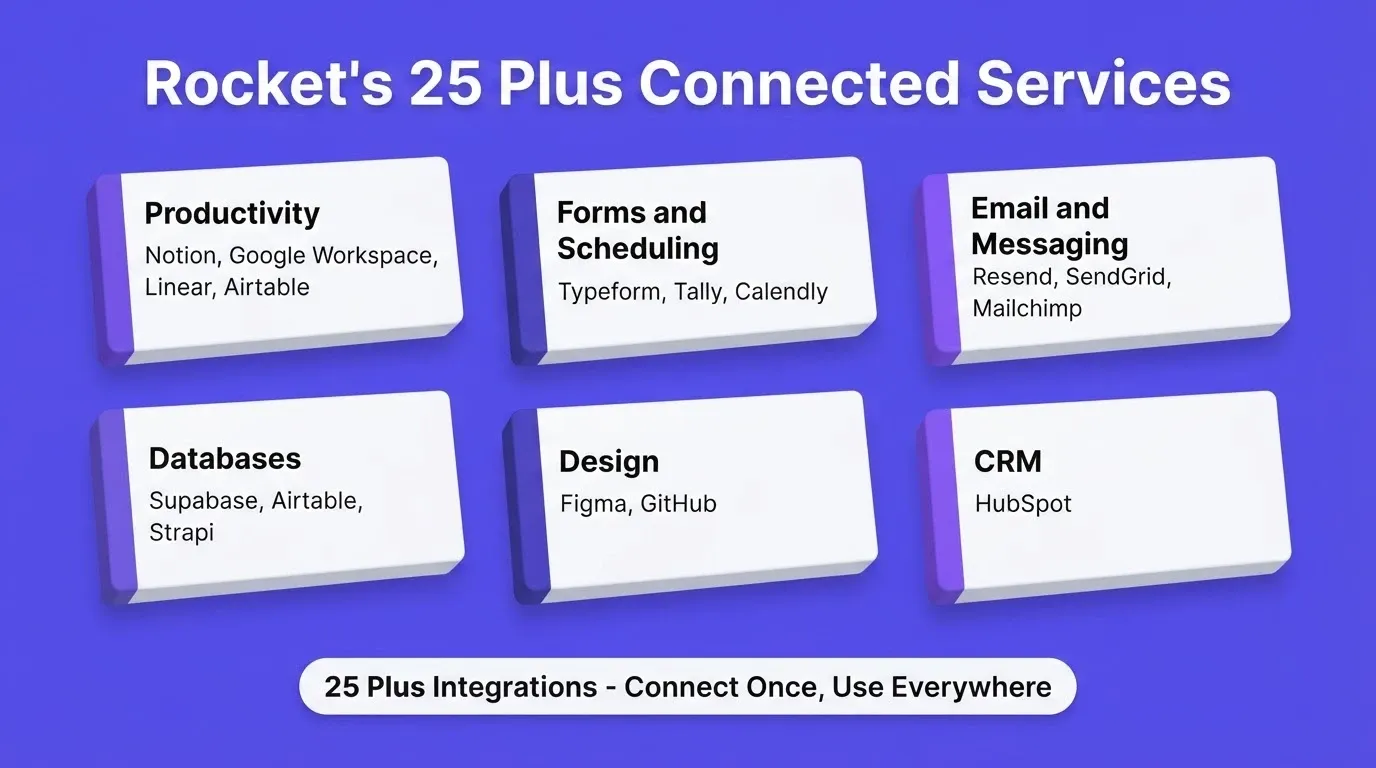
Rocket integrates with 25+ services out of the box. Connect once via API key or OAuth, then describe what you want to build. Rocket generates the code, UI, and logic automatically.
| Category | Connectors | Agency Use Case |
|---|---|---|
| Productivity | Notion, Google Workspace, Linear, Airtable | Sync briefs, docs, and task boards into project context |
| Forms and Scheduling | Typeform, Tally, Calendly | Client intake forms, approval requests, kickoff scheduling |
| Email and Messaging | Resend, SendGrid, Mailchimp | Automated status updates, approval notifications |
| Databases | Supabase, Airtable, Strapi | Store client data, deliverable versions, approval records |
| Design | Figma, GitHub | Import designs directly into production-ready apps |
| CRM | HubSpot | Sync client contacts and deal stages into project context |
How to Set Up Your Agency Workspace: Step by Step
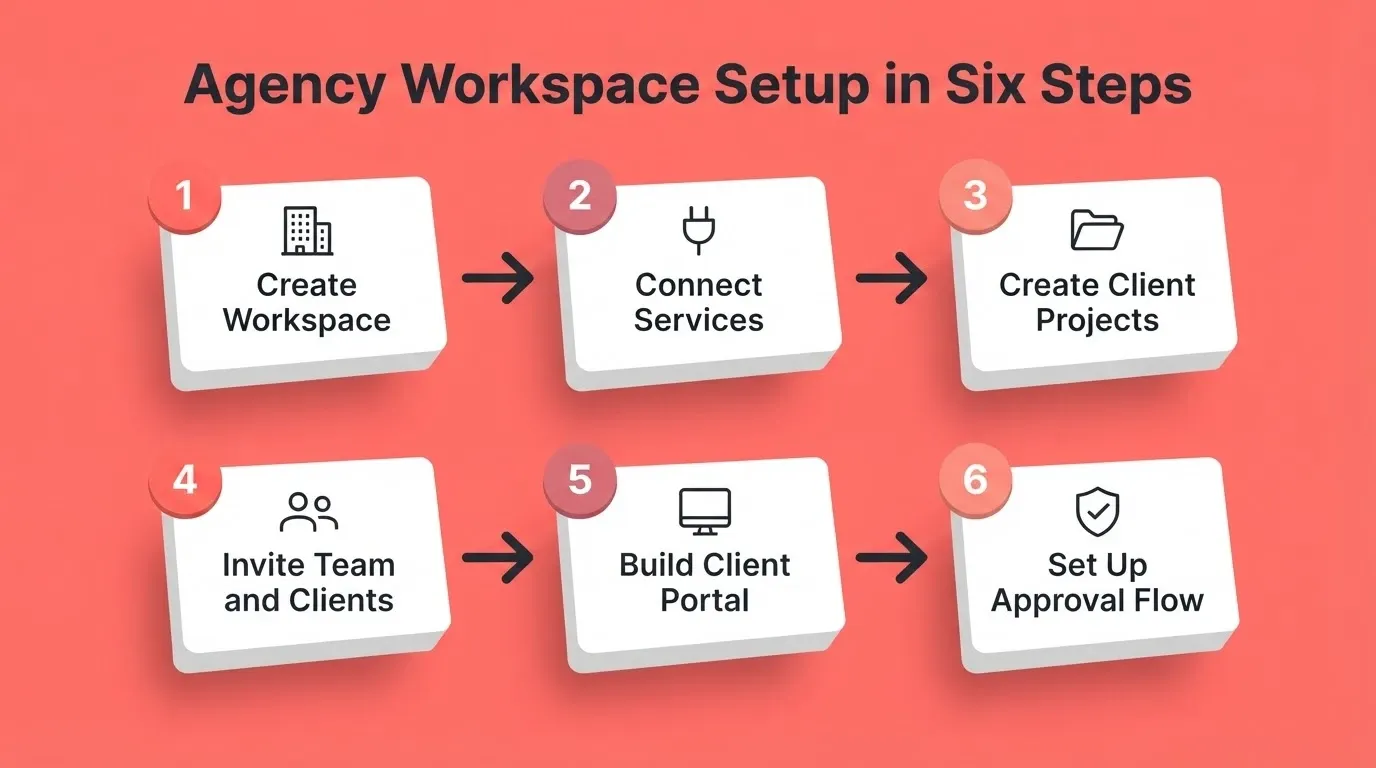
Getting started takes less than an afternoon. Here is the exact sequence to follow.
-
Create your workspace. Sign up at rocket.new. A default workspace is created automatically. Rename it to your agency name from Settings.
-
Connect your services. Go to Settings, then Connectors. Connect the tools your agency already uses. Workspace-level connections are shared across all projects automatically.
-
Create a project for each client. Upload the client brief and reference files into the project context. Every task inside that project inherits this context.
-
Invite your team and your clients. Core team members get Editor access. Clients get Viewer access. They see their deliverables but not your internal work.
-
Build your client portal. Start a Build task and describe the portal you need. Rocket generates the full application, including the UI, backend logic, and notification system.
-
Set up your approval workflow. Add an approval flow in the same project. Rocket integrates it directly into the portal.
Agencies looking to extend this further can build a full team collaboration platform to handle everything from resource planning to automated client reporting in one place.
The Agencies That Win Run on One System
Scattered tools are not a sign of a busy agency. They are a sign of an agency paying a coordination tax on every project, every week. The agencies that move fastest are the ones where the brief, the work, the feedback, and the approval all live in the same place.
A unified workspace for agency projects is not a future-state aspiration. It is the operational baseline that separates agencies that scale from agencies that stall. As client expectations for transparency and speed continue to rise, the workspace you run on becomes a genuine competitive advantage.
Build your agency workspace on Rocket and see how much faster your team moves when everything lives in one place. Start building today.
Table of contents
- -Why Agency Projects Fall Apart Across Disconnected Tools
- -How Many Tools Does the Average Agency Actually Use?
- -Where Does Agency Time Actually Go Each Week?
- -What a Unified Agency Workspace Actually Needs
- -Briefs, Assets, and Deliverables in One Place
- -Role-Based Access: Clients See What They Need, Nothing More
- -Scheduling, Deadlines, and Resource Planning
- -The Workspace-Project-Task Structure That Keeps Clients Separated
- -How Approval Trails Protect Your Agency
- -What an Approval Trail Needs to Capture
- -What the Ideal Agency Project Workflow Looks Like
- -How to Build Your Agency Workspace on Rocket
- -The Workspace-Project-Task Model in Rocket
- -Roles and Access Control
- -What You Can Build for Client Projects
- -Connected Services That Flow Into Every Project
- -How to Set Up Your Agency Workspace: Step by Step
- -The Agencies That Win Run on One System