Scattered hiring feedback costs time, money, and top candidates. A structured candidate evaluation hub with live updates replaces fragmented review cycles with one shared, scored, and visible workspace. It moves hiring panels to decisions faster.
Why do so many hiring decisions stall after the shortlist lands?
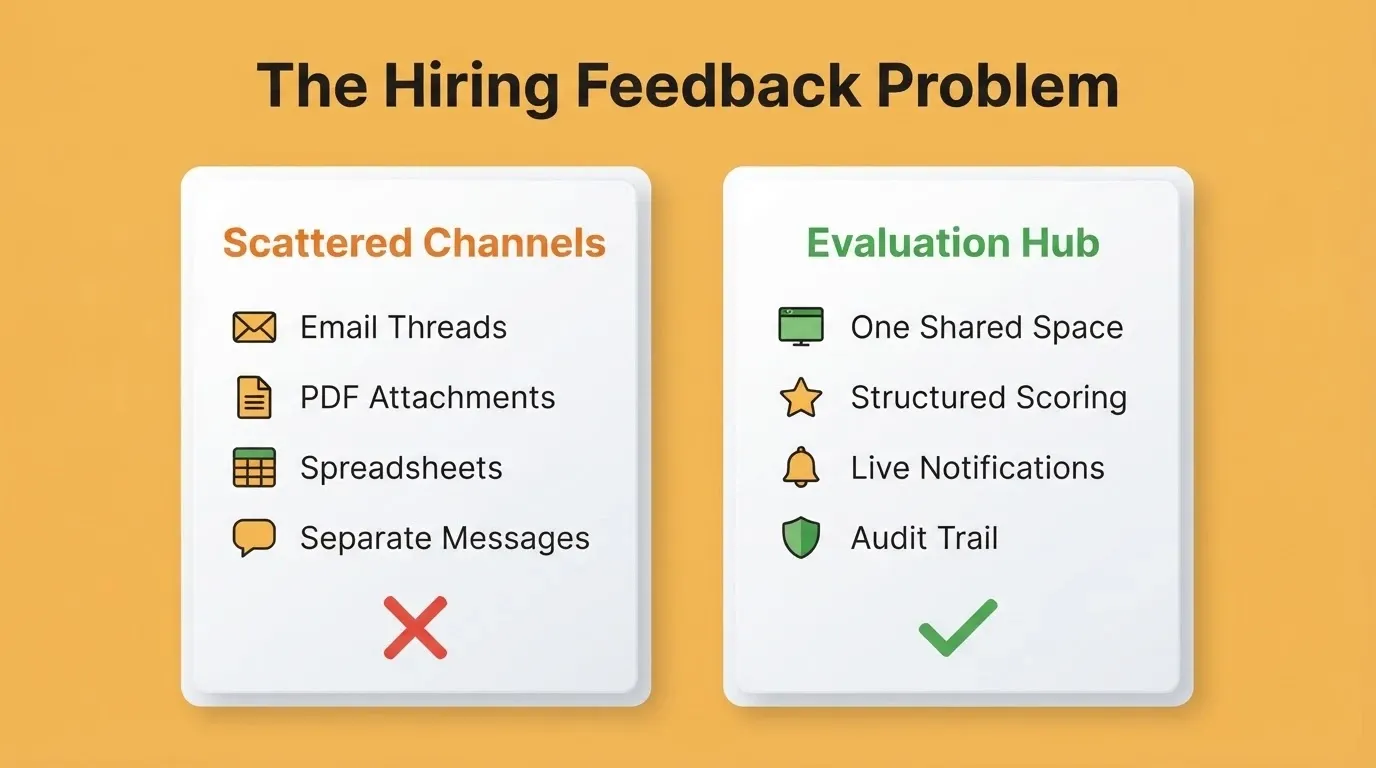
According to hiring statistics from Zippia, the average job posting attracts 250 resumes. In fact, 29% of recruiters say candidate experience and time to hire are their top priorities. When feedback lives in email threads, spreadsheets, and PDF attachments, the bottleneck is never the talent pool. It is always the review process.
This blog covers what a structured candidate evaluation hub looks like, what it must contain, how live updates compress the decision timeline, and how to build one without writing code.
Why Scattered Feedback Slows Down Hiring Decisions
When a recruiter sends a shortlist to a client or hiring panel, responses trickle back through different channels at different speeds. As a result, delays pile up quickly.
-
Stakeholder A replies by email within an hour with strong opinions on two candidates. But those opinions lack a scoring framework anyone else can reference.
-
Stakeholder B opens the PDF three days later and sends comments that directly contradict Stakeholder A. They have not seen the earlier feedback at all.
-
Stakeholder C never opens the document, so the recruiter spends a week chasing a response before the shortlist goes stale.
-
The recruiter then manually pieces together conflicting input with no shared record of who said what or when.
This is not a talent problem. It is a coordination problem. Teams that have moved toward a centralized candidate review system report faster alignment. Every opinion lives in one visible place.
What a Structured Candidate Review Process Looks Like
A structured process means every stakeholder evaluates every candidate against the same criteria. They use the same place and the same scoring scale. The difference between unstructured and structured evaluation is easy to measure.
| Factor | Unstructured Review | Structured Evaluation Hub |
|---|---|---|
| Feedback format | Free-text emails, scattered notes | Standardized scorecards with defined criteria |
| Visibility | Recruiter sees each response in isolation | All stakeholders see all feedback in real time |
| Speed | Days to weeks for full panel input | Hours to days with live notifications |
| Consistency | Opinions vary in depth and focus | Every reviewer scores the same dimensions |
| Decision quality | Based on loudest voice or last response | Based on aggregated scores and weighted criteria |
Research from the true cost of hiring shows the average cost per hire reached $4,700 in 2023. Positions also take roughly 44 days to fill. Structured evaluation directly attacks both numbers by removing the dead time between shortlist delivery and panel consensus.
Teams building a live hiring dashboard for executive search teams often pair it with evaluation scorecards. This gives clients a single view of both pipeline status and candidate quality.
Scoring Rubrics and Shared Candidate Profiles
Scoring rubrics remove ambiguity from the review process. Instead of asking "what do you think of this candidate," a rubric asks reviewers to rate specific dimensions on a defined scale.
-
Technical competence is rated on a scale relevant to the role, with clear descriptors for each score level.
-
Communication and leadership signals are assessed separately from technical ability. This stops strong personalities from overshadowing skill gaps.
-
Cultural alignment indicators are scored against pre-agreed team values rather than gut feeling.
Each candidate gets a shared profile page that collects every score, every comment, and every document in one place. When a hiring manager opens the profile, they see the full picture right away. They no longer need to ask the recruiter to summarize weeks of scattered input.
What to Include in a Candidate Evaluation Hub
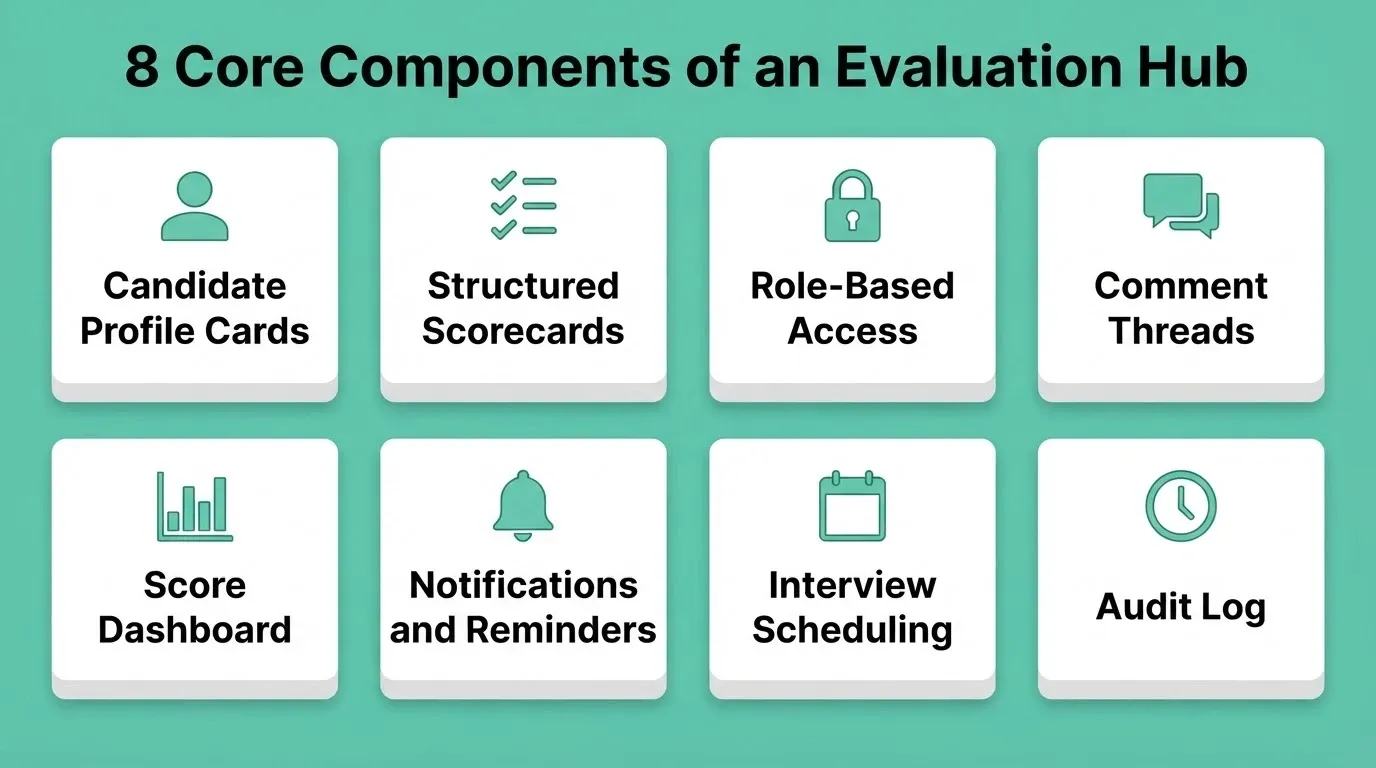
Before building, define the components your hub needs. The most effective evaluation hubs share a common set of elements, regardless of role or industry.
Candidate profile cards give each shortlisted candidate a dedicated page. It holds their resume, a recruiter summary, links to work samples, and a status indicator showing where they are in the process.
Structured scorecards are forms that every reviewer completes independently before seeing others' scores. Dimensions should be defined before the shortlist goes out. Typical dimensions include technical fit, communication, leadership potential, and cultural alignment, each rated 1 to 5 with written descriptors.
Role-based access ensures recruiters see everything, hiring managers see assigned candidates, and external clients see only what the recruiter has shared. Candidates never see internal scoring. This is not optional. It is what makes the hub safe to use with external stakeholders.
Comment threads per candidate keep threaded discussion attached to individual profiles. When a hiring manager asks a follow-up question, that conversation lives on the candidate's profile, not in a separate email chain.
Aggregate score dashboards show every candidate's average score, score distribution across reviewers, and completion status per reviewer. This is the view the recruiter uses to spot consensus and flag outliers for discussion.
Notification and reminder systems send automated alerts when a reviewer submits a score. They also send reminders when a reviewer has not completed their evaluation within a set window. This replaces manual follow-up entirely.
Interview scheduling integration connects directly to a scheduling tool once the panel reaches consensus. Integrations with Cal.com or Calendly cut out the back-and-forth that typically follows shortlist approval.
Audit logs provide a timestamped record of every score, comment, and status change. They support compliance, post-hire analysis, and demonstrating process integrity to clients.
How Live Updates Change the Hiring Decision Timeline
The gap between shortlist delivery and interview scheduling is where most hiring processes lose momentum. Fortunately, live updates close that gap. They make stakeholder activity visible the moment it happens.
-
Instant notifications alert the recruiter when a stakeholder submits a score. Follow-up then happens in hours instead of days.
-
Progress indicators show which reviewers have completed their evaluations and which have not. This creates gentle social accountability.
-
Comment threads keep discussion contextual. They stop conversations from scattering across email chains.
-
Aggregated score dashboards give the recruiter a real-time view of where consensus is forming and where disagreement needs resolution.
According to recruiting metrics from AIHR, 82% of companies believe data is critical to driving talent acquisition decisions. Live updates turn subjective opinions into visible data points. Recruiters and clients can then act on them together.
The same principle applies when building a client portal with AI. It gives external stakeholders a structured view into work that previously lived inside internal systems.
Compressing Shortlist Delivery to Interview Scheduling
The path from shortlist to interview scheduling involves multiple decision points. Each one is a potential bottleneck. Mapping this flow makes the compression opportunities visible.
1graph TD
2 classDef primary fill:#EEF2FF,stroke:#4F46E5,color:#1E293B
3 classDef accent fill:#FFF7ED,stroke:#F97316,color:#1E293B
4 classDef success fill:#F0FDF4,stroke:#22C55E,color:#1E293B
5
6 A[Recruiter Sends Shortlist] --> B[Stakeholders Receive Notification]
7 B --> C{All Reviews Complete?}
8 C -->|No| D[Automated Reminders Sent]
9 D --> C
10 C -->|Yes| E[Scores Aggregated Automatically]
11 E --> F{Consensus Reached?}
12 F -->|No| G[Discussion Thread Opened]
13 G --> H[Recruiter Facilitates Resolution]
14 H --> F
15 F -->|Yes| I[Top Candidates Flagged]
16 I --> J[Interview Slots Scheduled]
17
18 class A,B primary
19 class C,F accent
20 class I,J success
Without a centralized hub, each step in this flow requires manual work. The recruiter ends up relaying messages between every stakeholder. As a result, the timeline stretches from days to weeks.
With structured evaluation and live updates, steps B through E run at the same time instead of one after another. The recruiter shifts from chasing responses to managing exceptions. That single change can compress the shortlist-to-interview window by 40 to 60 percent.
Teams already building HR onboarding software in minutes apply the same logic to post-hire workflows. The pattern works just as well for pre-hire evaluation.
Why Recruiting Teams Choose Rocket for Custom Hiring Tools
Most applicant tracking systems offer a fixed evaluation module. The fields are set in advance, the workflow is rigid, and the client-facing experience looks like every other ATS on the market. For search consultants and in-house recruiting leads, that rigidity is the core problem.
Here is what makes Rocket a practical choice for building a custom evaluation hub.
-
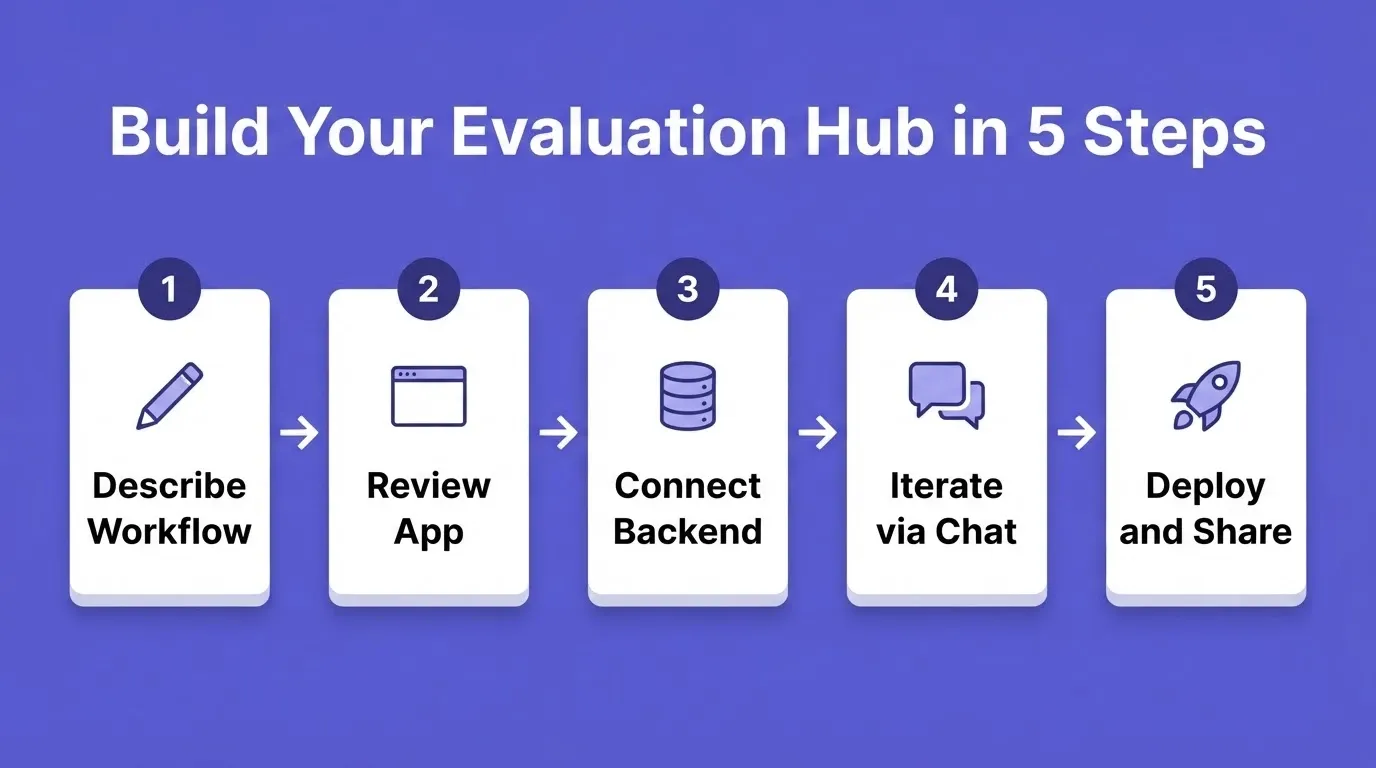
Rocket generates production-ready Next.js web apps from a plain-language description. A recruiting team describes their evaluation workflow, scoring criteria, stakeholder roles, and notification logic. Rocket then builds a working application with structured forms, real-time data sync, and role-based access.
-
Client-facing portals carry the recruiting firm's brand. The evaluation hub uses the firm's visual identity, not a generic software logo. Clients log in to a professional experience that feels purpose-built.
-
Supabase powers the backend. Candidate data, scores, and comments flow into a real database with row-level security. No spreadsheet, no shared Google Doc, no export-import cycle.
-
The hub goes live in the same session. Rocket includes one-click deployment with staging and production environments, full version history, and one-click rollback.
-
25+ connected services plug into existing workflows. Calendar tools handle interview scheduling. Email services manage automated notifications. Analytics tools track reviewer engagement. All of these connect directly into the build.
Generic ATS platforms charge per seat, offer limited customization, and lock evaluation data inside their ecosystem. Custom-built tools on Rocket match the exact workflow the team needs. They also give the firm complete ownership of their data and design.
As one recruiting operations lead shared on LinkedIn: "We stopped trying to customize our ATS and just built what we actually needed. The whole thing took less time than our last vendor evaluation."
Teams already using Rocket for performance management software apply the same approach to hiring. You describe the workflow, get a production-grade tool, and deploy it before the next review cycle.
Can Centralized Feedback Reduce Bias in Hiring Panels?
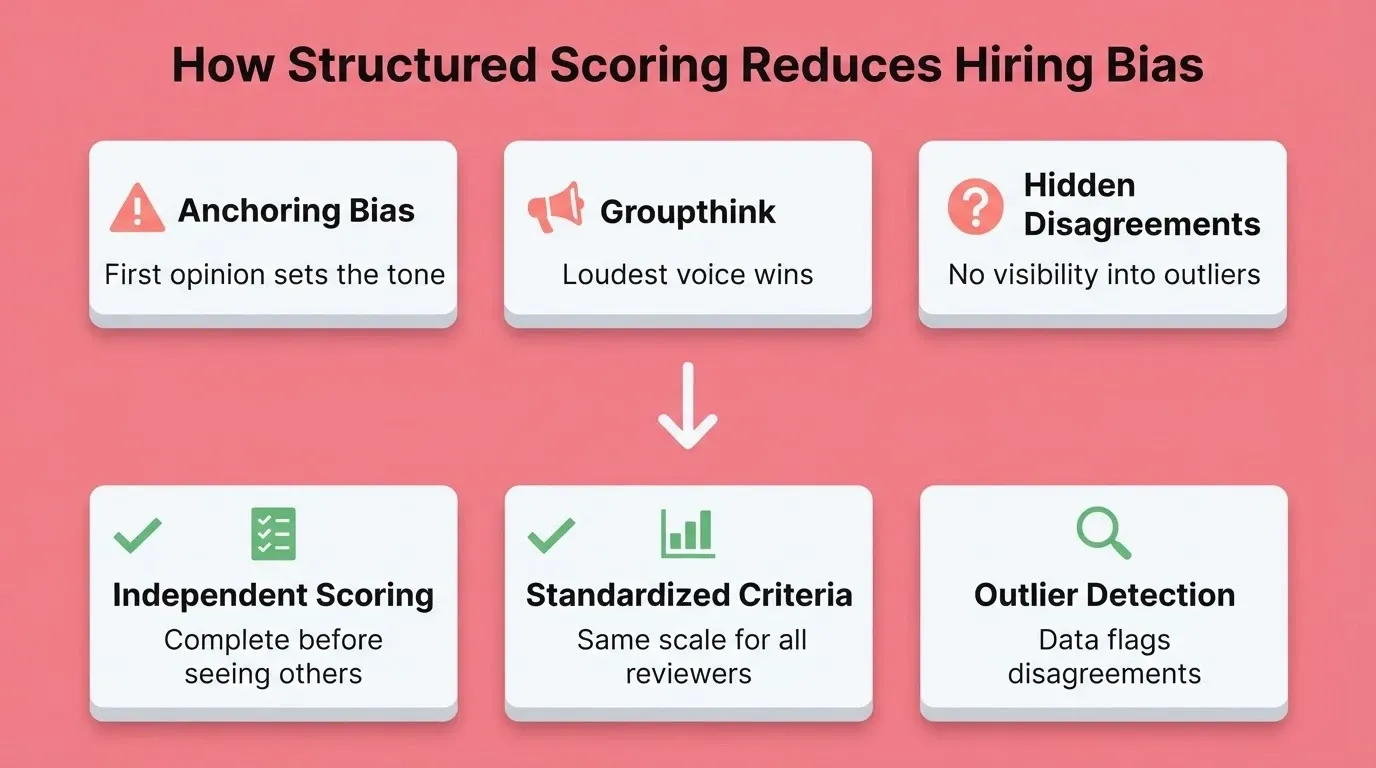
When feedback is scattered across channels, the loudest or fastest stakeholder often sets the tone. Later reviewers anchor their opinions to the first response they see. The recruiter has no way to detect this pattern until it is too late.
-
Structured scorecards force independent evaluation. Each stakeholder completes their review before seeing others' scores. This reduces groupthink and anchoring bias.
-
Standardized criteria shift the conversation from "I liked this candidate" to "this candidate scored 4 out of 5 on technical competence and 3 out of 5 on leadership signals."
-
Aggregate scoring highlights outliers. When one reviewer scores a candidate very differently from the rest, it surfaces as a data point worth discussing. It no longer stays hidden.
A hiring process that collects structured data from every reviewer, in the same format and on the same timeline, produces more defensible decisions. Those decisions are also more consistent and less dependent on whoever happened to reply first.
What Your Next Shortlist Review Should Look Like
The shift from scattered feedback to a centralized evaluation hub is not just a technology upgrade. It is a workflow redesign that changes how quickly and how well hiring panels reach consensus. Every shortlist sent with structured scoring and live visibility compresses the gap between "here are your candidates" and "let's schedule interviews."
For recruiting teams tired of synthesizing contradictory input from five different channels, the next step is clear. Define your criteria, give every stakeholder the same interface, and make every score visible the moment it lands.
Build the Hiring Workflow Your Process Actually Needs
The way hiring panels review candidates is changing. As recruiting teams move toward structured, data-driven evaluation, the tools supporting that process need to match the workflow. They should not force the workflow to match the tool. A custom candidate evaluation hub built on Rocket gives your team a branded, role-based, real-time review environment that reflects exactly how you work.
Describe your scoring criteria, stakeholder roles, and notification logic. Rocket.new builds the production-grade application in a single session, deployed, client-facing, and ready to use before your next shortlist goes out.
Table of contents
- -Why Scattered Feedback Slows Down Hiring Decisions
- -What a Structured Candidate Review Process Looks Like
- -Scoring Rubrics and Shared Candidate Profiles
- -What to Include in a Candidate Evaluation Hub
- -How Live Updates Change the Hiring Decision Timeline
- -Compressing Shortlist Delivery to Interview Scheduling
- -Why Recruiting Teams Choose Rocket for Custom Hiring Tools
- -Can Centralized Feedback Reduce Bias in Hiring Panels?
- -What Your Next Shortlist Review Should Look Like
- -Build the Hiring Workflow Your Process Actually Needs