
To build micro-fulfillment SaaS for DTC brands, create software that runs small urban warehouses as a subscription service for multiple brands, covering inventory, order routing, pick-and-pack, and courier dispatch, then white-label that stack as recurring fulfillment tech. The growing micro-fulfillment market gives operators a way to turn warehouse ops into scalable SaaS revenue using Rocket.new's Solve, Build, and Intelligence pillars.
Micro-fulfillment SaaS is software that lets an operator run a small urban warehouse as a subscription service for multiple DTC brands, handling inventory tracking, order routing, pick-and-pack queues, and courier dispatch from a single platform.
If you're an operator or entrepreneur launching or scaling micro-fulfillment centers for direct-to-consumer brands, this guide walks through the market, how micro-fulfillment compares with other models, the core software modules and order-to-delivery workflows, validation, city selection, unit economics, how to build the ops platform with Rocket.new, and the key FAQs.
DTC brands are under pressure to offer same-day or next-day delivery without absorbing the cost of a full in-house network, which is why local fulfillment software has become a real operating advantage.
The micro-fulfillment market hit $9.3 billion in 2025 and is growing at a 34% CAGR. Operators who build this software layer first can white-label their fulfillment technology to dozens of local brands, turning warehouse operations into a scalable monthly subscription business.
Why Do DTC Brands Need Micro-Fulfillment Software?
Small and mid-size DTC brands face a logistics problem that retailers like Walmart and Amazon solved years ago with large warehouses, dark stores, and custom automation technology.
-
Customers now expect same-day or next-day delivery as standard to meet rising customer expectations. American DTC e-commerce reached $239.75 billion in 2025, representing 19.2% of total retail e-commerce, and consumer demand for faster delivery is pushing brands toward local fulfillment solutions closer to urban areas.
-
Most DTC brands ship 50 to 500 orders per day. Large warehouses are wasteful at that scale, and traditional fulfillment processes are too slow for same-day turnaround times.
-
The supply chain gap is the software layer. Brands need a micro-fulfillment center within their city, but operators running those facilities have no structured way to manage inbound stock, pick-and-pack queues, or courier dispatch.
Shipping costs consume 15 to 25% of revenue for brands relying on cross-country fulfillment. Local micro-fulfillment helps brands deliver faster while reducing last-mile delivery costs by 20% or more. One Reddit thread on finding fulfillment for small e-commerce brands captured this reality: "You can try using a free matchmaking service like 3PeeL to connect with some smaller warehouse options that can meet your specific requirements" (r/smallbusiness). The fact that operators are still being matched through manual outreach shows how underserved this space remains.
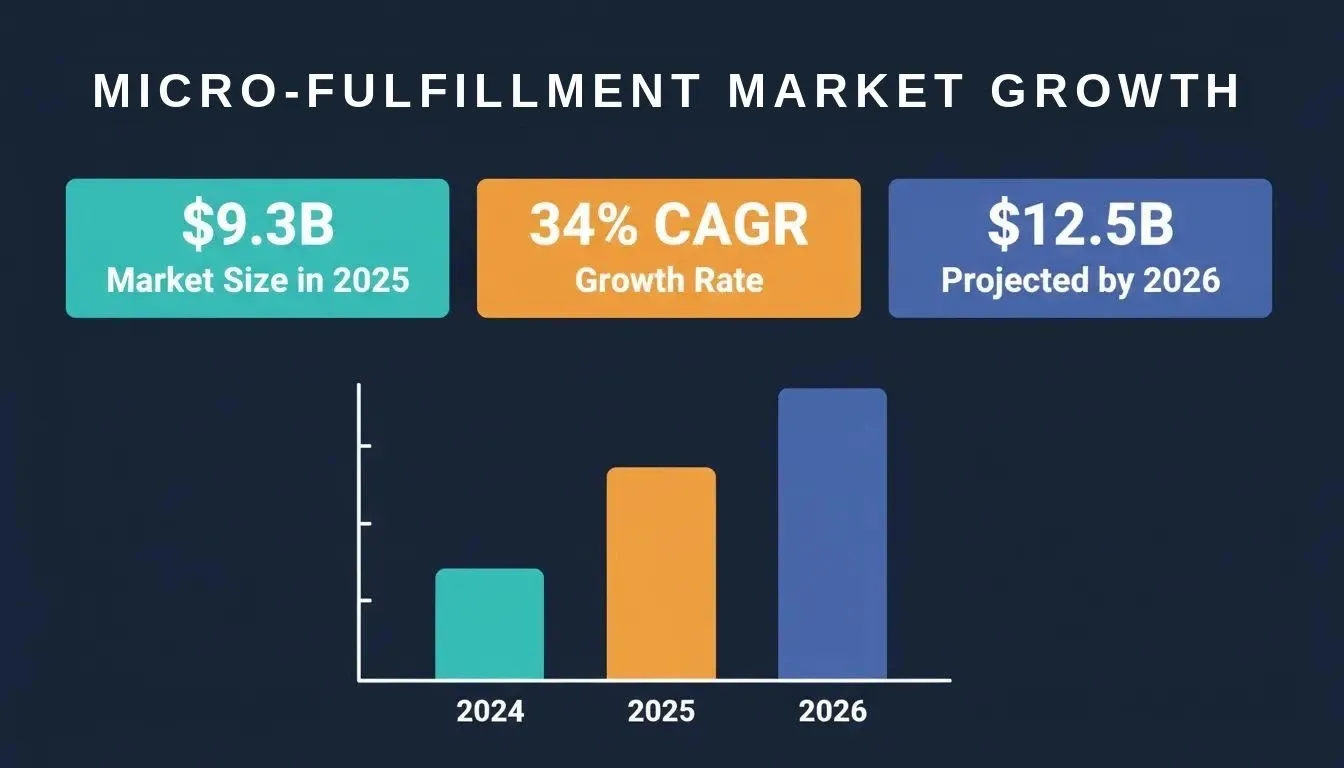
Micro-fulfillment market size: $9.3B in 2025, projected $12.5B by the end of 2026 at 34% CAGR
Micro-Fulfillment vs. 3PL vs. In-House: Which Model Fits?
Before building the software, operators need to understand how micro-fulfillment compares to the two alternatives DTC brands already know.
The key differentiator for micro-fulfillment SaaS is that the operator owns the technology layer, which converts a warehouse into a recurring-revenue business rather than a cost center and positions micro-fulfillment as a leading option for brands that need faster local fulfillment without building in-house infrastructure.
| Factor | Micro-Fulfillment SaaS | Traditional 3PL | In-House Fulfillment |
|---|---|---|---|
| Location | Urban, near end customer | Regional hub, often suburban | Brand's own facility |
| Delivery Speed | Same day / next day | 2 to 5 days standard | Varies |
| Min. Order Volume | 50 to 500 orders/day per brand | Usually 500+ orders/day | No minimum |
| Software Ownership | Operator-owned SaaS platform | 3PL's proprietary WMS | Custom or off-the-shelf |
| Cost to Brand | $500 to $2,000/mo + per-order fee | Per-unit pick/pack/ship | Fixed overhead |
| Scalability | Multi-brand, multi-city | Single-operator model | Tied to the brand's own growth |
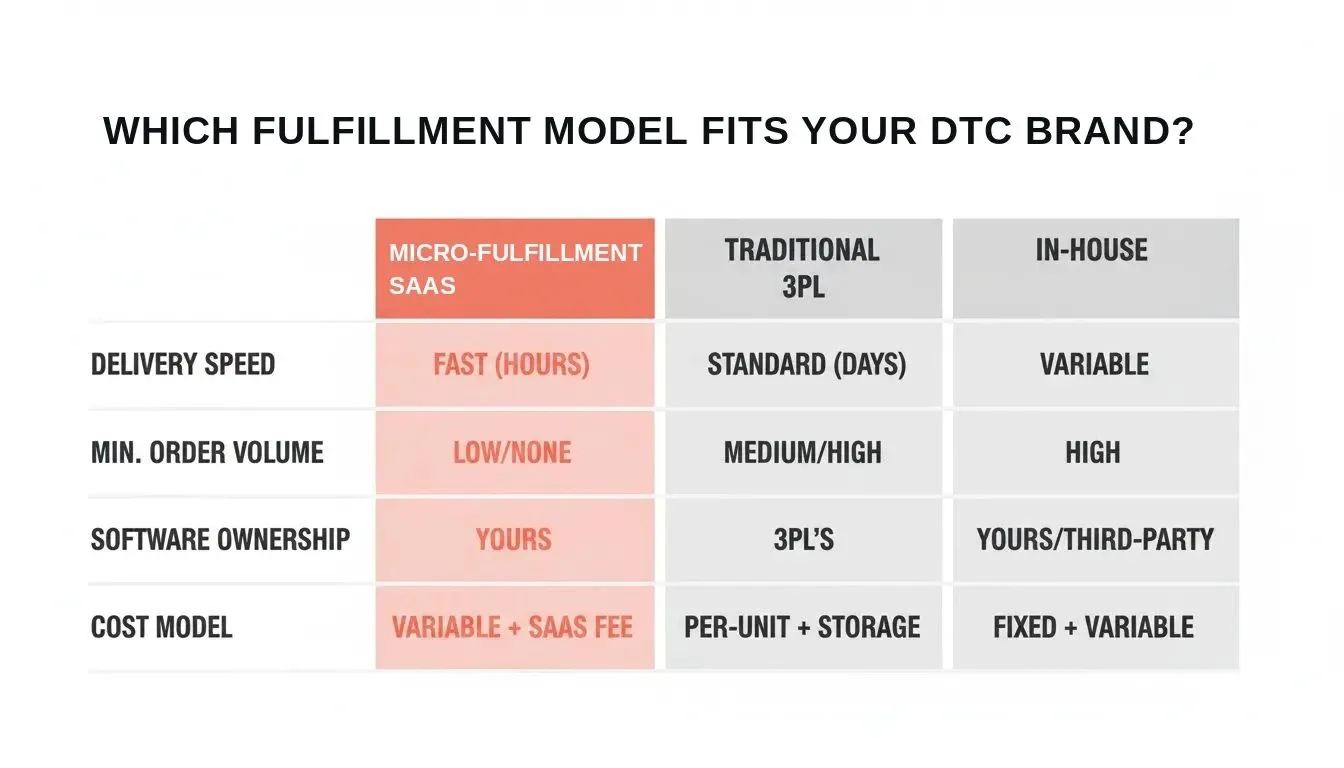
Micro-fulfillment SaaS outperforms 3PL and in-house models for DTC brands needing fast urban delivery, because the operator-owned software layer functions as a fulfillment solution rather than just another warehouse tool.
What Does a Micro-Fulfillment Platform Actually Handle?
A micro-fulfillment platform replaces the patchwork of spreadsheets, messaging apps, and manual coordination that most small operators rely on today. Building micro-fulfillment SaaS for DTC brands means covering five core operational modules, each serving a distinct stakeholder in the fulfillment chain.
-
Inventory management and warehouse operations. Track SKUs across warehouse space, use a warehouse management system to coordinate inventory placement across SKUs, manage inbound shipments with barcode scanning, and set automated restock alerts. Real-time visibility into stock levels means operators never oversell products to their DTC brands. Many micro fulfillment centers also use robotics for automated retrieval and can handle 10,000 SKUs when turnover is high.
-
Order routing and pick-and-pack queue. When online orders arrive from connected stores, the system routes them to the nearest micro-fulfillment center, creates a structured pick list, and moves items through a pack-and-ship workflow. You can learn how this connects to a broader shipment tracking app for e-commerce to give customers live parcel visibility.
-
Courier dispatch and last-mile coordination. Assign orders to local couriers or integrated services like FedEx and UPS, generate shipping labels, and provide customers with a live tracking link for their parcels.
-
Brand portal and customer experience. Each DTC brand gets a white-labeled inventory management system showing orders in progress, delivery confirmations, and monthly performance reports.
-
Analytics and operational insights. Track throughput per facility, identify bottlenecks in processes, and monitor delivery accuracy to maintain operational excellence across all locations, while predictive analytics can spot demand trends more effectively.
| Module | What It Does | Who Uses It |
|---|---|---|
| Inventory Engine | Tracks SKUs, stock levels, and replenishment cycles | Warehouse staff |
| Order Queue | Routes and prioritizes pick-and-pack tasks | Operators |
| Courier Dispatch | Assigns drivers, generates labels, and tracks parcels | Logistics team |
| Brand Portal | Shows order status, delivery data, and reports | DTC brand owners |
| Analytics | Monitors KPIs, flags operational issues | Operations manager |
The software layer is what turns a small warehouse into a scalable, multi-brand micro-fulfillment service. Without it, operators handle everything by hand, and that limits them to serving one or two brands at a time.
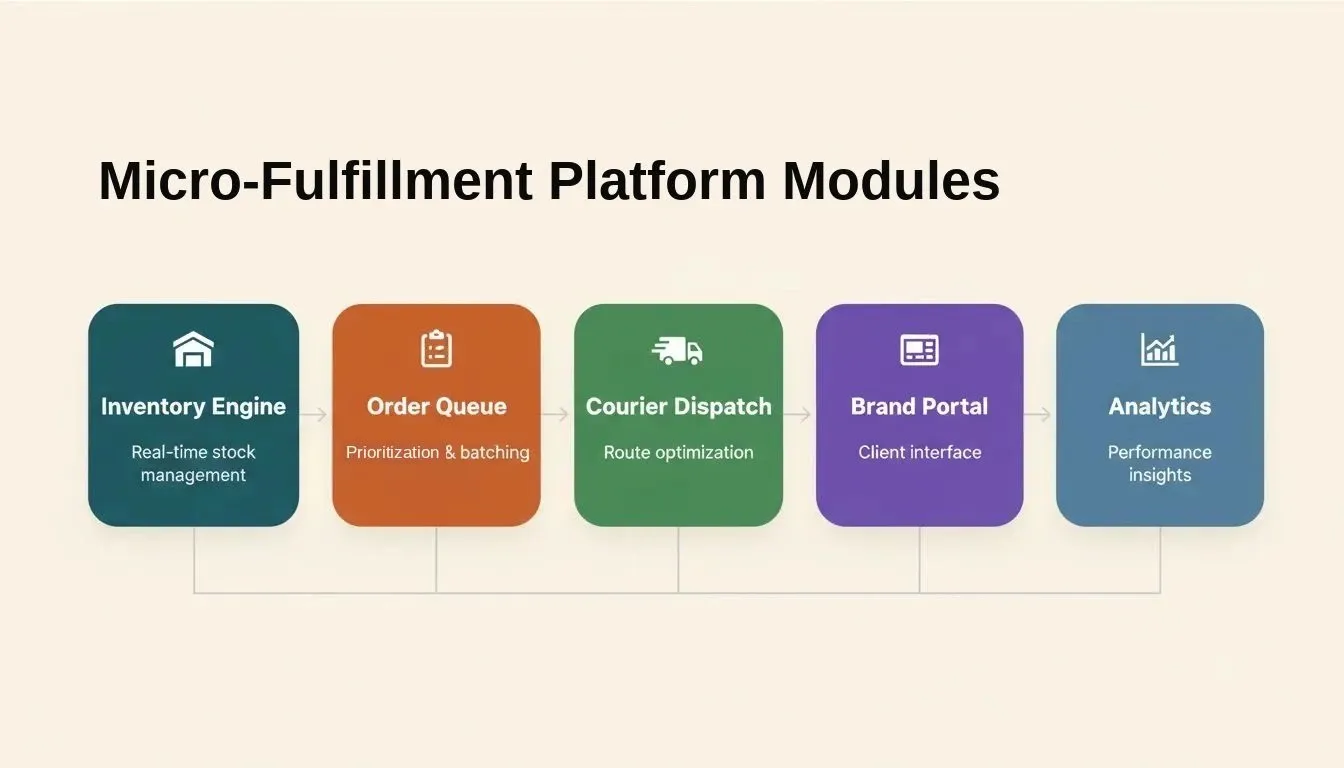
Five core modules every production micro-fulfillment SaaS platform must cover
How Does the Order-to-Same Day Delivery Flow Work?
Understanding the end-to-end process helps you identify which automated workflows your platform needs to support from day one. The flow below covers the six critical steps from order receipt to brand dashboard update.
Order-to-Delivery Flow:
-
DTC Store Order: Customer places an order on any connected DTC brand store
-
Inventory Check: Platform checks stock at the nearest micro-fulfillment facility; triggers a restock alert if low
-
Pick and Pack Queue: The order enters the structured pick list and moves through the pack-and-ship workflow
-
Courier Assignment: Local courier or integrated carrier (FedEx/UPS) assigned; shipping label generated
-
Same Day Delivery: Courier dispatched; customer receives live tracking link
-
Brand Dashboard Updated: Delivery confirmed; brand portal reflects real-time status
Each step produces real-time data showing what was picked, when it shipped, and where the courier is at that moment. That visibility also improves fulfillment efficiency across picking, packing, and dispatch. For a deeper look at building multi-user SaaS apps with role-based access, the operations app development guide covers the architecture patterns that apply directly here.
Validate Your Market Before You Build
Before writing a single line of code, the most important decision is which city to launch in and which DTC brand categories to target. Picking the wrong market is the most common reason micro-fulfillment operators fail to reach profitability.
Rocket's Solve capability is built for exactly this kind of pre-build validation. Run a Solve task to get a structured market analysis covering DTC brand density by city, competitor 3PL coverage gaps, average order volumes by product category, and a prioritized list of target brands to approach. Solve produces a structured report with data, insights, and actionable recommendations. You can see how this research-to-build workflow operates in Rocket's market validation to deployed product guide.
Once you are live, Rocket's Intelligence layer monitors competing 3PLs and micro-fulfillment operators in your target cities continuously. It watches across nine signal pillars, including website changes, hiring signals, pricing moves, news, and reviews, and delivers ranked Intel cards to your dashboard. This is the full Rocket platform at work: Solve to validate before you build, Build to generate the production app, and Intelligence to track the competitive landscape after launch.
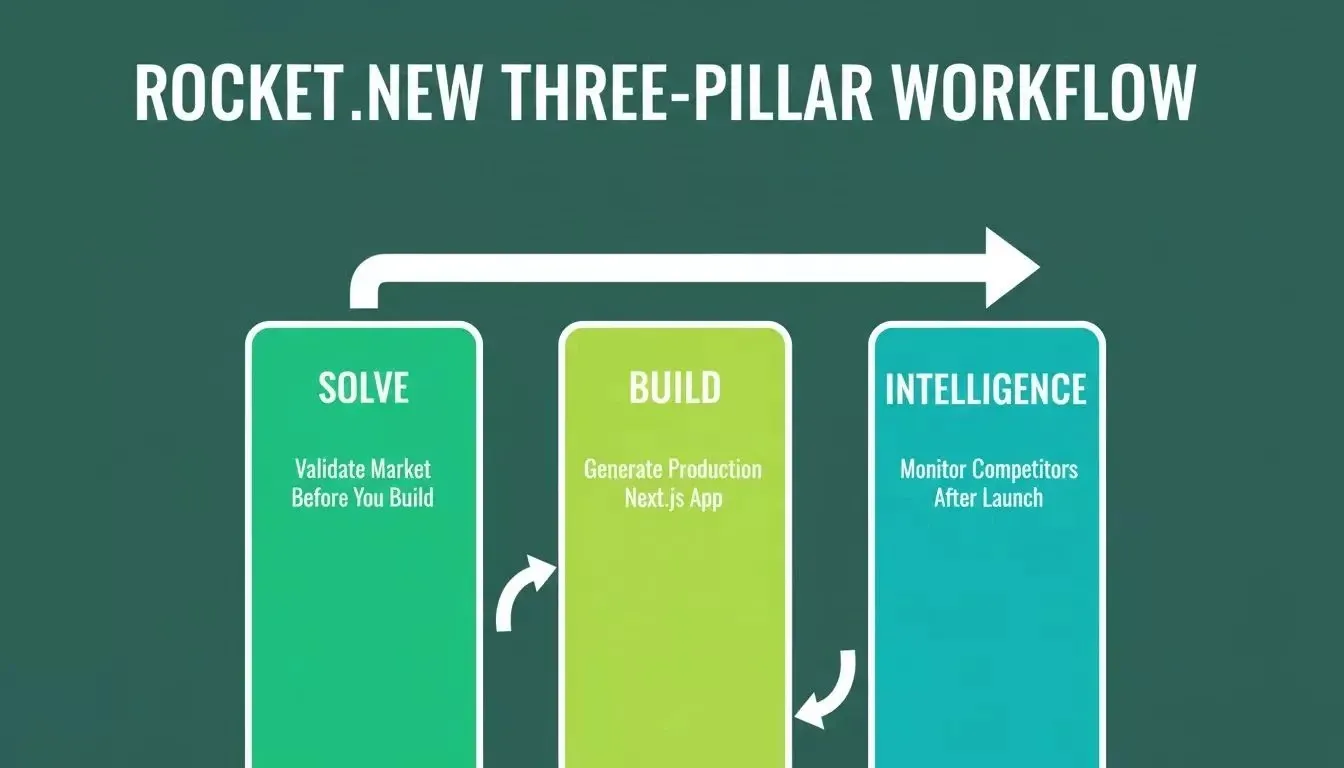
Rocket.new's three-pillar workflow: Solve validates, Build generates, Intelligence monitors
From Prompt to Production: Building Your Ops Platform on Rocket
Rocket's Build pillar generates production-ready Next.js web apps and Flutter mobile apps from a natural language description. The SaaS recipe in Rocket's documentation demonstrates exactly this pattern: a full-subscription SaaS with authentication, team workspaces, Stripe billing, and one-click deployment to Netlify, built in 30 to 45 minutes.
For a micro-fulfillment ops platform, your starting prompt would describe an operations platform with an inventory dashboard, inbound shipment logging, order pick-and-pack queue, courier assignment, and a brand portal with role-based access for warehouse staff, brand owners, and courier managers, with support for efficient scaling across brands and facilities.
What Rocket generates:
-
A production Next.js app with Supabase for authentication and database, Stripe for subscription billing, and Resend for transactional emails
-
Role-based access control so warehouse staff, brand owners, and courier managers each see only their relevant views
-
Real-time data syncing so every stakeholder sees live order and inventory updates
-
One-click deployment to Netlify, with the option to connect a custom domain
What you own and control:
-
On paid plans, you can download the full source code as a .zip file and self-host on your own infrastructure
-
GitHub sync lets you push your project to a repository for version control and further development
-
You can modify any component, add custom integrations, or hand the codebase to a developer with no platform lock-in restrictions
On a paid Rocket plan, you own your code and can customize every workflow to match your specific micro-fulfillment operations, whether you handle beauty products, fashion goods, or consumer electronics. Automation drives greater efficiency, and scalable workflows help minimize linear increases in headcount as order volume grows. For a full breakdown of what AI app builders actually cost compared to custom development, see the AI app builder vs hiring a developer ROI comparison.
Where Should You Launch Your First Hub?
Selecting the right city for your first micro-fulfillment facility determines how quickly you reach profitability and attract DTC brands searching for local fulfillment partners. While some retailers initially used existing stores for local fulfillment, dedicated micro-fulfillment hubs tend to be more reliable as store traffic increases. Use Rocket's Solve capability to run a structured market analysis before committing to a location, as the data will surface which cities have the highest DTC brand density and the weakest existing fulfillment coverage.
-
Austin, TX. A growing DTC ecosystem with beauty, wellness, and food brands shipping nationally. Low warehouse lease rates compared to coastal cities make it easier to test unit economics before scaling.
-
Atlanta, GA. The logistics capital of the Southeast with proximity to major shipping corridors. A large consumer base and thousands of e-commerce companies already operate from this metro area.
-
Phoenix, AZ. Rapid population growth and expanding suburban areas create rising regional demand for faster delivery. Low cost of living keeps operator overhead manageable.
-
Nashville, TN. A rising market with fashion, food, and consumer goods brands gaining momentum. Central geographic location serves multiple zip codes within a short delivery radius.
-
Miami, FL. A gateway for Latin American DTC brands entering the US. High population density in urban areas and year-round demand for products across multiple categories.
Start with one city, prove your model, then expand into a distributed network of facilities. Launching with one focused hub also makes the benefits easier to measure before you scale, from delivery speed to labor efficiency.
Each new location multiplies the brands you can serve and creates economies of scale through shared logistics infrastructure. For a structured approach to geographic expansion decisions, Rocket's geographic expansion planning guide covers how to use Solve to produce a city-by-city prioritization report.
Unit Economics and Revenue Model for Operators
The business model for a micro-fulfillment SaaS operator combines recurring subscription revenue with per-order transaction fees, creating a growth flywheel that compounds with each new brand.
-
Monthly platform subscription: $500 to $2,000 per brand. DTC brands pay a monthly fee for access to the fulfillment platform, warehouse space allocation, and dashboard reporting tools. Pricing varies based on SKU count and monthly order volume.
-
Per-order fulfillment fee: $3 to $8 per shipment. This covers pick-and-pack labor, packaging materials, and courier dispatch coordination. Higher-volume brands negotiate lower per-unit rates.
-
Profitability threshold: 15 to 25 active brands per facility. A single micro-fulfillment center operating in less space than a traditional warehouse can reach profitability with just 15 brands at moderate order volumes.
-
Revenue target: $30,000 to $80,000 monthly per facility. Once you pass the break-even line, margins run 40 to 60% because the software layer handles the operational complexity at near-zero marginal cost.
You are not selling warehouse space; you are selling a technology-powered fulfillment service. That distinction lets you charge recurring SaaS margins rather than compete on cost-center pricing against commodity storage providers.
The micro-fulfillment market reached $9.3 billion in 2025 and is projected to hit $12.5 billion by the end of 2026, expanding at a 34% CAGR, creating massive demand for software that handles inventory, order routing, and last-mile delivery coordination for operators serving DTC brands in fast-growing US cities.
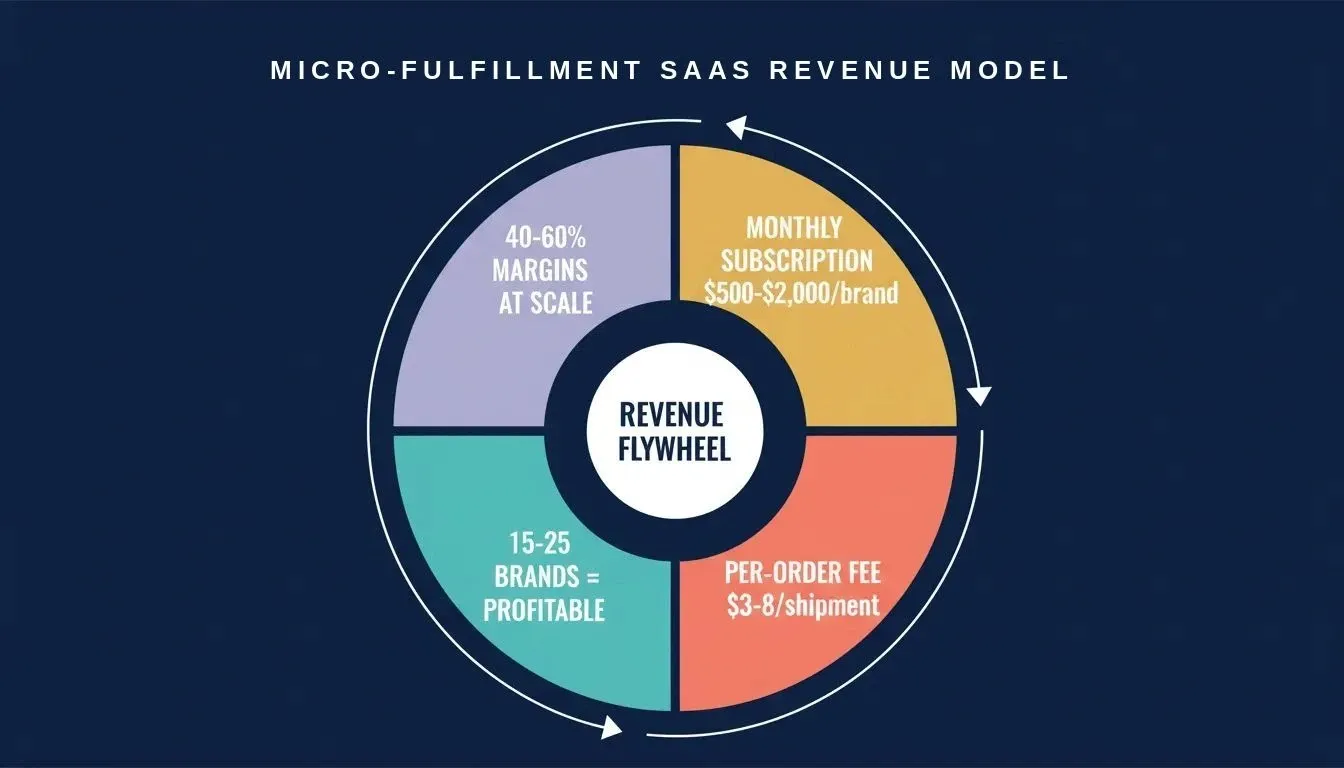
The revenue flywheel: subscription fees plus per-order fees compound with each new DTC brand added
Build Your Micro-Fulfillment SaaS Platform Today
The cities are ready. The DTC brands are searching for local fulfillment partners right now. And the software that ties it all together, inventory, orders, dispatch, and tracking, can be built in a single day with Rocket instead of months with a traditional dev agency.
Whether you are launching your first micro-fulfillment facility in Austin or expanding a distributed network across multiple cities, the technology layer is what separates a scalable business from a manual operation that cannot grow past a handful of brands. Sign up in about 30 seconds with Google, Apple, or email. No credit card required.
Start building your micro-fulfillment SaaS platform on Rocket.new
Table of contents
- -Why Do DTC Brands Need Micro-Fulfillment Software?
- -Micro-Fulfillment vs. 3PL vs. In-House: Which Model Fits?
- -What Does a Micro-Fulfillment Platform Actually Handle?
- -How Does the Order-to-Same Day Delivery Flow Work?
- -Validate Your Market Before You Build
- -From Prompt to Production: Building Your Ops Platform on Rocket
- -Where Should You Launch Your First Hub?
- -Unit Economics and Revenue Model for Operators
- -Build Your Micro-Fulfillment SaaS Platform Today