
Teams building for web and mobile need one platform that handles both. Rocket generates production-ready Next.js and Flutter apps from a single prompt, no framework expertise required, shipping in minutes instead of months.
Why are more than 40% of new mobile applications built with multi-platform frameworks today?
The cross-platform development market is projected to grow from $15.67 billion in 2025 to $47.61 billion by 2035, and the trajectory tells a clear story. Businesses need their products on iOS, Android, and the web simultaneously.
For teams without separate mobile and web engineering departments, the gap between ambition and execution used to stretch across months of hiring and planning.
AI changed that equation completely. Platforms that generate full applications from text descriptions now let a single person ship what once required a cross-functional team of six or more.
Why Cross-Platform Development is Now the Default Strategy
The era of choosing between "web first" or "mobile first" is over. Users expect consistent, high-quality experiences whether they open your product on a browser, an iPhone, or an Android device.
Businesses that cannot deliver across all three simultaneously lose users to competitors who can. So it is no surprise that the cross-platform development market is projected to grow from $15.67 billion in 2025 to $47.61 billion by 2035 at a CAGR of 11.75%. That is not a niche trend. It is a mainstream shift.
That growth is not driven by large enterprises alone. Startups, solo founders, and product teams of every size are moving to multi-platform strategies. The cost of building separately for each platform has simply become too high to justify.
The Business Case for Multi-Platform from Day One
- Over 7.5 billion smartphone users exist worldwide in 2026, each expecting app-quality experiences across phone, tablet, and desktop
- Customer acquisition costs drop when one product covers web, iOS, and Android without three separate codebases
- Enterprise IT departments save 30-40% on development cycles by consolidating platform strategy into one shared architecture
- More than 40-45% of new mobile apps now use cross-platform frameworks for at least part of their architecture
Teams that validate ideas with AI before building confirm product-market fit across platforms without writing framework-specific code. The shift is not about convenience. It is about staying competitive in a market where users abandon products that feel inconsistent across devices.
What is an AI Cross Platform App Builder?
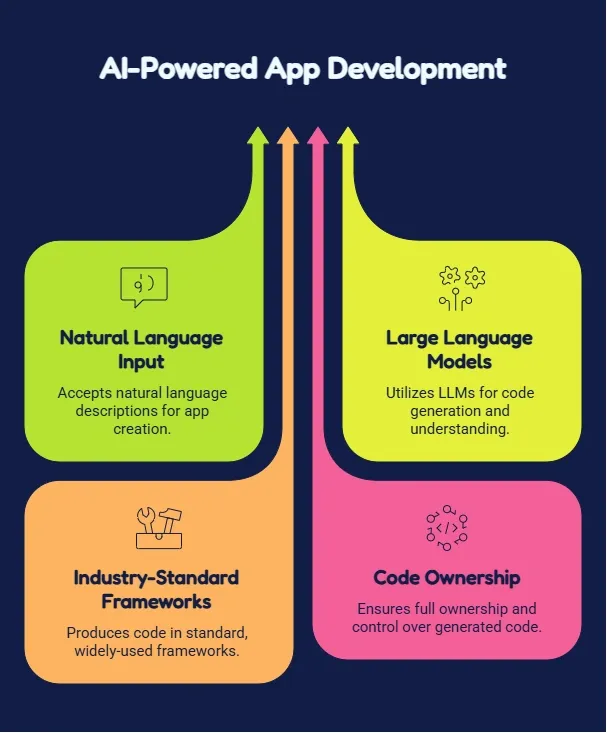 An AI cross-platform app builder accepts a natural language description of an application and generates production-ready code targeting multiple platforms at once. Unlike traditional tools that require learning proprietary languages or drag-and-drop interfaces, AI builders use large language models to produce real, maintainable code in industry-standard frameworks.
The critical distinction is code ownership. Traditional no-code tools trap your application inside their ecosystem. A genuine AI cross platform app builder generates standard framework code you can export, modify, and deploy anywhere with no ongoing subscription required to keep your app running.
How It Differs from Traditional Cross-Platform Tools
| Dimension | Traditional Tools | AI Cross Platform App Builder |
|---|---|---|
| Input method | Visual drag-and-drop | Natural language description |
| Framework output | Proprietary or locked-in code | Standard Next.js and Flutter |
| Design quality | Template-driven, generic | Intentional, design-system-backed |
| Iteration speed | Rebuild screens manually | Chat to refine in seconds |
| Deployment | Manual DevOps configuration | One-click to web and app stores |
| Vendor lock-in | High | Low, export and own your code |
Key Capabilities to Expect
A production-grade AI cross platform app builder should deliver:
- Dual-framework generation — Next.js for web (SEO-ready, server-rendered) and Flutter for mobile (native iOS and Android from one codebase)
- Design system output — typography, spacing, color tokens, dark and light theming, and responsive layouts generated automatically
- Integrated deployment — web hosting with custom domains and mobile app store submission from the same interface
- Built-in integrations — Stripe, Supabase, Google Analytics, and other services connecting without manual API configuration
- Iterative refinement — natural language chat, visual editing, and direct code access without full regeneration
How AI Changes the Cross-Platform Development Workflow
Traditional multi-platform development follows a rigid path: scope requirements, hire specialists, configure toolchains, write platform-specific code, run manual QA on each device, then deploy separately. Each handoff introduces delays. Each platform adds cost.
AI collapses all of these steps into a single conversation. You describe the product. The AI handles architecture, code, design, and deployment. That is a fundamentally different way of working.
Stage-by-Stage Comparison
| Stage | Traditional Approach | AI-Powered Approach |
|---|---|---|
| Planning | Weeks of technical scoping | Describe the app in plain language |
| Development | Separate teams for web and mobile | One prompt generates both |
| Testing | Manual QA on each platform | Live preview across devices in minutes |
| Deployment | DevOps setup per platform | One-click publish to web and app stores |
| Iteration | Submit change requests, wait for sprints | Chat with the AI, see changes instantly |
The cross-platform mobile development market reached $25.6 billion in 2026, with Flutter and React Native continuing to lead adoption. AI removes the framework learning curve entirely, letting product managers and founders describe outcomes instead of implementation details. As a result, the gap between "I have an idea" and "users are testing it" has compressed from months to days.
Real-World Use Cases: Who Benefits Most
Solo Founders and Early-Stage Startups
A solo founder building a marketplace, SaaS tool, or consumer app previously had to choose: build web first and lose mobile users, or build mobile first and lose web traffic. With an AI cross platform app builder, both ship simultaneously from the same prompt.
A founder can go from idea to live product on web, iOS, and Android in a single session without hiring anyone. For a practical walkthrough, see how to build a mobile app with AI step by step.
Product Teams at Growth-Stage Companies
Product teams managing separate web and mobile codebases spend a disproportionate amount of time on coordination: syncing feature parity, resolving platform-specific bugs, and managing two deployment pipelines. An AI cross platform app builder reduces this to a single source of truth.
Feature parity stops being a project and becomes the default. Teams ship to all platforms in one iteration cycle, and bug fixes apply everywhere automatically.
Enterprise IT Departments Modernizing Legacy Systems
Enterprise teams replacing legacy internal tools face a familiar challenge: users access these tools on desktop browsers and mobile devices. Building separate native apps is prohibitively expensive. An AI cross platform app builder generates a web app and a mobile companion simultaneously, with enterprise integrations connecting automatically. See how to build internal tools with AI without a developer for practical enterprise patterns.
Agencies and Freelancers
Agencies that previously quoted separate projects for web and mobile can now deliver both from a single engagement. The AI handles framework decisions and boilerplate, leaving the agency to focus on product strategy and client-specific customization. That is a meaningful competitive advantage when pitching.
Not every tool that claims multi-platform support delivers production-quality results. The criteria that separate genuine builders from marketing claims go beyond basic code generation.
Framework Authenticity
The generated app must use real, industry-standard frameworks. Tools that generate proprietary code or wrap web views in native containers produce apps that feel wrong on mobile: sluggish animations, non-native UI patterns, and poor performance on older devices.
Genuine cross-platform quality requires Flutter for mobile (native compilation to iOS and Android) and Next.js for web (server-side rendering, SEO, and performance optimization). If the output is not standard framework code, you are building on a foundation you do not own.
Design Quality from Generation One
The first version of your app should look like a senior designer built it. That means considered typography, visual hierarchy, dark and light theming, fluid animations, and responsive layouts that adapt correctly to every screen size. Template-driven tools produce generic interfaces. AI-native builders generate intentional design from the description itself.
Deployment Built In
If you need a separate DevOps process to ship, the tool only solved half the problem. A complete AI cross platform app builder handles web hosting with custom domains and generates signed APK and AAB bundles ready for Google Play and App Store submission, all from the same interface where you built the app.
Integration Depth
Real applications connect to payment processors, databases, analytics, email services, and authentication providers. The best platforms wire these integrations automatically — Stripe for payments, Supabase for database and auth, Google Analytics for tracking — without requiring manual API configuration for each platform separately.
The Frameworks Behind AI Cross-Platform Apps
Understanding why specific frameworks matter helps you evaluate whether an AI builder will produce apps worth shipping.
Why Next.js for Web
Next.js is the leading React framework for production web applications. It provides server-side rendering for SEO performance, incremental static regeneration for content-heavy pages, built-in API routes for backend logic, and a deployment model optimized for edge networks.
When an AI cross platform app builder generates a Next.js app, the output ranks in search engines, loads fast on mobile browsers, and scales to millions of users without architectural rewrites. That is not a prototype. It is a production deployment.
Why Flutter for Mobile
Flutter compiles directly to native ARM code for iOS and Android, producing apps that are indistinguishable from native Swift or Kotlin applications in terms of performance and feel. A single Flutter codebase covers both platforms, and the same codebase can also target web and desktop.
Flutter's widget system gives AI builders a rich component library to draw from. The result is generated apps with polished animations, custom UI patterns, and platform-specific behavior: Material Design on Android, Cupertino on iOS, all from the same source. For a deeper look at why Rocket chose these two frameworks, see why Rocket generates Next.js and Flutter.
The Market Validation
The cross-platform software market grew from $104.6 billion in 2025 to $121.04 billion in 2026 at a 15.7% compound annual growth rate, confirming that multi-platform strategy is now mainstream across industries.
On the framework side, Flutter leads with 46% developer adoption in 2026, while React Native holds at 35%, making these the default production choices for cross-platform mobile development. The choice between frameworks is no longer the hard part. The hard part used to be configuring them, and that is exactly what an AI cross platform app builder removes.
How Rocket Builds Web and Mobile Apps from One Prompt
Rocket is the world's first Vibe Solutioning platform. 1.5 million people have tried Rocket across 180 countries. The platform covers the complete arc from strategic intelligence to execution: research, decide, build, operate, grow, all inside one shared context.
Rocket was built around one belief: the work is only as good as the thinking before it. Most AI tools help you build faster. None of them tell you what to build. That is the problem Rocket was built to solve.
One Prompt, Two Frameworks
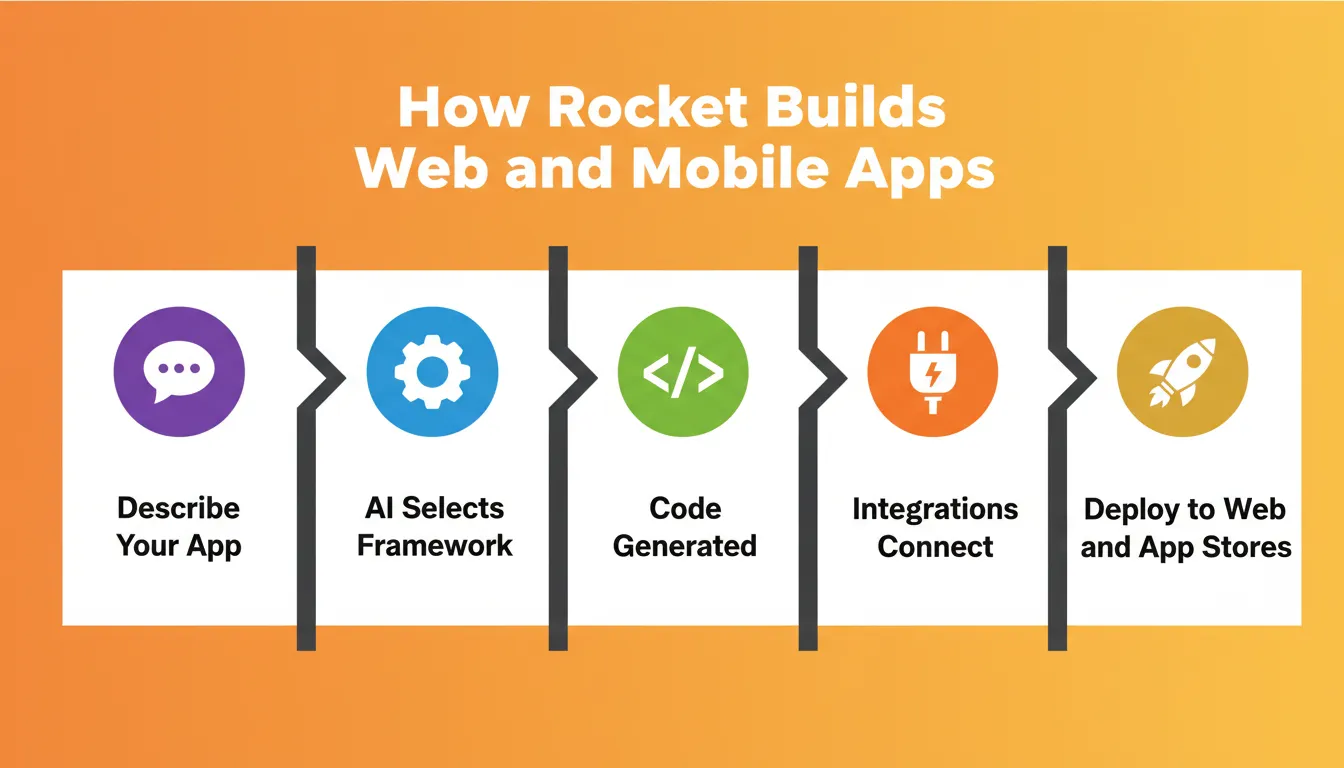
Describe your app in plain language and Rocket automatically assigns Next.js for web or Flutter for mobile, generating production-ready code for both from the same description. You describe the product. Rocket makes the architecture decision and generates code that any developer can maintain and extend.
Design That Looks Considered
Every generation includes considered typography, visual hierarchy, dark and light theming, and fluid animations. The design system is not applied after generation. It is embedded in the generation itself. Colors, spacing, component patterns, and interaction states are all intentional from the first version.
25+ Integrations Flow Into Every Build
Stripe, Supabase, Google Analytics, Mailchimp, HubSpot, Twilio, and more than 25 other services authenticate once and connect automatically across web and mobile. One integration covers both platforms. See the full connectors overview for the complete list.
Deploy to Web and App Stores Directly
Web apps go live with one click, with custom domain support and edge-optimized hosting. Flutter apps generate signed APK and AAB bundles ready for Google Play and App Store submission, with no Xcode required and no separate CI/CD pipeline to set up.
Iteration Happens in Conversation
After generation, refine through natural language chat, visual editing, or direct code access without regenerating from scratch. Ask Rocket to add a dark mode toggle, move navigation to the bottom on mobile, or add a Stripe checkout flow to the pricing page. The change applies in context, preserving everything already built.
Research-Informed Builds
When you start a build inside a Rocket project, the platform carries competitive intelligence, market research, and prior decisions into every generation. The result is a product that reflects real market conditions, not just the prompt you typed. That distinction matters more than it sounds, and it is why building from research context produces better outcomes than starting from a blank prompt.
"I've spent way too much time testing these so you don't have to. Here's my honest take — for actually shipping a mobile app to the store without drowning in configs, the all-in-one platforms are where it's at." — Reddit user, r/nocode
The Real Cost and Time Savings
Numbers tell the story better than promises. The data from teams using multi-platform AI builders shows consistent patterns across company sizes and industries.
Development Effort and Timeline
| Metric | Traditional Native Development | AI Cross Platform App Builder |
|---|---|---|
| Development effort | Baseline (100%) | 20-50% of traditional effort |
| Time from idea to live product | 20-28 weeks | Days to 4 weeks |
| Flutter MVP launch time | 20-28 weeks | 12-16 weeks (further compressed with AI) |
| Cost per platform | Full engineering salary per platform | Single codebase, shared cost |
| Bug fix propagation | Separate fix required per platform | One fix applies everywhere |
Pricing Comparison
| Tool | Starting Price | Mobile Support | Web Support | Code Export |
|---|---|---|---|---|
| Rocket | Subscription-based | Flutter (native) | Next.js | Full export |
| FlutterFlow | From $30/month | Flutter | Limited | Partial |
| Thunkable | From $39/month | React Native | PWA only | Limited |
| Adalo | From $36/month | React Native | Web app | Limited |
The Compounding Advantage
Cross-platform development can slash development effort by 50-80% and accelerate cycles by 30-40% compared to building separate native apps. Flutter MVPs typically launch in 12-16 weeks compared to 20-28 weeks for separate native apps, and AI tools compress that further to days.
These savings compound over time. Every sprint that would have been spent coordinating between web and mobile teams becomes a sprint spent on features that users actually notice. That is the real value of an AI cross platform app builder: not just the first build, but every build after it. For a detailed breakdown, see how AI app builders save development costs.
AI Cross Platform App Builders vs. Traditional Development
Rocket vs. Hiring a Development Team
| Factor | Hiring a Dev Team | AI Cross Platform App Builder |
|---|---|---|
| Time to first working prototype | 4-8 weeks | Minutes |
| Cost to MVP | $50,000-$150,000+ | Subscription-based |
| Framework expertise required | Yes, multiple specialists | None |
| Design expertise required | Separate designer needed | Built into generation |
| Deployment expertise required | DevOps engineer needed | Built into platform |
| Iteration speed | Sprint cycles (1-2 weeks) | Real-time via chat |
| Code ownership | Full | Full, export anytime |
How AI Builders Differ from Each Other
Different AI builders serve different use cases. Some focus on web-only output. Others generate mobile apps but not web. A smaller number generate both from a single prompt using standard frameworks.
When evaluating any AI cross platform app builder, these are the questions worth asking:
- Does it generate standard framework code (Next.js, Flutter) or proprietary abstractions?
- Does it include deployment infrastructure or require separate setup?
- Does it carry context between sessions or start fresh each time?
- Does it connect research and strategy to the build, or start from a blank prompt?
The answers to those four questions will tell you more than any feature comparison table.
The Future of AI Cross-Platform Development
The trajectory of AI cross platform app builders points toward three near-term developments that will further compress the gap between idea and shipped product.
Autonomous iteration is coming next. Current AI builders require human prompts to make changes. The next generation will monitor app performance, identify friction points in user flows, and propose improvements based on real usage data. The builder becomes a continuous co-pilot rather than a one-time generator.
Context-aware multi-platform optimization will follow. AI builders will generate platform-specific optimizations automatically: haptic feedback patterns for iOS, Material You theming for Android, Core Web Vitals optimization for web, all without requiring separate prompts for each platform.
Research-to-production pipelines represent the most significant shift. Platforms that connect market research, competitive intelligence, and user feedback directly into the build process will produce products that are strategically differentiated from day one, not just technically functional. Rocket is already building in this direction.
The AI Cross Platform App Builder Is the Future of Product Development
The teams winning in 2026 are not the ones with the largest engineering departments. They are the ones that eliminated the gap between deciding what to build and having it live across every platform their users touch.
An AI cross platform app builder removes the coordination overhead, the framework expertise requirement, the deployment complexity, and the maintenance burden that previously made multi-platform development a large-team endeavor. The right platform handles code generation, deployment, and iteration in one continuous workflow.
The best ones start from research, not a blank prompt. That distinction determines whether what gets built is worth building and whether it reflects real market conditions or just the first idea that came to mind.
Start building on Rocket.new — your first web and mobile app is one prompt away.
Table of contents
- -Why Cross-Platform Development is Now the Default Strategy
- -The Business Case for Multi-Platform from Day One
- -What is an AI Cross Platform App Builder?
- -How It Differs from Traditional Cross-Platform Tools
- -Key Capabilities to Expect
- -How AI Changes the Cross-Platform Development Workflow
- -Stage-by-Stage Comparison
- -Real-World Use Cases: Who Benefits Most
- -Solo Founders and Early-Stage Startups
- -Product Teams at Growth-Stage Companies
- -Enterprise IT Departments Modernizing Legacy Systems
- -Agencies and Freelancers
- -Framework Authenticity
- -Design Quality from Generation One
- -Deployment Built In
- -Integration Depth
- -The Frameworks Behind AI Cross-Platform Apps
- -Why Next.js for Web
- -Why Flutter for Mobile
- -The Market Validation
- -How Rocket Builds Web and Mobile Apps from One Prompt
- -One Prompt, Two Frameworks
- -Design That Looks Considered
- -25+ Integrations Flow Into Every Build
- -Deploy to Web and App Stores Directly
- -Iteration Happens in Conversation
- -Research-Informed Builds
- -The Real Cost and Time Savings
- -Development Effort and Timeline
- -Pricing Comparison
- -The Compounding Advantage
- -AI Cross Platform App Builders vs. Traditional Development
- -Rocket vs. Hiring a Development Team
- -How AI Builders Differ from Each Other
- -The Future of AI Cross-Platform Development
- -The AI Cross Platform App Builder Is the Future of Product Development