
Tracking accounts and rivals without a system means missed windows and cold outreach. Set up structured alerts across funding, leadership, product, and M&A signals. Rocket Intelligence surfaces what matters in real time, delivered to Slack or email, without burying you in noise.
What if you could call a prospect the same morning their funding news dropped?
Sales teams and intelligence analysts spend hours searching for signals that automated alerts can surface in seconds. Gartner found that sellers who gather buyer intelligence increase account growth by 5%, yet most sales pros still rely on manual searches, news tabs, or periodic LinkedIn scrolls to stay informed about the accounts they track.
Building a structured alert system for the companies you follow changes the game. You stop reacting and start anticipating. This guide covers why those alerts matter for sales and CI, what signals to track, how to configure a clean setup, and where modern tools go further.
Real-time company news alerts give sales teams a critical window to act before competitors do.
Why News Alerts Matter for Sales and Competitive Intelligence
Knowing what is happening at the companies you sell to, partner with, or compete against is not just useful. It is a revenue lever that directly affects deal timing and win rates.
- Timing beats volume every time. A rep who reaches out the morning a target company closes a funding round will always outperform one calling two weeks later when the story has already cooled.
- Continuous monitoring shapes competitive positioning. Markets shift quickly, and a competitor's hiring surge or product launch can change your account story before your next call.
- HubSpot's 2025 State of Sales found that 82% of sales professionals say AI surfaces better insights from data, yet the underlying signal stream still depends on how fast that news reaches your team.
- Sales advisor Dylan Wickliffe noted: "I've gone from chasing every possible deal to focusing on fewer, higher-value opportunities, putting more energy into strategic conversations instead of volume-based outreach." That shift only works when your intelligence feeds are accurate and current.
- Business outcomes tie directly to information speed. The organizations winning deals today treat real-time awareness as a core strategic capability, not an optional extra.
A clean alert system turns scattered data points into timely actions. The teams closing fastest are already tracking the right signals in the right way.
What Happens When You Miss a Key Account Move?
Most missed opportunities in B2B do not trace back to product fit or pricing. They trace back to timing. A key move happened at the account, and someone else found out first.
- A competitor lands the deal because they knew about the org restructure before you did.
- Your outbound arrives cold because you pitched the old CFO two days after the new one started.
- A customer quietly shifts budget to a rival platform while you are still planning a routine check-in call.
Real-time monitoring of account activity is what keeps these gaps from forming. Understanding how to build a competitive intelligence program is the foundation that makes alert systems work at scale.
Is Real-Time Tracking Worth the Setup?
The short answer is yes, but only when your alerts are configured to surface what matters, not everything at once. The medium through which you receive alerts matters as much as the content itself.
- Real-time alerts on breaking news give you a window of minutes to hours before that story spreads across your competitor's outreach, too.
- Receiving notifications as events happen, rather than in a daily digest, closes the reaction gap on high-stakes accounts.
- The reps who stay informed on every account they own are not reading more news. They are using smarter filters and real-time alerts to stay aware of what actually matters.
The setup investment is small. Getting there before the story spreads pays back fast.
What Should You Track? Signals That Actually Move Deals
Not all signals carry the same weight. The following types of events tend to trigger the most meaningful actions across B2B sales and intelligence teams.
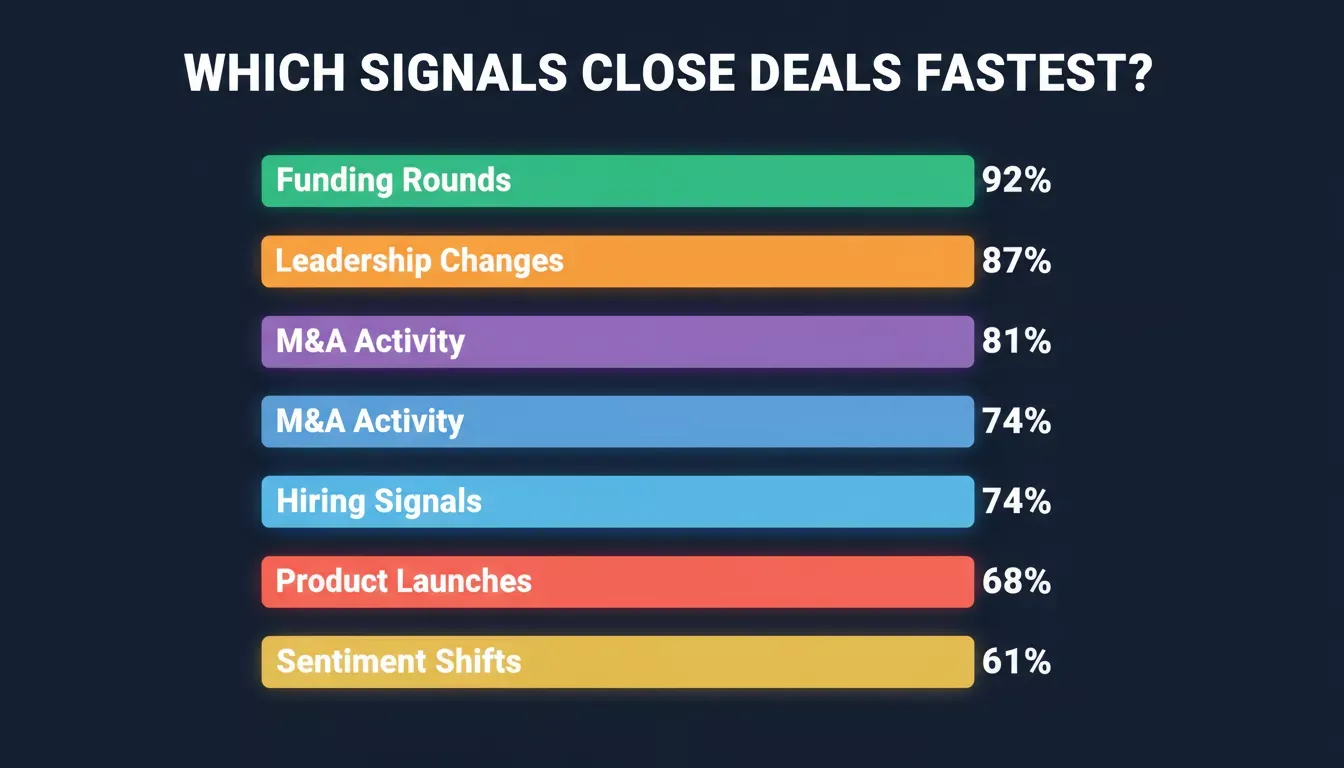
Funding rounds and leadership changes consistently rank as the highest-impact signals for B2B deal timing.
| Signal Type | Examples | Why It Matters |
|---|---|---|
| Funding and Financial | Series A/B/C rounds, stock filings, revenue reports | Budget availability, expansion intent |
| Leadership Changes | New CXO, VP Sales, board appointment | New priorities, relationship resets |
| Product and Technology | Product launches, new API connections, deprecations | Positioning shifts, competitive gaps |
| M&A Activity | Acquisitions, mergers, divestitures | Territory changes, account risk |
| Hiring Signals | Mass hiring in engineering or sales, layoffs | Growth intent, strategic bets |
| Reputation and Sentiment | Media mentions, review spikes, executive quotes | Account health, churn risk |
- Track multiple types of signals simultaneously rather than relying solely on press releases. A funding announcement paired with a VP Sales departure at the same account is a very different outreach trigger than either signal alone.
- Set alerts across a range of sources: industry news wires, social platforms, company blogs, job boards, and regulatory filings, each cover distinct signal layers.
- Monitor Medium posts from executives and board members at target companies. These often surface strategic thinking weeks before a formal announcement lands.
- Focus your watchlist on the accounts live in your pipeline or within one quarter of outreach. Signal overload on dormant accounts wastes attention on medium-priority names and buries updates on the high-value ones.
Funding Rounds and Financial Signals
Funding news is one of the most reliable trigger alerts for time-sensitive outreach across B2B sales teams.
- New capital means new budgets. A company that just closed a round is actively looking to deploy that capital, and your product may be exactly what their incoming head of revenue wants to evaluate.
- Track funding data on dedicated databases, stock filings, and industry news wires. Set keyword alerts combining the company name with search terms like "funding," "raises," "Series," and "closes round."
- Do not limit this to prospects. These signals highlight where competitors are investing and what they are building next, giving you a read on capability gaps before they close them.
Financial signals sit at the top of the alert priority stack for most sales organizations. The data is public, the timing window is short, and the reward for moving first is real.
Leadership Changes and Hiring Signals
A new executive at a target organization is one of the cleanest sales triggers in B2B, and one of the most consistently underused.
- New CXO hires typically spend their first six months auditing existing vendors and tech stacks. That window is your best opening to get in front of them before existing relationships lock back in.
- Monitor hiring pages, LinkedIn announcements, and press releases together. A spike in senior sales hiring signals an organization is about to expand its go-to-market, which often precedes a software evaluation cycle.
- Language patterns in job descriptions tell a deeper story. Phrases like "greenfield territory" or "building from scratch" signal that the company is entering a new market and may need new tools to support it.
Leadership monitoring deserves its own alert set, separate from general news tracking. These signals do not repeat, and the window to act is narrow.
Product Launches and M&A Moves Worth Watching
Product and M&A events create the sharpest competitive intelligence windows of any signal category.
- A competitor's product launch is your cue to refresh your battlecard. Check the feature claims, scan for customer reactions on review sites and forums, and update your positioning before the next sales cycle begins.
- M&A announcements shift account ownership, decision authority, and tech stack priorities faster than most teams anticipate. When a customer gets acquired, they are in evaluation mode for everything in their stack.
- Set content alerts and keyword monitoring around your top competitor names plus product-adjacent search terms. New content from competitors often surfaces strategic intent weeks before a press release does.
These events are unpredictable by nature. Alerts turn them into reactive opportunities instead of missed moments. Teams that track competitive signals before human analysts catch them consistently close faster.
How Do You Set Up Google Alerts Without Getting Buried?
Google Alerts is the most accessible free service for monitoring company mentions across the web, and one of the most frequently misconfigured tools in a B2B sales stack.
- Use exact-match phrases by wrapping your search term in quotes: "Acme Corp" instead of Acme Corp. This single adjustment eliminates most of the noise that buries real results.
- Select "Only the best results" over "All results" in the volume setting. The default level floods your inbox with loosely related content and makes it harder to act on what actually matters.
- Choose your delivery medium based on account tier. As-it-happens suits high-priority accounts; a daily or weekly digest fits better for background monitoring.
- Create separate company news alerts for each entity type: company name, CEO name, product names, and competitor brand terms. Combining everything into one search term makes results harder to filter and act on.
- For each alert, use specific words and phrases to narrow the scope. Adding your target company's industry or city as a modifier reduces false positives significantly.
- Set an RSS feed as your delivery medium for medium-volume alert streams you want to review on your own schedule.
- Visit alerts.google.com, sign in with your Google account, and save each alert to activate it. If results stay noisy after seven days, return to edit the search term or change sources to "News" only.
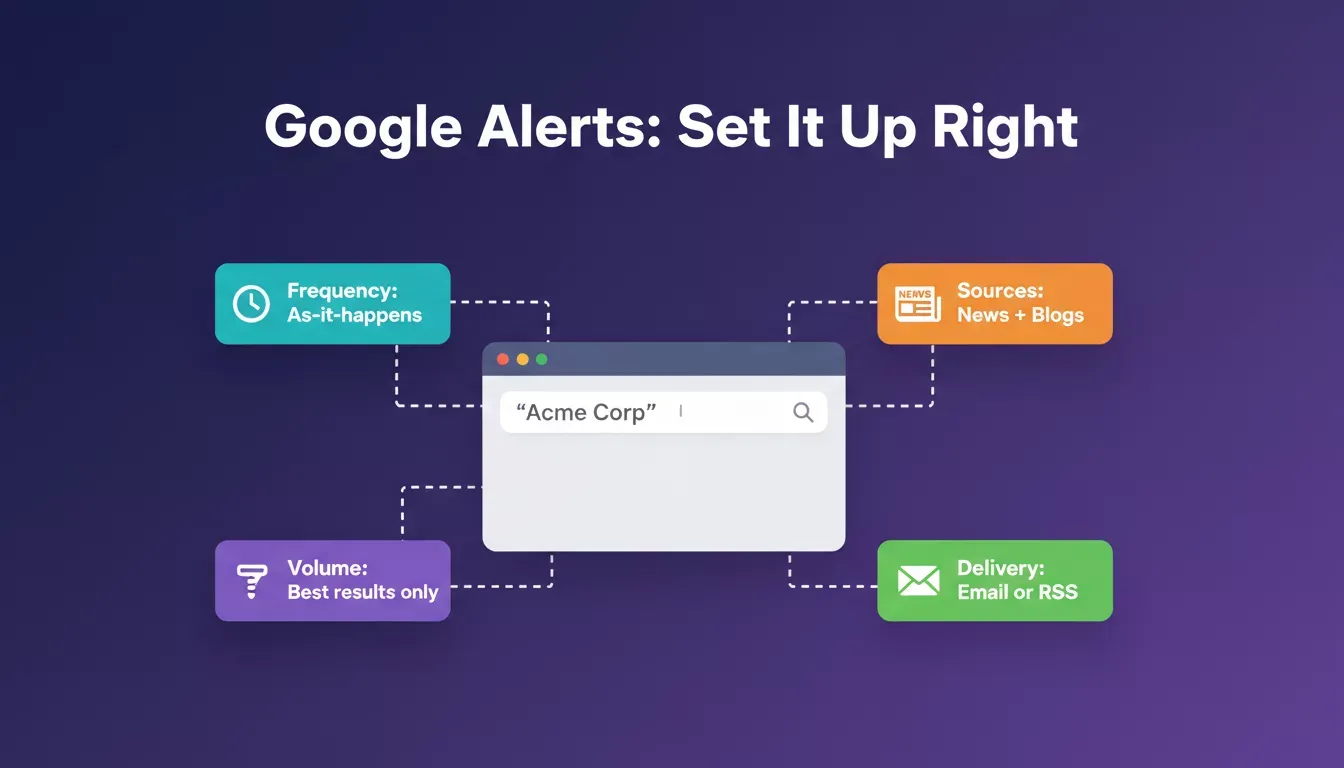
Proper Google Alerts configuration with exact-match phrases and filtered sources eliminates most inbox noise.
Google Alerts is a solid starting point as a free service for teams building their monitoring stack. The limits become visible when you need broader source coverage, sentiment context, or multi-signal correlation across many accounts at once.
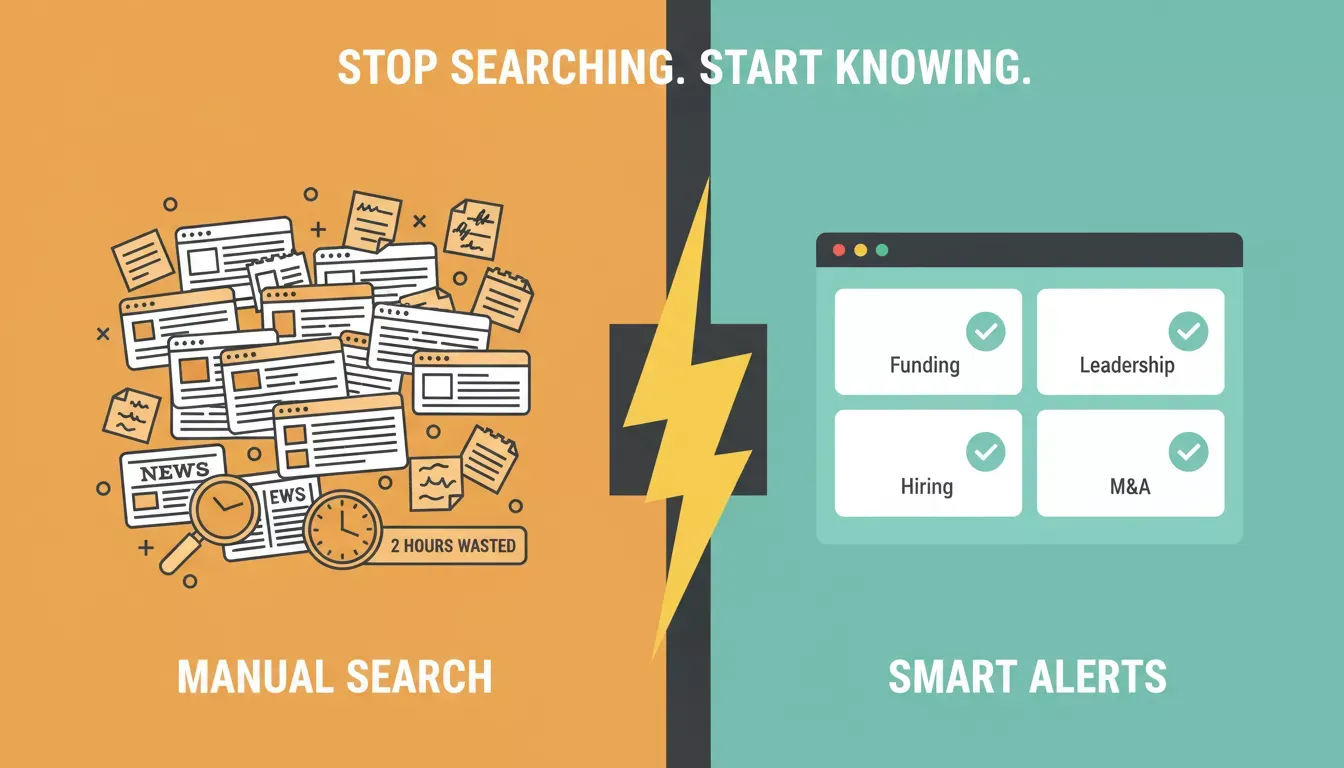
Manual research creates noise. Structured company news alerts create a signal.
How Rocket Intelligence Keeps You One Move Ahead
Google Alerts monitors text on the web. Rocket Intelligence monitors the signals behind the story and delivers them in the context of your work, not just your inbox.
- Rocket Intelligence tracks nine signal types in parallel, covering hiring patterns, product changes, funding news, media monitoring, sentiment shifts, and more, all for the companies on your watchlist.
- Alerts arrive in real time through the delivery medium you already use: email, Slack, or the Rocket app. No dashboard-checking required; the intel comes to you.
- The platform learns who you are and what you are watching. It frames every notification through the lens of your role and intent, so a competitor's product launch lands as a different brief for a sales rep than it does for a product manager.
- Competitor mentions from review sites, social platforms, job boards, and Medium posts are all pulled into a single daily brief. This cuts hours of manual monitoring and cross-source correlation every week.
- Unlike Google Alerts, which surfaces individual articles without context, Rocket clusters related signals. When two accounts in your pipeline make moves in the same week, you get one coherent brief, not a dozen separate notifications.
- The AI layer identifies sentiment shifts before they become breaking news: a cluster of negative reviews, a spike in competitor job postings in your markets, or a pattern in customer feedback across multiple online sites.
- McKinsey research shows that sales teams using automation-driven intelligence report consistent productivity gains of 10 to 15 percent (source).
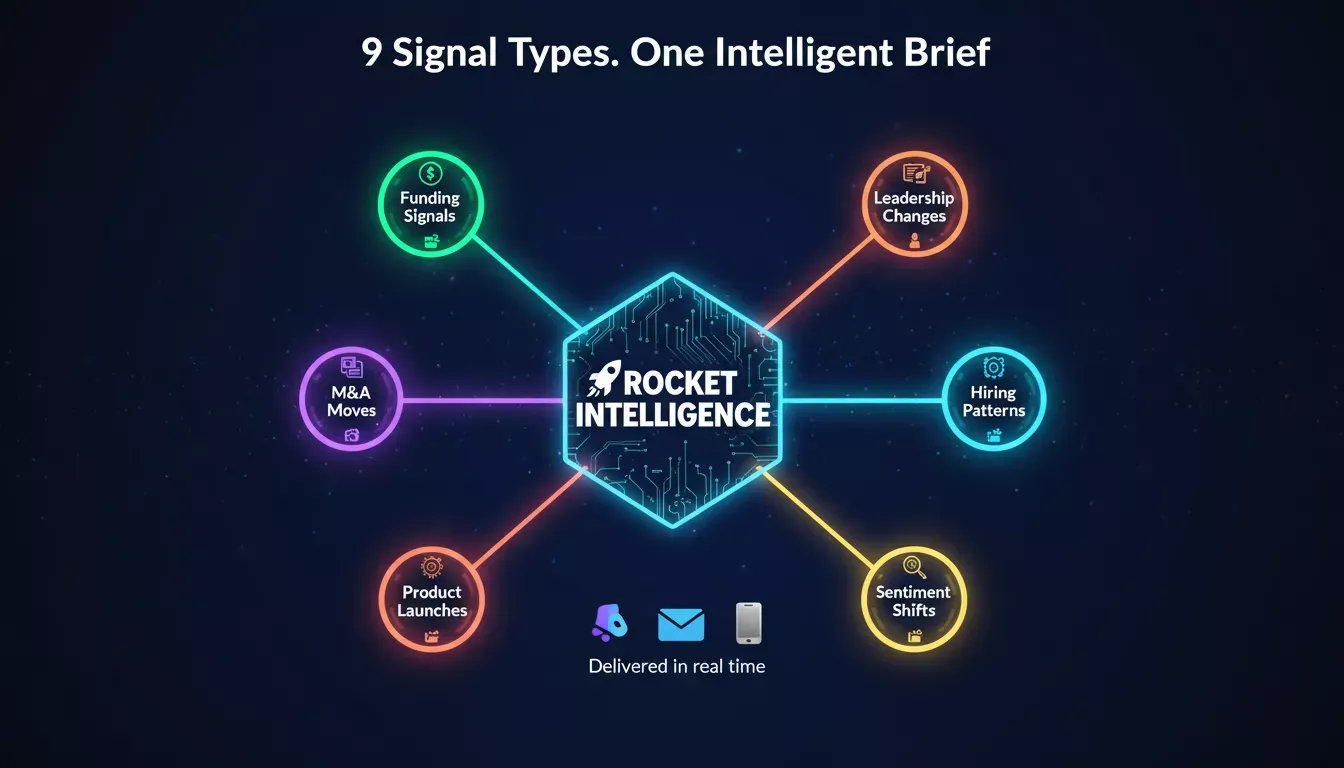
Rocket Intelligence aggregates nine signal types and delivers role-specific briefs to your existing workflow.
Traditional tools work until the accounts you track outnumber the hours you have. Rocket Intelligence scales with your watchlist, adds AI context to every signal, and delivers curated briefs to whatever delivery medium you already use. Your first company takes 30 seconds to follow, free.
Why Signal Clustering Changes Everything
Most alert tools treat each piece of news as an isolated event. Rocket Intelligence connects the dots across signal types, time periods, and companies to surface patterns that individual alerts miss entirely.
- A competitor's new VP of Sales hire, combined with a spike in job postings for enterprise account executives, tells a very different story than either signal alone. Rocket surfaces that pattern as a single strategic brief.
- When a customer gets acquired and simultaneously posts three new IT leadership roles, that combination signals an imminent tech stack review. Isolated alerts would never connect those dots.
- Teams using social media monitoring software alongside structured company alerts gain a complete picture of account health that no single source can provide.
Integrating Alerts Into Your Sales Workflow
The best alert system is one your team actually uses. Delivery medium and workflow integration determine whether intelligence reaches the rep before the call or sits unread in a tab.
- Route high-priority account alerts directly to Slack channels tied to those accounts. This keeps the signal visible without requiring anyone to check a separate tool.
- Use a daily digest for background accounts and reserve as-it-happens delivery for the top tier of your active pipeline. This prevents alert fatigue without sacrificing coverage.
- Build a weekly review into your team rhythm. Fifteen minutes reviewing the week's signals across your watchlist surfaces patterns that individual alerts miss in real time.
The goal is not more information. The goal is the right information at the right moment. Teams that align their alert cadence with their sales motion close the reaction gap that competitors exploit.
Building a Watchlist That Scales
A watchlist that starts with five accounts and grows to fifty needs a structure that does not collapse under its own weight. Tiering your accounts by priority is the most effective way to keep signal quality high as coverage expands.
- Tier 1 accounts (active pipeline, top renewal risks): as-it-happens alerts across all six signal types, daily brief review.
- Tier 2 accounts (warm prospects, key customers): daily digest, weekly review, focus on funding and leadership signals.
- Tier 3 accounts (background monitoring, dormant prospects): weekly digest, monthly review, broad keyword coverage only.
Scaling your company news alerts program is not about tracking more; it is about tracking smarter.
Turn Market Signals Into Pipeline Wins
The gap between knowing and not knowing closes the moment you put the right alert structure in place. Sales teams that stay current on their accounts, markets, and rivals spend less time on cold research and more time on conversations that are already warm. That difference shows up directly in deal velocity and win rates.
Start with the signals that matter most to your current pipeline, get your alert cadence right, and layer in smarter tooling as your watchlist grows. For a closer look at how automated intelligence handles moments when multiple rivals move in the same week, the piece on what Rocket.new does when competitors make strategic moves is worth a read.
Ready to stop missing the moves that matter? Start following your first account on Rocket in 30 seconds and get AI-curated company news alerts delivered to Slack or email.
Start free on Rocket and see the difference structured intelligence makes to your pipeline.
Table of contents
- -Why News Alerts Matter for Sales and Competitive Intelligence
- -What Happens When You Miss a Key Account Move?
- -Is Real-Time Tracking Worth the Setup?
- -What Should You Track? Signals That Actually Move Deals
- -Funding Rounds and Financial Signals
- -Leadership Changes and Hiring Signals
- -Product Launches and M&A Moves Worth Watching
- -How Do You Set Up Google Alerts Without Getting Buried?
- -How Rocket Intelligence Keeps You One Move Ahead
- -Why Signal Clustering Changes Everything
- -Integrating Alerts Into Your Sales Workflow
- -Building a Watchlist That Scales
- -Turn Market Signals Into Pipeline Wins