
Context engineering is replacing prompt engineering as the core AI skill. It means designing systems that control what an LLM sees, not just how you phrase a request. Better context architecture leads to more reliable AI agents in production.
Most teams still treat AI failures as a prompting problem, tweaking wording until an answer looks better. But the real cause is usually what the model never saw in the first place: the missing project details, stale documents, or absent tools. This guide breaks down why context, not phrasing, now decides whether an AI agent actually works in production.
Why Did the Industry Move Beyond Prompting to Context Engineering?
Context engineering is the discipline of designing and building dynamic systems that give an LLM the right information, tools, and state, in the right format and at the right time, so it can complete a task reliably in production.
The shift happened because production AI systems break in ways that better prompts cannot fix. When Andrej Karpathy publicly endorsed the move toward building context systems in June 2025, he confirmed what practitioners had felt for months: cleverly worded prompts no longer solve production-scale AI problems.
According to Harrison Chase of LangChain, most agentic system failures trace back to missing or poorly structured context rather than model limitations. The gap between a demo chatbot and a reliable AI agent lies in what information you provide the model, not how you phrase a single request.
-
Single prompts worked for simple tasks. When you needed a summary or a quick answer, a well-phrased prompt did the job. But agentic systems running multi-step workflows need far more than clever wording to deliver reliable AI outputs.
-
Large language models became capable but not omniscient. LLMs improved dramatically in reasoning, yet they still depend entirely on what information enters their context window at inference time. The model only knows what you show it.
-
AI agents exposed the real bottleneck. As teams deployed autonomous agents for coding, research, and operations, they discovered most failures were not model errors. There were gaps in what the LLM could see when generating its next token.
-
The vocabulary had to evolve. People associate prompt engineering with typing things into a chatbot, which undersells the complexity of managing multiple data sources, tool integrations, and session state for production AI applications.
For product managers, solopreneurs, front-end developers, and SMB teams building AI-powered apps or websites with minimal coding, this is the practical shift that separates prototypes from production-ready systems. The best practices for writing prompts still matter, but they represent only one layer of a larger context architecture.
The rest of this guide breaks down the move from prompt engineering to context engineering, the seven layers of a context window, why agents fail when context is weak, how to build context-first systems, and how Rocket.new applies shared context across AI app development workflows.
What Makes This Discipline Different From Writing Prompts?
Context engineering is a systems discipline, not a writing skill. Prompt engineering focuses on a single string of text you send to a large language model. Context engineering treats context as a system-level architectural problem spanning multiple data sources, tool integrations, and session states.
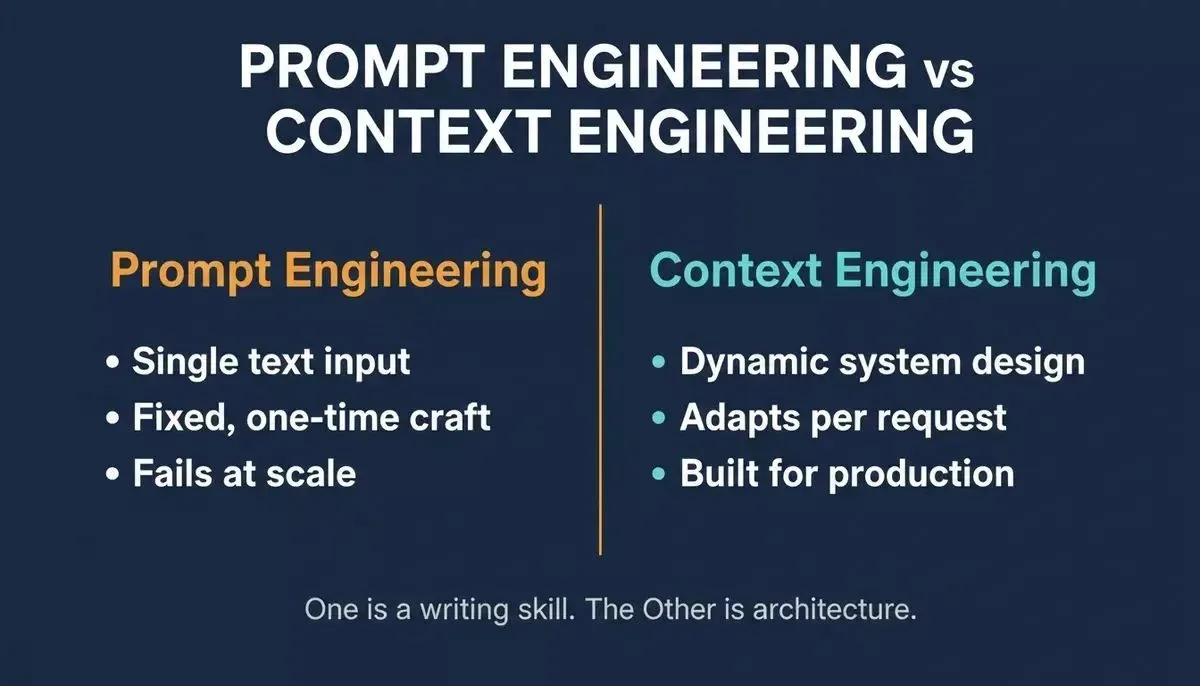
Prompt engineering and context engineering solve different problems at different levels of the stack.
-
It is a system, not a string. You are not crafting one perfect input. You are building a dynamic pipeline that assembles the right information before each LLM call, pulling from databases, APIs, documents, and conversation history.
-
It is dynamic, not static. The same AI agent might need calendar data for one request, code files for another, and customer records for a third. The system decides what to load into the context window at runtime based on the task.
-
It includes tools, not just text. Giving a model access to the right tools and functions, such as search, database queries, API calls, and code execution, is as important as giving it the right documents and instructions.
-
Format matters as much as content. A concise, structured summary outperforms a raw data dump, even when both contain identical information. How you present data to the LLM directly affects output quality.
Philipp Schmid, a researcher at Hugging Face, defined this practice as "the discipline of designing and building dynamic systems that provide the right information and tools, in the right format, at the right time, to give an LLM everything it needs to accomplish a task."
| Dimension | Prompt Engineering | Context Engineering |
|---|---|---|
| Scope | Single interaction | Entire session and system |
| Focus | Wording of one input | What information is present |
| Skill type | Craft | Architecture |
| Failure mode | Poor phrasing | Wrong or missing information |
| Scales to production | Rarely alone | Yes, when designed well |
| Dynamic | No, fixed text | Yes, adapts per request |
| Includes tools | No | Yes, tool definitions are included |
Teams already applying AI context optimization strategies are seeing measurable improvements in accuracy and cost efficiency across their LLM-powered applications. This shift also connects directly to how full-stack AI agents are planned and deployed in production today.
The Seven Layers of a Well-Constructed Context
When a large language model receives a request in a production system, the context window typically contains these distinct layers working together:
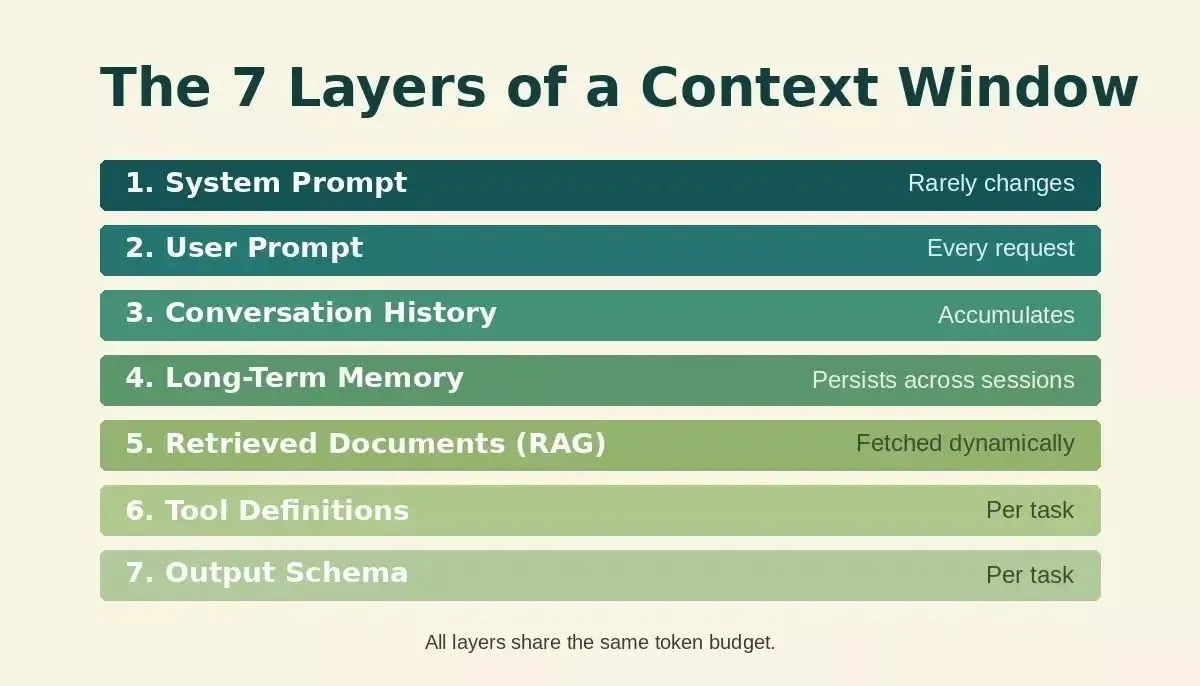
Every layer competes for the same token budget. Knowing which changes are rare vs. every request is the starting point for good context architecture.
| Layer | What it contains | Changes per request |
|---|---|---|
| System prompt | Behavioral rules, constraints, persona | Rarely |
| User prompt | The immediate task or question | Every request |
| Conversation history | Prior exchanges for session continuity | Accumulates |
| Long-term memory | Preferences, past decisions, and learned facts | Persists across sessions |
| Retrieved documents (RAG) | Dynamically fetched external content | Every request |
| Tool definitions | Functions the model can call | Per task |
| Output schema | Format requirements (JSON, Markdown, etc.) | Per task |
Each layer consumes tokens from the same limited context window. A 128K-token window split unevenly, say 80K tokens of raw codebase with only 5K left for instructions and retrieved docs, leaves the model reasoning on the wrong information. Overloading one layer starves the others of the attention they need from the LLM.
How Do AI Agents Succeed or Fail Based on Their Context?
Here is the uncomfortable truth most teams learn too late: when an AI agent produces garbage output, the underlying model itself is rarely broken. The context is that better retrieval reduces hallucinations by supplying grounded facts.
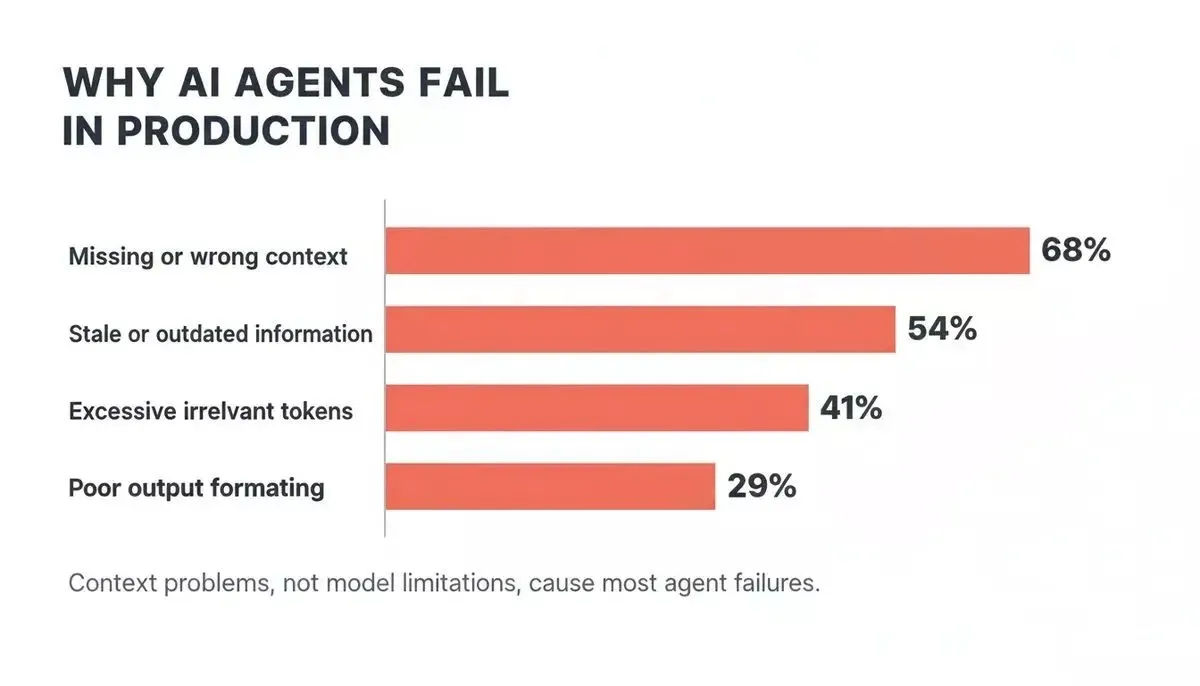
Context problems account for the majority of agent failures in production environments.
-
Missing context causes false assumptions. If the AI agent does not have access to your project's architecture decisions, it will make new ones that conflict with existing code. The LLM fills gaps with its own reasoning, which diverges from your intent; retrieval may rely on keyword matching or semantic similarity, and weak retrieval quality often leads to context failures.
-
Stale context creates contradictions. An agent using six-month-old documentation alongside current system prompt instructions will produce inconsistent results that are painful to debug across long sessions.
-
Excessive context dilutes attention. Dumping entire codebases into the context window forces the large language model to spread its attention across thousands of irrelevant tokens, weakening focus on the actual task at hand and increasing model failures.
-
Poor formatting confuses reasoning. A 50,000-token JSON blob is technically "context," but it gives the model no signal about what information matters most for the current step.
Harrison Chase of LangChain framed this clearly: "Most of the time when an agent is not performing reliably, the underlying cause is that the appropriate context, instructions, and tools have not been communicated to the model."
*"+1 for 'context engineering' over 'prompt engineering.' People associate prompts with short task descriptions you'd give an LLM in your day-to-day use. In every industrial-strength LLM app, it is the delicate art and science of filling the context window with just the right information for the next step." — Andrej Karpathy, *via Simon Willison
This quote captures the industry sentiment perfectly. The term "prompt" undersells the work. Building AI agents that work in production requires planning context across entire workflows, not just writing better questions for the language model. Understanding what inconsistent AI outputs signal for product decisions is a natural next step once you see context as the root cause.
How Rocket Applies Shared Context Across Every Build
Most AI tools start every session from a blank slate. You describe your project, paste in requirements, and re-explain decisions you made last week. Context gets lost at every handoff between tasks, between team members, between Tuesday and Thursday.
Rocket.new is a three-pillar platform: Solve (strategic research), Build (AI app generation in Next.js for web and Flutter for mobile), and Intelligence (continuous competitor monitoring). All three pillars share context through a common project architecture.
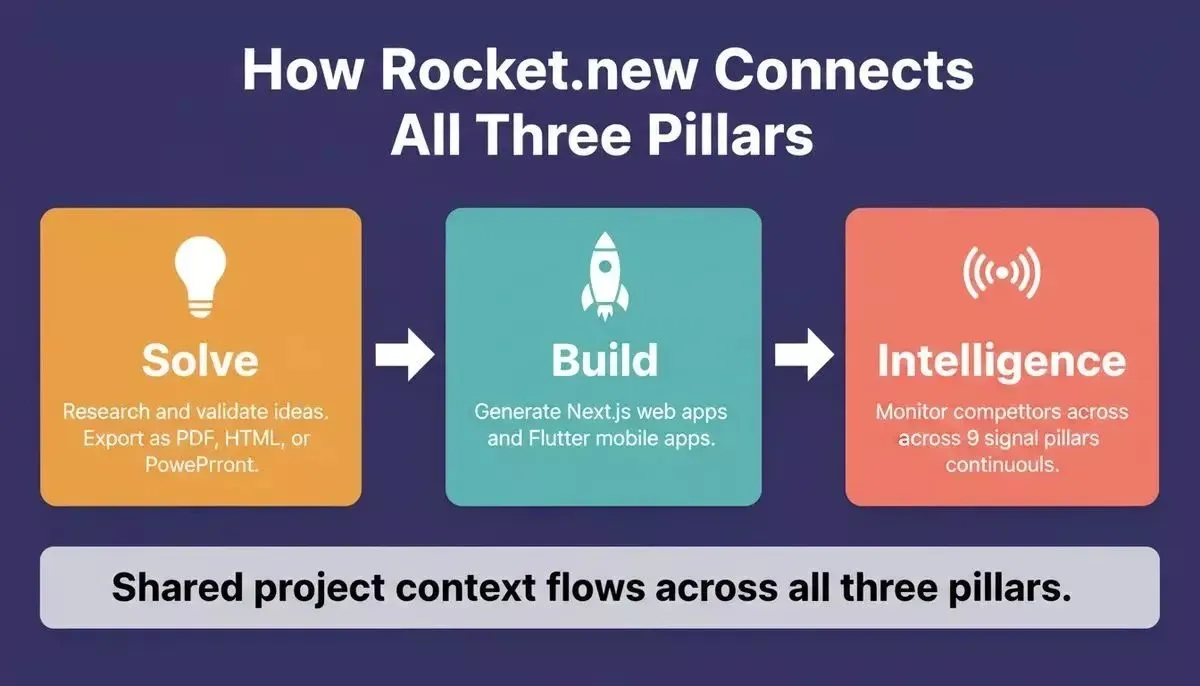
Solve, Build, and Intelligence each work independently but share context inside a project, so every task starts informed.
-
Project-level shared memory. A Rocket project groups related Solve and Build tasks together with shared context, uploaded files, and connected services. The market research you ran on Monday becomes context for the app you build on Friday, automatically.
-
Cross-task context via
@-mentions. When you start a new task, type@to reference any previous task in the same project. Rocket retrieves the conversation, findings, and conclusions from that task and uses them in the current one. You build on past work instead of re-explaining it. -
Prompt Intelligence at the input layer. Before any Solve or Build task begins, Rocket scores your prompt for clarity. If the score meets the minimum threshold, work starts immediately. If it falls below, Prompt Intelligence asks a short set of targeted questions to fill the gaps, then starts once it has enough to proceed, saving tokens and preventing poor LLM outputs before they happen.
-
Intelligence closes the loop. The Intelligence pillar watches competitors continuously across nine signal pillars, including product changes, pricing shifts, hiring velocity, and GTM moves, and delivers structured Intel cards to a live dashboard. When a competitor makes a move, you can start a Solve analysis or update your product in Build with that signal already in context.
-
Solve exports feed downstream tasks. Solve reports export as PDF, HTML, or PowerPoint. Build produces deployable Next.js web apps and Flutter mobile apps with downloadable code you can connect to GitHub. Every output is designed to become context for the next step.
This is not a feature. It is the architecture. The platform treats context as the foundation of every AI interaction, not an afterthought bolted on after the prompt.
Practical Steps to Start Thinking in Context Systems
Whether you use Rocket or build your own pipelines, these principles apply to any team working with large language models and AI agents in production.
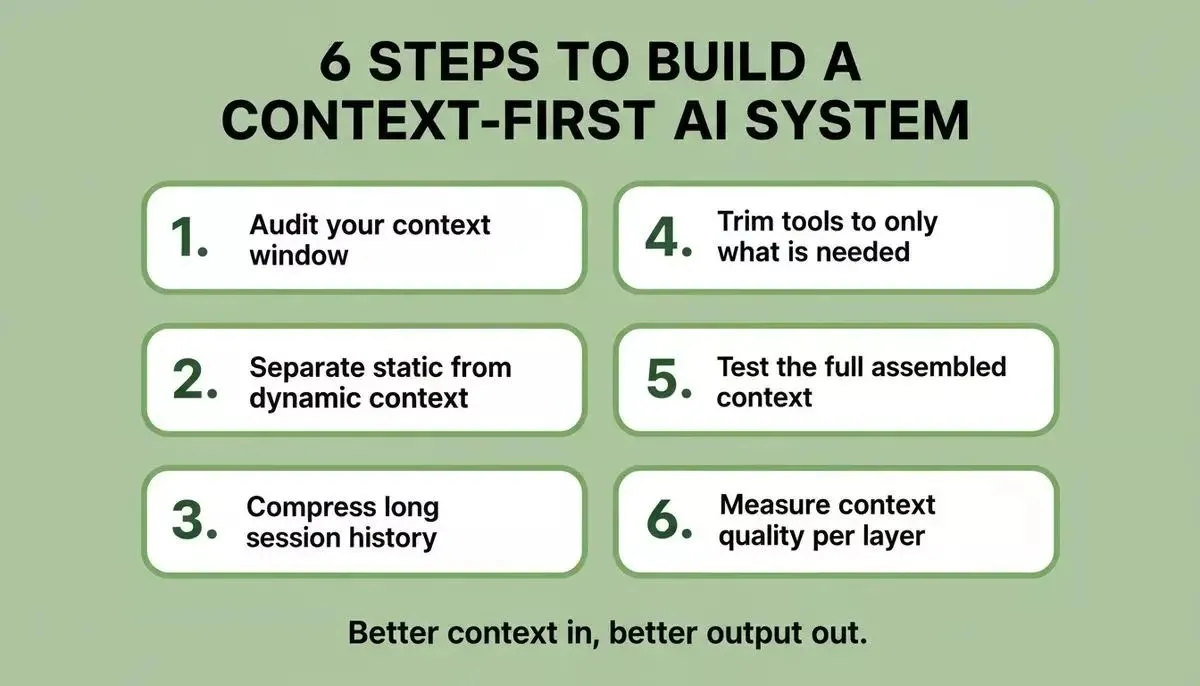
Six actionable steps any team can apply immediately, regardless of which tools they use.
-
Audit what actually enters your context window. Most teams have never inspected the fully assembled prompt their AI agent constructs at runtime. Log it. Read it. You will find redundancies, stale data, and formatting waste consuming precious tokens.
-
Separate static from dynamic context. System prompt instructions change rarely. User data and retrieved documents change with every request. Treat them differently in your context architecture to reduce unnecessary token usage.
-
Implement context compression for long sessions. After every 10-15 conversation turns, summarize previous exchanges into structured notes that preserve key decisions without preserving every word of the conversation history.
-
Give your AI agent the right tools, not all tools. Each tool definition consumes tokens from the context window. If a coding agent does not need email access for the current task, remove it from the tool list entirely. Keep relevant tools self-contained and robust to error.
-
Test with full context, not just prompts. When evaluating LLM outputs, test the complete assembled context window, not just the user-facing prompt. The answer to "why did the model fail?" almost always lives in what other information was present.
-
Measure context quality, not just output quality. Log token usage per layer. Track which retrieved documents actually appear in the model's response. Run evals against the assembled context, not just the final answer. What you cannot measure, you cannot improve.
Teams that treat context preservation as a first-class concern consistently ship more reliable AI products than teams optimizing individual prompts alone. This approach also directly informs how to build AI apps for operations teams that need to scale reliably. For teams that want to go deeper on why context gets lost between research and build phases, this breakdown is worth reading.
The Builders Who Provide Better Context Will Win
The shift from prompts to context systems is not a trend. It is the maturation of an industry. Every production AI application that works reliably in 2026 has a context architecture behind it, whether the team calls it that or not. The teams that recognize this early will ship products that actually work under real conditions.
The question is not whether to invest in this discipline. It is whether you want to build the context pipelines yourself or let a platform handle it at the infrastructure level.
Rocket.new, an AI development platform that combines Solve research, Build app generation, and Intelligence competitor monitoring, gives your projects shared context from research through deployment. Stop re-explaining decisions to your AI tools and start building on Rocket today.
Table of contents
- -Why Did the Industry Move Beyond Prompting to Context Engineering?
- -What Makes This Discipline Different From Writing Prompts?
- -The Seven Layers of a Well-Constructed Context
- -How Do AI Agents Succeed or Fail Based on Their Context?
- -How Rocket Applies Shared Context Across Every Build
- -Practical Steps to Start Thinking in Context Systems
- -The Builders Who Provide Better Context Will Win