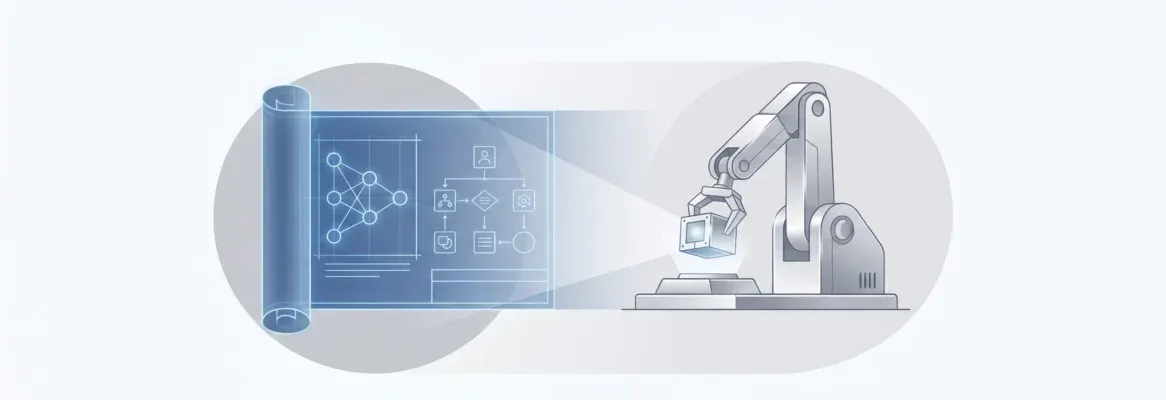
Full-stack AI agents connect perception, reasoning, action, and memory into one continuous loop. This blog covers architecture decisions, model selection, multi-agent patterns, evaluation frameworks, and production deployment for teams ready to ship.
Why do most AI agent projects stall between a working demo and a real production system?
According to LangChain's State of Agent Engineering report, 57% of organizations now have agents running in production environments, up from 51% the year before. A significant portion remains stuck in experimentation, cycling through tools and frameworks without a clear path forward.
The gap is not talent or budget. It is the absence of a structured approach that connects planning, architecture, building, and deployment into one continuous workflow. Most teams treat each phase as a separate project, losing context at every handoff.
This blog walks through the complete lifecycle of building autonomous agent systems, from defining their scope to monitoring them at scale. Whether you are a founder, product manager, or developer, the framework here will help you ship agents that actually work in the real world.
What Makes an AI Agent "Full Stack"?
Think of a full-stack AI agent as a system that handles the entire loop, from receiving input to taking action to learning from what happened. It is not just one piece of the puzzle. It is the whole picture.
Here is how the four layers work together:
-
Perception layer: The agent takes in inputs from text, APIs, sensor data, or user interactions and makes sense of them in context
-
Reasoning layer: LLMs, chain-of-thought logic, and retrieval-augmented generation (RAG) combine to make decisions based on accumulated context
-
Action layer: The agent acts through tool calls, code generation, API requests, or direct system interactions
-
Memory layer: Conversation history, vector embeddings, and learned patterns carry forward across sessions, so the agent gets smarter over time
A single-purpose chatbot is not a full-stack. A system that researches a market, drafts architecture, generates code, deploys it, and monitors performance, all while retaining context, is. The real differentiator is continuity. Each layer feeds the next without anyone manually re-entering information.
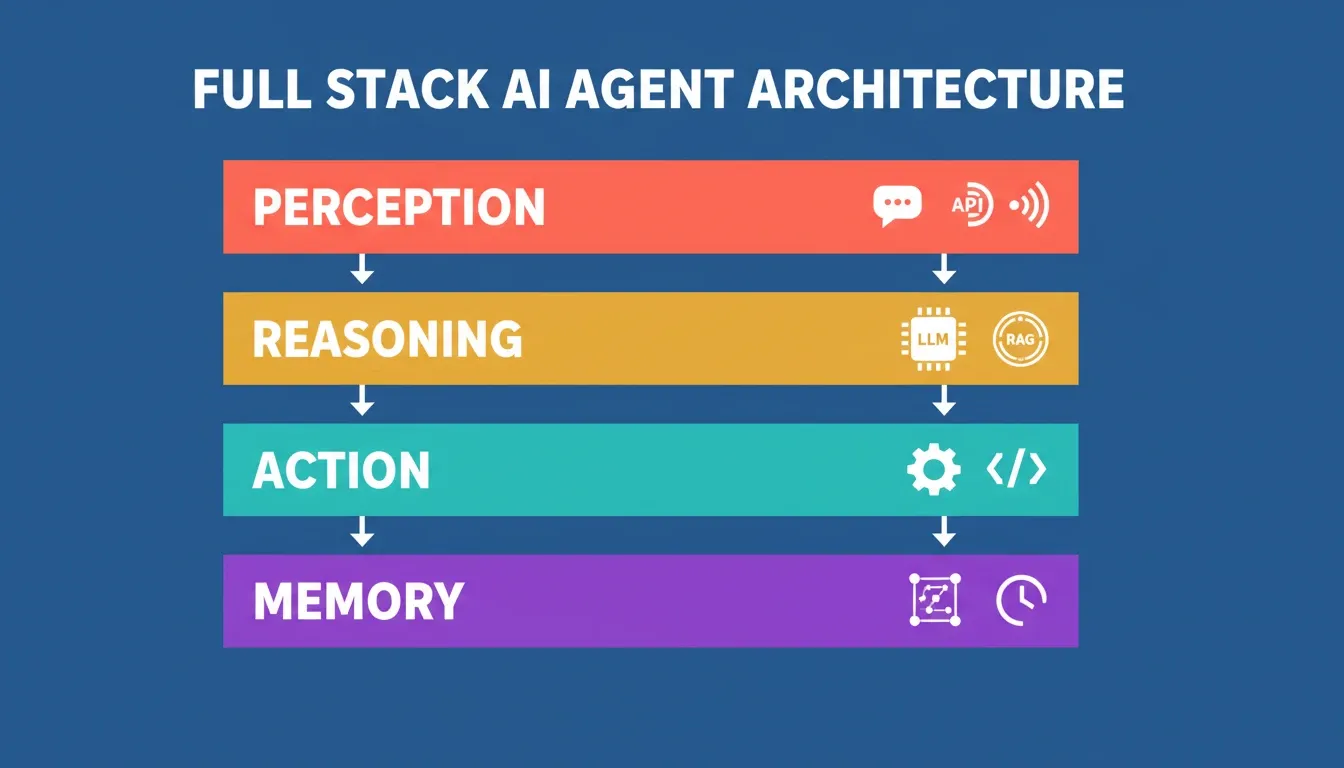
The four layers of a full stack AI agent. Each one feeds directly into the next without a manual handoff.
To understand where this fits in the broader landscape, it helps to read up on the key differences between agentic AI and AI agents before you start designing your architecture.
Single-Purpose Bot vs. Full Stack Agent
| Feature | Single-Purpose Bot | Full Stack AI Agent |
|---|---|---|
| Input types | Text only | Text, APIs, files, sensors |
| Reasoning | Pattern matching | Multi-step LLM reasoning with RAG |
| Actions | Predefined responses | Tool calls, code generation, API requests |
| Memory | Session-only | Persistent vector store and history |
| Learning | None | Compounds across sessions |
| Deployment | Simple webhook | Staged, monitored, versioned |
How Is the Market Shaping Agent Development?
The numbers make one thing clear: organizations are well past the experimentation stage.
According to Grand View Research's AI Agents Market report, the global AI agents market was valued at USD 7.6 billion in 2025 and is projected to reach USD 182.9 billion by 2033, growing at a CAGR of 49.6%. That kind of growth only happens when production deployments consistently outpace pilots.
So what is driving this growth? A few patterns stand out.
Key Use Cases Driving Adoption
LangChain's survey of 1,300+ professionals reveals where agents are delivering the most value right now:
-
Customer service leads at 26.5% of primary deployments, with agents placed directly in front of end users
-
Research and data analysis follows at 24.4%, where agents synthesize large volumes of information across multiple sources
-
Internal workflow automation accounts for 18%, with larger enterprises prioritizing internal productivity first
-
Code generation rounds out the top four, with coding agents dominating daily developer workflows
The use cases keep diversifying. Teams that started with a narrow chatbot are now expanding into multi-step research agents, autonomous operations coordinators, and AI-powered workflow automation systems.
Real-World Industry Applications
Full stack AI agents are already delivering measurable results across sectors:
-
Software engineering: Agent-assisted workflows reduce time-to-merge for routine features by 30-50% on reported team benchmarks
-
Financial services: Research agents synthesize earnings reports, regulatory filings, and market signals into structured briefs in minutes, not hours
-
Healthcare: Agents coordinate patient intake, insurance verification, and scheduling across disparate systems without manual re-entry
-
E-commerce: Autonomous agents monitor inventory, trigger reorder workflows, personalize recommendations, and handle customer queries from a single deployment
How Do You Plan an Agent Architecture?
Here is the truth: planning is where most agent projects succeed or fail. Teams that jump straight to code without defining scope, decision flows, and evaluation criteria end up spending months on rework.
The five pillars that matter most are:
-
Define the agent's role clearly: Write one sentence describing what it does, for whom, and what "done" looks like
-
Map decision boundaries: Identify where the agent acts on its own versus where a human needs to approve
-
Select your tool stack: Which APIs, databases, and services will the agent actually call?
-
Design the memory strategy: Short-term context windows, long-term vector stores, or a hybrid of both
-
Plan your evaluation framework early: Offline test sets plus online monitoring, not just one or the other
The best teams treat agent architecture like product architecture. They define user stories, map edge cases, and set success metrics before touching a single framework. This is also where building apps from structured AI prompts pays off. A well-structured brief produces dramatically better first outputs.
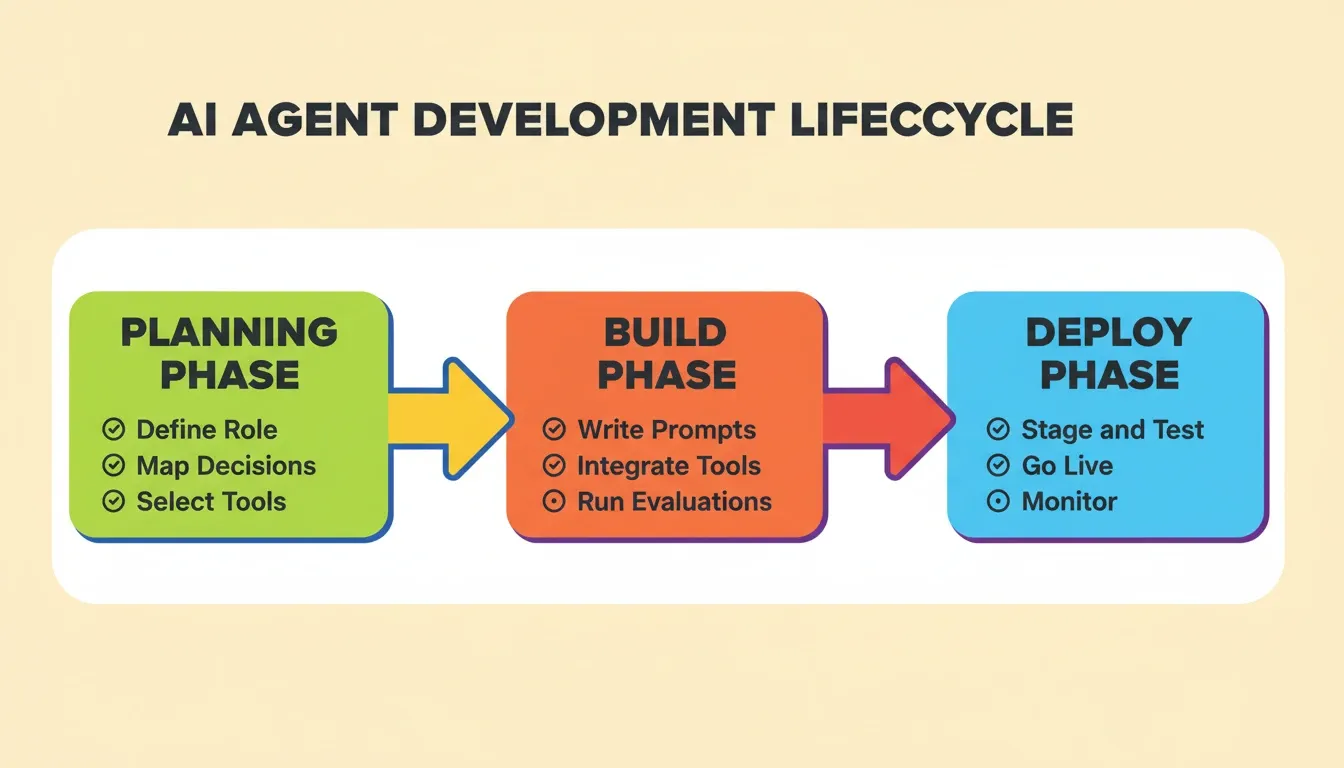
The three-phase agent development lifecycle. Decisions made during planning prevent expensive rework later.
Choosing the Right Model Strategy
The model debate has largely settled into a practical consensus: use multiple models, each optimized for a specific task.
Most production teams route requests based on complexity, cost, and latency. A lightweight model handles simple classification and routing. A more capable model tackles multi-step reasoning. A specialized fine-tuned model covers domain-specific tasks where general models fall short.
Fine-tuning is still the exception, not the rule. According to LangChain, 57% of organizations are not fine-tuning at all. They rely on base models combined with prompt engineering and RAG instead. The practical approach is to start with a capable general model, add RAG for domain knowledge, and fine-tune only when a specific task clearly requires it.
Memory Architecture Options
Choosing the right memory architecture is one of the most consequential decisions you will make when building a full-stack AI agent.
| Memory Type | Best For | Key Tradeoff |
|---|---|---|
| In-context window | Short sessions, simple tasks | Limited by token budget |
| Vector store (RAG) | Domain knowledge retrieval | Requires embedding pipeline |
| Episodic memory | Long-running agents, personalization | Storage and retrieval overhead |
| Structured database | Transactional data, state tracking | Requires schema design |
| Hybrid | Production agents at scale | Higher implementation complexity |
What Does the Build Phase Look Like?
Building an agent is not a one-shot task. It is an iterative loop of prompting, testing, fixing, and refining. The teams that succeed are the ones who embrace that loop rather than fighting it.
A few things to get right from the start:
-
Prompt engineering comes first: System prompts define agent personality, boundaries, and output format. Treat them like production code.
-
Tool integration follows: Connect the APIs, databases, and services your agent needs to act in the world
-
Observability is non-negotiable: According to LangChain, 89% of organizations have implemented some form of tracing, and 62% have detailed step-by-step inspection
-
Evaluation builds progressively: Start with offline test sets (52% adoption), add online monitoring (37%), then combine both for full coverage
The teams seeing success share one pattern: rapid iteration with tight feedback loops. They ship a minimal version, observe real behavior, and improve from there rather than trying to build something perfect on the first pass.
Overcoming Quality and Latency Barriers
Quality is the number one production killer, cited by 32% of teams as their primary blocker. The core challenges are accuracy, consistency, and an agent's ability to follow guidelines while still feeling natural to interact with.
Latency is the second biggest barrier at 20%. As agents move into customer-facing roles, response time becomes a critical part of the experience. The tradeoff between multi-step reasoning and speed requires intentional architectural decisions.
What actually helps:
-
Dedicated evaluation pipelines with ground-truth test sets
-
Human-in-the-loop review for high-stakes outputs
-
LLM-as-judge approaches for scalable automated quality checks
-
Streaming responses to reduce perceived latency for end users
-
Caching for deterministic sub-tasks that repeat frequently
Teams using both human review (59.8%) and automated evaluation (53.3%) together consistently achieve the most reliable results.
Prompt Engineering for Production Agents
System prompts are the constitution of your agent. Weak prompts produce inconsistent behavior at scale. Strong prompts do three things: they define scope precisely (what the agent will and will not do), specify output format for downstream consumers, and encode guardrails for edge cases and escalation triggers.
A production-grade system prompt typically runs 500-2,000 tokens. It goes through the same review cycle as production code. Teams that treat prompts as throwaway configuration consistently struggle with quality at scale.
Multi-Agent Systems: When One Agent Is Not Enough
Single agents hit ceilings. When a workflow requires parallel research, specialized domain expertise, or reasoning that exceeds a single context window, you need orchestrated teams of agents working together.
Multi-Agent Architecture Patterns
| Pattern | Description | Best For |
|---|---|---|
| Sequential pipeline | Agent A outputs feed Agent B | Linear workflows with clear handoffs |
| Parallel fan-out | Multiple agents run simultaneously | Research aggregation, parallel analysis |
| Supervisor-worker | Orchestrator delegates to specialists | Complex tasks requiring coordination |
| Debate/critique | Agents challenge each other's outputs | High-stakes decisions needing validation |
| Hierarchical | Nested agent teams with sub-orchestrators | Enterprise-scale automation |
The multi-agent systems segment is one of the fastest-growing in the market, driven by teams solving the context window and specialization limits of single agents. A supervisor agent coordinates a researcher, a writer, a fact-checker, and a formatter, with each one optimized for its narrow task.
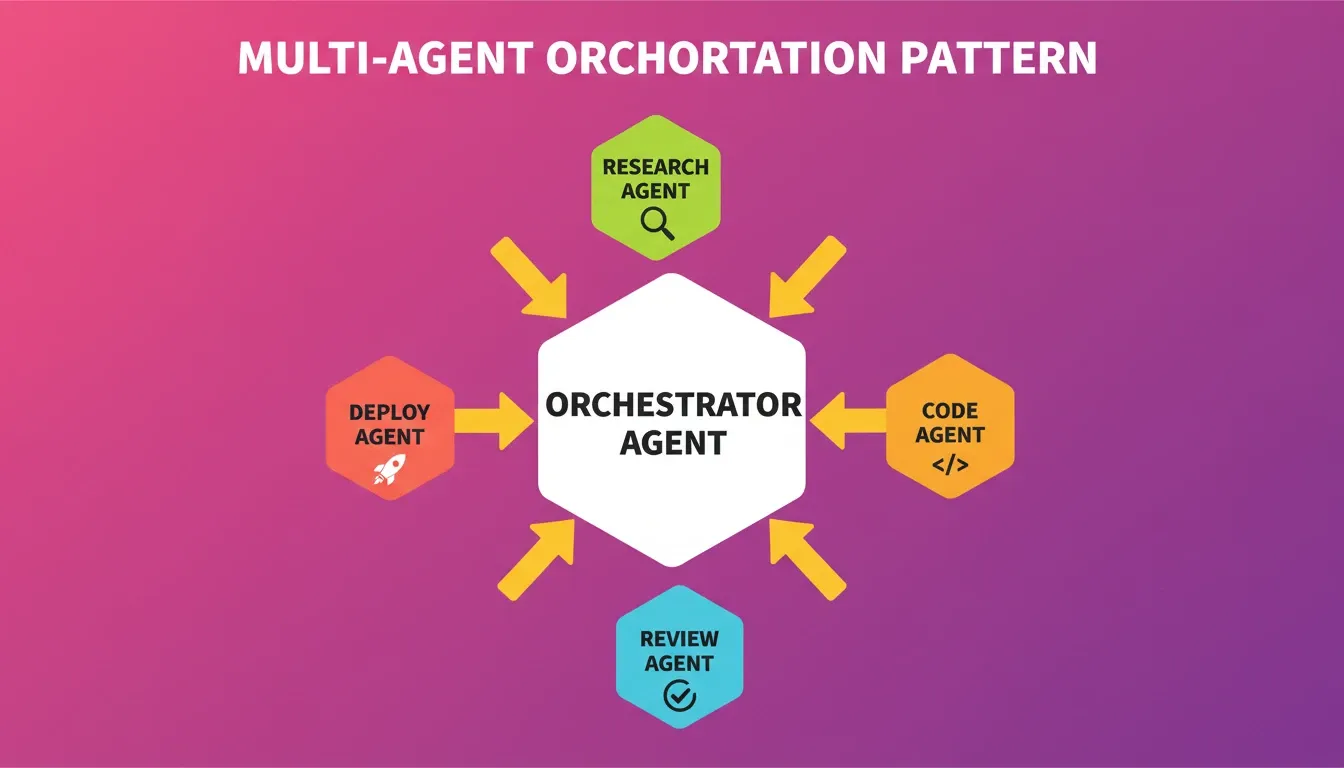
A supervisor-worker multi-agent pattern. One orchestrator coordinates four specialized agents, each handling a distinct task.
Avoiding Common Multi-Agent Pitfalls
A few failure modes show up repeatedly in production multi-agent systems.
Circular dependencies occur when agents wait on each other indefinitely. Always define a directed acyclic graph (DAG) for agent communication. Context loss at handoffs happens when raw conversation history passes between agents. Structured summaries preserve signal without bloating token budgets.
Cascading failures mean one agent's error silently corrupts downstream outputs. Build explicit error states and fallback paths into every agent boundary. Cost explosion is also a real risk: multi-agent systems multiply token usage, so set per-task budgets and monitor spend per interaction type from day one.
Where Rocket Fits in the Agent Development Stack
You have the architecture planned, the model strategy set, and quality gates defined. The question is: where does the actual building happen?
Most teams hit a wall here. They research in one tool, plan architecture in a document, generate code in another, deploy with a third, and lose context at every seam. Rocket keeps the entire arc, from strategic thinking to production deployment, in one shared-context workspace.
-
Solve produces the intelligence layer: Market research, competitive analysis, and architectural decisions live inside a project and carry forward into every task that follows
-
Build generates production-grade code: Describe your agent's behavior in natural language and get working Next.js or Flutter code with real design systems, not a throwaway prototype
-
Context compounds automatically: The research from your planning phase is present when the build task starts. The architecture decisions inform the code generation. Nothing gets re-explained.
-
25+ integrations flow into generation: Supabase for backend, Stripe for payments, OpenAI and Anthropic for model calls, all authenticated once and available in every build
-
Staging, versioning, and rollback protect production: Separate environments with full version history mean you iterate on agents without risking what is already live
1.5 million people have tried Rocket across 180 countries, from solopreneurs shipping MVPs to enterprise teams rethinking their entire stack. You type the problem. Rocket researches it, recommends a direction, and builds from that direction.
Teams exploring how AI is reshaping product development consistently find that the biggest gains come not from faster code generation, but from preserving context between research and build.
Rocket Pricing
All plans include unlimited team members. Credits never expire, and you can purchase additional credits on any plan. Enterprise options with SSO, data localization, and premium support are available via sales.
| Plan | Monthly Fee | Monthly Credits | Best For |
|---|---|---|---|
| Free | $0 | 20 | Light, exploratory, personal use |
| Pro | $25 | 100 | Production websites, web apps, mobile apps |
| Rocket | $50 | 250 | Full suite for individuals and teams |
| Booster | $250 | 1,500 | Power users and fast-moving teams |
A 20% discount applies to all paid plans when billed annually.
Deploying and Monitoring Agents at Scale
Shipping to production is not the finish line. In many ways, it is where the real work begins.
Before any agent goes live, run through these five steps:
-
Use staging environments: Test agent behavior against edge cases before real users encounter them
-
Implement detailed tracing: Every reasoning step, tool call, and output should be inspectable after the fact
-
Set up alerting on quality regressions: Automated checks should flag when agent accuracy drops below your defined threshold
-
Plan for rollback: Version control your agent configurations so you can revert to a known-good state instantly
-
Monitor cost alongside quality: As usage scales, per-token costs compound. Track spend per interaction type from the start.
For teams working through deploying full stack apps with AI tools, the deployment phase should feel like shipping any production software: staged, observable, and reversible. The key difference is that agent behavior is non-deterministic, so your monitoring needs to account for output variance.
The enterprises leading adoption (67% of 10,000+ employee organizations) succeed because they invest in platform teams, security infrastructure, and reliability engineering around their agents. Smaller teams achieve similar results by choosing platforms that handle infrastructure out of the box.
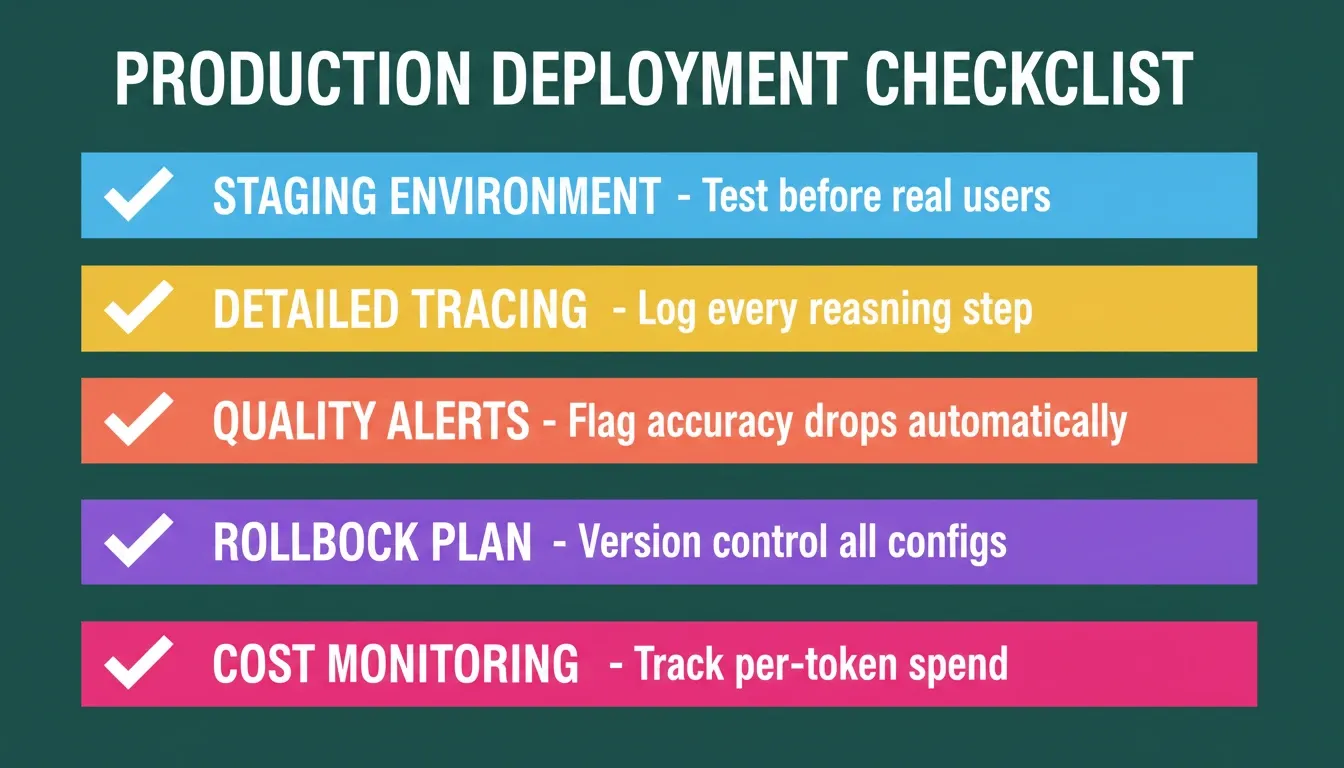
Five non-negotiable steps before any full stack AI agent goes live.
Observability Stack for Production Agents
| Layer | What to Monitor |
|---|---|
| Trace-level | Every LLM call, tool invocation, latency |
| Quality | Output accuracy, hallucination rate, guideline adherence |
| Cost | Tokens per interaction, cost per task type |
| Reliability | Error rates, retry frequency, timeout patterns |
| Business | Task completion rate, user satisfaction, escalation rate |
Security Considerations for Agent Systems
Production agents introduce risks that traditional applications simply do not face. Prompt injection, where malicious inputs try to override system instructions, requires input sanitization and output validation layers. Tool misuse from overly broad permissions can trigger unintended actions, so apply least-privilege principles to every tool integration.
Data leakage through unfiltered outputs can surface sensitive information in unexpected contexts. Implement PII detection and output filtering from day one. Regulated industries also need complete audit trails of every agent decision, so make sure your tracing infrastructure captures full reasoning chains. Teams building secure AI platforms need these controls baked in, not retrofitted after the fact.
The Future of Full Stack AI Agents
Full stack AI agents are moving from experimental to infrastructure. It is the same shift cloud computing made between 2008 and 2015, and it is happening faster.
Several trends will define the next phase. Longer context windows will reduce the need for complex retrieval pipelines, enabling agents to hold entire codebases in memory. Multimodal agents will process images, audio, and video alongside text, opening new use cases in healthcare, manufacturing, and media.
Agent-to-agent protocols such as Anthropic's Model Context Protocol (MCP) will standardize how agents communicate, enabling interoperable ecosystems. Autonomous evaluation will replace manual quality review for most tasks, with specialized judge models continuously monitoring production behavior. Teams building apps with AI today are establishing the institutional knowledge and evaluation infrastructure that will compound in value as the technology matures.
The Path Forward for Full Stack AI Agents
The path from concept to production agent is clearer than it was twelve months ago. Architecture patterns have stabilized, evaluation frameworks are maturing, and the market is rewarding teams that ship rather than those still experimenting.
The AI agents market is on track to reach USD 182.9 billion by 2033. The organizations capturing that value are building now, with structured workflows, proper observability, and platforms that preserve context from research through deployment.
What separates successful agent builders is not access to better models. It is having a workflow that eliminates handoff friction, compounds intelligence across every task, and lets teams iterate at the speed of thought.
You type the problem. Rocket researches it, recommends a direction, and builds from that direction. Start building your agent-powered product today and go from research to deployed app without losing a single insight along the way.
Table of contents
- -What Makes an AI Agent "Full Stack"?
- -Single-Purpose Bot vs. Full Stack Agent
- -How Is the Market Shaping Agent Development?
- -Key Use Cases Driving Adoption
- -Real-World Industry Applications
- -How Do You Plan an Agent Architecture?
- -Choosing the Right Model Strategy
- -Memory Architecture Options
- -What Does the Build Phase Look Like?
- -Overcoming Quality and Latency Barriers
- -Prompt Engineering for Production Agents
- -Multi-Agent Systems: When One Agent Is Not Enough
- -Multi-Agent Architecture Patterns
- -Avoiding Common Multi-Agent Pitfalls
- -Where Rocket Fits in the Agent Development Stack
- -Rocket Pricing
- -Deploying and Monitoring Agents at Scale
- -Observability Stack for Production Agents
- -Security Considerations for Agent Systems
- -The Future of Full Stack AI Agents
- -The Path Forward for Full Stack AI Agents