Duda is a strong website builder for agencies, but it cannot build backends, mobile apps, or SaaS products. In 2026, founders switched to Rocket.new because it covers the full product journey: market research with Solve, full-stack app generation with Build, and competitor tracking with Intelligence, all in one shared system. It starts free with no per-seat fees.
Duda is a solid website builder for agencies, but if you're a founder trying to ship a real product, build a SaaS, or launch a mobile app, it was never built for you.
In 2026, that gap became impossible to ignore as a new generation of AI app builders started doing things traditional website builders simply cannot.
This blog explains why founders chose Rocket.new as their Duda alternative.
What Duda Was Built For (And What It Wasn't)
Duda is genuinely good at what it does. It's a white-label website builder designed for agencies and freelancers who manage multiple client sites. The client management tools are strong, the templates are clean, and the workflow for handing off sites to clients is well thought out.
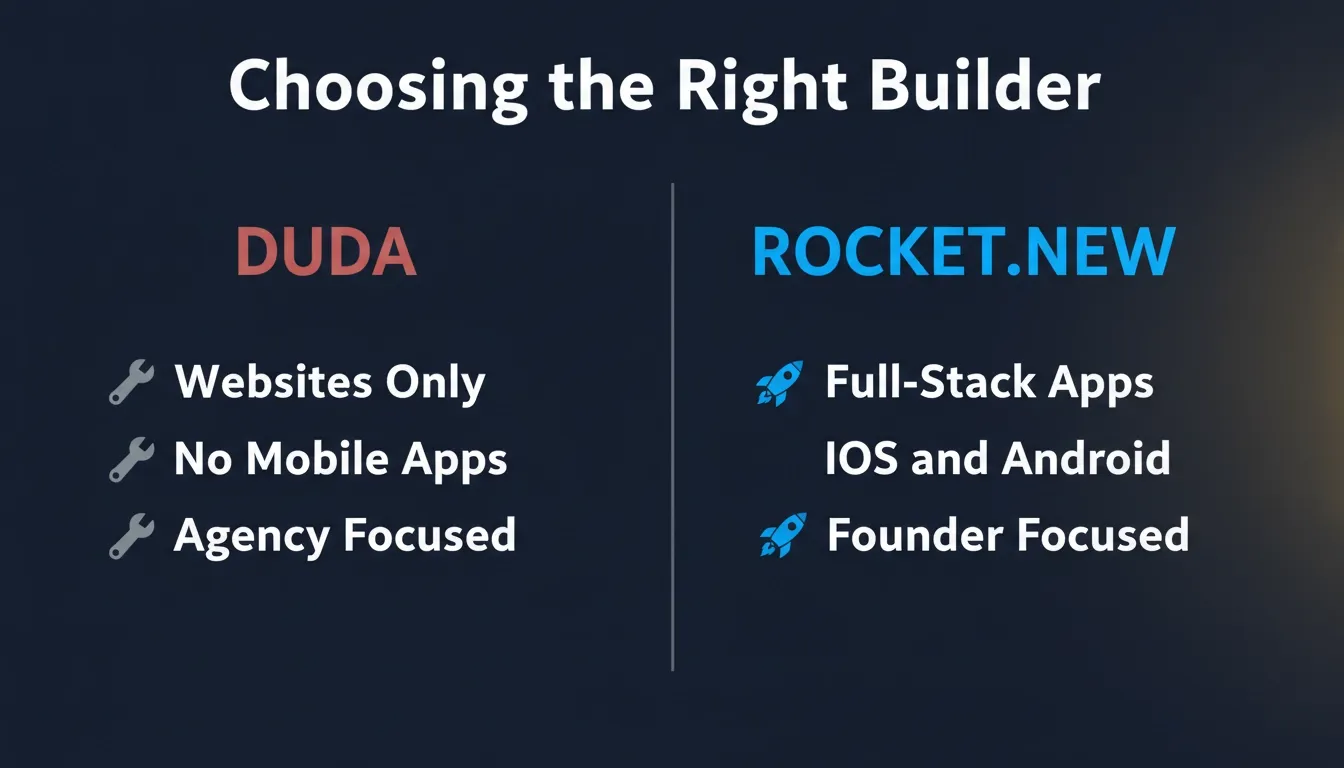
But here's the thing: that's the whole product.
According to TechRadar's 2026 review, Duda is best for "freelancers and agencies" and specifically not for users who "expect premium support on every plan." The review also flags real limitations that matter to founders:
-
No template switching: once you pick one, you're locked in
-
Cannot export your website on Basic or Team plans
-
Chat and phone support only available on higher-tier plans
-
Above-average pricing on lower tiers relative to what you get
Duda's pricing structure reflects its agency focus. The Basic plan starts at \$19/month, Team at \$29/month, Agency at \$52/month, and White Label at \$149/month. For a solo founder trying to validate an idea, that's a lot of money for a website you can't even export.
The Founder's Problem With Traditional Website Builders
Most website builders, Duda included, share the same fundamental constraint: they build websites, not products.
A website is a page. A product is a system. It has a backend, a database, user authentication, business logic, and often a mobile app running alongside it.
When founders in 2026 say they want to "build something," they rarely mean a five-page marketing site. They mean a working SaaS, a customer portal, a marketplace, or a mobile app they can put in front of real customers and investors. Traditional website builders can't do that.
How the AI App Builder Market Changed Everything in 2026
The shift didn't happen overnight, but 2026 is when it became undeniable.
The low-code and no-code development market was valued at \$13.2 billion in 2020 and is projected to reach \$45.5 billion by 2025, growing at a 28.1% CAGR. That kind of growth doesn't happen because people want prettier drag-and-drop editors. It happens because founders need to build real things, fast.
Most AI app builders from the first generation focused on making code generation faster. They let you describe what you wanted and generate a prototype in minutes. That was genuinely useful, but it still left a lot of questions unanswered: What should I build? Is there a market for it? What are my competitors doing?
Founders were still doing that thinking in separate tools, then trying to carry all of that context into a builder that had no idea what they'd already figured out. The problem wasn't just speed. It was context. That's the gap Rocket.new was built to close.
Duda vs. Rocket.new: What Founders Actually Need
Here's a straight comparison of what each platform offers for founders:
| Feature | Duda | Rocket.new |
|---|---|---|
| Website builder | Yes | Yes |
| Full-stack web apps | No | Yes, built with Next.js |
| Mobile apps | No | Yes, iOS and Android via Flutter |
| SaaS and dashboards | No | Yes |
| Backend and database | No | Yes |
| AI code generation | Limited | Full-stack generation |
| Natural language prompts | Partial | Yes |
| Market research built-in | No | Yes, via Solve |
| Competitor intelligence | No | Yes, via Intelligence |
| Template switching | No | Generates from scratch |
| Code export | Not on Basic or Team | Yes, on all plans |
| Pricing entry point | $19/month | Free plan available |
| Per-seat pricing | Yes | No, unlimited team members |
| Primary target user | Agencies and freelancers | Founders, startups, enterprise teams |
The difference isn't just features. It's the entire model. Duda assumes you already know what to build and just need a site. Rocket.new assumes you're a founder who needs to figure out what to build, build it, and then stay ahead of what happens after you launch.
Rocket.new: Built for the Way Founders Actually Work
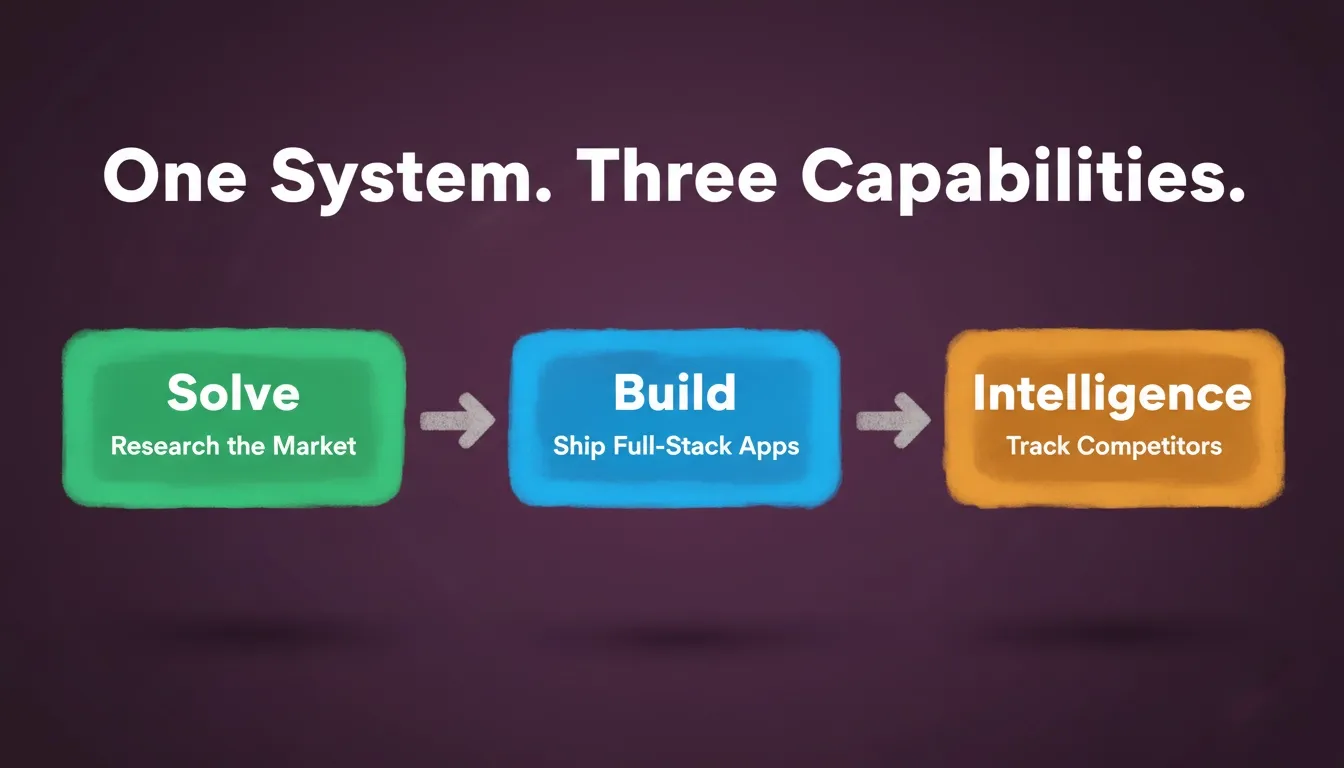
Rocket.new is the world's first Vibe Solutioning platform. It covers the full arc of how a startup operates, not just the build phase, but everything before and after it. The platform runs on three connected capabilities, all sharing context in one system so you never lose the thread.
Solve: The Thinking Before the Build
Before you write a single line of code, Rocket.new's Solve module lets you describe a market problem, decision, or opportunity in natural language. It returns structured research, evidence, and a clear recommendation, ready to present to investors or hand directly to the Build phase.
This is where non-technical founders get a real advantage. You don't need to know what stack to use or how to scope a project. You describe the problem, and Rocket.new helps you figure out what to build and why.
Build: Full-Stack Generation From First Prompt
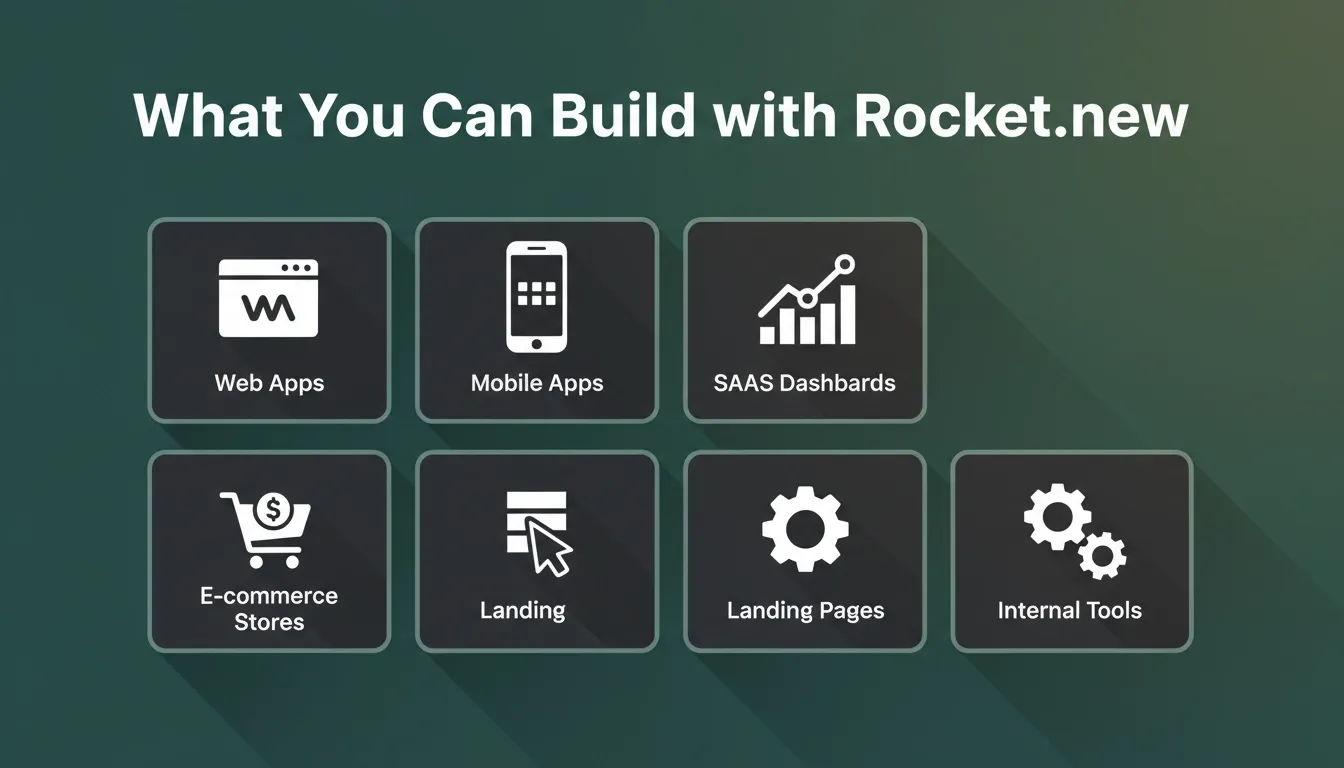
This is where Rocket.new pulls away from most AI app builders. It doesn't just generate a landing page or a static site. It generates production-ready, full-stack applications:
-
Web apps: SaaS platforms, dashboards, internal tools, and customer portals
-
Mobile apps: iOS and Android from a single Flutter codebase, ready for App Store and Google Play
-
Landing pages: Conversion-optimized with SEO and fast load times
-
E-commerce stores: With product catalogs, checkout flows, and payment integrations
The framework is assigned automatically: Next.js for web, Flutter for mobile. After generation, you can refine through Chat (natural language), Visual edit (click elements), or Code (edit source directly). There's no change limit. You can explore how Rocket generates Next.js and Flutter apps to understand the technical approach.
Intelligence: Know What Your Competition Just Did
After you launch, Rocket.new keeps watching. The Intelligence module tracks competitor pricing changes, product updates, messaging shifts, hiring signals, and social media activity continuously. Every signal becomes actionable context that feeds back into your build decisions.
This is the part that most solo founders and enterprise teams say they didn't know they needed until they had it. It's not just monitoring. It's interpretation.
Rocket.new Pricing: No Per-Seat Fees
One of the most overlooked advantages of Rocket.new over Duda is its pricing model. Rocket.new charges no per-seat fees, meaning your entire team can access the platform on every plan.
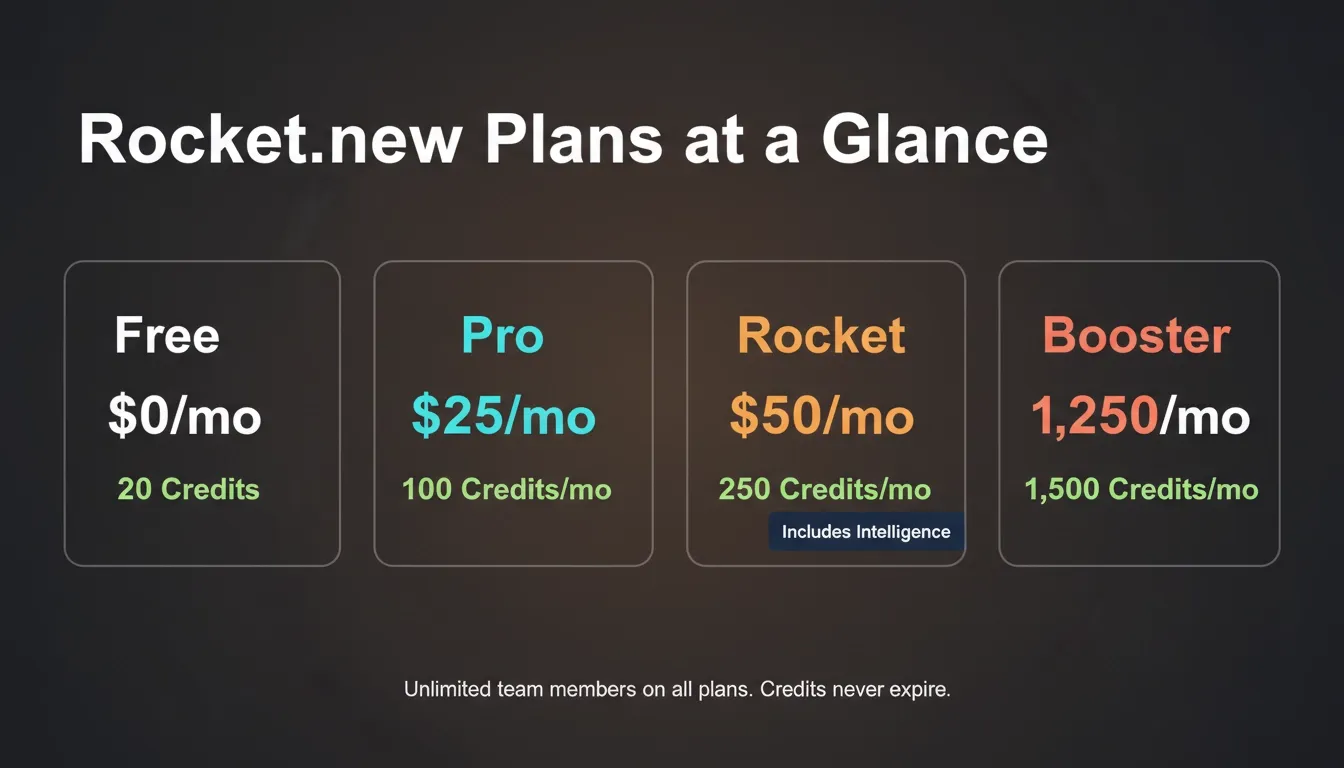 Here's how the Rocket.new plans break down:
| Plan | Monthly Fee | Credits Included | Key Capabilities |
|---|---|---|---|
| Free | $0 | 20 credits | Build: websites, apps, mobile apps |
| Pro | $25 | 100 per month | Build: all app types |
| Rocket | $50 | 250 per month | Build, Solve, and Intelligence |
| Booster | $250 | 1,500 per month | Full suite for power users |
Credits never expire, and you can buy additional credits as needed on any plan. All plans include unlimited team members, which is a meaningful difference from per-seat tools.
What Founders Are Saying
The shift from traditional website builders to Rocket.new isn't just a feature comparison. It's a different way of working.
"I just one shotted a prompt using @rocketdotnew and I can't put into words how astronomically better it is than any other no code AI tool. Actually made me question why I ever paid for Bolt, Lovable, V0, a0 etc when this tool puts them all to shame. Incredibly impressed, wow."— Mia Williams, @miatravls on X
"I've been trying out every no-code AI website/app builder you can think of for months, and Rocket is 100x better than anything else."— Solopr11, via rocket.new
These aren't agency owners managing client sites. These are founders and builders who needed something Duda was never designed to give them.
The Vibe Coding Shift: Why This Matters for Startups
Vibe coding, the practice of building software through natural language prompts rather than traditional coding, has moved from a novelty to a real workflow for startups in 2026. Non-technical founders can now describe what they want in plain language and get a working prototype in minutes.
Technical founders can move faster by skipping boilerplate and focusing on what makes their product unique. The platforms that win in this shift aren't the ones with the best templates. They're the ones that understand the full context of what a founder is trying to do, from the first idea to the first paying customer.
Duda's model, pick a template, drag and drop, publish, was built for a world where building software required a developer. That world is changing fast. If you want to understand how this shift is reshaping the industry, this breakdown of how vibe coding works is a great starting point.
Who Should Still Use Duda
To be fair, Duda isn't the wrong tool for everyone. If you're running a web design agency and managing dozens of client sites, Duda's white-label tools, client management features, and permission controls are genuinely well-designed for that workflow.
But if you're a founder, solo or with a small team, trying to build and launch a real product, Duda's limitations will show up quickly:
-
You can't build a backend or a database
-
You can't ship mobile apps
-
You can't export your code on the entry-level plans
-
You can't switch templates after you've started
-
You can't get phone or chat support unless you're on a higher-tier plan
These aren't minor inconveniences. They're structural limits that reflect what the platform was designed for. Founders who've hit these walls often start exploring what makes a strong no-code app builder before making the switch.
Why Founders Moved to Rocket.new in 2026
The answer is simple: Rocket.new builds what founders actually need to build.
Over 1.5 million people across 180 countries have tried Rocket.new. The platform generates full-stack web and mobile applications from a single prompt, with production-ready code, a live preview, and one-click deployment.
For non-technical founders, that means going from idea to working product without hiring a developer. For technical founders, it means moving faster without losing the strategic thread. For enterprise teams, it means shipping internal tools and customer-facing products at a speed that wasn't possible before. You can explore how AI is reshaping product development to understand the broader shift.
Duda is a website builder. Rocket.new is a product-building system. In 2026, that difference matters more than ever.
The Right Tool for the Right Job
The Duda alternative question isn't really about features. It's about what you're trying to do.
If you're an agency building client websites, Duda does that well. If you're a founder trying to build a product, you need a platform that was built for that job. The low-code and no-code market is growing at 28.1% annually because more people are building more things, and they need tools that can keep up with that ambition.
Rocket.new is the Duda alternative for founders who are done building websites and ready to build products. The platform is free to start, generates production-ready code in minutes, and gives you the full context, from market research to competitor intelligence, to make every build decision count.
Ready to build your product the right way? Start for free on Rocket.new and go from idea to working app without writing a single line of code.
Table of contents
- -What Duda Was Built For (And What It Wasn't)
- -The Founder's Problem With Traditional Website Builders
- -How the AI App Builder Market Changed Everything in 2026
- -Duda vs. Rocket.new: What Founders Actually Need
- -Rocket.new: Built for the Way Founders Actually Work
- -Solve: The Thinking Before the Build
- -Build: Full-Stack Generation From First Prompt
- -Intelligence: Know What Your Competition Just Did
- -Rocket.new Pricing: No Per-Seat Fees
- -What Founders Are Saying
- -The Vibe Coding Shift: Why This Matters for Startups
- -Who Should Still Use Duda
- -Why Founders Moved to Rocket.new in 2026
- -The Right Tool for the Right Job