
Rocket Intelligence reads nine competitor signal pillars, hiring, pricing, social posts, GTM, traffic, product, reviews, news, and website, to detect enterprise repositioning weeks before any website changes appear. No manual research. Real-time signals every day..
Rocket reads signal clusters across hiring, pricing, executive posts, and review data to detect competitor enterprise repositioning weeks before any website changes appear. According to Klue’s 2026 AI in Competitive Intelligence Report, 97% of CI teams are now building AI workflows, yet 87% still rely on static data and 81% cannot tell how fresh their competitive data is. For teams that need to track competitors continuously without manual research, Rocket Intelligence is the clear choice.
When a competitor decides to go upmarket, competitor websites are always the last place it shows up. The real signal arrives weeks earlier, across job boards, pricing pages, and executive posts. By the time the homepage messaging shifts, the strategy is already months old, and your sales team is already behind.
What is Competitor Enterprise Repositioning?
Real-time data on competitor activities, such as pricing changes and hiring trends, allows businesses to adjust their strategies proactively rather than reactively, enhancing their competitive edge.
Enterprise repositioning happens when a competitor shifts market focus toward larger accounts, longer sales cycles, bigger deals, and buyers who care about security and compliance. The market shift starts quietly. New job postings appear for enterprise sales roles. A pricing page adds a “Contact Us” tier.
Executive posts shift from addressing developers to addressing CTOs and procurement leaders. By the time those updates appear on competitor websites, the positioning decision was made six to eight weeks earlier.
Understanding the early signals of enterprise repositioning is the core challenge for any competitive intelligence program. Most teams discover the shift too late because they rely on monitoring competitor websites rather than reading the upstream signals that precede every strategic move.
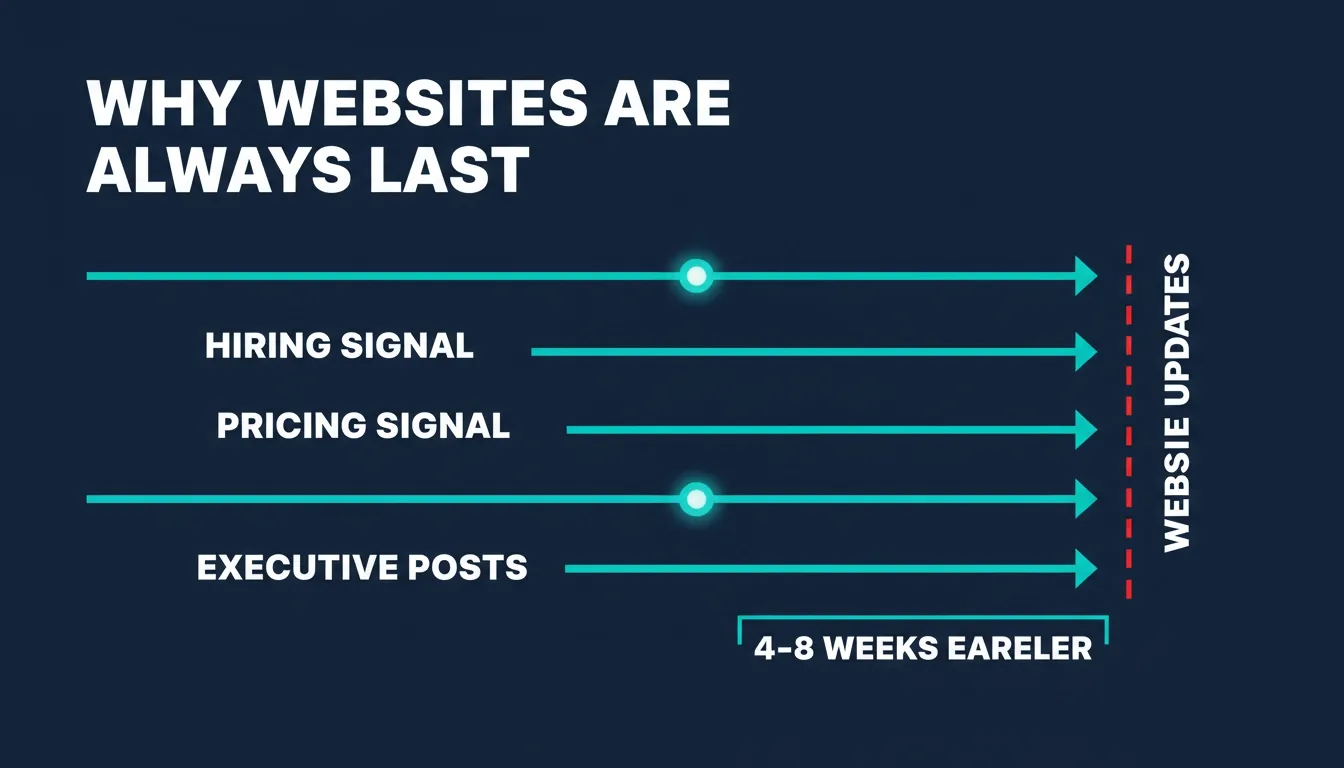 Hiring, pricing, and executive signals surface 4–8 weeks before any website change
How Does Rocket Detect the Early Signals?
Rocket Intelligence is an AI-powered system that continuously monitors every public platform a competitor operates on, across nine signal pillars, in real time rather than relying on periodic reporting. This is not an alerting system. It is an interpretation system, one that reads what is happening in the market across all competitor data sources and tells you what the pattern means for your specific business position.
Rocket.new's intelligence processes real-time data from over 150 sources to detect clusters of competitor activity, giving users a clearer view of emerging moves.
A single pricing page update in isolation is market noise. That same update alongside new enterprise job postings, enterprise-focused executive posts, and new “enterprise security” language on product pages is a clear market signal. Rocket reads those patterns across all nine pillars and tells you what they mean.
People and Hiring Pillar
Job postings reveal competitor market strategy faster than any other signal. When a competitor opens enterprise sales roles, VP-level customer success positions, or solutions engineer posts requiring enterprise security experience, those are deliberate market signals. Rocket tracks hiring patterns by department growth, role type, and the specific skills listed in each post.
A cluster of enterprise-focused job postings appearing in the same week is a strong early signal of a market repositioning in motion, often surfacing hours after the role goes live, days or weeks before any competitor websites reflect it.
Website and Pricing Pillar
Competitor pricing updates rarely land on the public homepage first. Companies often test enterprise messaging through ad campaigns before updating the main website, and sudden ad spend changes aimed at corporate buyers are an early signal. As MarketsandMarkets confirms, SaaS companies routinely test new pricing structures on select visitor segments before making them public.
A “Contact Sales for Enterprise” button appears on the pricing page; a product description adds “SOC 2 compliant” messaging where none existed before. Rocket monitors pricing page changes, messaging shifts, and product updates to feature descriptions in real time.
These signals surface competitor pricing strategies, hiring patterns, and product launches quickly enough to inform strategic decisions almost immediately.
Social Media and Executive Posts Pillar
Executives post in the direction of a new market strategy months before the website reflects it. Rocket tracks every public post and engagement from named executives across LinkedIn, X, Reddit, and other platforms, by date and impact level.
When multiple executives at the same competitor post about enterprise deals, procurement processes, and security requirements in the same week, that is a signal cluster that produces competitive insights. Rocket’s intelligence connects executive-post signals into a single picture, helping teams identify patterns before the competitor website changes.
The Nine Pillars That Reveal Strategy Before It Ships
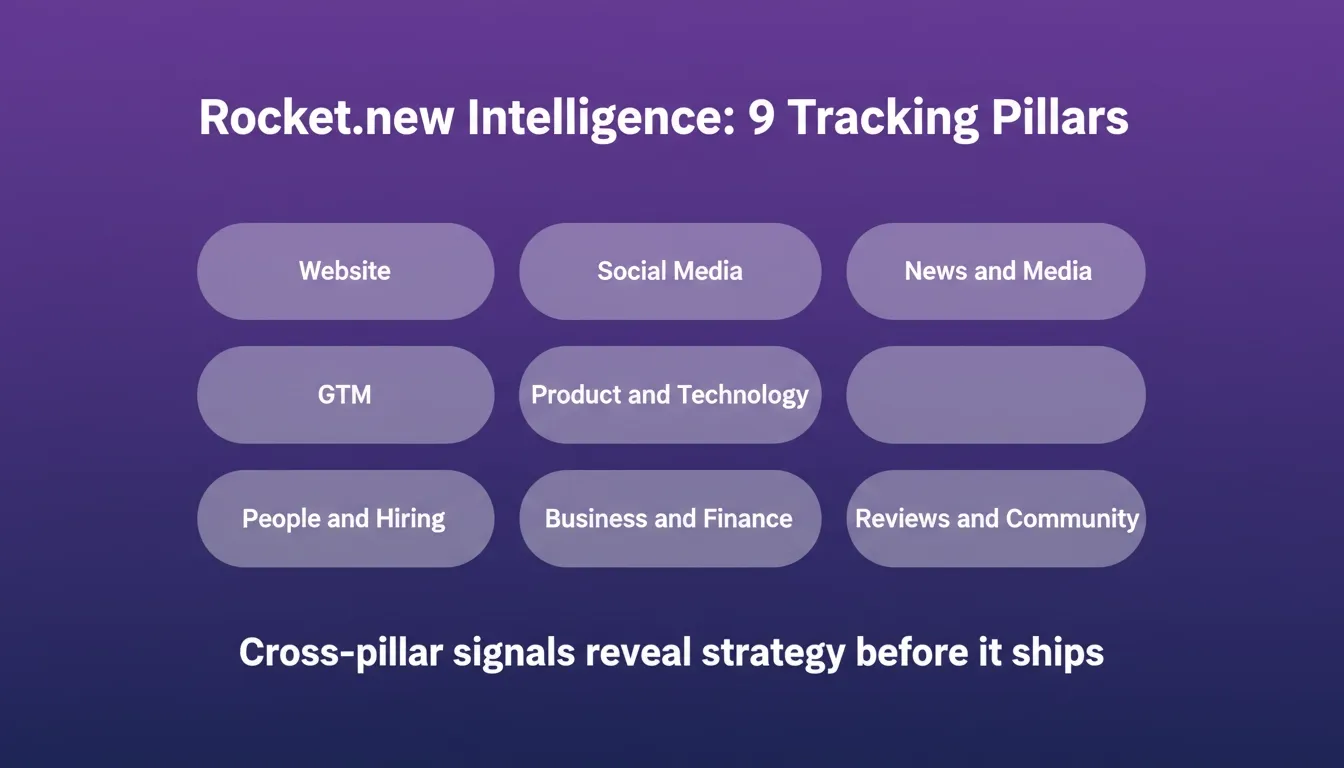 Nine tracking pillars give Rocket a complete view of every competitor’s public activity
Rocket Intelligence organises competitor monitoring across nine distinct pillars. Each pillar tracks a different dimension of a company’s public activity. The real insight comes from cross-referencing signals across multiple pillars simultaneously, so each isolated data point is synthesized into a cohesive strategic narrative.
| Pillar | What Rocket Tracks | Enterprise Repositioning Signal |
|---|---|---|
| People and Hiring | Job roles, exec moves, Glassdoor | Enterprise sales hires, VP-level additions |
| Website | Homepage, pricing page, blog | New enterprise tier, SOC 2 messaging |
| Social Media | Company and executive posts | Exec posts targeting CTOs, procurement |
| GTM | Ads, campaigns, creator partnerships | LinkedIn ads targeting IT leaders |
| Traffic | Visits, SEO rankings, channel mix | Traffic shift toward enterprise keywords |
| Product and Technology | Releases, GitHub, API, changelog | Enterprise feature rollouts |
| Business and Finance | Funding, pricing strategy, partnerships | New enterprise-tier pricing signals |
| News and Media | Press, journalists, media narrative | Certifications, enterprise partnerships |
| Reviews and Community | G2, Reddit, app reviews | Enterprise customer reviews are increasing |
This synthesis produces structured briefs for product teams and the marketing team.
When patterns across multiple pillars converge in the same day or week, Rocket identifies it as a signal cluster worth acting on. An enterprise push is visible across the Website, People, and GTM pillars simultaneously, not as three separate alerts, but as one interpreted story.
Why Competitor Websites Always Show Up Last
Most competitor analysis starts on competitor websites.
That is the problem. By the time a homepage messaging update or new pricing page goes live, the market decision is done, the sales team has been trained, and the first enterprise deals are already happening. Manual research on competitor websites cannot catch the signals that come weeks earlier, and it takes hours every day just to stay current.
Semrush’s research on competitive intelligence found that 45% of marketers say understanding market trends is the most valuable benefit of CI. Yet most competitive intelligence tools only give you raw data points from competitor websites, leaving your team to do the interpretation manually.
The competitive intelligence tools market reached $557.6 million in 2026 and is projected to hit $1.28 billion by 2033, reflecting demand for real-time competitive analysis beyond website-only monitoring. That manual research bottleneck means you arrive days late to every market shift.
For teams evaluating competitive intelligence for enterprise sales, the use case is clear: a standalone alerting tool tells you what changed on competitor websites. Rocket tells you what the competitor's move means and what to do about it today.
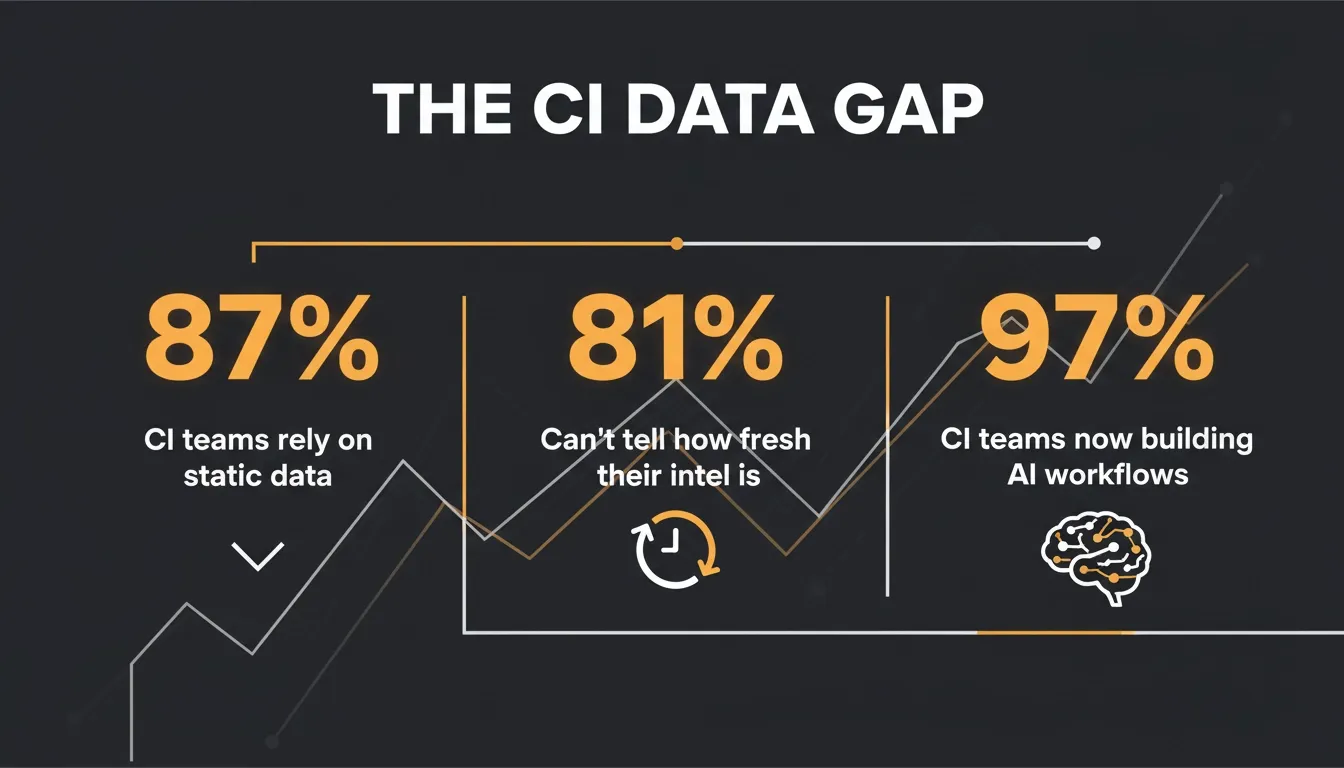 The competitive intelligence data gap that leaves most teams reacting instead of anticipating
What Most Competitive Intelligence Tools Get Wrong
Most competitive intelligence tools are alerting systems. They surfaced that a competitor's pricing page had changed. They do not interpret what the pricing change means or how it connects to the hiring patterns and executive posts that moved in the same week.
“We feel stuck between the notion of needing AI-generated battle cards because of how fast the market is changing day to day, and static resources can’t keep up. But the information is not always reliable or has the right spin before reps access it.” — Product Marketing Expert, SaaS (Klue’s 2026 AI in Competitive Intelligence Report)
AI tools are now used daily by 60% of CI teams, and adoption is growing 76% year over year.
That is the gap between competitive intelligence tools designed for alerting and Rocket Intelligence designed for interpretation. Vibe coding tools like Lovable and Bolt build what you describe, they have no market intelligence layer. Tools like Crayon or Kompyte track specific surfaces well but require your team to connect the dots manually across separate platforms, which makes it harder to turn scattered changes into actionable insights or spot broader competitive threats early. Rocket connects the dots as part of its core design.
Unlike quarterly competitive reports that arrive after decisions are already made, AI-powered systems provide real-time competitor data so teams can react to pricing shifts and product launches almost immediately instead of waiting for quarterly reports. Rocket surfaces signals the moment they appear, so your team responds to the market as it moves, not as it was.
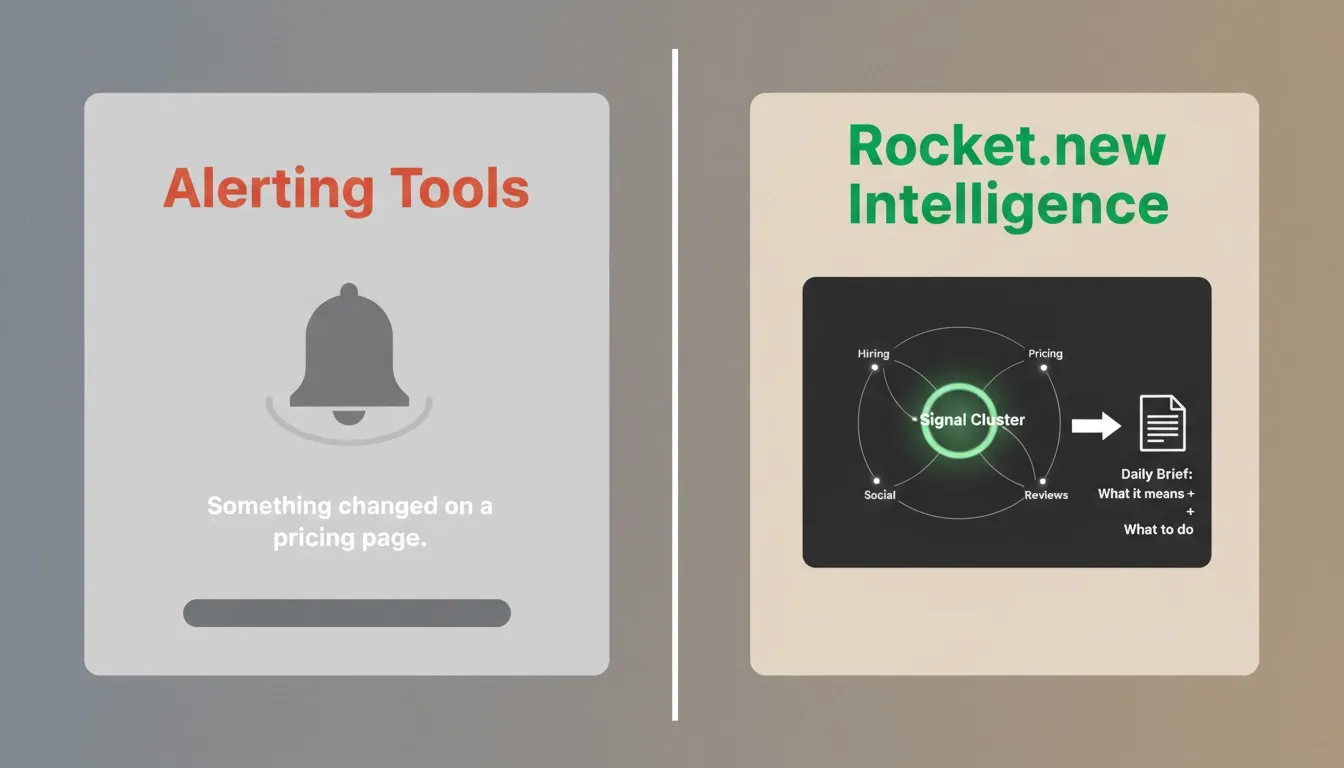
Alerting tools surface raw changes. Rocket interprets what those changes mean for your position.
How Rocket Intelligence Works in Practice
Rocket’s intelligence feature is designed so that competitor signals from Monday’s daily brief are present when a PM opens Solve on Wednesday, giving users shared context across functions. The pricing move detected last week is in the context of when marketing writes the next landing page. Intelligence compounds; it does not reset between sessions or team members.
That is one platform, one shared context, three core functions: research with Solve, building with Build, and tracking with Intelligence. Sales teams use competitor data as background for the call. Product teams see what a competitor shipped in the last 90 days and what their hiring patterns suggest they are building toward. Marketing uses it to stay ahead of shifts in the competitive landscape before a campaign goes live.
For roadmap planning, this means product decisions are grounded in what competitors are actually doing right now, not what they announced last quarter. The intelligence feature is part of a platform that also supports mobile and Next.js app builders, landing pages, and tools built from the same market context.
The Daily Brief: Three Outputs That Drive Decisions
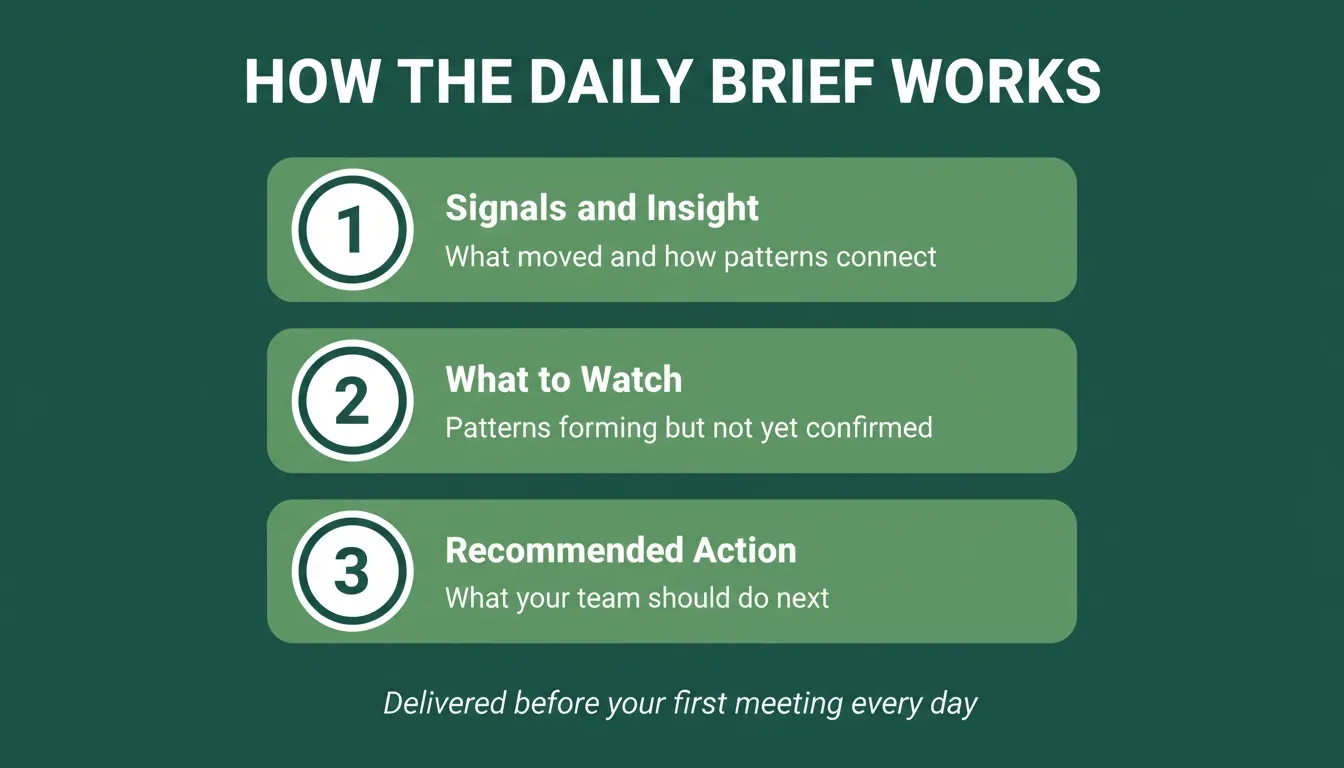 Three structured outputs per competitor, delivered before your first meeting
The daily brief Rocket produces for every tracked competitor has three parts and delivers actionable insights throughout:
(1) Signals and insight: what moved and how the patterns connect
(2) What to watch: patterns forming but not yet confirmed, and
(3) Recommendation: what your business should do or consider next.
Daily briefs arrive before the first meeting, so your team acts on real-time data, not last quarter’s market data.
For sales teams, this serves as background for the call. Knowing that a competitor updated their pricing page to add an enterprise tier on Tuesday, and that their VP of Sales posted about closing enterprise deals on Wednesday, means your sales reps walk into Friday’s call with that context. That is what competitor monitoring is designed for: interpretation delivers, not raw data hours later, but a structured brief ready to act on.
Understanding how sales leaders think about competitive context is exactly why Rocket Intelligence is built as an interpretation layer, not a monitoring dashboard. The competitor signal from your latest campaign connects back to the same intelligence layer, tracking what competitors are doing right now.
Stay Ahead of Every Competitor Move
Detecting a competitor repositioning toward enterprise is not about checking competitor websites more often. It is about reading the market signals that come weeks earlier, the hiring patterns, the pricing page updates, the executive posts, and the customer feedback shifts that reveal the strategy before it goes public.
Rocket intelligence is designed to read all of them, connect patterns across every signal pillar, and tell you what they mean. No manual research. Real-time data every day. One platform that stays ahead of competitor moves before they ship. That is the intelligence feature built for how competitive markets actually move.
Stop reacting to competitor moves after they happen. Rocket reads the hiring patterns, pricing shifts, and executive posts that reveal enterprise repositioning weeks before any website changes. Sign up and start tracking your competitors in real time.
Table of contents
- -What is Competitor Enterprise Repositioning?
- -How Does Rocket Detect the Early Signals?
- -People and Hiring Pillar
- -Website and Pricing Pillar
- -Social Media and Executive Posts Pillar
- -The Nine Pillars That Reveal Strategy Before It Ships
- -Why Competitor Websites Always Show Up Last
- -What Most Competitive Intelligence Tools Get Wrong
- -How Rocket Intelligence Works in Practice
- -The Daily Brief: Three Outputs That Drive Decisions
- -Stay Ahead of Every Competitor Move