
A false insurance claim detection app uses AI to flag suspicious claims before payouts. Rocket lets you build one with no code. Describe your requirements, get a full-stack app with database, auth, and scoring logic in minutes.
A false insurance claim detection app powered by AI can flag suspicious claims before payouts happen, cutting fraud losses for insurers of any size. With a no-code platform like Rocket, you can describe your fraud detection requirements in plain language and receive a production-ready, full-stack application, complete with database, authentication, and scoring logic, without writing a single line of code.
Why Is Insurance Fraud Costing Billions Every Year?
Why do insurance companies lose staggering amounts to fraud each year, and what would change if a single no-code app could flag suspicious claims before they get paid out?
The numbers tell a painful story. According to the Coalition Against Insurance Fraud, fraud costs American consumers $308.6 billion every year. That figure spans every major insurance category, and it keeps climbing.
Here is how those losses break down by category:
| Insurance Category | Estimated Annual Fraud Cost | Common Fraud Pattern |
|---|---|---|
| Life Insurance | $74.7 billion | Staged deaths, beneficiary fraud |
| Healthcare / Workers Comp | $68 billion / $34 billion | Upcoding, phantom billing, exaggerated injuries |
| Property and Casualty | $45 billion | Inflated damage claims, arson |
| Auto | $7.4 billion (theft alone) | Staged accidents, VIN cloning |
Fraud occurs in about 10% of all property-casualty insurance losses. Insurance companies spend millions on investigation teams, yet many fraudulent claims still slip through manual reviews.
Policyholders feel the impact too. When insurers pay out on fraudulent activities, those costs get passed along as higher premiums for honest customers. Organizations across the insurance industry now recognize that static, rule-based systems can no longer keep pace with evolving threats.
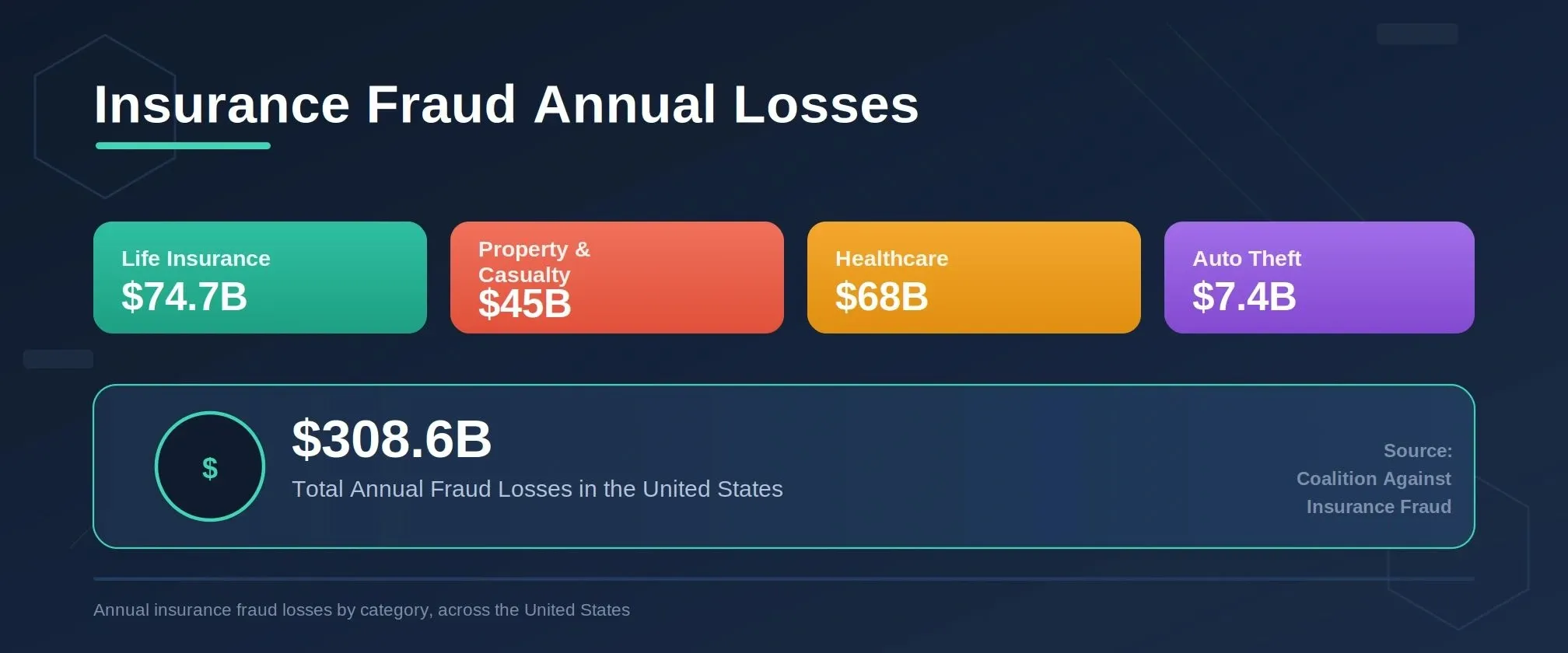
Annual insurance fraud losses across the United States, totaling over $308 billion.
What Makes a Fraud Detection System Work?
What goes into a fraud detection system that actually catches fraudulent claims without slowing down legitimate ones? The answer involves many factors, from data collection to machine learning models that adapt to new fraud patterns over time.
A modern insurance fraud detection system follows a structured pipeline. Claims flow through ingestion, feature engineering, ML scoring, and a final decision layer. Each stage must work correctly before the next can produce reliable results.
Fraud detection pipeline: from claim submission through AI scoring to the final approve or flag decision.
This structure is what separates a reliable fraud detection model from a simple keyword filter. If you have worked on building apps for the healthcare sector, the data pipeline concept will feel familiar.
Data Collection and Claims Processing
Getting the right data into the system is where everything starts. This stage is independent of the scoring model. You need it working correctly before any AI can help.
Claims processing begins the moment a claim is submitted. The system collects claim details like date of incident, claim amounts, policy details, and the claimant's history. Historical data plays a key role. The system compares each new claim against past records, looking for patterns that match known fraudulent cases.
External data sources add context by pulling information from public records, social media, and third-party databases. Without a high degree of data quality, even the best machine learning techniques will produce unreliable results.
Machine Learning Models and Risk Scoring
Once the data is collected, machine learning models take over to assign fraud likelihood scores and risk scores.
Key terms defined:
-
Risk score: A numerical value (typically 0-100) representing the probability that a given claim involves fraud, calculated by the model from input features.
-
False positive: A legitimate claim incorrectly flagged as fraudulent. High false-positive rates frustrate honest customers and increase investigation costs.
-
Straight-through processing: Automatic approval of low-risk claims without human review, reducing processing time from days to seconds.
-
Ensemble methods: Techniques that combine multiple machine learning models (e.g., XGBoost, gradient boosting, random forests) to produce more accurate predictions than any single model alone.
Logistic regression calculates the probability that a given claim is fraudulent based on categorical variables, claim amounts, and claimant behavior. Its outputs are interpretable, which matters for regulatory compliance. Gradient boosting and XGBoost handle complex, non-linear relationships between features, consistently outperforming single-model approaches on imbalanced fraud datasets where genuine fraud cases are rare. Isolation forests and autoencoders detect anomalies, claims that do not fit any known pattern, making them especially valuable for catching new fraud schemes.
Each claim receives a risk score that reflects how likely it is to involve fraud. High-risk claims move to the investigation queue, while low-risk ones proceed through straight-through processing in seconds. As investigators confirm or reject flagged cases, their feedback loops back into the model through continuous learning.
How Does AI Identify Fraudulent Claims in Real Time?
How do AI-powered fraud detection tools actually separate legitimate claims from potential fraud? The answer comes down to behavioral analysis, pattern recognition, and the ability to process massive volumes of claims data at speed.
According to MarketsandMarkets research, the global fraud detection and prevention market is projected to reach $15.06 billion by 2031, growing at a CAGR of 14.1%. This growth reflects how quickly insurance companies are adopting AI-powered solutions to detect and prevent fraudulent activities.
An AI model trained on real insurance claims can spot suspicious signals that human investigators would take weeks to notice. These signals include unusual claim timing, inconsistent policy details, and claim amounts that fall outside normal ranges.
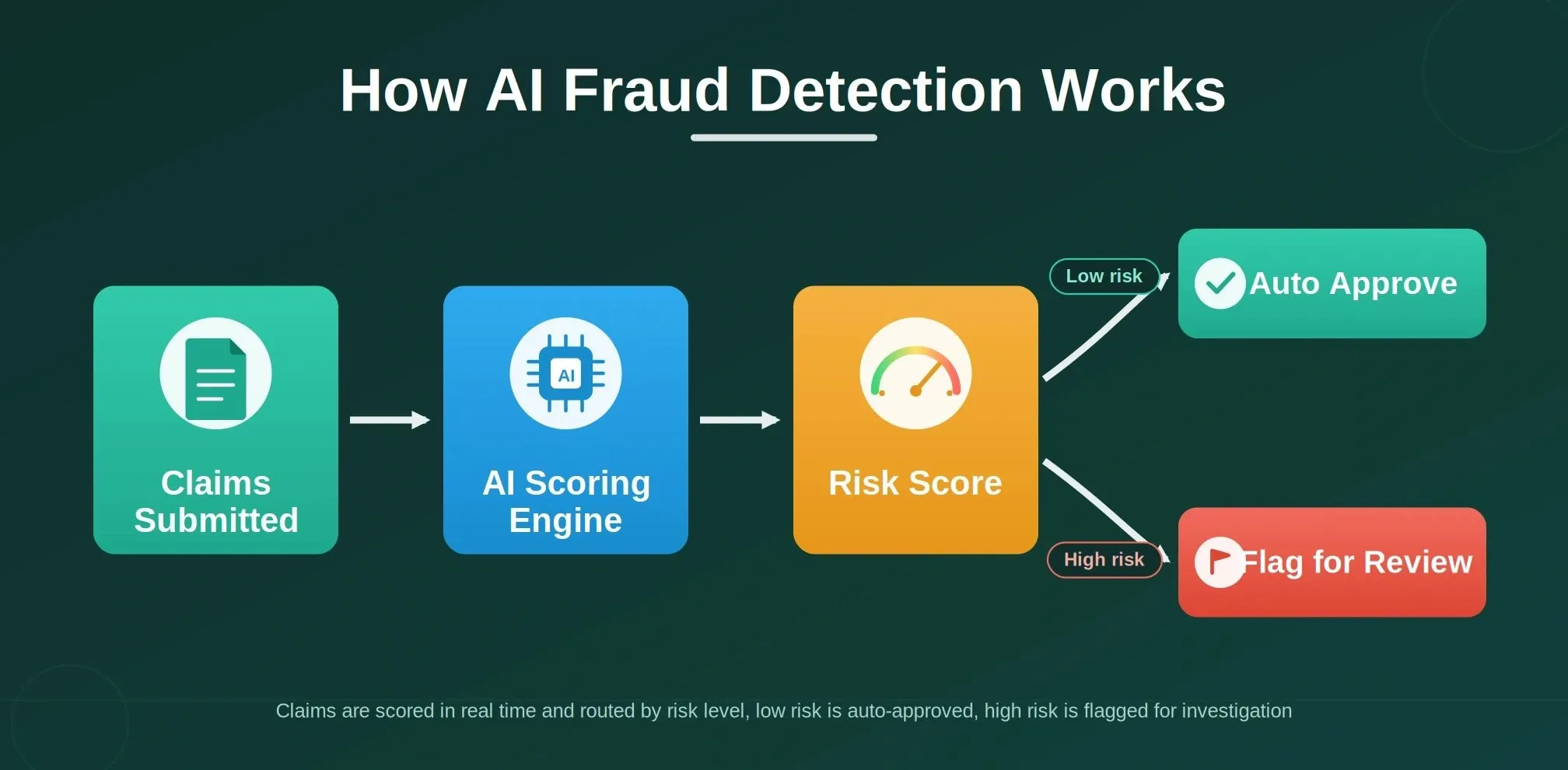
AI-powered fraud detection moves from raw claims data through scoring to a final approve or flag decision in real time.
Behavioral Analysis and Pattern Recognition
Behavioral analysis is one of the most effective methods for spotting potential fraud in insurance claims. This section stands independently. No prior context needed.
User behavior creates a digital fingerprint. The system tracks how claimants interact with submission forms, how quickly they file after an incident, and whether their behavior matches normal patterns. Organized fraud rings tend to follow recognizable structures, like filing claims from the same address range, using similar accident descriptions, or submitting during specific time windows.
Even when fraudsters change their approach, the behavioral analysis layer catches irregularities through anomaly spotting using isolation forests and autoencoders. The combination of behavioral analysis and pattern recognition gives insurers a way to detect fraud that static rules simply cannot match.
Reducing False Positives Without Missing Real Fraud
One of the biggest challenges in insurance fraud detection is balancing precision with recall, catching real fraud while not flagging too many legitimate claims.
False positives frustrate honest customers. When non-fraudulent claims get flagged and delayed, it damages trust and increases operational costs. Adjusting the risk score threshold determines how aggressive the system is. A lower threshold catches more fraud but generates more false positives, while a higher threshold reduces false alerts but may let some fraudulent cases through.
Building database-driven AI applications that balance these trade-offs is where the real challenge lies. The goal is a fraud detection system that insurers can trust for accuracy and speed.
Who Is This For?
A false insurance claim detection app built on a no-code platform is a practical fit for three distinct audiences.
Solo agents and small MGAs (Managing General Agents): You handle a manageable volume of claims but lack a data science team. A no-code fraud scoring tool lets you apply consistent rules across every submission without manual review of each one. Rocket's Solve feature can also help you validate which fraud patterns are most prevalent in your specific niche before you build.
Mid-size carriers: You process thousands of claims per month and need a system that integrates with your existing Supabase or Postgres database, enforces role-based access so only authorized investigators see flagged claims, and deploys without a multi-month engineering sprint. Rocket's Build feature scaffolds the full backend, database, authentication, and API routes, from a single prompt.
Enterprise teams piloting AI fraud detection: You want to test a proof-of-concept before committing to a six-figure vendor contract. Rocket generates production-ready Next.js code that your engineering team can inspect, extend, and push to GitHub. If the pilot works, you own the codebase outright. Rocket's Intelligence feature can also track what fraud-detection vendors and insurtech competitors are shipping, so your roadmap stays informed.
Why Rocket Makes Fraud Detection App Building Faster
So you understand the problem and the technology. The next question is: how do you actually build one of these fraud detection systems without hiring a team of data scientists and spending months on development?
This is where Rocket changes the game. Rocket is a vibe solutioning platform with three integrated capabilities: Solve for research and market validation, Build for AI-generated full-stack applications, and Intelligence for continuous competitor and market monitoring. For a fraud detection project, all three are relevant.
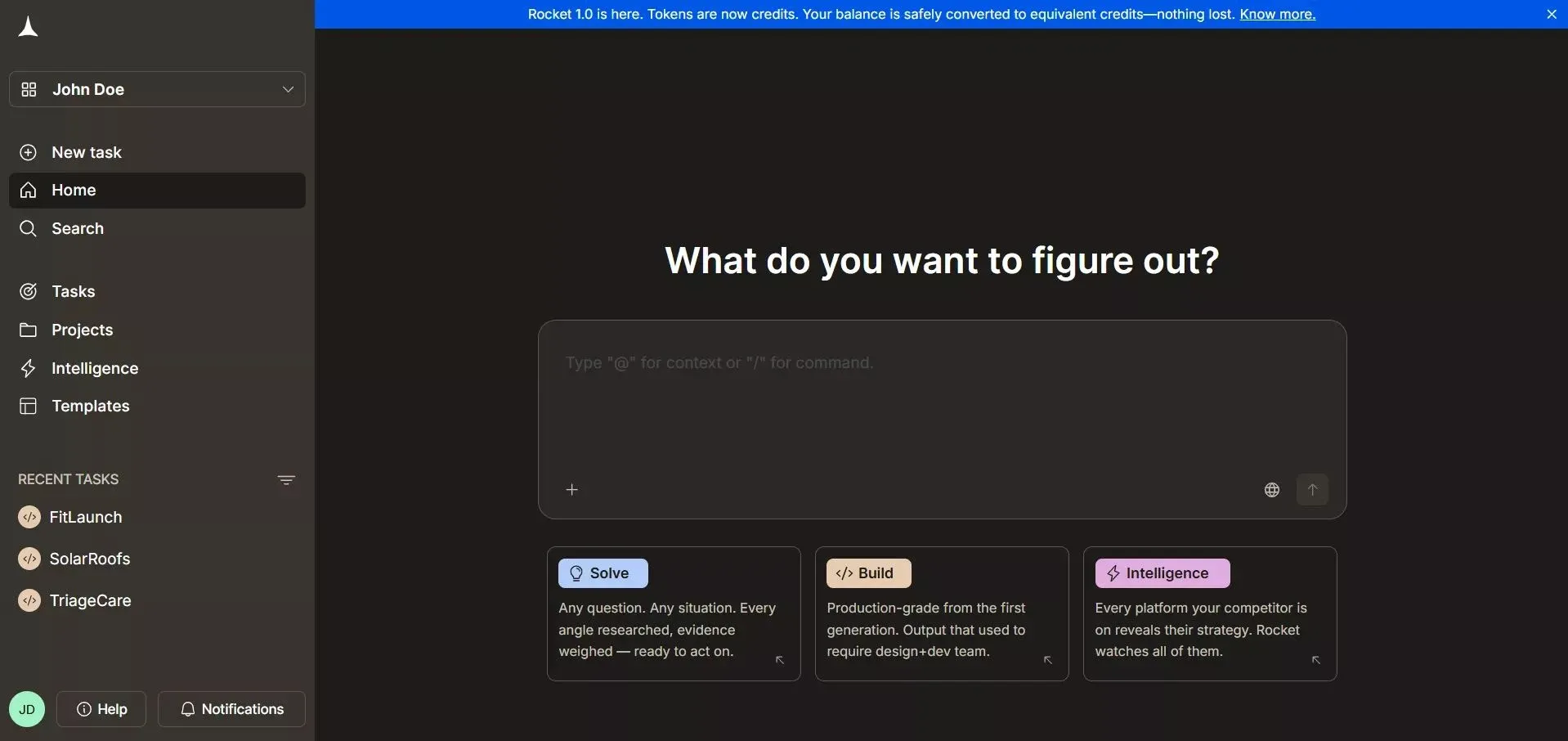
Rocket combines research, app generation, and competitive monitoring in one platform.
Before you build, use Solve to validate your approach: Ask Solve a question like "What are the most common auto insurance fraud patterns in the US, and which detection features have the highest accuracy?" You get a structured, evidence-backed report in minutes. That research then flows directly into your Build prompt as context.
Build your app in plain language: Tell Rocket what you want: a fraud detection dashboard that collects insurance claims, scores them with AI, and flags high-risk submissions for investigation. Rocket generates the full-stack application, including the Postgres database schema via Supabase, API routes, user authentication with role-based access control, and the frontend interface, all from a single prompt.
Stay current with Intelligence: Once your app is live, use Rocket's Intelligence feature to monitor what fraud-detection SaaS vendors and insurtech competitors are shipping. Nine signal pillars, including product changes, hiring patterns, and pricing moves, keep you informed without manual research.
What makes Rocket different from traditional development:
| Factor | Traditional Development | Rocket |
|---|---|---|
| Time to working prototype | 3+ months | Hours to days |
| Team required | Developers, data scientists, designers | Anyone with a clear idea |
| Backend setup | Manual database and auth configuration | Supabase scaffolded from chat |
| Code ownership | Varies by agency or contractor | Full ownership, export to GitHub |
| Deployment | Manual DevOps | One-click to Netlify or custom domain |
| Iteration cost | High (developer time per change) | Credits consumed per generation run |
A note on credits: Rocket uses a credit-based system, one balance covers Solve, Build, and Intelligence. A fraud detection app with scoring logic, a database, role-based access, and a dashboard falls into the high credit usage tier. Start with a focused MVP scope, iterate in stages, and add credits or upgrade your plan if you hit your limit mid-project.
The platform generates Next.js and Flutter code that you own completely. There is no vendor lock-in, and you can push the codebase to GitHub at any point via Rocket's two-way GitHub sync for Next.js TypeScript projects.
Rocket reduces time-to-prototype from months to hours, with full code ownership.
Can You Build a Reliable Fraud Detection App Without Coding?
Can a no-code platform really handle the complexity of insurance fraud detection, or does this use case demand custom development?
The short answer: yes, it is absolutely possible. Modern AI-powered platforms have reached a point where non-technical founders, insurance agents, and business analysts can create sophisticated fraud detection tools without writing a single line of code.
Here is a step-by-step approach to building your false insurance claim detection app:
Step 1: Define the Problem Scope
Start by selecting which type of fraud your system will focus on, whether that is claims fraud, underwriting fraud, or identity theft related to insurance applications. Use Rocket's Solve feature to research which fraud patterns are most costly in your specific insurance category before writing a single line of prompting. This research-first approach is what separates a well-targeted app from a generic one.
Step 2: Set Up the Data Structure
Create a database that captures relevant claim details: claimant information, incident date, claim amounts, policy type, and any supporting documents submitted. In Rocket, connect Supabase from chat and describe your schema. Rocket scaffolds the Postgres tables, row-level security policies, and storage buckets automatically. This is where claims data lives securely, with access controls ensuring only authorized investigators can view flagged records.
Step 3: Build the Scoring Model
Configure rules or connect a pre-trained AI model via Rocket's OpenAI or Anthropic connectors that assigns risk scores based on the input data. The system should flag claims above a certain threshold for manual reviews by investigators. Start with a logistic regression baseline. It is interpretable and easier to explain to regulators. Then layer in ensemble methods as your dataset grows.
Step 4: Add Real-Time Alerts and Notifications
When the system identifies a suspicious claim, it should send real-time alerts to the claims team via email (Resend or SendGrid connector) or SMS (Twilio connector). Rocket wires these connectors from a single prompt, reducing the time between detection and action.
Step 5: Test with Sample Data
Before going live, run the system against a dataset of known fraudulent and non-fraudulent claims. Check the accuracy, precision, and recall to validate the model performs at a reasonable level. A well-configured system using logistic regression and ensemble methods can achieve detection rates above 90% for known fraud patterns.
Step 6: Deploy and Monitor
Launch the application with one-click deployment to Netlify or a custom domain. Track performance over time using Rocket's built-in analytics. Use feedback from investigation results to improve the model through continuous learning.
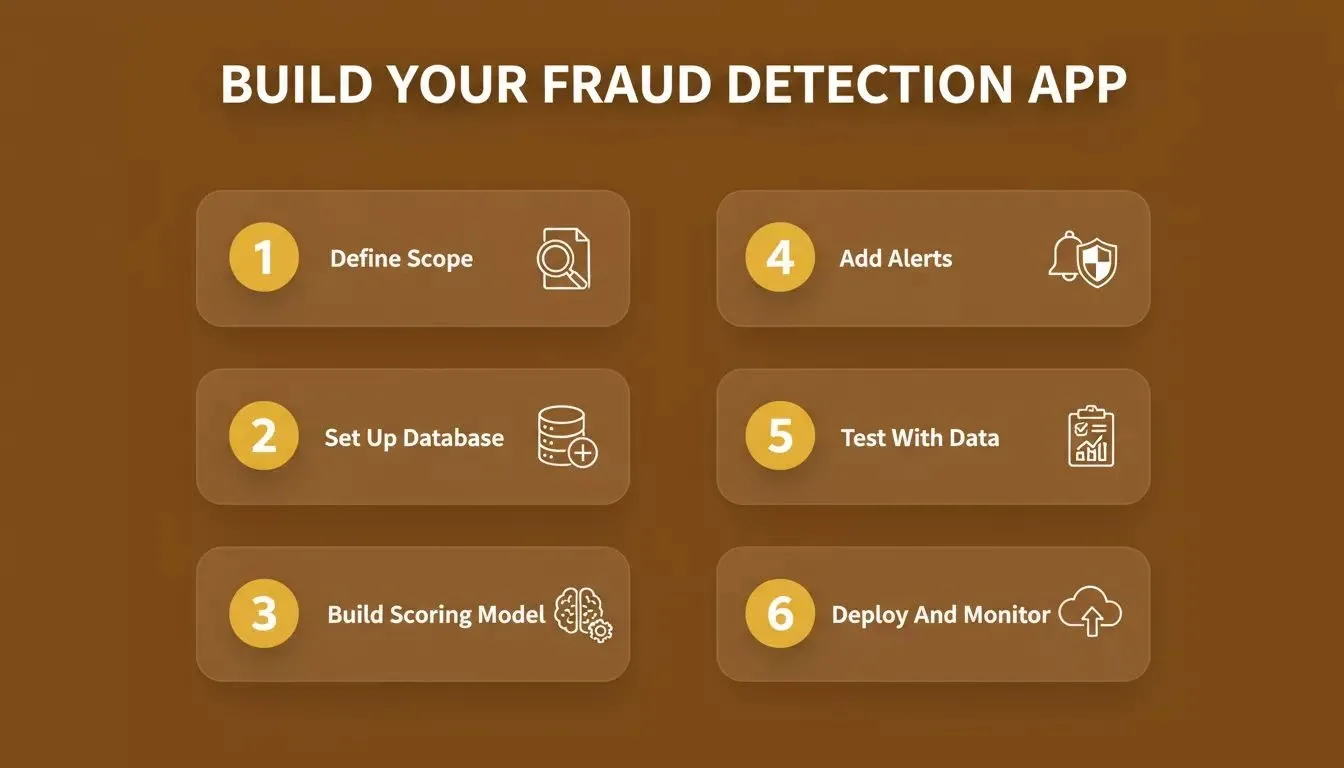
Six steps from idea to deployed fraud detection app, no coding required.
For teams looking to build internal tools quickly, Rocket's approach to building internal tools with AI without a developer follows the same pattern. Describe what you need, and the platform generates it.
What Challenges Do Insurers Face with Fraud Detection Today?
What roadblocks prevent insurance companies from catching more fraud, even with AI tools available?
Data quality and consistency remain a problem. Many insurers operate on legacy systems that store claims data in inconsistent formats. Without clean, structured data, even the best fraud detection model will struggle to produce reliable predictions.
Fraudsters evolve faster than static rules. Organized fraud rings constantly develop new methods to avoid detection. Systems that rely on fixed business rules degrade over time as criminals learn to work around them. Continuous learning and model retraining are the only ways to stay current.
Balancing automation with human judgment is difficult. Not every flagged claim deserves a full investigation. A scalable system must balance automated scoring with qualified human review, and agents need clear guidance on which ones to prioritize.
Compliance and transparency create friction. Regulators increasingly demand that insurers explain how they determine fraud risk. AI models that operate as black boxes create compliance challenges. Rocket's generated apps include GDPR and CCPA consent flows by default, and the interpretable outputs of logistic regression models make regulatory explanation straightforward.
The cost of building custom solutions is high. Traditional development requires data scientists, engineers, and months of work. Many mid-size insurance companies lack the resources and budget to build these tools from scratch, leaving them vulnerable to fraud attempts that larger competitors can catch.
Data Privacy and Compliance for Claims Data
Insurance claims data is among the most sensitive PII a business handles. Before deploying any fraud detection app, consider the following.
Health and workers' compensation claims may contain protected health information subject to HIPAA-adjacent state regulations. Confirm with your legal team whether your specific data flows trigger HIPAA obligations before connecting any external AI model to that data.
GDPR and CCPA: If you process claims from EU residents or California consumers, your app needs explicit consent flows, data deletion capabilities, and a privacy policy. Rocket's Build feature generates GDPR and CCPA consent banners and privacy policy scaffolding from a single prompt. See the Compliance and Privacy docs for the full list of controls.
Row-level security: Supabase, Rocket's primary database connector, enforces row-level security (RLS) policies at the database layer. This means investigators only see the claims they are authorized to access, a critical control for any system handling PII at scale.
Data residency: Supabase lets you choose your database region at project creation. For insurers with data residency requirements, select the appropriate region before generating your schema.
How Does a No-Code Fraud Detection App Compare to Alternatives?
| Approach | Time to Deploy | Cost | Code Ownership | Best For |
|---|---|---|---|---|
| Rocket (no-code AI) | Hours to days | Credits plus plan fee | Full, export to GitHub | Insurers wanting speed and ownership |
| Off-the-shelf SaaS (e.g., FRISS, Shift Technology) | Weeks to months | $50K-$500K+ annually | None | Large carriers with standard workflows |
| Custom in-house build | 3-12 months | $100K-$500K+ | Full | Enterprise with dedicated engineering |
| Freelance or agency build | 2-6 months | $30K-$150K+ | Varies by contract | Mid-size carriers with budget |
The no-code approach via Rocket sits in a unique position: it delivers the customization and code ownership of an in-house build at a fraction of the time and cost, without the vendor lock-in of off-the-shelf SaaS. The tradeoff is that complex scoring logic and large-scale data pipelines will consume more credits than a simple CRUD app. Plan your build scope accordingly.
For teams evaluating no-code options more broadly, the best no-code platform comparison covers how different tools stack up across use cases.
What a No-Code Fraud Detection App Cannot Replace
Honesty about limitations builds more trust than a purely promotional pitch. Here is what a no-code fraud detection app built on any platform, including Rocket, does not replace.
Special Investigations Unit (SIU) investigators. AI flags suspicious patterns; experienced investigators confirm fraud, gather evidence, and build the legal case. The app accelerates their work. It does not replace their judgment.
Legal discovery and litigation support. Once a fraud case moves to litigation, you need documented chain-of-custody for evidence, legal hold procedures, and discovery-ready data exports. These are processes, not software features.
Regulatory reporting obligations. Most jurisdictions require insurers to file Suspicious Activity Reports or equivalent fraud reports with state regulators. Your app can surface the data that triggers these obligations; it cannot file the reports or substitute for your compliance officer's sign-off.
Actuarial validation. Risk scores from an AI model need periodic actuarial review to confirm they are not introducing discriminatory bias against protected classes. This is a regulatory requirement in most US states and EU jurisdictions.
Turning Fraud Prevention Into a Competitive Edge
Insurance fraud is not going away. The companies that win are the ones that build effective detection systems before losses pile up. With AI-powered fraud detection becoming accessible through no-code platforms, even small insurers can now implement the same type of technology that enterprise organizations use to protect their bottom line.
The tools are ready, the data is available, and the approach is proven. Whether you are an insurance startup or an established company looking to modernize claims processing, the path from idea to working application has never been shorter.
Build your false insurance claim detection app today with Rocket.new. Describe your fraud detection requirements in plain language, and Rocket generates the full-stack application, database, authentication, and API automatically. No coding, no DevOps, no delays. Sign up and start building now.
Table of contents
- -Why Is Insurance Fraud Costing Billions Every Year?
- -What Makes a Fraud Detection System Work?
- -Data Collection and Claims Processing
- -Machine Learning Models and Risk Scoring
- -How Does AI Identify Fraudulent Claims in Real Time?
- -Behavioral Analysis and Pattern Recognition
- -Reducing False Positives Without Missing Real Fraud
- -Who Is This For?
- -Why Rocket Makes Fraud Detection App Building Faster
- -Can You Build a Reliable Fraud Detection App Without Coding?
- -Step 1: Define the Problem Scope
- -Step 2: Set Up the Data Structure
- -Step 3: Build the Scoring Model
- -Step 4: Add Real-Time Alerts and Notifications
- -Step 5: Test with Sample Data
- -Step 6: Deploy and Monitor
- -What Challenges Do Insurers Face with Fraud Detection Today?
- -Data Privacy and Compliance for Claims Data
- -How Does a No-Code Fraud Detection App Compare to Alternatives?
- -What a No-Code Fraud Detection App Cannot Replace
- -Turning Fraud Prevention Into a Competitive Edge