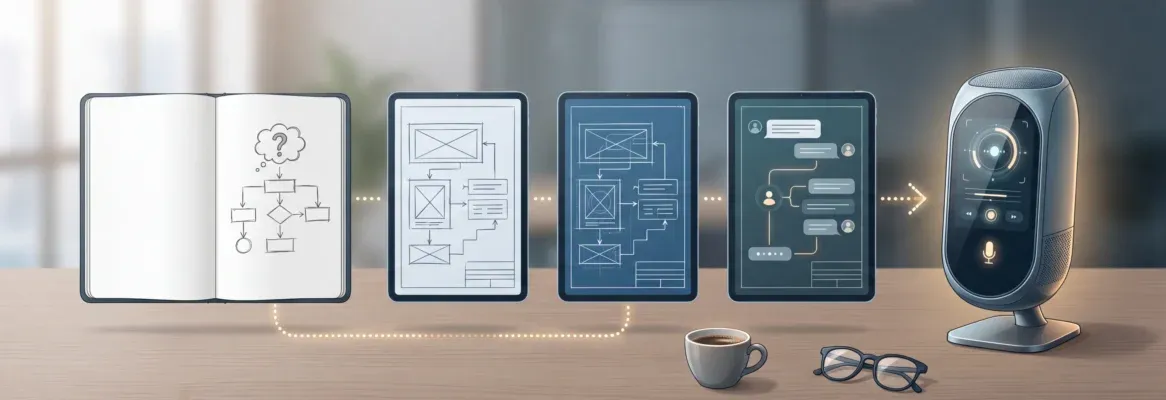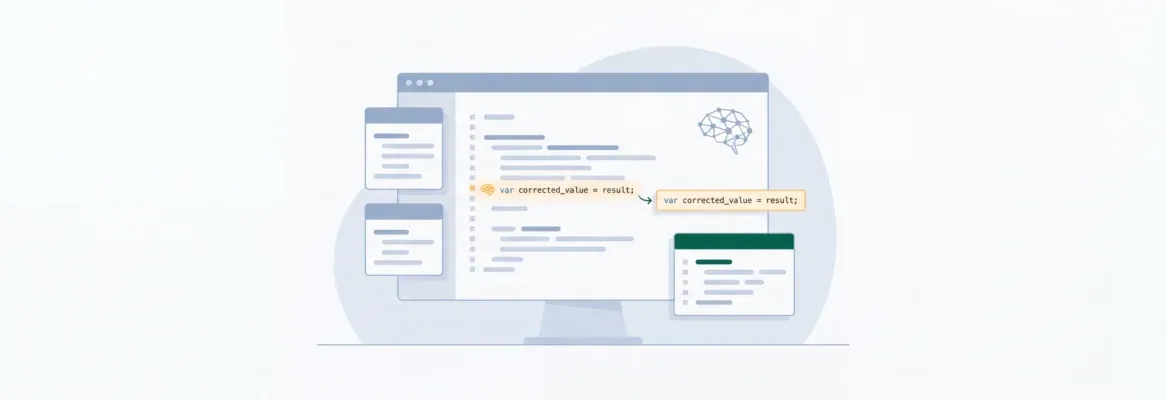
AI platforms now let anyone generate full stack apps from prompt in minutes. This blog covers the full workflow, six ways to start a build, how to write prompts that work, and a step-by-step walkthrough from idea to deployed app.
Can a single sentence replace an entire development team?
That question stopped being hypothetical in 2024. GitHub's developer survey found that 97% of enterprise developers have used AI coding tools at work. The number keeps climbing.
The shift from months-long development cycles to minutes-long prompt-driven generation is real and accelerating.
This blog breaks down how prompt-based AI platforms produce working full-stack applications. It also covers which components they handle, where they fall short, and what separates a production-ready output from a throwaway prototype.
What Does a Prompt-to-App Workflow Look Like?
The concept sounds simple: describe what you want, get a working app. However, the actual mechanics involve more structure than most people expect.
-
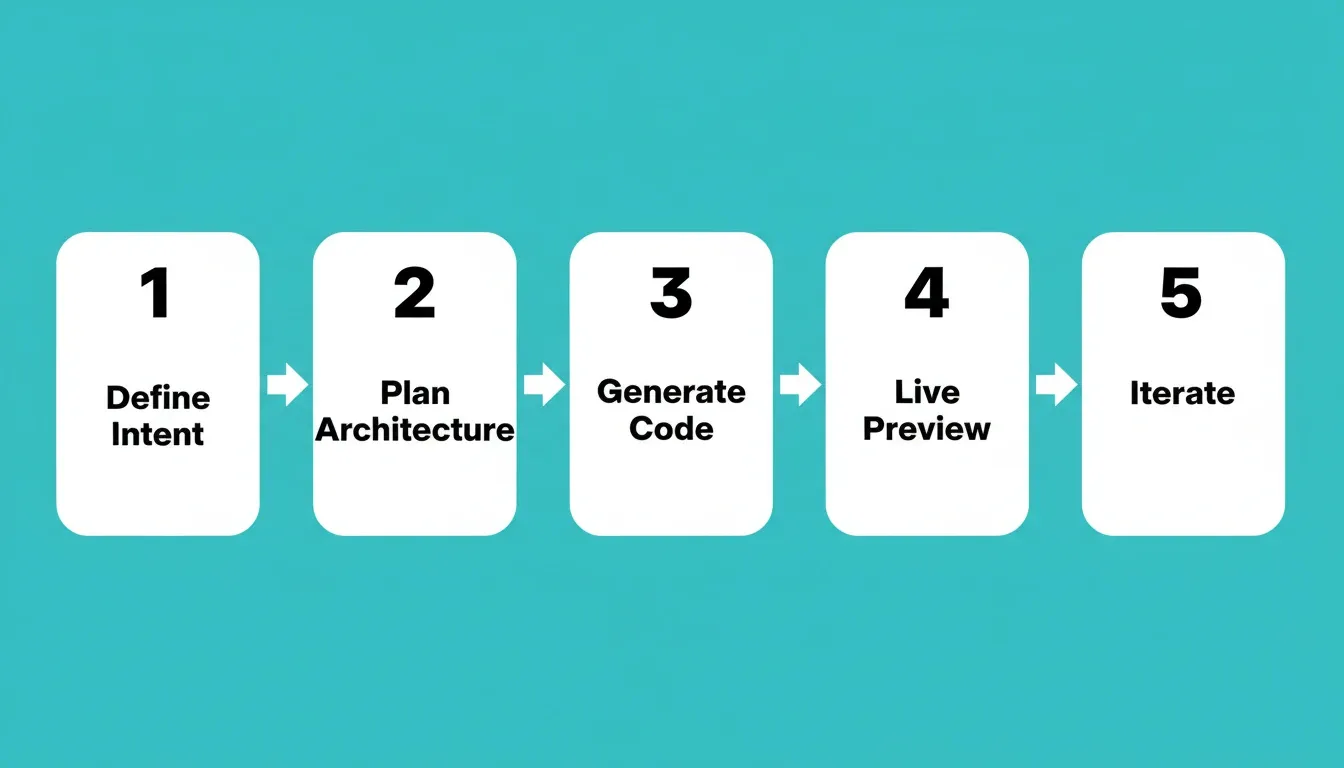
Define the intent clearly. Write a natural language description of what the application should do, who uses it, and what outcomes it delivers.
-
AI interprets architecture. The platform parses your prompt into technical decisions. These include framework selection, component structure, database schema, API routes, and UI layout.
-
Code generation runs. Frontend, backend, and infrastructure code are produced simultaneously. Typical frameworks include Next.js for web and Flutter for mobile.
-
Live preview renders. You see the application running immediately. You can interact with it, click buttons, and test flows.
-
Iterate through conversation. Refinements happen through follow-up messages rather than manual code edits.
This loop, describe, generate, review, and refine, replaces what traditionally required separate designers, frontend engineers, backend engineers, and DevOps specialists working across weeks. Solid prompt engineering best practices make the first output significantly closer to your vision.
Additionally, knowing how to build an app with AI in minutes helps you avoid the most common first-run mistakes.
Key Components of AI-Driven Full Stack Development
A full stack application touches multiple layers. AI platforms now handle all of them from a single prompt input. This is what makes it possible to generate full stack apps from prompt efficiently.
| Layer | What AI Generates | Traditional Requirement |
|---|---|---|
| Frontend UI | Responsive layouts, components, navigation | Designer and frontend developer |
| Backend Logic | API routes, server functions, authentication | Backend developer |
| Database | Schema design, queries, migrations | Database architect |
| Deployment | Hosting, SSL, custom domains | DevOps engineer |
| SEO and Performance | Meta tags, Core Web Vitals, accessibility | SEO specialist |
Platforms that generate production-grade code in Next.js and Flutter give you full ownership of the source. As a result, you can export, modify, and scale without vendor lock-in. This is a critical distinction between a real build and a locked prototype.
Six Ways to Generate Full Stack Apps from Prompt
Most guides only cover the "type a prompt" path. In practice, however, you can generate full stack apps from prompt in several different ways. The right approach depends on what you already have.
From a Plain Language Prompt
The most common starting point. Describe what you want and the platform builds immediately if your prompt is specific enough. If it is too vague, a good platform asks targeted clarifying questions about platform, audience, and must-have features before starting. This prevents wasted generation cycles.
Prompt examples that work:
-
"Build a SaaS dashboard for freelance designers to track client projects, invoices, and deadlines. Include a Kanban board, time tracker, and PDF invoice generator."
-
"Create a restaurant ordering web app with menu categories, item details, a cart, and a checkout flow with delivery address input."
From a Figma Design
Import an existing Figma design and convert it directly to production-ready code. The platform preserves your typography, spacing, visual hierarchy, and color system. Designers who want to convert Figma designs to full stack apps can skip the developer handoff entirely and ship directly from their design file.
From an Attachment
Upload a screenshot, wireframe, PDF, spreadsheet, or CSV. The AI analyzes the content and builds from it. This works well when you have a mockup or existing data structure you want to turn into a working application.
From a GitHub Repository
Import an existing Next.js TypeScript codebase and continue building from where it left off. The platform imports all files, installs dependencies, and sets up a live preview. Changes sync back to a dedicated branch with pull requests to main.
From a Template
Browse a template library and start from a pre-built pattern. Options include SaaS, landing page, e-commerce, and dashboard. Templates consume zero credits. Credits only apply when you start customizing through chat.
From a URL (Redesign)
Provide a live website URL and use slash commands to control the depth and direction of the redesign. Options include reimagining the layout, fixing conversion issues from heatmap data, rebuilding mobile-first, or generating a brand-matched new page.
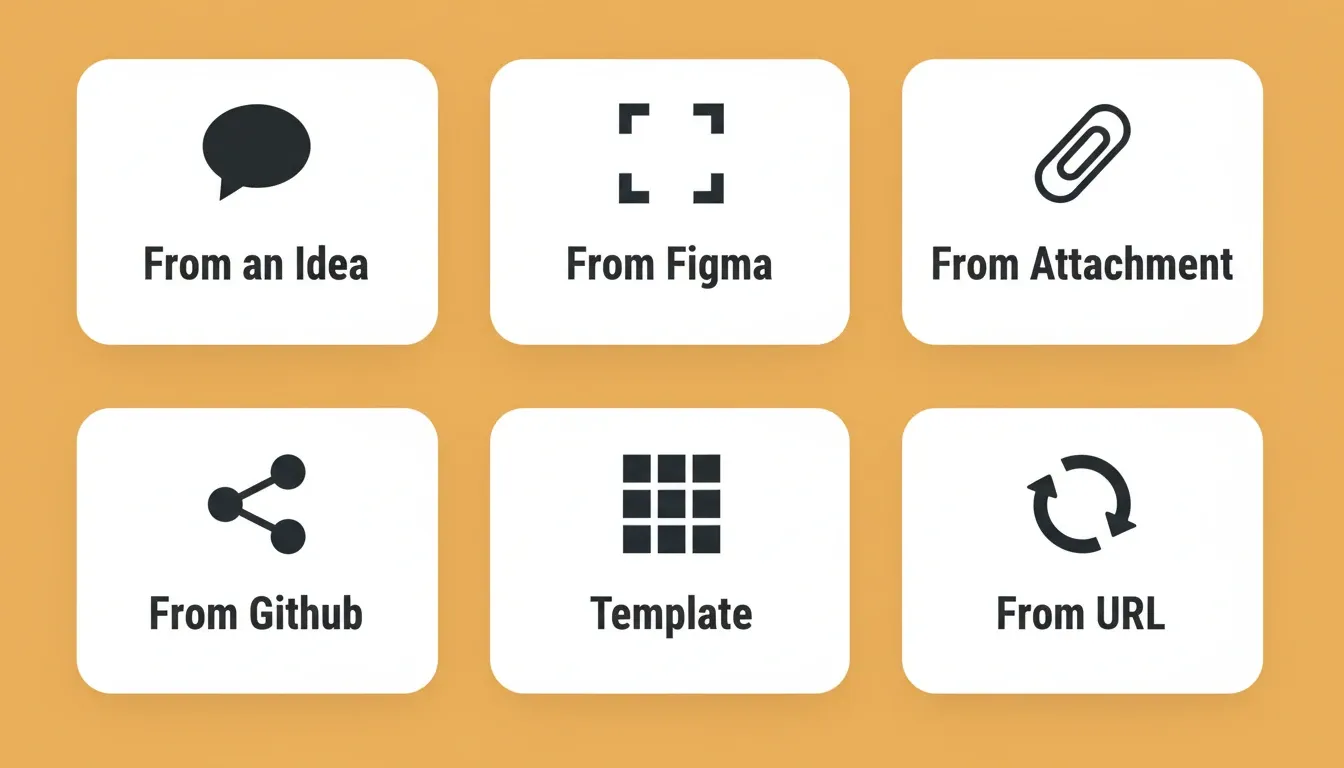
| Starting Method | Best For |
|---|---|
| From an idea | Starting fresh with a description |
| From Figma | Completed designs ready to become code |
| From attachment | Screenshot, wireframe, or data file |
| From GitHub | Existing Next.js TypeScript codebase |
| From template | Common pattern, fastest start, zero credits |
| From URL (Redesign) | Rebuilding or improving an existing site |
Where Rocket Fits in the Prompt-to-Production Pipeline
Most AI builders stop at the prototype. Rocket, however, starts where others end. It delivers production-grade output with the full stack handled from the first generation.
Rocket is a vibe solutioning platform tried by 1.5 million people across 180 countries. It combines strategic research (Solve), AI app building (Build), and team collaboration into a single workspace. Every build ships with SEO-ready structure, WCAG accessibility compliance, GDPR coverage, and performance optimization by default. These are the baseline, not optional extras.
What Rocket generates:
-
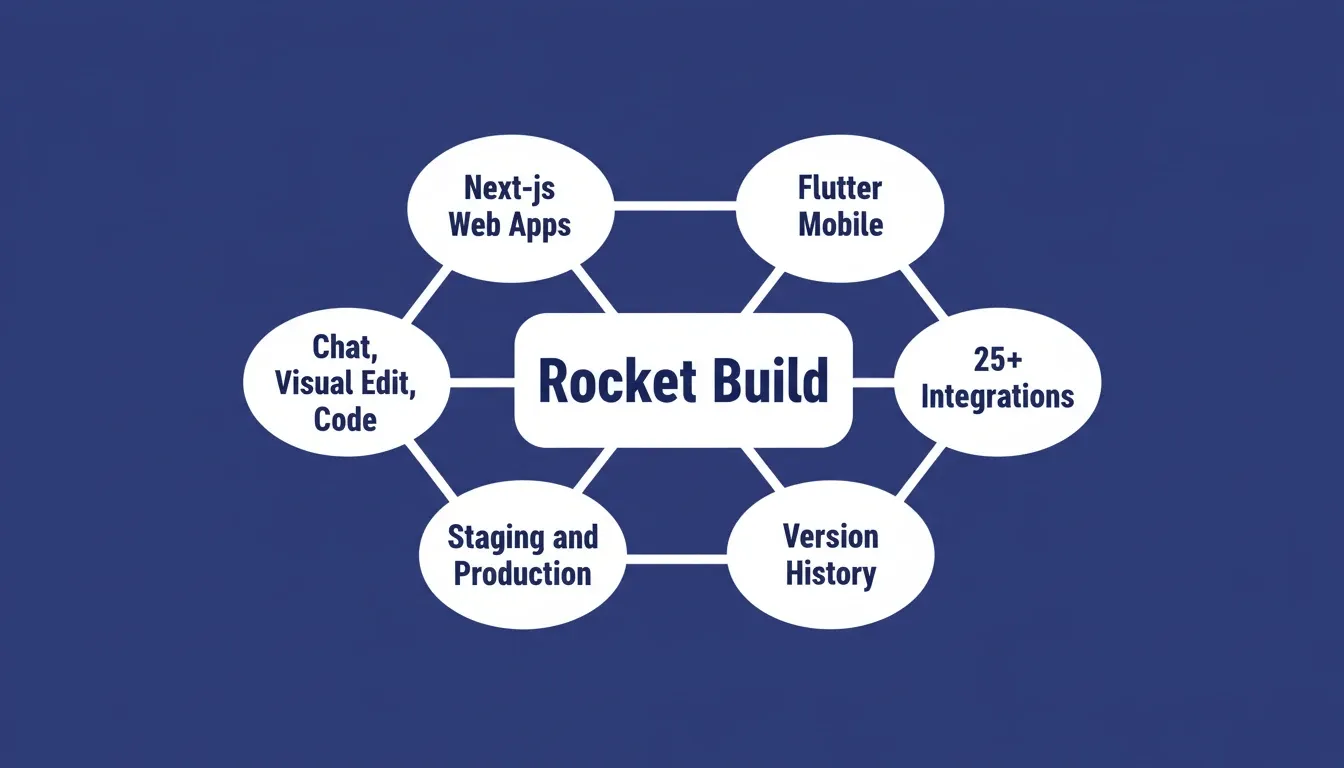
Web apps: SaaS products, dashboards, internal tools, e-commerce stores, AI-powered apps, and customer portals, all built in Next.js
-
Mobile apps: iOS and Android apps from a single Flutter codebase, with real design systems, dark/light theming, fluid navigation, and staggered animations, ready for the App Store and Google Play
-
Landing pages: Conversion-focused pages with built-in SEO and fast load times
-
E-commerce stores: Full stores with product catalogs, checkout flows, and payment integrations
Key platform capabilities:
-
Prompt Intelligence: Rocket scores every prompt for clarity. Specific prompts start building immediately. Most apps generate in 1 to 3 minutes. Vague prompts trigger targeted questions first, then start.
-
Three iteration modes: Chat (natural language changes, no limit), Visual Edit (click any element to adjust text, style, spacing, or images directly), and Code view (full access to generated Next.js or Flutter source files)
-
Version history: Every generation saves a version. You can compare code diffs, label milestones, roll back to any previous state, and deploy any version to staging or production independently.
-
25+ integrations built in: Stripe, Supabase, Google Analytics, OpenAI, Anthropic, Gemini, Mailchimp, Mixpanel, Airtable, Linear, Notion, Typeform, Resend, SendGrid, Twilio, Calendly, and more. Authenticate once and they flow into every build.
Recommended stacks by project type:
| Project Type | Recommended Stack |
|---|---|
| SaaS product | Supabase + Stripe + Resend + Netlify |
| E-commerce store | Supabase + Stripe + SendGrid + Google Analytics |
| AI-powered app | OpenAI or Anthropic + Supabase + Stripe |
| Booking or scheduling | Calendly + Supabase + Twilio or Resend |
| Lead generation site | Typeform + Mailchimp + Airtable + Google Analytics |
Describe your application in plain English. Rocket produces the complete stack, frontend, backend, database, and deployment, ready for real users.
How Do You Write Effective Prompts for App Generation?
The quality of your output depends almost entirely on the quality of your input. Vague prompts produce vague apps. Here is how to generate full stack apps from prompt with precision.
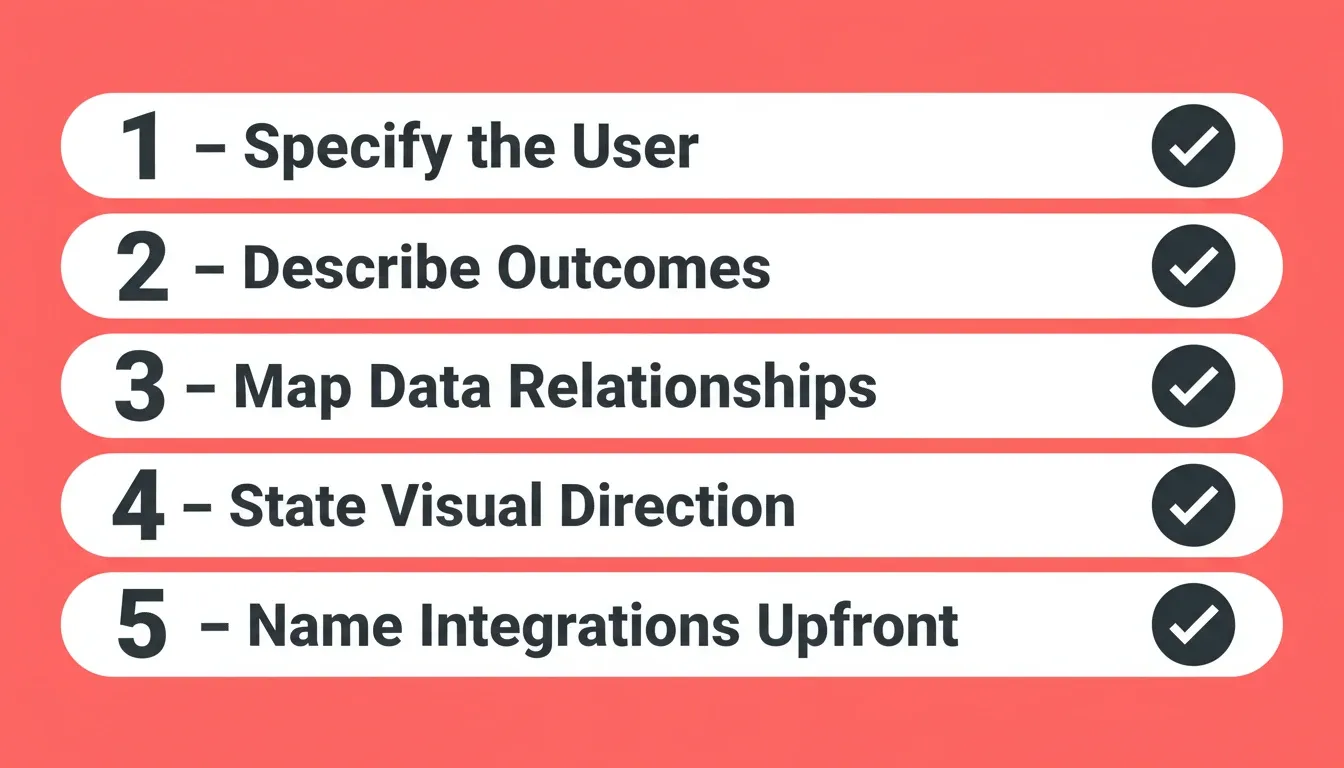
Five elements every strong prompt includes:
-
Specify the user. "A project management tool" is weak. "A project tracker for freelance designers managing client deadlines" gives the AI enough context to make architectural decisions.
-
Describe outcomes, not code. Focus on what the app should accomplish rather than how it should be built technically.
-
Include data relationships. Mention which entities relate to each other. For example, users have projects, projects have tasks, and tasks have deadlines.
-
State the visual direction. "Clean, minimal, dark mode with accent colors" beats "make it look good."
-
Name your integrations upfront. If you need Stripe payments, email notifications, or calendar booking, say so in the first prompt.
"Developers using generative AI tools were more than twice as likely to report overall happiness, fulfillment, and a state of flow." — GitHub Developer Survey, 2024
Prompt patterns that consistently produce better results:
-
Lead with purpose, not features. "Build a booking system for a hair salon" gives more context than "build a booking app."
-
Use the 3-5 feature rule. List the most important features upfront, then add more through chat after the initial build.
-
Name screens explicitly. For example, "The app has three screens: a dashboard, a settings page, and a client list."
-
Start lean, then iterate. Describe a focused core and add features through conversation after the initial generation.
For a deeper reference, the best prompts for app building covers prompt patterns across dozens of app types.
How to Get Your First App Live: A Step-by-Step Walkthrough
Here is exactly how to go from idea to deployed full stack app.
Step 1: Create an account. Sign up with Google, Apple, or email. No credit card is required. The Free plan includes 20 credits, which is enough to generate and preview your first app.
Step 2: Start a Build task. Click Build on the homepage. Choose a category tab such as Landing page, Dashboard, Website, SaaS, Mobile App, or E-commerce to see example prompts. You can also type your own idea directly into the input.
Step 3: Send your prompt. Click Send or press Enter. If your prompt is specific enough, Rocket starts building immediately. If it needs more context, Prompt Intelligence asks a short set of targeted questions. Answer them and generation starts.
Step 4: Watch generation. Rocket plans the architecture, writes production-ready code, and shows a live preview the moment generation finishes. Most apps complete in 1 to 3 minutes.
Step 5: Preview and iterate. Interact with the live preview like a real user. Click buttons, navigate screens, and fill forms. Make changes through chat, Visual Edit, or Code view. There is no change limit.
Step 6: Connect integrations. Open Connectors from the preview toolbar. Select the services you need, authenticate once, and describe the feature you want. Rocket generates the complete integration, including UI, backend logic, API calls, and error handling.
Step 7: Launch. Click Launch. Choose Staging to get a shareable preview URL for testing, or Production to go live with a custom domain and automatic HTTPS. You can also download the complete source code. Alternatively, you can deploy full stack apps with AI tools directly to the App Store or Google Play for Flutter mobile builds.
Mobile app distribution options:
| Distribution | Speed | Audience | Cost |
|---|---|---|---|
| Web preview link | Instant | Anyone with the link | Free |
| APK download (Android) | Minutes | Testers with devices | Included with paid plan |
| Google Play Store | Days to weeks | Public | $25 one-time |
| Apple App Store | Days to weeks | Public | $99/year |
Rocket Pricing Plans
| Plan | Price | Credits | What's Included |
|---|---|---|---|
| Free | $0 | 20 (one-time) | Build production-ready apps and Light Solve |
| Pro | $25/month | 100/month | Build production-ready websites, landing pages, web apps, mobile apps |
| Rocket | $50/month | 250/month | Build, Solve, and team collaboration |
| Booster | $250/month | 1,500/month | Build, Solve, SSO, data localisation, and premium support |
All paid plans include unlimited team members. Credits roll over month to month on monthly plans.
Common Pitfalls When Using AI to Build Applications
AI-generated apps are not perfect on the first try. Knowing where things break helps you work around limitations faster when you generate full stack apps from prompt.
-
Overloading a single prompt. McKinsey's research found that time savings shrank to less than 10% on tasks developers deemed highly complex. Break complex apps into smaller, focused prompts and add features incrementally through chat.
-
Skipping the review step. AI occasionally introduces errors or makes wrong assumptions about business logic. Use the code diff feature to review exactly what changed before moving on.
-
Ignoring backend logic. Many prompt-based tools handle UI well but struggle with complex data relationships, authentication flows, and third-party API handling. Choose a platform that generates complete backend logic, not just frontend scaffolding.
-
No deployment strategy. Building an app is only half the job. If your platform does not handle hosting, SSL, and domain configuration, you will spend hours on infrastructure setup after generation.
-
Making too many changes without testing. Test after every significant change. Rolling back is easy when you have version history, but catching regressions early saves time.
-
Vague iteration prompts. "Make it better" produces inconsistent results. Instead, be specific: "Change the header background to dark blue" or "Add a settings page with profile editing and a password change form."
Furthermore, building and deploying from one workspace eliminates the gaps where most projects stall or lose momentum between tools.
The Gap Between Idea and App Has Never Been Smaller
The ability to generate full stack apps from prompt is no longer a novelty. It is a production-grade workflow used by 1.5 million people across 180 countries. As AI models improve and platforms mature, the gap between what you can describe and what gets shipped will continue to close. The teams shipping fastest in 2026 are not the ones with the largest engineering headcount. They are the ones who describe clearly and iterate quickly.
You typed the idea. The rest is a prompt away. Start building on Rocket.new and go from description to deployed full stack app today.
Table of contents
- -What Does a Prompt-to-App Workflow Look Like?
- -Key Components of AI-Driven Full Stack Development
- -Six Ways to Generate Full Stack Apps from Prompt
- -From a Plain Language Prompt
- -From a Figma Design
- -From an Attachment
- -From a GitHub Repository
- -From a Template
- -From a URL (Redesign)
- -Where Rocket Fits in the Prompt-to-Production Pipeline
- -How Do You Write Effective Prompts for App Generation?
- -How to Get Your First App Live: A Step-by-Step Walkthrough
- -Rocket Pricing Plans
- -Common Pitfalls When Using AI to Build Applications
- -The Gap Between Idea and App Has Never Been Smaller