Rocket Intelligence by Rocket.new tracks every public platform your competitors operate on and delivers daily briefs with signals, context, and clear recommendations. Part of Rocket 1.0, the world's first vibe solutioning platform, it connects with Solve and Build through one shared context system.
What Is Rocket Intelligence?
Rocket Intelligence by Rocket.new is the competitive monitoring pillar of Rocket 1.0, the world's first vibe solutioning platform. It continuously tracks every public platform a competitor operates on, website changes, social activity, hiring signals, reviews, news, and ad campaigns, and delivers daily briefs that tell you what changed and what it means.
With 1.5 million users across 180 countries already on the platform, Rocket.new is the one system where strategic research, product building, and competitive intelligence share context and compound over time.
Why Most Businesses Are Still Flying Blind on Competitors
You ship a new feature. Three weeks later, you find out a competitor shipped the same one two weeks before you.
Most businesses run their competitive research the same way they have for years: a quick Google search, a scan of a competitor's homepage, maybe a G2 page review. It is manual, infrequent, and incomplete. According to McKinsey, 88% of companies are now using AI in at least one business function. Yet most are still relying on disconnected AI tools to track competitors, one for news alerts, one for social media, another for review platforms.
The cost of that blind spot is real. A pricing shift you missed. A hiring spike that signalled a product pivot. An executive interview that telegraphed a new market entry months before the press release. These are the signals that change how deals close, how products get prioritized, and how strategies get set. This is precisely the gap Rocket.new was built to close.
The Rocket.new Vibe Solutioning Platform
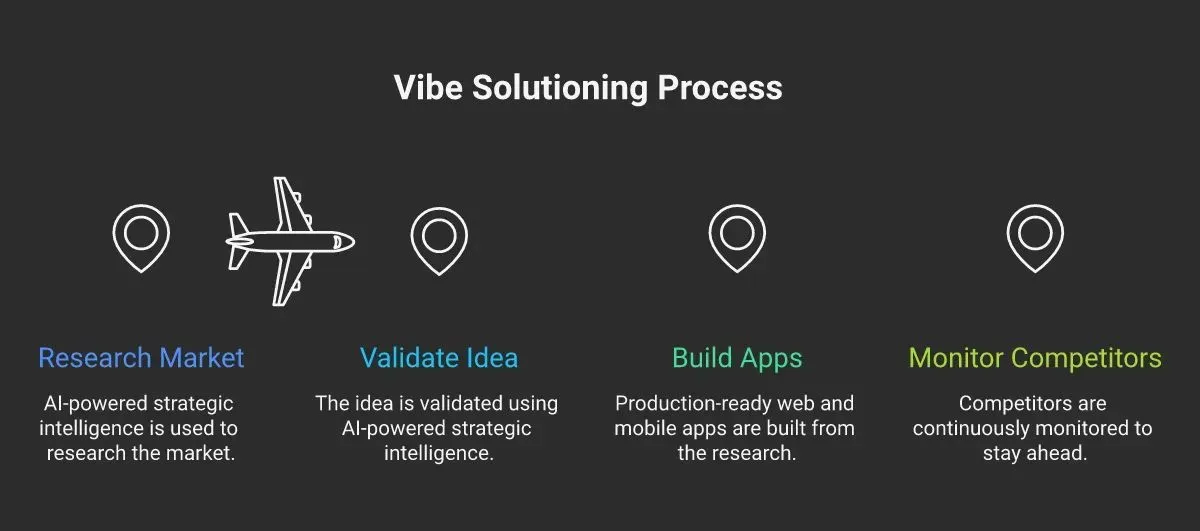
Rocket.new is the world's first vibe solutioning platform. Vibe solutioning is the practice of using AI to address the full arc of building a product, starting with the strategic intelligence that answers what to build and why, through the build itself, and into monitoring and improving what was built. It is different from vibe coding, which starts at execution and assumes the direction is already decided.
The platform ships with seven pillars: Solve, Build, Intelligence, Redesign, Context, Collaborate, and Support. Each pillar works independently. All of them share context. That shared context architecture is what separates Rocket from every separate tool on the market.
| Pillar | What It Does | Output |
|---|---|---|
| Solve | Strategic research and decision intelligence | Structured reports with data, insights, and recommendations |
| Build | Production-grade web apps and mobile apps | Next.js web apps and Flutter mobile apps, landing pages, and websites |
| Intelligence | Continuous competitive monitoring | Daily briefs, signal feeds, competitor profiles |
Each pillar alone is a game-changer for most businesses. Together, they form one platform, not three separate tools.
What Does Rocket Intelligence Actually Track?
Rocket Intelligence is the competitive intelligence engine inside Rocket 1.0. Set it up once per workspace, press enter on your competitor list, and it runs automatically from that point forward.
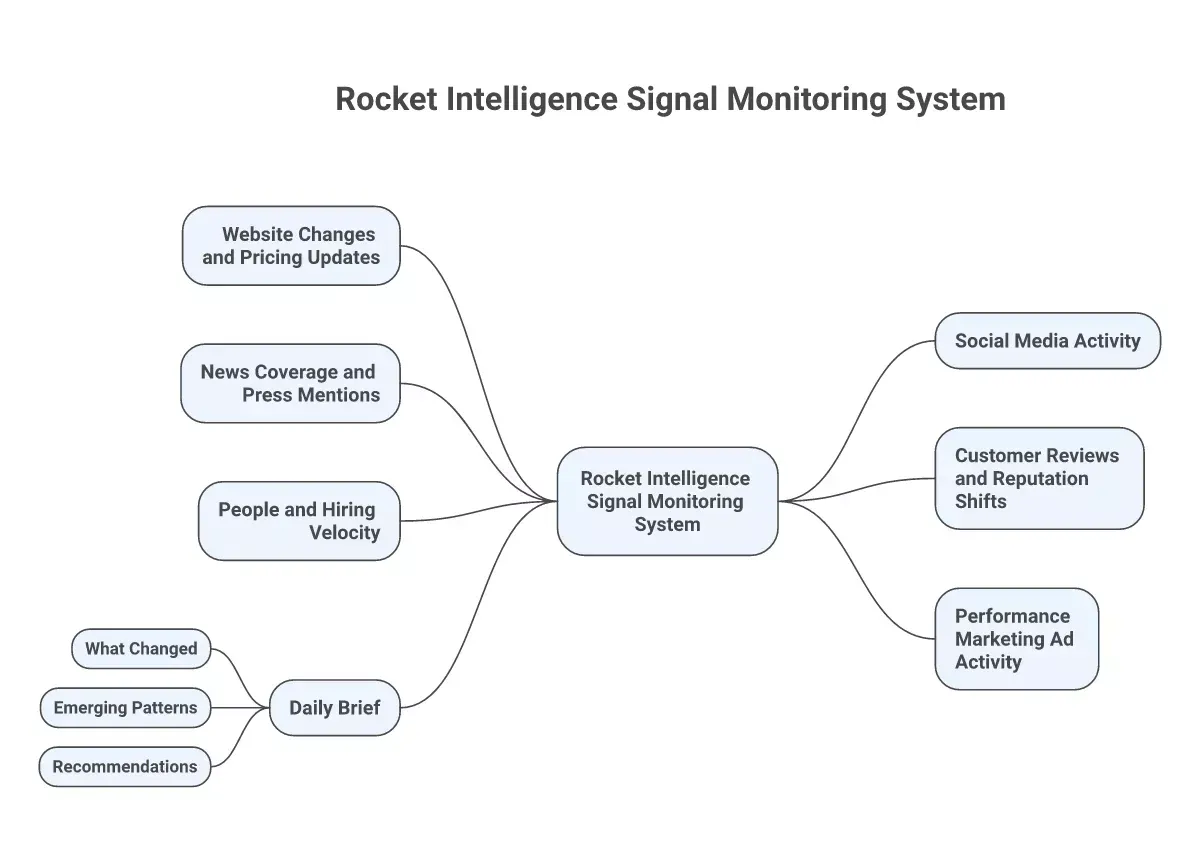
Intelligence monitors six distinct signal categories for every competitor you add:
- Website: every page change, pricing update, messaging shift, new feature announcement
- Social Media: posts and engagement patterns across LinkedIn, X, Instagram, Facebook, YouTube, TikTok, and Reddit
- News and Web Presence: press coverage, blog posts, partnership announcements, media mentions
- Reviews and Reputation: G2, Glassdoor, Capterra sentiment shifts over time
- People: headcount, hiring velocity, open positions by department, key executive activity
- Performance Marketing: ad activity across LinkedIn, Meta, and TikTok
That hiring concentration data alone is a signal most teams miss entirely. When a competitor suddenly posts 12 new engineering roles focused on mobile, that is a product pivot announcement; it just has not been made public yet. Intelligence surfaces months before any formal announcement confirms it.
How Rocket Intelligence Delivers Insights
The Daily Brief
Every morning, Intelligence produces a structured brief for every competitor you track. The brief has three parts: signals and insight, what to watch, and recommendations. It does not just describe what changed, it interprets what those changes mean in combination.
A pricing page update is noise in isolation. That same pricing change alongside three new enterprise sales job listings, a defensive G2 response about security, and a spike in LinkedIn posts targeting enterprise buyers is not noise.
It is a strategy shift. Rocket connects those dots automatically. Intelligence reads signal clusters, not individual changes.
The All Signals Feed and Competitor Profiles
Beyond the daily brief, the all signals feed gives you a chronological stream of every detected change, unfiltered, searchable, and filterable by competitor, signal type, or date range.
Each competitor also gets a full profile with six tabs: Overview, News, Website, Customers, People, and Social. The People tab tracks open positions by department, a direct view into where competitors are investing before any product announcement confirms it.
How Solve, Build, and Intelligence Work Together in One Platform
This is where Rocket connects research, execution, and continuous competitive intelligence in one shared context. Here is how the three capabilities connect:
No switching tools. No re-explaining context. No lost insight at the handoff. Most vibe coding tools like Lovable, Bolt, and v0 handle one step and stop. Standalone research tools find information and leave you to figure out what to do with it. Rocket connects all three steps with one shared context, carrying the thinking forward every time.
Who is Rocket.new Built For?
Rocket.new serves three distinct users:
The Builder: founders, developers, designers, and agencies shipping products. They use Solve to validate ideas, Build to generate production-grade code, and Intelligence to stay ahead of the competition in real time.
The Operator: product managers, sales leaders, marketers, consultants, and solo founders running strategic research. They use Solve for decision intelligence and Intelligence for continuous competitive intelligence, often without ever running a Build task.
The Platform Consolidator: enterprise and scaled-stage teams replacing separate tools with one shared-context system.
With 90% of tech workers now using AI tools at work, the question is no longer whether to use AI for business intelligence. It is whether to keep switching tools or move to one system that covers the full arc.
Why Rocket.new Beats Switching Tools
Most competitive research setups today are a patchwork: a Google Alert for news, a manual LinkedIn check for hiring signals, a weekly scan of the competitor website. Separate tools with no shared context always give you a partial picture.
Rocket Intelligence reads signal clusters. Standalone tools like Crayon, Klue, and Kompyte focus on competitive intelligence reporting on individual signals. What they do not do is connect those signals to your research output and your build roadmap in one system. With Rocket, the signal from Monday morning is present in context when you open Solve on Wednesday and Build on Friday.
"Every platform your competitor is on is a window into their strategy. Rocket watches all of them, and tells you what it means." — Rocket.new Intelligence
What Can You Build with Rocket.new?
Beyond Intelligence, Rocket's Build pillar produces production-ready products from a natural language prompt. Describe what you need, describe who it is for, press enter on a new Build task, and Rocket plans the architecture and writes the code generation automatically.
Web apps are built in Next.js. Mobile apps are built in Flutter with real design systems, dark and light theming, fluid navigation, and staggered animations. Every product ships with SEO-ready structure, WCAG accessibility compliance, and GDPR coverage by default.
You can build web apps, iOS and Android mobile apps ready for the App Store and Google Play, conversion-focused landing pages, multi-page websites, internal tools, internal dashboards, and customer portals. The platform also includes 25+ integrations, Stripe, Supabase, Notion, Linear, Airtable, Mailchimp, Mixpanel, and Google Analytics. Authenticate once, and they flow into every build.
Getting Started with Rocket.new
Sign up at Rocket.new in about 30 seconds with Google, Apple, or email, no credit card required. A new workspace is created automatically with a free plan and a starting credit balance.
From there, start a Solve task to validate an idea or research a market. Start a Build task to generate web apps, mobile apps, landing pages, or websites. Set up Intelligence from the sidebar to start tracking competitors. Each pillar works on its own. All three work better in one place, where shared context means the research from last week is present when you start building today.
The most expensive mistake in any business is not a bad execution; it is a good execution of the wrong thing. Most teams build fast. Few teams build right. Rocket.new is built for the second kind.
Ready to stop switching tools and start making faster, sharper decisions? Start for free at Rocket.new and set up your first Intelligence workspace today.
Table of contents
- -What Is Rocket Intelligence?
- -Why Most Businesses Are Still Flying Blind on Competitors
- -The Rocket.new Vibe Solutioning Platform
- -What Does Rocket Intelligence Actually Track?
- -How Rocket Intelligence Delivers Insights
- -The Daily Brief
- -The All Signals Feed and Competitor Profiles
- -How Solve, Build, and Intelligence Work Together in One Platform
- -Who is Rocket.new Built For?
- -Why Rocket.new Beats Switching Tools
- -What Can You Build with Rocket.new?
- -Getting Started with Rocket.new