TL;DR: Rocket.new generates production-ready websites from plain language, no templates, no drag and drop, no coding needed. It is the AI-powered website builder that builds from scratch every time.
What if building a website felt less like filling in a form and more like having a real conversation with a skilled developer?
That is exactly what the Rocket.new way to website builders delivers.
You describe what you want in plain language, and a fully functional, production-ready website comes back, no drag and drop, no template hunting, no coding needed.
According to HubSpot's 2026 State of Marketing Report, website, blog, and SEO remains the number one ROI-generating channel for marketers. Getting your site right matters more than ever.
So why are so many people still stuck wrestling with rigid templates and limited builders?
The Template Trap: How Traditional Website Builders Hold You Back
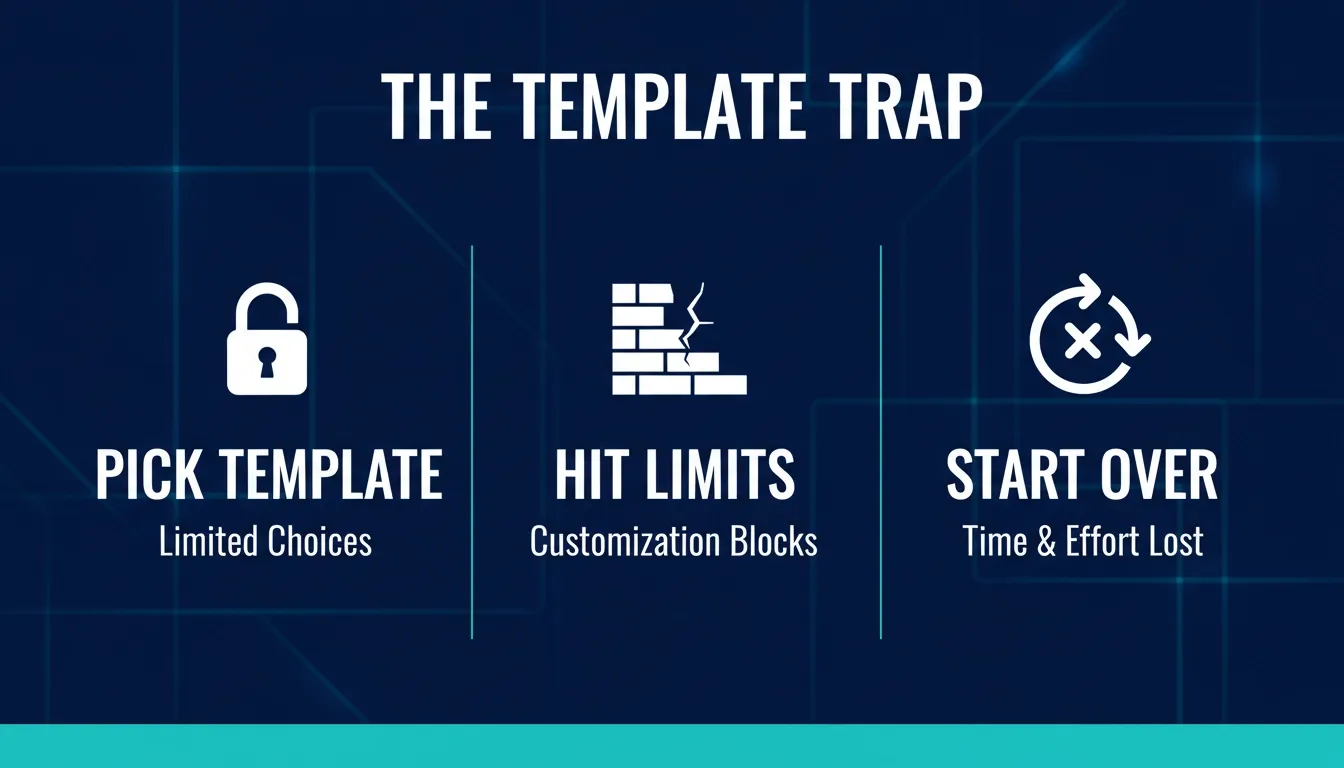
Most website builders were built around a simple idea: pick a template, fill in your content, publish. It sounds easy. And for the first ten minutes, it is.
Then reality kicks in.
You want to move a section. The template does not allow it. You want a layout that matches your brand. The closest option is three templates away and still not quite right.
You want to change the template entirely after spending 2 weeks building your site, and Wix, one of the most popular website builders, tells you that once you have chosen a template, you cannot switch it. You would have to start over from scratch.
That is not a minor inconvenience. That is a fundamental design flaw in how most traditional website builders work.
What Most Traditional Builders Get Wrong
Here is a quick look at where the biggest names fall short:
| Builder | Key Limitation | Entry Price |
|---|---|---|
| Wix | Cannot change template after selection; starts at $17/mo with only 2GB storage on cheapest plan | $17/mo |
| Squarespace | No forever free plan; pricier than alternatives at $16/mo minimum | $16/mo |
| GoDaddy | Limited customization; e-commerce only on top-tier paid plans | $10/mo |
| Weebly | No major updates in years; basic customization only | $10/mo |
| HubSpot | Steep learning curve; complex interface for beginners | $23/mo |
The pattern is clear. Most traditional builders trade flexibility for simplicity. They give you starting points, but those starting points come with invisible walls.
The Drag and Drop Illusion
Drag and drop sounds like freedom. In practice, it is freedom within a box. You can move things around, but only within the grid defined by the platform.
You can change colors, but only the ones the template supports. You can add plugins, but only the ones the marketplace approves.
For small business owners, freelancers, and founders who need a website that actually reflects their brand, not a slightly modified version of a template thousands of other sites are also using, this is a real problem. It is also time-consuming in ways that no one warns you about upfront.
"I spent three days trying to get my Squarespace site to look the way I wanted. In the end, I gave up and just accepted a layout that was close enough. It never felt like mine." — Indie Hackers community
Why No Code Tools Changed the Game But Only Halfway
The rise of no-code website builders was a genuine shift. Suddenly, building a website did not require coding knowledge. Non-technical founders could ship landing pages. Small businesses could get online without hiring a developer.
But no code tools still had a ceiling.
-
They gave you tools, not outcomes.
-
You still had to make every design decision yourself.
-
The output still looked like it came from a template library, because it did.
The gap between "I can build a website" and "I can build the website I actually want" stayed wide open. Low code platforms helped close part of that gap, but the complete website you envisioned was still out of reach.
What AI Website Builders Actually Promised
When AI website builders arrived, they promised something different. Not just drag and drop, but generation. Describe what you want, get a website back.
The early versions were impressive demos. But most AI builders still had the same underlying problem: they generated from a pool of templates and components. The output looked AI-made. Generic cards. Predictable grids. Layouts that announced themselves as auto-generated.
The design quality gap was real. And users noticed.
The Three Gaps Most AI Builders Never Closed
Most AI builders on the market today share three structural gaps:
-
No pre-build intelligence: The tool has no opinion on whether what you asked it to build was worth building. It just builds.
-
No shared memory: Every session starts from zero. You re-explain your brand, your goals, your preferences every single time.
-
You manage everything: API keys, configurations, performance, error handling. The tool builds; you operate.
These are not minor feature gaps. They are architectural gaps. And they explain why so many websites built with AI builders still feel hollow.
Rocket.new: Building Websites the Way They Should Be Built
Rocket.new takes a different approach entirely. It is not a template library with an AI layer on top. It is an AI-powered website builder where you describe what you want in plain language, and Rocket generates production-ready code from scratch, code that looks like a senior designer touched it from the first generation.
No templates. No limits.
How Rocket.new Works
The process is straightforward:
-
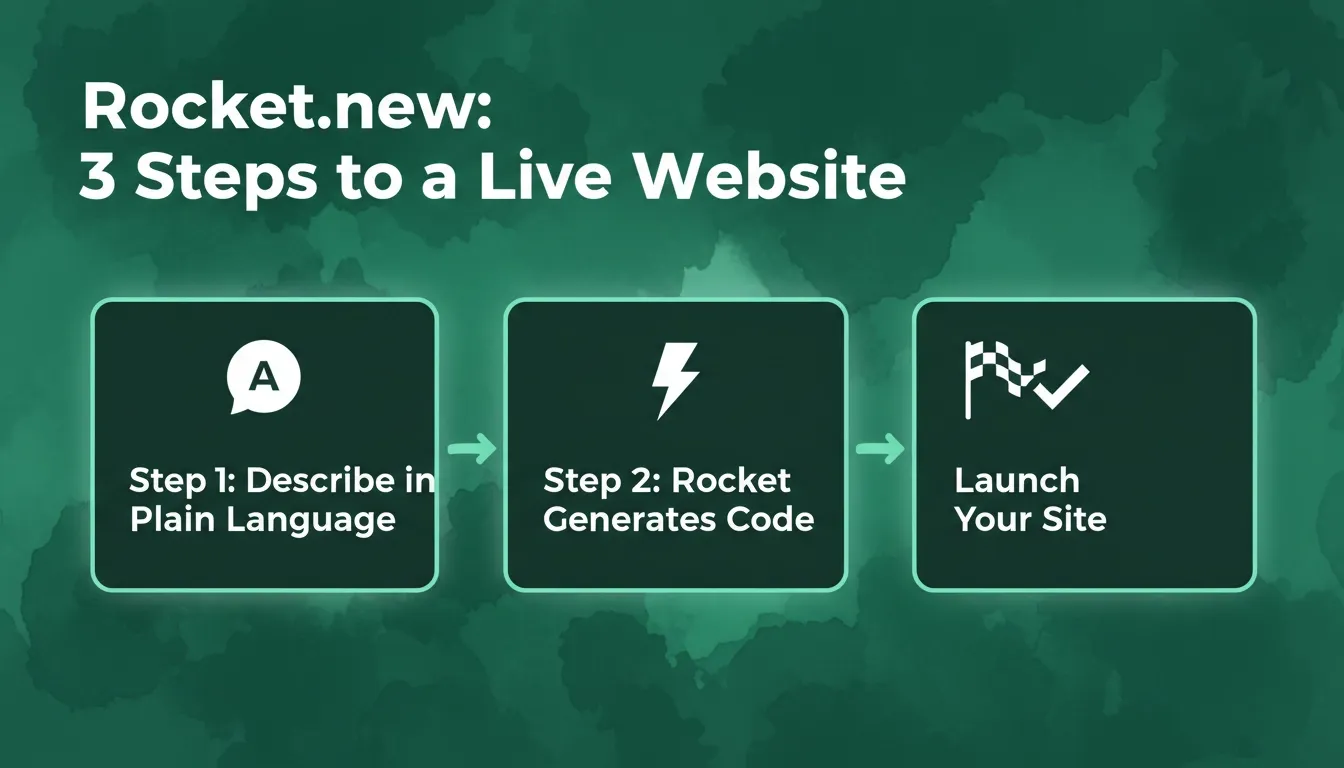
Describe your idea: Use plain language. "Build a landing page for a SaaS product targeting small businesses" or "Create a portfolio site for a freelance photographer with a dark aesthetic." A single prompt is all it takes.
-
Rocket generates: The platform plans architecture, writes production-ready code, and shows a live preview. Most websites generate in minutes.
-
Refine and launch: Iterate through Chat (natural language), Visual Edit (click elements directly), or Code (edit source files). No change limit.
The output is not a wireframe or a mockup. It is a working, deployable website with real design hierarchy, intentional typography, and visual identity specific to your project.
What You Can Build with Rocket.new
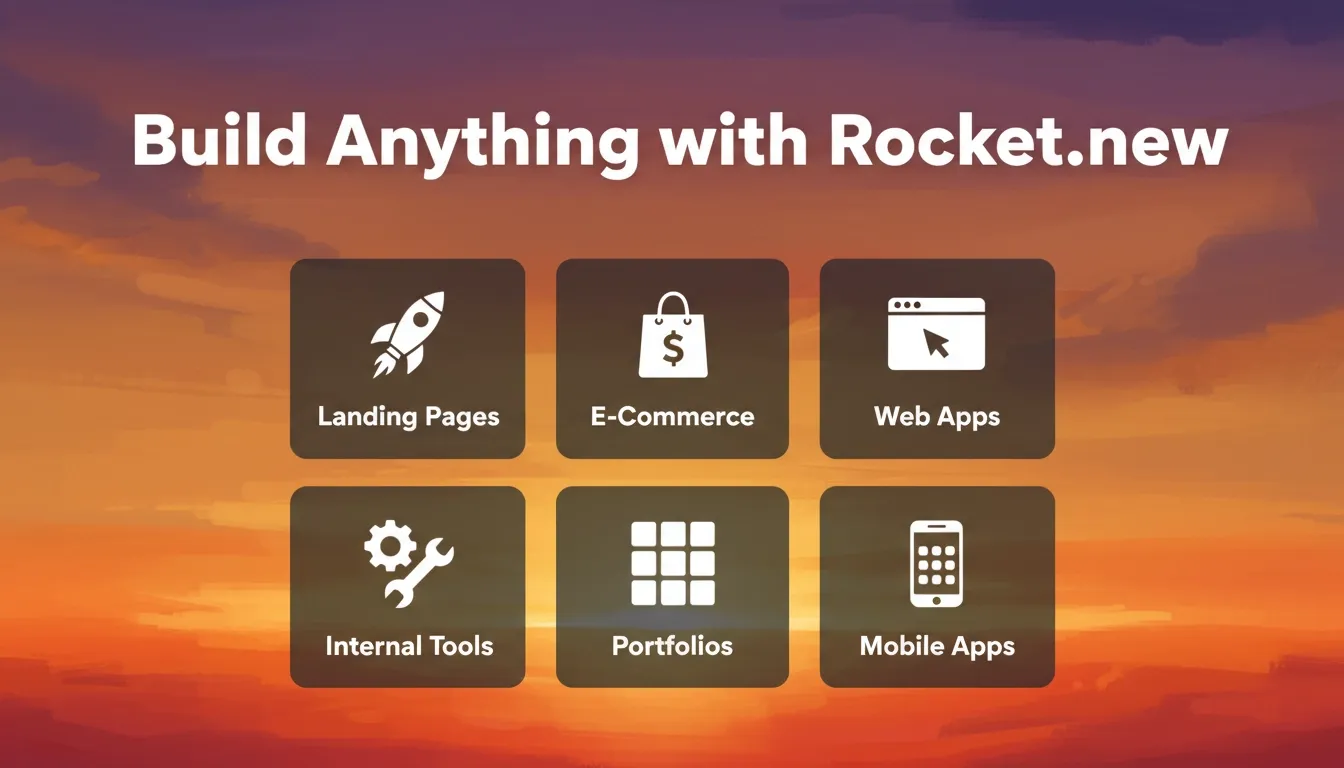
Rocket.new covers the full range of web projects, from simple landing pages to complex web apps:
-
Landing pages: Conversion-focused, SEO-ready, built from your actual project context so the hero speaks to your specific customer problem
-
Multi-page websites: Full sites where every page holds the same quality standard as the homepage
-
Web apps: SaaS dashboards, customer portals, internal tools, and AI-powered apps
-
E-commerce stores: Product catalogs, checkout flows, payment integrations
-
Blogs and portfolios: Visually appealing, fully responsive, built to your brand
The Design Quality Difference
Here is where Rocket.new separates from every other AI website builder on the market. Most AI builders produce output that looks like AI made it. Rocket generates output that looks like a design team touched it.
Rocket does not pull from a template library. It generates considered typography, real hierarchy, and visual identity specific to your project from the ground up. Nothing reads as AI-made.
Rocket.new vs Traditional Builders: A Direct Comparison
| Feature | Traditional Builders | Rocket.new |
|---|---|---|
| Starting point | Template selection | Plain language description |
| Design flexibility | Limited to template grid | Fully custom, generated from scratch |
| Template switching | Often impossible (Wix locks you in) | No templates, every build is unique |
| Technical skills needed | Moderate (drag and drop editor) | None (natural language) |
| Code access | Restricted or none | Full source code download |
| Custom domain | Paid plans only | Available on free and paid plans |
| Mobile optimization | Automatic but template-bound | Fully responsive, built-in |
| Iteration method | Manual drag and drop | Chat, Visual Edit, or direct Code |
| Output quality | Template-based, generic | Production-grade, design-quality |
| Backend logic | None | Full frontend and backend |
| User authentication | Plugin-dependent | Built-in |
| Free plan | Rarely available | Yes, $0 with 20 credits |
The Compound Intelligence Advantage
One thing that sets Rocket.new apart from every other AI website builder is its memory architecture. Most tools start from zero every session. Rocket is built on the opposite principle.
Add your brand guidelines, your research, your product brief once and every task that follows already knows everything. The tenth website you build inside a project knows everything the first nine established.
This is not a feature. It is an architectural difference that compounds over time.
For agencies building websites for multiple clients, for founders iterating on their product site week after week, for marketing teams spinning up pages for every campaign, this matters enormously. The entire process becomes faster and more aligned with your brand the more you use it.
Built-In Performance and SEO Infrastructure
Rocket.new does not just build websites. It ships them with everything they need to perform. According to Rocket.new's own Lighthouse benchmarks, sites built on the platform score 92-100 across Performance, SEO, Accessibility, and Best Practices:
-
Built-in analytics: Visitors, conversions, Core Web Vitals, all tracked from day one
-
SEO-ready structure: Clean semantic HTML, meta descriptions, structured data, XML sitemaps, all generated automatically
-
Staging and production environments: Full version history, one-click rollback
-
Integrations: Stripe, Google Analytics, Supabase, Mailchimp, Notion, Linear, and more, all flowing directly into the build
Redesign: For Sites You Already Have
Already have a website that is underperforming? Rocket.new's Redesign feature lets you point it at any live URL and tell it what needs to change using slash commands:
-
Reimagine Website Design: Modern look, all existing content preserved
-
Full Website Makeover: Completely new look, layout, and copy
-
Mobile-First Redesign: Rebuilt for mobile optimization and how most users actually arrive
-
Fix Conversion Issues: Analyze and redesign around bounce and drop-off problems
-
Redesign Like Competitor: Apply the design style of one website to yours
This gives businesses a third option between starting from scratch and hiring an agency.
Who Is Rocket.new Built For?
Rocket.new serves three distinct types of users across 1.5 million people in 180 countries:
The Builder: Founders, developers, and agencies shipping products. They need production-quality output fast, with full control over the code when they want it.
The Operator: Marketing teams needing pages, sales teams needing prospect pages, ops teams needing internal tools. They do not want to write code. They want results.
The Platform Consolidator: Enterprise teams replacing tool sprawl. Instead of separate tools for design, building, analytics, and content, one platform handles the full arc from idea to live site.
For small business owners in particular, Rocket.new removes the technical skills barrier entirely. You do not need a design background. You do not need to understand web development. You describe what you want, and you get a professional result.
The Website Builder Problem Has a Better Answer
The website builder market has been stuck in the same loop for years. Pick a template. Hit a wall. Start over. Pay more for features that should have been included from day one.
The Rocket.new way to website builders breaks that loop. No templates means no template walls. No limits means your website looks and works exactly the way you need it to.
With a free plan, production-grade output from the very first prompt, and a platform that gets smarter over time, there has never been a better time to leave templates behind.
Table of contents
- -The Template Trap: How Traditional Website Builders Hold You Back
- -What Most Traditional Builders Get Wrong
- -The Drag and Drop Illusion
- -Why No Code Tools Changed the Game But Only Halfway
- -What AI Website Builders Actually Promised
- -The Three Gaps Most AI Builders Never Closed
- -Rocket.new: Building Websites the Way They Should Be Built
- -How Rocket.new Works
- -What You Can Build with Rocket.new
- -The Design Quality Difference
- -Rocket.new vs Traditional Builders: A Direct Comparison
- -The Compound Intelligence Advantage
- -Built-In Performance and SEO Infrastructure
- -Redesign: For Sites You Already Have
- -Who Is Rocket.new Built For?
- -The Website Builder Problem Has a Better Answer