
Before you ship, every access control gap, unencrypted data store, and unvetted vendor is a liability waiting to activate. This checklist covers the five security layers that separate a safe SaaS launch from a costly one.
Does your team have a security checklist before launch?
Most don't.
According to IBM's 2026 Cost of Data Breach report, the average data breach now costs organizations $4.99 million. That is a 12% jump over last year. Most incidents trace back to gaps a structured review would have caught early.
-
Security breaches targeting SaaS platforms increased 56% in 2026, with AI-driven attacks leading the surge
-
Verizon's 2026 DBIR found that 31% of all breaches now start with software vulnerabilities, surpassing stolen credentials
-
The Thales Cloud Security Study reports the average enterprise uses 85 SaaS apps, yet only 8% encrypt more than 80% of their cloud data
For teams concerned with protecting your application from agentic bot traffic, a thorough SaaS security review catches threats that automated scans miss entirely.
The Complete SaaS Security Checklist at a Glance
Before diving into each section, use this table as a quick reference before your launch date.
| Security Domain | Key Items | Priority |
|---|---|---|
| Access Control | MFA for all accounts, least privilege, quarterly access reviews, offboarding automation | Critical |
| Data Protection | AES-256 at rest, TLS 1.3 in transit, data classification, backup testing | Critical |
| Secrets Management | Environment variable storage, secrets vault, key rotation schedule | Critical |
| Incident Response | Written IR plan, SIEM deployment, tamper-proof audit logs, tabletop exercises | High |
| Vendor Risk | SOC 2 Type II verification, BAAs, vendor lifecycle management | High |
| Network Security | API key rotation, WAF deployment, vulnerability scanning, dependency updates | High |
| Security Testing | OWASP Top 10 testing, penetration testing, DAST/SAST scanning | High |
| Compliance | SOC 2 / GDPR / HIPAA / PCI DSS mapping, compliance roadmap, ownership assignment | Medium |
Access Control and Authentication
Access control is the foundation of every SaaS security strategy. When authentication fails, everything else in your checklist becomes irrelevant. Companies face exposure across their entire environment as a result.
Multi-Factor Authentication Setup
Implementing multi-factor authentication (MFA) remains the single most effective security measure against credential theft. It applies to every SaaS application, regardless of size.
-
Require MFA for all user accounts, not just admin roles
-
Support hardware tokens, authenticator apps, and biometric verification
-
Implement adaptive authentication that evaluates device, location, and login patterns
-
Set session timeouts that balance security with user experience
-
Enforce MFA re-authentication for high-sensitivity actions, such as payment changes or permission escalation
Every SaaS application should treat MFA as a baseline, not an optional upgrade. Add this to the top of your checklist and implement it before any other access control step.
Role-Based Permissions and Privilege Management
Access management works best when users receive only the permissions they need. This principle, known as least privilege, is the cornerstone of zero-trust architecture. Under zero-trust, no user or system is trusted by default, regardless of network location.
-
Define roles based on job function, not individual requests
-
Implement least privilege across all SaaS applications and systems
-
Create separate admin accounts distinct from daily-use accounts
-
Document every permission level and who approved it in your checklist
-
Apply zero-trust principles: verify every access request, assume breach, and limit blast radius
Security teams should review permission structures quarterly. Privilege creep happens gradually. Without regular reviews, users accumulate access they no longer need.
Regular Access Reviews and Offboarding
Regular access reviews prevent orphaned accounts from becoming attack vectors. When employees leave, their access should terminate the same day. Delayed offboarding is one of the most common SaaS security gaps organizations face.
-
Conduct quarterly audits of all user access levels across SaaS applications
-
Automate account deactivation upon employee termination
-
Review service account credentials and rotate them on schedule
-
Audit third-party integration tokens and revoke any that are no longer actively used
Monitoring Privileged User Actions
Privileged user actions carry the highest risk because admin accounts can bypass normal security controls.
-
Log every privileged user action with timestamps and context
-
Set alerts for unusual admin behavior outside normal working hours
-
Require secondary approval for high-impact changes, such as permission escalation
-
Review privileged user actions monthly to identify patterns
Understanding web application security best practices gives security teams the broader framework to connect access control decisions to your full application threat model.
Data Protection and Encryption Standards
Data protection is where SaaS security gets specific. General access control limits who can reach your systems. Encryption and data classification, however, determine what happens to sensitive data once someone is inside.
Encryption at Rest and in Transit
Every piece of sensitive data in your SaaS application needs encryption at rest and in transit. There are no exceptions.
-
Use AES-256 for data stored in databases and file systems at rest
-
Enforce TLS 1.3 for all data in transit between services and systems
-
Encrypt backups with the same rigor as production data
-
Manage encryption keys separately from the data they protect, and rotate them on a defined schedule
-
Use a dedicated key management service (KMS) rather than storing keys alongside encrypted data
The Thales Cloud Security Study found that only 8% of organizations encrypt 80% or more of their cloud data. That means 92% of enterprises leave significant portions of sensitive information exposed.
Sensitive Data Classification and Storage
Not all data carries the same risk level. A classification system helps security teams prioritize protection efforts and focus resources where they matter most.
| Classification Level | Examples | Security Measures Required |
|---|---|---|
| Critical | Payment card data, health records, credentials, PII | AES-256, access logging, audit trails, data masking, tokenization |
| Sensitive | Customer emails, usage analytics, internal reports | Encryption at rest, role-based access, retention policies |
| Internal | Team documentation, project plans, meeting notes | Access control, standard encryption |
| Public | Marketing content, published docs, open APIs | Integrity checks, version control |
Classifying your data upfront makes your checklist actionable. Each level maps to specific controls, so security teams know exactly what to implement and can evaluate compliance requirements accordingly.
Secrets Management
One of the most overlooked items on any SaaS security checklist is how your application handles secrets. This includes API keys, database credentials, OAuth tokens, and service account passwords.
-
Store all secrets as environment variables. Never hardcode credentials in source code or configuration files.
-
Use a dedicated secrets management tool, such as HashiCorp Vault or AWS Secrets Manager, for production environments
-
Rotate secrets on a defined schedule and immediately upon any suspected compromise
-
Audit which services have access to which secrets, and apply least-privilege principles to service accounts
-
Scan your codebase for accidentally committed secrets before every deployment
Secrets management failures are responsible for a disproportionate share of SaaS breaches. Fortunately, they are almost entirely preventable with the right tooling and discipline.
Customer Data Handling and Compliance
Customer data carries unique obligations that extend beyond standard data protection measures.
-
Map every location where customer data is stored, processed, or transmitted
-
Implement data retention policies that comply with GDPR, CCPA, and industry standards
-
Provide customers with data export and deletion capabilities as required by privacy regulations
-
Maintain a business associate agreement with any third-party vendor handling customer data
Privacy regulations vary by region. The baseline, however, is clear: know where customer data lives, who accesses it, and how long you store it.
Backup Strategies for Data Loss Prevention
Data loss events can happen through attacks, system failures, or simple human error.
-
Automate daily backups with geographic redundancy
-
Test backup restoration monthly to confirm data integrity
-
Store backup encryption keys in a separate secure location
-
Define recovery time objectives (RTO) and recovery point objectives (RPO) for each data tier
-
Verify that backup systems are themselves access-controlled and monitored
Your backup strategy is only as good as your last successful restore test.
Security Testing Before Launch
Most SaaS teams test functionality. Fewer test security. A structured security testing program before launch catches the vulnerabilities that functional testing misses entirely.
OWASP Top 10 Coverage
The OWASP Top 10 is the industry-standard reference for the most critical web application security risks. Every SaaS application should be tested against each category before launch.
| OWASP Risk | What to Test | Mitigation |
|---|---|---|
| Broken Access Control | Unauthorized resource access, privilege escalation | Enforce server-side authorization on every request |
| Cryptographic Failures | Weak algorithms, unencrypted sensitive data | AES-256 at rest, TLS 1.3 in transit |
| Injection | SQL, NoSQL, OS command injection | Parameterized queries, input validation |
| Insecure Design | Missing threat modeling, insecure design patterns | Security design reviews before development |
| Security Misconfiguration | Default credentials, unnecessary features enabled | Hardening checklists, automated config scanning |
| Vulnerable Components | Outdated libraries, unpatched dependencies | Dependency scanning, automated updates |
| Auth Failures | Weak passwords, missing MFA, session fixation | MFA enforcement, secure session management |
| Data Integrity Failures | Unsigned updates, insecure deserialization | Code signing, integrity verification |
| Logging Failures | Missing security event logging | Comprehensive audit logging with SIEM |
| SSRF | Unvalidated server-side requests | Allowlist-based URL validation |
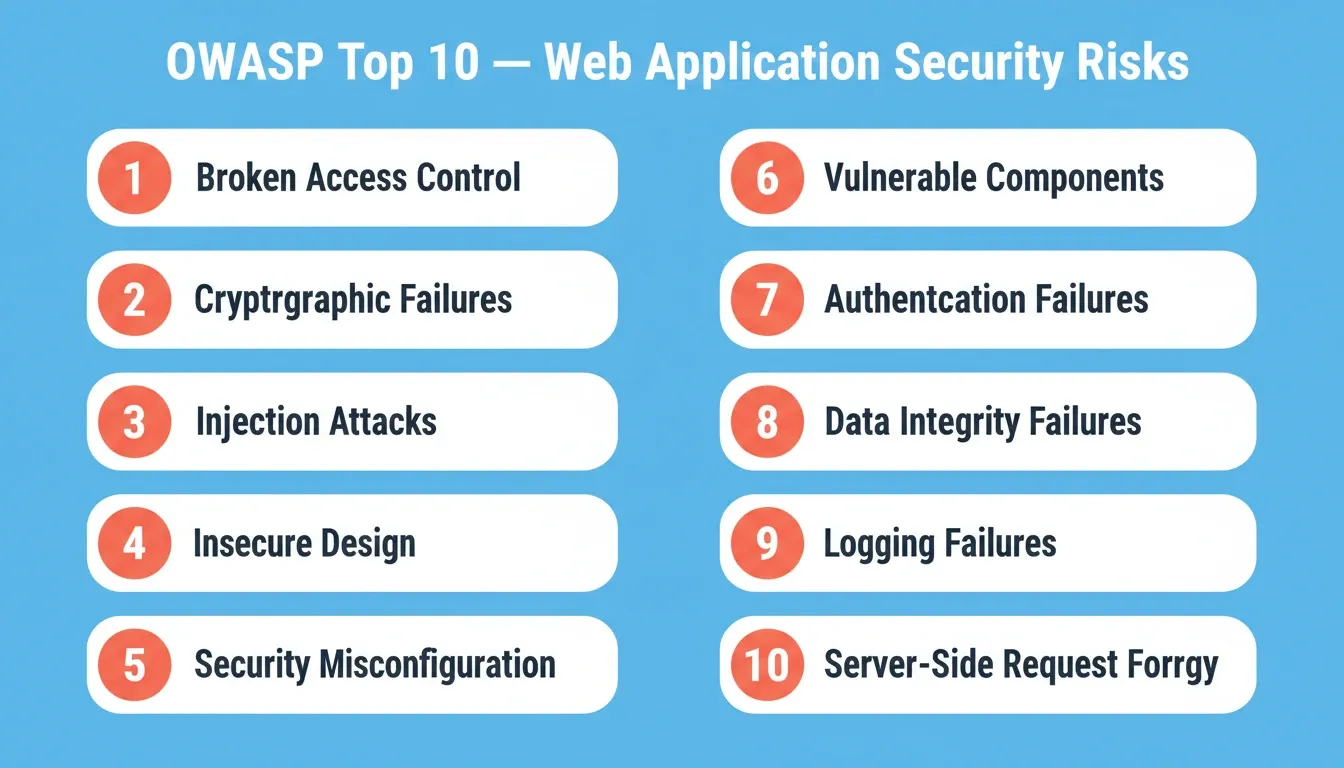
OWASP Top 10 web application security risks — all 10 categories numbered 1 to 10 with consistent coral-orange number circles
Penetration Testing
Penetration testing involves security professionals actively attempting to breach your application. It should happen before your first public launch and after any major architectural change.
-
Conduct a black-box test that simulates an external attacker with no prior knowledge
-
Run a gray-box test where testers use a standard user account to simulate insider threats
-
Test API endpoints specifically, since SaaS applications expose far more attack surface through APIs than traditional web apps
-
Address all critical and high findings before launch, and document medium and low findings with remediation timelines
Static and Dynamic Analysis
Automated security testing tools catch vulnerabilities continuously throughout development, not just at launch.
-
SAST (Static Application Security Testing): Scans source code for vulnerabilities before deployment. Integrate it into your CI/CD pipeline so every commit gets checked.
-
DAST (Dynamic Application Security Testing): Tests the running application by simulating attacks against your staging environment before every production release.
-
SCA (Software Composition Analysis): Scans third-party dependencies for known CVEs. Tools like Snyk or Dependabot automate this continuously.
-
Container scanning: If you use Docker or Kubernetes, scan container images for vulnerabilities before deployment.
Additionally, teams that want to scale their SaaS safely need these testing layers in place before growth begins. Security gaps that are manageable at 100 users become critical at 10,000.
How Should Security Teams Handle Incident Response?
Incident response separates organizations that recover quickly from those that spiral into prolonged crises. Having a plan before incidents occur cuts response time and limits damage to your SaaS applications and business operations.
Building Your Incident Response Plan
An incident response plan defines who does what when a security event hits your systems.
-
Assign clear roles for incident commander, communications lead, and technical responders
-
Define severity levels with specific triggers and escalation paths for each incident type
-
Document containment procedures for each incident category
-
Conduct tabletop exercises quarterly to keep the plan sharp
-
Establish communication templates for customer notifications, regulatory bodies, and internal stakeholders
Each security incident improves your SaaS security posture for the next one. The checklist becomes more comprehensive over time, but only if you run the post-incident review every time.
Continuous Monitoring and Threat Detection
Continuous monitoring gives security teams visibility into threats before they escalate into full incidents.
-
Deploy SIEM tools that aggregate security information from all SaaS apps and systems
-
Configure alerts for anomalous behavior patterns, not just known attack signatures
-
Monitor for unusual data access patterns and flag potential threats after hours
-
Track failed authentication attempts and identify accounts showing brute-force patterns
-
Set up rate limiting on all API endpoints to detect and block automated attack patterns
For teams building monitoring capabilities from scratch, building a bot detection dashboard without a developer shows how to implement continuous monitoring with minimal overhead.
Audit Logs and Security Event Tracking
Audit logs are your forensic trail when security incidents occur. Without them, incident response becomes guesswork.
-
Log all authentication events, data access, and configuration changes with complete detail
-
Retain audit logs for at least 12 months, with critical security logging stored longer
-
Implement tamper-proof logging that prevents attackers from covering their tracks
-
Ensure logs capture user identity, timestamp, action taken, resource affected, and outcome
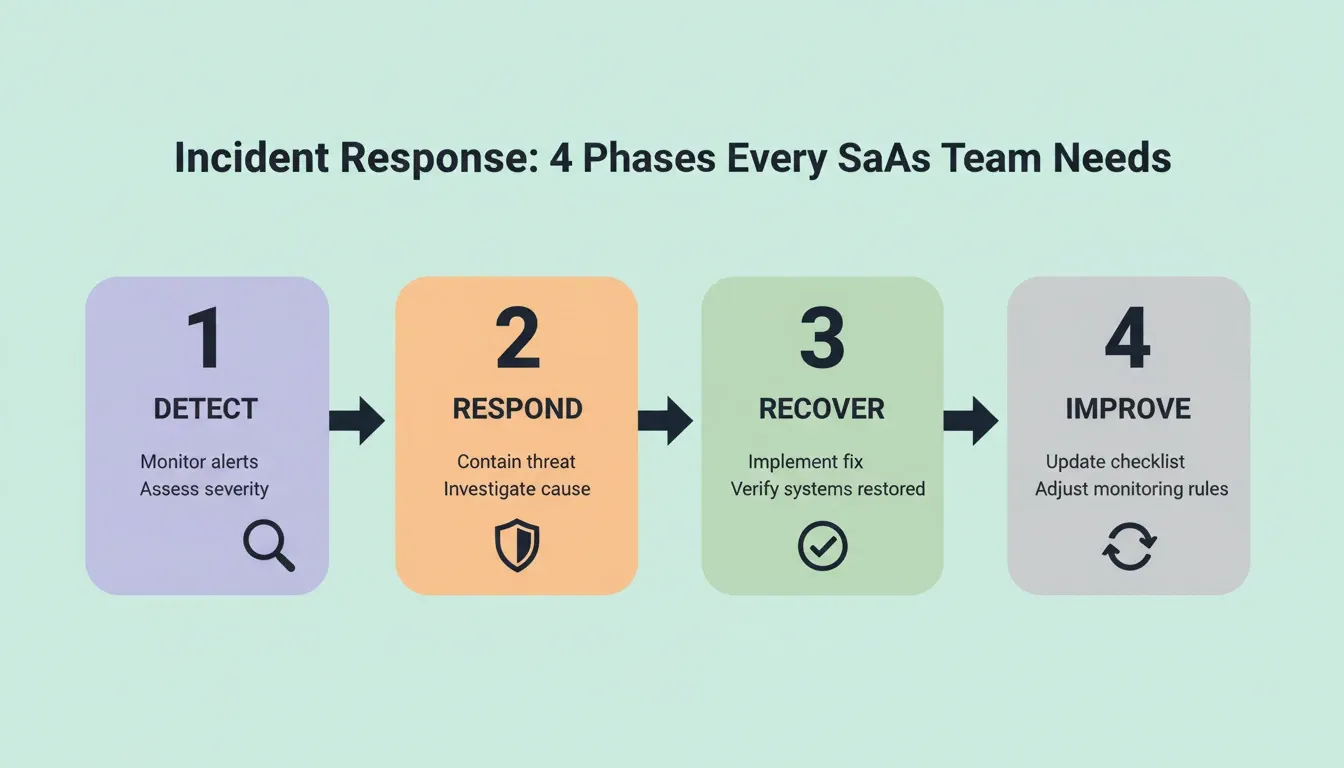
Incident response four phases — Detect, Respond, Recover, Improve — numbered and connected with arrows for SaaS security teams
SaaS Vendor Risk Assessment and Management
Every third-party vendor in your SaaS stack introduces risk you must manage throughout the vendor lifecycle. Verizon's 2026 Data Breach Investigations Report confirms that supply chain and third-party compromises continue rising. As a result, vendor management is a non-negotiable part of your SaaS security review.
Evaluating Third-Party Vendor Security Posture
Before onboarding any SaaS vendor, evaluate their security controls against your compliance requirements and business needs.
-
Request SOC 2 Type II reports or equivalent compliance certifications from each provider
-
Review the vendor's incident response history and public breach disclosures
-
Evaluate their data encryption standards, access control mechanisms, and security policies
-
Confirm they conduct regular penetration testing and vulnerability assessments
-
Check their practices against NIST or ISO frameworks to evaluate compliance
Most organizations evaluate vendors only during onboarding. Quarterly re-assessments catch deteriorating security postures before they affect your business systems.
Business Associate Agreements
A business associate agreement (BAA) defines security responsibilities between your organization and each SaaS vendor.
-
Specify data handling obligations, including encryption requirements
-
Define breach notification timelines and incident response coordination processes
-
Include audit rights that let you verify the vendor's compliance claims
-
Establish termination protocols for data return and secure deletion
Without formal agreements, your compliance posture depends entirely on vendor goodwill. That is not a risk any organization handling sensitive data should carry.
Vendor Onboarding and Termination Protocols
Manage the full lifecycle of every SaaS vendor relationship with documented processes your security teams can follow consistently.
-
Create a standardized vendor onboarding checklist covering security, compliance, and service requirements
-
Assign each vendor a risk tier based on their access to sensitive data
-
Document all API connections, data flows, and access credentials for each vendor
-
Upon termination, revoke all access, rotate shared credentials, and confirm complete data deletion
Your vendor management process should match the rigor of your internal security controls. Third parties with access to your data carry the same risk as internal employees.
What Network Security Measures Protect Against Threats?
Network security measures create the perimeter around your SaaS applications and infrastructure. Even with strong access control and encryption, exposed APIs and unpatched systems invite attacks.
API Key Management and Rotation
API keys are one of the most common attack vectors targeting SaaS applications today.
-
Store API keys in dedicated secrets management tools or as environment variables. Never store them in source code.
-
Rotate API keys on a defined schedule: every 90 days for standard keys, every 30 days for privileged access
-
Implement key scoping so each API key carries minimum permissions required
-
Monitor API key usage patterns and flag unexpected activity
-
Revoke compromised API keys immediately and audit all recent calls
Teams focused on building API documentation tools with AI should implement key management into their workflow from the start. Documentation and security discipline go hand in hand.
Rate Limiting and DDoS Protection
Distributed denial-of-service (DDoS) attacks and credential stuffing campaigns are among the most common threats targeting SaaS login and API endpoints.
-
Implement rate limiting on all authentication endpoints to block brute-force attacks
-
Apply progressive rate limits: warn at threshold, throttle at double, and block at triple
-
Use a web application firewall (WAF) to filter malicious traffic patterns before they reach your application
-
Configure DDoS protection at the CDN or load balancer level for volumetric attacks
Infrastructure Security and Vulnerability Scanning
Infrastructure security extends beyond the application layer to protect the systems underneath your SaaS software.
-
Run automated vulnerability scans weekly against all public-facing services and systems
-
Implement web application firewalls to filter malicious traffic
-
Segment your network to limit lateral movement during security incidents
-
Keep all dependencies and runtime environments updated with security patches
-
Use container scanning tools to identify vulnerabilities in your deployment pipeline
Modern AI tools can identify potential threats faster than manual review cycles. This gives security teams a head start on patching before vulnerabilities are exploited.
Compliance Frameworks and Regulatory Standards
Compliance is the framework that validates your SaaS security practices against industry-accepted standards. It also provides visibility into how well your controls work.
Meeting SOC, ISO, and NIST Requirements
Different compliance standards apply depending on your industry, business model, and customer base.
-
SOC 2 Type II: Requires documented security controls with evidence of sustained operations over time. It is the baseline requirement for most B2B SaaS companies selling to enterprise buyers.
-
ISO 27001: Provides a comprehensive security management system framework. It is recognized internationally and often required for European enterprise contracts.
-
NIST Cybersecurity Framework: Offers flexible guidelines that organizations can adapt to their risk profile. It is widely adopted in US government and regulated industries.
-
HIPAA: Required for any SaaS provider handling protected health information. Violations carry penalties up to $1.9M per violation category per year.
-
PCI DSS: Mandatory when your application processes, stores, or transmits payment card data.
-
GDPR: Applies to any organization processing personal data of EU residents. Fines reach up to 20 million euros or 4% of global annual turnover.
Most organizations need compliance with multiple frameworks. Map overlapping requirements to avoid duplicating effort across your security teams.
Compliance Penalty Reference
Understanding the financial exposure of non-compliance helps prioritize your roadmap.
| Framework | Applies To | Maximum Penalty |
|---|---|---|
| GDPR | Any org processing EU resident data | 20 million euros or 4% global annual turnover |
| HIPAA | Healthcare data handlers (US) | $1.9M per violation category/year |
| PCI DSS | Payment card data processors | Fines plus loss of card processing rights |
| CCPA | California consumer data (US) | $7,988 per intentional violation |
| SOC 2 | B2B SaaS (enterprise buyers require it) | No statutory fine; contract and reputational risk |
Creating Your Compliance Roadmap
A compliance roadmap turns abstract requirements into actionable items on your SaaS security checklist.
-
Identify which frameworks apply based on your data types, geography, and industry
-
Map current security controls to each framework's requirements and evaluate gaps
-
Prioritize gaps by risk level and effort required to implement solutions
-
Assign ownership for each compliance requirement with clear deadlines
-
Schedule regular compliance reviews to stay ahead of regulatory changes
Compliance requirements evolve with technology and threats. Building your roadmap as a living document keeps your SaaS security practices current without scrambling during audit season.
How Rocket Helps You Build Secure SaaS Applications
Building secure SaaS applications traditionally means choosing between speed and comprehensive security controls. Most development teams either ship fast with security gaps or spend months configuring security infrastructure before writing a single feature.
Rocket generates production-ready Next.js web apps and Flutter mobile apps with security-conscious defaults from the first generation. Here is what Rocket handles by default, and what you can add through conversation:
| Security Layer | Rocket Default | Add via Conversation |
|---|---|---|
| HTTPS | Automatic for all custom domains | Already included |
| GDPR compliance | Baseline coverage built in | Cookie consent banners, geo-based consent flows, DSAR management tools |
| WCAG accessibility | WCAG 2.1 AA baseline | Full ARIA labels, keyboard navigation, color contrast fixes |
| Environment variables | API keys stored at server level, auto-stripped from shared exports | Additional secrets management patterns |
| Staging/production | Separate environments, full version history, one-click rollback | Custom deployment configurations |
| Role-based access | Three-level access control (Admin, Creator, Viewer) | Additional access restriction patterns |
When you connect integrations through Rocket, such as Stripe, Supabase, OpenAI, and 25+ others, API keys are stored as environment variables at the server level. They are never exposed in client-side code. Additionally, they are automatically stripped from any project shared via Rocket's Remix feature.
Use the /Implement Privacy Compliance command to add GDPR consent banners, CCPA notices, and privacy policy pages. Use /Generate Accessibility Report for WCAG 2.1 AA compliance documentation. Rocket's Build capability generates the product; Solve validates the direction before you build; and Intelligence monitors the competitive environment after you ship.
Teams working on a SaaS development workflow that incorporates security from the start will find that Rocket's defaults cover a significant portion of the pre-launch checklist automatically.
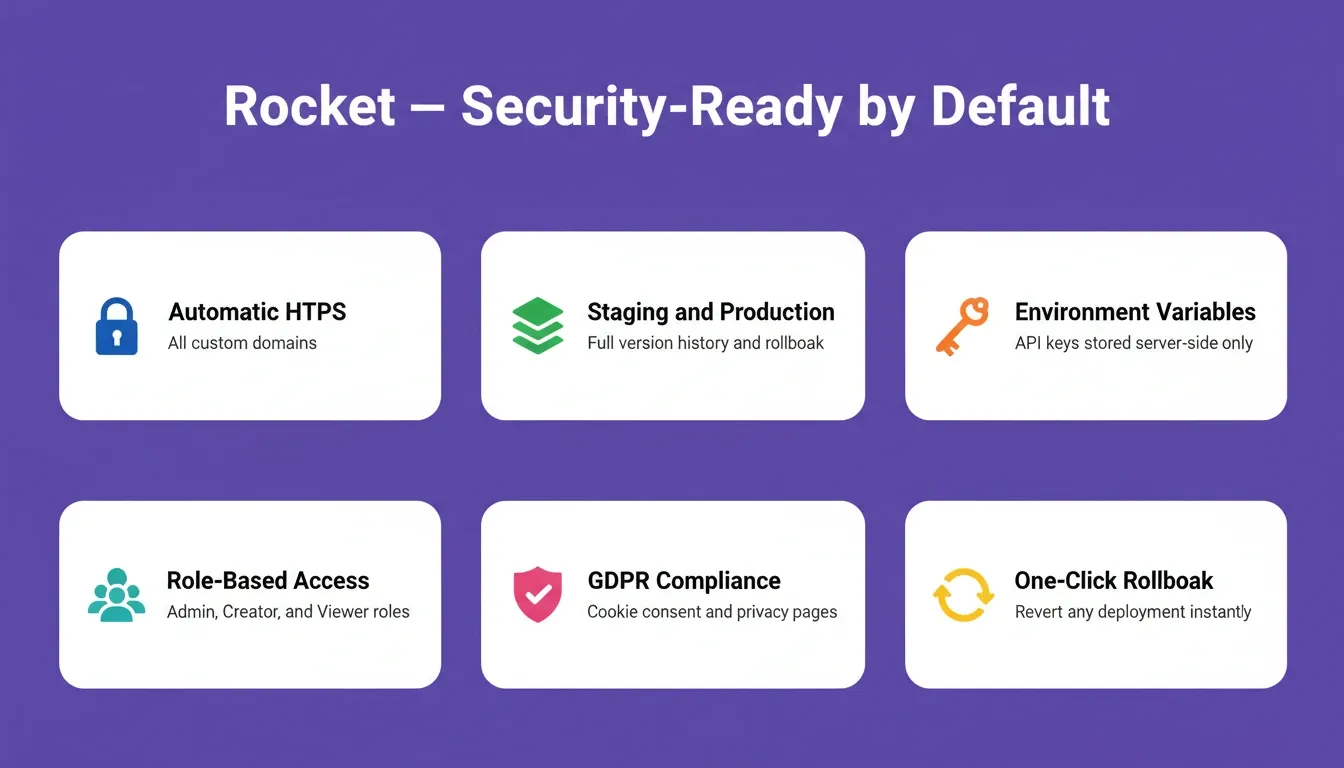
Rocket security-ready defaults — automatic HTTPS, staging and production environments, environment variables, role-based access, GDPR compliance, and one-click rollback
"The accelerating shift to cloud and AI is forcing enterprises to rethink how they manage risk at scale." — Sebastien Cano, Senior Vice President of Cyber Security Products, Thales
Launch With Security Built In, Not Bolted On
Every gap in your SaaS security checklist is a decision made before users trust you with their data. Security is not a one-time task. It is an ongoing practice that grows with your product, your team, and the threats targeting your systems.
As AI-driven attacks grow more sophisticated and compliance requirements expand globally, the organizations that treat security as a feature from day one will carry a structural advantage over those that retrofit it later. The checklist in this guide covers the five layers that matter most: access control, data protection, incident response, vendor risk, and network security.
You type what you want to build. Rocket handles the security defaults, the compliance scaffolding, the staging and production environments, and the full code ownership. Your SaaS security checklist is covered before you write a single feature. Start building on Rocket for free and ship with confidence.
Table of contents
- -The Complete SaaS Security Checklist at a Glance
- -Access Control and Authentication
- -Multi-Factor Authentication Setup
- -Role-Based Permissions and Privilege Management
- -Regular Access Reviews and Offboarding
- -Monitoring Privileged User Actions
- -Data Protection and Encryption Standards
- -Encryption at Rest and in Transit
- -Sensitive Data Classification and Storage
- -Secrets Management
- -Customer Data Handling and Compliance
- -Backup Strategies for Data Loss Prevention
- -Security Testing Before Launch
- -OWASP Top 10 Coverage
- -Penetration Testing
- -Static and Dynamic Analysis
- -How Should Security Teams Handle Incident Response?
- -Building Your Incident Response Plan
- -Continuous Monitoring and Threat Detection
- -Audit Logs and Security Event Tracking
- -SaaS Vendor Risk Assessment and Management
- -Evaluating Third-Party Vendor Security Posture
- -Business Associate Agreements
- -Vendor Onboarding and Termination Protocols
- -What Network Security Measures Protect Against Threats?
- -API Key Management and Rotation
- -Rate Limiting and DDoS Protection
- -Infrastructure Security and Vulnerability Scanning
- -Compliance Frameworks and Regulatory Standards
- -Meeting SOC, ISO, and NIST Requirements
- -Compliance Penalty Reference
- -Creating Your Compliance Roadmap
- -How Rocket Helps You Build Secure SaaS Applications
- -Launch With Security Built In, Not Bolted On