
25 ready-to-use AI prompts for API testing covering CRUD, security, performance, error handling, and contract validation. Each prompt is annotated with what it catches. Paste into ChatGPT, Claude, or Gemini and adapt to your endpoints.
What you'll find here: 25 structured AI prompts covering functional, security, performance, error handling, and contract testing, ready to paste into ChatGPT, Claude, or Gemini. Written for QA engineers and developers who want faster, more complete API test coverage without writing boilerplate from scratch.
The core stat: 81% of API-related work involves testing, yet only 17% of teams practice contract testing. AI prompts close that gap in minutes.
Who this is for: QA leads, backend developers, and platform engineers building or maintaining REST APIs.
AI-generated test prompts help QA teams catch bugs faster and cover more endpoints per sprint. This guide delivers 25 ready-to-use top AI prompts for API testing across five categories, each structured for immediate use and annotated so you know exactly what each prompt catches and why it matters.
Why Your API Testing Strategy Needs AI-Driven Prompts
The shift toward AI-assisted testing is not a prediction. It already happened.
According to Mordor Intelligence, the AI-powered software testing market is projected to reach $39.43 billion by 2031, growing at a 26.88% CAGR. QA teams that write targeted AI prompts are catching defects earlier, covering more edge cases, and automating test generation at scale.
-
81% of API-related work involves testing, according to Postman's 2025 State of the API Report. Testing remains the single most common activity for developers working with APIs, ahead of development (73%) and documentation (58%).
-
Only 17% of teams practice contract testing. That gap means most teams catch failures in production, not in staging. AI prompts bridge this by generating contract validation scripts from a single sentence.
-
57% of test cases are now automated across the industry. Teams with strong prompt libraries push that number above 80% within a quarter.
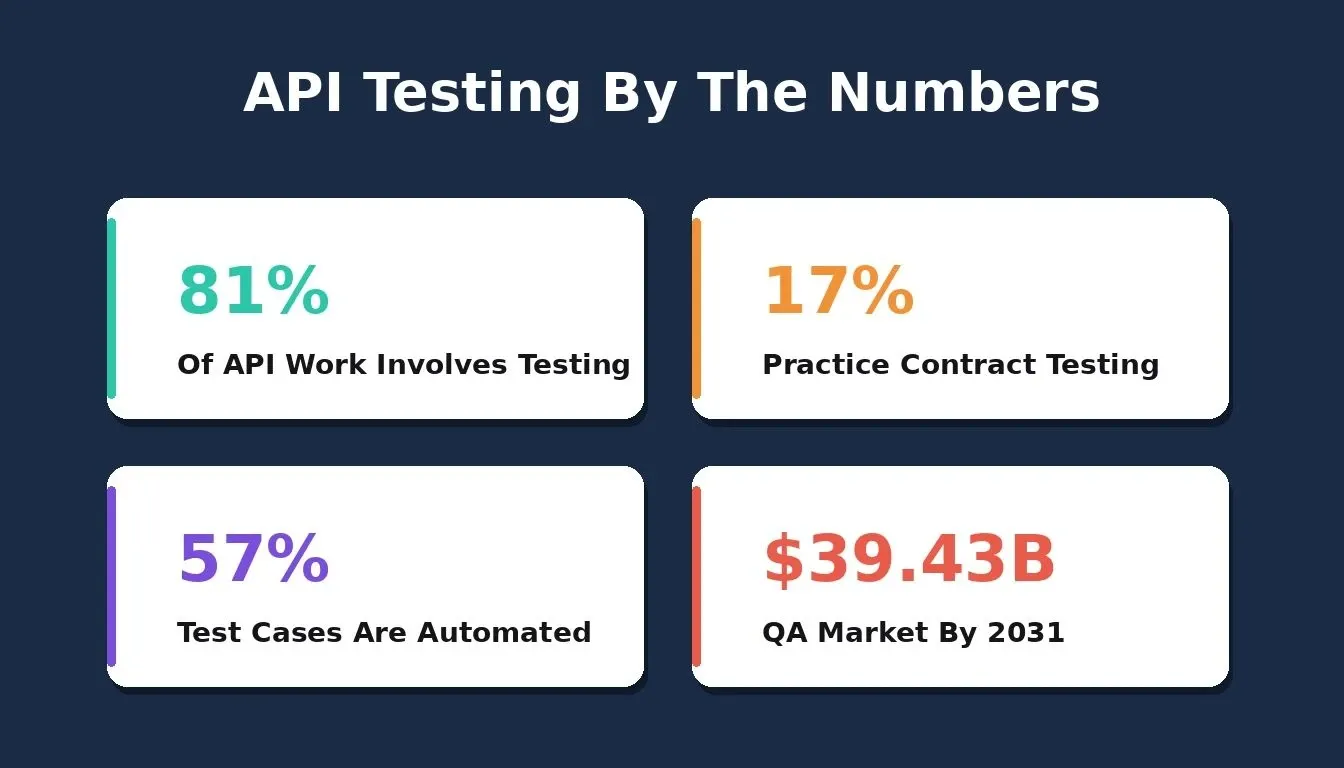
Key API testing statistics that show where AI prompts deliver the most value
| Metric | 2024 | 2026 Projected |
|---|---|---|
| AI-powered QA market size | $9.32B | $11.99B |
| Teams using AI test tools | ~42% | ~61% |
| Average test automation coverage | 49% | 57% |
| Contract testing adoption | 12% | 17% |
Testing is the most common API activity at 81%, yet contract testing sits at just 17%. That gap is where AI prompts deliver the most value. - Postman State of the API 2025
The real advantage is speed. Writing test cases manually takes hours. A well-structured prompt produces a full test suite in seconds, covering happy paths, edge cases, and failure modes that a human tester might skip under deadline pressure.
Teams already using Rocket's prompt-to-API development guide report faster iteration cycles because the AI handles boilerplate test logic.
How to Structure Prompts for Reliable API Validation
Before jumping into specific prompts, understanding prompt structure determines whether you get a useful test suite or a generic skeleton.
-
Name the endpoint and HTTP method. Testing the POST /api/users endpoint gives the AI a concrete target.
-
Specify expected inputs and outputs. Include field names, types, required vs optional flags, and expected status codes.
-
State the testing goal. Are you testing for functional correctness, security vulnerabilities, performance limits, or contract compliance?
-
Include edge cases explicitly. Mention empty strings, null values, oversized payloads, and special characters.
Learning prompt engineering best practices makes every prompt in this guide more powerful for your specific endpoints.
Functional and CRUD Testing Prompts
These five prompts validate that your API endpoints handle standard create, read, update, and delete operations correctly. Functional test coverage is the baseline every QA team needs before moving to security or performance validation.
Prompt 1 - Create Operation Validation
Generate a complete test suite for the POST /api/products endpoint. Test with valid JSON body containing name (string, required), price (number, required), and category (string, optional). Verify 201 response with a returned product ID. Test missing required fields return 400.
Why it matters: Catches missing validation logic and incorrect HTTP status codes on the most common write operation.
Prompt 2 - Read with Filters and Pagination
Write tests for GET /api/products that verify pagination with page and limit query parameters. Confirm correct item count per page, valid next/previous links, and that filtering by category returns only matching records. Test an empty result set returns 200 with an empty array.
Why it matters: Exposes off-by-one errors, missing filter logic, and broken pagination that only appear under real query conditions.
Prompt 3 - Update with Partial Data
Create tests for PATCH /api/products/:id that send partial updates. Verify that only the submitted fields change while other fields remain unchanged. Test with an invalid product ID and confirm 404 response.
Why it matters: Partial update bugs are among the most common causes of silent data corruption in production.
Prompt 4 - Delete with Cascade Check
Generate tests for DELETE /api/products/:id. Verify 204 response on success. Confirm the product no longer appears in GET requests afterward. Test deleting a product that has associated orders and verify the API returns 409 conflict or handles cascading correctly.
Why it matters: Cascade failures are rarely tested manually and frequently cause orphaned records or broken foreign key constraints.
Prompt 5 - Bulk Operations
Write test cases for POST /api/products/bulk that accepts an array of product objects. Test with 1, 10, and 100 items. Verify partial failure handling when some items have validation errors. Confirm the response includes both success and failure counts with item-level error details.
Why it matters: Bulk endpoints are high-risk surfaces. A single missing partial-failure handler can silently drop valid records.
Teams auto-generating API routes with AI find these prompts especially useful for validating generated endpoints against their actual schemas.
Security and Authentication Testing Prompts
Security flaws in APIs cost more than any other defect type. According to recent QA industry data, 75% of security teams now use AI tools for penetration testing and threat detection. These prompts target the vulnerabilities that manual testing frequently overlooks.
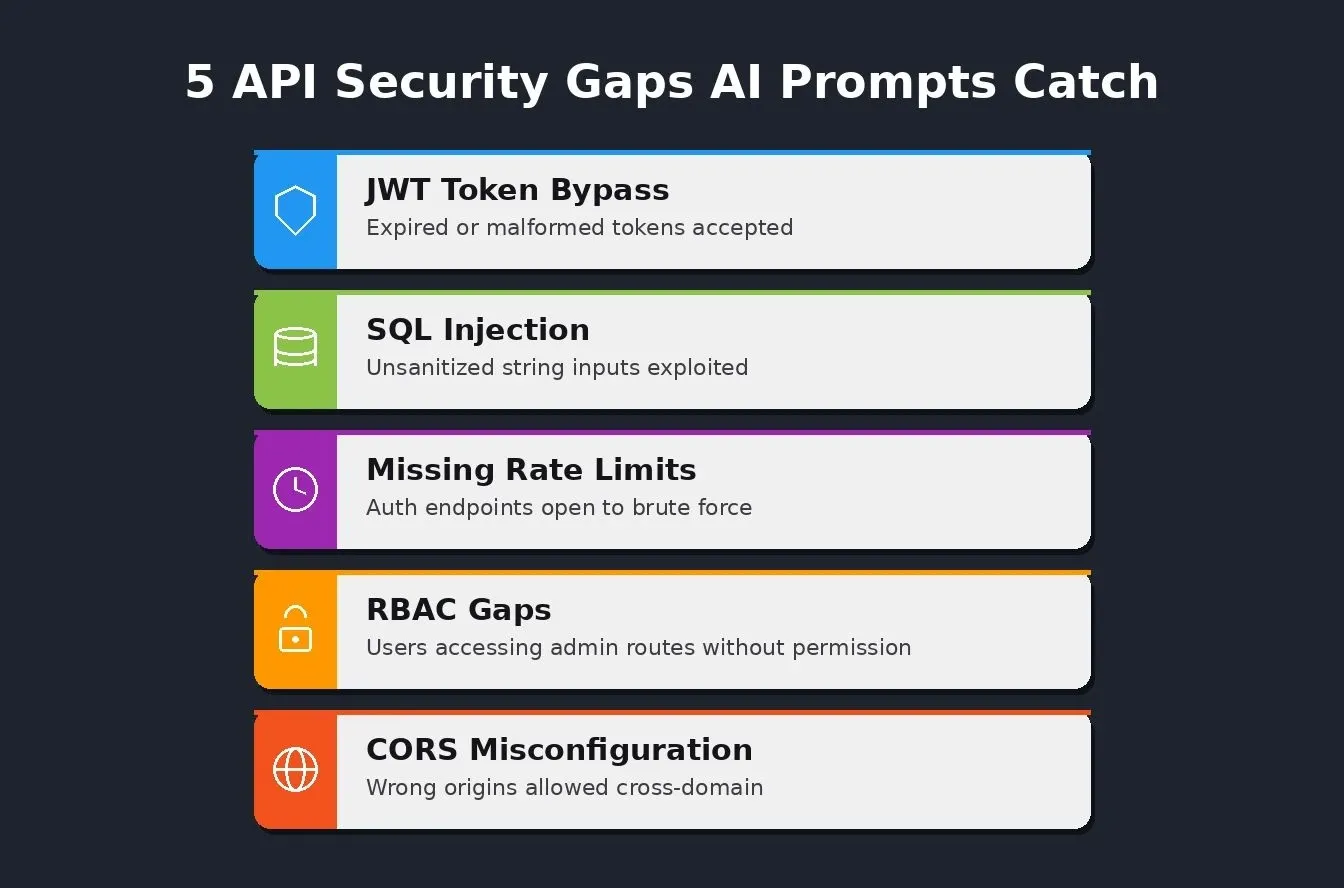
The five most common API security gaps that structured AI prompts reliably surface
Prompt 6 - JWT Token Validation
Generate security tests for all protected endpoints. Test with expired tokens, malformed tokens, tokens signed with wrong keys, and missing Authorization headers. Verify that each returns 401 with a clear error message. Confirm that the token payload cannot be tampered with.
Why it matters: Token misconfiguration is the leading cause of authentication bypass in REST APIs.
Prompt 7 - SQL Injection Prevention
Write injection test cases for every endpoint that accepts string parameters. Send payloads including single quotes, UNION SELECT statements, OR 1=1 patterns, and comment sequences. Verify the API sanitizes all inputs and returns 400 for malicious payloads instead of exposing database errors.
Why it matters: SQL injection remains the most exploited API vulnerability class. Automated prompt coverage catches it before a penetration tester does.
Prompt 8 - Rate Limiting Verification
Create tests that send 100 requests per second to POST /api/auth/login. Verify that the API returns 429 Too Many Requests after exceeding the rate limit. Confirm the response includes the Retry-After header.
Why it matters: Missing rate limits on auth endpoints make credential-stuffing attacks trivially easy.
Prompt 9 - Role-Based Access Control
Generate RBAC tests for /api/admin endpoints. Test with user, editor, and admin role tokens. Verify users get 403 Forbidden for admin-only routes. Confirm editors can read but not delete resources.
Why it matters: RBAC gaps are invisible in happy-path testing and only surface when a lower-privilege user escalates access.
Prompt 10 - Cross-Origin and CORS Validation
Write tests that verify CORS headers on all public endpoints. Send requests from allowed and disallowed origins. Confirm preflight OPTIONS requests return correct Access-Control-Allow headers.
Why it matters: Misconfigured CORS headers are one of the most common sources of browser-side data leakage.
A single missed authentication check can expose entire data sets to unauthorized access. For teams building APIs that interact with AI agents, the Rocket.new security checklist for Build apps is an essential companion to these prompts.
Performance and Load Testing Prompts
Performance bugs only surface under pressure. These prompts help AI generate tests that simulate real-world load conditions before your users find the bottlenecks first.
Prompt 11 - Baseline Response Time
Generate performance tests for GET /api/dashboard that measure P50, P95, and P99 response times under normal load (50 concurrent users). Flag any endpoint that exceeds 200ms at P95. Include assertions for response time thresholds.
Why it matters: P99 latency spikes are invisible in single-request testing and directly impact user-perceived reliability.
Prompt 12 - Spike Load Handling
Write a load test script that ramps from 10 to 500 concurrent users over 60 seconds on POST /api/orders. Monitor error rates, response times, and throughput. Verify the API maintains sub-500ms response time at 200 concurrent users and degrades gracefully past that point.
Why it matters: Graceful degradation under spike load separates production-ready APIs from ones that crash on launch day.
Prompt 13 - Database Query Performance
Create tests that identify slow database queries triggered by API calls. Test GET /api/reports with large date ranges (365 days) and verify response completes within 2 seconds. Include tests for N+1 query patterns by requesting nested resources.
Why it matters: N+1 query bugs are the single most common cause of API performance degradation at scale.
Prompt 14 - Concurrent Write Conflict
Generate tests that send simultaneous PUT requests to the same resource from 10 different clients. Verify the API handles concurrency correctly using optimistic locking or last-write-wins. Confirm no data corruption occurs and conflict responses include the current resource version.
Why it matters: Concurrency bugs are nearly impossible to catch with sequential testing and cause silent data loss in multi-user systems.
Prompt 15 - Payload Size Limits
Write tests that send increasingly large request bodies to POST /api/uploads, from 1KB to 50MB. Verify the API rejects payloads above the configured maximum with 413 Payload Too Large. Confirm the error message states the size limit.
Why it matters: Missing payload size enforcement is a common denial-of-service vector that is trivial to exploit.
Understanding how to build production-ready apps with Rocket.new means your endpoints ship with typed routes and input validation already in place, making these performance prompts faster to run and easier to interpret.
Error Handling and Edge Case Prompts
The prompts that catch the trickiest bugs are the ones testing conditions nobody thought to test manually. Edge case coverage is where AI-driven test generation delivers the highest return on prompt investment.
Prompt 16 - Malformed JSON Handling
Generate tests that send malformed JSON to all POST and PUT endpoints. Include missing closing braces, trailing commas, unquoted keys, and binary data in JSON fields. Verify every endpoint returns 400 Bad Request with a description of the parsing error.
Why it matters: Unhandled parse errors frequently expose stack traces or internal error messages to clients.
Prompt 17 - Null and Empty Value Testing
Write test cases that send null, empty string, zero, false, and undefined for every required field on POST /api/customers. Verify each value type triggers appropriate validation. Confirm the error response identifies which field failed and why.
Why it matters: Type coercion bugs, where null is treated as valid, are among the hardest to catch without systematic boundary testing.
Prompt 18 - Unicode and Special Character Support
Create tests for all text input fields using emoji characters, right-to-left scripts (Arabic, Hebrew), CJK characters, and strings with zero-width joiners. Verify the API stores and returns these correctly without corruption or truncation.
Why it matters: Encoding bugs in international character handling cause silent data corruption that only surfaces in production with real users.
Prompt 19 - Timeout and Network Error Recovery
Generate tests that simulate network timeouts, connection resets, and partial responses. Verify retry logic on the client side and idempotency on the server side. Confirm that a retried POST request does not create duplicate records.
Why it matters: Non-idempotent retry behavior is a leading cause of duplicate orders, payments, and records in distributed systems.
Prompt 20 - Deprecated Endpoint Handling
Write tests for deprecated API versions. Send requests to /v1/users when /v2/users is current. Verify the API returns a deprecation warning header with a sunset date. Confirm backward compatibility so that responses remain valid even when the version is deprecated.
Why it matters: Breaking changes in deprecated endpoints are a top cause of third-party integration failures that teams discover too late.
One prompt covering malformed inputs can prevent dozens of production incidents that traditional test plans miss entirely. Teams building apps with Rocket.new's version history and rollback can trace exactly which code change introduced a regression when these edge case tests fail.
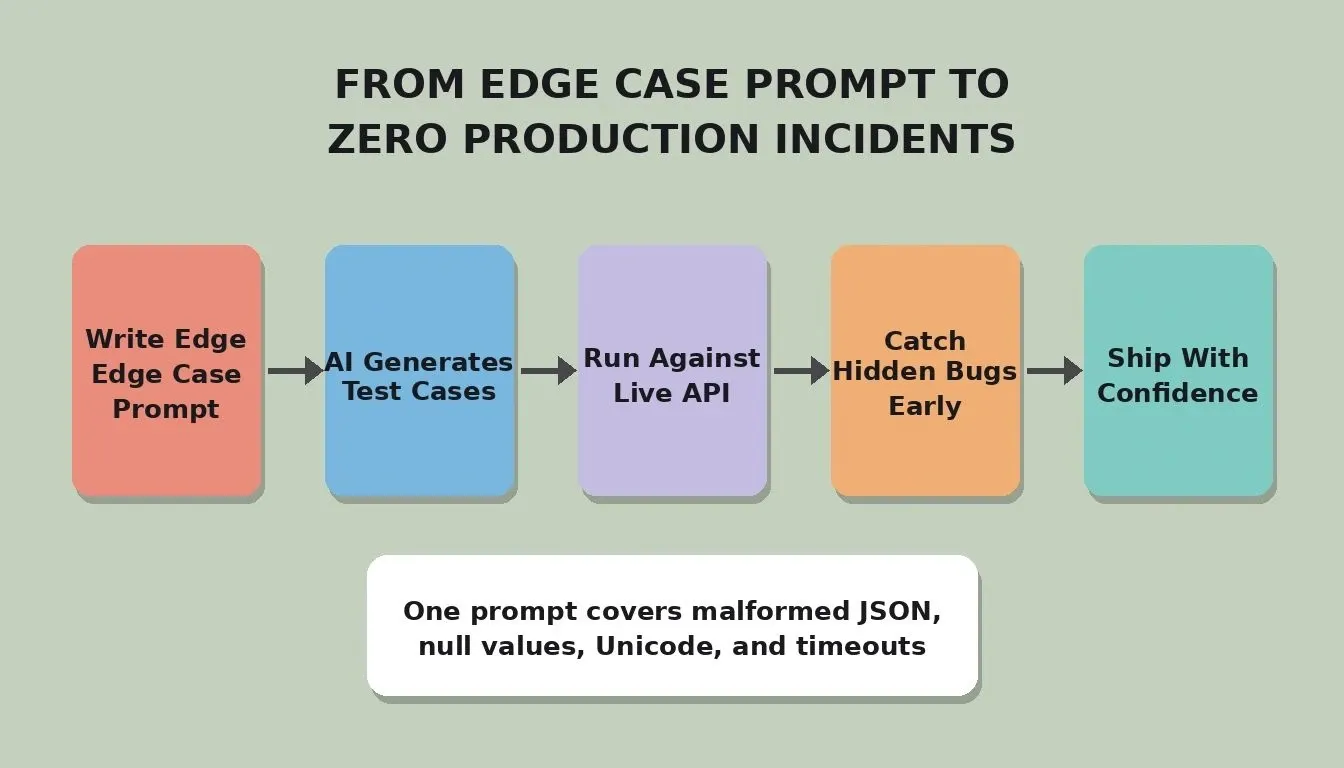
How a single edge case prompt translates into production-level confidence
API Documentation and Contract Testing Prompts
Contract testing catches breaking changes before they reach production. With only 17% of teams practicing it today, these prompts give your team an immediate advantage in API test automation and release confidence.
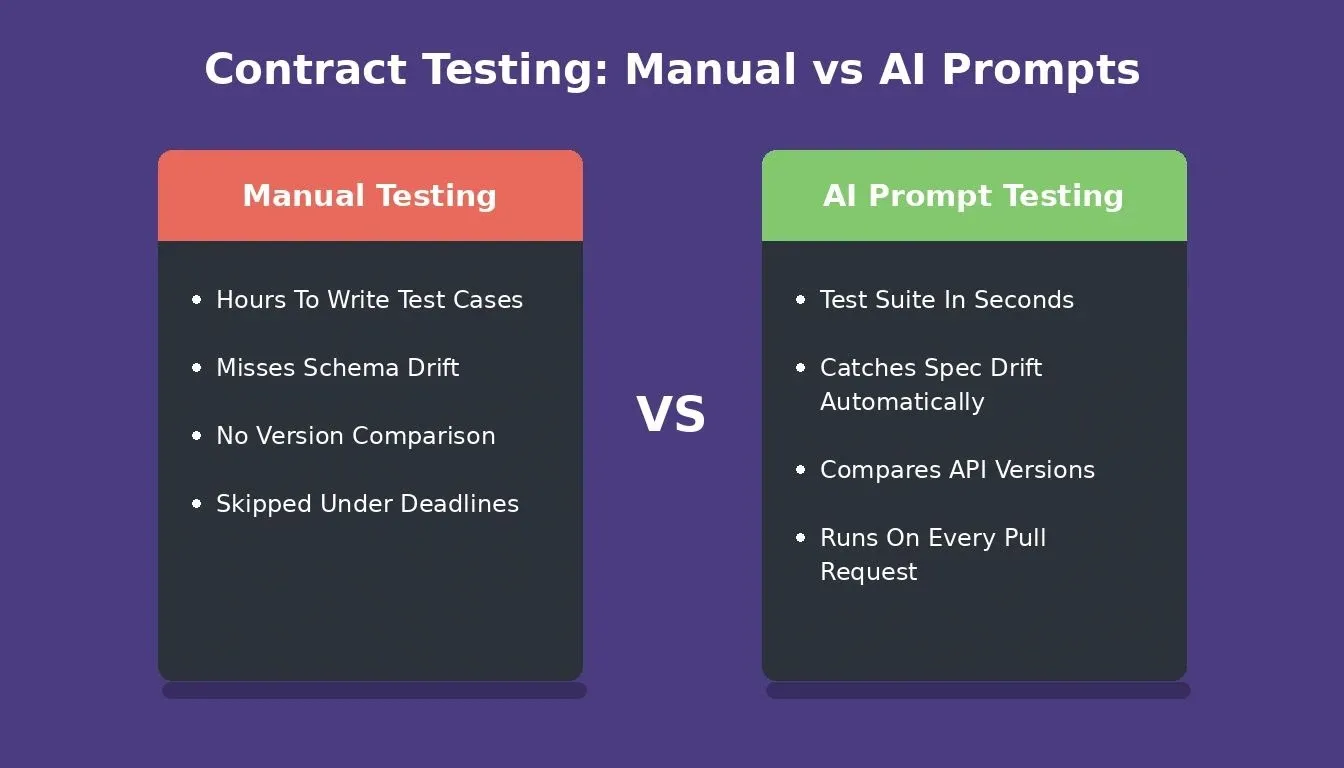
Why AI-driven contract testing outperforms manual approaches on every dimension
Prompt 21 - OpenAPI Schema Validation
Generate tests that fetch the OpenAPI spec from /api/docs and validate every documented endpoint against its actual response. Flag any response field missing from the spec, any undocumented status code, and any type mismatch between spec and reality.
Why it matters: Spec drift, where documentation diverges from actual behavior, is the root cause of most consumer-side integration failures.
Prompt 22 - Backward Compatibility Check
Write contract tests that compare the current API response schema against the previous version stored in version control. Flag any removed fields, changed types, or modified required/optional status. Verify that all existing consumers would still parse responses correctly.
Why it matters: Backward compatibility failures are invisible until a downstream consumer breaks. Contract tests catch them at the source.
Prompt 23 - Response Header Compliance
Create tests that verify every endpoint returns required headers: Content-Type, X-Request-ID, Cache-Control, and rate limit headers. Confirm header values match documented formats. Flag any endpoint missing required headers.
Why it matters: Missing or malformed response headers are a common source of caching bugs, CORS failures, and client-side retry storms.
Prompt 24 - Webhook Payload Validation
Generate tests for outgoing webhook payloads on /api/webhooks/orders. Verify the payload matches the documented schema. Test with events for order.created, order.updated, and order.cancelled. Confirm retry behavior when the receiving server returns 500.
Why it matters: Webhook schema drift is rarely caught by unit tests and causes silent failures in every downstream system that consumes the events.
Prompt 25 - CI/CD Pipeline Test Setup
Write a test configuration that runs the full API test suite on every pull request. Include functional, security, and contract tests in parallel. Set a quality gate that blocks merge if any security test fails or if code coverage drops below 80%. Output results in JUnit XML format.
Why it matters: Without a CI/CD quality gate, security and contract tests are optional, which means they get skipped under deadline pressure.
Contract tests act as a safety net between your API and everyone who depends on it. When combined with functional and security prompts, they form a complete quality layer across your release pipeline. Teams that want to go deeper on API integration patterns will find the best practices for API-integrated code automation a useful next read.
How Rocket.new Helps You Build APIs That Are Easier to Test
Every prompt above works better when the API itself is built with testing in mind from the start. That is where Rocket.new changes the equation.
Rocket.new generates production-grade Next.js and Flutter apps from a single prompt. Each build includes typed API routes, input validation, and error handling out of the box. Your test prompts validate endpoints that already follow best practices.
Supabase is available as a connector you can add to any Rocket.new project. When you connect Supabase, Rocket.new scaffolds a complete backend with Postgres database, user authentication, file storage, and edge functions from chat, giving your test suite a well-structured, documented backend to validate against.
Version history and one-click rollback mean every test failure leads to a quick recovery. Every Rocket.new build saves a version. Compare diffs, label milestones, roll back changes, and redeploy any previous version from chat.
26+ connected services, including Stripe, OpenAI, Google, and Anthropic, wire directly into builds from a single prompt. External API connections are pre-validated, reducing the surface area your test suite needs to cover. You can import API endpoints from Postman collections, cURL commands, or Swagger specs directly into Rocket.new and bind responses to UI components automatically.
Iterate through conversation. After running your test prompts and finding issues, describe the fix in plain English. Rocket.new applies targeted changes without regenerating the entire project.
Explore the Rocket.new Build overview to see how the full development lifecycle connects.
Related Reading
Ship Faster APIs with Prompts That Actually Work
The 25 prompts in this guide cover the testing categories that matter most: functional correctness, security, performance, error handling, and contract compliance. Copy them, adapt them to your endpoints, and run them through your preferred AI tool.
The teams shipping the most reliable APIs are the ones treating prompt-driven test generation as a daily practice, not an experiment. The AI-powered software testing market is projected to reach $39.43 billion by 2031. QA teams that invest in structured AI prompts for API testing today are building the workflows that will define software quality standards for the next decade.
Building reliable APIs starts with building them right. When your endpoints, validation, and auth are solid from the first generation, every test prompt produces cleaner results and faster feedback loops.
Ready to build APIs that pass every test from day one? Start your project on Rocket.new and generate production-grade endpoints with testing built in.
Table of contents
- -Why Your API Testing Strategy Needs AI-Driven Prompts
- -How to Structure Prompts for Reliable API Validation
- -Functional and CRUD Testing Prompts
- -Security and Authentication Testing Prompts
- -Performance and Load Testing Prompts
- -Error Handling and Edge Case Prompts
- -API Documentation and Contract Testing Prompts
- -How Rocket.new Helps You Build APIs That Are Easier to Test
- -Related Reading
- -Ship Faster APIs with Prompts That Actually Work