42% of startups fail from misreading market demand. Rocket.new's fast-track method compresses research, competitive intelligence, and product building into one continuous workflow using Solve, Intelligence, and Build.
Voice of Customer (VoC) research is the systematic practice of gathering and acting on real customer signal to guide every product decision. For builders, it answers the question every build starts with: what should I build, and for whom?
This guide covers the Rocket.new fast-track method: how to run deep customer research, layer in competitive intelligence, and ship directly from that context inside one platform.
Key Takeaways
- 42% of startups fail from misreading market demand, not from poor execution
- Traditional VoC cycles run quarterly; Rocket.new's fast-track compresses research-to-build into one continuous workflow
- Solve delivers a structured research report in about 45 minutes, covering customer JTBD, findings, risk matrix, and execution path
- Intelligence monitors competitors across nine signal pillars continuously
- Build generates production-grade Next.js web apps and Flutter mobile apps directly from the research context in your project
Are You Building the Right Product?
Most founders assume they are. The data says otherwise. Research from Founders Forum shows that 42% of startups fail simply because they misread market demand, building things nobody actually wanted. That's not a skills problem. It's an information problem.
Voice of Customer (VoC) research is the fix. It's the systematic practice of gathering, synthesizing, and acting on real customer signal to guide every product decision.
This guide breaks down the fast-track method built for founders and product teams, and shows exactly how Rocket.new collapses the gap between customer insight and product building.
What Is Voice of Customer Research for Builders?
VoC research for builders is not a one-time survey. It's a continuous intelligence habit that draws from every channel where customers reveal what they actually need, before a single line of code gets written.
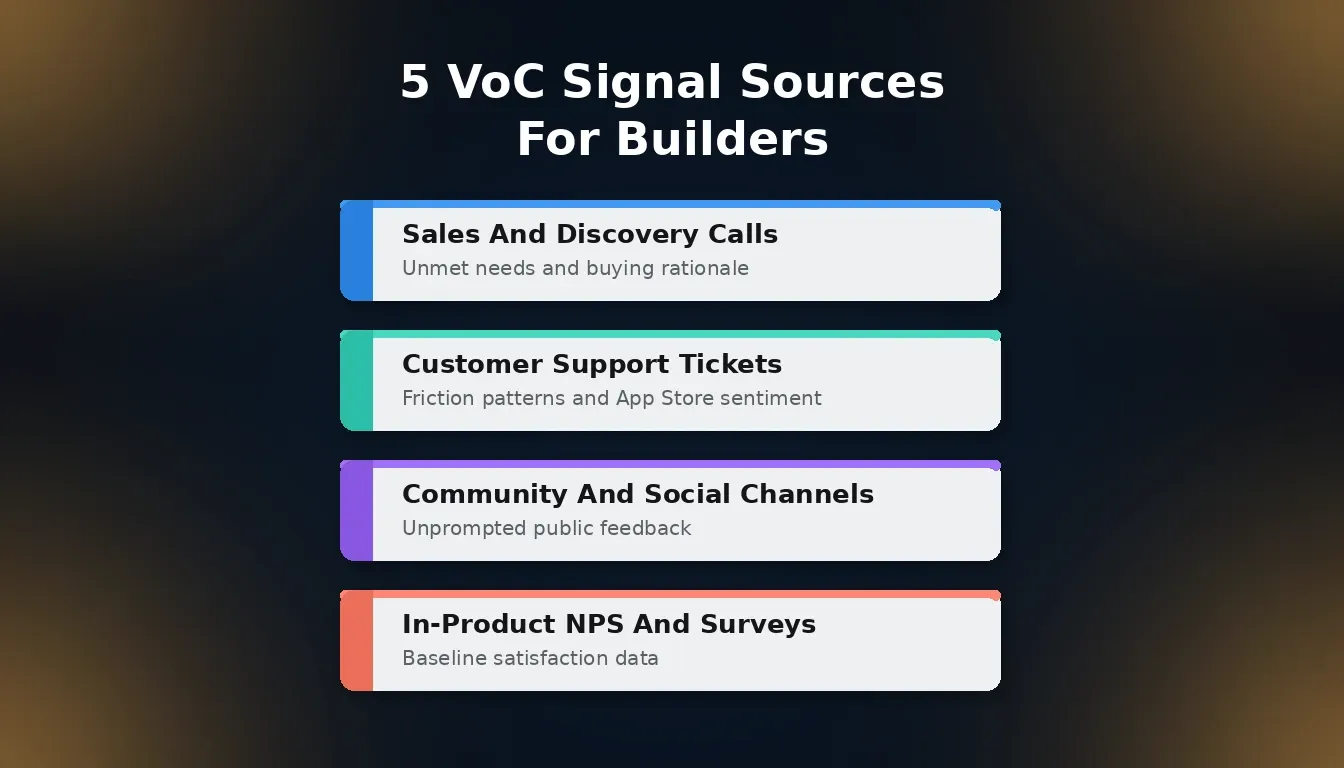
The five core signal sources that feed Voice of Customer research for product builders
- Recorded sales and discovery calls: Prospects reveal unmet needs, competitor gaps, and the real reason they started evaluating
- Customer support tickets: Structured, timestamped, and tied to specific accounts, including the comments left inside tickets that explain the real context
- Review platforms: G2, Capterra, App Store reviews where detailed customer comments and star ratings surface comparative sentiment in unprompted language
- Community channels, videos, and social posts: The earliest indicators of brewing dissatisfaction, from comments on product launch posts to threads in Reddit and Slack communities
- In-product NPS and surveys: Useful for measuring baseline satisfaction, weaker for discovering what customers haven't told you yet
For builders, VoC research ultimately answers the most important question in product building: what should I build, and for whom? The global VoC segment was valued at $1.69 billion in 2024 and is growing at 18.9% CAGR through 2030, driven by teams connecting customer insight to build decisions faster than ever before.
VoC Research by Persona: What the Method Looks Like in Practice
The fast-track method adapts to team size and context.
Two-person SaaS team: A founder and a developer use Solve to answer a single sharp question before each sprint, "why are users dropping off at step three of onboarding?", rather than running a quarterly research cycle. The Solve output takes about 45 minutes, surfaces the JTBD mismatch, and the developer opens Build with that context already loaded.
Enterprise product manager: A PM at a growth-stage company uses Intelligence to monitor five competitors continuously, then triggers a Solve deep-dive when a signal cluster appears. The Solve output becomes the brief for the next roadmap cycle, and Build generates the counter-positioning page from the same project context.
Why Product Teams Skip VoC Research And What That Costs
Three common reasons founders skip VoC research come up again and again, and none of them hold up when you have the right process.
- "It takes too long": Traditional VoC cycles run quarterly, by which point the market has already moved on
- "It's expensive": Legacy research setups require dedicated tools, manual tagging, and often an external research function
- "I already know my customers": The most expensive assumption a builder can make, typically formed from a handful of vocal accounts, not a validated pattern
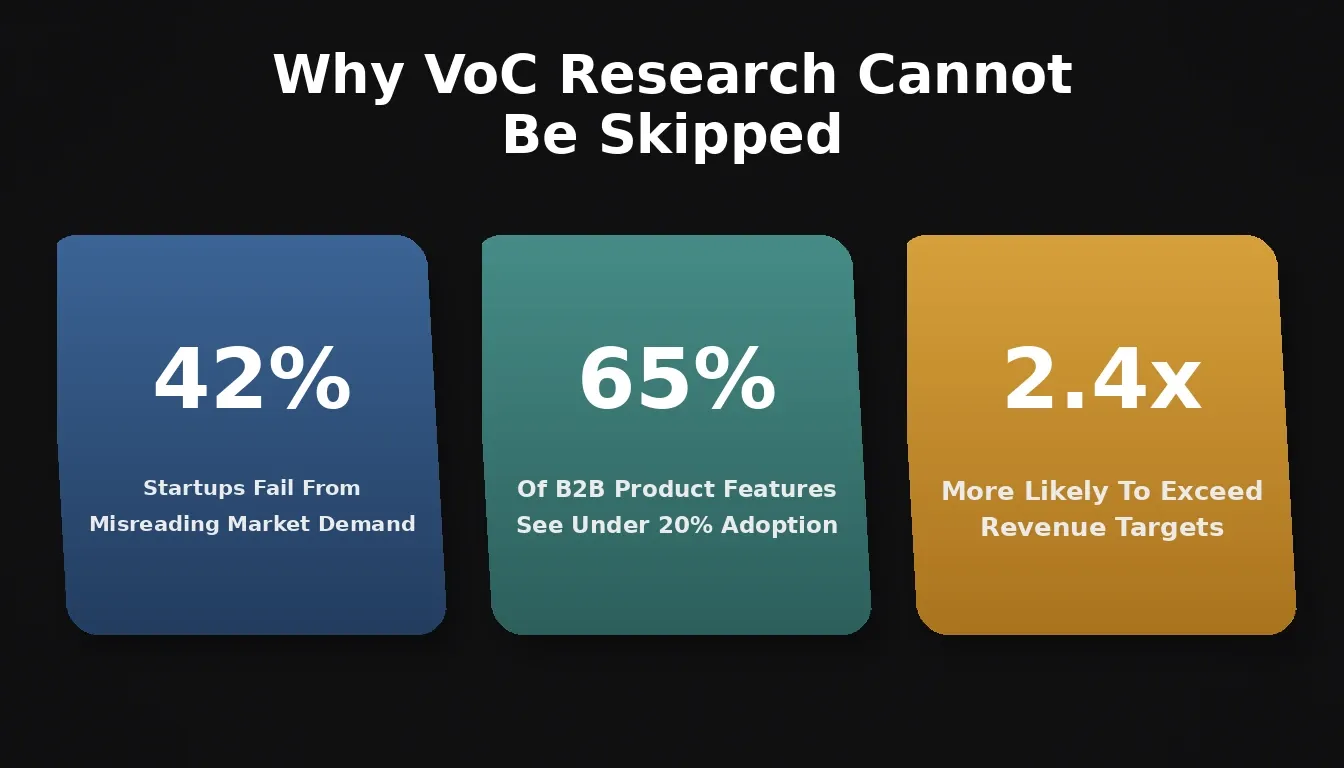
Key statistics that show the real cost of skipping Voice of Customer research
65% of B2B product features see less than 20% adoption, meaning teams are consistently shipping things customers never asked for. And 73% of B2B SaaS product teams now use AI to synthesize customer feedback at least weekly, up from just 19% in 2023. Those teams are 2.4x more likely to exceed revenue targets and show 25% lower churn than peers who don't.
"The riskiest moment in product is when teams build based on a few loud customer voices instead of validated patterns. VoC platforms must show pattern strength, not just request counts." Marty Cagan, SVPG
Good VoC research surfaces validated patterns across your full customer base, not just the loudest voices, and that difference is what separates products people love from roadmaps that quietly miss the mark.
The 5 Core Signal Sources for VoC Research
Modern VoC research for builders pulls from five distinct source types, each carrying different signal density and a different kind of insight.
| Signal Source | What It Reveals | Signal Type |
|---|---|---|
| Sales and discovery calls | Unmet needs, competitor gaps, buying rationale | Qualitative |
| Customer support tickets | Friction patterns, bug clusters, workflow breakdowns | Structured |
| Review platforms (G2, Capterra, App Store) | Comparative sentiment, competitor weaknesses | Qualitative |
| Community and social channels | Unprompted public feedback, early frustrations | Unstructured |
| In-product NPS and surveys | Baseline satisfaction, structured data points | Quantitative |
The average SaaS company generates 400 to 1,200 hours of recorded customer conversations per month, but product teams typically review less than 3% of it. That means the highest-leverage signal source is also the most consistently ignored one.
If you want to understand how to do market research and validate a business idea before you build, the signal sources above are where that research begins, and Rocket.new is the only platform that keeps those findings alive through every subsequent build step.
The Rocket.new Fast-Track Method
Traditional VoC research follows a slow path: gather data in one tool, tag it in a spreadsheet, wait for quarterly synthesis, debate the findings, then finally build something.
The Rocket.new fast-track method compresses that cycle. Research, competitive intelligence, and product building happen inside one platform with shared compound context, nothing gets re-explained, nothing gets lost between steps.
The Rocket.new fast-track: from customer question to shipped product in one continuous loop
- Frame the question: Scope it to a specific segment and decision
- Run Solve: Submit in plain language; receive a structured report in about 45 minutes
- Add competitive intelligence: Use Intelligence to see how competitors respond to the same customer needs
- Build from context: Open Build inside the same project; all research is already present
- Monitor and repeat: Continuous Intel cards feed back into the next research question
Step 1: Frame the Right Question First
The research is only as good as the question that starts it, and vague questions produce reports nobody acts on.
- "Why are customers churning after the onboarding flow?" targets a specific drop-off point with clear actions attached
- "What job is the 5-person SaaS team actually hiring our product for?" surfaces the real use case vs. the assumed one
- "Which competitor features are our customers mentioning most in support tickets?" connects competitive monitoring directly to product priorities
Keep questions specific to a segment, and separate the discovery question from the validation question. First find the problem, then confirm the solution.
Step 2: Use Solve for Deep Customer Research
Rocket.new's Solve is the decision intelligence engine at the center of the fast-track method. Give it any business question in plain language and it runs parallel research streams across multiple sources simultaneously.
- Delivers a complete structured analytical deliverable in about 45 minutes, work that typically takes a research team days or a strategy firm weeks
- Direct verdict at the top: The recommendation comes first, not buried in appendices
- Core customer objectives and jobs-to-be-done: What customers are actually trying to accomplish, in their language
- Key findings with signal strength tags: Every finding is marked High, Medium, or Low confidence, and conflicting signals are called out explicitly
- Risk matrix, execution path, and export as PDF, PPT, HTML, or PRD: Ready to act on, present to a team, or hand to an investor
That Solve output doesn't disappear after you read it. It becomes the foundation of every task that follows inside the project, present when a developer opens Build, present when marketing writes a page. Learn more about how Solve is different from asking AI a question.
Step 3: Add Competitive Intelligence to the Research Layer
Understanding what customers need is one side of the VoC picture. Competitive intelligence tells you how competitors are responding to those same needs and which gaps they're leaving open.
Rocket.new's Intelligence monitors competitors across nine signal pillars: Website, Social Media, News and Media, GTM, Product and Technology, People and Hiring, Business and Finance, Reviews and Community, and Traffic.
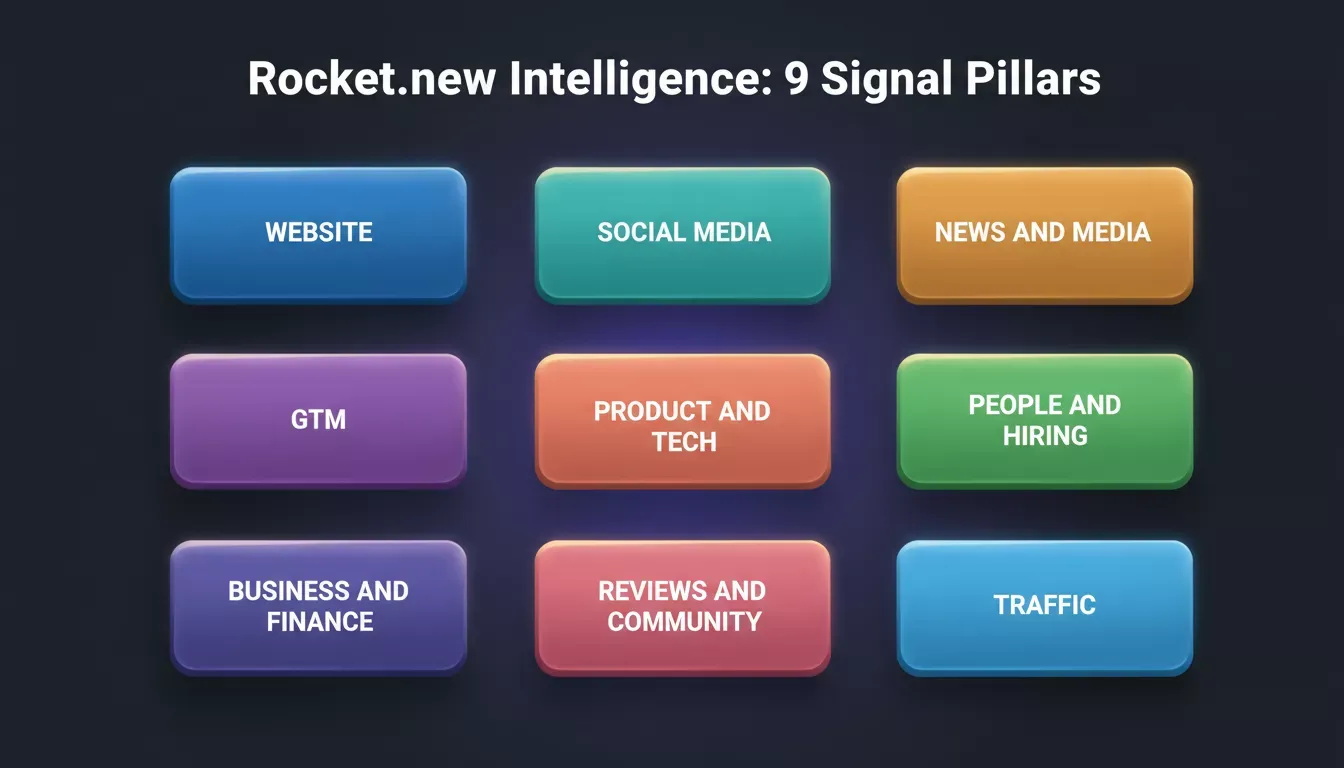
Rocket.new Intelligence monitors competitors across nine signal pillars simultaneously
Each day, Intelligence produces a structured Intel card for every tracked competitor: what changed, what the pattern signals, and what your business should do in response. That brief is updated continuously and waiting before the first meeting of the day.
Step 4: Build Directly From the Research Context
Here's the architectural difference that sets Rocket.new apart. The research doesn't live in a separate document that gets summarized into a build brief. It's already in the project when you open a Build task.
- The Solve output is already present: Customer insights, JTBD, risk matrix, and product direction are inherited by every build task automatically
- Competitive intelligence from Intelligence is already there: No re-briefing on what competitors shipped last month
- Web apps generated in Next.js: Production-grade, with SEO-ready structure, WCAG accessibility compliance, and GDPR coverage built in as the baseline
- Mobile apps generated in Flutter: Real design systems, dark and light theming, fluid navigation, and staggered animations from the first generation
- 26+ integrations authenticate once and flow into every build, including Stripe, Google Analytics, Supabase, Notion, Linear, Airtable, Mailchimp, Mixpanel, and more
The build starts where the research ended, which is how it should work, and which is not how any other AI platform in the market is structured. See how teams that research on Rocket.new ship better than teams that just prompt.
Competitive Monitoring as Ongoing Customer Intelligence
One of the most underrated parts of VoC research is treating competitive monitoring as a continuous product input, not a project you run once a year before planning season.
- Signal clusters tell the real story: A single pricing page update is noise; that same update alongside new enterprise sales hires, a shift in social messaging, and defensive comments on G2 reviews is a clear strategic signal
- Competitor review comments reveal unmet customer needs: When customers post detailed negative comments about a competitor's onboarding in G2 or Capterra, that's a direct signal about what the market wants and isn't getting
- Hiring patterns show where competitors are investing next: A cluster of new ML engineering roles or enterprise sales hires is a product signal months before any announcement
Rocket.new's Intelligence feature connects competitive monitoring directly to the same project workspace where product decisions are being made. Intel cards are updated continuously, not just when someone remembers to check. Explore how competitive intelligence software shapes product strategy.
Rocket.new as the AI Platform for Product Building and Research
Rocket.new is the world's first Vibe Solutioning platform, the first AI platform where business research and product building happen in the same place, connected through a shared compound context architecture.
Solve: Decision Intelligence
Solve turns any customer, market, or competitive question into a structured analytical deliverable. Any question in plain language, parallel research streams, output in PDF, PPT, HTML, or PRD, ready to act on, present to a team, or hand to an investor.
Every Solve output stays in the project and becomes the foundation of every build and marketing task that follows.
Intelligence: Continuous Competitive Monitoring
Intelligence monitors every public surface a competitor operates on and delivers Intel cards that connect signals into strategy. Nine signal pillars tracked. Absence detection. Cross-pillar pattern recognition. Personalized to your role.
Context and Projects: Compound Intelligence Architecture
Context and Projects form the shared memory architecture that makes Rocket.new a platform rather than a set of separate tools. Add files and background once, and every task that follows inherits everything automatically.
Cross-task context lets you reference any previous task in a new one. Works with Notion, Google Docs, and Google Sheets. Every task makes the next one smarter.
Build: Production-Grade Generation
Build generates production-grade products from the research foundation you've already built inside the project. Web apps in Next.js, mobile apps in Flutter, conversion-focused pages, internal tools, customer portals, and compliance systems.
The build starts from the research, not from a blank prompt. That's the architectural difference. Read more about why Rocket.new starts from research and not a blank prompt.
How Credits Work on Rocket.new
Credits are the unit of usage across every Rocket.new capability. Solve research sessions, Build generation tasks, and Intelligence competitor setups all draw from the same credit pool.
| Plan | Price | Credits | Key Features |
|---|---|---|---|
| Free | $0 | 20 (one-time) | Build apps + Light Solve |
| Pro | $25/month | 100/month | Build apps + Light Solve |
| Rocket | $50/month | 250/month | Build + Full Solve (auto-routed) + Intelligence |
| Booster | $250/month | 1,500/month | Build + Full Solve (auto-routed) + Intelligence |
All paid plans include unlimited team members. Credits can be topped up mid-cycle as needed.
Rocket.new vs Other Tools for VoC-Led Product Building
AI builders like Lovable, Bolt, and v0 are capable at generating code, but they share one structural gap: they build what you tell them to build, starting from zero each session, with no pre-build intelligence and no persistent memory across team members or tasks.
The cons of relying on separate tools become clear quickly: customer research lives in one app, competitive monitoring in another, and building in a third, with manual handoffs between every step and no shared context to connect them.
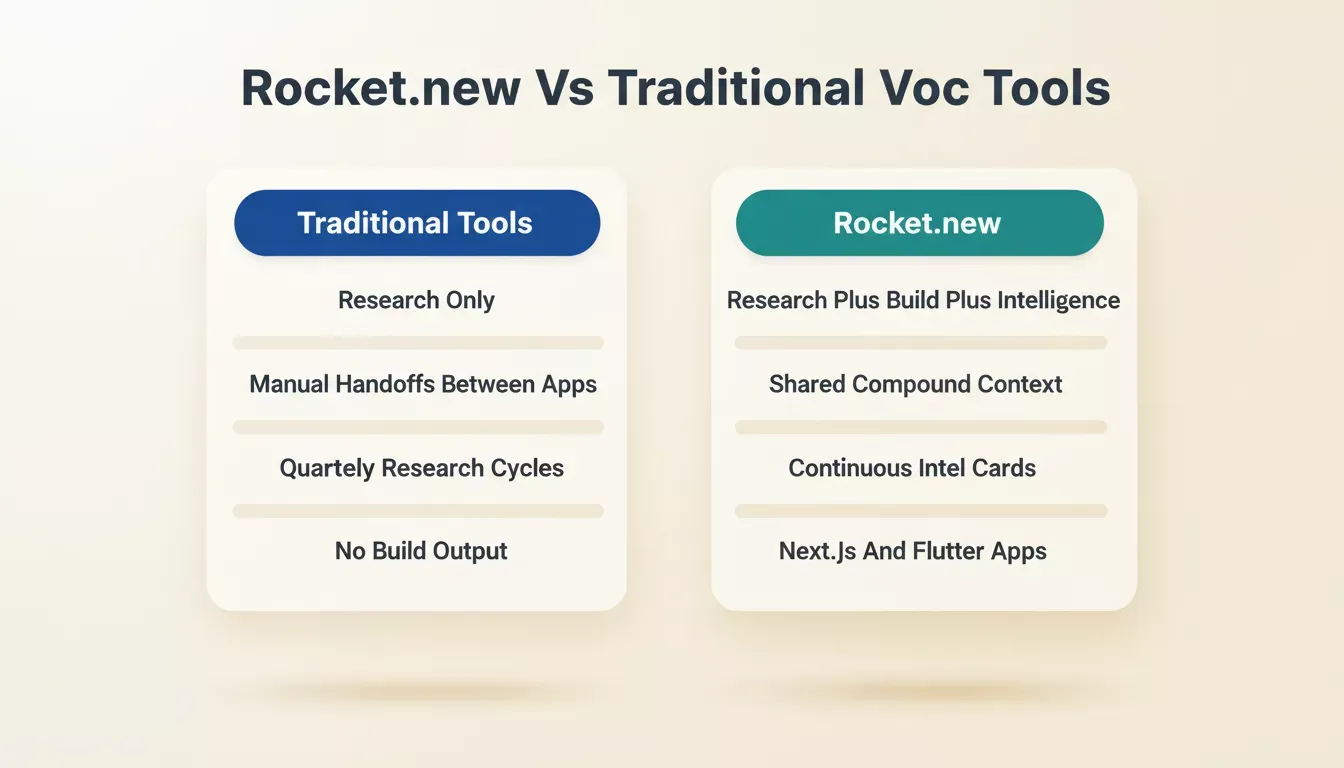
Rocket.new combines research, competitive intelligence, and production-grade building in one platform
| Capability | Traditional VoC Tools | AI Builders (Bolt / Lovable / v0) | Rocket.new |
|---|---|---|---|
| Deep customer research | Yes | No | Yes (Solve) |
| Competitive monitoring | Limited | No | Yes (Intelligence, 9 pillars) |
| Persistent project context | No | No | Yes (Context + Projects) |
| Builds from research context | No | No | Yes (Build) |
| Continuous Intel cards | No | No | Yes (Intelligence) |
| Export formats | Varies | N/A | PDF, PPT, HTML, PRD |
| Free plan available | Some | Some | Yes |
The difference is the architecture. Other tools give you pieces. Rocket.new gives you one system where those pieces connect and compound, and where the thinking before the build is treated as seriously as the build itself.
For a deeper comparison, see Rocket.new vs other AI builders that start from a blank prompt.
Start building from customer insight, try Rocket.new for free.
Table of contents
- -Key Takeaways
- -Are You Building the Right Product?
- -What Is Voice of Customer Research for Builders?
- -VoC Research by Persona: What the Method Looks Like in Practice
- -Why Product Teams Skip VoC Research And What That Costs
- -The 5 Core Signal Sources for VoC Research
- -The Rocket.new Fast-Track Method
- -Step 1: Frame the Right Question First
- -Step 2: Use Solve for Deep Customer Research
- -Step 3: Add Competitive Intelligence to the Research Layer
- -Step 4: Build Directly From the Research Context
- -Competitive Monitoring as Ongoing Customer Intelligence
- -Rocket.new as the AI Platform for Product Building and Research
- -Solve: Decision Intelligence
- -Intelligence: Continuous Competitive Monitoring
- -Context and Projects: Compound Intelligence Architecture
- -Build: Production-Grade Generation
- -How Credits Work on Rocket.new
- -Rocket.new vs Other Tools for VoC-Led Product Building