
20 sequenced AI prompts to build an appointment scheduling app 2026, covering auth, booking, payments, notifications, and analytics. Paste them into Rocket to ship a production-ready scheduling platform in a weekend. No code needed.
Key takeaways:
- 20 structured prompts covering five build phases: foundation, booking flow, notifications, provider ops, and reporting
- Each prompt includes expected output, a verification checklist, and a refinement to extend it
- Rocket generates production-ready Next.js (web) and Flutter (mobile) code, real files you can download or push to GitHub
- No credit card required to start; no programming knowledge needed
What Does a Complete AI Scheduling Assistant App Need?
Before jumping into prompts, here is the full architecture at a glance.
- Five phases cover every layer of a production scheduling system
- Each prompt includes expected output, a verification checklist, and a follow-up refinement
- Build order matters: foundation prompts create the data models that booking and notification layers depend on
The five-phase build path: each phase feeds the next, from data models through to revenue analytics.
| Phase | Focus Area | Prompts | Key Features |
|---|---|---|---|
| Foundation | Data models and auth | 1-4 | Multi-role login, provider profiles, service menu, business hours with buffer time |
| Booking Flow | Client-facing scheduling | 5-8 | Availability calendar, real-time slot blocking, Stripe deposits, reschedule and cancellation |
| Notifications | Reducing no-shows | 9-12 | Email via Resend, SMS and WhatsApp via Twilio, no-show follow-up sequences |
| Provider Ops | Daily management | 13-16 | Dashboard, block-out dates, client history, waitlist management |
| Reporting | Revenue and performance | 17-20 | Revenue dashboard, empty states, mobile-responsive layout, Core Web Vitals |
You can find a broader prompt library for app building on Rocket if you want to extend beyond scheduling. Now, let us get into the prompts.
How Long Does It Take to Build a Scheduling App From Scratch?
Most developers estimate six to twelve weeks to code an appointment scheduling system from scratch. Yet 40% of all bookings happen after business hours (as of 2024), according to scheduling industry research, meaning your app needs to work around the clock from day one.
The good news: you can skip the weeks of manual coding entirely. With the right set of structured AI prompts to build an appointment scheduling app and a no-code AI builder, you can go from zero to a deployed scheduling app in a single weekend. This guide walks you through 20 prompts, organized in build order, covering five phases that transform a blank canvas into a full appointment scheduling platform with payments, reminders, and analytics.
Before you build, consider validating first. Rocket's Solve pillar turns business questions into structured, evidence-backed research reports, market sizing, competitor pricing teardowns, and feature prioritization. You can validate your scheduling app idea before writing a single prompt, which takes minutes and gives you a PRD-ready brief. That is the research-to-launch workflow: Solve, then Build, then Intelligence.
How Do Foundation Prompts Shape Your App Architecture?
The first four prompts lay the groundwork. Without solid data models, the booking flow and notifications will break. These foundation prompts establish the core scheduling logic, role-based access control, and service catalog that every later phase depends on.
Rocket generates Next.js for web apps and Flutter for mobile apps, production-ready code you can download or sync to GitHub at any point. This is real, exportable code, not a locked-in platform output. To understand why Rocket chose this stack, the Next.js and Flutter explainer covers the reasoning in full.
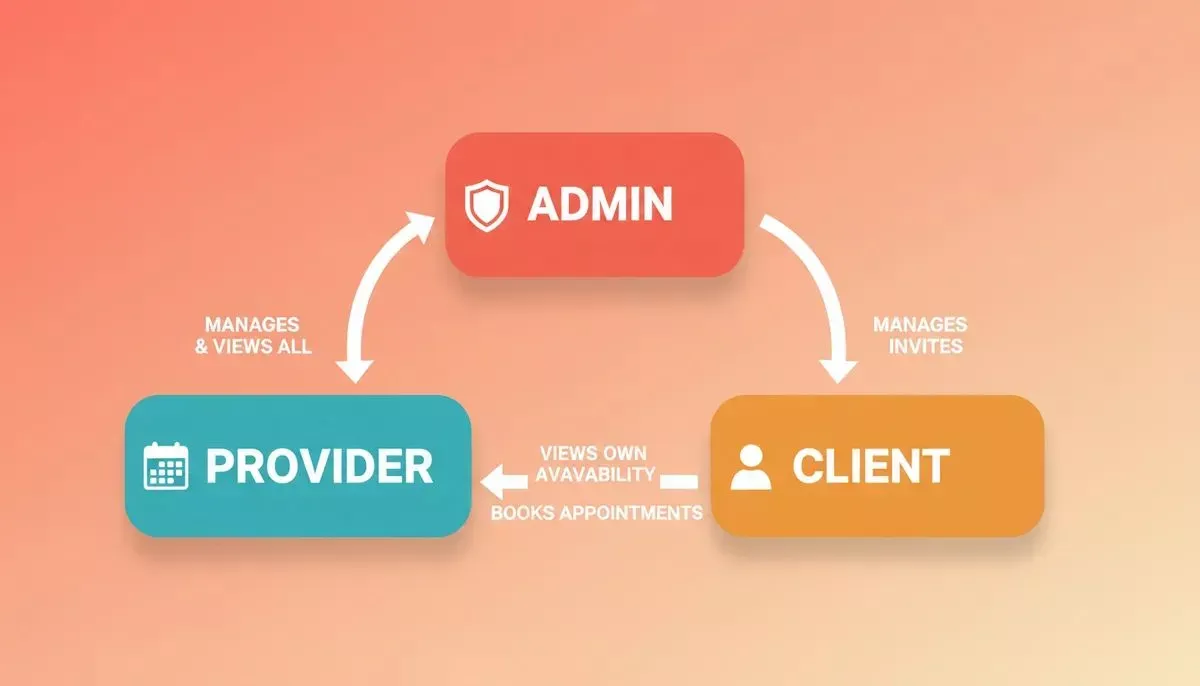
Three distinct roles with separate permission scopes: the foundation for a secure scheduling app.
Prompt 1: Multi-Role Authentication
Build a scheduling app with three user roles: admin, provider, and client. Use email and password authentication. Providers can only see their own calendar. Clients can only book appointments. Admins manage all providers and settings.
Expected output: A login and registration system with role-based routing.
What to check: Confirm that a client cannot access provider settings. Test that a provider cannot view other providers' calendars.
Refinement: "Add Google OAuth as a second login option and redirect new users to an onboarding wizard based on their role."
Prompt 2: Provider Profile Setup
Create a provider profile page where each provider adds their name, photo, specialty, bio, and contact details. Display these profiles on a public-facing directory that clients can browse and filter by specialty.
Expected output: A form for providers and a card-grid directory for clients with search and filter.
- What to check:*Verify that profile changes save immediately, and the public directory updates without a page reload.
Refinement: "Add a rating display pulled from completed appointment reviews and sort providers by average score."
Prompt 3: Service Menu with Pricing
Build a service catalog where providers list their offerings. Each service has a name, description, duration in minutes, price, and category. Clients see a grouped menu when they start booking.
Expected output: A CRUD interface for providers and a categorized service menu for clients.
What to check: Verify that duration values feed into the scheduling logic later. Confirm that a provider can deactivate a service without deleting it.
Refinement: "Add package deals where clients can buy a bundle of sessions at a discounted rate."
Prompt 4: Business Hours and Buffer Time
Add a weekly schedule editor where providers set their working hours for each day. Include a buffer time setting between appointments, ranging from 5 to 30 minutes. Block out lunch breaks automatically.
Expected output: A weekly grid editor with drag-to-set hours and a buffer slider.
- What to check:*Buffer time must subtract from available slots, not just display visually.
Refinement: "Allow providers to set different schedules for different service types."
Which Booking Flow Prompts Handle Real-Time Availability?
These four prompts create the client-facing scheduling experience with live calendar sync, payments, and flexible rescheduling. Stronger AI scheduling assistants can also negotiate meeting times conversationally, which is useful context for how an AI scheduling app can evolve beyond basic booking flows. Real-time slot blocking is the most critical feature in any appointment booking system; without it, double-bookings erode client trust instantly.
Prompt 5: Availability Calendar with Slot Blocking
Build a booking calendar that shows only available time slots based on the provider's schedule, buffer times, existing appointments, and calendar management rules. Make it sync against multiple calendars to avoid double-booking across work and personal availability, then block a selected slot immediately so no other client can book it.
Expected output: An interactive AI scheduling tool calendar view showing green open slots and grey blocked ones, rather than a basic slot picker.
What to check: Open two browser tabs and try to book the same slot simultaneously. Only one booking should succeed. Also confirm the app reads availability correctly from Google Calendar and Outlook Calendar connections.
Refinement: "Add timezone detection so clients in different regions see slots in their local time." For teams that want a pre-built scheduling layer, Cal.com API integration is also an option worth exploring alongside a custom build.
Prompt 6: Stripe Deposit Collection
Add a Stripe payment step after slot selection. Collect a deposit of 20% of the service price. Show a payment summary before charging. Store the payment intent ID for refund logic later.
Expected output: A checkout step with Stripe Elements, deposit calculation, and confirmation page.
What to check: Test with Stripe test cards. Verify the deposit amount calculates correctly for each service tier. For a deeper look at how payments wire into AI-built apps, the guide on Stripe payment integration covers the full setup.
Refinement: "Add support for full upfront payment as a provider toggle."
Prompt 7: Reschedule Flow
Let clients reschedule meetings or appointments up to 24 hours before the slot. Show a new calendar with available times. Move the booking and release the old slot instantly.
Expected output: A reschedule button on the client's appointment card that opens the availability picker.
What to check: Verify the old time slot becomes available again within seconds to keep booking meetings frictionless.
Refinement: "Allow providers to set a custom rescheduling window per service type."
Prompt 8: Cancellation with Refund Logic
Add cancellation for both clients and providers. If a client cancels more than 48 hours before, refund the full deposit. Between 24-48 hours, refund 50%. Under 24 hours, no refund.
Expected output: A cancel button with a clear refund policy summary and automated Stripe refund processing.
- What to check:*Test each time bracket with different cancellation timestamps.
Refinement: "Send a cancellation reason survey and log reasons in the provider's analytics panel."
Can Notification Prompts Actually Reduce No-Shows?
Automated reminders cut no-shows by 29% (as of 2023), a significant improvement for service businesses that lose revenue on empty slots. AI scheduling chatbots qualify leads and confirm appointments instantly before reminders even begin. The following four prompts build a multi-channel notification system that adapts based on client response, reducing missed appointments without requiring manual follow-up.
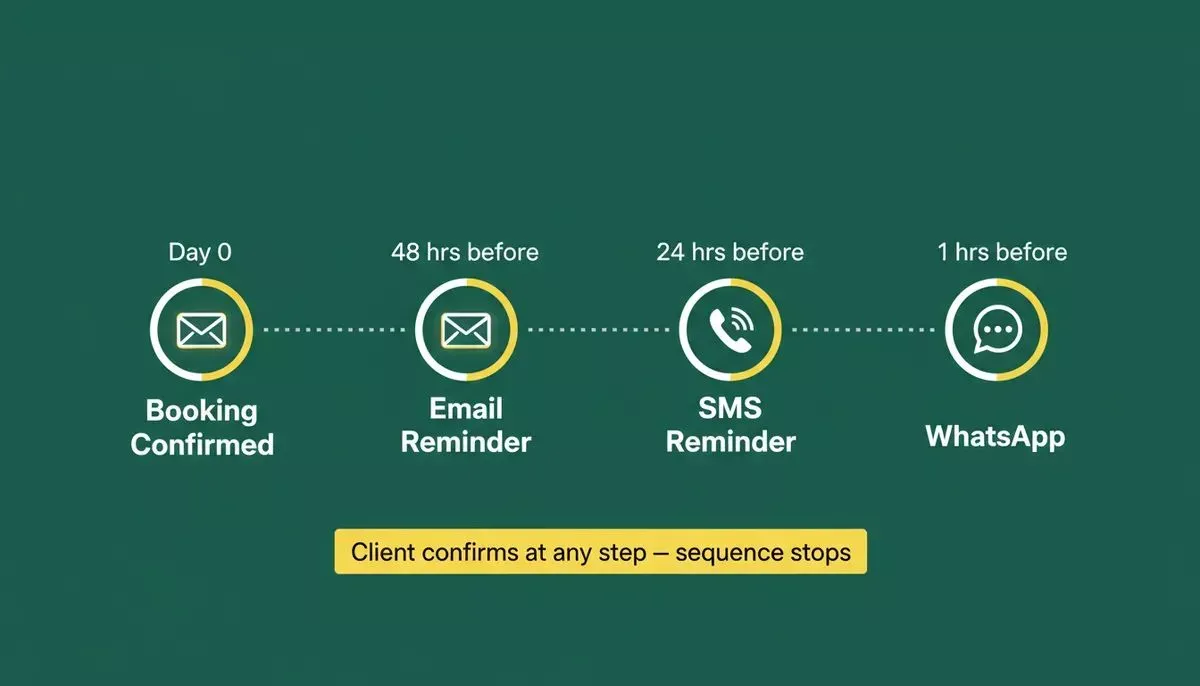
The three-channel reminder sequence
Prompt 9: Booking Confirmation via Resend
Send an email confirmation when a booking is created. Use Resend as the email provider. Include appointment date, time, provider name, service name, a booking link, and a calendar file attachment.
Expected output: A transactional email triggered on booking creation with a downloadable .ics file and support for a booking link.
What to check: Open the .ics file in Google Calendar and Apple Calendar. Verify the event time matches the booked slot. Confirm the booking link opens correctly in the web app.
Refinement: "Add the provider's cancellation policy as a footer note."
Prompt 10: SMS and WhatsApp Reminders via Twilio
Send an SMS reminder 24 hours before the appointment and a WhatsApp message 2 hours before. Use Twilio for both channels, and also send reminders for follow-up actions like confirming, cancelling, or asking for a callback.
Expected output: Two scheduled notifications per booking with clickable action links. More advanced versions may also support phone calls for high-value appointments.
What to check: Verify that cancelling via the link updates the booking status.
Refinement: "Add a provider setting to choose which reminder channels to activate."
Prompt 11: Appointment Reminder Sequence
Create a reminder sequence: email 48 hours before, SMS 24 hours before, WhatsApp 2 hours before. If the client confirms at any step, skip remaining reminders. As an optional extension, support recurring meetings for regular appointments or standing check-ins.
Expected output: A sequential notification pipeline that adapts based on client response and still works when coordinating multiple participants for a shared booking scenario.
What to check: Confirm that clicking " Confirm “ in the email stops the SMS from sending.
Refinement: "Add a personal calendar link in the first reminder."
Prompt 12: No-Show Follow-Up
If a client misses an appointment without cancelling, trigger a follow-up email 30 minutes after the missed slot. Offer to rebook at a discounted rate.
Expected output: An automated follow-up that fires when appointment status changes to no-show.
What to check: Confirm the no-show status triggers only after the appointment end time passes.
Refinement: "After three no-shows, automatically require full prepayment for future bookings."
Why Rocket Turns These Prompts Into a Working App
You might be wondering: where do you actually paste these AI prompts to build an appointment scheduling app? That is where Rocket.new comes in.
Rocket is not just a code generator; it is a three-pillar vibe solutioning platform:
- Solve turns business questions into structured, evidence-backed research reports. Use it before you build: run a competitive teardown of Calendly vs. Acuity, size the scheduling market for your vertical, or generate a feature-prioritization PRD. Solve outputs are shareable HTML reports and slide decks you can hand to stakeholders.
- Build generates production-ready Next.js web apps and Flutter mobile apps from plain-language prompts. Real code, downloadable or synced to GitHub. No credit card required to start.
- Intelligence monitors competitors across nine signal pillars (pricing, product changes, hiring, GTM, reviews, and more) after you launch. Follow Calendly, Acuity, and Setmore; get structured Intel cards when they change pricing or ship a feature that overlaps with yours.
The natural workflow for a scheduling app: validate the market with Solve, build with these 20 prompts, then monitor competitor moves with Intelligence.
92% of developers already use AI coding tools at work (as of 2024), according to a GitHub developer survey. Unlike Calendly or Acuity Scheduling, Rocket ships your app to a custom domain you own, with full code access; you can export the source anytime; you are never locked in.
What Provider Operations Prompts Keep Your Business Running?
Once clients are booking, providers need tools to manage their day. As teams grow, provider operations often spill into task management and project management alongside pure booking workflows. These four prompts cover the operational layer, the dashboards, scheduling controls, and client management features that turn a booking system into a full-service business tool.
Prompt 13: Daily Dashboard
Build a provider dashboard showing today's appointments in chronological order with quick-action buttons to mark as completed or no-show.
Expected output: A single-page daily view with color-coded appointment cards.
What to check: Verify that marking an appointment completed updates analytics.
Refinement: "Add a weekly view toggle and a revenue summary at the top."
Prompt 14: Block-Out Dates and Vacations
Add a block-out calendar where providers can mark full days or specific hour ranges as unavailable. Support recurring blocks like every Sunday.
Expected output: A date picker with full-day and partial-day blocking, plus a recurring pattern option.
What to check: After blocking a date, confirm zero slots appear on the client booking page.
Refinement: "Show a warning if blocking conflicts with existing confirmed appointments."
Prompt 15: Client History and Notes
Create a client profile page visible to providers. Show full appointment history, total spend, no-show count, and a notes section for each visit. Providers should also be able to assign tasks or follow-ups tied to a client record after each visit.
Expected output: A searchable client list with detailed profile pages. These notes can support critical tasks such as follow-up outreach or prep for the next appointment. This pattern works across many service verticals; the no-code booking website guide shows a real example of how client profiles and history look in a deployed app.
- What to check:*Verify that client tags filter correctly in the list view.
Refinement: "Add an AI summary that generates a one-line client overview."
Prompt 16: Waitlist Management
When all slots for a day are full, show a Join Waitlist button. If a cancellation opens a slot, automatically notify the first person on the waitlist via SMS.
Expected output: A waitlist queue per provider per day with automated SMS notifications and expiry logic. Future versions can use conversational booking to collect intake details before the appointment.
What to check: Test with two people on the waitlist and verify the notification sequence. AI systems can handle intake forms conversationally and detect missing information before the visit.
Refinement: "Add a waitlist priority option where VIP-tagged clients jump ahead."
How Do Reporting Prompts Close the Revenue Loop?
The final four prompts give you visibility into what is working. Reporting also helps teams optimize schedules, not just measure revenue after the fact. A complete appointment scheduling app is not just about booking; it needs analytics that connect scheduling activity to revenue outcomes.
Prompt 17: Revenue Dashboard
Build a reporting page showing total revenue, bookings completed, cancellation rate, and no-show rate with weekly and monthly trend charts.
Expected output: A dashboard with cards for key metrics and interactive line charts.
What to check: Verify that revenue numbers match Stripe payouts.
Refinement: "Add a revenue forecast based on confirmed future bookings."
Prompt 18: Empty State Handling
Design empty states for every section with a helpful message and CTA button guiding the user to their next action.
Expected output: Friendly empty states with illustrations, action buttons, and cute and helpful icons across all views so first-run setup is easier to scan.
- What to check:*New accounts should see empty states everywhere, not broken pages.
Refinement: "Add onboarding tooltips that guide new providers through first booking setup."
Prompt 19: Mobile-Responsive Layout
Make every page fully responsive. The booking calendar should work on mobile with swipe navigation, run smoothly in a browser tab, and should not force users into a new browser tab for core booking actions. Test at 375px, 768px, and 1440px breakpoints.
Expected output: A responsive web app design that adapts across phone, tablet, and desktop.
What to check: Open the booking page on a phone. Verify time slot selection works with touch.
Refinement: "Add a mobile app install prompt for home screen."
Prompt 20: Core Web Vitals Audit
Run a performance audit on the deployed app. Target LCP under 2.5 seconds, FID under 100ms, and CLS under 0.1.
Expected output: A performance-optimized build with passing Core Web Vitals scores. Rocket's built-in performance dashboard scores your app against Core Web Vitals and surfaces one-click fixes. For a broader look at your options, the guide on AI app deployment covers hosting, CDN, and go-live steps.
What to check: Run Google PageSpeed Insights. All three Core Web Vitals should be green.
Refinement: "Add image CDN support and enable server-side rendering for booking pages."
The Build Flow: From Prompt to Production
The five phases run in strict order; each phase's data models feed the next. Here is the sequence:
- Foundation (Prompts 1-4): Data models and auth ready
- Booking Flow (Prompts 5-8): Calendar and payments live
- Notifications (Prompts 9-12): Reminders and no-show logic active
- Provider Ops (Prompts 13-16): Dashboard and client tools ready
- Reporting (Prompts 17-20): Revenue analytics deployed and live
This same phased flow also supports task scheduling once booking data is in place.
Follow the order; skipping phases creates broken dependencies between data models and UI layers.
Rocket vs. Hand-Coding vs. SaaS Scheduling Tools
Not every team should build from scratch. Here is an honest comparison to help you decide.
| Approach | Time to Launch | Code Ownership | Customization | Best For |
|---|---|---|---|---|
| Hand-code from scratch | 6-12 weeks | Full | Unlimited | Teams with dedicated engineering |
| Calendly / Acuity / Setmore | Minutes | None | Limited to their UI | Teams that need scheduling only |
| Rocket (these 20 prompts) | 1-3 days | Full (Next.js + Flutter) | Unlimited | Founders and product teams who need custom logic |
The scheduling software market reached $546 million in value by 2026, according to market research. The growth signal is clear: demand for scheduling tools is rising, but off-the-shelf SaaS tools cap your differentiation at their feature set. Over time, scheduling is likely to shift toward agent-to-agent communication for bookings.
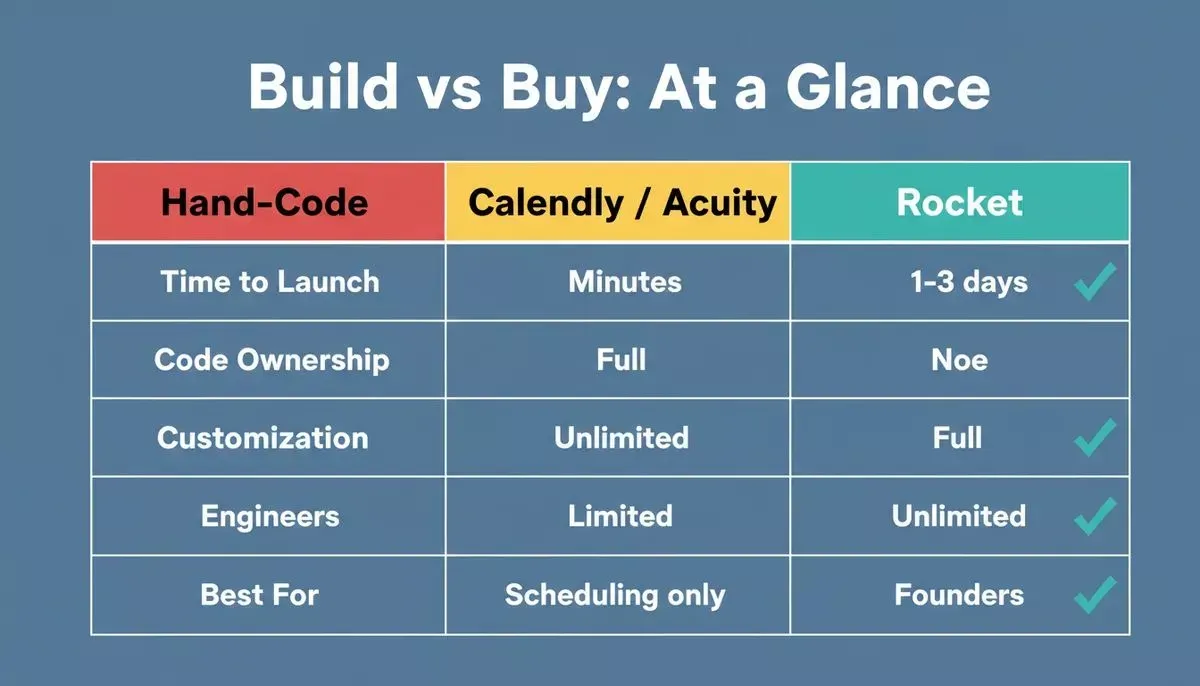
Comparison table showing Hand-Code vs Calendly/Acuity vs Rocket
Building with Rocket gives you the speed of a SaaS tool and the flexibility of custom code. In that comparison, another gap is pricing structure: larger SaaS vendors often reserve advanced controls and procurement support for enterprise pricing.
You can also explore how Rocket compares to other AI builders if you want to evaluate options before committing. The guide on building a full-stack app with an AI builder shows what the output looks like end-to-end.
Scheduling App Market Stats at a Glance
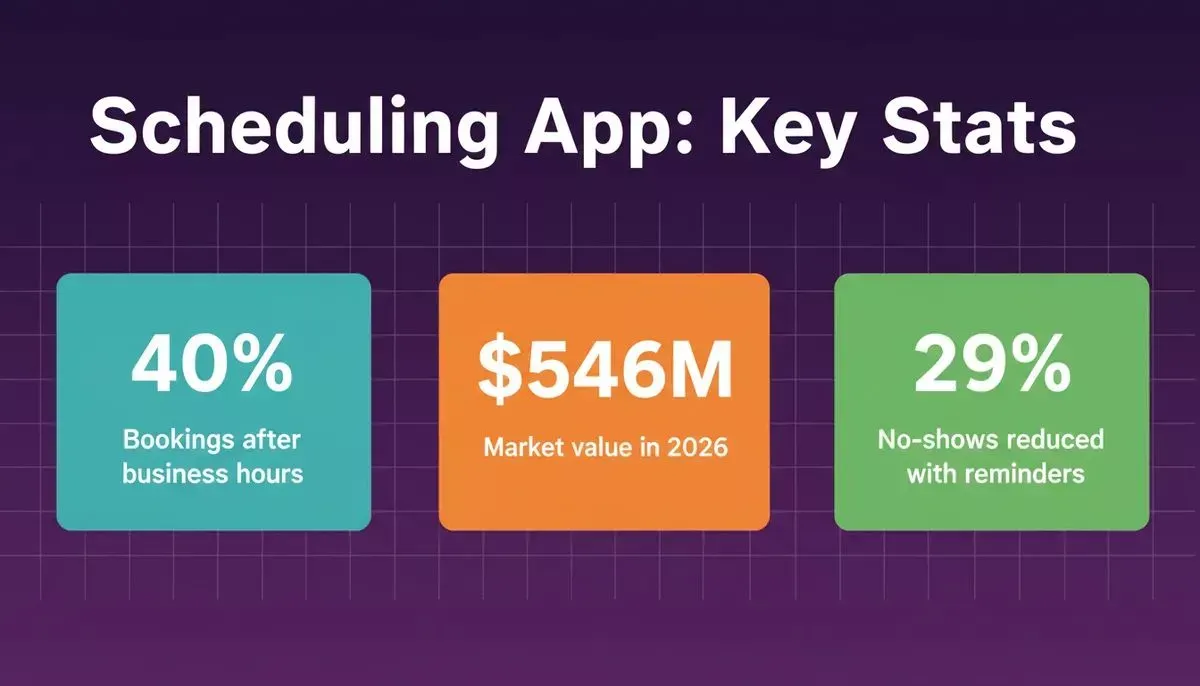
Three data points that make the case for building a custom scheduling app in 2026.
Ship Your Scheduling App This Weekend
These 20 prompts represent a complete build path for anyone who wants to use AI prompts to build an appointment scheduling app, not a wishlist. Each one feeds the next, and together they produce an app that handles booking, payments, reminders, operations, and analytics. It is built for end-to-end automation, not just a simple booking flow. Service businesses that act on this can stop losing revenue to no-shows and manual scheduling within days.
The workflow does not end at deployment. Once your app is live, use Rocket Intelligence to follow Calendly, Acuity, and any other scheduling tool in your market. This kind of product can help busy professionals, service businesses, or a sales team reduce manual scheduling load. When a competitor changes pricing or ships a new feature, you get a structured Intel card, not a raw alert, so you can respond with a Solve report or a new Build prompt rather than guessing.
Note: Open Rocket, paste your first foundation prompt, and have a working scheduling app deployed by Sunday. No templates, no monthly seat fees, no code required. No credit card needed to start.
Start building for free and have your first booking page live today. Rocket handles the full-stack Next.js and Flutter code, database, auth, and deployment in one pass, no developer required, no credit card needed.
Table of contents
- -What Does a Complete AI Scheduling Assistant App Need?
- -How Long Does It Take to Build a Scheduling App From Scratch?
- -How Do Foundation Prompts Shape Your App Architecture?
- -Prompt 1: Multi-Role Authentication
- -Prompt 2: Provider Profile Setup
- -Prompt 3: Service Menu with Pricing
- -Prompt 4: Business Hours and Buffer Time
- -Which Booking Flow Prompts Handle Real-Time Availability?
- -Prompt 5: Availability Calendar with Slot Blocking
- -Prompt 6: Stripe Deposit Collection
- -Prompt 7: Reschedule Flow
- -Prompt 8: Cancellation with Refund Logic
- -Can Notification Prompts Actually Reduce No-Shows?
- -Prompt 9: Booking Confirmation via Resend
- -Prompt 10: SMS and WhatsApp Reminders via Twilio
- -Prompt 11: Appointment Reminder Sequence
- -Prompt 12: No-Show Follow-Up
- -Why Rocket Turns These Prompts Into a Working App
- -What Provider Operations Prompts Keep Your Business Running?
- -Prompt 13: Daily Dashboard
- -Prompt 14: Block-Out Dates and Vacations
- -Prompt 15: Client History and Notes
- -Prompt 16: Waitlist Management
- -How Do Reporting Prompts Close the Revenue Loop?
- -Prompt 17: Revenue Dashboard
- -Prompt 18: Empty State Handling
- -Prompt 19: Mobile-Responsive Layout
- -Prompt 20: Core Web Vitals Audit
- -The Build Flow: From Prompt to Production
- -Rocket vs. Hand-Coding vs. SaaS Scheduling Tools
- -Scheduling App Market Stats at a Glance
- -Ship Your Scheduling App This Weekend