
Use 20 structured prompts across five phases to build a complete restaurant management system covering auth, orders, kitchen ops, inventory, and reporting with Rocket.new's Build pillar. No coding required.
Use these AI prompts to build restaurant management system across five phases: foundation, orders, kitchen ops, inventory, and reporting. They produce a complete, connected platform with Rocket's Build pillar.
Each prompt generates a working module, not an isolated screen, because Rocket carries context across every step.
Why Does Building a Restaurant System Start with Better Prompts?
Before writing a single prompt, consider using Rocket's Solve pillar to validate your restaurant concept: market size, competitor landscape, and pricing strategy. That way your Build prompts start from a researched foundation rather than assumptions. Rocket is a three-pillar vibe solutioning platform: Solve (market research and decision intelligence), Build (the AI app generator), and Intelligence (continuous competitor monitoring). The 20 prompts below operate inside the Build pillar.
How do you prompt an AI to generate a restaurant system that handles five roles, live kitchen queues, and split bills without ending up with a tangled prototype? The restaurant industry crossed a tipping point in 2026. According to Mordor Intelligence (accessed July 2026), the restaurant management software market hit USD 7.49 billion this year, growing at 14.52% CAGR through 2031.
That growth tells a clear story. Restaurant owners and operators are moving from manual spreadsheets to AI-powered platforms that handle restaurant operations end-to-end. The challenge is that restaurant management AI tools need extremely specific instructions to produce connected systems rather than isolated mockups.
The prompts below follow a five-phase build order that mirrors how real restaurants operate. Each prompt includes what to expect from the output, what to check before moving on, and a follow-up refinement prompt for generating full-stack apps from prompts.
Disclaimer:* "Expected output" sections are illustrative of typical results. AI generation output varies by prompt phrasing, plan tier, and project context. Test each phase before moving to the next.*
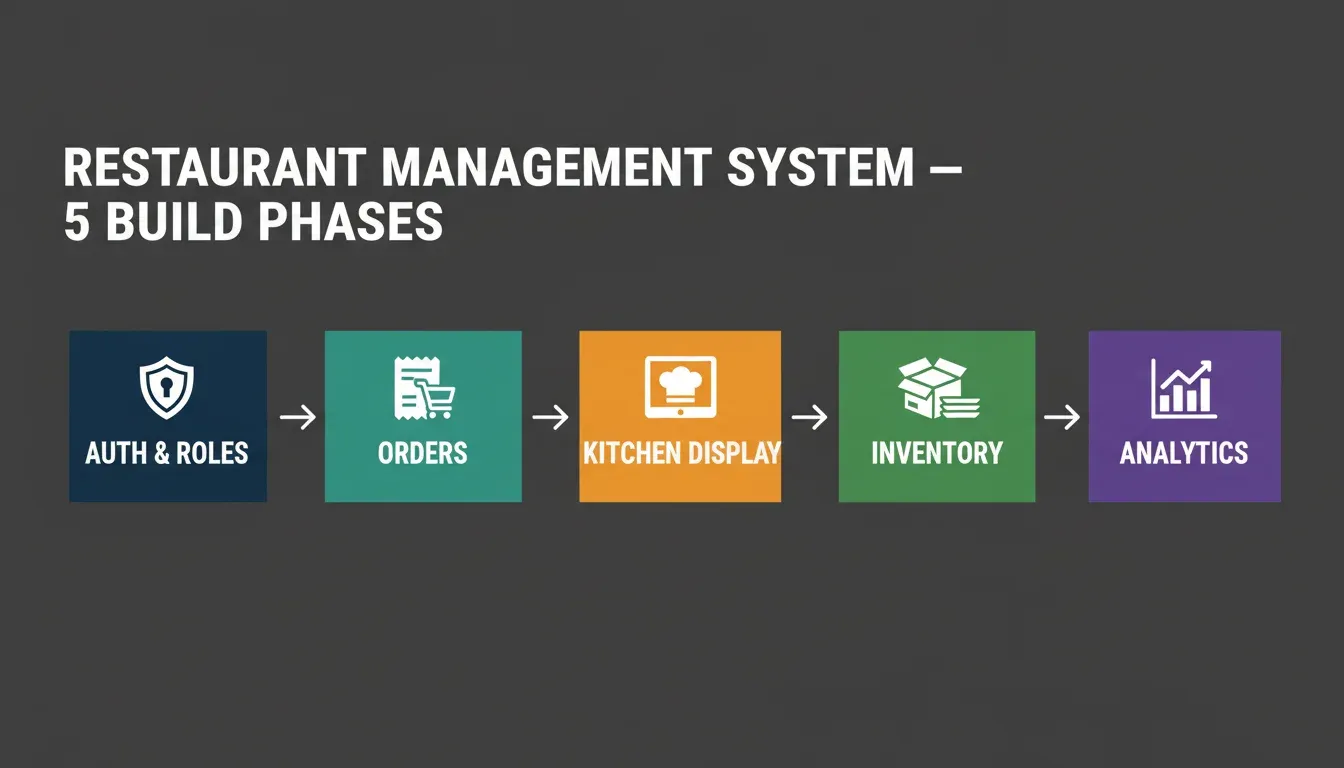
Five-phase architecture of a complete restaurant management system built with AI prompts
What Should Your Foundation Phase Cover?
A restaurant management system is software that unifies ordering, kitchen display, payments, inventory, and staff scheduling into one connected platform. The foundation phase sets up your restaurant concept as a working system. Before any restaurant menu shows up on screen, the AI needs to understand your user roles, their permissions, and how data flows between them.
-
Multi-role authentication is the backbone. Without it, every screen becomes a security risk. Your system needs at least five roles: owner, manager, waiter, kitchen staff, and cashier, each with distinct access levels.
-
Menu design connects directly to ordering, inventory, and reporting. Prompting the AI to set up menu items with categories, pricing tiers, allergen tags, and seasonal ingredients availability creates a data model that feeds every other module.
-
Table configuration maps your physical dining room to the digital floor plan, enabling reservations and real-time status tracking.
Food safety compliance fields should be built into your restaurant menu schema from the start. Customer satisfaction depends on accurate allergen warnings and ingredient transparency, so prompting for these early prevents expensive rebuilds later. Staff training becomes easier when each role sees only the screens relevant to their work, reducing errors during a busy shift.
Prompts for Multi-Role Authentication
These two prompts establish the security layer that every other feature depends on. The AI can generate row-level security policies tied to each role via Supabase. Rocket pushes SQL migration scripts to keep your Postgres schema, tables, and RLS policies in sync. Review the generated policies against the Rocket security checklist before moving to Phase 2.
Prompt 1: "Build a restaurant management app with Supabase authentication supporting five user roles: Owner (full access to all modules including revenue reports and staff management), Manager (access to scheduling, inventory, and daily reports), Waiter (table-side ordering and bill management only), Kitchen Staff (kitchen display and order queue only), Cashier (payment processing and daily close-out). Use row-level security so each role only sees their permitted data."
Expected output: Authentication screens with role selection, Supabase RLS policies per table, and navigation guards restricting unauthorized views.
What to check: Log in as each role and confirm restricted screens return access denied. Verify that restaurant operations data isolation works correctly across all roles.
Prompt 2: "Add an owner-only admin panel where new staff accounts are created with role assignment. Include email invitation, temporary password generation, and first-login password reset. Show an audit log of all role changes with timestamps."
Follow-up refinement: "Add shift-based access windows so waiters can only log in during their scheduled hours."
Prompts for Menu and Table Configuration
Menu descriptions and table layouts form the data layer that every customer-facing and kitchen-facing screen reads from. Getting these right up front saves dozens of refinement prompts later.
Prompt 3: "Create a menu management module where managers add, edit, and remove menu items. Each item has: name, menu description with sensory language, price, category (appetizer, main, dessert, beverage), photo upload, prep time estimate, allergen tags, and seasonal ingredients availability toggle. Include bulk price editing and menu ideas generator that suggests new dishes based on popular items and seasonal ingredients."
Expected output: CRUD interface with photo upload, category filters, allergen badge display, and a suggestions panel. Restaurant menu items save to Supabase with proper relationships.
What to check: Toggling availability hides the item from customer-facing views. Menu descriptions display correctly with formatting. Menu engineering data (cost, popularity) feeds into the analytics module.
Prompt 4: "Build a floor plan editor where managers drag and drop tables onto a grid layout. Each table has a number, capacity (2-12 seats), shape (round, square, rectangular), and status (available, occupied, reserved, being cleaned). Connect this to a real-time reservation system with time slots."
Follow-up refinement: "Add a section divider for indoor, outdoor, and private dining room areas with separate capacity counters."
How Do You Prompt AI for Order Management and Payments?
Order management is where restaurant operations get complex fast. A single table might have split checks, course-timed items, dietary modifications, and a mix of payment methods. The AI-powered prompts below handle these edge cases without requiring you to write a single line of code.
The restaurant management software sector is projected to add USD 9.12 billion in value by 2030 at 19.4% CAGR, driven by workflow automation and digital ordering. North America accounts for 49.9% of this growth. These numbers confirm that AI tools for restaurant operations represent a fast-growing market.
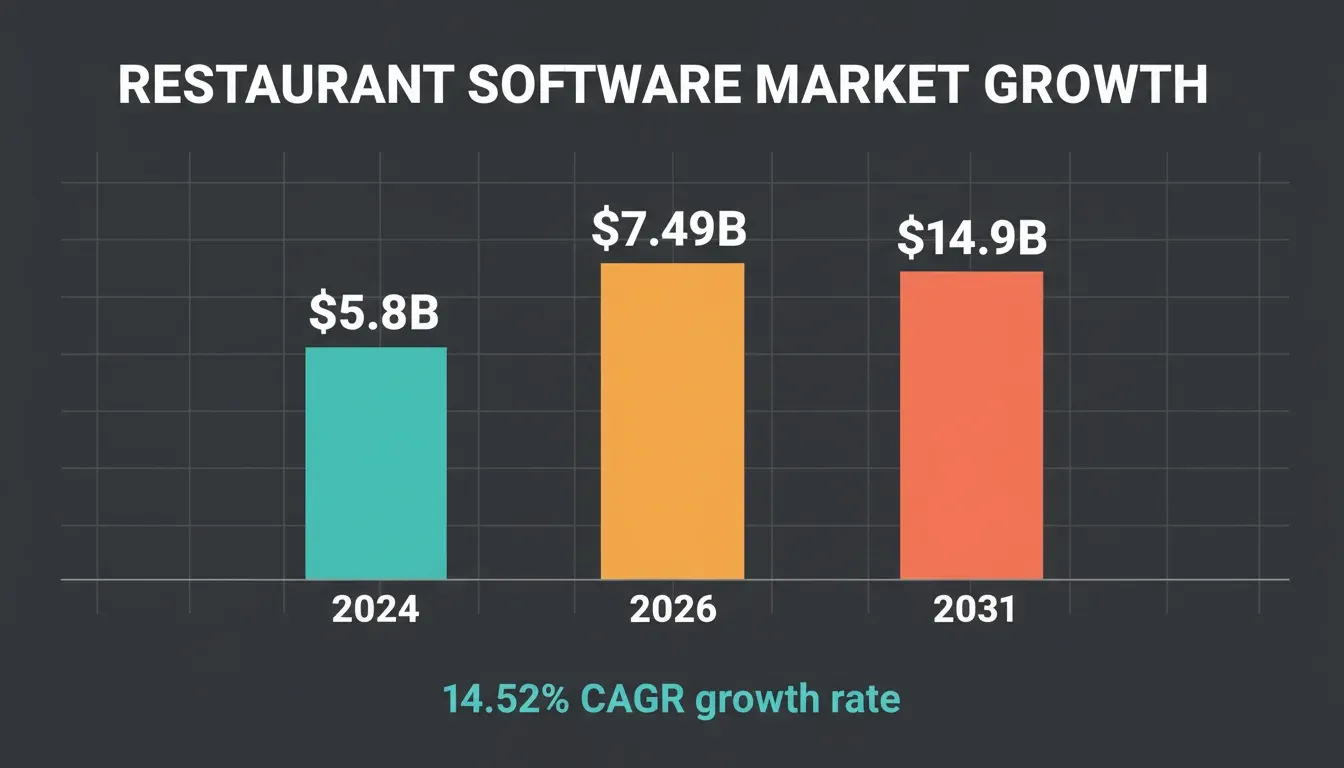
Restaurant management software market growth trajectory showing 14.52% CAGR through 2031
| Feature | Impact |
|---|---|
| Table-side ordering | Reduces wait times and eliminates handwriting errors |
| Stripe integration | Handles split bills, tips, and multi-currency payments |
| Real-time order status | Improves guest experience with live updates |
| Inventory auto-deduction | Reduces food waste as orders fire |
Prompts for Real-Time Order Routing
These prompts create the connection between your dining room and kitchen. The AI generates real-time subscriptions so orders appear instantly on kitchen displays.
Prompt 5: "Build a waiter ordering screen that shows the assigned tables with current status. Tapping a table opens the restaurant menu with category tabs. Items can be added with quantity, modifications (no onion, extra sauce, allergy alert), and course assignment (starter, main, dessert). Submitting an order sends it to the kitchen display in real time via Supabase subscriptions."
Expected output: Table grid view, menu browser with modification modal, cart summary per table, and real-time push to KDS.
What to check: Orders appear on KDS within two seconds. Modifications display prominently. Customer interactions are logged with timestamps for dispute resolution.
Prompt 6: "Add order priority logic: VIP tables get flagged orders that jump the queue. Large party orders (8+ guests) trigger a kitchen prep alert 15 minutes before the reservation starts. Connect ordering data to Rocket's connector system for real-time analytics."
Follow-up refinement: "Include a fire next course button so waiters control when the kitchen starts the next set of dishes for each table."
Understanding how to build a WhatsApp order management app alongside your main system can give your restaurant an additional customer-facing ordering channel without extra development effort.
Prompts for Payment Processing and Bill Splitting
Payment is where restaurants lose the most revenue to errors. These AI-powered prompts generate Stripe-connected checkout flows that handle the edge cases restaurants deal with daily.
Prompt 7: "Create a bill management screen for cashiers and waiters. Support: pay full bill, split equally among N guests, split by item selection, and custom amount split. Connect to Stripe for card payments, support cash marking, and generate digital receipts via email. Include tip calculation suggestions (15%, 18%, 20%, custom)."
Expected output: Split bill interface with drag-to-assign items, Stripe checkout integration, receipt generation, and tip calculator.
Prompt 8: "Add end-of-day cash reconciliation for the cashier role. Compare expected cash (from cash-marked transactions) against actual drawer count. Flag discrepancies over $5. Generate a daily close-out report showing total sales data by payment method, tips collected, and refunds processed."
What to check: Sales data matches across the waiter view, cashier view, and owner reports. Stripe webhook confirmations update order status. Food waste from comped items appears in the waste report.
What Makes Kitchen Display Prompts Different from Standard CRUD?
Kitchen display prompts differ because they require priority logic, station routing, and course-timing that standard CRUD generation does not produce. They operate under time pressure during peak hours where a ten-second delay cascades into cold food and unhappy guests. The AI-powered prompts here generate priority-aware, course-timed, station-routed displays that improve restaurant operations measurably.
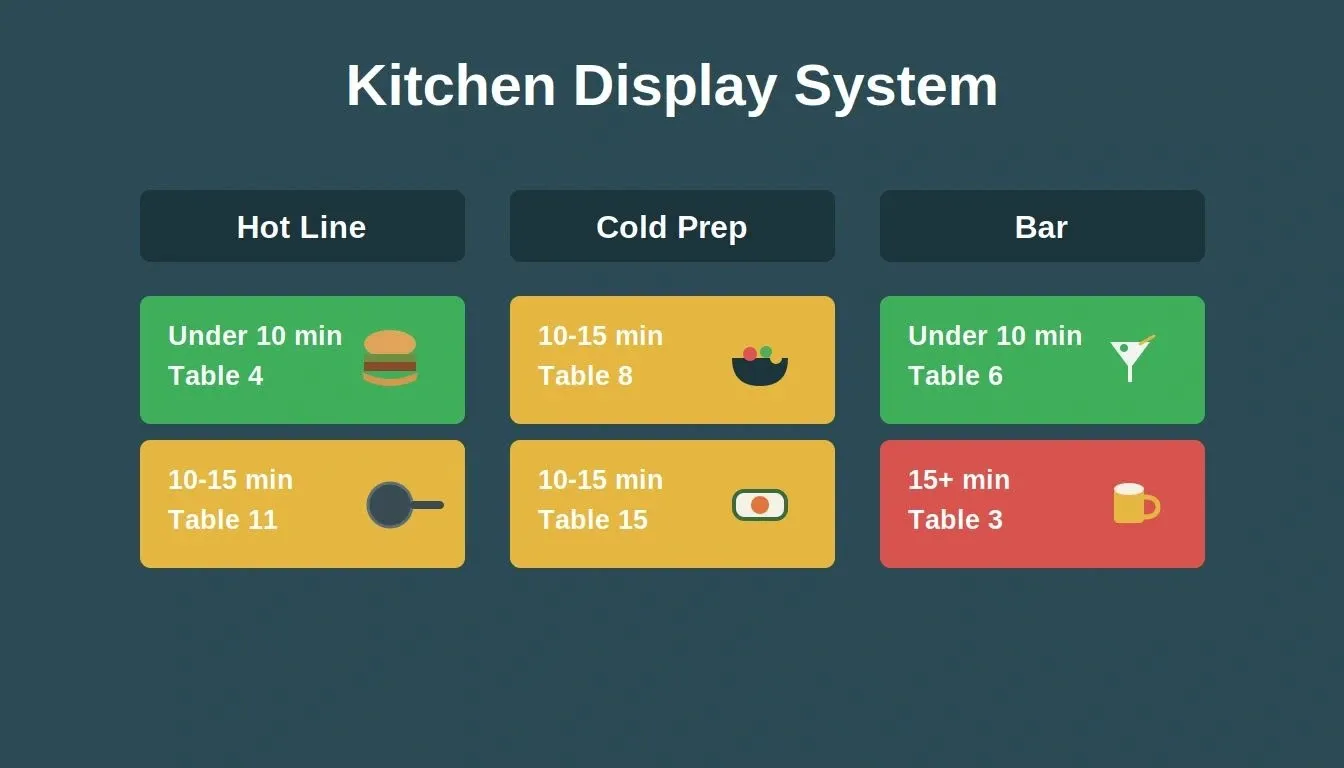
Station-based KDS with color-coded timers: green under 10 min, yellow 10-15 min, red 15+ min overdue
| Feature | Standard Dashboard | AI-Prompted KDS |
|---|---|---|
| Update frequency | Manual refresh | Real-time, sub-second |
| Priority handling | None | VIP queue jumping, overdue alerts |
| Station routing | All orders to one screen | Items split by station (grill, cold, bar) |
| Course timing | Not supported | Fire-on-ready with configurable delays |
| Alert system | None | Color-coded overdue timers, sound alerts |
The restaurant industry relies on consistent execution during service. AI helps by generating the logic that restaurant managers would otherwise need custom developers to build. This reduces food costs from wasted prep and eliminates overcooked items sitting in the pass.
Prompts for Live Kitchen Queuing and Alerts
These prompts generate a kitchen display that thinks like a line cook, prioritizing by urgency and station assignment.
Prompt 9: "Build a Kitchen Display System with station-based views (Hot Line, Cold Prep, Bar, Pastry). Each order card shows: table number, items for that station only, modifications highlighted in red, time since order was placed with a color timer (green under 10 min, yellow 10-15, red 15+). Add sound alerts for overdue items."
Expected output: Multi-station KDS with filtered views, color-coded timers, audio alerts, and bump-to-complete functionality.
What to check: Items route correctly to stations. Timer colors change at thresholds. Bumping an item updates the waiter view and fires the next course if applicable.
Prompt 10: "Add a kitchen manager override panel. Allow reordering the queue manually, reassigning items between stations, and marking items as 86'd (sold out) which immediately updates the restaurant menu availability and notifies active waiters."
Follow-up refinement: "Track average completion time per menu item and surface slow items in a weekly report for menu engineering review."
Prompts for Course-Firing Control Logic
Course firing is what separates a restaurant app from a simple ordering tool. The AI needs to understand temporal dependencies between courses. The guest experience suffers when dessert arrives while someone is still eating their main.
Prompt 11: "Implement course-firing logic: when all appetizer items for a table are bumped as complete, automatically fire the main course tickets. When mains are complete, queue dessert with a configurable delay (default 5 minutes). VIP tables skip delay and fire immediately. Generate overdue alerts if any course exceeds its station average prep time by more than 50%."
Expected output: Automated course progression, configurable delays per table, VIP override, and overdue notification system.
Prompt 12: "Add a course-hold feature where waiters can pause firing for a table (e.g., guests are still talking, not ready for next course). Show held tables with a distinct indicator on the KDS. Restaurant managers can view all held tables and manually release them."
What to check: Course progression respects holds. Releasing a hold immediately fires queued items. All status changes log for customer satisfaction review.
Course-firing logic: order flows from apps through mains to dessert, with overdue alerts routing to the manager at each stage
How Do Inventory and Staff Scheduling Prompts Reduce Waste?
Inventory and scheduling prompts reduce waste by connecting ingredient-level stock tracking to every order that fires, and by surfacing labor cost projections before a shift is published. The National Restaurant Association's 2026 State of the Industry report (accessed July 2026) projects the US restaurant industry at $1.55 trillion in sales this year, with persistent cost pressures on food and labor cited as top operator concerns. The NRA benchmarks labor cost at under 30% of revenue as the healthy threshold.
AI-powered tools that track stock levels and predict staffing needs based on sales data patterns give restaurant owners a competitive edge. These prompts generate the inventory and scheduling modules that reduce waste and food costs simultaneously.
-
Low-stock alerts via Twilio SMS notify managers before a dinner service runs out of key seasonal ingredients (Twilio SMS connector shipped in Rocket's August 2025 week 4 release)
-
Supplier order forms auto-populate based on par levels and historical demand patterns
-
Staff scheduling accounts for peak hours, labor costs, and employee availability preferences
-
Operational efficiency improves when the system identifies trends like undervalued loyal guests who visit during off-peak times
Prompts for Inventory Tracking and Supplier Alerts
These prompts connect your restaurant menu items to ingredient-level stock tracking. The AI generates automatic deductions and alert thresholds.
Prompt 13: "Build an inventory module where each restaurant menu item links to a recipe with ingredient quantities. When an order fires, automatically deduct ingredient amounts. Show current stock levels with color indicators (green: 3+ days supply, yellow: 1-2 days, red: below par level). When any ingredient hits red, trigger a Twilio SMS alert to the on-duty manager."
Expected output: Recipe-linked inventory with auto-deduction, color-coded stock dashboard, and SMS alert integration. Restaurant management AI handles the calculation logic.
What to check: Deductions match order quantities. Alerts fire at correct thresholds. Confirm bulk receive updates stock correctly. Verify the supplier order auto-populates.
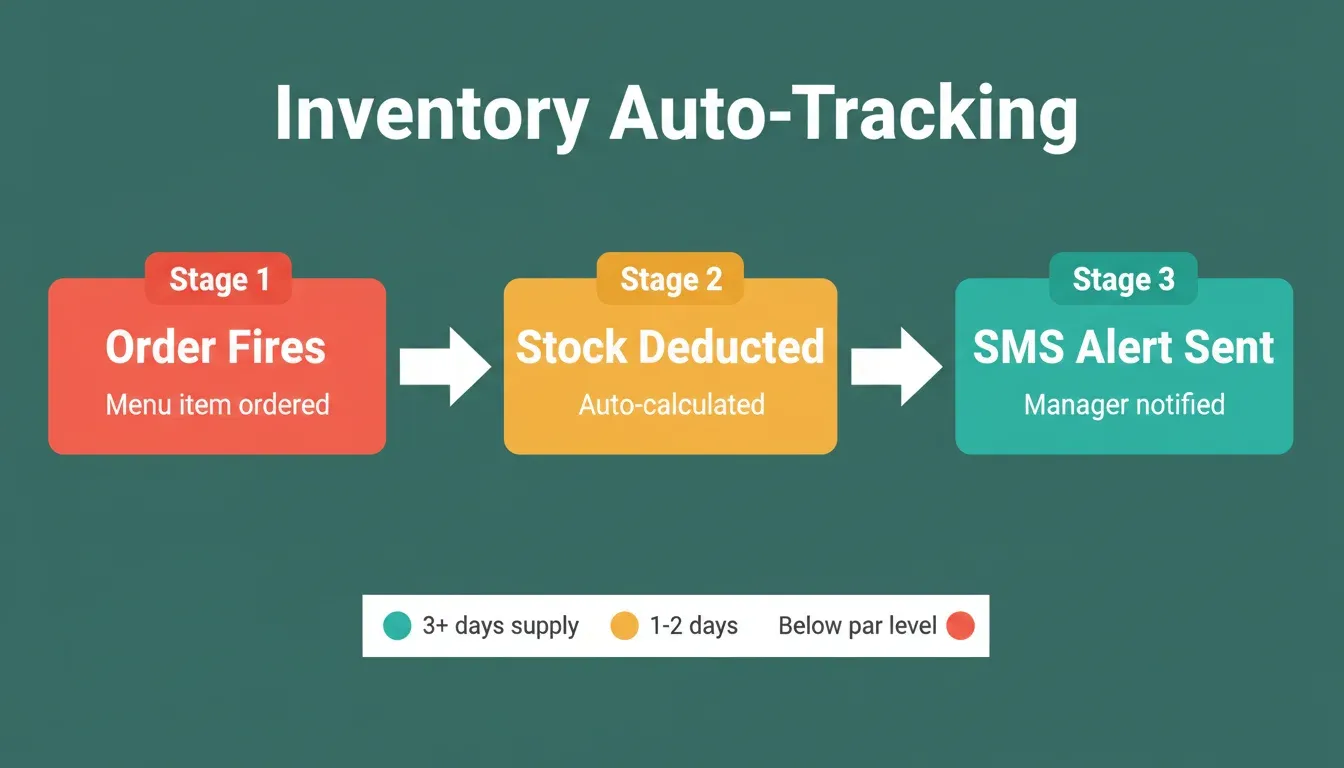
Three-stage inventory flow: order fires, stock deducts automatically, Twilio SMS alerts the manager when levels hit the red threshold
Prompt 14: "Add a supplier management section with contact details, order history, lead times, and pricing per ingredient. Generate automatic purchase orders when stock hits reorder point. Include a weekly food costs report comparing actual usage against theoretical (recipe-based) usage to identify food waste and potential theft."
Follow-up refinement: "Add seasonal ingredients scheduling that suggests menu changes based on supplier price fluctuations and availability windows."
For teams building connected operational tools, the guide on building AI apps for operations teams covers patterns that apply directly to restaurant back-of-house workflows.
Prompts for Staff Scheduling and Shift Management
Labor optimization directly impacts profitability. These prompts generate scheduling tools that connect to Rocket's full-stack build capabilities for creating connected systems.
Prompt 15: "Create a staff scheduling module where restaurant managers build weekly rotas. Pull sales data from previous weeks to suggest staffing levels per shift. Show labor costs as a percentage of projected revenue. Flag overstaffed and understaffed shifts. Allow staff to request time off and swap shifts with manager approval."
Expected output: Drag-and-drop schedule builder, AI-suggested staffing levels, labor cost projections, and self-service swap requests.
What to check: Repeat visits and customer behavior patterns from historical data inform staffing suggestions. Restaurant industry labor benchmarks (under 30% of revenue) trigger warnings. The restaurant management system connects scheduling to the auth module so only scheduled staff can clock in.
Prompt 16: "Add clock-in/clock-out with geofencing so staff must be on-premises. Track actual hours against scheduled hours. Generate payroll summaries by pay period. Include break compliance tracking for food safety labor regulations."
Follow-up refinement: "Show real-time labor cost as a live ticker on the manager dashboard, updating as staff clock in and out."
Why Rocket Handles Restaurant Complexity in One System
Restaurant apps are among the hardest to build because they connect so many moving parts: real-time kitchen displays, multi-role security, payment splitting, inventory deductions, scheduling, and reporting. All of this must work during a busy shift without latency.
Rocket is the vibe solutioning platform combining Solve (market research and decision intelligence), Build (the AI app generator), and Intelligence (continuous competitor monitoring) in one workspace with shared context. The Build pillar generates your restaurant app. The Solve pillar can validate your restaurant concept before you write prompt one. The Intelligence pillar can track what competing restaurant software vendors are shipping.
The Build pillar generates full-stack applications with Supabase backends, row-level security, and pre-built connectors for Stripe, Twilio, Resend, and OpenAI. One system, from prompt to production. You can explore what is possible in Rocket's 25+ integrations overview.
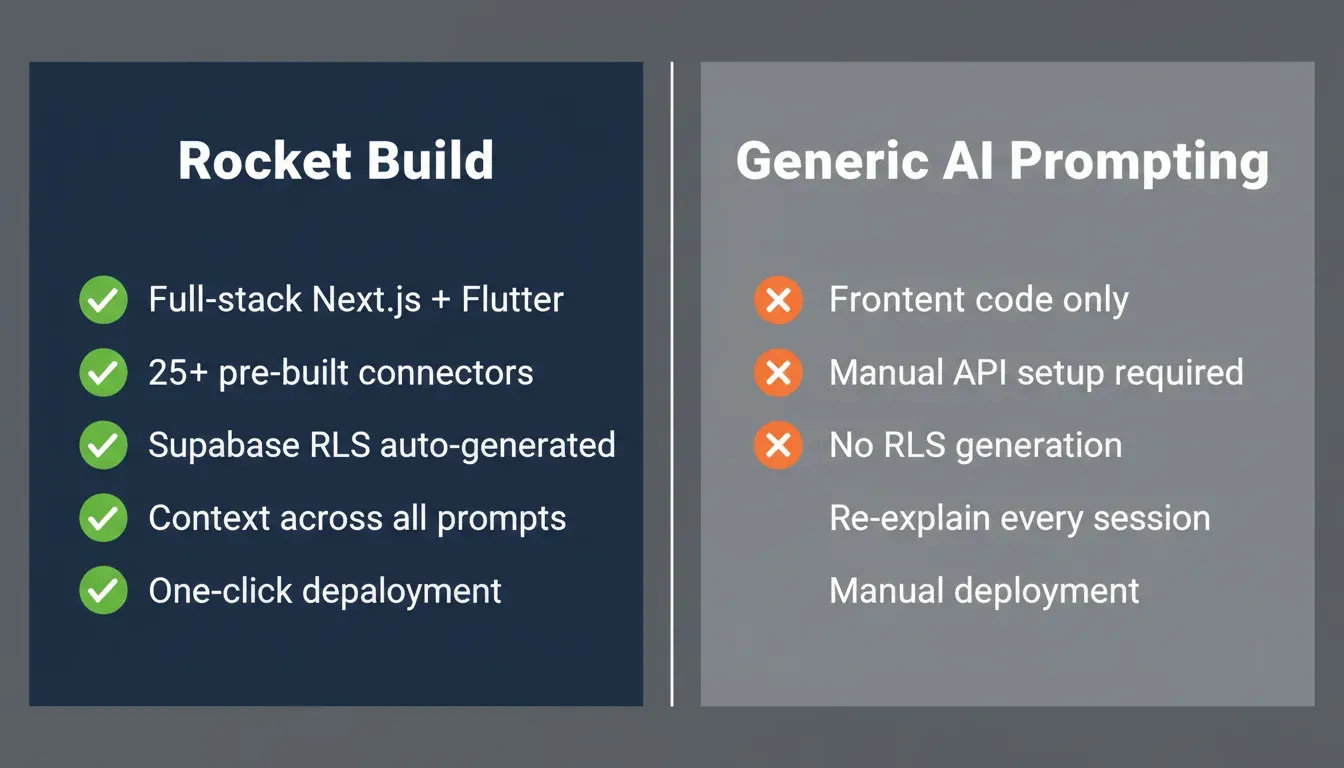
Rocket Build delivers full-stack output with pre-built connectors, while generic AI prompting produces frontend code only with no backend wiring
| Feature | Rocket Build | Generic AI Prompting |
|---|---|---|
| Full-stack output | Next.js + Flutter + Supabase backend | Frontend code only, no backend wiring |
| Pre-built connectors | 25+ services authenticated once | Manual API setup per service |
| Row-level security | Supabase RLS generated via migration scripts | Not generated, manual implementation |
| Cross-prompt context | Context carries across all 20 prompts | Re-explain schema every session |
| Mobile output | Flutter app for iOS and Android | Not included |
| One-click deployment | Live URL with SSL and CDN | Manual deployment required |
-
Full-stack output: Next.js frontend and Flutter mobile apps connected to a Supabase database with auth, RLS policies, and real-time subscriptions
-
25+ pre-built connectors including Stripe for payments, Twilio for SMS alerts, Resend for email receipts, and OpenAI for menu ideas generation. Authenticate once and they flow into every build.
-
Context carries across prompts: when you build the KDS after the ordering module, Rocket connects them to the same order table automatically
-
One-click deployment takes the entire restaurant app live with SSL, CDN, and scalable hosting
The restaurant management AI approach works because Rocket understands the relationships between modules. Your prompts build on each other, and the platform maintains context, so prompt 12 knows about the data structures you set up in prompt 1. This consistent execution eliminates the integration headaches that sink most restaurant software projects.
*"97% of developers on enterprise teams have used AI coding tools at some point in their workflow." — *GitHub Octoverse 2024 Developer Survey
That statistic reflects how AI-powered development became the default approach. For restaurants, this means building custom software is no longer expensive or slow. With the right prompts and Rocket.new, a complete restaurant management platform can go from idea to deployed app in a single day. See Rocket's pricing and credits for plan details.
For a real-world example of how a cloud kitchen was built from prompt to production, read the Cardamom Central Kitchen case study.
Which Reporting Prompts Complete Your Restaurant Dashboard?
Reporting prompts complete the system by connecting every data point (orders, payments, inventory, staff hours) into dashboards that surface decisions, not just numbers. Restaurant managers need dashboards that surface actionable insights without requiring them to run SQL queries.
-
Revenue dashboards show sales data by time period, payment method, and menu category
-
Reservation calendars visualize booking density and no-show patterns
-
Mobile-responsive audit trails satisfy franchise compliance and food safety requirements
-
Online reviews sentiment tracking connects customer feedback to specific shifts and staff performance
Prompts for Revenue and Analytics Views
These prompts generate the dashboards that restaurant owners check every morning. Sales data becomes actionable when it connects to menu design performance and guest experience metrics.
Prompt 17: "Build an owner dashboard showing: daily/weekly/monthly revenue with comparison to previous period, top-selling menu items with contribution margin, worst-performing items flagged for menu engineering review, average table turn time, and customer satisfaction scores from collected feedback. Include export to CSV and scheduled email reports."
Expected output: Multi-panel analytics dashboard with charts, KPI cards, comparison indicators, and export functionality.
Prompt 18: "Add a social media posts performance tracker that pulls engagement metrics for connected restaurant accounts. Show which content creation efforts drove the most reservations. Include review monitoring from Google and display overall rating trends. Surface personalized offers suggestions based on customer behavior data."
What to check: Revenue totals match Stripe transaction records. Menu item performance connects to the inventory food costs data. Accurate responses from the reporting module match data across all views.
For teams who want to understand how to build a financial reporting dashboard as a standalone module, the guide on building a dashboard for financial reporting covers the same patterns used in Prompt 17.
Prompts for Reservation Calendar and Mobile Responsiveness
The final prompts handle booking management and mobile access for managers who are not always at a desktop terminal.
Prompt 19: "Create a reservation calendar with 15-minute time slots showing table assignments. Support online booking from a customer-facing widget, phone-in reservations added by staff, and walk-in tracking. Show estimated wait times based on current table status. Send confirmation SMS via Twilio and reminder messages 2 hours before the reservation."
Expected output: Interactive calendar view, customer booking widget, wait-time calculator, and automated SMS confirmations.
Prompt 20: "Make the entire system mobile-responsive with a PWA manifest. Optimize the manager dashboard, KDS view, and waiter ordering screen for tablet and phone layouts. Add offline mode for the ordering screen so waiters can take orders during brief network outages, syncing automatically when connection restores."
Follow-up refinement: "Add a customer-facing feedback form that appears after payment, collecting ratings for food quality, service speed, and overall guest experience. Route low scores to the manager immediately."
Your Restaurant System Is Twenty Prompts Away
These twenty prompts follow a logical build order that mirrors how restaurants actually operate: from who can access what, through ordering and kitchen execution, to inventory controls and revenue visibility. The structure matters as much as the prompts themselves because each phase builds on the data models established in the previous one.
The restaurant industry is moving faster toward AI-powered operations than most operators realize. Whether you run a single cafe or manage multiple locations, starting with structured prompts and a platform built for connected systems puts you ahead of competitors still piecing together disconnected tools.
Ready to start building?
Paste your first foundation prompt into Rocket right now. Watch the multi-role auth scaffold appear in seconds, then work through each phase until your full restaurant management platform is live. Sign up free and start building today.
Table of contents
- -Why Does Building a Restaurant System Start with Better Prompts?
- -What Should Your Foundation Phase Cover?
- -Prompts for Multi-Role Authentication
- -Prompts for Menu and Table Configuration
- -How Do You Prompt AI for Order Management and Payments?
- -Prompts for Real-Time Order Routing
- -Prompts for Payment Processing and Bill Splitting
- -What Makes Kitchen Display Prompts Different from Standard CRUD?
- -Prompts for Live Kitchen Queuing and Alerts
- -Prompts for Course-Firing Control Logic
- -How Do Inventory and Staff Scheduling Prompts Reduce Waste?
- -Prompts for Inventory Tracking and Supplier Alerts
- -Prompts for Staff Scheduling and Shift Management
- -Why Rocket Handles Restaurant Complexity in One System
- -Which Reporting Prompts Complete Your Restaurant Dashboard?
- -Prompts for Revenue and Analytics Views
- -Prompts for Reservation Calendar and Mobile Responsiveness
- -Your Restaurant System Is Twenty Prompts Away