
Build a production-ready multi-tenant SaaS no-code app with tenant isolation, role-based access, and Stripe billing using AI platforms. Rocket generates real Next.js code from a single prompt- no dev team required.
Why do most founders still believe they need a full engineering team to ship a multi-tenant product? The global SaaS market hit $315.68 billion in 2025, growing at 18.7% CAGR through 2034. Over 70% of modern SaaS vendors now use some form of multi-tenancy architecture.
And yet, building one from scratch still feels like a six-figure problem reserved for funded startups with backend engineers on payroll. That assumption is outdated.
AI-powered code platforms now generate production-ready web apps complete with tenant isolation, authentication flows, and database schemas from plain language descriptions. The barrier between "I have an idea" and "I have paying tenants" has collapsed faster than most people realize.
What Does Multi Tenancy Mean for SaaS Products?
Before jumping into tools, it helps to understand what you are actually building. Multi tenancy is an architecture pattern where a single app instance serves multiple tenants, each with their own isolated data, configurations, and user accounts.
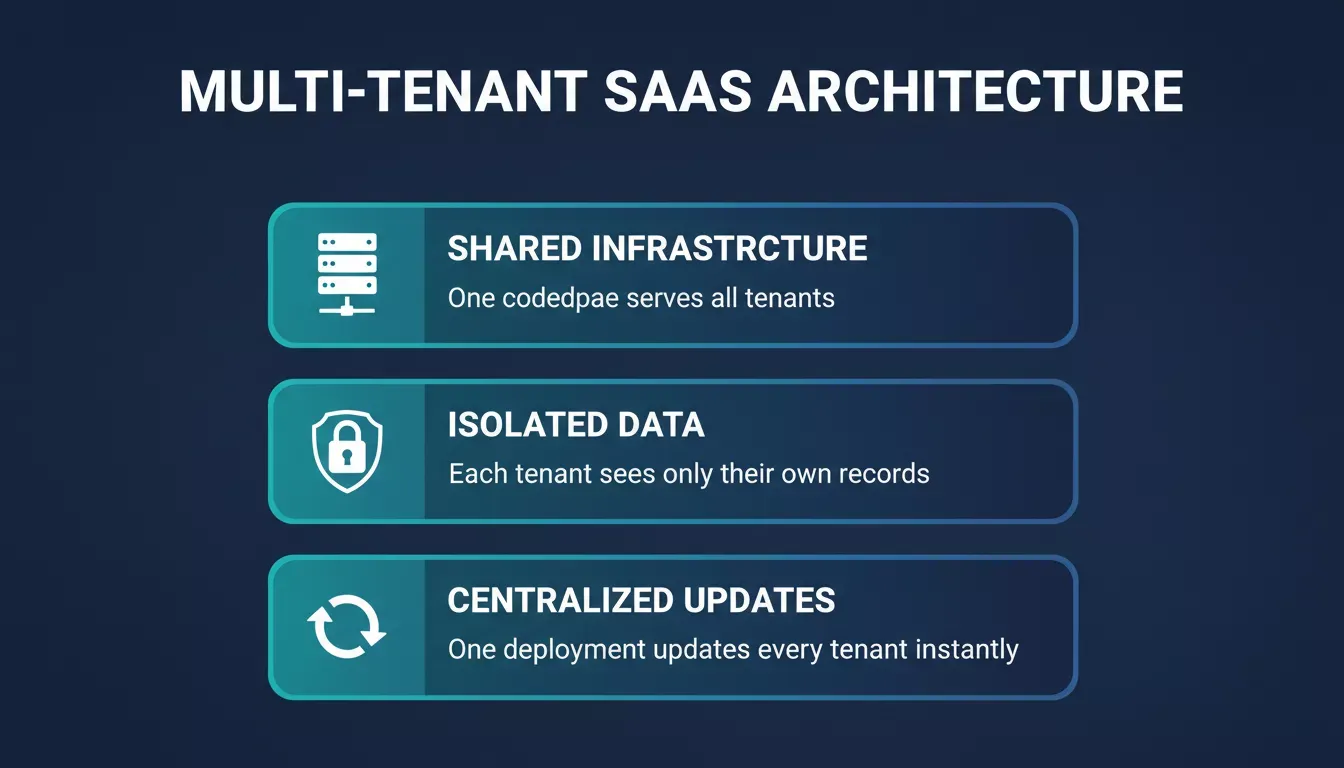
Multi-tenant architecture: one codebase, isolated data per tenant, centralized updates
-
Shared infrastructure, separate experiences: All tenants run on the same codebase and database infrastructure, but each customer only sees their own data, users, and settings
-
Cost savings at scale: One deployment handles hundreds or thousands of tenants instead of spinning up separate servers for each customer
-
Centralized maintenance: Bug fixes, feature updates, and security patches ship to every tenant simultaneously without individual deployments
-
Data privacy boundaries: Each tenant's data sits behind strict access control rules, so one customer can never view another tenant's records
-
Faster time to value for new tenants: Onboarding a new tenant takes seconds rather than days because no new infrastructure needs provisioning
This architecture is the reason platforms like Slack, Notion, and HubSpot can serve millions of organizations from the same application. The challenge has never been understanding the pattern, it has always been implementing it without a full engineering team.
| Aspect | Single Tenant | Multi Tenant |
|---|---|---|
| Infrastructure | One instance per customer | Shared instance, isolated data per tenant |
| Cost per customer | High (dedicated servers) | Low (shared resources across tenants) |
| Maintenance | Update each deployment separately | Single update reaches all tenants |
| Scaling | Linear cost growth | Sublinear cost growth as tenants increase |
| Security model | Physical isolation | Logical isolation with role-based access control |
| Best for | Enterprise with strict compliance needs | SaaS products serving many organizations |
The real challenge has always been implementing multi tenancy without writing traditional code from scratch, especially the backend logic for tenant isolation, user accounts, permissions, and role-based access.
Why Non-Technical Founders Are Choosing AI Builders to Ship Faster
Something shifted in the last two years. People who previously needed to hire full custom dev teams or spend months learning programming frameworks are now shipping real SaaS products in days.
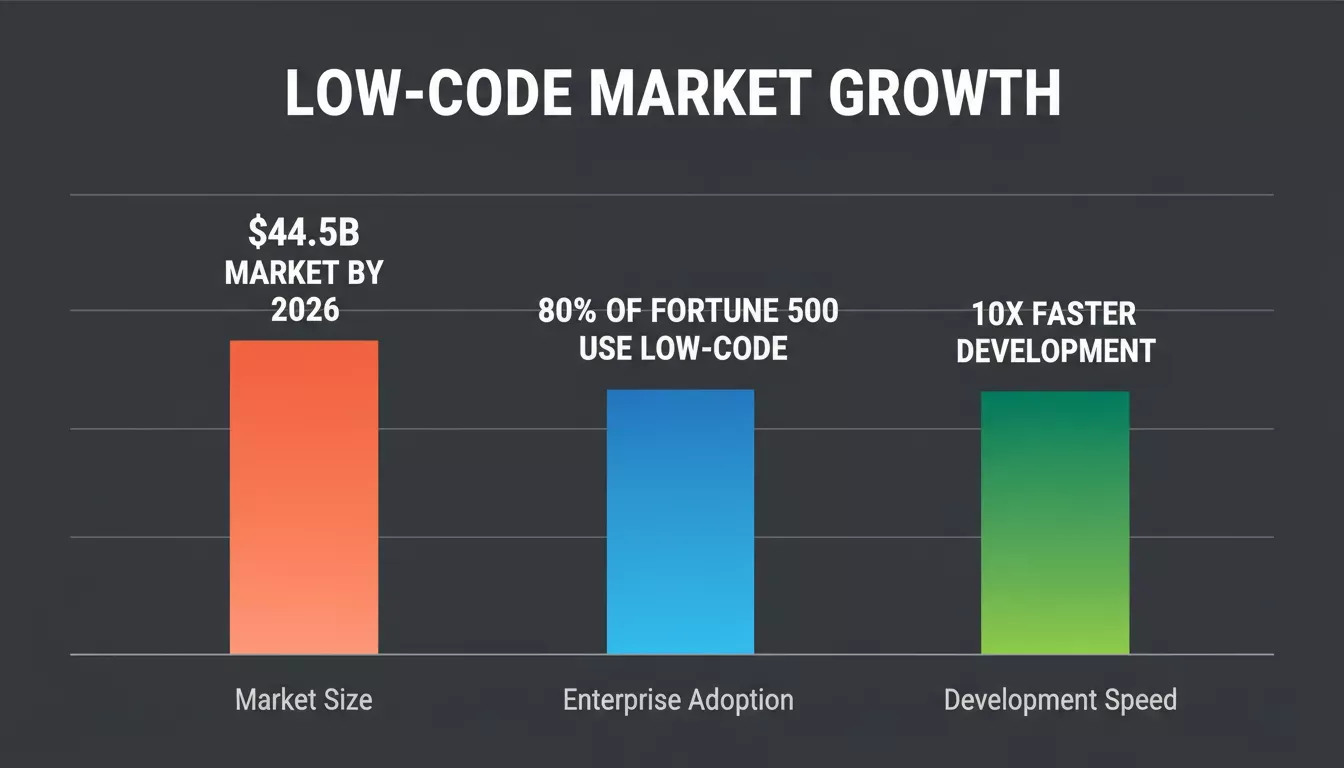
Low-code and no-code market growth: key statistics driving AI builder adoption
-
The low-code market is exploding: Gartner projects the broader low-code development technologies market will reach $44.5 billion by 2026, growing at a 19% CAGR
-
Citizen developers outnumber pro developers: By 2026, 80% of low-code platform users will come from non-IT departments, outnumbering professional developers roughly 4:1
-
AI no code tools generate production code, not prototypes: Modern AI builders write the same Next.js, React, and backend logic that a senior developer would produce, complete with API routes, database schemas, and authentication for tenants
-
Speed-to-market advantage: Organizations using these platforms report development times up to 10x faster and costs up to 70% lower compared to writing traditional code manually
-
Enterprise adoption validates the approach: 78% of Fortune 500 companies currently deploy low-code no code tools for mission-critical systems
When building a web app costs $200 instead of $200,000, the definition of who can build software and create a multi tenant saas system changes completely.
"I am working on a multi tenant idea where each customer has isolated data. My stack is usually Next, Prisma, and Postgres. I experimented with AI builders and was surprised at how much backend logic they handled out of the box." — Reddit user in r/nocode
For startups choosing between no code tools, this market shift means the question is no longer whether AI can build your multi tenant app. The question is which platform handles the complexity of tenants, roles, and scale best.
Can AI Handle Role-Based Access and Tenant Isolation?
This is where skeptics push back hardest. Multi tenancy requires real backend logic: tenant-scoped database queries, role-based access control, subdomain routing, and API-level isolation. Can an AI code platform actually handle all of that without writing traditional code?
-
Tenant-scoped database design: AI builders generate schemas where every table includes a tenant_id column, and all queries automatically filter by the authenticated user's organization. Each tenant's data stays completely isolated at the database level.
-
Role-based access control built in: Admin, editor, viewer, and custom roles with granular permissions come configured from the first generation. Tenants can manage their own internal roles without admin intervention.
-
Authentication and SSO support: Email and password, magic links, Google OAuth, and enterprise SSO through providers like Supabase Auth give tenants flexible sign-in options
-
Subdomain-per-tenant routing: Each tenant accesses the app through their own subdomain, with Next.js middleware handling the routing logic automatically for all tenants
-
API-level isolation with api connector support: Every API endpoint validates tenant context through an api connector layer, so one organization's requests never touch another tenant's data
-
Row-level security policies: Database-level rules block cross-tenant data access even if application code has an error, especially straightforward with Supabase, where you define policies in a single line of configuration
AI platforms generate these patterns because they have been trained on thousands of open-source multi-tenant codebases. The multi-tenant architecture comes pre-configured rather than hand-built by a full custom dev team.
Multi-tenant request flow: authentication, tenant resolution, and role-based data access
Each tenant operates in a completely sandboxed environment. Teams managing tenants at scale can assign roles, control permissions, and manage user accounts without any single line of backend code written manually.
Tenant Usage Analytics and Monitoring for Multi Tenant SaaS
Understanding how tenants use your application is as important as building it. Tenant usage analytics give you visibility into which organizations are most active, which features drive retention, and where users drop off across different tenant accounts.
Production-grade multi tenant saas systems should track tenant usage analytics at multiple levels: per-tenant session counts, feature adoption rates, API request volumes per organization, and error rates by tenant. This data helps you prioritize roadmap decisions, identify at-risk accounts before churn, and demonstrate business value to enterprise clients.
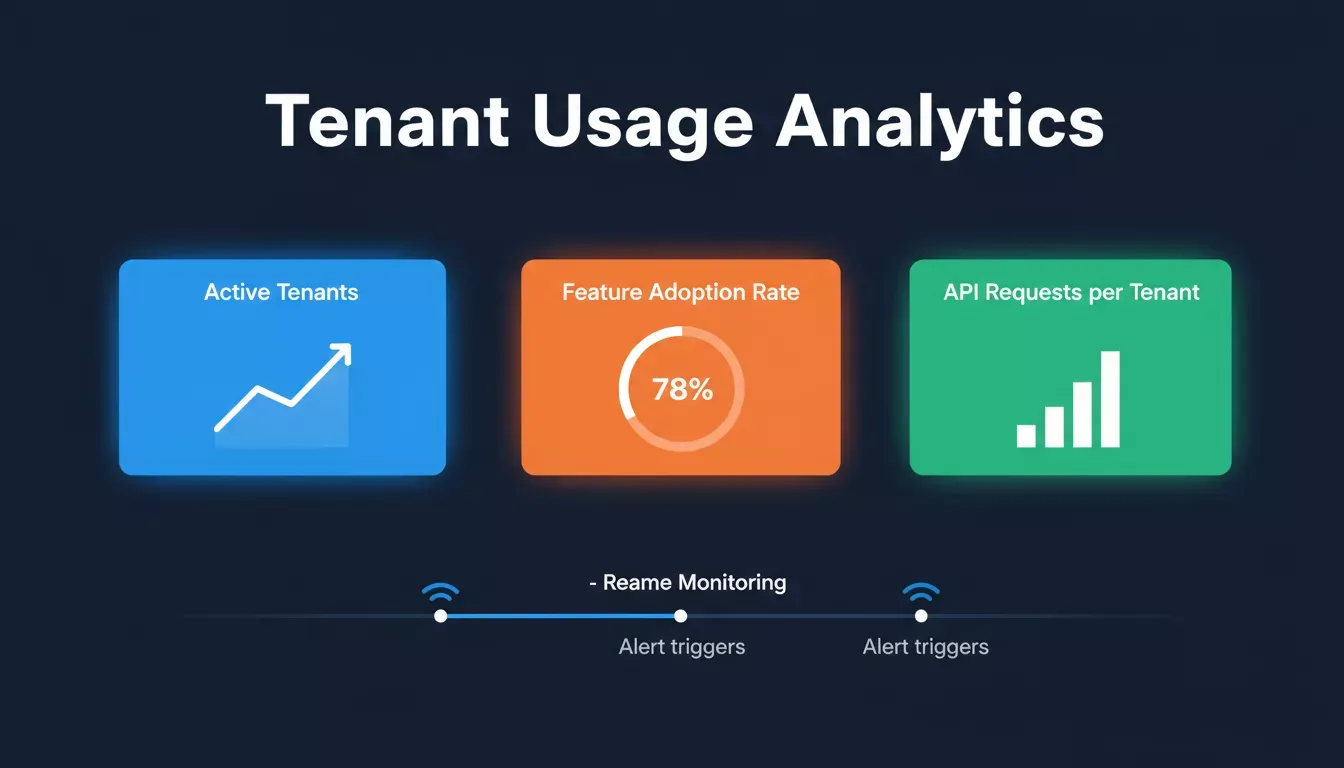
Real-time tenant usage analytics: track adoption, requests, and growth signals per organization
AI-built applications on modern infrastructure connect analytics services like Google Analytics, Mixpanel, or custom dashboards directly into the tenant context layer. Each analytics event automatically carries the tenant_id, so reports segment cleanly by organization without manual configuration. Teams can monitor tenant usage analytics in real time and set automated alerts when usage patterns signal a problem.
How Does Rocket Compare to Bubble and Other Platforms?
Not all no-code tools handle multi-tenancy the same way. The differences between platforms become obvious when you need real tenant isolation, production-ready performance, and the ability to scale past your first hundred tenants.
-
Bubble uses privacy rules for tenant separation: Bubble handles basic multi tenancy through its privacy rules system, but performance degrades noticeably past a few hundred active tenants. Bubble's visual workflow engine adds complexity when you need custom roles, api connector logic, or tenant-specific configurations.
-
Bubble templates exist for multi tenancy: Several Bubble templates attempt to solve tenant isolation, but they rely on Bubble's proprietary runtime. Moving off Bubble later means rebuilding everything from scratch.
-
Adalo and Glide lack backend depth: These platforms work well for simple apps but cannot handle the complex logic required for proper multi-tenant data separation, role-based access control across tenants, or api connector workflows
-
DrapCode offers multi-tenant templates: DrapCode provides multi-tenant templates but locks you into proprietary infrastructure with limited flexibility for custom backend logic
Rocket takes a different approach entirely. Instead of building on top of a proprietary runtime like Bubble, Rocket generates real Next.js TypeScript code that you own completely. The output runs on standard infrastructure: Vercel, Netlify, or any Node.js host.
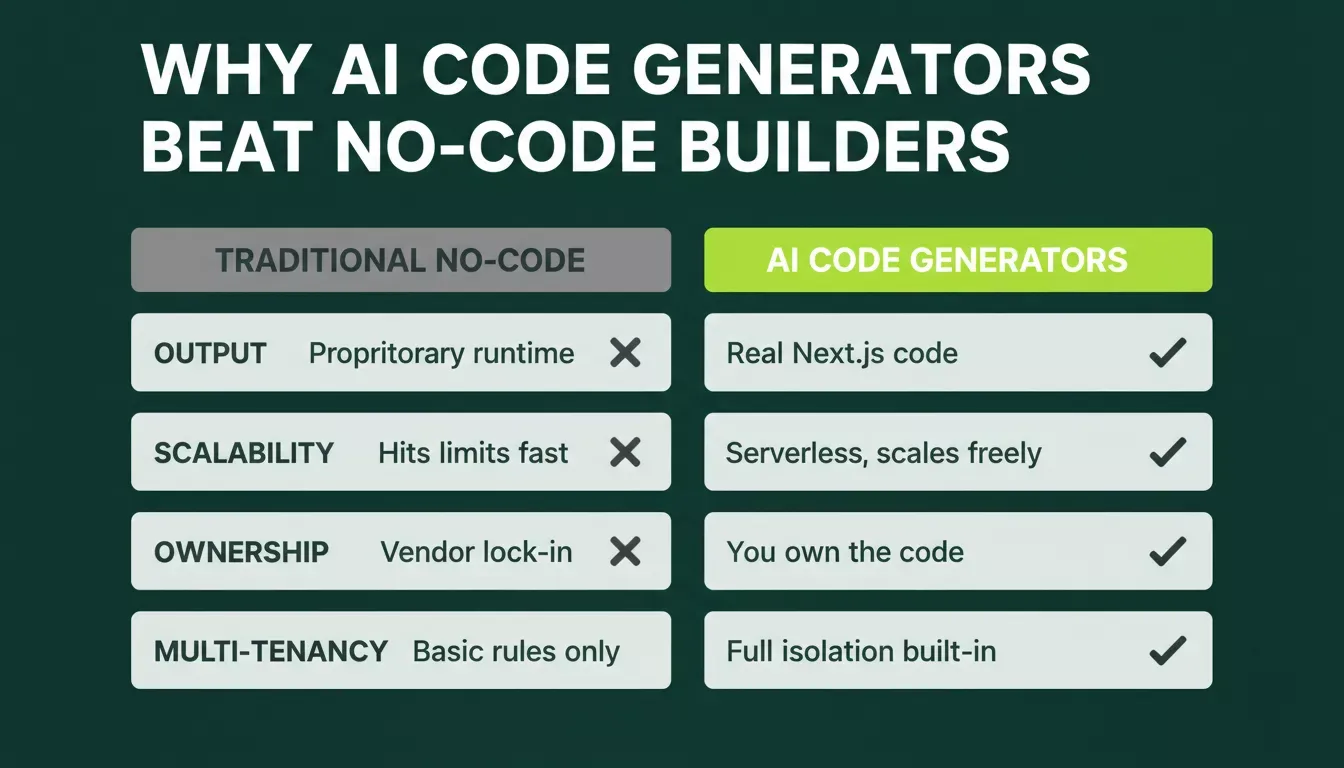
AI code generators vs traditional no-code builders: a direct comparison across the metrics that matter
-
Next.js output by default: Every web app Rocket generates uses Next.js with TypeScript, server-side rendering, API routes, and production-ready multi tenant architecture from the first build
-
Supabase for tenant data and auth: Connect Supabase in one click for PostgreSQL databases with row-level security, real-time subscriptions, and tenant-scoped authentication, all configured automatically for your tenants
-
26+ api connector options flow into generation: Stripe for billing, Google Analytics for tracking, Mailchimp for tenant communications, SendGrid, Twilio, and more. Each api connector authenticates once and becomes available in every build.
-
Cross-task context for iterative building: Rocket's cross-task context carries your project decisions forward using @-mentions. The multi-tenant structure defined in your first build is available in every subsequent task without re-explaining it to the platform.
-
Editor and Viewer roles within Rocket: Two collaboration roles within the platform let your team work together with appropriate access levels and permissions across every project and task
-
One-click deploy with staging environments: Ship to a live URL instantly, test in staging, connect custom domains, and roll back to any previous version
Unlike Bubble, you can download Rocket's output, run it locally, push to GitHub, or deploy anywhere. No vendor lock-in, no proprietary runtime, no limits on what tenants can do within your multi tenant app. For teams that have outgrown Bubble's constraints, this is the production-ready path forward.
The gap between Bubble-style no code tools and AI code platforms like Rocket comes down to one thing: whether the output is code you would trust to serve paying tenants and enterprise customers at scale. You can also explore how Rocket compares directly to Bubble for a detailed feature breakdown.
Platform Comparison: Multi-Tenant SaaS Use Cases
| Platform | Multi-Tenant Support | Output Type | Scalability | Vendor Lock-in |
|---|---|---|---|---|
| Rocket | Full isolation, RBAC, subdomains | Real Next.js code | High, serverless | None, own your code |
| Bubble | Privacy rules only | Proprietary runtime | Limited past ~200 tenants | High |
| Adalo | Basic user roles | Proprietary | Low | High |
| DrapCode | Templates available | Proprietary | Moderate | High |
| Glide | Simple data separation | Proprietary | Low | High |
What Steps Get You From Idea to Live Multi Tenant App?
The process is shorter than most people expect. Here is what a typical path looks like when you use an AI platform to create a multi-tenant product from zero: no Bubble templates, no custom dev team, no months of backend development.
-
Define your tenant model: Decide whether tenants are companies, teams, or individual users. Sketch out what data each tenant owns, what roles exist within each organization, and how tenants interact with each other (or stay isolated).
-
Describe your app in plain language: Write a prompt covering the core screens, tenant onboarding flow, admin dashboard, user management page, and billing section. Include specifics about permissions, roles, and the features each tenant type gets access to.
-
Generate and review the complete app: The AI builds your multi tenant app in 1-3 minutes. Review the architecture, check the database schema for proper tenant_id columns, and test the role-based access control flows across different tenant accounts.
-
Iterate through conversation: Add features, adjust the UI for different tenant views, connect api connector services like Stripe and SendGrid, and refine tenant management workflows through simple follow-up messages. No writing code manually.
-
Test with sample tenants: Create two or three test organizations as separate tenants, invite users with different roles to each tenant, and verify that data isolation works correctly.
-
Deploy and scale with real tenants: Launch to production with a custom domain, set up analytics to monitor tenant usage patterns, and watch real tenants use your saas product. Built-in performance monitoring tracks page speed, tenant growth, and conversion rates for your multi tenant saas system.
Six steps from idea to live multi-tenant SaaS: define, describe, generate, iterate, test, deploy
From first prompt to live product, teams report timelines of days rather than months. The maintenance burden drops too, since the underlying Next.js framework handles scalability for thousands of tenants, so you focus on features rather than infrastructure management.
Gartner projects that by 2029, low-code platforms will power 80% of mission-critical applications globally. The trajectory is clear: multi tenant saas apps built without writing traditional code are becoming the standard, not the exception. If you want to see what is possible, explore what you can build on Rocket across different product categories.
For teams evaluating the full-stack AI approach, how Rocket generates Next.js and Flutter explains the technical decisions behind the output format and why it matters for long-term scalability.
Your Next Multi Tenant Product Starts With One Prompt
The technical barriers that once separated people with ideas from people who ship products have dissolved. Multi-tenant architecture, role-based access control, tenant isolation, billing through Stripe, api connector workflows: none of these require a custom dev team anymore. The no code tools and AI platforms caught up to the ambition.
Whether you are building a client portal for enterprise tenants, a team collaboration platform, or an industry-specific saas product serving thousands of organizations, the path from concept to paying tenants is measured in days now, not quarters.
Ready to build your multi-tenant SaaS app without writing traditional code? Describe what you want on Rocket.new and watch it generate a full Next.js product with tenant isolation, role-based access, and one-click deployment in minutes.
Start building on Rocket for free and ship your first multi tenant saas system this week.
Table of contents
- -What Does Multi Tenancy Mean for SaaS Products?
- -Why Non-Technical Founders Are Choosing AI Builders to Ship Faster
- -Can AI Handle Role-Based Access and Tenant Isolation?
- -Tenant Usage Analytics and Monitoring for Multi Tenant SaaS
- -How Does Rocket Compare to Bubble and Other Platforms?
- -Platform Comparison: Multi-Tenant SaaS Use Cases
- -What Steps Get You From Idea to Live Multi Tenant App?
- -Your Next Multi Tenant Product Starts With One Prompt