
20 copy-paste AI prompts to build a production-ready task management app with Rocket.new, organized across five phases: foundation, core features, collaboration, reporting, and hardening. Use Rocket.new's Solve to validate first, then Build to ship.
These 20 copy-paste AI prompts to build a task management app give product managers, solopreneurs, front-end developers, and SMB teams a structured path to go from natural-language prompts to a working app. The sequence covers prompt engineering for setup, authentication, core task flows, team collaboration, reporting, UI polish, and production hardening, so you can build something scalable and maintainable instead of stopping at a prototype.
Before you write a single prompt, Rocket.new's Solve pillar can validate whether your task app idea addresses a real market gap, and Intelligence can monitor what competing tools are shipping. This guide focuses on the Build phase, where structured prompting helps teams ship faster with less traditional coding overhead, but the thinking that precedes it is where production-ready apps actually begin.
Why Structured Prompts Outperform Vague Descriptions
How does one prompt sequence produce a production-ready app while another generates a broken skeleton? The difference comes down to structure.
97% of developers on enterprise teams have used AI coding tools at work. Yet most generated code still requires significant manual cleanup. The gap is not the AI model itself.
The gap is prompt quality.
When you write prompts for app builders, specificity determines output quality. Vague requests like "build me a task app" produce generic scaffolds missing real-world logic. Structured prompts that define context, features, technical constraints, and expected output generate functional apps that actually work.
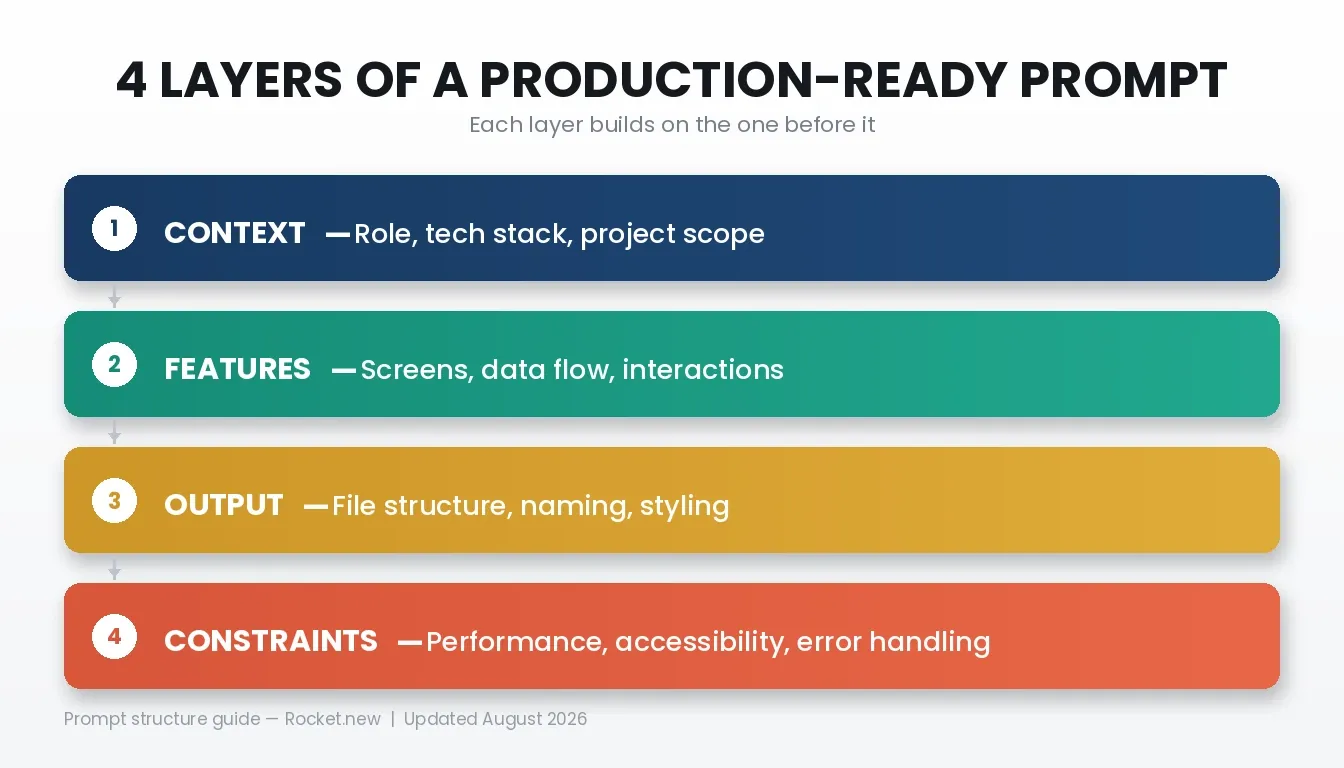
Every production-ready prompt is built from four layers: context, features, output spec, and constraints. Miss one and the AI fills the gap with assumptions.
- Context layer: define the role, tech stack, and project description so the AI app builder knows the boundaries
- Feature layer: list exact screens, data flow, and user interactions for each component
- Output layer: specify file structure, naming conventions, and styling framework
- Constraint layer: set performance targets, accessibility standards, and error handling expectations
This layered approach to prompt patterns means each instruction builds on the previous one. The generated code stays consistent across files because the AI maintains context from your structured plan throughout the session.
One practical note before you start: Rocket.new's Prompt Intelligence scores every prompt before work begins. If your prompt is specific enough, Rocket.new starts immediately. If it falls below the clarity threshold, Prompt Intelligence asks a short set of targeted questions and starts once it has enough to proceed. The prompts in this guide are written to be specific enough to skip the questions entirely.
Every "What to check" step in this guide is there by design. Generated code needs human review. Test after every significant change. That discipline is what separates a shipped product from a prototype that never leaves your laptop.
Phase One: How Do I Set Up the Foundation for a Task App?
Every task management app starts with solid architecture. These four prompts create the scaffolding that all other features depend on. Run them in order; later prompts assume the database schema and auth system from earlier ones are already in place.
Prompt 1: Project Scaffold and Tech Stack
"Create a new Next.js project with TypeScript, Tailwind CSS, and Supabase integration. Set up the folder structure with /app, /components, /lib, and /types directories. Include a configured Supabase client, environment variable setup, and a basic layout component with a navigation sidebar."
Expected output: A clean project structure with a working Supabase connection, typed environment variables, and a responsive shell layout.
What to check: Verify the Supabase client initializes without errors, and the layout renders on both desktop and mobile views.
Follow-up prompt: "Add a loading state to the layout and configure the Supabase auth listener in a provider component."
Prompt 2: Authentication System
"Generate a complete authentication system using Supabase Auth. Include email/password sign-up, sign-in, password reset flow, and OAuth with Google. Create protected route middleware, a user context provider, and session persistence. The sign-in page should have form validation with helpful error messages."
Expected output: Working auth pages, middleware that redirects unauthenticated users, and session management across page refreshes.
What to check: Test the password reset email flow end-to-end. This is the most common generation gap for auth prompts.
Follow-up prompt: "Add rate limiting to the sign-in endpoint and display a lockout message after five failed attempts."
Prompt 3: User Onboarding Flow
"Build a three-step onboarding wizard for new users. Step one collects workspace name and team size. Step two lets users invite team members via email. Step three presents a template picker with options for personal task list, team project board, and sprint planning. Save selections to the user profile and redirect to the dashboard on completion."
Expected output: A multi-step form with progress indicator, email validation for invites, and template-based workspace creation.
What to check: Confirm the onboarding only shows once per user and that skipping steps still creates a usable workspace.
Follow-up prompt: "Add the ability to skip onboarding and show a dismissible setup checklist on the dashboard instead."
Prompt 4: Database Schema Generation
"Generate the Supabase database schema for a task management app. Include tables for workspaces, projects, tasks, subtasks, comments, activity_log, and team_members. Define relationships, indexes for common queries, row-level security policies, and timestamp columns. Add a workback schedule table that tracks key milestones with start and end dates."
Expected output: SQL migration files with proper foreign keys, RLS policies scoped to workspace membership, and indexed columns for task filtering.
What to check: Run the migration on a fresh Supabase instance. Missing RLS policies are the most common gap here.
Follow-up prompt: "Add a custom fields JSON column to the tasks table and create a trigger that logs all task status changes to activity_log."
Generating a database schema from scratch is one of the highest-leverage prompts in this sequence. For a deeper guide on this topic, see how to generate a database schema with AI.
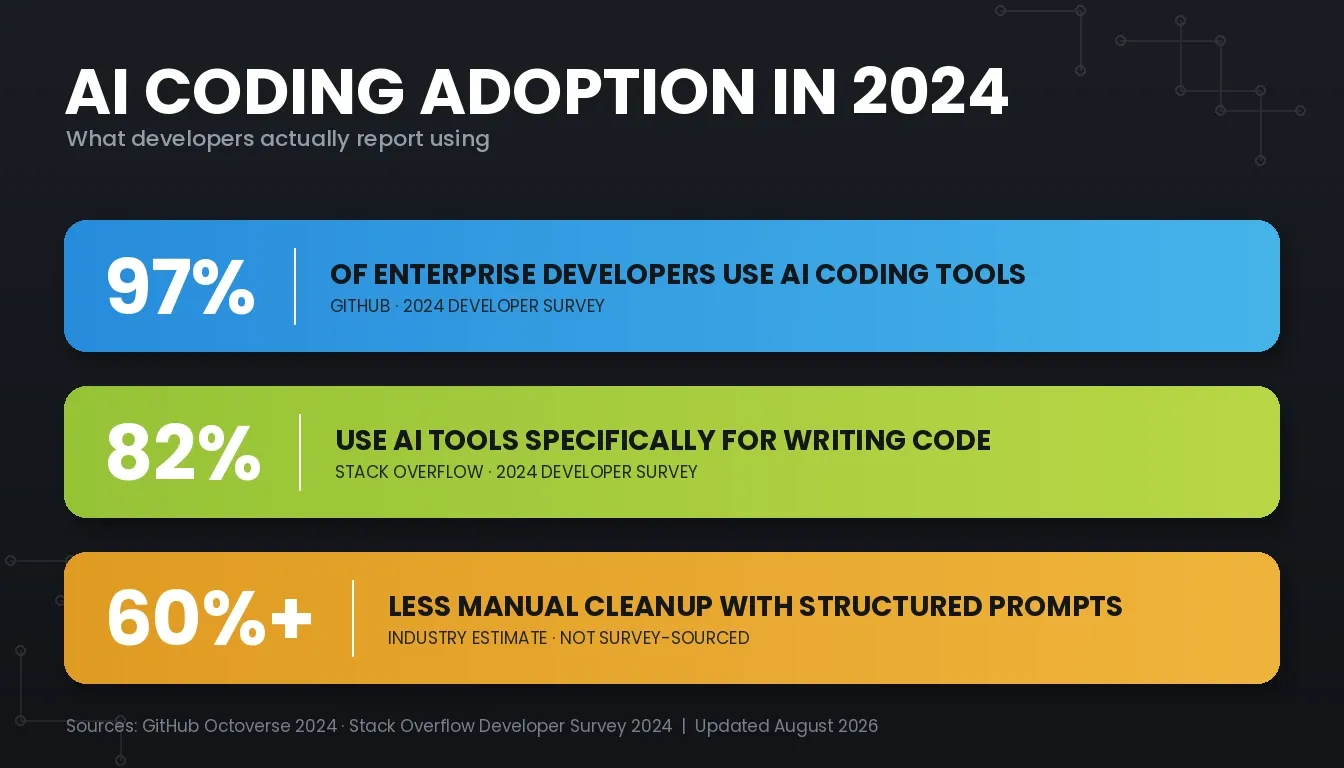
82% of developers already use AI for writing code. The gap between good and poor results is almost entirely explained by prompt structure, not model capability.
Phase Two: Which Prompts Generate the Core Task Management Features?
With the foundation set, these prompts generate the screens users interact with daily. Each prompt targets a single feature so you can test and refine independently.
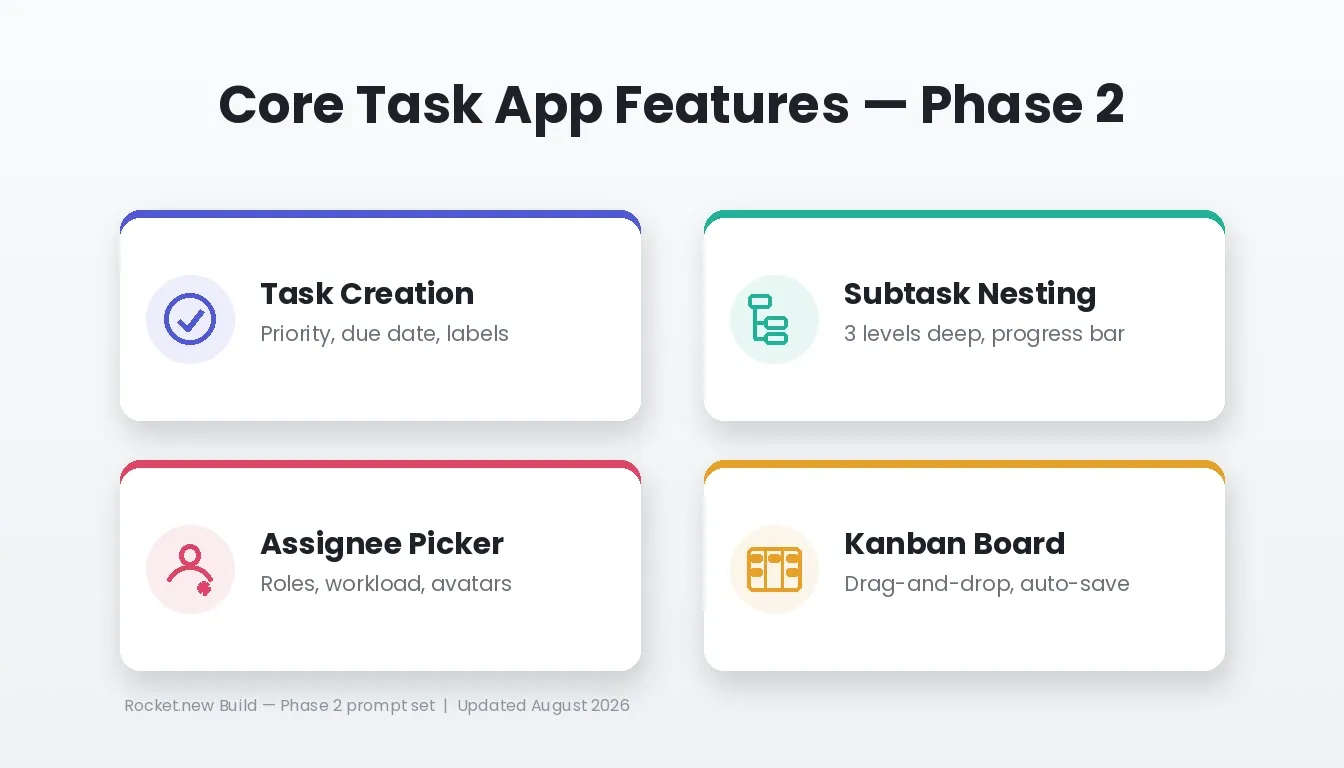
The four core feature prompts in Phase 2 map directly to the screens your users will open every day.
Prompt 5: Task Creation with Priority and Due Date
"Create a task creation form with title, task description, priority selector (Low, Medium, High, Urgent), due date picker, label tags, and project assignment. Include keyboard shortcuts for quick entry, inline validation, and optimistic UI updates. Store tasks in Supabase with the logged-in user as creator and track who can assign owners to each task."
Expected output: A modal or slide-over form that creates tasks instantly with correct priority badges and due date display in the task list.
What to check: Verify that creating a new task updates the list without a full page reload.
Follow-up prompt: "Add a markdown-enabled description field and support file attachments up to 10MB."
Prompt 6: Subtask Nesting and Progress Tracking
"Add subtask support to the task detail view. Users should be able to create nested subtasks up to three levels deep, mark tasks complete individually, and see parent task progress as a percentage bar based on completed children. Include drag-to-reorder within subtask groups."
Expected output: An expandable subtask tree with checkboxes, progress calculation, and smooth reorder animations.
What to check: Test the progress rollup when marking deep-nested subtasks as done.
Follow-up prompt: "Add the option to convert a subtask into a standalone task while preserving its description and assignee."
Prompt 7: Assigning Tasks, Assignee Selection, and Team Roles
"Build an assignee picker component that shows team members with avatars and online status. Support multiple assignees per task, role-based permissions (Admin, Editor, Viewer), and a quick-assign dropdown in the project tracking board. Filter the member list by name or role and display assigned task counts next to each person."
Expected output: A searchable dropdown with real-time presence indicators, role badges, and workload visibility.
What to check: Confirm that Viewer-role users cannot reassign tasks or change priorities.
Follow-up prompt: "Add a workload view that shows each team member's assigned items grouped by due date and status."
Prompt 8: Kanban Board with Drag-and-Drop
"Generate a Kanban-style status board with columns for To Do, In Progress, Review, and Done. Cards should display title, assignee avatar, priority badge, and due date. Implement drag-and-drop between columns with smooth animations and auto-save on drop. Include column task counts and the ability to add custom columns for deal stages."
Expected output: A fully interactive board where dragging a card between columns updates its status in the database immediately.
What to check: Test with 50+ cards to verify scrolling performance and drop-zone accuracy.
Follow-up prompt: "Add card filtering by assignee, priority, and due date range without losing column context."
Building a Kanban board is a common starting point for teams who want to understand how to build a project tracking web app before extending it into a full task management system.
Phase Three: How Do Collaboration Prompts Work?
Task management without team collaboration is just a to-do list. These prompts add the communication layers that define roles, eliminate communication gaps, and keep distributed teams aligned.
Prompt 9: Team Workspace and Project Organization
"Create a workspace switcher that supports multiple tools and project containers. Each workspace has its own members, settings, and billing context. Projects within a workspace contain their own task boards, timelines, and access permissions. Add a sidebar navigation that groups projects by category with collapsible sections."
Expected output: Multi-workspace support with clean separation of data, project hierarchy, and intuitive navigation.
What to check: Verify that switching workspaces completely refreshes the project list and task context.
Follow-up prompt: "Add a workspace-level search that finds tasks, projects, and comments across all projects."
Prompt 10: Comment Threads and Mentions
"Add a comment system to task detail views. Support threaded replies, @mentions that notify the mentioned user, rich text formatting, and link previews. Comments should show relative timestamps, edit history, and the ability to pin important updates. Include an email template for mention notifications with a direct link back to the task."
Expected output: Threaded comments with real-time updates, mention autocomplete, and email notifications.
What to check: Test that @mentions trigger notifications and that the email link opens the correct task.
Follow-up prompt: "Add emoji reactions to comments and a 'resolve' action for follow-ups that hides resolved threads by default."
Prompt 11: Activity Log and Audit Trail
"Generate an activity feed that logs all changes to tasks, projects, and team membership. Show who changed what, when, and the previous value. Include filters by user, action type, and date range. Display the feed as a timeline in the project sidebar and as a personal feed on the dashboard."
Expected output: A chronological activity stream with rich action descriptions and contextual links to changed items.
What to check: Confirm that bulk actions (moving multiple tasks) generate individual log entries.
Follow-up prompt: "Add the ability to export the activity log as CSV for compliance review and schedule weekly digest emails to support a weekly review for teams."
Prompt 12: Notification Preferences and Delivery
"Build a notification system with in-app alerts, email delivery, and browser push notifications. Let users configure preferences per project: all activity, mentions only, or assignments only. Add a notification center with mark-as-read, bulk dismiss, and reorder alerts by priority. Support time blocking for focus hours where notifications are held until the block ends."
Expected output: Granular notification settings with reliable multi-channel delivery and quiet-hours support.
What to check: Verify that notifications respect time blocking and queue properly during focus periods.
Follow-up prompt: "Add a weekly summary email that shows tasks completed, overdue items, and upcoming deadlines."
For teams building collaboration-heavy apps, the guide on team collaboration app development covers patterns that extend naturally from these prompts.
How Rocket.new Turns One Prompt Into a Deployable App
Most AI app builders handle one step and stop. You write prompts in one tool, debug in another, deploy through a third, and carry context between all of them yourself. Rocket.new eliminates this fragmentation. It is the system, not a tool in a chain.
Rocket.new is the world's first Vibe Solutioning platform, built around three core pillars that work together through shared compound context:
- Solve takes any business question and returns a structured, evidence-backed research report in 60 to 90 minutes. Use it before you build: validate whether a task management app addresses a real gap, scope the feature set, and generate a PRD. The Solve output does not disappear after export. It becomes the foundation of the Build task that follows.
- Build generates production-grade web apps in Next.js and Flutter mobile apps from a single prompt. The framework is assigned automatically based on what you are building. Every app ships with SEO-ready structure, WCAG accessibility compliance, and GDPR coverage as defaults, not optional extras.
- Intelligence monitors every public platform your competitors operate on, continuously. Use it after you ship to track what competing task apps are changing in their pricing, product, and positioning.
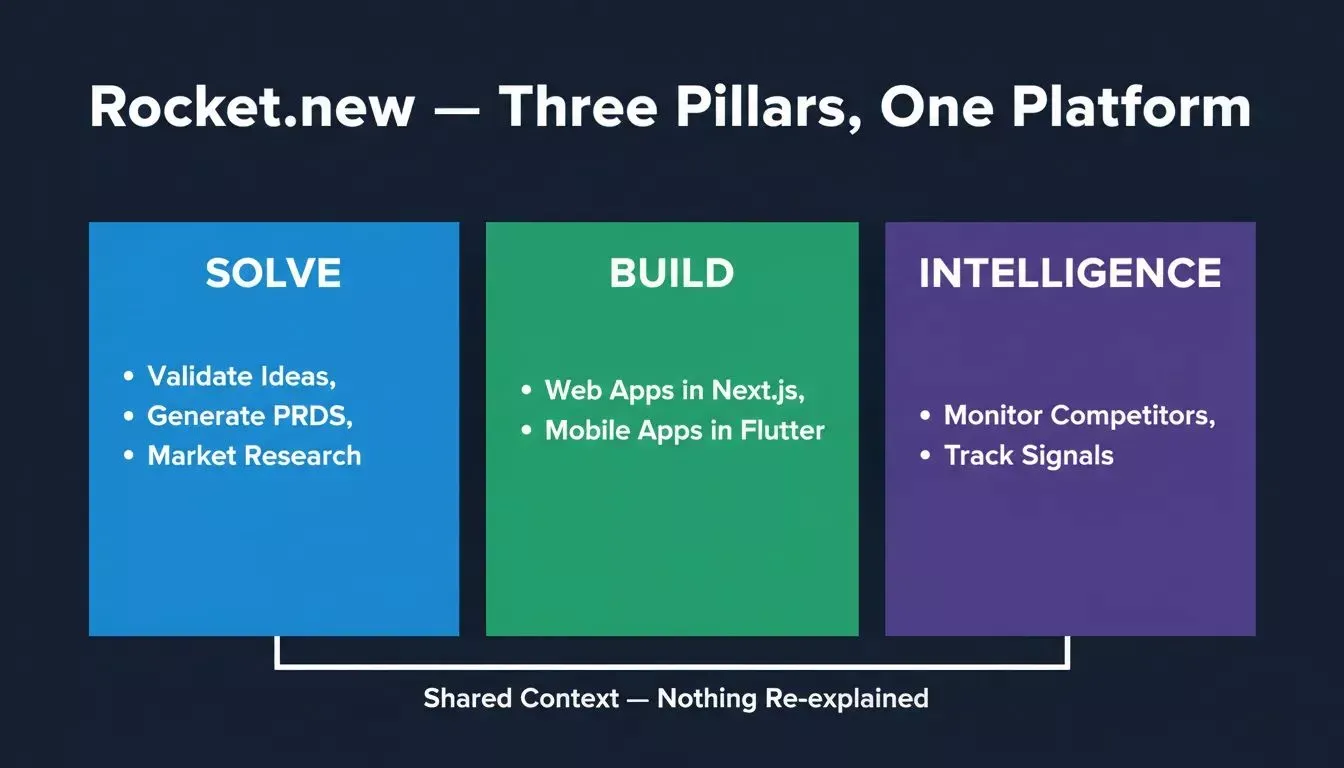
Solve validates the idea. Build generates the app. Intelligence monitors what ships next. All three share the same context, so nothing is re-explained.
When you paste a structured prompt into Rocket.new, the platform generates a complete full-stack application in one session: Next.js frontend, Supabase backend, authentication, database schema, and deployment configuration, without context switching between tools.
Two Rocket.new-specific capabilities that matter for complex builds like task management apps:
Prompt Intelligence scores every prompt before work begins. If your prompt is specific enough, Rocket.new starts immediately. If it falls below the clarity threshold, it asks a short set of targeted questions and starts once it has enough to proceed confidently.
Advisor Agent is a senior architect sub-agent built into the code generation pipeline. It runs on the most capable model available, operates in read-only mode, and is invoked specifically when the coding agent fails to fix a bug after two or more attempts. The Advisor never writes code. It returns structured analysis: root causes, a recommendation, numbered implementation steps, and a trade-off table. For a task management app with complex RLS policies and multi-workspace data separation, this is the capability that prevents error loops from becoming dead ends.
Here is what sets Rocket.new apart from other AI app builders:
- Full-stack generation in one session: web and mobile, frontend and backend, from a single conversation
- Live preview during editing: see changes render in real-time as you refine, not after a rebuild cycle
- Built-in deployment: one-click publish to a staging URL, then connect a custom domain with automatic HTTPS
- Persistent context across tasks: the Solve research that validated your idea is present when the developer opens the build task; nothing is re-explained
- Code export and ownership: download the generated Next.js or Flutter source code anytime
Bolt and Lovable are capable vibe coding builders in the same category. The structural difference is that they build what you tell them to build. Rocket.new figures out what is worth building, then builds it. The intelligence that answers what to build connects directly to the build that executes it.
As one developer noted in a Hacker News discussion on building with LLMs: "The whole process is so slow that it hits timeouts all over the place" when using fragmented AI toolchains. Rocket.new solves this by keeping research, generation, and deployment in a single workspace.
Phase Four: Data, Reporting, and Automation Prompts
A production task app needs visibility into progress and automated workflows. These prompts handle the reporting layer and scheduled operations that turn a functional app into a team productivity system.
Prompt 13: Productivity Dashboard with Charts
"Create a project management dashboard showing tasks completed this week versus previous week, overdue task count, team velocity trend (line chart), and workload distribution by assignee (bar chart). Include date range filters and export-to-PDF functionality. Pull data from the tasks and activity_log tables and display structured outputs in chart components."
Expected output: An interactive dashboard with four chart widgets, date filtering, and PDF export.
What to check: Verify chart data matches actual task counts in the database. Off-by-one errors in date ranges are the most common issue.
Follow-up prompt: "Add a customizable widget grid where users can rearrange dashboard cards and save layouts per user."
Prompt 14: Overdue Task Alerts via Twilio
"Set up a scheduled function that runs daily at 9 AM UTC. It queries all tasks past their delivery date and due date that are not marked complete. For each overdue task, send an SMS alert via Twilio to the assigned user and an email summary to the project admin. Log all sent alerts to prevent duplicate notifications and support reorder alerts by priority level."
Expected output: A cron-triggered function with Twilio integration, deduplication logic, and an admin summary email.
What to check: Test with tasks that have no assignee. Missing null checks on phone numbers are the most common failure.
Follow-up prompt: "Add a 'snooze' action items button in the alert that postpones the next notification by 24 hours."
Prompt 15: CSV Export and Data Portability
"Generate an export feature that lets users download their project data as CSV files. Support exporting tasks (with all fields including end dates), comments, and activity logs as separate sheets or a combined workbook. Include date range filtering, project selection, and a work breakdown structure format option. Add progress indicators for large exports."
Expected output: A download button that generates a properly formatted CSV with UTF-8 encoding and appropriate column headers.
What to check: Export a project with special characters in task titles and verify the CSV opens correctly in Excel.
Follow-up prompt: "Add scheduled weekly exports that auto-email the CSV to workspace admins every Monday at 8 AM."
Prompt 16: Recurring Tasks Scheduler
"Build a recurring task feature. When creating a task, users can set a recurrence pattern: daily, weekly on specific days, monthly on a date, or custom interval. When a recurring task is marked complete, automatically create the next instance with the same properties but a new due date based on the schedule. Display recurring tasks with a repeat icon badge and let users edit the series or just one instance."
Expected output: Recurrence configuration in the task form and automatic instance creation on completion.
What to check: Complete a weekly recurring task and verify the next instance appears with the correct date offset.
Follow-up prompt: "Add the ability to pause a recurring series and resume it later without losing the pattern."
Automation and scheduling logic like this is a core part of productivity app development. Getting it right in the prompt phase saves significant debugging time later.
Phase Five: Polish Prompts for Production-Ready Finish
The difference between a demo and a shipped product is polish. These four prompts handle the details that make users trust your app and come back daily.
Prompt 17: Empty State UI for Every Screen
"Design empty states for all key screens: project list (no projects), task board (no tasks), activity feed (no recent activity), and team view (no members). Each empty state should include an illustration placeholder, a brief explanation, and a primary action button. Match the overall app design system with consistent spacing and colors."
Expected output: Contextual empty states that guide users toward their next action instead of showing blank screens.
What to check: Verify empty states show for genuinely new users and disappear after the first relevant item is created.
Follow-up prompt: "Add a sample data generation button on empty states that populates demo tasks for new users to explore."
Prompt 18: Mobile-Responsive Layout
"Refactor the entire app layout for mobile responsiveness. The sidebar should collapse into a hamburger menu on screens below 768px. Task cards should stack vertically, the Kanban board should scroll horizontally, and forms should use full-width inputs. Add touch-friendly tap targets (min 44px) and swipe gestures to complete or archive tasks from the task list view."
Expected output: A fully responsive layout that works on phones, tablets, and desktops without breaking any existing functionality.
What to check: Test the Kanban drag-and-drop on mobile. Touch-based dragging is the most common regression after responsive refactors.
Follow-up prompt: "Add a bottom tab bar for mobile with quick-add task, inbox, and navigation shortcuts."
Prompt 19: Dark Mode Toggle
"Implement a dark mode toggle with system preference detection. Create a theme provider that applies color tokens globally. Dark mode should use surfaces like #1E293B for backgrounds and #F8FAFC for text. Include smooth transitions between modes, persist the preference per user, and apply dark styling to all components, including charts, modals, and dropdowns."
Expected output: A working theme switcher that respects OS preferences and applies dark mode consistently across all screens.
What to check: Toggle between modes rapidly and check for unstyled flashes or components that remain in light mode.
Follow-up prompt: "Add a per-workspace theme option and support for custom brand colors in the sidebar."
Prompt 20: Skeleton Loading States
"Replace all loading spinners with skeleton loading screens that match the actual content layout. For task lists, show animated card placeholders. For the dashboard, show chart-shaped skeletons. For the Kanban board, show column headers with card-shaped pulse animations. Use CSS-only animations to minimize adding features that increase bundle size."
Expected output: Content-aware skeleton screens that eliminate layout shift when data loads.
What to check: Throttle network speed to 3G and verify skeletons appear correctly before content replaces them.
Follow-up prompt: "Add error states with retry buttons for when API calls fail, replacing the skeletons with a friendly error message."
If you want to see how Rocket.new handles the SEO and accessibility polish layer automatically, the SEO-ready builds guide explains what ships by default versus what you need to prompt for explicitly.
The Five-Prompt Hardening Sequence
Functional apps are not the same as production-ready apps. This hardening sequence uses five targeted prompts to address security, performance, and reliability before you share your app with real users.
| Hardening Prompt | Purpose | Expected Output | Pass Criteria |
|---|---|---|---|
| RLS Policy Audit | Verify row-level security on all tables | SQL script testing each policy | No cross-workspace data leaks |
| API Route Auth | Protect all API endpoints | Middleware checking session tokens | 401 on unauthenticated requests |
| Input Validation | Sanitize user inputs | Zod schemas on all form submissions | Reject malformed data gracefully |
| Error Boundaries | Catch runtime crashes | React error boundary components | App shows recovery UI, not white screen |
| Core Web Vitals | Performance audit | Lighthouse report with fixes | LCP under 2.5s, CLS under 0.1 |
The big picture: each hardening prompt addresses a specific category of technical issues that could cost you users or data. Run them in order because later prompts depend on earlier fixes being in place.
The five hardening prompts map to three categories: Security (steps 1-3), Stability (step 4), and Performance (step 5). Run them in order.
After running the sequence, you will have addressed the edge cases and technical constraints that separate a weekend project from a shipped product. The lessons learned from this hardening process apply to every app you build going forward, not just this task manager.
One more step worth running after hardening: Rocket.new's built-in /Generate GEO And AEO Report command audits your app's discoverability in AI search engines and surfaces fixes for structured data, FAQ markup, and citation signals. For a task management app competing in a crowded category, AI search visibility is a distribution channel worth optimizing from day one.
Your Task App Is Twenty Prompts Away
Building a complete task management app used to require a team, a budget, and months of planning. With the right prompt sequence and an AI app builder that maintains context across generations, the same result takes an afternoon. The key is prompt order: foundation first, features second, polish third, hardening last.
These twenty prompts give you a structured plan that any modern AI tool can follow. Writing better prompts is a skill that improves with practice, and this library is your starting point.
Ready to ship your task app today? Start with Solve to validate the market gap, then paste your first foundation prompt into Rocket.new and generate a working full-stack application with authentication, database, and one-click deployment in minutes.
Table of contents
- -Why Structured Prompts Outperform Vague Descriptions
- -Phase One: How Do I Set Up the Foundation for a Task App?
- -Prompt 1: Project Scaffold and Tech Stack
- -Prompt 2: Authentication System
- -Prompt 3: User Onboarding Flow
- -Prompt 4: Database Schema Generation
- -Phase Two: Which Prompts Generate the Core Task Management Features?
- -Prompt 5: Task Creation with Priority and Due Date
- -Prompt 6: Subtask Nesting and Progress Tracking
- -Prompt 7: Assigning Tasks, Assignee Selection, and Team Roles
- -Prompt 8: Kanban Board with Drag-and-Drop
- -Phase Three: How Do Collaboration Prompts Work?
- -Prompt 9: Team Workspace and Project Organization
- -Prompt 10: Comment Threads and Mentions
- -Prompt 11: Activity Log and Audit Trail
- -Prompt 12: Notification Preferences and Delivery
- -How Rocket.new Turns One Prompt Into a Deployable App
- -Phase Four: Data, Reporting, and Automation Prompts
- -Prompt 13: Productivity Dashboard with Charts
- -Prompt 14: Overdue Task Alerts via Twilio
- -Prompt 15: CSV Export and Data Portability
- -Prompt 16: Recurring Tasks Scheduler
- -Phase Five: Polish Prompts for Production-Ready Finish
- -Prompt 17: Empty State UI for Every Screen
- -Prompt 18: Mobile-Responsive Layout
- -Prompt 19: Dark Mode Toggle
- -Prompt 20: Skeleton Loading States
- -The Five-Prompt Hardening Sequence
- -Your Task App Is Twenty Prompts Away