
A competitor analysis maps what rivals sell, how they price, and where they win customers. Seven steps: define your competitive set, audit products, study pricing, analyze positioning, check traffic, read reviews, and build your report. Rocket automates the data-heavy middle steps.
Why do companies keep losing deals to competitors they never properly studied? According to Crayon's 2025 State of Competitive Intelligence report, sellers go head-to-head with a rival in 68% of deals, yet the average team rates its competitive selling readiness at just 3.8 out of 10.
That gap exists because most businesses treat competitor analysis as a one-time project. They build a snapshot, file it away, and make business decisions on data that is already months out of date. Markets shift faster than spreadsheets get updated.
This guide covers seven practical steps to build a competitive analysis that actually shapes strategy, from identifying the right rivals to turning your findings into a competitive analysis report that your sales, product, and marketing teams can act on.
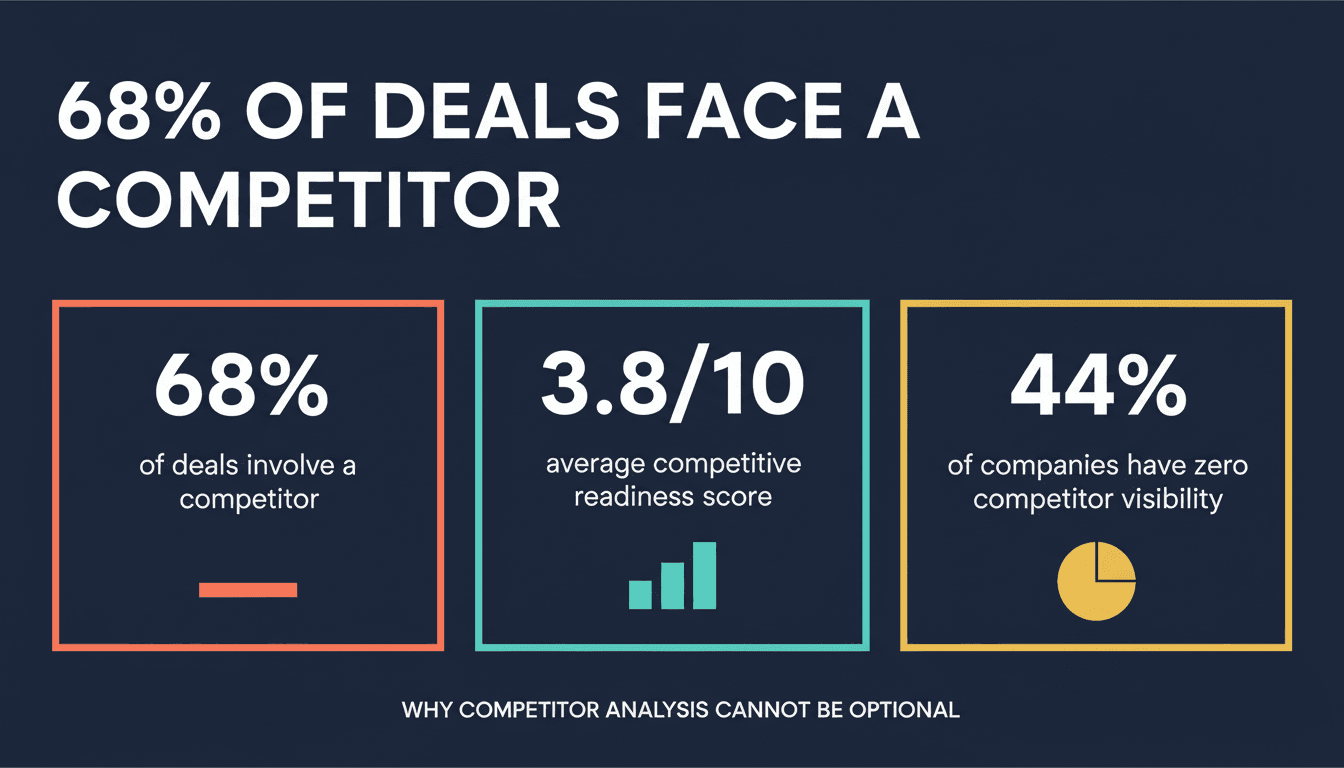
The competitive readiness gap is real: most teams face rivals in nearly every deal but are underprepared to win them.
How to Do Competitor Analysis: What Is It and Why Does It Matter?
Competitor analysis is the ongoing practice of researching and evaluating competing products, companies, and market alternatives to understand the competitive landscape and identify opportunities for differentiation.
It covers products, pricing, marketing strategy, and positioning, giving your team a clear picture of where rivals are strong and where they fall short.
Running a regular competitive analysis helps businesses identify market opportunities, sharpen their value proposition, and give sales teams the context they need to win competitive deals. Skip it, and your business is making product and pricing decisions without understanding the competitive environment around it.
What Is the Difference Between Direct and Indirect Competitors?
Not all competitors require the same level of analysis. Direct competitors are those that offer similar products or services to the same audience, making them the most obvious rivals in sales cycles. Indirect competitors provide different products or services that solve the same core need, and while they may not compete directly today, they could expand into your market.
The distinction between direct and indirect competitors matters because your response to each looks different. Direct and indirect competitors both erode market share, so your competitive analysis should map both categories rather than focusing only on the obvious rivals. A complete competitor analysis also accounts for emerging players, companies not yet in your market but moving toward it.
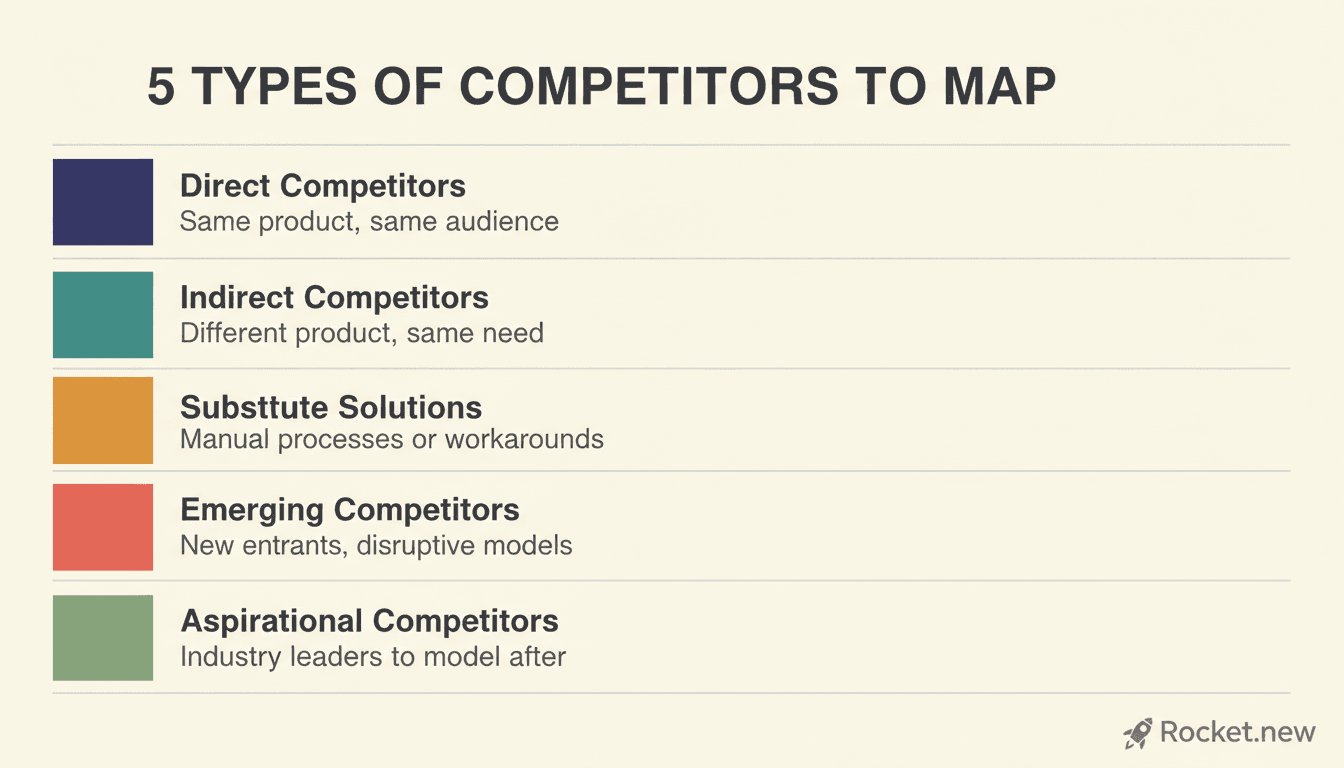
Mapping all five competitor types gives your analysis a complete picture of the threats and opportunities in your market.
Step 1: Define Your Competitive Set
Building your competitor list is the first step in any competitive analysis. Most teams start with the names they already know, rivals that come up on sales calls. That starting list is useful, but nearly always incomplete.
How to identify competitors you might be missing:
-
Search for your core product category on Google, Amazon, and industry review platforms to find competitors you have not tracked yet
-
Pull CRM win-loss notes to identify which companies prospects mentioned when they chose another option
-
Check G2, Capterra, or Trustpilot for alternatives to and competitors of listings in your category
-
Ask your sales team which competitor names surface most often during active deals
-
Look at which companies are buying paid search ads on your brand keywords or category terms
Not all competitors deserve deep research. Identify your top five to eight direct competitors for detailed analysis, then maintain a separate watch list for indirect and emerging rivals. Emerging competitors are new entrants or startups that may have little market share today but could still disrupt your category with a different approach or business model.
Substitute solutions are non-product alternatives customers may use instead, such as manual processes or internal tools.
Aspirational competitors are industry leaders you learn from, even when they do not target the same customers.
A competitive market analysis that starts with a well-scoped list produces sharper insights than one built on twenty names with no prioritization. Learn how to map your full competitive picture in this competitive mapping and analysis guide.
Step 2: Audit Competitors' Products, Features, and Messaging
Once you have defined your competitive set through market research, the next step in any competition analysis is a product audit. This means systematically reviewing what each competitor offers, how they describe it, and where their product features differ from yours.
What to cover in a competitor product audit:
-
Core features vs. your product: document what each competitor includes, what they charge as an add-on, and what they are missing entirely
-
Website messaging and positioning: read competitors’ websites, home pages, and pricing pages to understand how competitors communicate value, identity, and tone to customers
-
Target customers: identify the target audience each competitor explicitly addresses in their copy, case studies, and testimonials, and what that reveals about their customer base
-
Product gaps: note the features customers request in reviews that competing products do not yet deliver, which can point to market gaps
-
Unique differentiators: spot claims that only one competitor makes, revealing where they are trying to stand apart from the rest of the market, and sharpening your unique value proposition
-
Search visibility clues: use advanced search operators with targeted search strings to find competitor documents, landing pages, and other public materials
Comparing competing products side by side is how you gain insights into real gaps that your business can fill. Research shows that 44% of companies currently have zero competitor visibility, which means most rivals around you are also making product decisions in the dark.
The goal is not to copy competitors. It is to understand your product position relative to theirs well enough to make confident decisions about what to build, price, and market next.
A well-scoped list inside a competitor analysis framework produces sharper insights, especially when you prioritize the five to eight direct rivals competing for the same customers and use all available data instead of relying only on familiar names. For a deeper look at how product managers run this process, see how PMs benchmark competitor features and roadmaps.
Step 3: Decode Competitor Pricing Strategies
What Pricing Tiers Reveal About Market Position
Pricing is one of the clearest signals of how a competitor thinks about their target market and their business model. A company charging a premium for a similar product is betting on brand strength or feature depth. Aggressively pricing is typically chasing volume or trying to displace a dominant rival.
What to map for each competitor:
-
Entry-level, mid-tier, and enterprise pricing ranges (where publicly visible on competitors’ websites)
-
Freemium tiers, trial structures, and the conditions attached to them
-
Whether pricing is transparent or hidden behind a talk to sales conversation
-
How pricing has shifted over the past 12 months, web archive tools like Wayback Machine let you track historical pricing pages
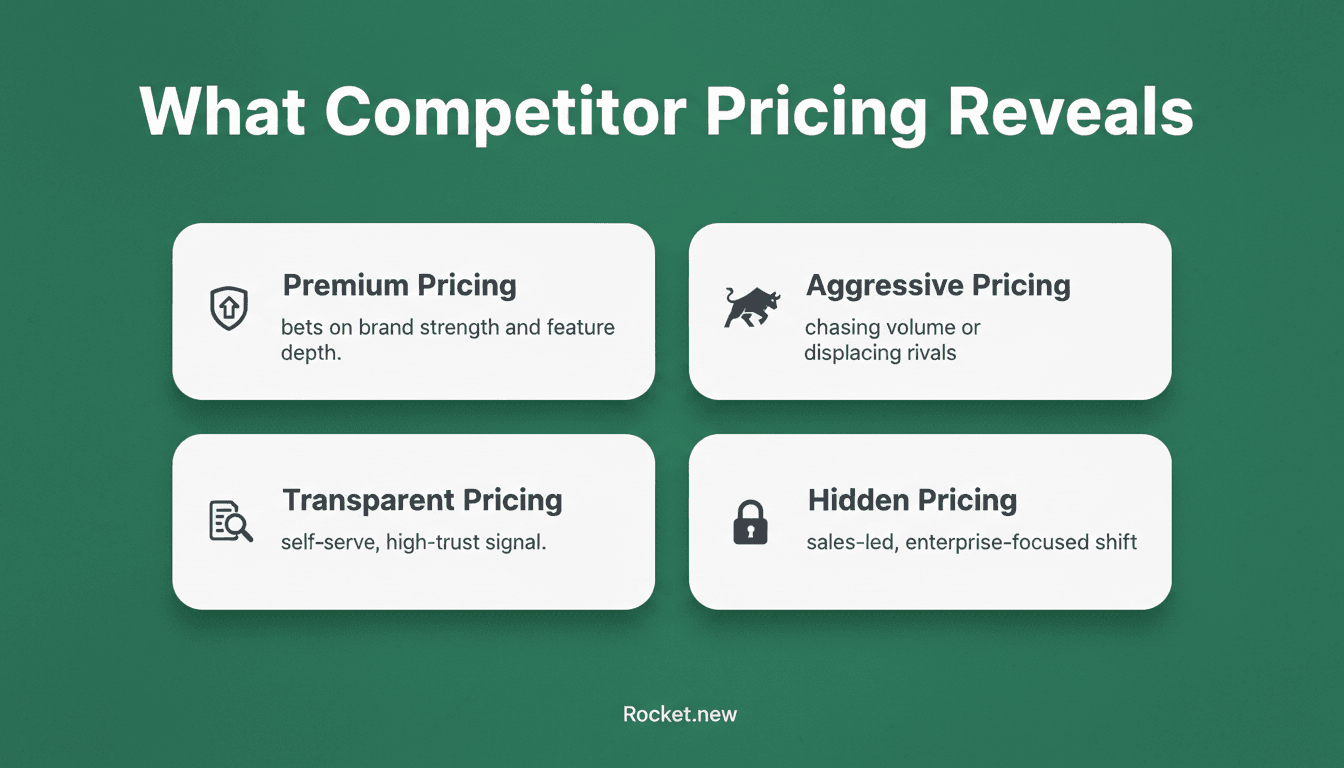
Each pricing model signals a different competitive intent; reading it correctly shapes your own positioning decisions.
Pricing strategy tells you more than what a competitor charges. A move from self-serve pricing to a sales-led model signals a shift in their target customers and their market positioning. That kind of shift carries direct implications for your own business model and where you choose to compete.
Read more on how competitive strategy frameworks shape market positioning decisions.
Step 4: Analyze Brand Positioning and Marketing Channels
Which Marketing Channels Are Competitors Leaning On?
Brand positioning tells you how a competitor wants customers to perceive them. Marketing channels show you where they are spending to build that perception. Together, these two dimensions reveal both the story a competitor is telling and the audiences they are paying to reach.
What to analyze in this step:
-
Social media presence: check, which platforms each competitor is active on, how often they post, and what content earns the most engagement across each social media platform
-
Content and SEO: look at competitor blog topics, which keywords they rank for, and whether they are investing in long-form content or short-form social media campaigns
-
Paid advertising: search competitors’ brand names on Google to see whether they are running search ads, and scan social media platforms for sponsored content
-
Email marketing: Sign up for competitor newsletters to see how they communicate with potential customers and how often they push promotional content
“It all starts with our positioning and really understanding which consumers or groups and segments of consumers are most capable of loving what your brand does. From there, we start to understand their behaviors, their needs.” — Shingly Lee, VP of Marketing at GURU Energy (via Shopify Masters)
After mapping marketing channels for multiple competitors, patterns become clear. The channels every competitor is ignoring are often the cheapest places to gain a competitive edge. Understanding how these channels connect to your overall go-to-market strategy sharpens every decision you make from this data.
1flowchart LR
2 A[Build Competitor List] --> B[Audit Products]
3 B --> C[Map Pricing]
4 C --> D[Analyze Channels]
5 D --> E[Study Traffic]
6 E --> F[Read Reviews]
7 F --> G[Build Report]
8 style A fill:#4F46E5,color:#fff,stroke:#4F46E5
9 style B fill:#7C3AED,color:#fff,stroke:#7C3AED
10 style C fill:#0891B2,color:#fff,stroke:#0891B2
11 style D fill:#059669,color:#fff,stroke:#059669
12 style E fill:#D97706,color:#fff,stroke:#D97706
13 style F fill:#DC2626,color:#fff,stroke:#DC2626
14 style G fill:#1E293B,color:#fff,stroke:#1E293BStep 5: Understand How Competitors Get Their Traffic
Traffic data shows which digital marketing channels each competitor is genuinely investing in, not just which ones they talk about. High organic search traffic signals that a competitor has built real SEO authority over time. A traffic profile dominated by paid search suggests they are buying visibility rather than earning it.
What to check for each competitor:
-
Organic traffic estimates and top-ranking pages, tools like Ahrefs or Semrush, provide reliable estimates
-
Paid search activity, are they buying ads on their own brand keywords or targeting yours
-
Referral traffic sources, which include review platforms, industry directories, and partner sites, send visitors to them
-
Social media traffic share compared to organic search
-
Traffic trends over the past 6 to 12 months to spot whether each competitor is growing or declining in their digital marketing reach
According to Ahrefs, 63% of websites now receive some AI chatbot traffic, with 50% of that coming from ChatGPT alone. That means your competitors’ traffic picture now includes AI-sourced visits alongside Google search rankings, which changes how you should interpret their digital marketing performance data.
Traffic trends reveal strategic shifts before they show up in a competitor’s messaging or product announcements. A competitor whose organic traffic is declining but whose paid search spend is rising is often in the middle of a market repositioning.
Step 6: What Do Customer Reviews Actually Tell You?
Customer reviews are one of the richest sources of competitive intelligence available, and most businesses underuse them. Platforms like G2, Capterra, and Trustpilot give you direct customer feedback on what competitors do well and where they consistently fall short. You did not fund that research. Their customers did it for you.
What to extract from competitor reviews:
-
Complaint patterns: recurring themes in negative customer reviews reveal genuine product weaknesses, not isolated incidents
-
Loyalty drivers: what satisfied customers mention most often shows which features built customer satisfaction and brand loyalty in that competitor’s base
-
Switching reasons: reviews from customers who left a competitor often name exactly what triggered the decision, giving you a clear window into customer preferences and where rivals fall short
-
Use case diversity: how existing customers describe the product reveals which market segments a competitor actually serves vs. the ones they claim to target
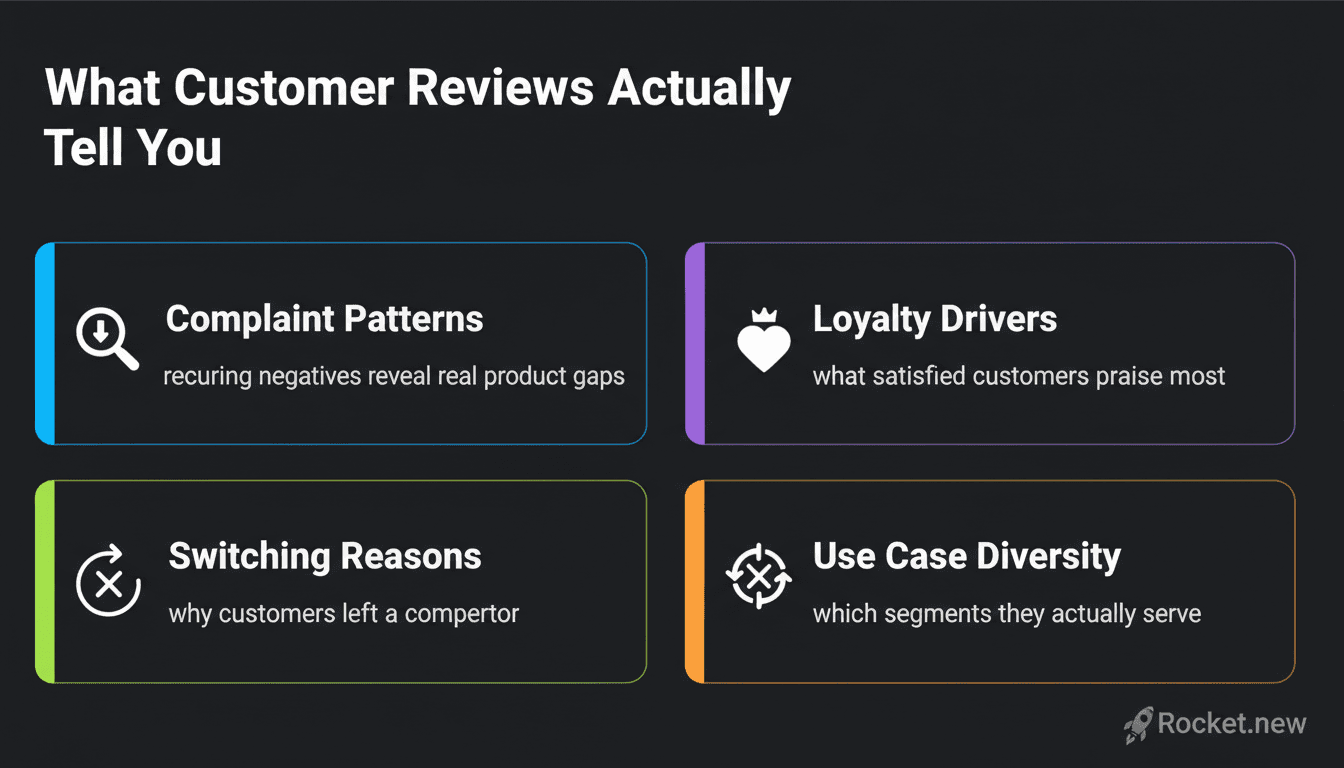
Customer review intelligence is free primary research that your competitors’ customers conducted for you.
Review sites also provide data on customer engagement and customer satisfaction scores over time. Tracking how those scores shift after a pricing change or product update tells you whether customers accepted the move or started searching for alternatives.
The most useful intelligence from third-party review sites is not the star rating. It is the specific language customers use to describe what they need and whether the competitor’s product actually delivers it. Build this into a repeatable research function with this competitive intelligence program guide.
Step 7: Build Your Competitive Analysis Report
What Should Your Competitive Analysis Report Include?
As part of a competitive analysis framework, this report is where all your gathered competitor data becomes something the business can act on. It does not need to be long; it needs to be structured so that anyone reading it can quickly see where each competitor stands, what gaps exist, and what the company should do differently.
Competitor analysis also helps teams understand industry standards so they can meet and exceed the benchmarks that matter.
Core sections in a competitive analysis report:
-
Competitor overview, company size, funding, core products, target market, and customer base
-
Product and features comparison, findings organized in a competitive matrix or comparison framework that tracks key product features and capabilities, and is updated as the market evolves
-
Pricing summary, tiers, model, pricing strategy, and available sales data for each competitor
-
Marketing and channel summary, where each competitor invests their marketing efforts, and what content they lead with
-
Strengths and weaknesses, per-competitor breakdown of what each company does well, where they fall short, and which market gaps their weaknesses create
-
SWOT analysis, your own strengths and weaknesses relative to the competitive field, plus the market opportunities and threats your research revealed
-
Recommended actions: three to five specific steps for product, sales, and marketing teams
| Report Section | What It Covers | Primary Audience |
|---|---|---|
| Competitor overview | Company, size, funding, core product summary | Leadership |
| Feature comparison | Side-by-side product features table | Product team |
| Pricing summary | Pricing strategy and tier breakdown | Sales team |
| Channel summary | Marketing channels and marketing efforts | Marketing team |
| Strengths and weaknesses | Per-competitor breakdown | All teams |
| SWOT analysis | Your company vs. the competitive field | Strategy team |
| Market opportunities | Gaps and differentiation angles | Product + Marketing |
| Recommended actions | Product, sales, and marketing next steps | All teams |
A competitive analysis example worth following: document your top three direct competitors in the same template format so your team can compare findings at a glance.
This structure also makes it far easier to identify competitors’ strengths and weaknesses relative to your own position, sharpen your business strategy, and spot sources of competitive advantage across the market landscape. See how understanding your unique selling proposition connects directly to what your competitive analysis reveals about the market.
If you are building a competitive analysis for a business plan or investor pitch, the founder’s guide to the competition section covers exactly what investors look for and how to structure it.
Common Pitfalls That Make Competitor Analysis Useless
Running a competitive analysis is the right instinct. Running it poorly produces something worse than no analysis at all, it produces false confidence in conclusions that do not reflect reality.
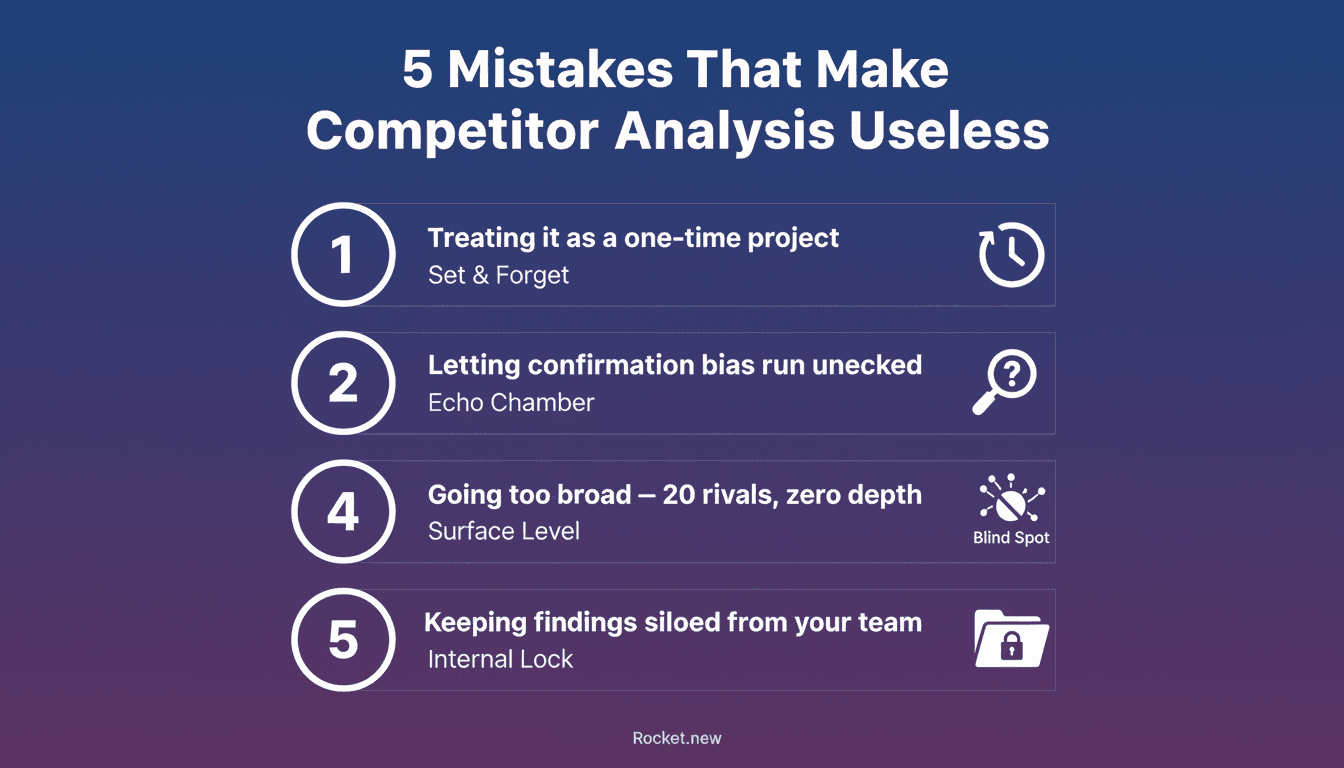
Avoiding these five mistakes is what separates a competitive analysis that drives decisions from one that collects dust.
The most common mistakes to avoid:
-
Treating it as a one-time project: markets shift, competitors reprice, and new entrants appear constantly. Competitor data from six months ago is not a competitive analysis; it is a historical record
-
Letting confirmation bias run unchecked: it is easy to seek data that confirms what you already believe about your market position. Build the analysis from evidence first, then draw conclusions
-
Going too broad: analyzing twenty competitors at the surface level gives you a complete picture of nothing. Depth on five to eight key competitors beats breadth across twenty, with shallow coverage
-
Ignoring indirect competitors: a competitor solving the same customer problem with a different product is still capturing market share and customer budget that could belong to your business
-
Keeping findings siloed: a competitive analysis report that only lives in one person’s drive does not reach your sales team, your product team, or leadership when they need it most
The hardest part of competitor analysis is not the initial research. It is maintaining a regular cadence, sharing findings across teams, and keeping competitor data current enough to inform decisions being made this week rather than three months ago. For a structured walkthrough of how to write and present these findings, see how to write a competitive analysis with examples.
How Rocket Intelligence Runs Steps 2-5 Automatically
Steps 2 through 5 of any competitive analysis, product tracking, pricing monitoring, channel analysis, and traffic signals share one structural problem. They require continuous data gathering across dozens of sources simultaneously. Most teams can run that research once. Staying current as competitors move and markets shift is where the process breaks down.
Rocket Intelligence was built to close that gap. Rather than delivering raw alert streams your team must analyze manually, it reads nine signal categories for every competitor you track: website changes, social media activity, news and press mentions, traffic patterns, product and technology shifts, people and hiring signals, business and finance data, paid advertising activity, and reviews and community feedback.
What makes Rocket Intelligence different from traditional competitive tools:
-
Interpretation, not just monitoring: when a competitor updates their enterprise pricing page, adds machine learning engineering roles, and shifts their social media content toward enterprise use cases in the same week, Rocket reads that as one connected strategic signal, not three separate alerts. That is the kind of market dynamics pattern that manual research consistently misses
-
Continuous competitive awareness: tools like Crayon and Klue deliver alert streams. Your team still has to analyze, synthesize, and carry those findings forward manually. Rocket delivers interpreted intel with a clear recommended action attached to each signal
-
Every team works from one source: sales, product, and marketing all pull from one shared competitive picture, so a pricing shift flagged on Monday is already informing the product research session your team runs on Thursday
-
Competitive insights at scale: a small team gains the same strategic advantage that used to require a dedicated competitive intelligence analyst
Staying ahead of competitors in fast-moving markets means having valuable insights that are current, not insights that were current three months ago. Rocket gives your team that competitive edge continuously, across every signal category that matters.
Turn Competitive Insight Into Confident Action
A well-run competitive analysis is not about copying what rivals do. It is about understanding the competitive field clearly enough to make confident product, pricing, and marketing decisions. The seven steps in this guide give your team a repeatable process, from defining your competitor list to building an analysis report that sales, product, and leadership teams can all act on.
The teams that stay competitive are not the ones with the most data. They are the ones who keep competitor insights current and act on them consistently. Running this on a regular cadence, connected to a live intelligence source, turns research into a real strategic advantage.
Ready to stop gathering competitive data by hand?
Rocket.new Intelligence monitors your competitors across nine signal categories and delivers interpreted intel your whole team can act on immediately. Start free today.
Table of contents
- -How to Do Competitor Analysis: What Is It and Why Does It Matter?
- -What Is the Difference Between Direct and Indirect Competitors?
- -Step 1: Define Your Competitive Set
- -Step 2: Audit Competitors' Products, Features, and Messaging
- -Step 3: Decode Competitor Pricing Strategies
- -What Pricing Tiers Reveal About Market Position
- -Step 4: Analyze Brand Positioning and Marketing Channels
- -Which Marketing Channels Are Competitors Leaning On?
- -Step 5: Understand How Competitors Get Their Traffic
- -Step 6: What Do Customer Reviews Actually Tell You?
- -Step 7: Build Your Competitive Analysis Report
- -What Should Your Competitive Analysis Report Include?
- -Common Pitfalls That Make Competitor Analysis Useless
- -How Rocket Intelligence Runs Steps 2-5 Automatically
- -Turn Competitive Insight Into Confident Action