
A fake profile detection dashboard scores every new account against behavioral signals, flags suspicious users automatically, and routes them to an admin queue. In 2025, social media scams drove $2.1B in reported losses. Rocket.new ships the full trust system in one Build session.
A fake profile detection dashboard is a moderation system that scores every new account against behavioral signals, flags suspicious users automatically, and routes them to an admin queue for review. Community apps that deploy one-stop fraud before it reaches real users. In 2025, social media scams drove $2.1 billion in reported losses, an eightfold increase since 2020, according to FTC data. Nearly 60% of romance fraud victims said the scam started on a social network, not a dating app.
What signals indicate a fake account? Batch registration from the same IP range, AI-generated profile pictures that fail reverse image search, generic bio text, and abnormal messaging velocity within the first 24 hours.
Can a small team build this without a data science hire? Yes, Rocket generates the Supabase schema, LLM-powered scoring logic, admin queue, and edge function restrictions from a single Build prompt.
Why Fake Profiles Are a Growing Threat to Community Apps
Fake accounts on community platforms are no longer obvious spam. Today's fake accounts use AI-generated images, customized bios, and coordinated messaging campaigns to pass as genuine users, and these fake identities on social platforms create a significant challenge for online security and trust across social networking sites.
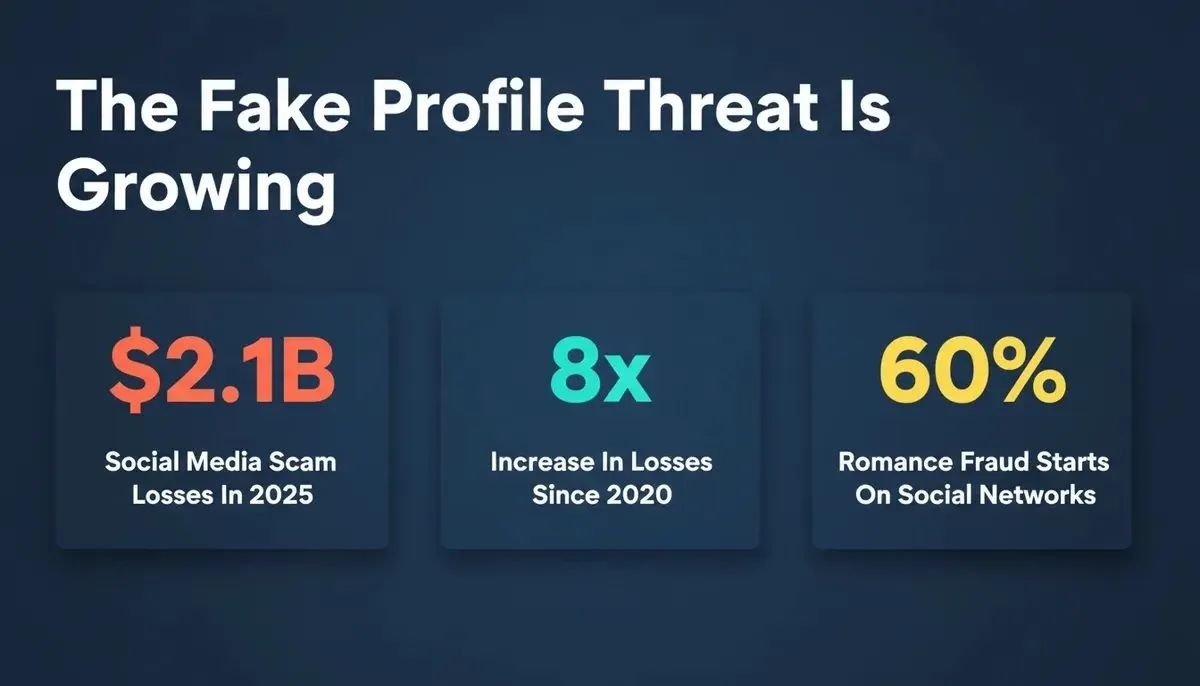
Social media fraud statistics that every community app founder needs to know
-
The Goose dating app case showed how fake accounts operate at scale. A Wired investigation found that over two dozen Instagram accounts with AI-generated profile pictures sent identical pitches to recruit users. These fake accounts had suspicious accounts with follower count ratios and profile-picture inconsistencies that went undetected for months.
-
Social media platforms lose billions yearly. The FTC reported that Facebook alone accounted for more fraud losses than text and email scams combined in 2025. Fake accounts target individuals by exploiting posted interests, location data, and social connections, and detection systems should minimize personal information collection while identifying fraudulent profiles and reducing identity theft risk.
-
Community apps face a detection gap. Unlike large platforms with dedicated trust teams, community-focused apps often lack the infrastructure to catch fake accounts at registration time, even though published fake profile identification work reports machine learning algorithms reaching about 98% accuracy on datasets such as 994 real accounts and 200 fake accounts, which smaller teams typically cannot operationalize on their own. That gap widens as the platform scales.
-
Trust collapse is the real cost. When fake accounts reach real users, the damage extends past financial loss. Once users suspect fake accounts populate the network, engagement drops and the brand suffers lasting harm.
The Goose scandal proved this is not hypothetical. It is a present, commercially destructive problem every community app founder must address.
What Detection Signals Should Your Dashboard Track?
A fake profile detection dashboard works by aggregating multiple behavioral signals into a single trust score; no single data point is reliable on its own. On social sites, this process begins with data collection and feature extraction, then moves through a broader process of combining signal families to detect fake profiles rather than relying on any single rule.
| Signal Family | Data Points | Detection Goal |
|---|---|---|
| Account Velocity | Registration timestamps, IP clustering, device fingerprints | Catch batch-created fake accounts |
| Profile Metadata | Bio completeness, photo analysis, name patterns | Flag fake accounts with AI-generated or stolen images |
| Behavioral Patterns | Message frequency, response timing, template similarity | Identify bot-like fake accounts using scripted interactions |
| Social Graph | Connection patterns, mutual friends, follower ratios | Spot fake accounts with unnatural network shapes |
| Content Signals | Reverse image search results, bio keywords, link spam | Detect fake accounts reusing stolen content |
The five signal families every fake profile detection system must monitor
-
Profile metadata signals are your first line of fake account detection. A profile picture that returns no results in a reverse image search, combined with a generic bio and a recently created account, raises the risk score immediately. In practice, profile characteristics like username length, bio completeness, profile picture status, and posts shared are common inputs for feature selection.
-
Behavioral scoring goes deeper. Fake accounts tend to follow predictable patterns: mass-following users within hours, sending identical messages to many people, and engaging only during specific time windows. This user behavior is typically turned into model inputs during feature extraction and refined before scoring.
Device and network fingerprinting can also capture IP reputation and VPN usage indicators when identifying fake profiles.
Your system normalizes these signals into a single trust score per account. Building a bot detection dashboard is a practical starting point for identifying fake accounts across your user base.
Account Creation Velocity and Behavioral Scoring
Account creation velocity is one of the most reliable early indicators for fake account detection, helping surface suspicious accounts and false profiles early across online social networks. When dozens of accounts register from the same IP range within minutes using similar email patterns and device fingerprints, the system should flag the entire batch.
-
Registration clustering: Compare new account timestamps against rolling averages. A spike of 50 signups in 10 minutes from a single region signals coordinated fake account creating.
-
Device and browser fingerprinting: Fake accounts often share device identifiers. Even when created across different email addresses, the same browser fingerprint or phone device signature ties them together, creating linkage across accounts through shared network and device traits.
-
Early behavior windows: Monitor the first 24 hours of each account. Fake accounts that immediately send messages to many users, skip profile completion, or follow a fixed action sequence reveal themselves through behavioral patterns a scoring system flags automatically.
These early signals become numerical features that feed directly into the scoring layer for deeper analysis. Proper user authentication at registration is the first checkpoint where these signals are captured.
How LLM-Assisted Scoring Powers Fake Account Detection
Effective fake account detection combines rule-based filters with LLM-assisted classification, not a custom-trained machine learning pipeline, though more traditional machine learning algorithms remain common in fake account detection tasks and use various methodologies. Here is what that means in practice, and why it matters for what you can actually build.
Rule-based filters handle the high-confidence, low-ambiguity cases: accounts from known spam IP ranges, profiles with no avatar after 24 hours, or registration bursts that exceed your velocity threshold. These fire instantly, require no model, and catch the majority of obvious fake accounts.
LLM-assisted scoring handles the ambiguous middle tier. Common alternatives in fake profile detection include classification algorithms such as random forest for robust classification, support vector machines, naive bayes, and related vector machines built on decision trees. When Rocket connects an LLM (OpenAI, Anthropic, or Gemini) to your Supabase-backed app, you can send a new account's profile text, bio, and early behavioral signals to the model and receive a structured risk assessment in return. A prompt like "Score this profile for signs of inauthenticity on a scale of 0 to 100 and return the top three signals" produces a consistent, actionable output that feeds directly into your trust score column.
Connector-based verification handles profile picture analysis. Rocket can import any REST API via its custom API importer, including reverse image search services. For more complex datasets, teams may later extend the stack with XGBoost, which is effective for handling large datasets in fraud detection, plus deep learning models or a neural network model for text and image signals; these are promising solutions among modern mechanical learning models. The API response flows into the scoring pipeline as a numerical signal alongside the rule-based and LLM outputs. This is core to any solid web application security posture for community platforms.
Fake profile detection pipeline: three scoring layers combine into a single trust score that routes to moderation or clearance
What This Architecture Can and Cannot Do
This approach is well-suited for community apps at the MVP-to-growth stage. It catches the majority of fake accounts, including coordinated registration bursts, AI-generated bios, and stolen profile pictures, without requiring a data science team or a custom model training pipeline. As teams outgrow a rule-based setup, hybrid models can be one of the more promising solutions.
What it does not do: it does not train a custom classifier on your labeled dataset or run cross-validation in the scikit-learn sense. If your platform reaches the scale where you need a purpose-built ML pipeline, that is a separate engineering investment, and that separate stack may use hybrid models that combine Random Forest, XGBoost, and SMOTE to improve classification accuracy on imbalanced datasets and increase model robustness. For most community apps, the rule-based plus LLM-assisted approach described here is the right starting point, and Rocket can build it.
Evaluation Signals That Matter
Review these evaluation metrics and performance metrics continuously, in line with NIST guidance for ongoing performance evaluation, so you can track model performance over time and validate it on representative testing datasets.
-
Flag rate: what percentage of new accounts are flagged? A sudden spike signals a coordinated attack, and confusion matrix outputs plus evaluation metrics such as precision, recall, and F1 score help judge whether the threshold is actually working.
-
Moderator dismiss rate: if moderators dismiss more than 30% of flagged accounts, your scoring thresholds are too aggressive.
-
Response time: how long between a flag and a moderator action? Faster responses reduce the window in which fake accounts interact with genuine users.
-
LLM consistency: run the same borderline profile through your scoring prompt periodically to check for model drift as the underlying LLM updates.
In published experimental results, hybrid models using SMOTE to handle class imbalance have improved model performance, with an F1 score of 98% and detection accuracy of 98.24%, which gives teams a benchmark when comparing approaches.
Step-by-Step Dashboard Architecture for Moderation Teams
Build your fake profile detection dashboard in four numbered steps. Each step maps to a concrete Rocket Build prompt.
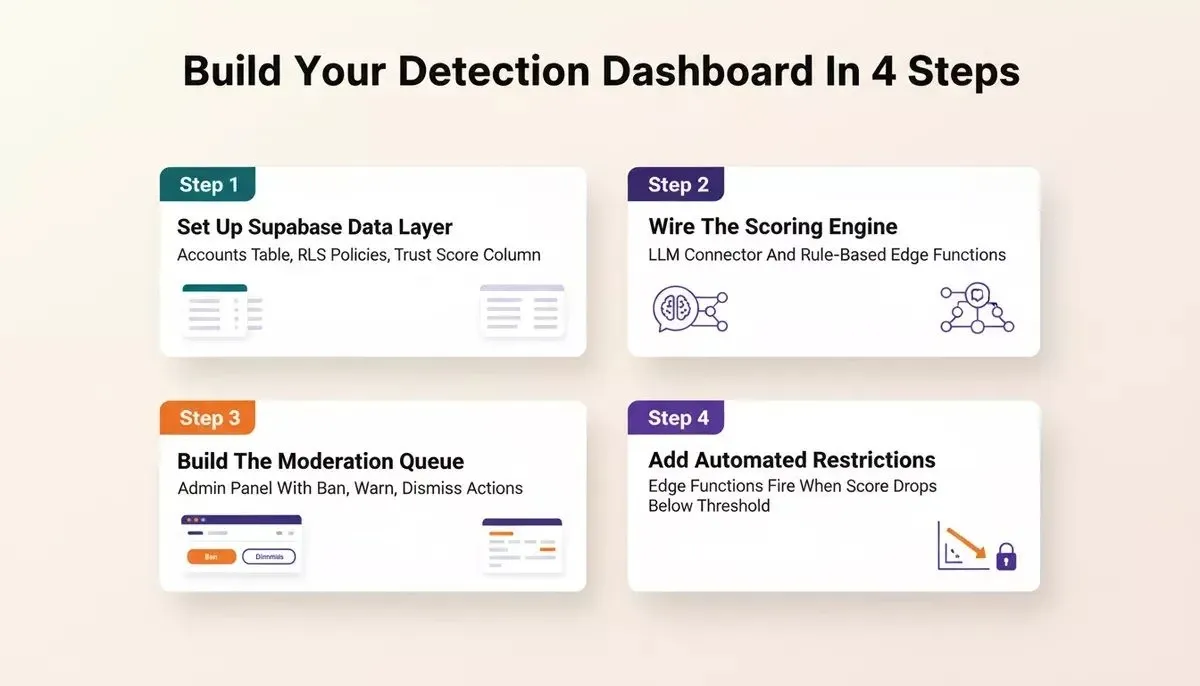
Four build steps that take you from a blank prompt to a working fake profile detection system
Step 1: Set up the Supabase data layer
Connect Supabase to your Rocket project. Ask Rocket to generate an accounts table with columns foruser_id,registration_ip,profile_complete,trust_score,flag_reason, andmoderation_status. Enable row-level security so moderators see all rows but users see only their own.
Step 2: Wire the scoring engine
Add an LLM connector (OpenAI or Anthropic) and describe your scoring logic in chat. Add rule-based filters as Supabase edge functions: flag any account with trust score below 40, registration IP in a known spam range, or no profile picture after 24 hours.
Step 3: Build the moderation queue
Ask Rocket to generate an admin panel that displays all accounts wheremoderation_status = 'flagged', sorted by trust score ascending. Each row shows the trust score, flag reason, profile preview, and three action buttons: Ban, Warn, Dismiss.
Step 4: Add automated restrictions
Ask Rocket to create a Supabase edge function that fires whentrust_scoredrops below your hard threshold. The function restricts the account's messaging and search visibility immediately, before any human review.
| Layer | Components | Function |
|---|---|---|
| Data Ingestion | Supabase tables, API connectors, webhook listeners | Pull account data, profile metadata, and activity logs into one system |
| Scoring Engine | LLM connector, rule-based edge functions, score aggregation | Produce a trust score per account for fake account identification |
| Moderation Queue | Admin panel with view controls, ban/warn/dismiss actions, case notes | Let moderators view and act on flagged fake accounts |
| Automated Response | Edge functions, threshold triggers, account restrictions | Restrict accounts automatically when scores exceed your configured limit |
For teams building internal admin tools without a developer, this four-step architecture is the fastest path from concept to a working moderation system.
Why Rocket Is Where Community Trust Infrastructure Starts
Rocket generates the full fake profile detection stack, including Supabase backend, LLM-powered scoring, admin moderation queue, and automated edge function restrictions, from a single Build session.
-
Supabase-backed scoring: Rocket generates the database schema, tables, and row-level security policies for storing account behavior data and trust scores. The data model is ready for LLM-assisted scoring from the start.
-
LLM risk assessment via built-in AI connectors: Connect OpenAI, Anthropic, or Gemini through Rocket's connector panel. Profile text and behavioral signals flow to the model; structured risk scores flow back into your Supabase table with no custom backend code required.
-
Custom API import for image verification: Rocket's REST API importer connects to any reverse image search service by importing the endpoint from a cURL command or OpenAPI spec. The response feeds directly into your trust score pipeline.
-
Admin moderation queue with ban, warn, and dismiss: The admin panel ships with role-based access, action logging, and case management. Your team can view and act on flagged fake accounts in a clean interface, and those moderator decisions can feed a feedback loop for future model updates.
-
Automated account restriction via edge functions: Set score thresholds, and Supabase edge functions handle the rest. When a fake account's risk score exceeds the limit, the system restricts it automatically.
-
Weekly trust report: A reporting dashboard tracks flagged account volume, resolution rates, scoring trends, and moderator response time over time, helping support the model's adaptability by surfacing which rules or scoring factors are driving dismissals.
Following a solid SaaS security checklist before launch ensures your detection system is hardened from day one, not patched after an incident.
After the cofounder's resignation from Goose, every community and dating app founder faces the same question: could this happen to my platform? Rocket gives you the tools to answer with confidence, not because you got lucky, but because you built the detection infrastructure first.
What a Weekly Trust Report Looks Like in Practice
A weekly trust report turns raw detection data into a decision-making tool that tells you whether your fake account detection system is actually working.
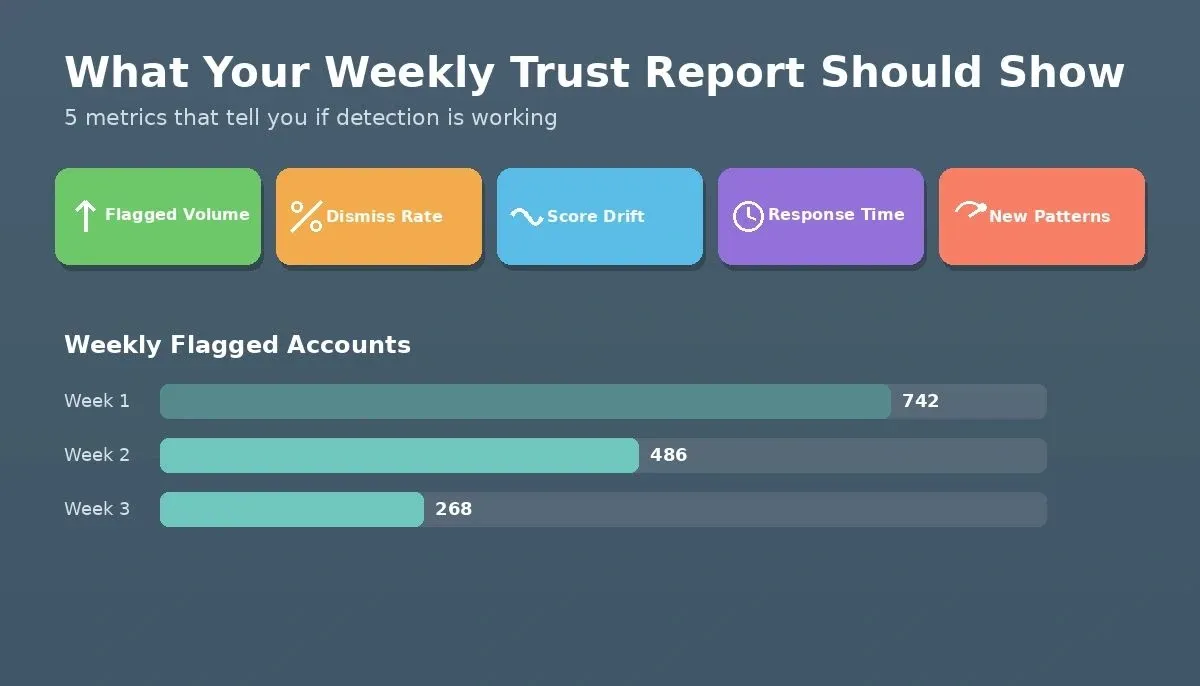
Five metrics that reveal whether your fake account detection is performing or drifting
-
Flagged account volume: How many accounts crossed the risk threshold this week? A rising trend signals evolving tactics from bad actors.
-
Resolution breakdown: Of flagged fake accounts, how many were banned, warned, or dismissed? A high dismiss rate means your scoring thresholds need recalibration.
-
Scoring consistency: Track whether your LLM-assisted scores drift week over week on the same borderline test profiles.
-
Average response time: How fast does your team act on flagged records? Faster responses reduce the window in which fake accounts interact with genuine users.
-
New pattern alerts: Surface new behavioral patterns the scoring layer detects, for example, fake accounts shifting from stolen photos to AI-generated images.
Building a community app with trust baked in from the start means your weekly trust report shows steady improvement, not a crisis that catches your team off guard.
Trust Is the Product Your Community Remembers
The Goose scandal showed what happens when fake accounts grow unchecked inside a community platform. Users leave, press coverage turns negative, and the platform's value collapses. That damage is preventable with the right system, the right scoring logic, and the right moderation tools.
The tools to ship this full trust layer exist today. Rocket lets you go from a blank prompt to a working fake profile detection dashboard, with Supabase scoring, LLM-assisted risk assessment, admin queues, and automated restriction logic, in a single Build session.
Ready to build your community trust infrastructure? Rocket generates the full fake profile detection dashboard, including Supabase scoring engine, LLM-assisted risk assessment, admin moderation queue, and automated restriction logic, in a single Build session. Start building on Rocket today and ship the trust system your community deserves.
More advanced teams may also periodically retrain hybrid models and revisit SMOTE settings when class imbalance changes.
Table of contents
- -Why Fake Profiles Are a Growing Threat to Community Apps
- -What Detection Signals Should Your Dashboard Track?
- -Account Creation Velocity and Behavioral Scoring
- -How LLM-Assisted Scoring Powers Fake Account Detection
- -What This Architecture Can and Cannot Do
- -Evaluation Signals That Matter
- -Step-by-Step Dashboard Architecture for Moderation Teams
- -Why Rocket Is Where Community Trust Infrastructure Starts
- -What a Weekly Trust Report Looks Like in Practice
- -Trust Is the Product Your Community Remembers