
Going from a marketplace MVP spec to a live product on Rocket.new is a real, repeatable path for non-technical founders. Validate your idea, build with AI, ship in days, and monitor competitors post-launch, all without writing a single line of code.
What stops most marketplace ideas from ever becoming real products? It's rarely a lack of vision. Founders usually have clear specs, solid thinking, and a real problem to solve. The gap shows up between the spec document and the working product: the months of hiring, the budget overruns, the scope creep, and the dependency on a technical co-founder who may not exist yet.
42% of startups fail simply because they build products nobody wants. The minimum viable product approach exists to solve exactly this, but only if you can get from spec to a live product without burning six months and a six-figure budget. That's where Rocket.new changes the picture.
This guide breaks down marketplace MVP fundamentals, compares traditional development with AI-powered and no-code builders, and shows how Rocket.new's Solve, Build, and Intelligence workflow helps you launch, share context across the build, iterate after release, and monitor competitors from one system.
What Is a Marketplace MVP?
A minimum viable product for a marketplace is the simplest working version of a two-sided platform that proves real value to both sides. It comes with more moving parts than most app types.
Two sides to serve: Most apps serve one user type. Marketplaces serve at least two: buyers and sellers, clients and service providers, vendors and customers. That structural difference makes marketplace MVPs more complex to spec, build, and launch than a standard SaaS product or internal tool.
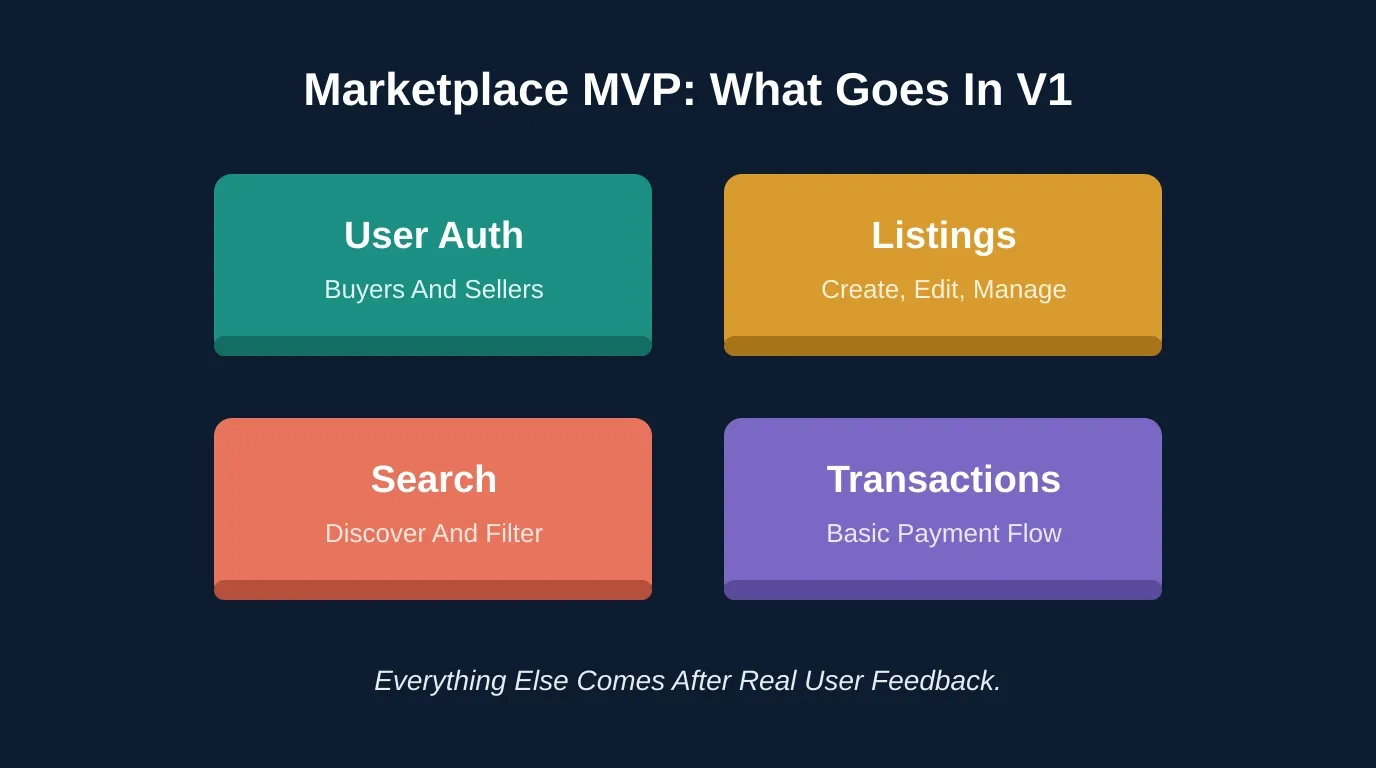
The four non-negotiable components of a marketplace MVP. Everything else comes after real user feedback.
Most founders try to build all of this to production quality before showing it to anyone. That is almost always the wrong move. It delays real user feedback and burns budget on features that may change completely.
What Should a Marketplace MVP Include on Day One?
A clean marketplace spec is what separates a product that ships from one that stays in a document. Your v1 scope should cover exactly five things:
- Core problem: The one real problem this marketplace solves for one specific niche
- Target users: Who are both sides of the platform, and what does each need on day one?
- Core features: Listings, profiles, search, and a transaction flow, nothing more in v1
- Business model: Commission per transaction, subscription-based model, or flat listing fees?
- Key flows: Sign up, post a listing, discover a listing, complete a transaction
Analytics, internal tools, customer portals, and mobile apps come after you have real feedback from real users. Scope discipline at this stage is what makes the difference between shipping and stalling. Learn how vibe coding for product managers applies the same principle to product scoping.
What Does Traditional Development Actually Cost?
Building a marketplace MVP the traditional way is a significant investment in both time and money. The cost gap between traditional and AI-powered development is not marginal; it is structural.
Development cost and timeline comparison across four approaches. Based on publicly listed rate data as of 2026.
| Development Approach | Typical Cost Range | Typical Timeline |
|---|---|---|
| In-House Team | $80,000 - $200,000+ | 6-12 months |
| Local Agency | $60,000 - $150,000+ | 4-8 months |
| Freelancers | $15,000 - $60,000 | 3-5 months |
| AI-Powered Platform | $0 - $5,000 | 1-4 weeks |
For non-technical founders, the traditional path adds another problem: a dependency on a technical co-founder who may not be easy to find or recruit. Freelancers introduce quality and management overhead. Agencies are expensive and slow.
Alex Iskold, a venture investor with decades of experience backing early-stage founders, put the risk plainly:
"What I see is the inability to share the pie and inspire and recruit a technical co-founder, 95% end up in struggle, launch delays, and ultimate failure or much smaller success." — Alex Iskold, via LinkedIn
Waiting for a technical co-founder before you start validating your marketplace idea means waiting, possibly indefinitely.
Are No-Code and AI-Powered Builders a Real Option Now?
Yes, and the numbers support it. The no-code and AI-powered development market has matured significantly.
- 70% of new enterprise applications in 2025 were built using low-code or no-code technologies, up from less than 25% in 2020.
- The global low-code development platform market is forecast to exceed $30 billion in 2026.
- Organizations report up to a 90% reduction in development time compared to traditional custom development.
Today's AI-powered platforms generate production-ready web apps and mobile apps with user authentication, real data models, payment integrations, and custom domain deployment. No technical knowledge is required from the founder. Learn more about how AI app builders save development costs.
What Problems Do Most AI Builders Still Have?
Fast-generation tools like Bolt, Lovable, and v0 are competent at producing UI from a prompt. But there are structural gaps that surface fast once you try to ship a real marketplace with real users.
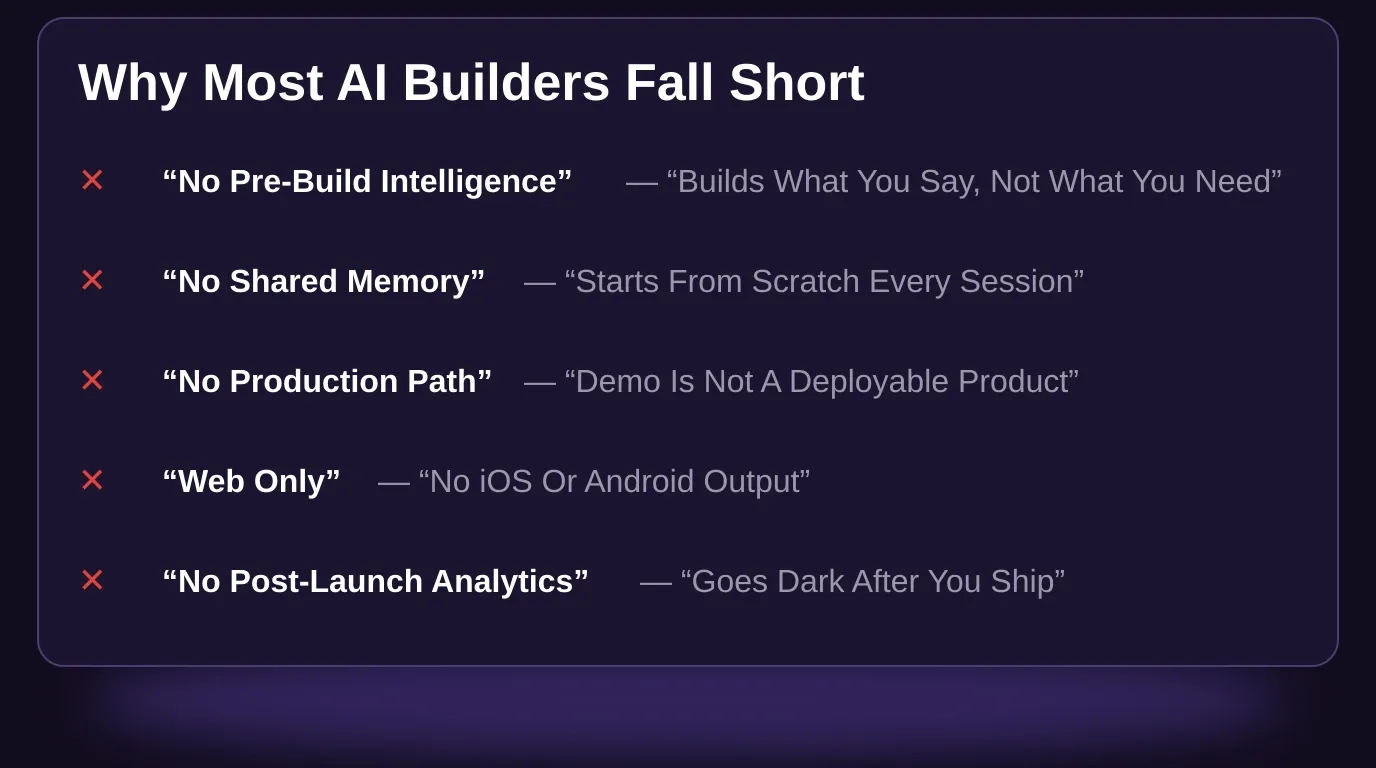
Five structural gaps that prevent most AI builders from taking a marketplace from spec to live product.
- No pre-built intelligence: These tools build what you tell them to build. They don't help you figure out whether the spec makes sense, what to prioritize, or whether you're solving the right core problem.
- No shared memory: Every session starts fresh. Your brand guidelines, your spec, your research, re-explained from scratch every time.
- No complete path to production: Generating a demo is not the same as shipping a live product. Staging environments, production deployment, version history, one-click rollback, and a custom domain are not part of the package.
- No mobile apps: Most AI app builders generate web-only output. Marketplace founders who want to reach users on iOS and Android need a separate tool entirely.
- No post-launch visibility: Once live, these tools offer no built-in analytics to track visitors, conversions, or Core Web Vitals.
These gaps are exactly what Rocket.new was built to close. See how Rocket.new compares to other AI builders in a detailed breakdown.
From Marketplace Spec to Live Product: The Rocket.new Workflow
Rocket.new is a vibe solutioning platform that combines strategic research, AI app building, and competitive intelligence into a single product. The platform has three core pillars: Solve, Build, and Intelligence, each handling a distinct phase of the journey from spec to live product.
Solve: Validate Your Marketplace Spec Before You Build Anything
Most no-code and AI app builders skip the thinking step entirely. Rocket.new starts with it before a single screen is generated.
Solve is Rocket.new's research engine. It takes your marketplace idea and turns it into a complete, structured product brief with an executive summary, supporting evidence, and actionable recommendations. It helps you define target users for both sides of the platform, narrow the core features needed for v1, and surface wrong assumptions before the build starts.
A founder validating a freelance services marketplace ran Solve first. The output surfaced a critical assumption gap: the spec assumed sellers would self-onboard, but the target niche required curated vetting. Catching that before a single screen was built saved weeks of rework. Explore what Solve on Rocket.new does and how it differs from asking a chatbot.
Build: Web Apps and Mobile Apps, Production-Ready from Day One
Once the spec is clear, Build takes over. What Rocket.new generates is not a mockup or a wireframe; it is a working, deployable product.
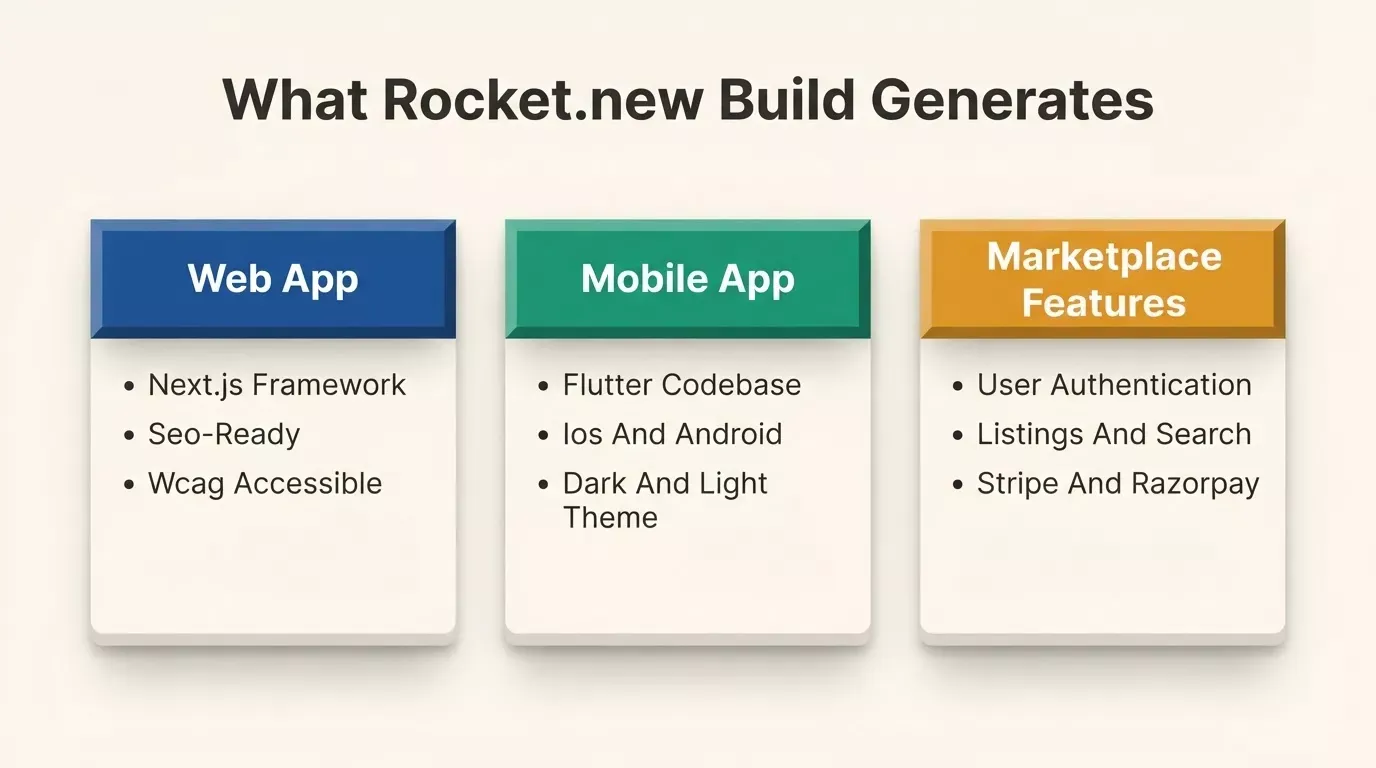
Everything Rocket.new generates in a single Build session: production-ready web, mobile, and marketplace-specific features.
- Web apps in Next.js: Production-grade, SEO-ready, WCAG-accessible web applications from the first generation.
- Mobile apps in Flutter: A single codebase that ships to both iOS and Android, with real design systems, dark and light theming, fluid navigation, and staggered animations.
- Marketplace-specific capabilities built in: User authentication for buyers and sellers, listing creation and management with real data models, search and discovery, payment integrations via Stripe and Razorpay, customer portals for each user type, and custom domain deployment with automatic HTTPS.
- 25+ connectors: Stripe, Supabase, Google Analytics, Mixpanel, Mailchimp, Twilio, SendGrid, HubSpot, and more, all connect directly into generation without separate setup. See the full connectors overview in Rocket.new's docs.
Rocket.new generates a staging URL within the build session. You can share it with early users before pushing to production, which means real feedback can start in days, not months. Explore the full tech stack Rocket.new generates and why it matters for production-grade apps.
Context: Your Marketplace Spec Travels with Every Build
Re-explaining your product to a new AI session is one of the most frustrating parts of working with most AI builders. Rocket.new solves this with a shared context architecture that carries across every task in a project.
Store your spec, brand guidelines, research, and key decisions once. Every build task pulls from this context automatically. The thinking compounds rather than resets; every task makes the next one smarter. Read more about how Rocket.new's shared memory works across tasks and projects.
Launch, Gather User Feedback, and Iterate Quickly
Shipping to real users, even a small group, is where a marketplace spec becomes a validated idea with real traction signals.
- Staging URL first: Publish to a staging URL and share with early users before going live on production.
- One-click production deployment: When the product is ready, push to production on a custom domain in one action.
- Version history and rollback: Full version history and one-click rollback mean that nothing built is ever lost, and stable builds stay protected if later updates introduce bugs.
- Built-in analytics: Track visitors, conversions, and Core Web Vitals after launch; no external analytics tool to configure.
- Monitor the market after launch: Once your marketplace is live, use Rocket.new Intelligence to track competitor moves across nine signal pillars: Website Intelligence, Social Media, News and Media, GTM, Product and Technology, People and Hiring, Business and Finance, Reviews and Community, and Traffic (rolling out). See the Intelligence pillars overview.
- Iterate through the conversation: Add new features through chat in the Build interface. The context carries forward automatically.
Use the MVP stage to surface operational and UX friction early, before scaling user acquisition.
The feedback loop between real users and product improvements is where marketplace MVPs get refined into real products worth scaling.
How Does Rocket.new Compare to Other AI Builders for Marketplace MVPs?
| Feature | Bolt / Lovable / v0 | Rocket.new |
|---|---|---|
| Pre-build intelligence (Solve) | No, starts from blank prompt | Yes |
| Shared context memory | No, resets each session | Yes |
| Production-ready Next.js / Flutter | No, prototype-grade output | Yes |
| Custom domain deployment | Limited, third-party setup needed | Yes |
| 25+ connectors | Limited, manual API integration | Yes |
| Mobile apps (iOS + Android) | No, web-only output | Yes |
| Built-in analytics post-launch | No, external tool required | Yes |
| Competitive intelligence | No | Yes, nine-pillar Intelligence module |
| Human help inside the platform | No | Yes |
Bolt, Lovable, and v0 build what you tell them to build. Rocket.new figures out what's worth building and then builds it.
What Does the Timeline Look Like for Non-Technical Founders?
Building a marketplace MVP on Rocket.new is not a theoretical shortcut. It is a real, repeatable timeline that replaces months of traditional development.
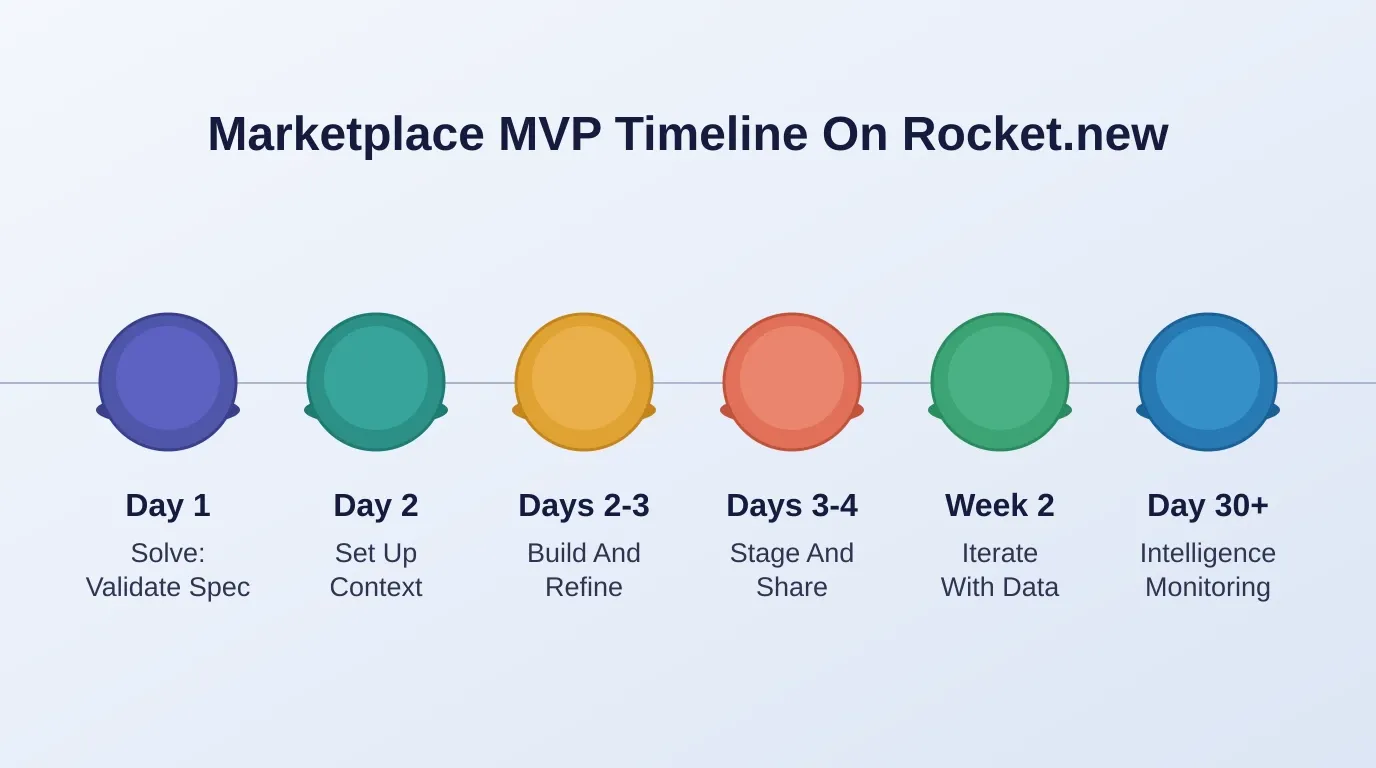
A realistic week-by-week timeline for taking a marketplace from spec to live product on Rocket.new.
- Day 1: Use Solve to validate your spec, define your core features, and confirm your business model
- Day 2: Set up Context with your brand guidelines, spec, and any research
- Days 2-3: Describe your marketplace in Build, refine the output through chat, and visual edit
- Days 3-4: Review the staging URL, share with a small group of early users
- Week 2: Iterate based on real user feedback and data from built-in analytics
- End of Week 2: Push to production on a custom domain, ready for your full user base
- Day 30+: Use Rocket.new Intelligence to monitor competitor pricing moves, hiring signals, and GTM shifts
Weeks, not months. A fraction of the cost of traditional custom development. Real traction signals from real users, not assumptions written into a spec. See what building an MVP the Rocket.new way looks like in practice.
Wrapping Up: Ship the Marketplace, Don't Perfect the Spec
Getting from a marketplace MVP spec to a live product has always been the hard part. The traditional development process made it slow, expensive, and dependent on technical resources that most early-stage founders don't have.
From MVP for marketplace spec to live product on Rocket.new, the path is a real, repeatable workflow: validate the thinking, build from that foundation, ship to real users, and iterate with data. All in one platform, without writing a single line of code.
A marketplace that ships, even in a stripped-down, core-features-only form, is worth more than a perfect spec that never becomes a product.
Ready to take your marketplace from spec to live product? Start building on Rocket.new and ship your marketplace MVP without a single line of code.
Table of contents
- -What Is a Marketplace MVP?
- -What Should a Marketplace MVP Include on Day One?
- -What Does Traditional Development Actually Cost?
- -Are No-Code and AI-Powered Builders a Real Option Now?
- -What Problems Do Most AI Builders Still Have?
- -From Marketplace Spec to Live Product: The Rocket.new Workflow
- -Solve: Validate Your Marketplace Spec Before You Build Anything
- -Build: Web Apps and Mobile Apps, Production-Ready from Day One
- -Context: Your Marketplace Spec Travels with Every Build
- -Launch, Gather User Feedback, and Iterate Quickly
- -How Does Rocket.new Compare to Other AI Builders for Marketplace MVPs?
- -What Does the Timeline Look Like for Non-Technical Founders?
- -Wrapping Up: Ship the Marketplace, Don't Perfect the Spec