From MVP scope template spec to live product on Rocket.new: a step-by-step guide for non-technical founders who want to build a minimum viable product, test assumptions with real users, and ship a functional product without a developer queue.
What Building an MVP Actually Takes
What separates the product that ships from the one that lives in a Google Doc forever?
Most founders assume the answer is code. It is not. The answer is clarity. Whether the team actually defined what they were building, who they were building it for, and what they were deliberately not building before a single line of code was written.
A minimum viable product is the simplest version of your app that tests your core assumptions with real users. Not a full-featured build. Not a pitch deck.
According to CB Insights data, 42% of startups fail because they build products nobody wants. The fix is not more code. It is better scoping before a single screen gets designed.
Most startups do not fail at the execution stage. They fail because they skipped the thinking stage entirely and built something that did not match real user needs or market demand. That is the problem an MVP scope template spec is designed to prevent.
Why Most MVPs Stall Before They Ship
Most product teams understand the idea of an MVP. Fewer actually follow through on what it requires. The lean startup methodology made the build-measure-learn loop famous.
The logic is simple: ship the first version, get it in front of real users, measure what happens, and use that real data to decide what to build next.
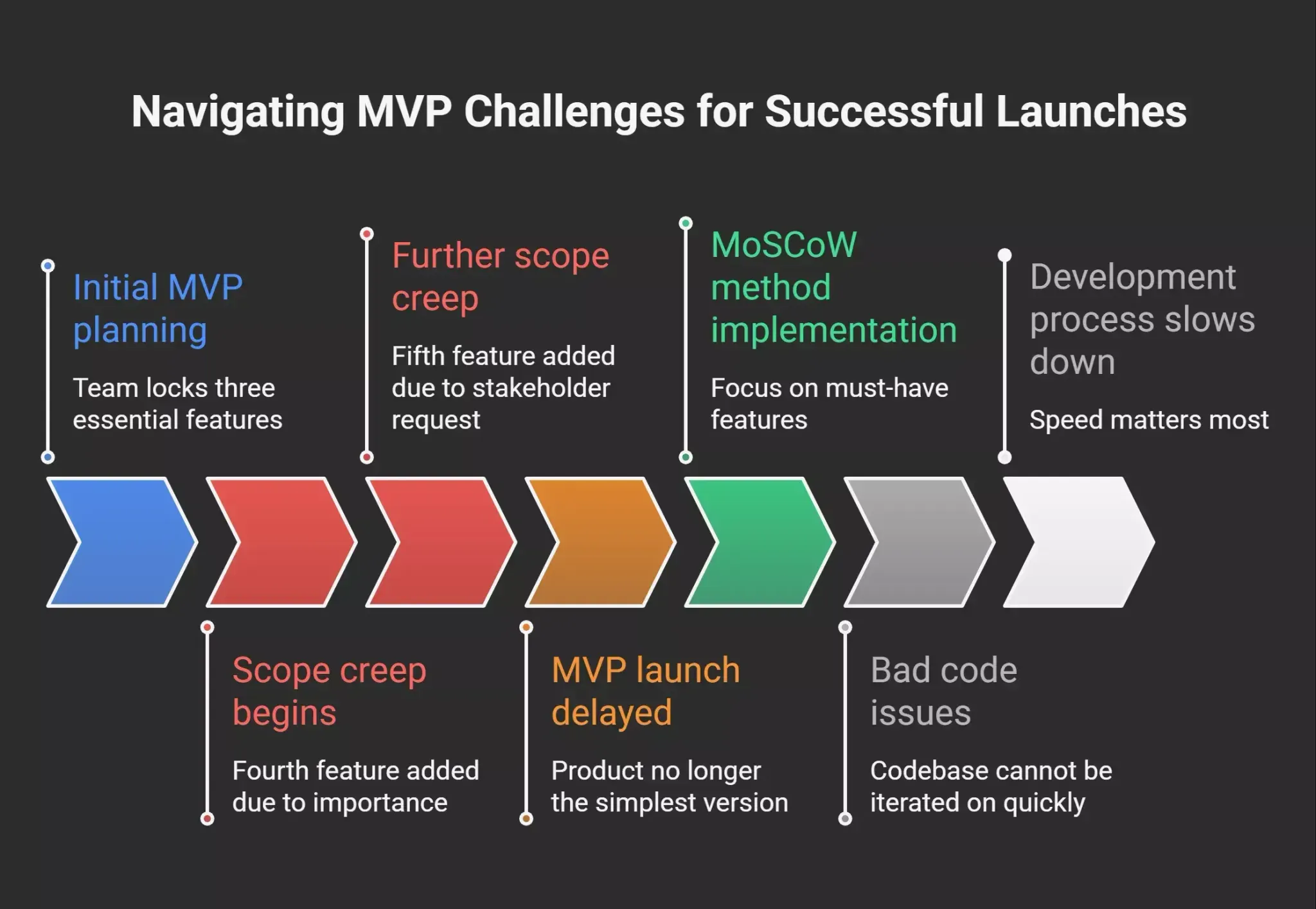 Scope creep is the most common cause of delayed launches. It starts with good intentions. A team locks three essential features, then adds a fourth because it seems important, then a fifth because a stakeholder asked for it. By the time the product ships, it is no longer the simplest version of anything.
The MoSCoW method exists precisely to prevent this. Must-have, Should-have, Could-have, and Won't-have. Only what falls in the must-have column belongs in an MVP. Everything else is future development. Staying focused on only what matters for the first version is what makes the build-measure-learn loop actually work.
The other failure mode is bad code. Teams rush to ship, skip the spec, and end up with a codebase that cannot be iterated on quickly. Every new feature takes longer than the last because the foundation was never properly laid. The development process slows down at exactly the moment when speed matters most.
The MVP Scope Template: Your First Real Document
An MVP scope document is the contract between your idea and your development process. Teams that skip it almost always regret it later. It is also the document that keeps product teams aligned when pressure builds to add features, change direction, or expand the target audience mid-build.
A good MVP scope template covers six things:
| What to Define | Why It Matters |
|---|---|
| Core problem your app solves | Keeps the build focused on user needs, not assumptions |
| Who your early users and target audience are | Shapes every feature decision and user story in the project |
| Three to five essential features for the MVP | Removes scope creep and prevents adding features mid-build |
| What is deliberately out of scope | Saves budget and protects the development timeline |
| How you will measure success | Gives the team a clear signal for when to gather feedback |
| Frontend and backend requirements | Aligns expectations with technical reality before development starts |
Define the Core Problem First
Before any screen gets designed, write one sentence describing the single real problem the app solves. This is the core action the product exists to perform. Everything else is secondary. If you cannot write that sentence clearly, you are not ready to build yet. Start with market research, talk to potential users, and validate that the problem is real before writing a single user story.
Name Your Target Audience and Early Users
Knowing who will test the working prototype narrows the scope fast and stops the build from trying to serve everyone at once. Your target audience for the MVP is not everyone who might eventually use the product. It is the single user type whose problem is most acute and who will give you the most useful early user feedback.
Lock Your Essential Features to Three to Five
Most product teams make the mistake of treating the MVP as a reduced version of the full product. It is not. It is only what is required to test the core assumption. List your potential features, apply the MoSCoW method, and keep only what falls in the must-have column. Everything else goes on the future development list.
Write Down What You Are Not Building
The out-of-scope list is just as important as the feature list. It is the document that lets you say no to scope creep without debate. When a stakeholder asks why a feature is missing, the answer is already written down. That clarity protects the budget and the timeline.
Set One Measurable Test for Success
A clear signal tells the team when the MVP has done its job and when it is time to gather feedback and move to the next steps. Define it before you build. Without it, there is no way to know whether the first version succeeded or failed.
Capture Frontend and Backend Requirements Early
Surprises here cause the most costly delays in any development process, especially for non-technical founders without a dedicated technical lead. The more specific you are in the spec, the fewer decisions get made under pressure during the build stage.
A tightly written MVP scope does not slow teams down. It is the thing that lets them move fast without second-guessing every decision mid-build. For a practical look at how to prioritize what goes into your build, how to iterate on an MVP with AI tools is a useful companion.
The Development Process and Where It Gets Stuck
Building an app from scratch with a developer team typically costs between $15,000 and $150,000 and takes 3 to 6 months. By the time the working app is ready, the market has already moved. Source: Ideas2IT
That timeline is the core problem for most founders. Not the cost alone. The time. Every week spent in development is a week where your assumptions about user needs are aging without real data to test them against.
-
MVPs rarely die because of bad ideas. They stall at the stage between the spec and the build, where the idea waits for someone else's calendar to free up.
-
Non-technical founders face the biggest gap. Every screen has to be described in detail, every backend behavior specified, and every change queued in a developer's sprint.
-
Outdated assumptions are a real cost. When the build takes months, the decisions baked into the early-stage scope become stale before a single real user opens the app.
-
The budget hit is only part of the problem. The real cost is the feedback loop that never happens, and the market signals you miss while waiting for the working prototype.
-
Slow iteration cycles compound the damage. One slow round means one set of stale assumptions. Three slow rounds means an app built on a spec that no longer matches the users it was designed for.
The faster you move from spec to live product, the faster you reach early user feedback. That feedback loop is where building an MVP actually does its job. Understanding how much it costs to build a SaaS with AI gives useful context on how the economics of MVP development have shifted.
A Voice From the Builder Community
The gap between spec and shipped app is closing fast. The people building products are starting to talk about it openly.
"If, as a designer or a product manager, I can get an MVP built without having to get my dev team involved, I'm going to do it... In the first cohort of my vibe coding course, I saw students go from idea to a completed, AI-enabled app with registration, authorization, a backend database, and more in just 4 weeks. And they only spent a few hours each on their apps." - Drew Falkman, Designer and Product Educator- LinkedIn
Non-technical founders are no longer waiting two weeks or three weeks for a developer to be available. They are shipping working prototypes in days and getting them in front of real users before the traditional development process would have even produced a wireframe.
-
The bottleneck was never the idea. It was always the gap between the document and the deployed app. That gap is now collapsing.
-
Non-technical founders are shipping working apps without developer queues, without multi-month timelines, and without six-figure budgets.
-
Designers, product managers, and solo founders are moving from idea to backend-connected, deployed app in the time it used to take just to write a brief.
-
The teams moving fastest right now are the ones that stopped waiting for a technical co-founder and started shipping with the tools available today.
The tools have caught up with the ambition. What used to take a development team three months now takes a focused founder a long weekend. This shift is part of a broader movement in vibe coding that is changing how products get built from the ground up.
Your Launchpad: Building on Rocket.new
Rocket.new is the world's first Vibe Solutioning platform, built to cover the full arc of the product journey from first question to live app to ongoing competitive intelligence, all in one system with shared context.
Most AI tools ask you to do all the thinking yourself. They hand you a blank prompt box and call it a platform. Rocket.new works differently because it starts one step earlier, before the build, at the point where most product teams make their most expensive mistakes.
Think It. Then Build It Without Starting Over
The lean startup methodology says to validate before you build. Rocket.new makes that possible without switching tools or re-explaining context at every stage.
-
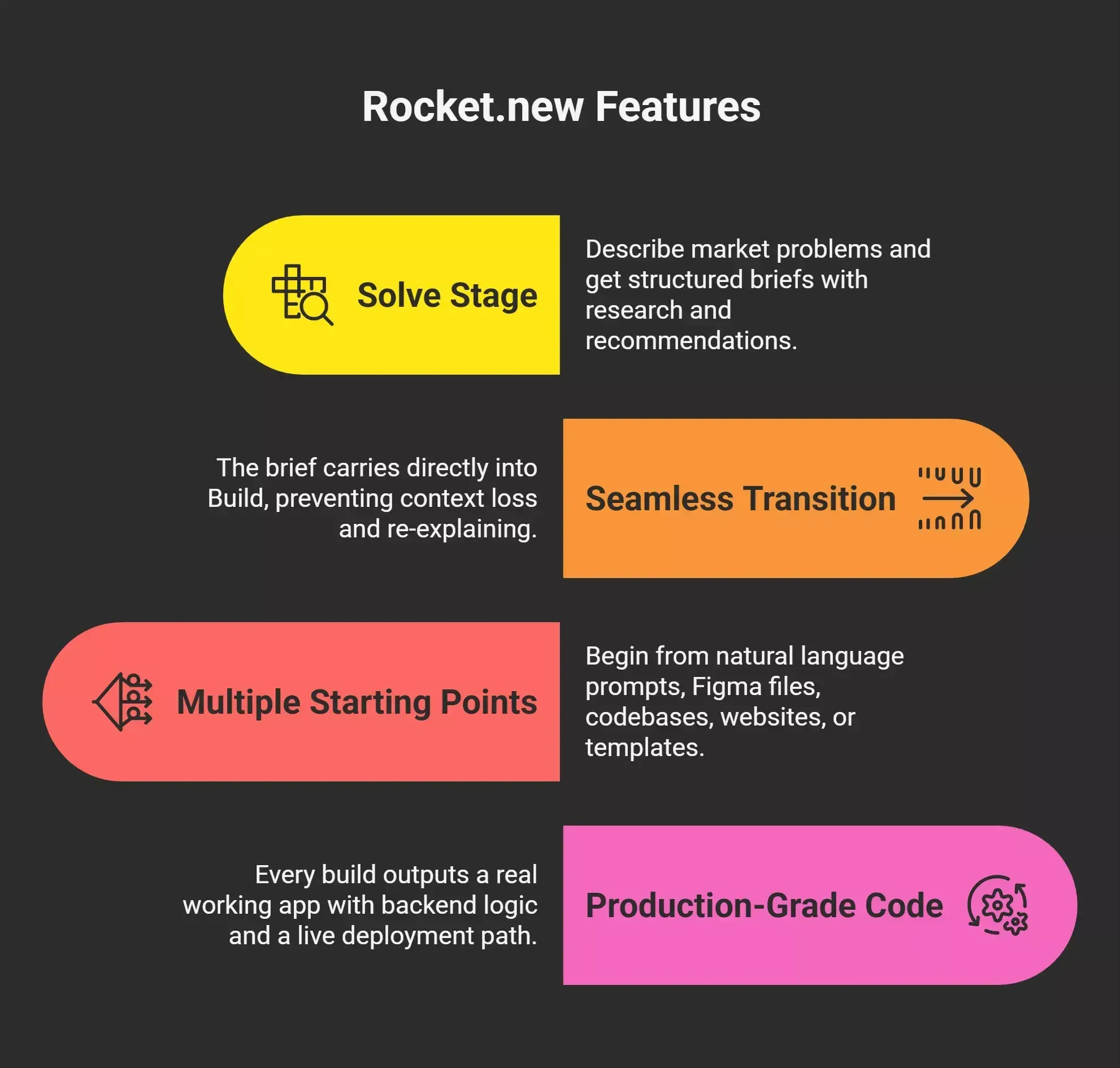
Rocket.new starts at the Solve stage. Describe any market problem, decision, or product idea in plain language. Rocket.new returns a structured brief with market research, evidence, and a clear recommendation. This is where you validate market demand, understand user needs, and define the core problem before a single line of code is written.
-
That brief carries directly into Build. No re-explaining, no context lost between stages, no starting from scratch. The market research that validated your direction becomes the foundation of the app you build.
-
You can begin from multiple starting points: a natural language prompt, a Figma file, an existing Next.js codebase, a live website you want to reimagine, or any of the free templates, including MVP-ready starting points.
-
Every build outputs production-grade code. A real working app with backend logic, real screens, and a live deployment path. Not a clickable prototype that users cannot actually use.
The spec you define in Solve becomes the app you ship from Build. Nothing gets lost in translation between the two.
Core Features That Support MVP Development
Every project on Rocket.new ships with a full set of capabilities designed to carry teams from early-stage prompt to a market-ready product, without switching platforms mid-build.
-
One-shot app building. Describe your app in a single prompt and get a complete working app back. This covers mobile apps (Flutter), web apps (Next.js), SaaS dashboards, landing pages, and internal tools, all production-ready from the first prompt. Non-technical founders do not need to write a single line of code.
-
Staging and production environments. Test your assumptions on a staging build before pushing to real users, protecting the live app while you validate each new version. Full version history and one-click rollback are included.
-
Free templates. Pick a starting point close to your use case. Rocket.new adapts it to your brand, stack, and goals so teams building an MVP skip the blank-page problem entirely. Templates consume zero credits.
-
Two-way GitHub sync. Pull your code, edit it, and push changes back. Technical teams can extend the build without losing the Rocket.new workflow.
-
Built-in analytics. Track how real users interact with your app after launch and gather feedback without any additional setup or third-party tools. Visitors, conversions, and Core Web Vitals are all covered from day one.
-
Rocket Intelligence. After the app ships, Rocket.new gives you a personalized intelligence engine shaped by your role and what you are trying to accomplish. A founder watching for funding signals and a sales lead watching for pricing moves follow the same company and get completely different briefs because the same signal means something different depending on who you are.
These are not separate tools bolted together. They all live in one system with shared context, so every action in one stage directly informs the next. For a closer look at what goes into a production-ready build, the complete guide to AI app creation covers the full picture.
Rocket.new vs. Traditional MVP Development
| Capability | Traditional Development | Rocket.new |
|---|---|---|
| Time to first version | Three to six months | Hours to days |
| Cost to build | $15,000 to $150,000 | Fraction of the cost |
| Market research stage | Separate tool or consultant | Built into Solve |
| MVP testing environment | Requires setup | Staging included |
| Gathering user feedback | Third-party analytics tools | Built-in analytics |
| Adding new features post-launch | New developer sprint | Chat-based iteration |
| Product roadmap intelligence | Manual competitor research | Rocket Intelligence |
| Code access | Developer dependency | Two-way GitHub sync |
Why Other AI Builders Fall Short
Tools like Lovable and Bolt let you build fast. But the thinking layer before the build, and the intelligence layer after it, are entirely absent.
-
No research stage. You bring all the thinking yourself, meaning you start the build without knowing if the market actually supports what you are shipping.
-
No product direction or PRD generation. Every other tool hands you a blank prompt box and calls it a platform.
-
No intelligence layer that knows who you are. Other tools show you data and leave you to figure out what it means. Rocket Intelligence shapes every signal around your role and your stated purpose. The brief a product leader gets, and the brief a sales leader gets, are not the same brief.
-
Building fast without context just gets you to the wrong place faster. Speed without the right foundation is how teams ship confidently and land with no traction.
-
Rocket.new holds the scope, the build, and the market intelligence together. The context you gathered in Solve does not disappear when you move to Build. It follows every decision you make.
Speed matters. But speed with the right context is what separates a working app that gains traction from one that gets rebuilt three months later. If you are evaluating alternatives, the comparison with Lovable breaks down the key differences in detail.
Getting Early User Feedback and Iterating Fast
Shipping the app is the beginning, not the finish line. The first round of MVP testing almost always produces surprises. Most product teams are surprised by what real users actually do when they get in front of the product for the first time.
The build-measure-learn loop only works if you can move through it quickly. Here is what that looks like in practice on Rocket.new:
-
Real users ignore the features you thought were most important. This is not failure. It is information. Write it down and act on it. Early user feedback is the most valuable data you will collect in the early stages of any product.
-
They find value in the screens you almost cut. The feature you nearly removed from scope is often the one that generates the most engagement. User behavior reveals patterns no spec could have predicted.
-
Watching how real users move through the app is worth more than a month of internal planning. Get the working prototype in front of a single user as fast as possible. Even one user can tell you things that weeks of internal debate cannot.
-
The iteration cycle on Rocket.new is short. Push to staging, test with users, gather feedback, and push to production. Each loop takes days, not the weeks a traditional development process would require.
-
Built-in analytics remove the guesswork. You can see exactly where users drop off, which screens hold attention, and which call-to-action section converts, all without any additional tools.
-
Each loop compounds. The product gets sharper with every round, and early adopters who see fast responses to their feedback become the loudest advocates.
Iteration speed, not first-build perfection, is what turns an MVP into something people actually pay for and stick with. Reaching product market fit requires real data from real users, not assumptions from internal planning sessions. For a practical framework on this, how to build an app fast with AI is worth reading alongside this guide.
From Spec to Shipped: The Shortest Path Wins
Most founders spend weeks writing specs, waiting for developers, and rebuilding based on outdated assumptions. By the time feedback arrives, the MVP has already drifted from the market.
Rocket.new removes that delay. Your MVP scope turns into a working product without long build cycles, developer bottlenecks, or massive upfront costs. Research, building, analytics, and competitive intelligence all live in one connected system, so nothing gets repeated and every step compounds.
That is how Rocket.new takes teams from MVP spec to live product faster than traditional development.
Ready to go from MVP scope template spec to a live product without the wait?
Table of contents
- -What Building an MVP Actually Takes
- -Why Most MVPs Stall Before They Ship
- -The MVP Scope Template: Your First Real Document
- -Define the Core Problem First
- -Name Your Target Audience and Early Users
- -Lock Your Essential Features to Three to Five
- -Write Down What You Are Not Building
- -Set One Measurable Test for Success
- -Capture Frontend and Backend Requirements Early
- -The Development Process and Where It Gets Stuck
- -A Voice From the Builder Community
- -Your Launchpad: Building on Rocket.new
- -Think It. Then Build It Without Starting Over
- -Core Features That Support MVP Development
- -Rocket.new vs. Traditional MVP Development
- -Why Other AI Builders Fall Short
- -Getting Early User Feedback and Iterating Fast
- -From Spec to Shipped: The Shortest Path Wins