
Building a medical appointment app with AI no longer requires a development team. This blog covers features, tech stack, compliance, and how to go from prompt to live scheduling app in minutes.
Why do missed appointments cost the U.S. healthcare system over $150 billion annually?
Outdated scheduling workflows that ignore patient behavior and real-time availability are the root cause. According to Emergen Research, the medical scheduling software market reached USD 3.47 billion in 2025. It is growing at 13.4% CAGR as providers move toward AI-driven alternatives.
AI tools now handle everything from patient intake to automated slot filling.
This blog walks through the complete process of building an intelligent scheduling platform that reduces no-shows and maximizes clinic capacity.
Why Healthcare Providers Need AI-Powered Scheduling
The scheduling problem runs deeper than phone tag and full voicemail boxes. Missed and mismanaged appointments create compounding losses across revenue, patient outcomes, and staff burnout.
- No-show rates range from 5% to 30% depending on specialty and patient population
- A single practice losing two patients per day to no-shows can lose over $50,000 in annual revenue
- Manual scheduling forces front-desk staff to spend 30 to 45 minutes per hour on phone-based coordination
- Patients increasingly expect self-service booking, similar to how they book flights, restaurants, and rideshares
Clinics relying on paper calendars or outdated EHR scheduling modules face growing patient attrition. Competitors who modernize first capture those patients. Double-bookings and scheduling conflicts also lead to longer wait times, which directly lower patient satisfaction scores.
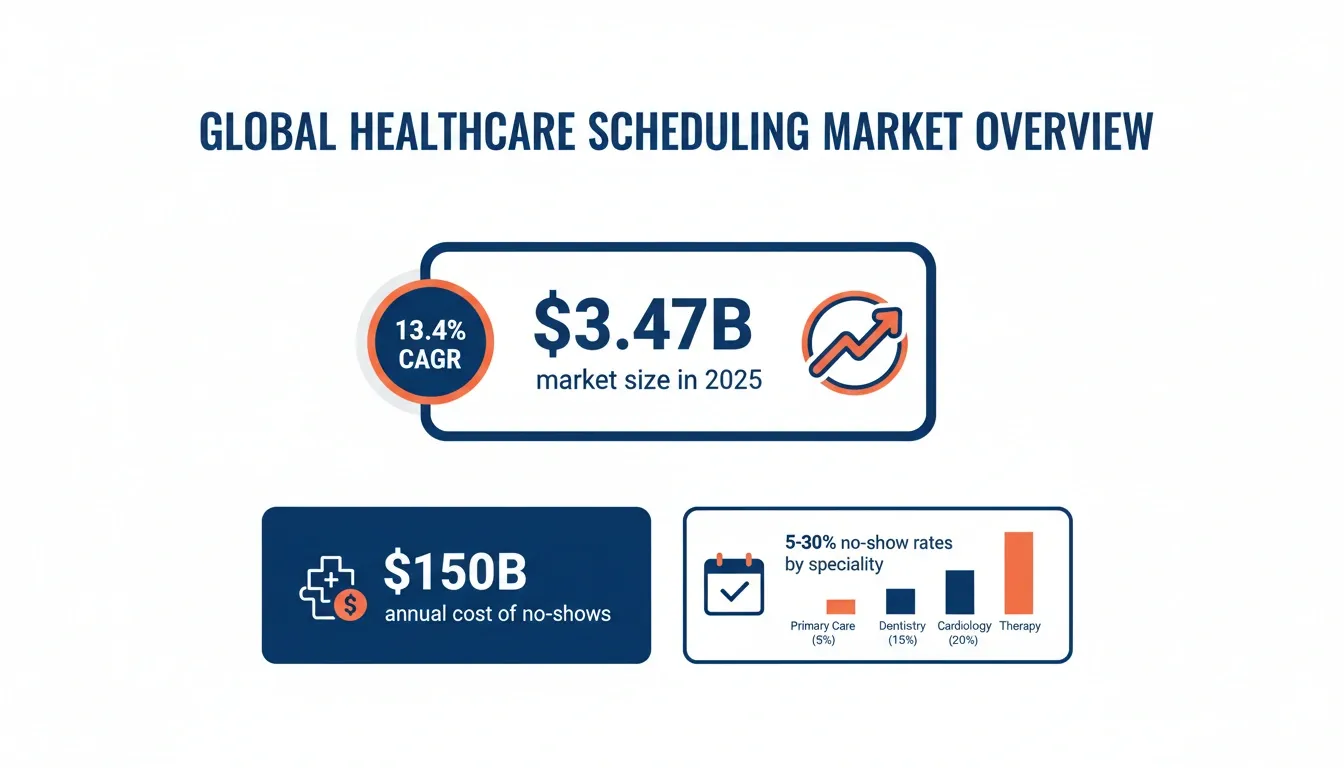
Healthcare scheduling market growth and the financial impact of appointment no-shows on medical practices.
Healthcare providers investing in intelligent scheduling tools are seeing measurable improvements in fill rates and patient retention within weeks of going live. The gap between what patients expect and what most clinics deliver represents the biggest opportunity in healthcare operations right now.
What Features Should Your Scheduling App Include?
The difference between a scheduling app patients love and one they abandon comes down to the feature set. Not every feature matters equally. Here is what the data says drives retention.
- Real-time availability sync across providers, locations, and appointment types
- Patient self-scheduling with immediate confirmation
- Automated reminders via SMS, email, and push notifications
- Provider-side dashboard showing daily and weekly views with color-coded status
- Waitlist management that auto-fills cancelled slots from standby patients
- Connection with EHR/EMR systems and payment gateways
- Multi-language support for diverse patient populations
- Mobile-first patient portal accessible on iOS and Android
| Feature | Patient Impact | Clinic Impact |
|---|---|---|
| Self-scheduling portal | 24/7 booking access | 60% fewer phone calls |
| Automated SMS/email reminders | Fewer missed appointments | Up to 30% no-show reduction |
| Waitlist auto-fill | Shorter wait for openings | Recovered revenue from cancellations |
| Calendar sync | Syncs with personal calendars | Reduced double-bookings |
| Telehealth toggle | Choose in-person or virtual | Flexible resource allocation |
| Mobile patient app | Book from any device | Broader patient reach |
The appointment scheduling software market is projected to grow from USD 546.1 million to USD 1.9 billion by 2034 at 14.70% CAGR, according to Fortune Business Insights. This growth confirms that patient expectations are driving rapid feature adoption across the medical scheduling software landscape.
Start with the features patients use daily: self-booking, reminders, and the telehealth toggle. Then add provider-side intelligence in your next iteration. For a related scheduling app pattern, see how no-code job scheduling apps handle dispatch calendars, mobile views, and Stripe invoicing from a single prompt.
How Does AI Improve the Appointment Booking Process?
Adding AI to a scheduling system transforms it from a static calendar into an active participant in clinic operations. The shift is less about replacing humans and more about handling the patterns humans miss.
- Predictive scheduling analyzes historical data to suggest optimal appointment slots for each patient
- Natural language processing lets patients book through conversational interfaces and chatbots
- Machine learning models identify patients likely to no-show and trigger pre-appointment engagement
- AI-based load balancing distributes appointments evenly across providers and time slots
- Smart slot suggestions factor in appointment type, provider expertise, and patient travel time
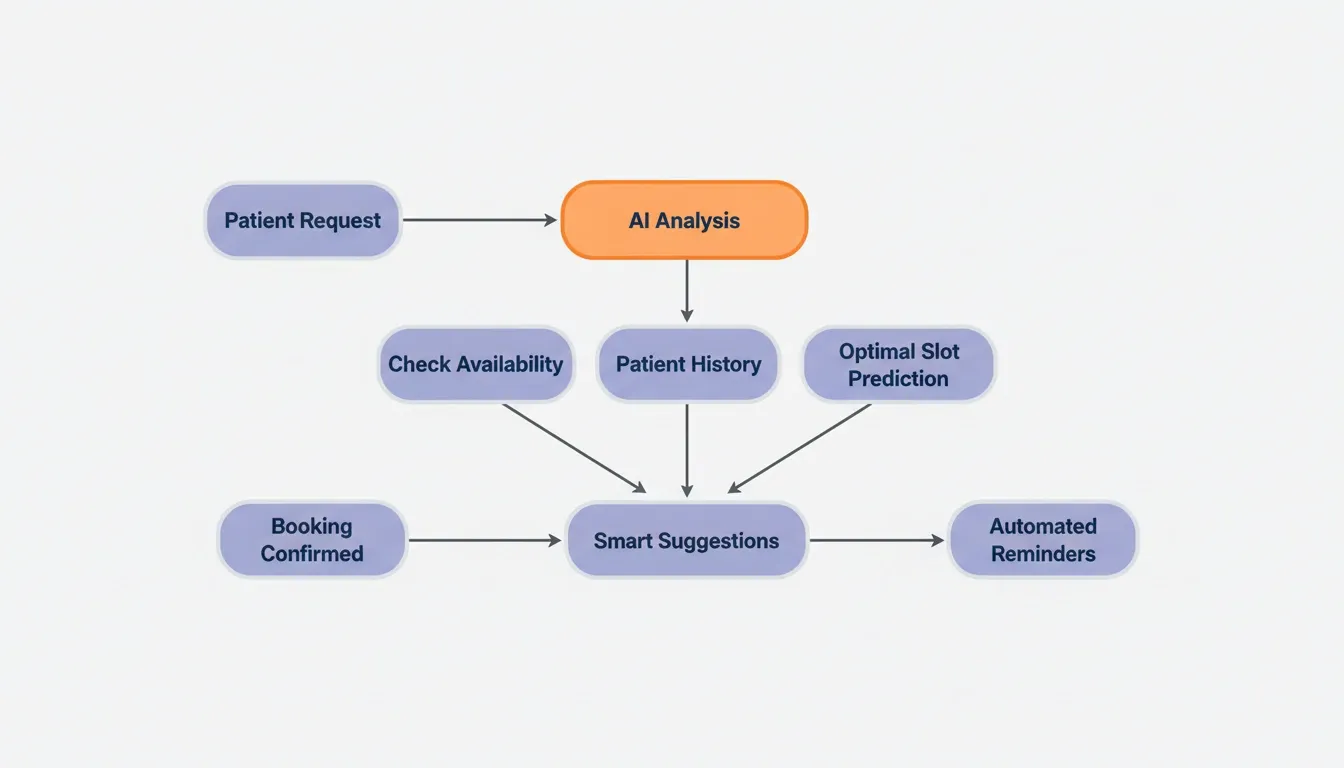
AI appointment booking workflow: from patient request through smart slot matching to instant confirmation.
AI does not replace the scheduling coordinator. Instead, it handles the repetitive pattern recognition that coordinators never had time for anyway.
Smart Notifications and Predictive No-Show Alerts
The biggest revenue leak for medical practices is the patient who simply forgets their appointment. Smart notification systems turn passive reminders into active, personalized interventions.
- Multi-channel reminders via SMS, email, WhatsApp, and push notifications, sent at optimal times based on patient response history
- Escalation workflows that increase reminder frequency for patients flagged as high no-show risk
- Two-way confirmation that lets patients confirm, reschedule, or cancel directly from the notification
- Predictive alerts that notify staff 24 to 48 hours before a likely no-show, giving time to fill the slot from the waitlist
- Post-appointment follow-up messages that prompt rebooking for recurring care visits
Practices using automated multi-channel reminders consistently report no-show reductions between 25% and 40%. That single feature alone often pays for the entire scheduling system.
What Technology Stack Powers a Medical Appointment App?
Choosing the right tech stack determines whether your app scales to 10 patients or 10,000. Modern healthcare scheduling apps share a common architecture, but the implementation details matter enormously.
The table below maps each layer to its technology and explains why it fits healthcare specifically.
| Layer | Technology | Why It Fits Healthcare |
|---|---|---|
| Web frontend | Next.js | SEO-ready, fast load, server-side rendering for patient portals |
| Mobile app | Flutter | Single codebase for iOS and Android patient apps |
| Backend / database | Supabase (PostgreSQL) | Row-level security, built-in auth, HIPAA-friendly hosting options |
| SMS reminders | Twilio | Two-way SMS, delivery receipts, BAA available |
| Calendar scheduling | Cal.com | Open-source scheduling infrastructure, provider availability sync |
| Payments | Stripe | PCI-compliant, subscription billing for recurring patients |
| Video/telehealth | Twilio Video or Daily.co | HIPAA-eligible video APIs for virtual appointments |
A well-designed database schema separates a scheduling app that works in a demo from one that handles real clinic load. Your core tables need to cover patients, providers, appointments, time slots, notification logs, and an audit log for every data access event. The audit log is required for HIPAA. Connecting Supabase as your backend scaffolds the full PostgreSQL database, authentication, and row-level security policies automatically.
Step-by-Step: Planning Your Medical Appointment App
Before writing a single prompt, a clear plan prevents the most common scheduling app failures: scope creep, missed integrations, and compliance gaps.
Here is how each phase of your medical appointment app development breaks down:
- Step 1: Define patient flow — map every touchpoint from booking to post-visit follow-up
- Step 2: Map provider availability — include multiple locations, specialties, and appointment types
- Step 3: Choose your tech stack — Next.js with Supabase handles healthcare scale well
- Step 4: Design the database schema — patients, providers, appointments, time slots, and notification logs
- Step 5: Build core features — self-scheduling portal, provider dashboard, and automated reminders first
- Step 6: Add AI features — predictive no-show scoring, smart slot recommendations, and chatbot intake
- Step 7: Test with real users — run a pilot with one provider before scaling to the full practice
- Step 8: Deploy and monitor — use separate staging and production environments, then track Core Web Vitals and conversion rates after launch
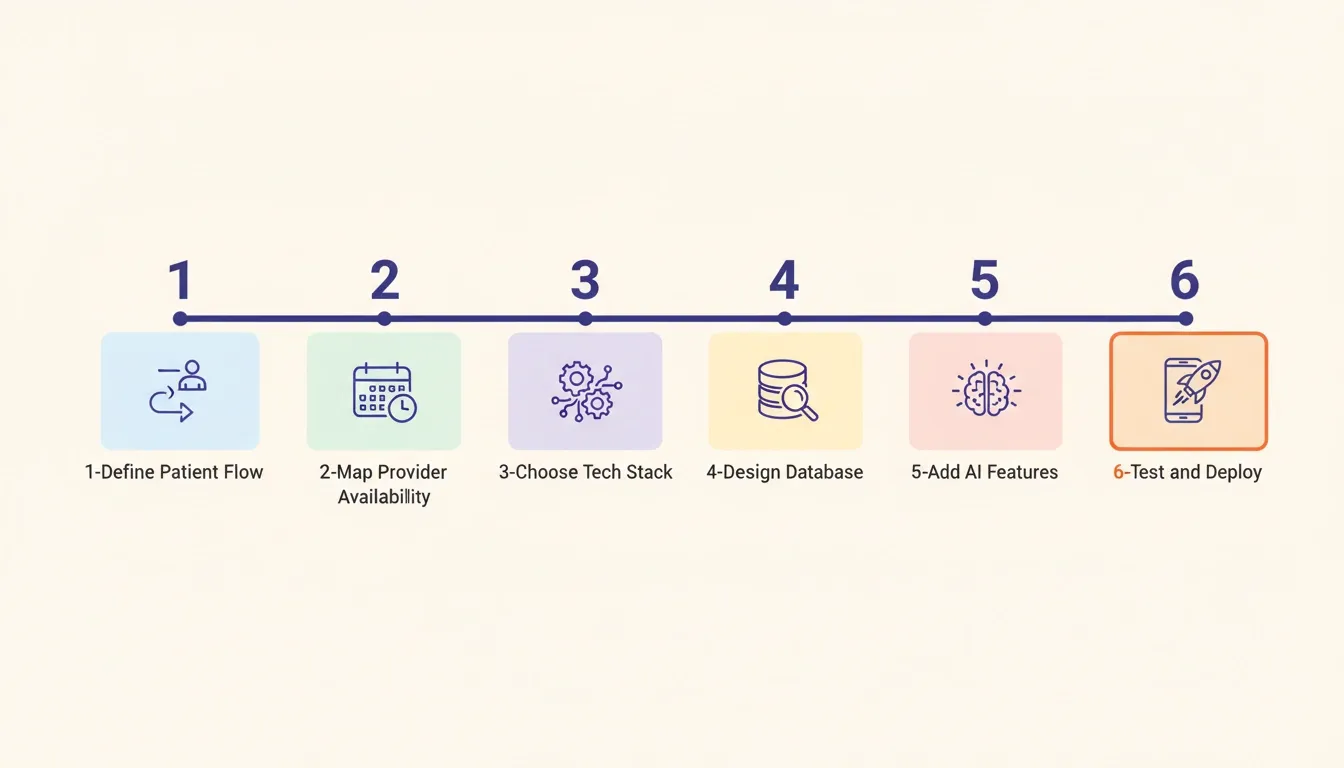 Eight-phase development roadmap for building a production-ready medical appointment scheduling app.
According to MGMA's 2025 research, practices that adopted technology-driven scheduling improvements saw meaningful attendance gains within the first quarter. The key is shipping a focused first version quickly, then iterating based on real patient behavior data.
From Concept to Live App: The Rocket Approach
Traditional development for a medical appointment app means 3 to 6 months of coding, $50,000 to $150,000 in development costs, and ongoing maintenance overhead. Rocket collapses that entire timeline into minutes.
Rocket is a vibe solutioning platform. It combines strategic research with Solve, production-grade app building with Build, and competitive monitoring with Intelligence, all in one place. For a medical appointment app, the workflow looks like this:
- Describe your app in plain language. Rocket scores prompt clarity and asks clarifying questions before generating, so the first version reflects genuine product thinking.
- Rocket generates production-ready code. A Next.js web app and Flutter mobile app with patient portals, provider dashboards, appointment logic, and authentication typically generate in 1 to 3 minutes.
- Refine through conversation. Change data models, adjust layouts, add features, and connect integrations, all in context without re-explaining.
- Deploy with one click. A staging URL is ready for testing. Then promote to production with a custom domain and automatic HTTPS.
Here is a prompt that produces a working medical appointment app on the first generation:
"Build a medical appointment scheduling app for a multi-provider clinic. Patients should be able to self-book appointments, receive SMS and email reminders, and manage their upcoming visits. Providers need a dashboard showing their daily schedule with color-coded appointment status. Include a waitlist feature that auto-fills cancelled slots. Connect Supabase for the database, Twilio for SMS reminders, and Stripe for co-pay collection."
The table below compares what each approach delivers across the capabilities that matter most for healthcare scheduling.
| Capability | Rocket | Template builders | Code-only tools |
|---|---|---|---|
| First-generation quality | Production-ready, design-system quality | Generic template layouts | Requires manual styling |
| Mobile app (Flutter) | Included, iOS and Android | Rarely included | Manual setup required |
| Database and auth | Supabase auto-scaffolded | Manual setup | Manual setup |
| SMS reminders (Twilio) | Connected from chat prompt | Not included | Manual API integration |
| WCAG accessibility | Built-in by default | Optional add-on | Manual implementation |
| GDPR compliance | Built-in by default | Optional add-on | Manual implementation |
| Deployment | One-click, custom domain | Varies | Manual DevOps |
| Version history and rollback | Built-in | Rarely included | Git only |
"After switching to automated, two-way texting, Atlas Medical Center cut its no-show rate from 14.2% to 4.91% in three months, about 3x better than the industry average." — Curogram Healthcare Blog
The speed advantage compounds. Every iteration and feature addition follows the same pattern: describe it, generate it, deploy it. Rocket also includes a built-in Advisor Agent. This senior architect sub-agent resolves error loops and makes architectural decisions automatically. It is especially valuable when building complex healthcare logic like multi-provider availability and HIPAA-compliant data flows.
Rocket Pricing
Rocket runs on a monthly subscription and credit system. The table below reflects official pricing as of July 2026.
| Plan | Monthly Cost | Credits/Month | Best For |
|---|---|---|---|
| Free | $0 | 20 (one-time) | Testing and first builds |
| Pro | $25/month | 100 | Personal projects and side projects |
| Rocket | $50/month | 250 | Teams needing research and intelligence |
| Booster | $250/month | 1,500 | Power users with high-volume usage |
All paid plans include unlimited team members. Annual billing saves 20%. Extra credits can be added on top of any plan as needed. Verify current rates at the official Rocket pricing page before purchasing.
Which Compliance Standards Should Your App Follow?
Healthcare apps operate under strict regulatory requirements. Ignoring compliance is not just risky. It is a legal and financial liability from day one.
| Standard | What It Covers | Who It Applies To |
|---|---|---|
| HIPAA | Protected health information (PHI) | All U.S. healthcare providers and their tools |
| GDPR | Personal data of EU patients | Apps serving European patients |
| HITECH | Electronic health record security | Healthcare entities using digital systems |
| SOC 2 | Data security practices | SaaS platforms handling sensitive data |
| WCAG 2.1 AA | Accessibility for patients with disabilities | Any patient-facing digital product |
Key compliance requirements for scheduling apps include the following:
- End-to-end encryption for all patient data in transit and at rest
- Role-based access controls separating patient, staff, and admin permissions
- Audit logging for every data access and modification event
- Business Associate Agreements (BAAs) with any third-party service touching patient data, including Twilio, Stripe, and your hosting provider
- Data retention policies aligned with state and federal regulations
Rocket ships every build with WCAG accessibility compliance and GDPR coverage built in by default. These are not optional extras. They are part of the baseline output. For HIPAA-specific requirements, you configure HIPAA-compliant hosting and sign BAAs with each service provider. Building on platforms that already handle hosting security, SSL certificates, and infrastructure compliance saves months of paperwork.
Testing and Launching Your Medical Appointment App
Shipping a healthcare app without a proper testing phase is the fastest way to lose patient trust. Here is the testing sequence that works for scheduling apps.
Pre-launch testing should cover:
- Functional testing: book, reschedule, and cancel appointments across all appointment types
- Notification testing: verify SMS and email reminders fire at the correct times with accurate information
- Role-based access testing: confirm patients cannot access provider dashboards, and staff cannot access admin functions
- Mobile testing: test the patient app on both iOS and Android across multiple screen sizes
- Accessibility audit: verify WCAG 2.1 AA compliance using Rocket's built-in accessibility checker
Rocket provides separate staging and production environments with full version history and one-click rollback. Run your pilot on the staging URL, gather feedback from one provider, then promote to production. For a step-by-step walkthrough of building and deploying a mobile patient app, see how to build a mobile app with AI.
After launch, the metrics that matter most are:
- Booking completion rate: what percentage of patients who start the booking flow finish it
- No-show rate: track weekly to measure the impact of your reminder system
- Slot utilization: percentage of available appointment slots filled
- Reminder response rate: how many patients confirm, reschedule, or cancel via the notification
The Future of AI-Powered Medical Scheduling
Healthcare scheduling is shifting from paper-based chaos to intelligent, patient-first systems that fill every available slot. The market momentum, patient expectations, and available AI tools all point in one direction. Clinics that modernize their booking experience now will capture the patients their competitors lose to friction.
You have the blueprint, the feature priorities, the tech stack, and the compliance path. The tools to build a medical appointment app with AI already exist. They do not require a development team or six months of waiting.
Rocket generates a production-ready healthcare scheduling platform, complete with patient portals, Flutter mobile apps, automated SMS reminders via Twilio, a Supabase backend, and Stripe payments, all from a plain-language description. WCAG accessibility and GDPR compliance are built in by default. Start building on Rocket for free and ship your first working version today.
Table of contents
- -Why Healthcare Providers Need AI-Powered Scheduling
- -What Features Should Your Scheduling App Include?
- -How Does AI Improve the Appointment Booking Process?
- -Smart Notifications and Predictive No-Show Alerts
- -What Technology Stack Powers a Medical Appointment App?
- -Step-by-Step: Planning Your Medical Appointment App
- -From Concept to Live App: The Rocket Approach
- -Rocket Pricing
- -Which Compliance Standards Should Your App Follow?
- -Testing and Launching Your Medical Appointment App
- -The Future of AI-Powered Medical Scheduling