Revenue intelligence software connects pipeline signals, call recordings, and market data into one view so sales teams can forecast accurately and act on real buyer behavior. The best platforms add live competitive context that activity-only tools miss.
What if every deal that slipped last quarter left behind a clear trail of warning signals, and your team had the right tool to read all of them in real time?
That's the core promise of modern revenue intelligence platforms. The global revenue intelligence market was valued at $3.83 billion in 2024 and is forecast to hit $10.7 billion by 2033 at a 12.1% CAGR. Sales data today spills across CRM records, call logs, emails, and market feeds, yet most sales teams still build forecasts from stale snapshots and quarterly pipeline reviews.
The gap between available signals and forecasting accuracy is where pipeline visibility breaks down. That's where the sales process starts to leak, and deals quietly slip.
Implementing revenue intelligence can be challenging due to siloed data, which makes it difficult to compile a complete picture of each customer from various sales and marketing tools.
This guide covers what these platforms track, how they differ from adjacent tools, and where the market and competitive context fit in.
What Does a Modern Revenue Platform Actually Track?
Revenue intelligence software is broader than a CRM and narrower than a full business intelligence suite. Revenue intelligence helps improve forecasting accuracy by providing predictive analytics that reveal growth opportunities and ensure effective resource allocation.
A revenue intelligence platform focuses specifically on the data that determines how deals progress and how accurately a team can call outcomes. The goal is to give every sales manager something to act on, not just one more dashboard to glance at.
Why Static CRM Data Falls Short
Most CRM records reflect what sales reps believe is happening, not what buyers are actually doing. Manual data entry creates gaps: call outcomes go unlogged, follow-ups slide, and account notes grow stale. CRM data drifts faster than most teams realize.
When sales, marketing, and customer success teams all pull from different snapshots, data silos form. Siloed data corrupts forecasts quietly, a confident pipeline call that misses by 20%, a deal that slipped with no explanation. Sales managers making data-driven decisions need records that reflect reality, not rep optimism.
Teams that invest in CRM app development as a foundation see this problem clearly: the CRM is only as good as the intelligence layer sitting on top of it.
The Four Data Layers That Change the Picture
Revenue intelligence takes this fragmented state and connects four data layers:
-
Sales activities, captured without manual effort, calls, emails, meetings, and stage changes logged via automated activity capture, so reps aren't reconstructing their day after every call
-
Conversation intelligence, AI-analyzed call transcripts that surface buyer sentiment, objections raised, deal risk signals, and competitor mentions in real time
-
Pipeline health metrics, engagement velocity, multi-threading scores, deal health flags, and deal insights that show up before a rep updates their notes
-
Customer behavior and touchpoints, usage patterns, renewal signals, support volume, and the customer interactions that customer success needs to plan around
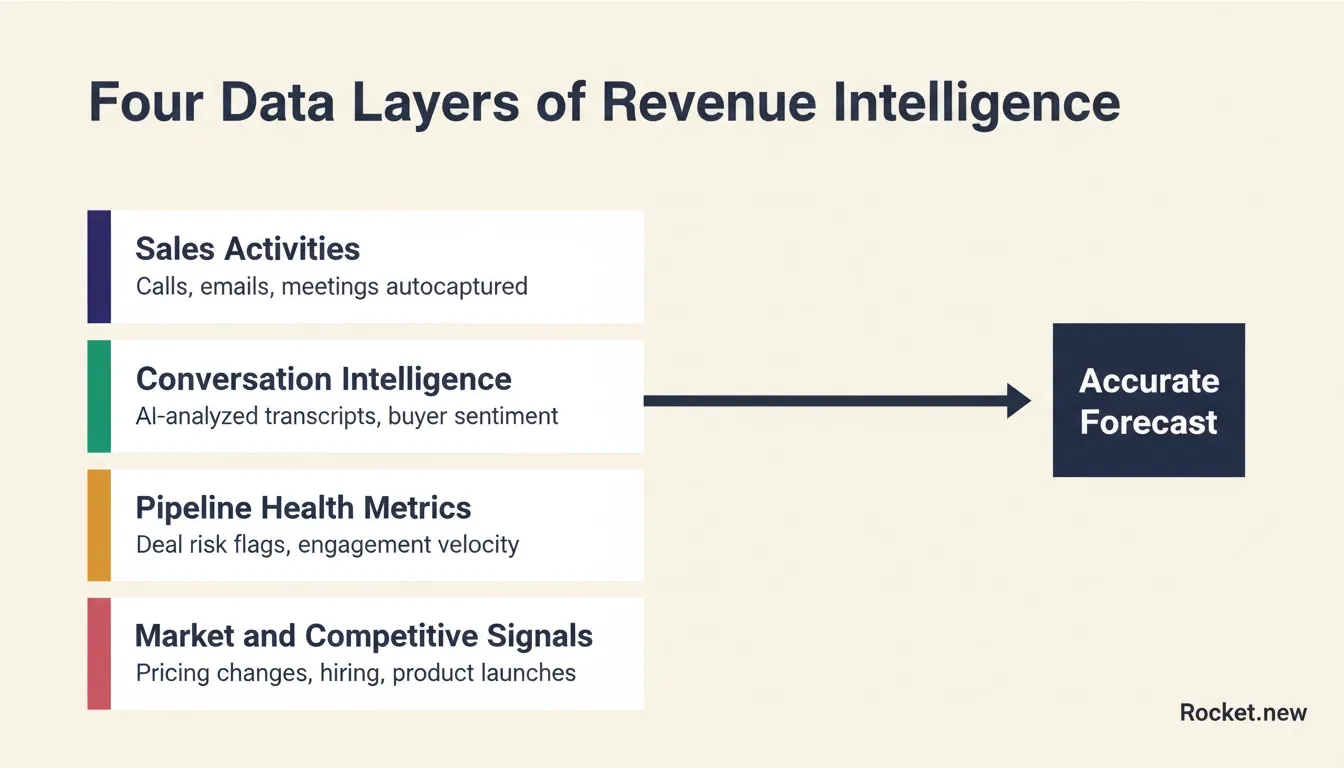 The four data layers that power accurate revenue forecasting
Revenue intelligence insights emerge when these four layers connect. Sales performance data becomes readable across the entire team, not just where reps wrote things down. Data-driven decisions across sales, marketing, forecasting, and revenue operations finally share a consistent foundation.
By leveraging revenue intelligence, organizations can improve their sales performance through enhanced collaboration across teams, as it eliminates data silos and provides a unified view of customer interactions.
What Inputs Does a Platform Like This Actually Draw On?
Four input categories feed a revenue intelligence platform, and understanding each one shows why some tools cover more ground than others. Revenue intelligence solves the problem of incomplete data by pulling signals from all four layers simultaneously, using machine learning and artificial intelligence to find the patterns that matter.
| Input Category | Key Data Captured | Signal Type | Who Uses It |
|---|---|---|---|
| Activity and Pipeline | Emails, calls, meetings, CRM stage changes | Sales engagement depth | Sales reps, sales managers |
| Conversation and Calls | Transcripts, sentiment, keyword tracking | Deal momentum, deal risk | Sales leaders, coaches |
| Market and Competitive | Pricing changes, hiring, product launches | External pipeline context | GTM teams, marketing teams |
| Customer and CS | Usage metrics, renewals, support volume | Churn risk, upsell flags | Customer success teams |
Activity and Pipeline Signals
The data from sales activities, calls, emails, meetings, and CRM updates tells a continuous story about every open deal across the sales process. Revenue intelligence software captures these activities automatically, which is where the difference from manual CRM management becomes most clear.
Pipeline health metrics update as buyer behavior shifts, showing deal risk signals as they develop. Buyer signals stay visible, and CRM data stays accurate. Pairing this with business workflow automation removes the manual handoffs that introduce errors into pipeline data.
Market and Competitive Data
This is the input layer most revenue intelligence software skips, and the one that can change a forecast result entirely. A competitor cuts the price two weeks before your close date. A target account starts hiring for a new function. A rival ships a product that overlaps with your pitch.
None of these signals live in a CRM, yet all of them directly affect deal outcomes. Marketing teams and GTM teams that feed live competitive signals into their pipeline consistently find a competitive edge that activity-based platforms simply cannot provide. Predictive analytics models produce better outputs when external context is part of the input, not just what is happening inside the CRM.
How Does This Differ from Sales Intelligence?
Sales intelligence and revenue intelligence software are related, but conflating them leads teams to buy the wrong tool for the wrong problem.
Sales intelligence focuses on the front end of the funnel. Intelligence tools in this category tell sales reps where to look: which companies match your ICP, which contacts hold budget authority, and which accounts are showing intent signals. The question answered: who should we be talking to?
Revenue intelligence software covers what happens after those conversations start. It tracks deal health, pipeline visibility across the entire book, conversation intelligence from rep-buyer calls, and forecast models built on observed activity rather than rep opinion.
More accurate forecasting requires both in sequence: sales intelligence fills the pipeline; revenue intelligence tracks what happens to those accounts once they are in motion. Sales leaders who use both intelligence tools together see the clearest forecasts. Revenue intelligence software closes the loop that sales intelligence opens.
According to ZoomInfo's 2026 platform analysis, conversation intelligence, sales engagement, and sales forecasting are converging into unified platforms. Understanding the types of competitive intelligence, strategic, tactical, and operational, helps revenue teams decide which signals to prioritize at each stage of the sales cycle.
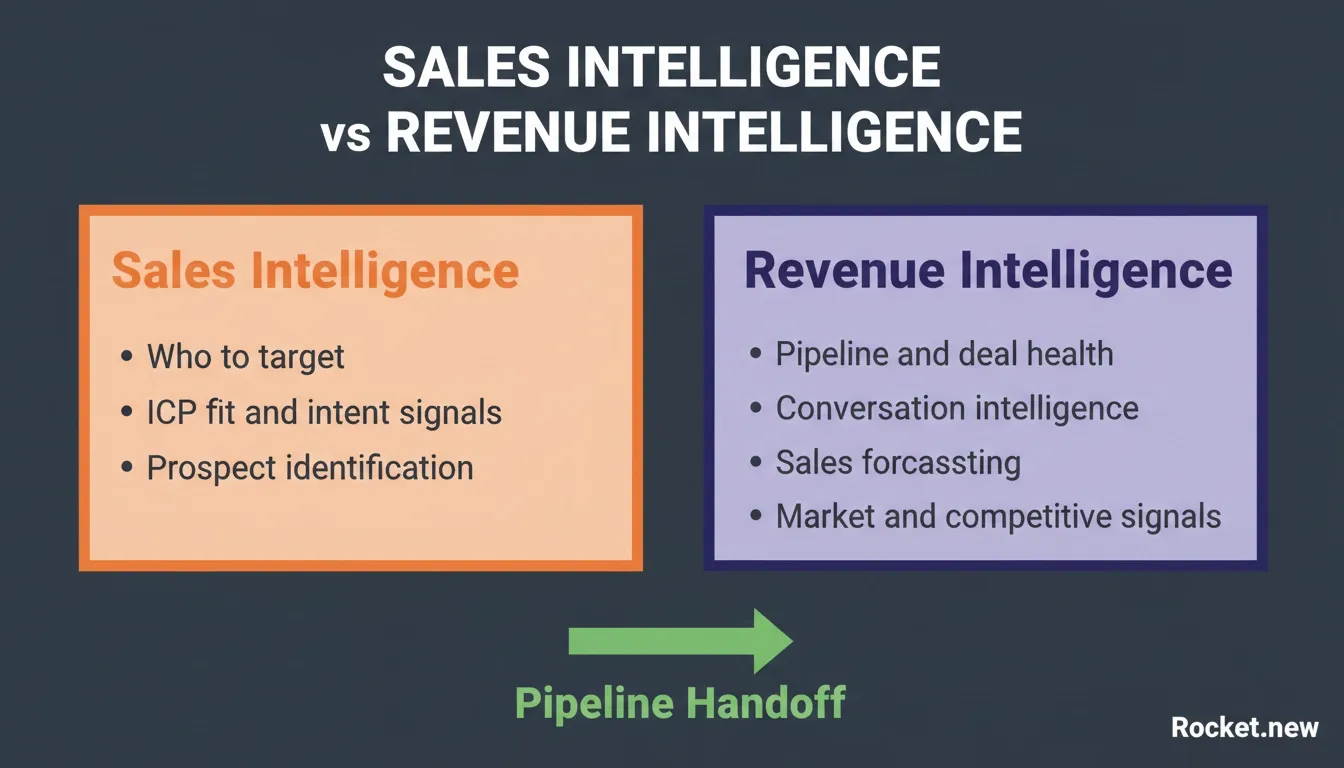 Sales intelligence vs. revenue intelligence: scope, data sources, and use cases
How Do GTM Teams Put These Tools to Work?
Revenue intelligence tools serve different roles differently; sales reps, sales managers, and revenue leaders each draw distinct value from the same data. The teams seeing the biggest returns are those using the platform across all three layers at once, not just handing it to reps to manage.
What Sales Reps and Managers See Day-to-Day
Sales reps get the context they used to hunt for manually. Before a call, they see recent buyer activity, deal insights from prior interactions, and any deal risk flags the platform has raised. Revenue intelligence tools surface real-time sales insights at the moment they are useful, not in a weekly report that half the team skims.
Sales managers use the same signals for coaching. A rep struggling at late-stage deals? Pull the call data from those accounts. Implementing revenue intelligence at this level alone tends to cut sales cycle length and lift sales performance across the entire team.
A well-built sales app that integrates with the intelligence layer eliminates the context-switching that slows reps down between calls. GTM teams that standardize on one platform find that omnichannel GTM alignment across sales, marketing, and customer success sharpens considerably.
Where Forecasting Accuracy Actually Comes From
Most forecast errors trace back to one root cause: the model is built on what sales reps say about their deals rather than on observed buyer behavior. A revenue intelligence platform changes that. It pulls observable signals, call sentiment, email response rates, engagement cadence, and competitive mentions, and combines them with CRM stage data to produce a forecast grounded in real activity.
Forecasting accuracy improves when you work from a single source of truth rather than a patchwork of rep submissions. Predictive analytics models trained on historical patterns flag at-risk deals before the buyer goes quiet.
Connecting these signals to a data visualization dashboard gives revenue leaders a live view of pipeline health that static reports cannot match. AI-powered tools also help drive revenue growth by giving marketing teams and GTM teams early visibility into where the pipeline is thinning before it becomes a quarter-end scramble.
"Data/insights often lack... Every tool is disparate, too much so. Not only is data disjointed, but rep engagement is disjointed too." - Noah Marks, VP of GTM Strategy and Operations at Udemy, via GTMnow Newsletter
How Rocket Connects Market and Competitive Signals to Your Revenue Team
Most revenue intelligence software handles the internal data work well: capturing sales activities, analyzing conversation intelligence, and modeling pipeline health signals. Rocket.new Intelligence adds the external layer that most revenue intelligence platforms miss, what is shifting in the market around the accounts you are trying to close.
It watches the companies on your list across ten signal pillars, pricing changes, hiring patterns, product announcements, news events, funding moves, social media, website changes, reviews, traffic, and GTM activity, and delivers live context to your team in real time. The result is data analytics built from both internal activity and external market signals, so your team has a complete picture rather than half of one.
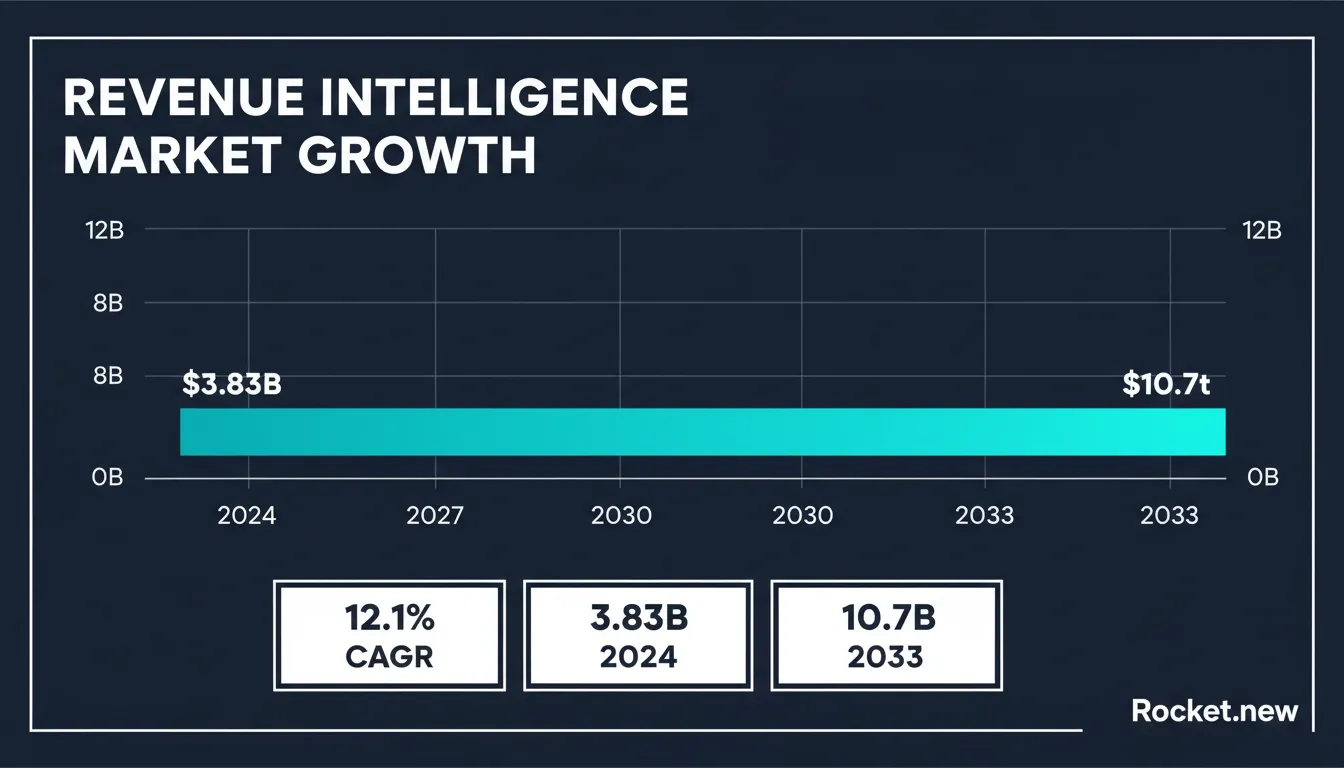 Revenue intelligence market growth: $3.83B in 2024 to $10.7B by 2033
Here is what makes the approach different from standard revenue intelligence tools:
-
Live market monitoring at the account level, Rocket tracks every entity on your list and surfaces changes as they happen, not in a weekly digest
-
Competitive edge through early context, when a rival cuts price or ships a product the week before your close date, your team sees it in time to respond
-
AI-powered signal framing, signals arrive through the lens of your role and your current deals, so they are immediately usable rather than raw data to interpret
-
A single source of truth for external and internal signals, sales, marketing, and customer success all follow the same entity list and share the same competitive picture
-
Streamlined operations across the revenue team, alerts delivered in the app, via email, or through Slack, without manual data entry required
Implementing revenue intelligence fully means getting both layers right: internal signals from calls and CRM activity, and external signals from the market. Revenue intelligence software focused on internal data alone catches deal risk after it has already developed; market signals catch it before the competitor knocks on your prospect's door.
Teams building a competitive intelligence program alongside their revenue stack see the clearest results. Combining that with the right AI integration strategies ensures the signals flow automatically into the tools your team already uses.
Build your intelligence layer at Rocket Intelligence.
The platforms that work best connect sales data, call signals, and customer behavior into a model that surfaces actionable insights, not just reports on what already happened. The gap between average and great forecasting accuracy comes down to data quality and data completeness, and both are addressable.
Revenue generation improves when teams stop making decisions from an incomplete picture. Whether you are a sales manager coaching to patterns or a CRO calling the quarter, the market and competitive layer is what turns a reasonable forecast into a reliable one. Start there, and sales, marketing, and customer success alignment follow naturally.
Rocket gives your revenue team the complete intelligence layer, internal signals, and live market context in one place.
Start building for free and see how fast your pipeline picture sharpens.
Table of contents
- -What Does a Modern Revenue Platform Actually Track?
- -Why Static CRM Data Falls Short
- -The Four Data Layers That Change the Picture
- -What Inputs Does a Platform Like This Actually Draw On?
- -Activity and Pipeline Signals
- -Market and Competitive Data
- -How Does This Differ from Sales Intelligence?
- -How Do GTM Teams Put These Tools to Work?
- -What Sales Reps and Managers See Day-to-Day
- -Where Forecasting Accuracy Actually Comes From
- -How Rocket Connects Market and Competitive Signals to Your Revenue Team