
Rocket.new’s Intelligence layer catches every public signal your competitors generate, detects the clusters those signals form, and connects what your team learns about the market directly to what it builds next, all inside one shared project with one compound memory.
Why Most AI Tools Miss What Matters Before the Build Starts
What does a fragmented strategy cost your product team?
When market research, competitive strategies, and product building live in separate systems, fragmented work creates a disadvantage for product teams instead of any real advantage. The brief you put together on Tuesday is gone by Thursday.
Teams cannot easily understand how scattered market inputs should shape the next build. Teams lose hours pulling context together across multiple platforms, and they still miss the clusters that only surface when signals from different sources connect.
What keeps teams relying on quarterly reports instead of live signals?
The old model is one big report every quarter, lots of planning, then straight back to building. By the time that report is finished, a competitor has already updated their pricing page, published more posts about a new feature, and opened roles that reveal where they plan to build next. Continuous competitive intelligence monitoring catches those patterns in real time, before the market door closes.
According to research on AI adoption in the enterprise, workers using AI tools save up to an hour a day on execution tasks, yet most teams still struggle to answer the question that matters most: what should we build next? Most AI tools make building faster. They do not tell you what is worth building.
Rocket was designed to solve the first half of the problem and connect it directly to the build.
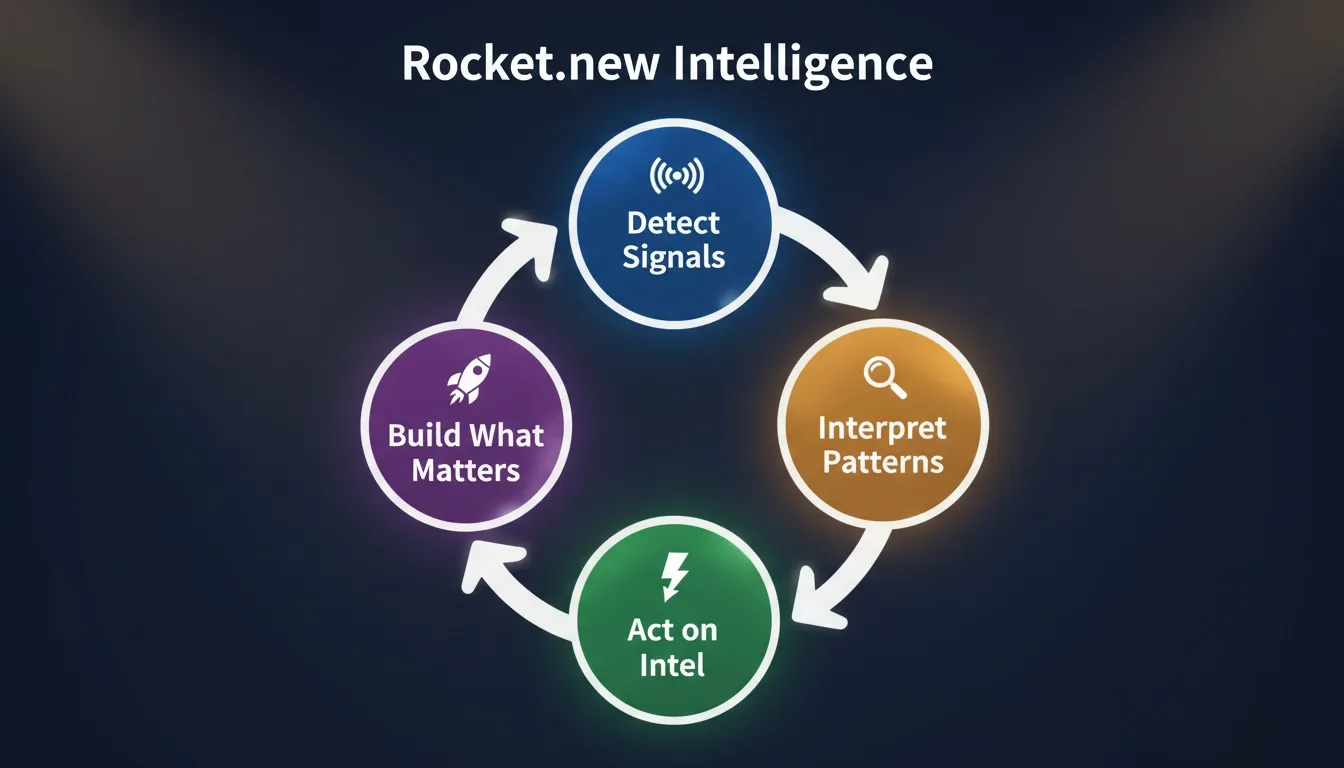 Rocket Intelligence closes the loop between what you learn about the market and what your team builds next.
What is a Signal Cluster on Rocket and Why Does It Reveal What No Single Platform Change Would Ever Show on Its Own?
A signal cluster is what happens when Rocket’s intelligence engine detects multiple small signals from different sources pointing in the same direction at the same time. A competitor updates their pricing page. A week later, more posts appear on their LinkedIn about enterprise security. Their G2 review stream starts picking up the word “compliance.” A new job post appears for an enterprise sales lead.
Individually, none of these would warrant a response. Together, they form a cluster, a pattern that surfaces early indicators of directional pivots weeks before any press release confirms it. That is what most competitive intelligence approaches miss. Rocket detects the cluster.
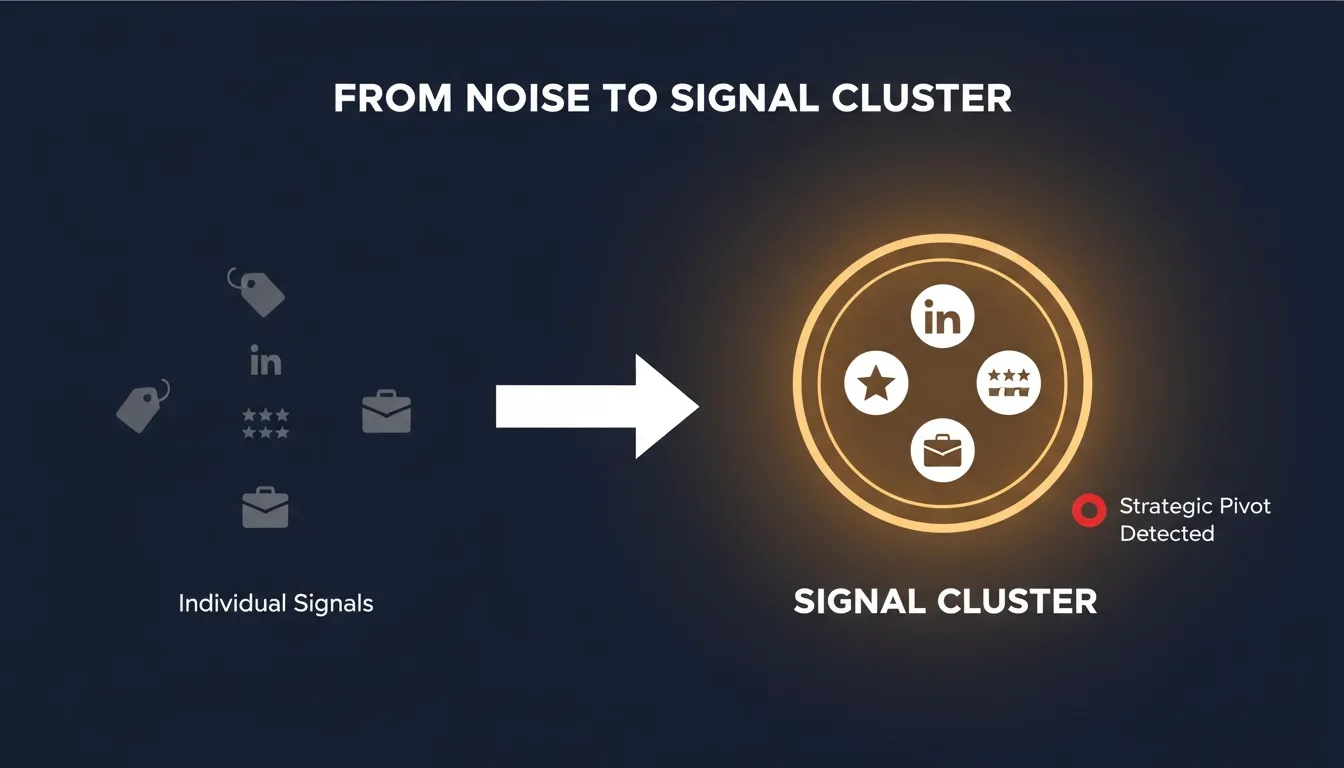 Individual signals are noise. Rocket groups them into clusters that reveal competitor strategy before it becomes public.
How does the intelligence engine detect a signal cluster?
Intelligence is an interpretation layer, not an alerting system. When a signal appears, it is evaluated against everything else happening across every surface simultaneously, other signals in the same window, the competitor’s historical patterns, and your specific business context. The system flags it as a meaningful pattern rather than noise.
What does a green signal mean, and when does activity turn red?
Each piece of Intel carries a confidence score and context. A signal consistent with prior patterns is informational, worth tracking, but not urgent. When multiple signals from different pillars converge in the same window, a pricing page update combined with enterprise hiring and a spike in review volume, Intelligence surfaces this as a significant cross-pillar finding that requires a response.
How does Rocket filter signals to avoid noise?
Signal filtering is not a manual gate. It is an automated system that weighs every signal by pillar, recency, and cross-source reinforcement. Absence is also a signal; what a competitor is conspicuously not doing factors into the interpretation alongside what they are actively publishing. Unlike separate competitive-intelligence tools, Rocket keeps a continuous flow of insights into product building and strategic decisions without manual transfer.
What Does Rocket's Competitive Intelligence Layer Actually Watch?
Rocket Intelligence monitors every public surface a competitor operates on across ten pillars. When you follow a company, you get a full canvas with an Overview tab and nine content pillar tabs, each tracking a different dimension of their public activity.
Each of the ten pillars tracks a distinct dimension of competitor activity. Together, they reveal strategy.
| Pillar | What Rocket Tracks | Cross-Pillar Role |
|---|---|---|
| Website | Pricing page changes, messaging shifts, and new feature pages | Anchor signal for strategic pivots |
| Social Media | Post volume, engagement, and executive activity across platforms | Reinforcing signal for messaging shifts |
| News and Media | Third-party press, editorial coverage, media narrative | Supporting signal for market positioning |
| GTM | Paid campaigns, creator partnerships, developer marketing | Reinforcing signal for acquisition moves |
| Traffic | Visit volumes, source mix, and SEO ranking changes | Directional signal for growth model |
| Product and Technology | Feature releases, engineering velocity, API changes | Core signal for roadmap direction |
| People and Hiring | Open roles, headcount, exec moves, hiring velocity | Directional signal for investment areas |
| Business and Finance | Funding, pricing strategy, and commercial partnerships | Anchor signal for strategic direction |
| Reviews and Community | G2, Reddit, HN, app store sentiment, and keyword clusters | Confirming signal for positioning gaps |
Website and pricing page monitoring
Every update to a competitor’s pricing page is captured: structural changes, new tiers, feature removals, and messaging shifts. Rocket records what changed and interprets what it means for your business, not just the raw difference. A pricing page update that would take hours to notice is surfaced the morning it happens.
Social media and community tracking
Rocket tracks posts across LinkedIn, X, Instagram, Facebook, YouTube, TikTok, Reddit, and more. A single comment is noise. A shift in comment sentiment across twenty posts is a signal worth catching. When a competitor’s post generates an unusual engagement spike, or comment tone shifts from positive to defensive, Rocket surfaces the pattern so users can focus on shifts that matter instead of isolated post noise.
Hiring signals and people data
Headcount, open roles by department, hiring velocity, key executive posts, and departures all feed into the People and Hiring pillar. A competitor investing in a new engineering area always shows up in hiring before it shows up in a product launch. When three enterprise sales roles and two security engineering roles appear in the same week, that combination tells a story months before any announcement.
Reviews and community analysis
G2, Glassdoor, Capterra, Trustpilot, and similar platforms feed into the Reviews and Community pillar. When a competitor’s review stream starts picking up the same terminology, “slow onboarding,” “missing integrations,” “no mobile app”, that is a positioning door you can walk through. Review patterns also reveal unmet demand that the competitor has not shipped.
GTM and ad account activity
The GTM pillar tracks paid campaigns, creator partnerships, PR motions, and developer marketing. A competitor ramping ad spend while also updating their pricing page and publishing enterprise compliance content is not doing three separate things; it is one coordinated market move. Rocket reads it as one story across three pillars simultaneously.
How Are Signals Grouped and Delivered?
What goes into your Intel feed?
Rocket delivers Intel through two personalized feeds: Following (companies you track) and For You (companies outside your universe whose signals match your interests). Each piece of Intel is ranked by significance, personalized to your role, and includes the interpretation of what the signal means for your business specifically.
The key principle: change beats state. What changed matters more than a static snapshot. Rocket surfaces what moved, not just what exists.
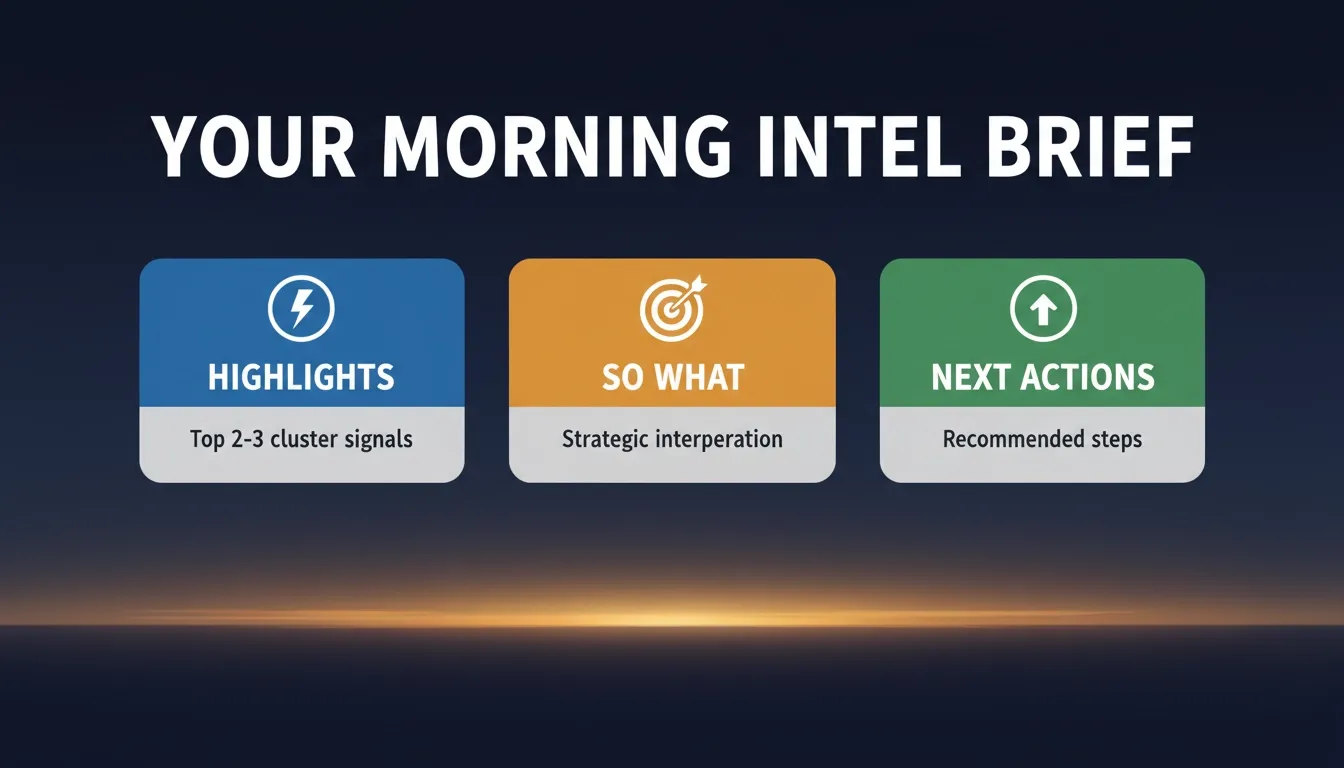 Intel arrives ranked and interpreted, highlights, strategic context, and recommended next steps in one view.
How does the memory and shared context loop work?
Every signal and every piece of Intel is held in the project’s shared context. That is the memory layer, and it keeps your market intelligence liquid. When you open a build task on Friday, the cluster from Monday’s Intel is still present. Intelligence does not reset between sessions. It compounds.
That loop, signal detected, context saved, build task grounded in market reality, is what makes building on Rocket different from building with any other AI tool. Research on AI adoption shows that over 50.6% of U.S. businesses now have paid AI subscriptions. The teams that pull ahead close the loop between what they detect and what they build.
How Does Watching the Market Turn Into Product Building?
One platform: Intelligence, Solve, and Build and why does that matter?
The reason most teams lose the signal between research and execution is that research and execution live in separate systems. One platform with Intelligence, Solve, and Build sharing one context means the signal does not get dropped at the handoff. The competitive Intel present in your Solve report is present in your build task. No re-explaining. No re-uploading. No context lost. The platform aggregates unstructured market insights into complete product briefs and data-validated hypotheses, helping you validate what should be built inside one system.
This is the foundation of vibe solutioning, where intelligence, strategy, and execution converge in a single workflow. Understanding how AI is changing product development starts with closing the gap between market signals and what gets built.
How does shared context prevent lost intelligence between tasks?
Rocket’s compound architecture means every task in a project inherits shared context through one system that carries intelligence across every prior task. The pricing page signal from Monday. The cross-pillar pattern flagged a competitor’s upmarket move on Wednesday.
The Solve report that validated your counter-positioning on Thursday. All present when the build task opens on Friday. That persistent context becomes background for the call when the team reviews the roadmap or makes decisions. Same context. Same memory. The intelligence stays liquid across every step.
For product managers using Rocket, this means competitive analysis and roadmap decisions happen in the same place where the product gets built, not across three disconnected tools.
From Market Signal to Finished Product: How Rocket Closes the Gap
Rocket.new is the world’s first vibe solutioning platform, where Intelligence, Solve, and Build share one project, one context, and one compound memory with no handoff required between the three.
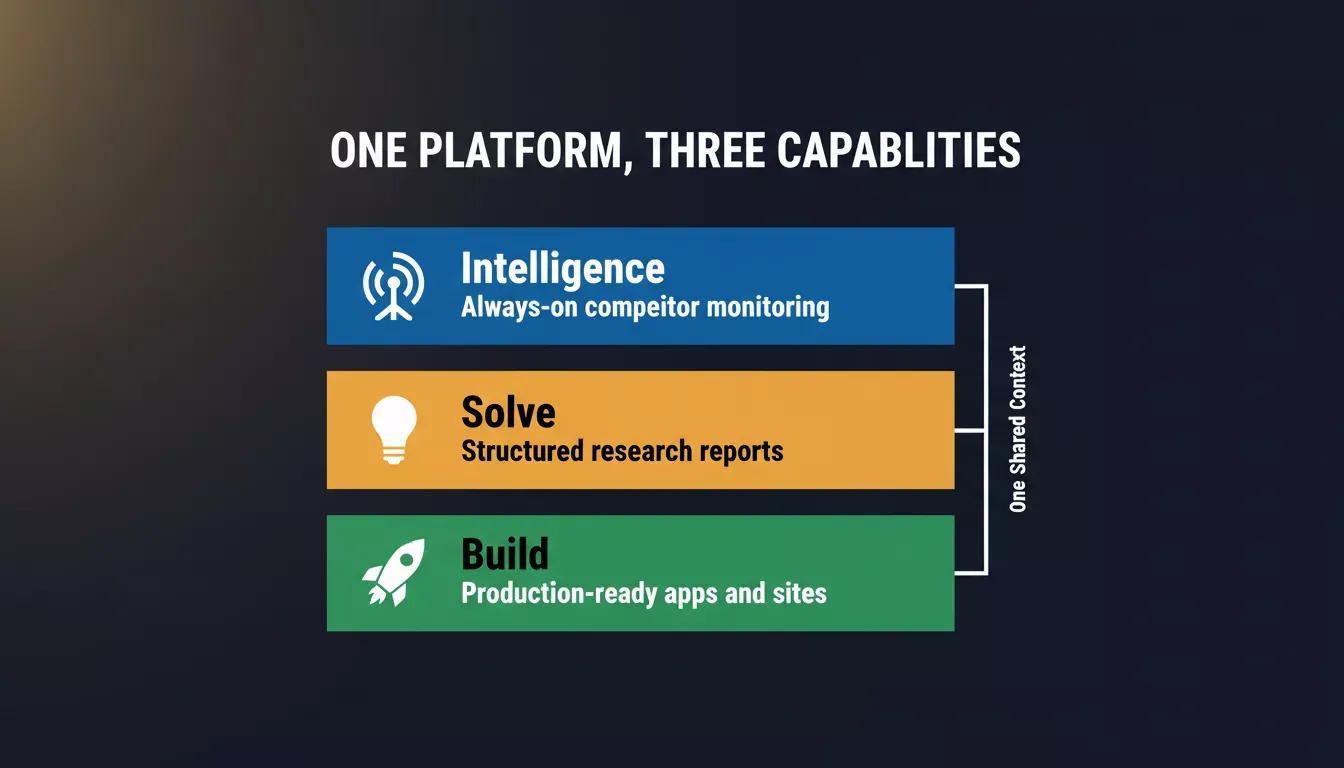
Intelligence monitors the market. Solve validates the strategy. Build the product. All three share one context.
What one platform looks like in practice
Rocket Intelligence catches every signal your competitor generates, detects the cross-pillar patterns that reveal their direction, and delivers ranked Intel with interpretation and recommended actions. Rocket Solve takes the strategic question that Intel raises and returns a complete, structured report with findings, evidence, and recommendations. Rocket Build generates a production-ready web app, mobile app, or landing page from that foundation.
You describe what you need, and the code generation starts from the accumulated market context, not from a blank prompt. Every product decision is grounded in competitive intelligence, not assumptions. This is why knowing what to build and why starts with Intelligence, not with a backlog.
What AI Features Separate Rocket from Other AI Tools in This Space?
Most AI tools give you one piece. App builders like Lovable and Bolt build what you describe but have no view of what the market is doing and no memory of prior research. ChatGPT and Perplexity surface information but cannot turn that research into a working app.
Most tools do one thing well and hand the rest back to you. No-code tools often use AI to make app creation more intuitive for non-technical users, but Rocket extends that with market-aware context. Rocket’s backend integrations connect external data sources, APIs, and databases to improve app functionality and streamline data flow for both technical and non-technical teams.
Rocket returns a complete outcome: the signal detected, the strategy validated, the product built, all from one shared project. The positioning, the feature set, the copy, you can see the competitive context in the output, along with the features shaped by what the market is signaling next. See what Solve delivers before your next product decision.
For teams thinking about competitive intelligence and roadmap planning, Rocket is the only platform where that planning and the resulting build happen in the same workspace. And for those exploring what Rocket Intelligence is as a competitive intelligence platform, the answer is: it is the layer that connects market awareness to product action.
What Does a Real Intelligence Loop Look Like in Practice?
A morning where the signals did the planning
Your team tracks three competitors. Tuesday morning’s Intel surfaces a cross-pillar pattern: two competitors shifted messaging toward enterprise compliance themes on social, one updated their pricing page, and G2 review data for both picked up “security” and “audit trail” in the last seven days. One opened a new GTM campaign targeting enterprise accounts and posted three new sales roles at the same time.
Any single signal is easy to lose in the noise. Together, they form a cross-pillar pattern, and Rocket has already detected it, interpreted it, and surfaced a recommended action: open a Solve task and re-evaluate the roadmap before the competitor’s positioning takes hold.
What does automation handle that used to take hours?
A product lead opens a Solve task: given the compliance shift we are catching in our category, what should our roadmap prioritize this quarter? Rocket runs structured research, catches relevant community and practitioner conversations, and returns a report with strategies, a recommended plan, and a clear verdict.
The context from the Intel and the Solve report is already present when the build task opens. No one has to pull it from a separate folder or re-explain the background, because the system carries a reliable background into the call or planning discussion.
Research on AI decision-making speed notes that while AI adoption is accelerating, the ability to act on AI insights quickly continues to lag behind the speed at which those insights are generated. This gives customers a more reliable path from insight to action. Rocket is the link between the insight and the action. The teams that catch cross-pillar patterns early and respond with a grounded build rather than a guess are the ones that launch before the market door closes.
What the Loop Delivers
The core idea is not just speed. The goal is to build the right thing faster, and to save your team from building something the market will miss.
Rocket connects every market signal to every product decision. The cross-pillar pattern that surfaces on Monday becomes the strategy conversation on Wednesday and the build task on Friday. The context stays liquid. Nothing gets lost between the Intel and the shipped product. That is a structural advantage of keeping intelligence and execution connected. The loop closes, and then starts again.
That is what the first vibe solutioning platform was built to do. Catch the signals. Detect the patterns. Plan the response. Close the loop. Build what the market actually needs.
Stop guessing what the market wants and start building from intelligence that compounds.
Rocket brings competitive signal detection, strategic validation, and product generation into one platform with one shared memory, so what you learn on Monday becomes what you ship on Friday, and that setup surfaces the platform’s AI features early so teams can start from live signals instead of static reports. Start building on Rocket today.
Table of contents
- -Why Most AI Tools Miss What Matters Before the Build Starts
- -What does a fragmented strategy cost your product team?
- -What keeps teams relying on quarterly reports instead of live signals?
- -What is a Signal Cluster on Rocket and Why Does It Reveal What No Single Platform Change Would Ever Show on Its Own?
- -How does the intelligence engine detect a signal cluster?
- -What does a green signal mean, and when does activity turn red?
- -How does Rocket filter signals to avoid noise?
- -What Does Rocket's Competitive Intelligence Layer Actually Watch?
- -Website and pricing page monitoring
- -Social media and community tracking
- -Hiring signals and people data
- -Reviews and community analysis
- -GTM and ad account activity
- -How Are Signals Grouped and Delivered?
- -What goes into your Intel feed?
- -How does the memory and shared context loop work?
- -How Does Watching the Market Turn Into Product Building?
- -One platform: Intelligence, Solve, and Build and why does that matter?
- -How does shared context prevent lost intelligence between tasks?
- -From Market Signal to Finished Product: How Rocket Closes the Gap
- -What one platform looks like in practice
- -What AI Features Separate Rocket from Other AI Tools in This Space?
- -What Does a Real Intelligence Loop Look Like in Practice?
- -A morning where the signals did the planning
- -What does automation handle that used to take hours?
- -What the Loop Delivers