Rocket.new reads competitor job postings, pricing shifts, and social signals in real time to forecast product launches 30 to 60 days ahead. Its Intelligence pillar turns scattered hiring data into strategic foresight, so your team acts before competitors announce.
What if you could see what competitors are building before they announce it?
Rocket.new reads hiring activity, rate adjustments, and social media signals in real time to forecast product launches 30 to 60 days ahead. The competitive intelligence tools market is projected to grow from $557.6 million in 2026 to $1.28 billion by 2033. Most companies still rely on quarterly reports. Rocket skips that entirely.
Why Job Postings Are the Earliest Competitor Signal
Competitor job postings reveal strategic intent before any press release, pricing change, or product announcement confirms it. Job listings are a leading indicator that most companies ignore because their market research sits in scattered signals across multiple platforms.
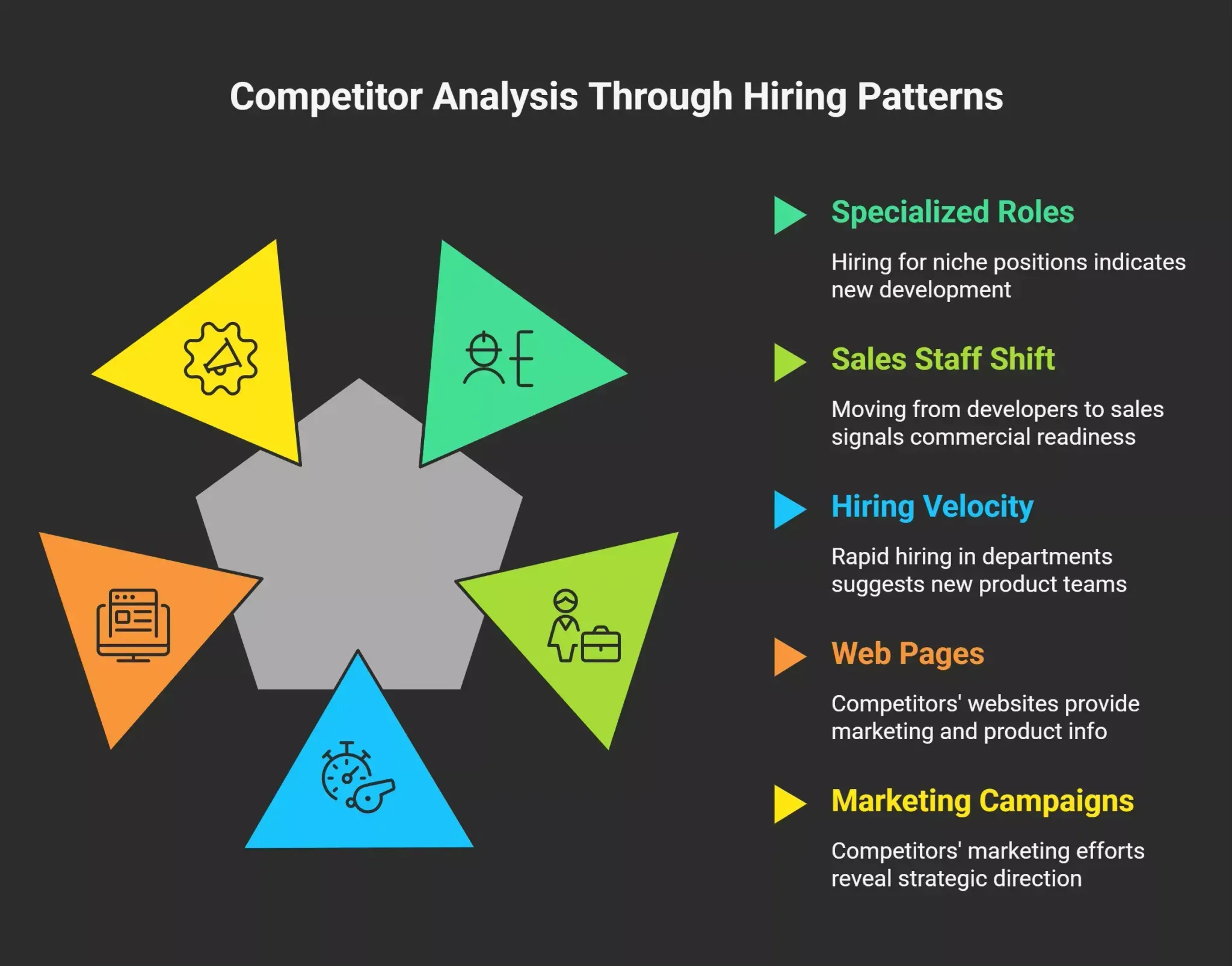
What Hiring Patterns Reveal
-
A cluster of job postings for specialized roles points to a new development cycle months before any announcement
-
When competitors shift from hiring developers to hiring sales staff, it signals readiness for commercial rollout
-
Hiring velocity in specific departments reveals whether a competitor is staffing a new product team
The competitor data sitting on public career pages is a map of strategic direction. Rocket.new reads this hiring activity as a direct indicator of what competitors plan to ship. Job descriptions, required skills, and seniority mix all carry strategic signals that most organizations miss entirely.
How Rocket.new Turns Hiring Into Competitor Analysis
-
Rocket uses a compound model linking recruitment data with competitors' web pages and marketing campaigns
-
Machine learning models track historical hiring activity to flag anomalies
-
The platform evaluates profile types to deduce which product lifecycle stage a competitor is entering
When a competitor hires multiple employees in one field, it signals vertical expansion. Monitoring hiring patterns lets your team anticipate competitor moves weeks before public announcements. Such an analysis of competitor hiring patterns, job titles, and reporting lines gives your team a clearer picture of their organizational structure and strategic initiative.
From Scattered Signals to a Clear Picture
Pricing Shifts, Social Media, and Review Sites
-
Competitor tracking goes beyond hiring. Rocket.new's Intelligence monitors pricing pages, social media for messaging shifts, and review sites for customer feedback
-
A hiring surge in a new product area, paired with pricing changes, indicates a high-intent product launch
-
Competitive signals from social media and new releases feed into one system
AI-powered competitive intelligence catches every signal that most companies miss because their market research sits in scattered signals across multiple platforms.
| Signal Type | What It Reveals | Lead Time |
|---|---|---|
| Hiring activity spikes | New product team forming | 60 to 90 days |
| Pricing changes | Market repositioning | 30 to 45 days |
| Social media content changes | Positioning experiments | 14 to 30 days |
| Product updates | New capabilities imminent | 7 to 14 days |
Why Continuous Monitoring Wins
-
60% of competitive intelligence teams now use AI tools daily, and AI adoption grew 76% year over year
-
AI-powered competitor analysis replaces static reports with real-time alerts on competitor activity
-
Automated Daily Briefs give your team a background for the call without manual market research
Knowing a competitor's product launches helps a budding entrepreneur adjust positioning before the market landscape shifts. Companies that track competitors continuously make faster strategic decisions because they see the competitive landscape weeks ahead. Hiring signals predict product direction with far more accuracy than quarterly reports and Rocket.new's Intelligence turns those hiring signals into structured daily briefs before the first meeting of the day.
What People Are Saying
"By tracking how a competitor's team is shifting, who they're hiring, where they're posting, you can build a working theory of their product roadmap before they tell the world." - Octopus Competitive Intelligence on Vocal Media
This matches what Rocket.new does at scale. Where most companies believe they need expensive standalone tools to track competitors, Rocket takes raw signals and turns them into a clear picture on one platform without switching between apps. The context from every competitor feeds one dashboard. Every platform your competitor is on is a window into their strategy. Rocket watches all of them and tells you what it means.
How Rocket.new Handles Competitive Intelligence
Rocket.new is the world's first Vibe Solutioning platform, connecting market research, code generation, and competitor tracking in one place. Most tools only let you monitor competitors. Rocket lets you research, build production-grade web apps and mobile apps, and then track competitors to stay ahead in the market landscape. Every step shares context with the next, so intelligence compounds rather than resets.
Rocket 1.0 ships with seven pillars: Solve, Build, Intelligence, Redesign, Context, Collaborate, and Support. All capabilities connect through a shared context architecture. The Intelligence signal from last week informs this week's product decision. Nothing is re-explained. Everything compounds.
-
Vibe Solutioning platform connecting decision making, building, and monitoring
-
25+ integrations including Stripe, Google Analytics, Supabase, Notion, Linear, and more
-
Supports Flutter mobile and Next.js web on multiple platforms
-
Collaboration features so every team member shares context
-
Seven pillars, one platform: Solve, Build, Intelligence, Redesign, Context, Collaborate, and Support
What Makes Rocket.new Different
Rocket's monitoring shares context with Solve and Build. When Rocket.new's Intelligence spots competitors adjusting their rates, you open a Solve task to research implications, then move into a Build task to ship a response without switching tabs. The context carries forward.
Intelligence is not an alerting system; it is an interpretation system. A pricing page update in isolation is noise. That same update alongside enterprise-focused social posts, defensive review responses, and new enterprise sales job openings is a single clear strategic signal.
Use Cases: Competitor Tracking Meets Vibe Solutioning
-
Track competitors and respond with mobile apps: Rocket flags competitor activity in your market. Use Rocket for competitive analysis, then Build to ship Flutter mobile or Next.js web responses on multiple platforms
-
React to feature launches with product updates: When competitors ship new capabilities, your team has the market research to respond. The competitive intelligence feature prioritization workflow connects signals directly to your build queue
-
Prepare for pricing changes: Real-time alerts on pricing shifts give your team a call to action before deals close. See how Rocket.new decodes competitor pricing for your sales team
-
Connect scattered signals across the market landscape: Rocket links hiring patterns, social media, and competitor signals into faster strategic decisions. The predictive competitive intelligence system runs continuously after a one-time setup
Reading the Market Before Competitors Move
Knowing competitors' market share and identifying your product's competitive advantage separates reactive companies from leaders. Continuous competitor monitoring, gathering scattered signals and delivering a clear picture, is what lets you use Rocket.new to turn competitor noise into action. Hiring freezes, geographic expansion into a new region, and shifts in competitor talent strategies all surface in Rocket's daily briefs before they show up in press releases or public announcements.
The competitive intelligence software landscape is shifting toward AI-powered interpretation. Rocket.new does not just monitor. It reads signal clusters, connects them to your business context, and delivers a recommendation before the first meeting of the day. That is the difference between a monitoring tool and a competitive strategy system.
Stop guessing what competitors are building next. Start using Rocket.new to turn competitor job postings, pricing shifts, and social signals into a strategic forecast your team can act on today.
Table of contents
- -Why Job Postings Are the Earliest Competitor Signal
- -What Hiring Patterns Reveal
- -How Rocket.new Turns Hiring Into Competitor Analysis
- -From Scattered Signals to a Clear Picture
- -Pricing Shifts, Social Media, and Review Sites
- -Why Continuous Monitoring Wins
- -What People Are Saying
- -How Rocket.new Handles Competitive Intelligence
- -What Makes Rocket.new Different
- -Use Cases: Competitor Tracking Meets Vibe Solutioning
- -Reading the Market Before Competitors Move