
Rocket.new helps founders and product teams build and launch AI-powered MVPs in a single weekend without hiring developers. From market research to app generation and deployment, the platform combines strategy, build, and intelligence so you can validate ideas with real users faster.
Why Traditional Development Keeps Good Ideas Stuck
Most product ideas don't die because they're bad. They die because building them takes too long, and traditional development was never designed for speed at the idea stage.
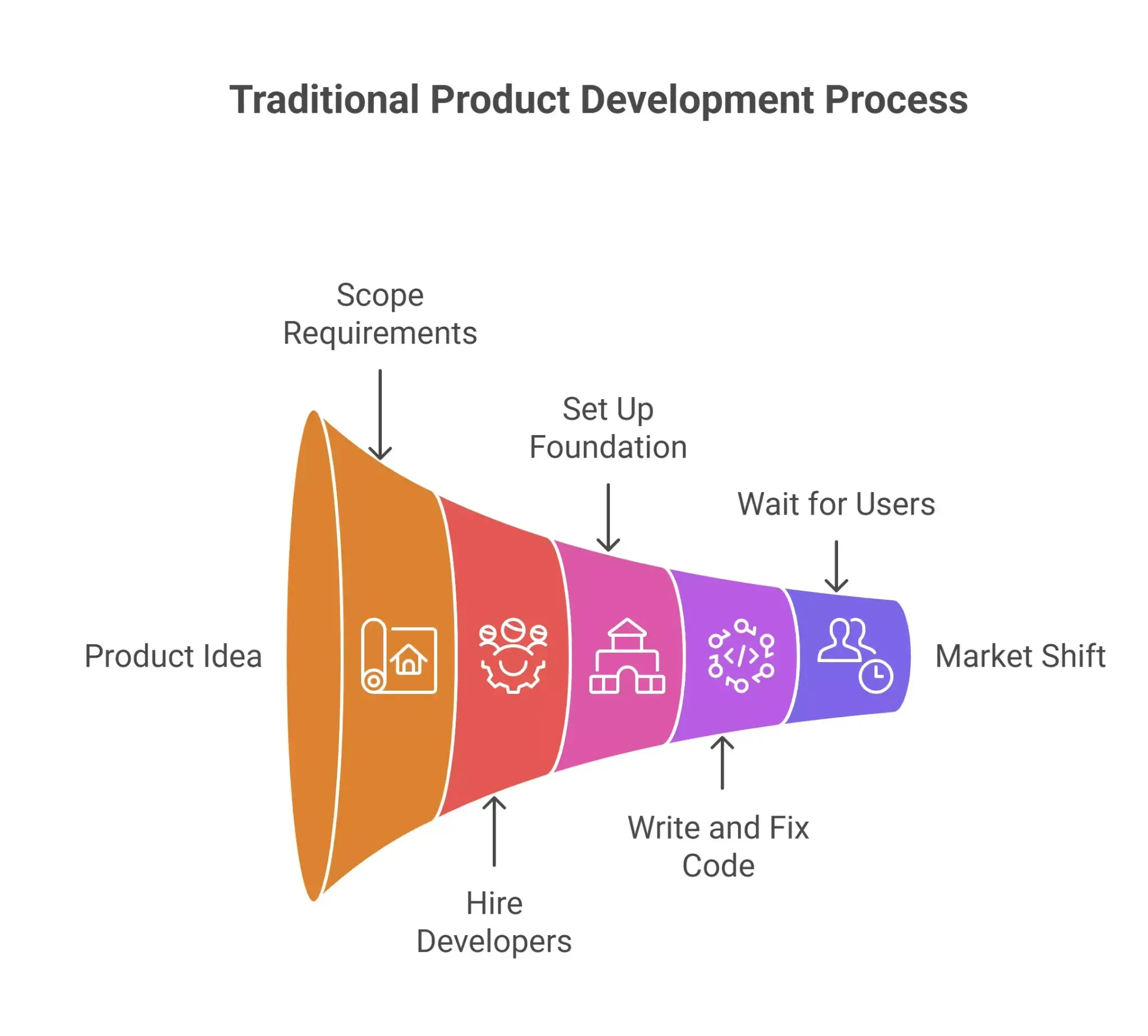 Here is what the traditional path actually looks like:
-
Scope requirements: Weeks of alignment sessions before a single line of code gets written
-
Hire developers: Sourcing and onboarding alone can take 4–8 weeks
-
Set up the foundation: Database schema, backend logic, and login systems all built from scratch
-
Write code, fix code, repeat: Developers cycle through this for months
-
Wait for real users: By the time a functional product exists, the market may have shifted
Traditional app development costs $40,000 to $400,000 or more, with timelines stretching 6–12 months. That is not building an MVP. That is spending real money to find out whether the problem was even worth solving.
The Real Cost Difference: AI Builder vs. Traditional Development
No-code platforms reduce app development time by up to 90% compared to traditional coding - Source: Adalo. For most SaaS founders and product teams, this changes the math entirely.
| Approach | Cost | Timeline |
|---|---|---|
| Traditional development | $40,000 – $400,000+ | 6–12+ months |
| Hiring freelancers | $15,000 – $80,000 | 2–6 months |
| AI MVP builder | $50 – $500 total | Days to weeks |
You don't need a full budget. You need a clear problem and a weekend.
What AI MVP Builders Can Actually Build
There is a real gap between what people assume these tools can do and what today's AI builders actually handle. A well-designed AI builder takes care of:
-
Web apps and mobile apps: Full builds from a single prompt, covering both outputs from the same interface
-
Authentication flows: Login systems, user sign-up, and onboarding screens generated automatically
-
Payment flows: Stripe connections and payment logic built in without touching any backend setup
-
Data layer: Data models, database schema, and backend logic connected to your UI by the AI
-
Full stack output: Reusable components, staging and production environments, all ready to deploy
70% of new enterprise applications built in 2025 use low-code or no-code technologies, up from less than 25% in 2020 - Source. The question is no longer whether to use AI tools to build. It is the AI builder that fits your workflow.
The Weekend MVP Playbook
Here is a practical breakdown of how to ship your AI MVP this weekend using Rocket.new. Three focused sessions are all it takes. By Sunday evening, you will have something in front of real users.
Friday Night: Define the Core Problem
Before you open Rocket.new, your one job on Friday is to get clear on the problem. Not a feature list. One sharp sentence that describes what is broken for a specific type of person.
-
Write one problem sentence: Example: "Freelancers lose track of client feedback scattered across long email threads."
-
Do a 30-minute research pass: Search Reddit, LinkedIn, and X for people describing the exact pain
-
Capture their language: The phrases real users use become your prompt language and product positioning
-
Scope two to three core user flows: Nothing more. This is your minimum viable product for the weekend
Saturday: Build Your Working App with Rocket.new
Saturday is for building. With a clear problem in hand, Rocket.new handles everything from market research to working prototype, keeping all context connected.
-
Open Rocket.new and describe the problem: Write it as a problem to solve, not a list of features
-
Run Solve first: Rocket researches the market, recommends what to build, and returns a structured brief with data models, user flows, key features, and product direction
-
Take the brief straight into Build: Rocket carries your full context forward. No re-explaining, no starting over
-
Refine with plain language prompts: Adjust any flow, screen, or feature by describing what needs to change
-
Deploy to staging by Saturday evening: Share the link with 2–3 testers tonight. Early friction is useful
Sunday: Test with Real Users and Ship
Sunday is for validation, not features. Watch what real people do with what you built. Their behavior tells you more than any survey.
-
Share with 5–10 target users: People who match the profile you defined on Friday
-
Watch without explaining: Where they hesitate or stop is exactly where the product needs work
-
Ask one question: "What was the most frustrating moment?" That single answer is your iteration priority
-
Fix two to three friction points: Not a new feature list. The specific moments where users got stuck
-
Push a production-ready build by Sunday afternoon: This is the version that goes out to real users
-
Set up a simple feedback loop: A form, a short direct message thread, or a call. Keep the signal coming
By Sunday evening, you will have real data on whether your app solves the core problem you defined Friday night. That feedback loop is what separates a validated MVP from an expensive guess.
Why Most AI App Builders Miss the Point
Most AI tools focus on one thing: generating code fast. That is useful. It is also only one piece of what an MVP actually needs to succeed.
The gaps that show up with most AI-assisted tools:
-
No research before building: You get a working app, but no data on whether the problem is worth solving
-
No competitor visibility: You don't know what others have already tried or failed at in your specific market
-
Context lives in separate tabs: Your market research, build workflow, and competitor tracking are completely disconnected
-
Only output is code: There is no loop back from the build to the strategy
The most popular AI tools, including Bolt, Lovable, and Replit, are genuinely good at one thing: taking a prompt and returning a working app. That is where their system stops. Prompt quality is everything, and there is no guidance on what makes a strong brief.
To learn more about how Rocket.new compares, read our Rocket.new vs Bolt comparison and Rocket.new vs Lovable breakdown.
Rocket.new: The World's First Vibe Solutioning Platform
Rocket.new calls itself the world's first vibe solutioning platform. Once you go through the full workflow, that label makes complete sense. Over 1.5 million people have tried Rocket across 180 countries.
Three connected capabilities make up the platform, and they all share a single context:
-
Solve: Describe any market problem, decision, or opportunity. Rocket returns research, evidence, and a clear recommendation on what to build. Ready to present to a room or take straight into Build.
-
Build: Generate production-ready code for web apps, mobile apps, SaaS products, internal tools, and dashboards. Start from a prompt, a brief, or a Figma import. One-click deploy to staging and production.
-
Intelligence: A personalized, always-on engine that monitors companies across nine signal pillars and delivers insights shaped by who you are and why you are watching. Not raw data. Interpreted intelligence that compounds over time. Day 1, you see what happened. Day 90, you start seeing what is coming.
The critical difference is that when you finish Solve, you don't start over in Build. Rocket carries your decisions, market research, and positioning forward so you are always building the right thing, not just building fast.
Core Features at a Glance
| Feature | What It Does |
|---|---|
| Market Research (Solve) | Analyzes your market, recommends what to build, identifies gaps competitors miss |
| AI App Builder (Build) | Generates web apps, mobile apps, SaaS products, and dashboards from a single prompt |
| Market Intelligence | Monitors companies across nine signal pillars and delivers interpreted insights shaped by your role |
| 25,000+ Templates | Starting points for every use case, adapted to your brand, stack, and goals |
| One-Click Deploy | Staging and production environments, ready to share with real users immediately |
| Figma Import | Start from your design, carry full context into the build |
| SOC 2 + ISO 27001 | Enterprise-grade security on by default, not bolted on later |
No other AI builder in the market connects all three phases, research, build, and intelligence, in one place with shared context that compounds over time.
For non-technical founders and SaaS builders, Rocket.new is the clearest path from "I have a problem worth solving" to "I have real user feedback" without waiting months or spending a budget before validation. Explore more in our guide on building a startup with vibe coding.
Weekend MVP: Days, Not Months
AI MVP builders have compressed the timeline from months into a single weekend. The best tools now do more than write code. They help you figure out what to build, generate a working app fast, and stay ahead of every company that matters to you while you iterate. That full cycle, thinking, building, tracking, is what Rocket.new delivers in one place.
Whether you are a SaaS founder, a non-technical builder without a coding background, or part of a product team trying to validate ideas quickly, 48 hours is enough time to go from a problem statement to a functional product in front of real users.
Start building on Rocket.new today and ship your AI MVP this weekend.
Table of contents
- -Why Traditional Development Keeps Good Ideas Stuck
- -The Real Cost Difference: AI Builder vs. Traditional Development
- -What AI MVP Builders Can Actually Build
- -The Weekend MVP Playbook
- -Friday Night: Define the Core Problem
- -Saturday: Build Your Working App with Rocket.new
- -Sunday: Test with Real Users and Ship
- -Why Most AI App Builders Miss the Point
- -Rocket.new: The World's First Vibe Solutioning Platform
- -Core Features at a Glance
- -Weekend MVP: Days, Not Months