
Rocket.new Solve turns any business question into a clear, structured answer in 60 to 90 minutes. It searches 150+ sources at the same time and marks every finding by how reliable it is. The research connects directly to what you build next, all in one place.
Can one session really replace three weeks of strategy work?
Yes, it can. That is exactly what happens when teams use a structured, AI-powered session built for clarity and fast execution. Instead of long meetings, scattered notes, and delayed decisions, everything comes together in one focused space. You move from confusion to direction without wasting time switching between tools.
According to McKinsey's State of AI 2025 survey of 1,993 participants across 105 countries, 88% of organisations now use AI in at least one business function. Yet most are still in the early stages. Most have not yet used AI deeply enough to see real business results.
This blog shows how to close that gap with a structured approach.
What is Rocket.new Solve?
Rocket.new Solve is a decision intelligence engine. You describe any business situation in plain language. Rocket maps out the problem, searches 150+ sources at the same time, and gives you a complete, structured answer within 60 to 90 minutes.
This is not a chatbot. It is not a search engine. The difference between an AI that answers and a platform that solves is not just a feature. It is a completely different approach. Rocket maps out the problem before research starts. It looks at every angle: market trends, competition, risks, opportunities, and financial impact.
The output covers 8 to 12 sections depending on your question. Every finding is marked by how strong the evidence is: HIGH, MEDIUM, or LOW. Conflicting information is flagged clearly rather than hidden. The output does not disappear after you export it. It becomes the starting point for everything your team does next.
Why Traditional Strategy Takes So Long?
Most strategy work today runs across four to six different tools. The person doing the work has to hold everything together. They carry notes between tools, re-explain the situation at every step, and turn the output of one tool into the input for the next.
The result is predictable: weeks of work for a decision that should take hours. Not because the research is hard. Because the back-and-forth between tools wastes so much time. The most expensive mistake in any business is not a bad execution. It is a good execution of the wrong thing.
Five problems cause this:
- Research takes too long because you have to pull information from dozens of places manually.
- Context gets lost when work is handed over. The brief that gets passed along is always a shorter version of the original thinking.
- Decisions get made before the thinking is done, because deadlines force it.
- Tools do not connect. The analysis, the PRD, and the competitive brief all live in separate documents.
- General AI tools answer questions but do not give you a structured, ready-to-use output.
How Rocket.new Solve Works
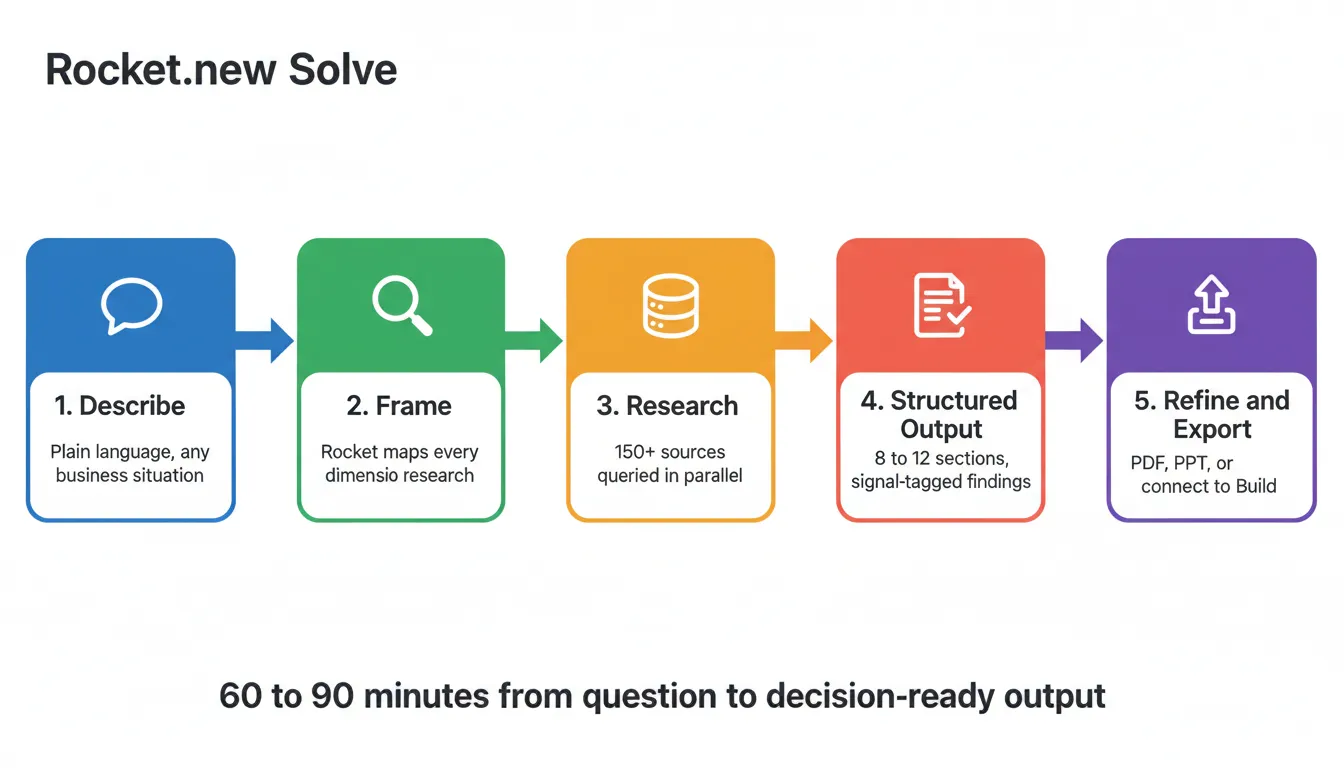
Solve follows five steps. It turns what normally takes weeks into one focused session.
Step 1: Describe Your Situation
You describe the situation the way you would explain it to a colleague. Rocket checks how clear your prompt is before starting. If it is clear enough, work starts right away. If not, Rocket asks a few focused questions to get the details it needs, then starts.
Step 2: Map the Problem Before Research Starts
Before any research runs, Rocket maps out every part of the problem. This is what makes Solve different from other AI research tools. Solve finds things you did not think to ask about but needed to know. If the research turns up a risk, a deadline, or a competitor move that was not in your prompt, it shows up in the output with a clear explanation of why it matters.
Step 3: Search 150+ Sources at the Same Time
Solve runs thousands of searches at the same time across more than 150 sources. This includes market size data, competitor activity, pricing benchmarks, regulations, customer feedback, hiring signals, financial data, and news. Searching in parallel is why the output is ready in 60 to 90 minutes instead of days.
Step 4: A Structured Output You Can Act On
The output is not a summary. It is a structured report built for making decisions. It starts with a clear recommendation at the top. It then covers goals and what users need, key findings marked HIGH, MEDIUM, or LOW, a competitive overview, a risk section, and a clear action plan with owners, timelines, and checkpoints. You can also upload your own files such as financial models, reports, board decks, and customer research. Rocket reads them properly, including all formulas and data connections.
Step 5: Refine, Export, and Connect to Build
After the first output, you can keep the conversation going. Ask for more detail on one section, push back on a finding, or change the direction entirely. Export as a PDF or a presentation deck. The Solve output becomes the starting point for everything that follows in your project. The PRD is there when the developer opens the Build task. The competitive brief is there when the landing page gets written.
What Rocket.new Solve Can Produce
| Use Case | What Solve Delivers |
|---|---|
| Market entry strategy | Market overview, sizing, competitor map, regulations, go-to-market plan |
| Competitive assessment | Full breakdown, gaps, threat list, response plan |
| Pricing strategy | Benchmark data, model comparison, price signals, recommendation |
| Product direction and PRD | Priority framework, feature scope, evidence, tradeoffs |
| Investment analysis | Investment case, financial signals, risk list, recommendation |
| Board and investor materials | Evidence-backed narrative, market context, competitive positioning |
| M&A assessment | Target profile, synergy analysis, risk factors, integration notes |
| Regulatory research | Region-specific rules, compliance gaps, timeline |
| Sales deal brief | Competitive positioning for a specific account, objection responses |
Solve is not just for market research. It covers strategic decisions, product planning, competitive prep, and board-level materials. For teams who want to validate a business idea before writing code, Solve is the right starting point.
Real-World Use Cases
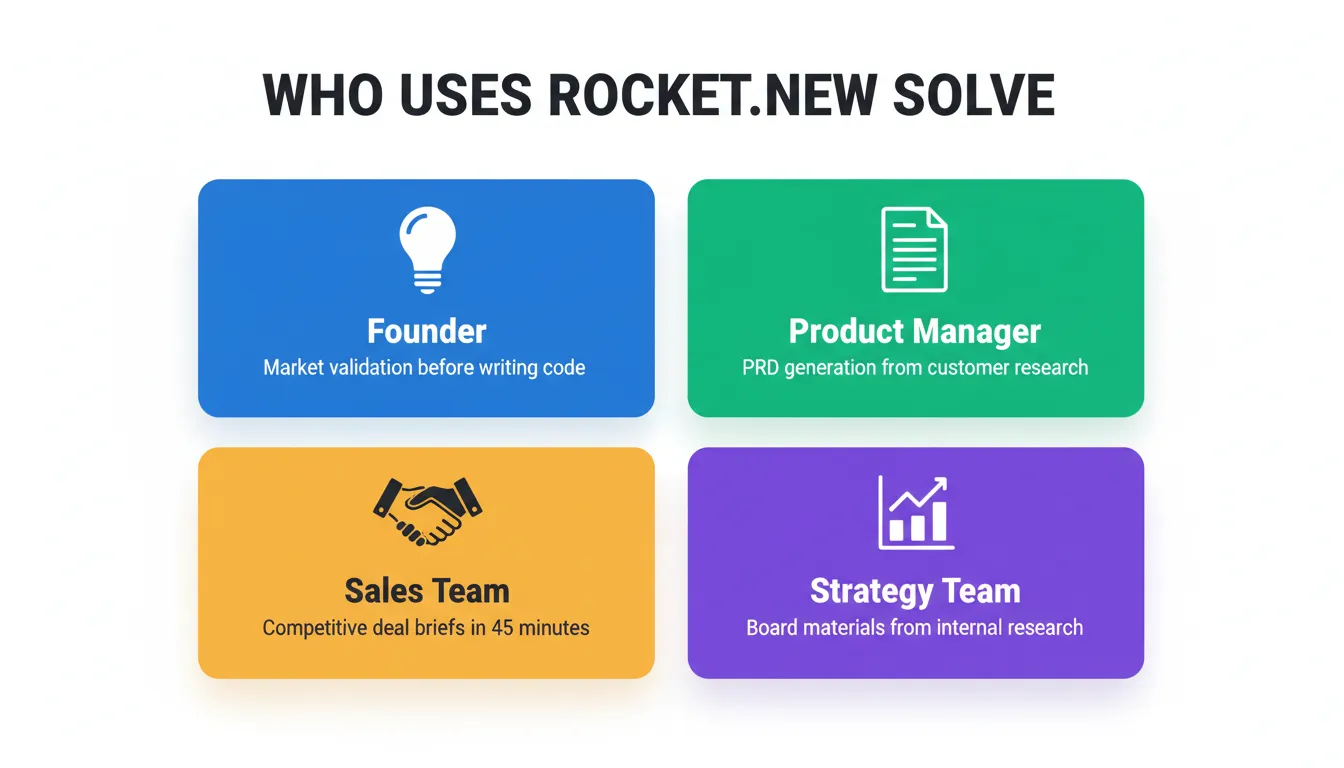
Founder Checking If a Market Is Worth Entering
A solo founder wants to build an AI scheduling tool for healthcare providers. Before writing a single line of code, they run a Solve session. Within 90 minutes, they have a clear report covering compliance rules, gaps in the competition, and pricing benchmarks. It also includes a specific recommendation on where to start. That output becomes the project context. When they open a Build task, every decision is already grounded in the research.
Teams that research on Rocket before building consistently ship products that better match what the market needs. The research-to-deployed-app workflow shows exactly how this flow works in practice.
Product Manager Writing a PRD
A PM at a 50-person SaaS company needs a PRD for a new reporting feature. They upload customer feedback files into Solve and describe the competitive context. Solve reads the files properly and maps the customer problems. It returns a structured PRD with prioritised features, clear criteria, and a risk section. The PM refines two sections through conversation and exports as a PDF in under two hours.
Sales Team Getting Ready for a Big Deal
An enterprise sales team has a final meeting with a prospect who is also looking at two competitors. They run a Solve session with the prospect's company name, industry, and key priorities. Solve returns a clear brief covering likely objections, the best positioning angles, and risk factors. The team walks in with a brief that took 45 minutes to produce instead of two days.
For sales teams who need to stay ahead of competitor moves, pairing Solve with Rocket's competitive intelligence tools creates a real ongoing advantage.
Strategy Team Building Board Materials
A 120-person company needs to present a market expansion plan to the board. The strategy team uploads their internal research into Solve. They ask it to turn that research into a board-ready document with external data, competitive context, and a phased plan. Solve reads the files, checks them against external signals, and returns a clear board document. Total time: four hours instead of three weeks.
Rocket.new Solve vs Other AI Research Tools
A common question: how is Rocket.new Solve different from ChatGPT, Perplexity, or Claude for business research? The answer is not about features. It is about how the whole thing works.
| Capability | General AI Chatbot | Rocket.new Solve |
|---|---|---|
| Problem framing before research | No | Yes |
| Queries 150+ sources in parallel | No | Yes |
| Signal strength tagging | No | Yes (HIGH / MEDIUM / LOW) |
| Conflicting signals called out | No | Yes |
| Structured 8 to 12 section output | No | Yes |
| Upload and read internal files | Limited | Yes, reads files properly |
| Export as PDF or PPT | No | Yes |
| Output connects to build context | No | Yes |
General AI tools answer questions. Solve solves them. The research, the output, and the next steps are all in one place. Nothing gets handed back. Nothing gets lost.
McKinsey's 2025 survey found that AI high performers are nearly three times more likely than others to redesign how their teams work. And redesigning workflows is one of the biggest factors in getting real business value from AI. Solve is built to be that redesign for strategic decision-making.
How Context Builds Over Time
The thing that sets Rocket.new Solve apart from other AI research tools is what happens after the output is ready.
In most AI tools, every session starts from scratch. You explain your company, your market, and your situation again every time. In Rocket, every Solve output is saved to your project. The market research from month one is still there when the PM writes the PRD in month two. The competitive brief from last quarter is still there when the sales team preps for this quarter's deals.
This is how context builds over time in Rocket. The more you use it, the smarter it gets. Your team stops repeating themselves and starts building on what they already know.
Founders and operators who want to see how this works across the full platform can read more about how Rocket's shared memory works across research and build tasks.
What Every Solve Output Includes
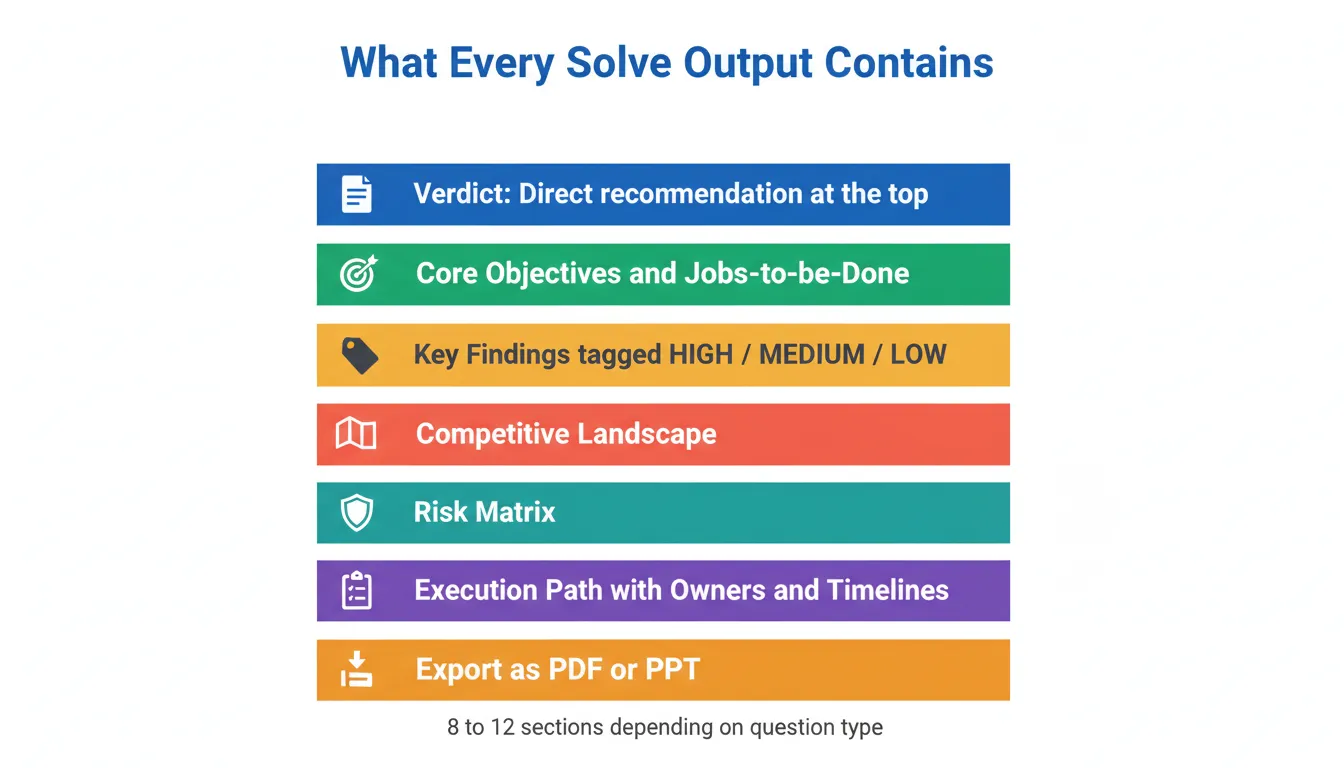
Problem mapping. Before research starts, Rocket maps out every part of the problem. This is what turns a generic AI answer into a structured, useful report.
Parallel search across 150+ sources. Thousands of searches run at the same time. This is why the output is ready in 60 to 90 minutes, not days.
Signal strength labels. Every finding is marked HIGH, MEDIUM, or LOW. Conflicting information is flagged clearly. You always know how strong the evidence is.
File reading. Upload your own files: financial models, reports, board decks, customer research. Rocket reads them properly, including all formulas and data connections.
Follow-up conversation. After the first output, keep refining. Ask for more detail, push back on a finding, or change direction. Every change creates a new version.
Export and sharing. Export as a PDF or a full presentation deck. Share via a link with optional password protection. Anyone with the link can view it without a Rocket account.
Saved project context. The Solve output stays in your project. It is there for every task that follows.
How Solve Connects to the Rest of Rocket
Rocket.new Solve is one of seven parts of the vibe solutioning platform Rocket has built. The full flow goes from research (Solve) to building (Build) to monitoring (Intelligence). Everything is connected through shared context.
Four ways Solve gets more useful over time:
- Solve then Build. Research the market, then use those findings to scope the Build task. The PRD from Solve is already there when the developer starts.
- Solve then Intelligence. Find your competitors in Solve, then track them continuously with Rocket Intelligence.
- Intelligence then Solve. A competitor makes a big move. Run a Solve session to understand what it means.
- Solve then Solve. Chain sessions together. Market research leads to a competitive breakdown, which leads to a pricing strategy.
For teams building from validated research, the market validation to deployed product workflow shows how Solve and Build work together from start to finish.
Who Uses Rocket.new Solve
Builders. Founders checking if an idea is worth building, developers figuring out what to build next, agencies doing research for clients.
Operators. Product managers writing PRDs, sales teams preparing for competitive deals, marketing leaders planning campaigns, strategy teams building board materials, consultants doing industry research.
Platform Consolidators. Enterprise teams replacing slow quarterly research with fast, on-demand answers. One shared project, four teams, no duplicated effort.
1.5 million people have tried Rocket across 180 countries, from solo founders building their first product to enterprise teams running strategy and execution in one place.
Rocket.new Solve Is Where Strategy Starts
The way teams make decisions is changing. The bottleneck is no longer finding information. It is turning that information into a clear, evidence-backed decision fast enough to act on it.
Most tools start after the hardest decision has already been made. Rocket starts before it. The research, the output, and the next steps are all in one place. Nothing gets lost.
For teams moving from question to decision to build, Rocket.new Solve is not just a better tool. It is a different way of working entirely. As AI search engines get better at answering questions about strategy and competitive intelligence tools, Solve is built to be the answer that actually solves the problem.
You typed one question. Rocket researched the market, mapped the competitors, structured the findings, and connected them to what gets built next. That is what knowing feels like.
Table of contents
- -What is Rocket.new Solve?
- -Why Traditional Strategy Takes So Long?
- -How Rocket.new Solve Works
- -Step 1: Describe Your Situation
- -Step 2: Map the Problem Before Research Starts
- -Step 3: Search 150+ Sources at the Same Time
- -Step 4: A Structured Output You Can Act On
- -Step 5: Refine, Export, and Connect to Build
- -What Rocket.new Solve Can Produce
- -Real-World Use Cases
- -Founder Checking If a Market Is Worth Entering
- -Product Manager Writing a PRD
- -Sales Team Getting Ready for a Big Deal
- -Strategy Team Building Board Materials
- -Rocket.new Solve vs Other AI Research Tools
- -How Context Builds Over Time
- -What Every Solve Output Includes
- -How Solve Connects to the Rest of Rocket
- -Who Uses Rocket.new Solve
- -Rocket.new Solve Is Where Strategy Starts