
Agentic UX design in a no-code app builder means AI agents handle research, planning, and code generation for users. Rocket.new delivers this through Solve, Build, and Intelligence, three connected pillars in one vibe solutioning platform.
Most app builders still wait for instructions: you click, you configure, you wait for output. Rocket.new flips that relationship: describe a goal, and the platform's agents research the market, generate the app, and keep watch on competitors while you review and steer rather than operate every step yourself.
This shift from operator to delegator is what the rest of this guide unpacks, starting with what "agentic" actually changes in how an interface behaves.
What Does Agentic Mean for App Interfaces?
An agentic app builder treats AI agents as first-class members of the user experience, not a chatbot in the corner. The shift moves from command-based interaction to intent-based delegation.
-
Traditional UI: User navigates menus, fills forms, triggers each action manually. The app logic sits dormant until activated by user inputs.
-
Conversational UI: User asks AI a question in natural language. AI responds with text. Still reactive, still waiting.
-
Agentic/Delegative UI: User states a goal. AI agents plan the approach, execute multi-step workflows, connect external APIs, generate code, handle data updates, and surface results for review.
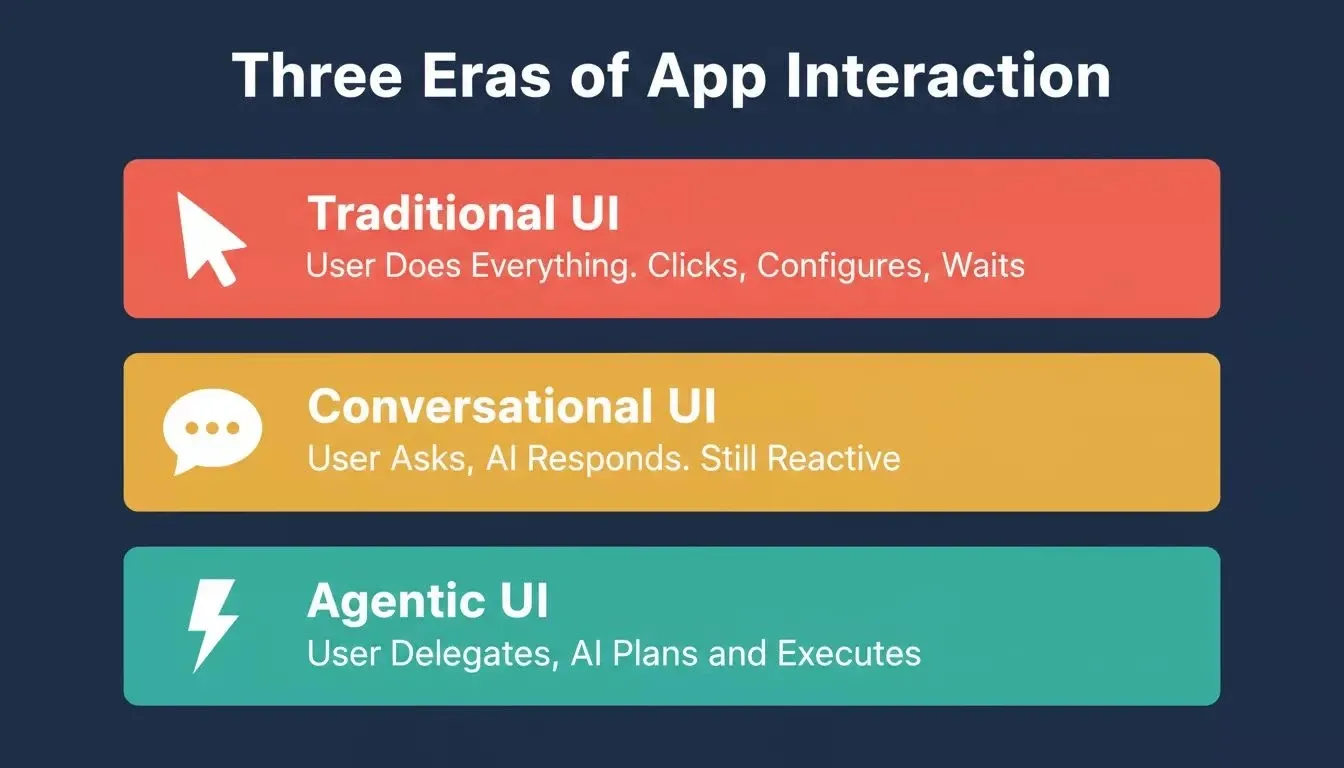
Three eras of app interaction: the shift from operating to questioning to delegating changes every design decision in how you build.
| Dimension | Traditional UI | Conversational UI | Agentic UI |
|---|---|---|---|
| User role | Operator | Questioner | Delegator |
| AI role | None | Responder | Autonomous executor |
| App logic | Static rules | Prompt-response | Dynamic workflows |
| Code generation | Manual | Snippets only | Production-ready code |
| Workflow automation | User-configured | Suggested | Agent-orchestrated |
| Error handling | User fixes | AI suggests a fix | Agent retries with reasoning |
Most no-code tools still operate in columns one or two. A vibe solutioning platform operates in column three, where AI agents handle complex logic, automate workflows, and produce working code without the user writing a single line.
Understanding the distinction between agentic AI vs AI agents is foundational before choosing a platform, since the two concepts drive very different design decisions in your app's autonomy model.
Why Are Enterprise Apps Embedding AI Agents at Record Speed?
Gartner projects that 40% of enterprise applications will embed task-specific AI agents by the end of 2026, up from under 5% in 2024. That number signals a shift in how we think about app development and what users should expect from the tools they use daily.
“Agentic AI adoption has moved from experiment to standard practice. The share of agentic AI projects doubled from 21% to 51% in 2025 alone.”
Most founders still build apps where the user does all the clicking, searching, and decision-making. The app just sits there, waiting for instructions. But the paradigm has flipped.
Today, the best AI agents inside an agentic app builder take action before you ask. They plan workflows, write code, connect external APIs, and deploy cloud infrastructure without requiring the user to manage every step. This is the core of what product managers now call delegative UI, and it changes how every app builder, no-code platform, and low-code tool approaches the development process.
Why Are Most No-Code Apps Still Stuck in the Old Paradigm?
Traditional no-code tools were designed for a world where users drag and drop interface elements, configure conditional logic manually, and wire up each integration by hand. The drag-and-drop interface feels fast at first, but the complexity ceiling arrives quickly.
-
App logic limits: Most platforms cap at simple conditional logic. Business logic that requires multi-step reasoning, branching decisions, or coordination across third-party services breaks down.
-
No autonomy: The user must initiate every action. No-code tools do not plan, do not research, and do not act between sessions. Every workflow automation requires manual setup time.
-
Learning curve compounds: As apps grow in complexity, the learning curve for traditional no-code tools steepens. Non-technical users hit walls. Technical founders find themselves writing code anyway.
The result? Builders spend weeks on tasks that an agentic app builder with AI agents could complete in hours. App development stalls, and the gap between what users expect and what the app delivers keeps growing.
How Agentic Platforms Compare to Traditional No-Code and Vibe Coding Tools
| Capability | Traditional No-Code | Vibe Coding Tools | Vibe Solutioning Platform |
|---|---|---|---|
| Pre-build market research | None | None | Built-in (Solve) |
| Code quality | Visual/limited | Production-grade | Production-grade |
| Competitor monitoring | None | None | Continuous (Intelligence) |
| Shared context across tasks | None | Per-session only | Persistent across all tasks |
| Autonomy model | User-driven | Prompt-driven | Intent-driven with override |
| Export and self-host | Yes (limited) | Yes | Yes (full source code) |
| Security and compliance defaults | Varies | Varies | WCAG, GDPR, SEO by default |
What Are the Core Design Principles of Agent-First Apps?
Building an agentic app requires rethinking three foundational design principles. These principles determine whether users trust the AI agents working on their behalf or abandon the platform entirely.
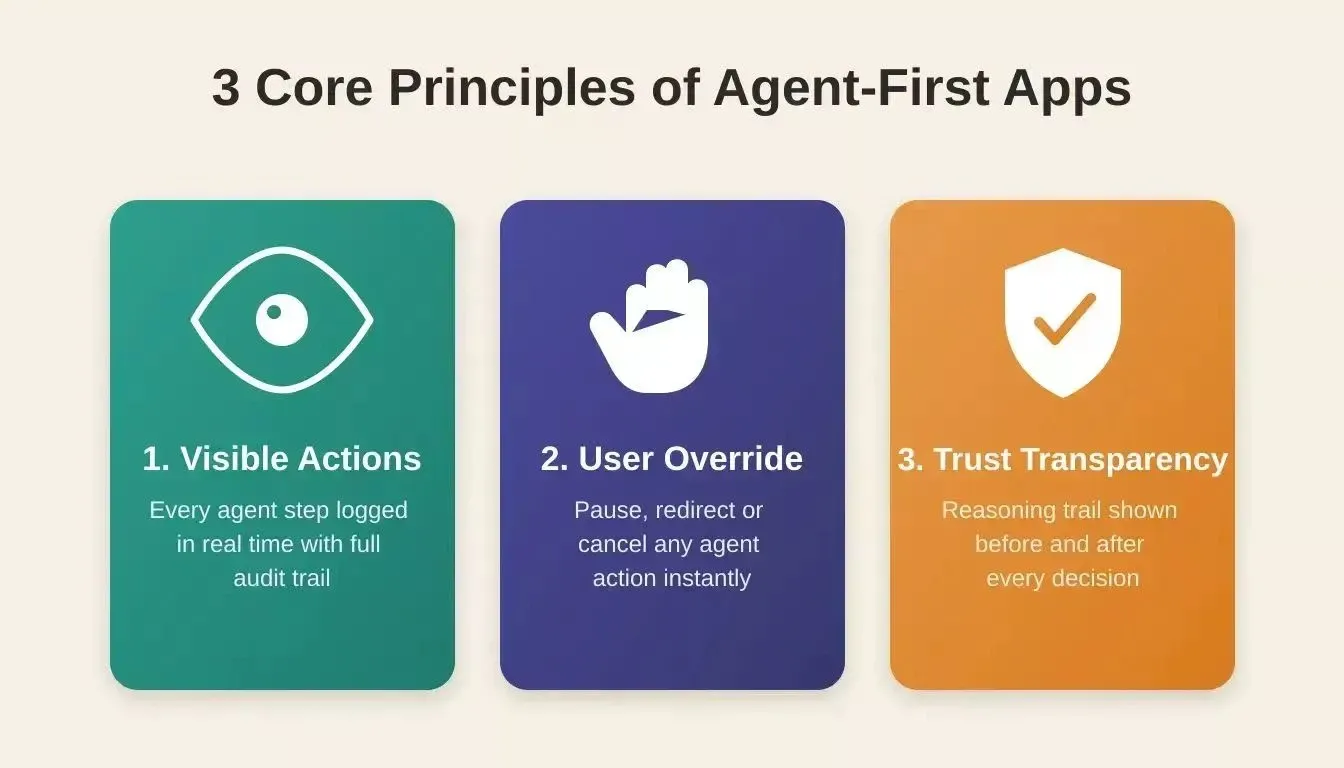
Three non-negotiable principles for agentic UX design: visibility, control, and transparency. Miss any one, and users will not trust the system enough to delegate.
1. Visible Agent Actions
Every step an AI agent takes must appear in a visible log or timeline. The user sees what was researched, what code was generated, what APIs were called, and what decisions were made. Audit logs show the full chain of reasoning, not just the final output. This visibility builds confidence with non-technical users and technical founders alike.
2. User Override at Every Step
Users can pause, redirect, or cancel any autonomous action at any moment. Override controls sit at the same level as the agent's actions, not buried in settings. Advanced logic decisions get flagged for approval before execution when stakes are high. The user maintains complete control without needing to manage every micro-decision.
3. Trust-Building Transparency
AI agents explain their reasoning trail before and after each decision. The system shows confidence levels, data sources, and alternative paths considered. Version control tracks every change so users can roll back any agent action. Integrated testing validates generated code before it reaches production.
These three principles separate a good no-code builder from an agentic app builder that teams actually rely on for production-ready apps. Explore how vibe coding for product managers applies these same principles to everyday product workflows.
How Does the Autonomy Dial Pattern Work?
The autonomy dial is a design pattern where agent builders calibrate trust per task type. Low-risk actions like generating UI components or running data queries execute automatically. High-risk actions like deploying to production, modifying sensitive data, or connecting paid third-party services require explicit user approval.
This pattern allows multi-agent orchestration to function across complex workflows without overwhelming the user with approvals on every step. The AI agents build confidence gradually, earning more autonomy as the user validates their decisions over time.
Agentic UX flow: goal to plan to autonomy gate. Low-risk actions auto-execute with a log, high-stakes actions surface for approval, and every action feeds the user's review trail.
Who Should Be Building Agentic Apps Right Now?
The shift to agentic app development matters most for three groups building internal tools, customer-facing products, and operational workflows.
-
Product managers who need to ship faster without expanding engineering teams. They describe what they need, and agent builders handle the code, testing, and deployment.
-
Technical founders building internal tools for small teams. They want production-ready apps without spending weeks on frontend development, backend setup, and third-party integration.
-
Non-technical users in operations, marketing, or sales who need custom internal dashboards, form submission workflows, and data update automations.
These groups share a common need: building internal tools with AI that handle app logic, connect external APIs, manage databases, and deploy to cloud infrastructure without requiring a dedicated engineering team. Teams that want to go further can explore full-stack AI agents for end-to-end planning and deployment workflows.
A Worked Example: PM Validates a Feature Idea in One Afternoon
-
Solve (research, 60 to 90 min): The PM asks: "Should we build a churn-reduction dashboard for our ops team?" Solve runs thousands of queries across 150+ sources simultaneously and returns a structured report covering market data, competitive landscape, user need evidence, and a build recommendation.
-
Build (code generation, ~3 min): The PM opens a Build task inside the same project. Rocket.new inherits the full Solve context with no re-explaining. The PM describes the dashboard in plain language. Rocket.new generates a production-ready Next.js internal dashboard with role-based access, Mixpanel integration, and WCAG-compliant UI.
-
Intelligence (ongoing monitoring): The PM adds three competitors to their Intelligence watchlist. Rocket.new monitors their product pages, hiring signals, pricing, and reviews across nine pillars continuously, surfacing Intel cards when something changes that affects the PM's strategic decisions.
The full arc, from "should we build this?" to deployed internal tool to ongoing competitive awareness, happens inside one platform with one shared context. Nothing is re-explained between steps.
How Rocket.new Delivers the Agentic Experience That Founders Need
Rocket.new is the vibe solutioning platform, the first platform where business thinking and building happen in the same place. 1.5 million people have tried Rocket.new across 180 countries, from solopreneurs to enterprise teams. It operates across three connected pillars that together deliver a complete agentic UX design experience.
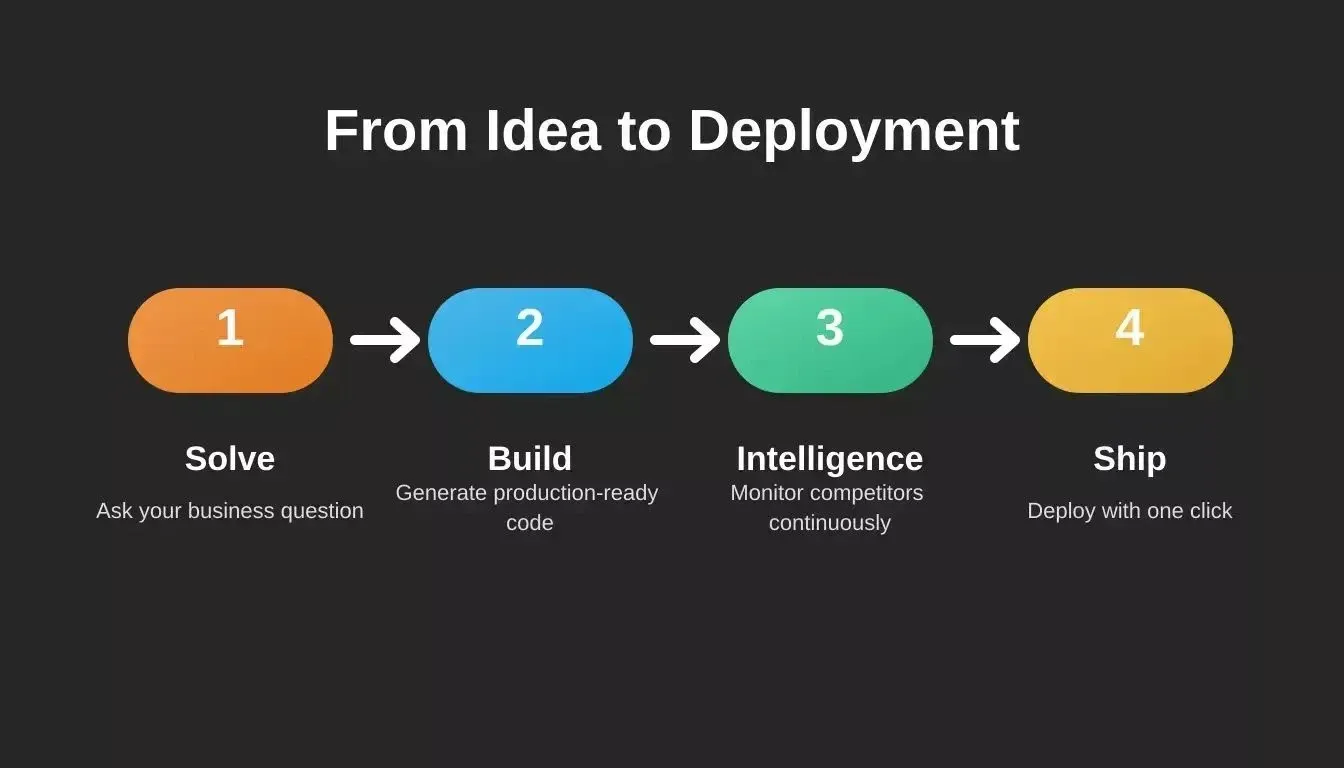
Rocket.new's four-step agentic workflow: research before you build, build from that research, monitor after you ship, all in one shared-context platform.
Pillar One: Solve (Decision Intelligence)
Solve takes any business question described in plain language and delivers a complete, structured solution ready to act on, present, or build from. Rocket.new frames the problem before research begins by identifying every dimension: market dynamics, competitive landscape, risks, opportunities, and financial implications. It then runs thousands of queries across 150+ sources simultaneously.
The Solve output does not disappear after export. It becomes the foundation of the Build task. The PRD is present when the developer opens the build task; the competitive brief is present when the landing page is written. Learn more about how Solve turns business questions into actionable deliverables.
Pillar Two: Build (Production-Grade Generation)
Build generates production-ready products from natural language descriptions, Figma files, or existing GitHub repositories. Web applications are built in Next.js; mobile applications in Flutter. Every product ships with SEO-ready structure, WCAG accessibility compliance, GDPR coverage, and performance optimization by default. These are the baseline, not optional extras.
-
Code to production: Generated code ships with version control, integrated testing, and cloud deployment by default.
-
25+ integrations: Stripe, Supabase, Google Analytics, Notion, Linear, Airtable, and more. Authenticate once, and they flow into every build.
-
Full source code: You own the code. Download it, self-host it, or push it to GitHub via two-way sync.
Where traditional no-code tools require you to build agents from scratch, configure each API endpoint, and wire visual workflows manually, Rocket.new connects strategy to execution in one platform.
Pillar Three: Intelligence (Continuous Competitor Monitoring)
Intelligence is the third pillar and the one most agentic UX discussions miss entirely. Intelligence watches companies you care about across every public surface they operate on: website, social, news, hiring, traffic, product, GTM, finance, and reviews. It tells you not just what changed, but what it means for your business specifically.
Those findings are packaged as Intel cards, ranked and personalized updates that surface in your feeds so you can scan and act without hunting for information.
| Pillar | What It Watches |
|---|---|
| Website | Messaging changes, pricing edits, new feature announcements |
| Social Media | Executive posts, campaign themes, community sentiment |
| News and Media | Press coverage, analyst mentions, editorial narrative |
| GTM | Paid campaigns, creator partnerships, SEO moves |
| People and Hiring | Hiring velocity, leadership changes, team growth signals |
| Product and Technology | Release velocity, feature changes, GitHub activity |
| Reviews and Community | G2, Reddit, Hacker News, App Store sentiment |
| Business and Finance | Funding, partnerships, and pricing strategy evolution |
| Traffic | Acquisition and expansion signals |
Intelligence is not a news aggregator or alert tool. It is an interpretation layer. When a signal appears, it is evaluated against everything else happening across every surface simultaneously, then framed against your specific role and strategic questions.
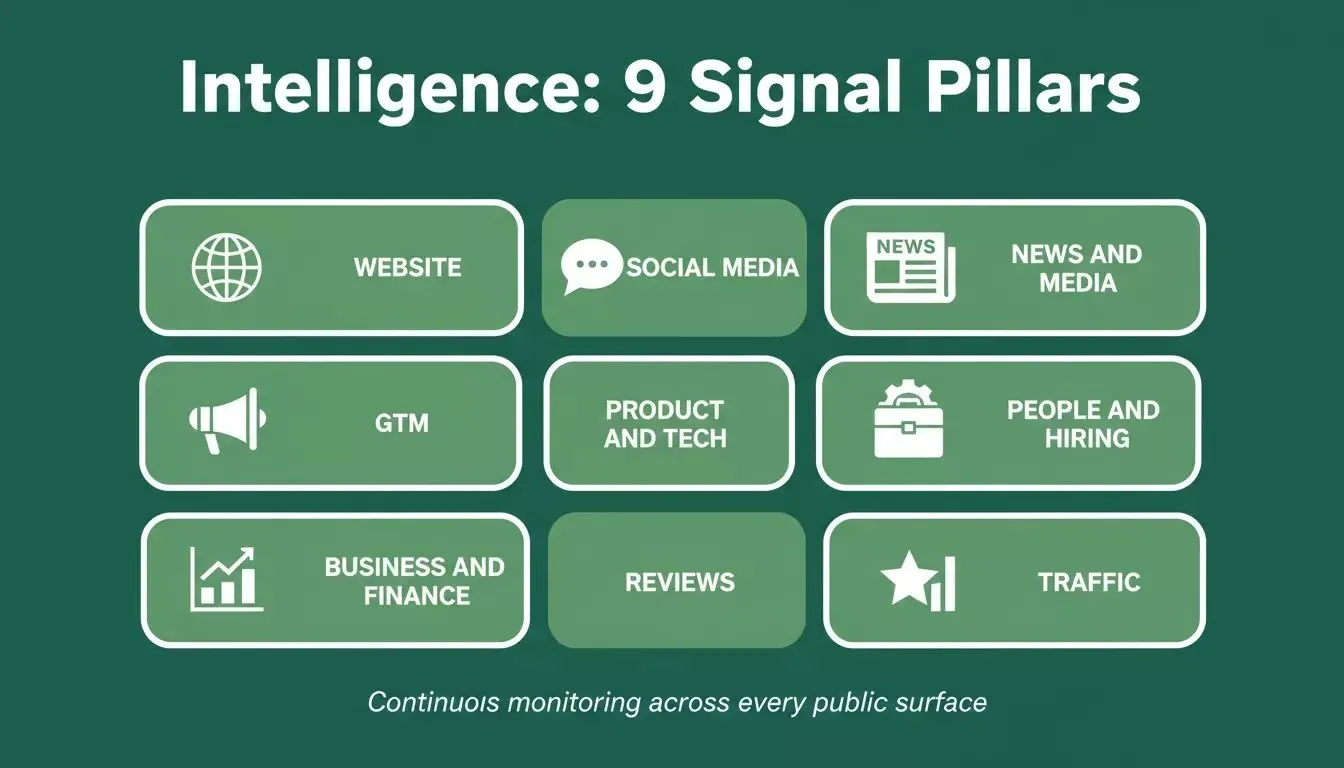
Rocket.new Intelligence monitors competitors across nine signal pillars simultaneously. Not just what changed, but what the pattern of changes means for your business.
What Makes This Different from Other Agent Builders?
-
Shared compound context: Research from Solve flows directly into Build. Intelligence signals inform the next Solve task. Nothing is re-explained between steps. Every task makes the next one smarter.
-
Free plan to start: New users get 20 free credits with no credit card required. Sign up with Google, Apple, or email in about 30 seconds. Paid plans start at $25/month.
-
No setup time: Unlike platforms that require API access configuration, key management, and environment setup, Rocket.new handles infrastructure. Users focus on outcomes.
-
Security and compliance by default: Every build ships with WCAG accessibility compliance, GDPR coverage, and SEO-ready structure as defaults, not add-ons. The platform supports SSO and data localisation on the Booster plan.
-
Full code ownership: Download your source code at any time. Two-way GitHub sync keeps your repo and Rocket.new in sync. You are never locked in.
As John Moriarty noted in UX Collective: "We are evolving from designing screens to designing systems that can make contextual decisions while maintaining design integrity."
That observation captures exactly what a vibe solutioning platform does: it shifts the builder role from crafting individual screens to architecting systems where AI agents generate experiences on demand.
How Do You Measure Success in Agent-Driven Products?
Building an agentic app builder is one thing. Knowing whether it actually works for users is another. The metrics shift when AI agents handle the work.
-
Task completion without intervention: What percentage of workflows do AI agents complete without the user needing to step in? Higher autonomy rates signal trust in the system.
-
Override frequency: How often users correct or redirect agent actions. Low override rates suggest the AI models are calibrated well. High rates signal that app logic or AI tools need refinement.
-
Time-to-outcome: Development time from intent statement to working app. An agentic app builder should reduce this from weeks to hours for most use cases.
-
Agent transparency score: User satisfaction with the visibility and explainability of AI agent decisions. Tracked through feedback on reasoning trails and audit logs.
According to Figma's 2025 research, 94% of designers and marketers still carefully review AI-generated outputs. This confirms that transparency and override are not optional features. They are requirements for any agentic app builder that expects production adoption. The share of agentic AI projects doubled from 21% to 51% in 2025, signaling that AI workflow builders are moving from experiment to standard practice.
The Products That Win Will Let AI Do the Thinking
The gap between apps that make users do everything and apps where AI agents handle the heavy lifting is now the defining competitive advantage. Founders and product managers who understand agentic principles, visible actions, user override, and trust transparency will build products that feel like they belong in 2026, not 2020.
The builders who move first will ship faster, iterate smarter, and deliver experiences their users never expected from a no-code platform or low-code tool. Start building agent-first apps today.
Ready to build apps where AI does the work? Rocket.new gives you AI agents that research, plan, generate code, and monitor competitors, all in one platform with full transparency and user control. Start building free on Rocket.new and ship your first agentic app today.
Table of contents
- -What Does Agentic Mean for App Interfaces?
- -Why Are Enterprise Apps Embedding AI Agents at Record Speed?
- -Why Are Most No-Code Apps Still Stuck in the Old Paradigm?
- -How Agentic Platforms Compare to Traditional No-Code and Vibe Coding Tools
- -What Are the Core Design Principles of Agent-First Apps?
- -1\. Visible Agent Actions
- -2\. User Override at Every Step
- -3\. Trust-Building Transparency
- -How Does the Autonomy Dial Pattern Work?
- -Who Should Be Building Agentic Apps Right Now?
- -A Worked Example: PM Validates a Feature Idea in One Afternoon
- -How Rocket.new Delivers the Agentic Experience That Founders Need
- -Pillar One: Solve (Decision Intelligence)
- -Pillar Two: Build (Production-Grade Generation)
- -Pillar Three: Intelligence (Continuous Competitor Monitoring)
- -What Makes This Different from Other Agent Builders?
- -How Do You Measure Success in Agent-Driven Products?
- -The Products That Win Will Let AI Do the Thinking