
AI employee monitoring without opt-in design, scoped data collection, and anonymization destroys trust. Meta's 2026 program caused a data breach and staff revolt. This guide shows founders how to build workplace AI tools that employees actually accept.
AI employee monitoring refers to the use of automated systems to observe, record, and analyze how employees work, tracking activity patterns, application usage, and productivity signals. Done without consent, architecture, and privacy-first defaults, it destroys the trust your product depends on.
Why Did Meta's Tracking Program Trigger a Staff Revolt?
Why would over 1,600 employees at one of the world's largest technology companies sign a petition against their own employer's AI initiative? That question sits at the center of a growing debate about where workplace AI crosses from "understanding work" into "watching workers."
A Cornell University study published in Communications Psychology found that more than 30% of participants criticized AI surveillance compared to roughly 7% for human monitoring, according to researchers Rachel Schlund and Emily Zitek at Cornell's ILR School. Meta learned this lesson the hard way in 2026, when its Model Capability Initiative captured keystrokes, mouse movements, and screenshots from employee laptops to train AI agents capable of performing computer tasks.
The result was not better AI models. It was a SEV 2 data breach exposing 45,000 database tables, a unionization effort in the UK, and a program paused indefinitely. For founders building workplace AI tools today, the Meta case is not just a news story. It is a product design lesson written in lost trust, leaked data, and regulatory risk.
What Went Wrong at Meta's Model Capability Initiative?
Meta's employee monitoring software program, known internally as MCI, was designed to collect real examples of how people actually use computers. The AI surveillance system recorded mouse movements, clicking patterns, dropdown navigation, and periodic screenshots across more than 200 applications and websites.
| Issue | Detail |
|---|---|
| No opt-out for US employees | GDPR excluded EU/UK staff; US workers had zero control |
| Data over-exposure | Keystroke and screen-capture data were widely accessible internally |
| SEV 2 breach | Performance reviews, private conversations, and people data exposed |
| Executive exemptions | Rank-and-file employees tracked; executives broadly exempt |
| Regulatory warning | The petition cited "security and regulatory risks, including potential breaches" |
One Meta engineer wrote in an internal post viewed by nearly 20,000 coworkers: "I don't want to live in a world where humans, employees or otherwise, are exploited for their training data." That message became a rallying point for collective action inside the company.
The ai driven surveillance approach failed precisely because it treated employees as training data sources rather than consenting collaborators. Companies that use constant surveillance without transparency create the conditions for backlash, even when the stated purpose seems legitimate. An internal security review found that granular keystroke and screen-capture data was far more widely accessible inside the company than intended.
How Does Algorithmic Oversight Differ From Human Oversight?
Algorithmic oversight produces measurably worse outcomes than human oversight across every dimension that matters for employee trust and performance.
Researchers Rachel Schlund and Emily Zitek at Cornell University's ILR School examined how workers respond to algorithmic versus human monitoring across four experiments with approximately 1,200 participants. Their findings, published in Communications Psychology (a Nature Portfolio journal), revealed clear patterns in employee behavior and employee sentiment.
| Factor | AI Algorithmic Monitoring | Human Oversight |
|---|---|---|
| Perceived autonomy | Significantly reduced | Largely preserved |
| Criticism rate | Over 30% of participants | About 7% of participants |
| Task performance | Measurably worse | Stable or improved |
| Resistance intent | Higher across all studies | Lower and manageable |
| Willingness to add context | Low without explicit framing | Naturally present |
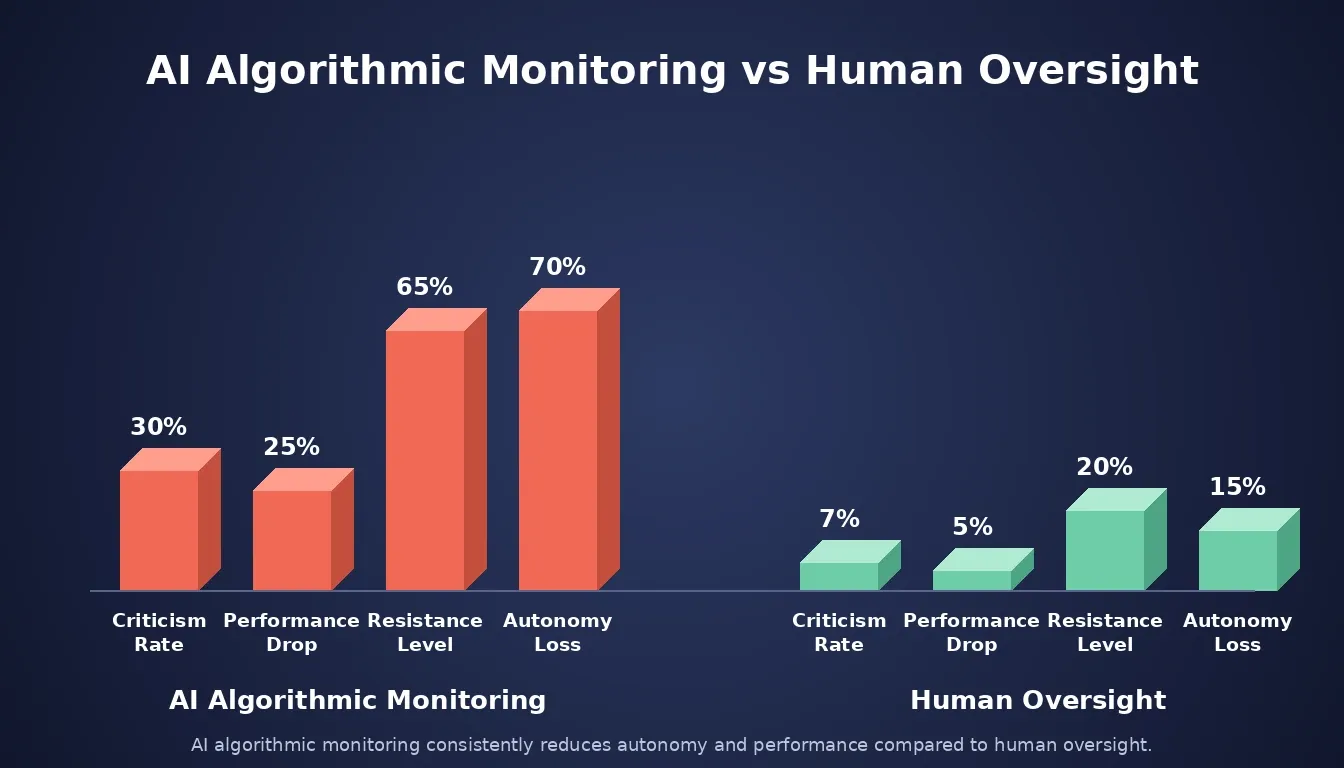
AI algorithmic monitoring consistently reduces perceived autonomy and task performance compared to human oversight.
The research makes one point especially clear for AI systems designers. When surveillance is framed as genuinely developmental, designed to help employees improve rather than evaluate them, the autonomy penalty drops significantly. Machine learning models can still learn from workplace activity patterns. The difference is whether people feel they are participants or subjects.
This data gives founders a roadmap. The question is not whether to use AI tools for workplace monitoring. The question is how to design monitoring systems that preserve employee trust while still gathering the activity patterns and productivity reports that organizations need.
What Should Founders Build Into Workplace AI From Day One?
Privacy-first design means building opt-in controls, scoped data collection, and anonymization into your architecture before you write a single line of application logic, not as a retrofit after backlash.
If you are building employee monitoring tools or any workplace AI software that observes how people work, the design decisions you make before launch determine whether your product creates value or creates resentment. Here is what the research and the Meta case study tell us about building ai driven employee monitoring software that employees will actually accept.
How Should Opt-In Design Work in Practice?
Opt-in design means employees activate monitoring voluntarily, with full context about what is collected, how it is used, and what they receive in return, with the default state set to off.
Opt-in is not a checkbox buried in onboarding flows. It means employees choose to participate with full context about what data is collected, how it is used, and what they get in return.
- Default state should be off, not on. Workers activate monitoring when they want productivity reports or workflow analysis.
- Provide clear data boundaries so employees know exactly which applications are observed and which remain private.
- Allow pause controls. Meta eventually offered 30-minute pauses after backlash. Build this from day one, not as a concession.
- Give employees access to their own data. Transparency creates accountability in both directions.
Founders who want to understand the full scope of what building internal tools with AI can look like will find that privacy architecture is a design decision, not an afterthought.
What Does Scoped Observation Look Like?
Scoped observation means your AI employee monitoring system collects only the minimum data required for a stated, disclosed purpose, nothing more, nothing adjacent.
- Track task completion patterns and workflows, not keystrokes or screenshots of private messages.
- Focus monitoring tools on team performance metrics and process bottlenecks rather than individual surveillance scores.
- Time-bound collection windows tied to specific projects or improvement cycles, not continuous recording.
- Separate the signals needed for improving productivity from the raw data that would constitute workplace surveillance.
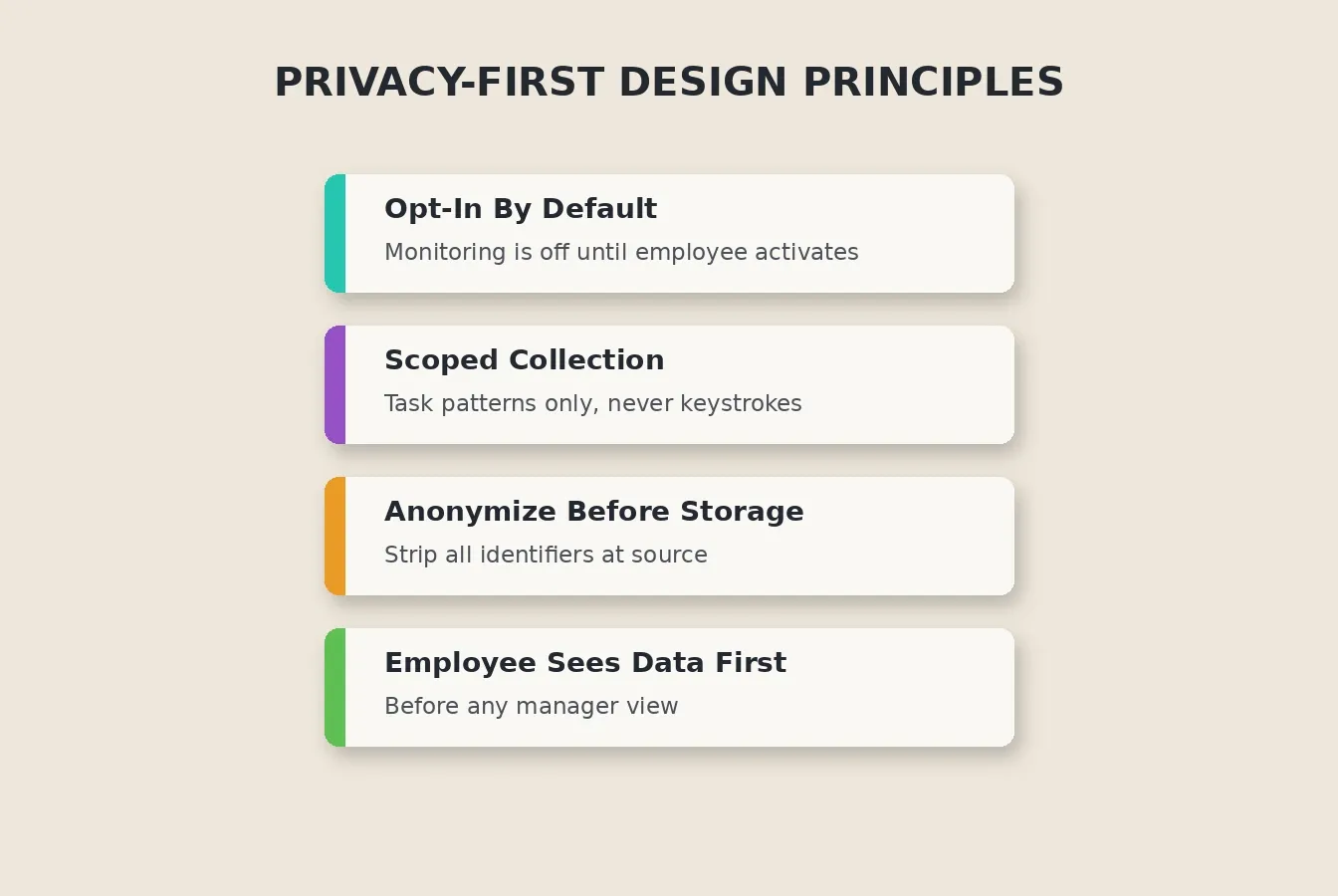
Four non-negotiable design principles for any workplace AI tool that employees will actually trust.
Why Does Anonymization Matter for AI Training Data?
Anonymization means stripping all personally identifiable information from employee data before it enters any training pipeline, storage system, or reporting layer.
The Meta breach exposed personally identifiable employee data across 45,000 Hive tables because the system was not designed with anonymization as a default. Founders building AI models from workplace data need to treat anonymization as a structural requirement.
- Strip identifying information before data enters training pipelines.
- Aggregate activity patterns at the team level rather than tracking individual employees.
- Implement data retention limits that automatically delete raw observations after processing.
- Build compliance with GDPR and regional privacy regulations into the data architecture, not bolted on after launch.
The five-gate flow in plain language:
- Gate 1: Opt-in check: If the employee has not activated monitoring, no data is collected.
- Gate 2: Scope check: If the signal falls outside the disclosed collection purpose, it is discarded before storage.
- Gate 3: Anonymization: Personal identifiers are stripped, and data is aggregated to the team level.
- Gate 4: Retention: Raw observations are auto-deleted once the processing window closes.
- Gate 5: Employee-first reporting: The employee sees their own aggregated data before any manager view is generated.
Every employee signal passes through opt-in, scope, and anonymization gates before reaching any reporting layer.
This decision flow is what separates responsible use of AI from the kind of AI surveillance that triggers petitions, lawsuits, and data breaches. Every workplace monitoring system should pass through these gates before a single byte of employee data enters any pipeline.
How Rocket Helps You Ship Privacy-First Workplace Tools
Rocket won't auto-generate a compliant workplace monitoring app with zero prompting, but it removes the infrastructure lift that normally makes privacy-first design expensive. Here is what the workflow actually looks like, grounded in what the docs support.
Note: The section below describes Rocket's capabilities as documented in the official Compliance and Privacy and Security Checklist docs.
Authentication and row-level security via Supabase. Ask Rocket to wire up Supabase Auth so employee data is scoped per user at the database level from the start. Supabase row-level security (RLS) enforces access control at the database layer, meaning even if there is a bug in your application code, RLS prevents one user from reading another's data. The prompt is straightforward:
"Add authentication to my app using Supabase Auth. Enable row-level security on all Supabase tables. Add policies so users can only read and write their own data."
Compliance flows via /Implement Privacy Compliance. Once your data model is in place, use Rocket's built-in slash command to add GDPR/CCPA consent banners, geo-based consent flows (full GDPR banner for EU visitors, CCPA opt-out for California visitors, simplified notice elsewhere), and policy pages in the same session. As the docs state clearly: Rocket does not add these automatically, so you prompt for them before launch, not after.
What this compresses. What used to mean weeks of backend work, a separate compliance consultant, and a security review becomes a handful of targeted prompts. You still own the privacy decisions. Rocket executes them at production quality. Founders building B2B SaaS products with AI will recognize this as the same principle behind any compliance-sensitive architecture.
Traditional employee monitoring software vendors like ActivTrak, Hubstaff, and Time Doctor offer pre-built surveillance features. But they force a specific monitoring philosophy on your product. When you create your own workplace AI tool on Rocket, you control the privacy boundaries, the data flow, and the employee experience from the first line of code.
The difference matters because trust is a product feature, not a policy document. Organizations that rely on off-the-shelf monitoring systems inherit whatever privacy tradeoffs those vendors made. Founders who understand how AI app builders reduce development costs also understand that building custom means owning every design decision, including the ones that protect your users.
Why Do Privacy-Scoped Tools Outperform Surveillance Software?
Privacy-scoped monitoring outperforms constant surveillance on every business metric that matters: engagement, performance, and retention.
The business case for privacy-first design is not just about avoiding backlash. It directly affects employee productivity, employee performance, and retention in ways that constant surveillance cannot match.
- Teams monitored with scoped, transparent tools report higher engagement and lower anxiety about being watched.
- The Cornell study confirmed that employees feel more productive when they understand what data is collected and why.
- TD Bank's 2026 deployment of WorkiQ in its risk management unit drew scrutiny from Canadian privacy experts who noted no peer-reviewed evidence establishes that such monitoring tools improve business outcomes.
- Reduced turnover among high-performing workers who have the most employment options and are first to leave invasive environments.
- Real time insights from aggregate data prove more actionable for managers than individual keystroke logs that require human interpretation.
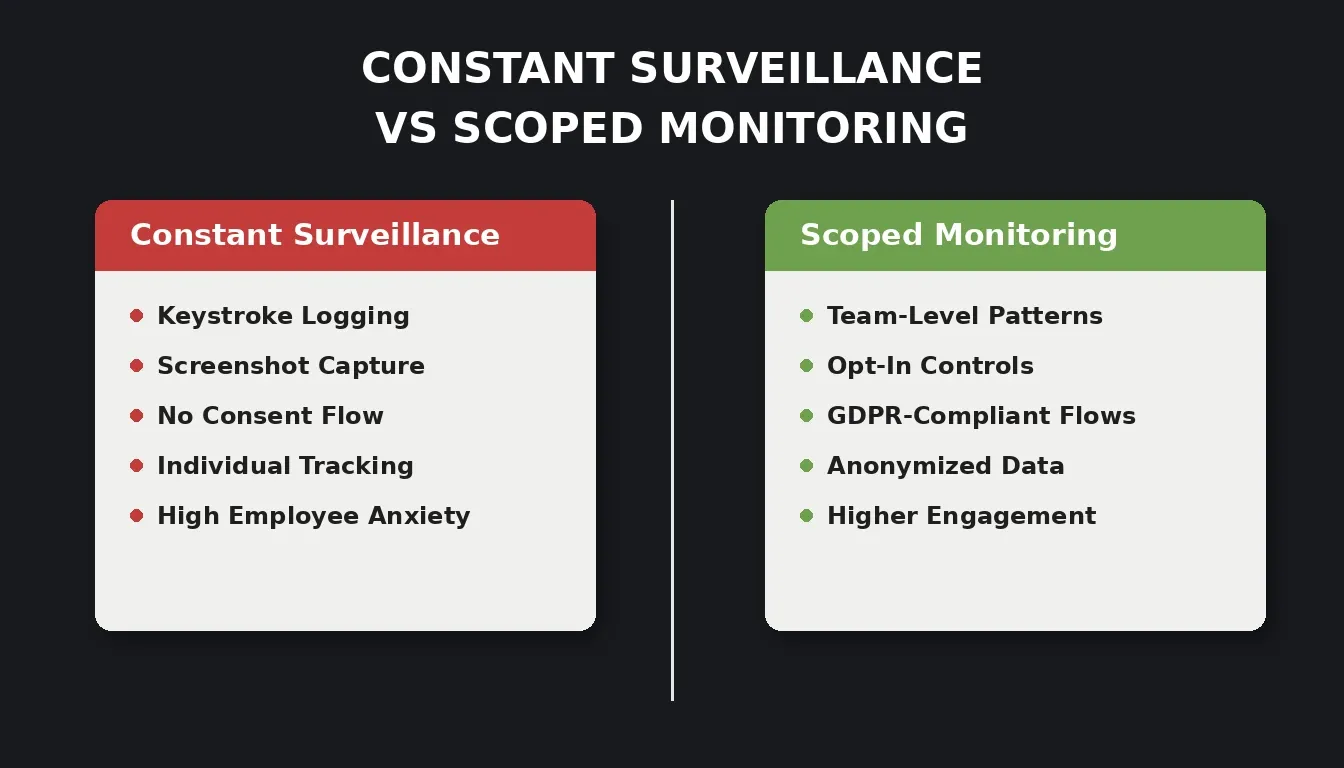
Privacy-scoped monitoring correlates with higher engagement and lower attrition compared to constant surveillance approaches.
The right balance is not about choosing between understanding work and protecting privacy. Privacy-scoped monitoring systems collect meaningful productivity metrics, identify workflow inefficiencies, and generate useful reports for managers. They just do it without treating employees like suspects under a microscope.
Federal guidance adds further context. The Consumer Financial Protection Bureau issued Circular 2024-06 in October 2024 warning that ai driven surveillance may implicate the Fair Credit Reporting Act. The Department of Labor published its AI and Worker Well-Being guidance the same month advising employers against using AI tools to engage in invasive monitoring. While these are non-binding, they signal the direction of legal accountability. (Guidance current as of October 2024; check CFPB and DOL websites for updates.)
Founders who want to understand the broader security implications of building AI-powered applications should review common app security mistakes before shipping any tool that handles employee data.
Teams looking at the full production checklist will find web application security best practices directly applicable to workplace monitoring tools. And those exploring the production readiness angle can also reference what production-grade from the first generation actually means for a deeper look at how Rocket approaches quality from day one.
Trust Is a Feature You Ship on Launch Day
The Meta story is a cautionary tale with a clear lesson for every founder building workplace AI. Privacy, consent, and scoped data collection are not features you bolt on after employees revolt. They are architectural decisions that determine whether your product generates value or generates lawsuits.
If you are ready to build a workplace AI tool that treats employee trust as a competitive advantage, start with a platform that gives you the right building blocks from the first prompt.
Rocket.new gives founders full-stack AI development with Supabase Auth, row-level security, and a /Implement Privacy Compliance command that wires GDPR and CCPA consent flows in a single session. Sign up today and ship your privacy-first workplace application before your next sprint ends.
Table of contents
- -Why Did Meta's Tracking Program Trigger a Staff Revolt?
- -What Went Wrong at Meta's Model Capability Initiative?
- -How Does Algorithmic Oversight Differ From Human Oversight?
- -What Should Founders Build Into Workplace AI From Day One?
- -How Should Opt-In Design Work in Practice?
- -What Does Scoped Observation Look Like?
- -Why Does Anonymization Matter for AI Training Data?
- -How Rocket Helps You Ship Privacy-First Workplace Tools
- -Why Do Privacy-Scoped Tools Outperform Surveillance Software?
- -Trust Is a Feature You Ship on Launch Day