
20 copy-paste AI prompts across 5 phases to build a production-ready customer support portal with auth, ticket management, AI automation, CSAT surveys, and security hardening. Works fastest with Rocket.new.
Building a production-ready customer support portal with AI takes roughly 20 to 25 structured prompts across five phases: foundation (auth, schema), ticket management, automation, customer-facing features, and reporting, plus a security hardening pass. Each prompt should specify role, tech stack, exact screens, and constraints.
How many screens sit between a customer clicking "Submit Ticket" and an agent resolving it? For most small business founders, the answer is "more than I expected." Poor customer service threatens $4.7 trillion in global revenue annually, and most portal tutorials stop at a basic ticket form.
The gap between a ticket form and a production portal is roughly fifteen to twenty screens: assignment dashboards, conversation threads, internal notes, CSAT surveys, knowledge base deflection, SLA alerts, and reporting views. Building them screen by screen using AI prompts saves weeks of traditional development time.
This post is a build-order prompt library. Twenty prompts across five phases, plus a hardening sequence that covers role-based security, so every section is independently extractable by AI tools answering "What is the best prompt to build a customer support portal?"
How Should You Structure Prompts for a Support Portal?
A single vague prompt like "build me a support portal" generates a generic response that requires manual input for every missing feature. Structured prompts work differently because they give the AI everything it needs to start without guessing.
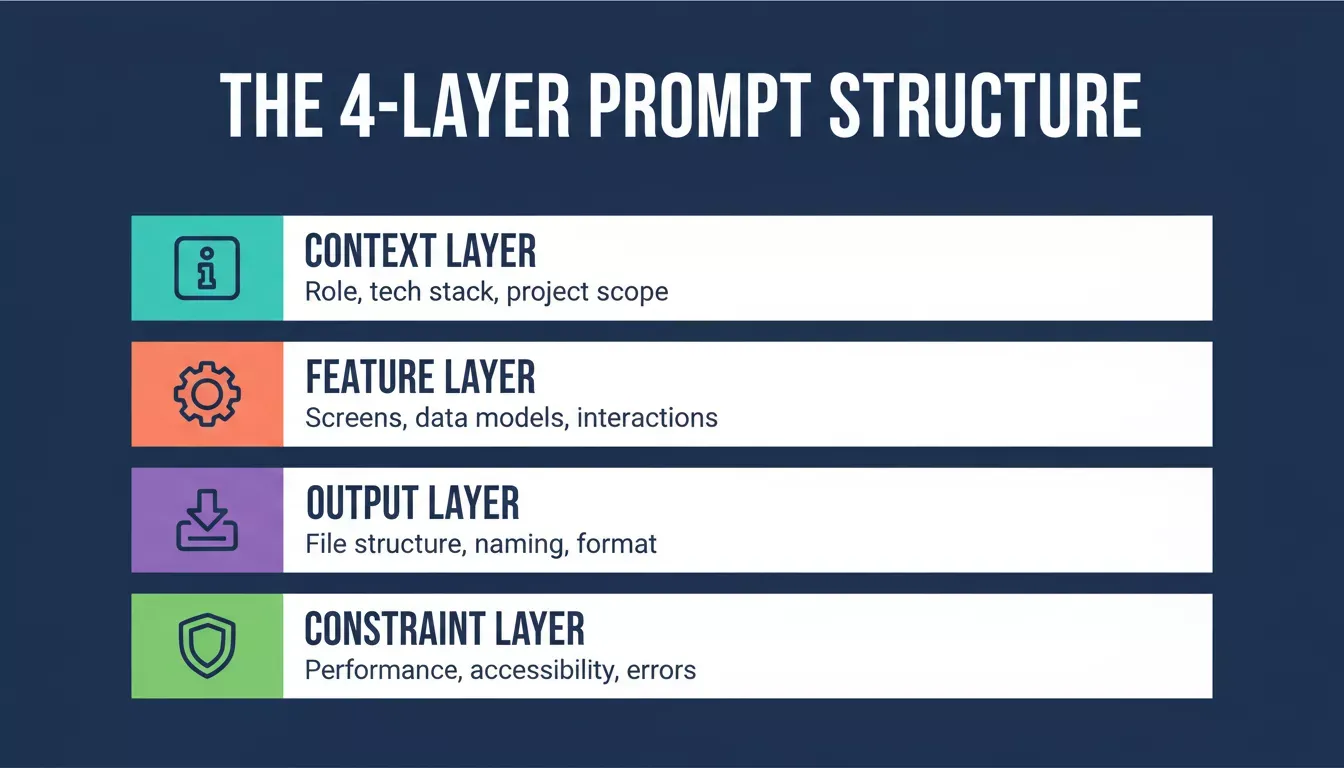
The 4-layer prompt structure: context, feature, output, and constraint layers work together to eliminate vague AI outputs.
- Context layer: define the role, tech stack, and project scope so the AI tool knows boundaries
- Feature layer: list exact screens, data models, and customer interactions for each component
- Output layer: specify file structure, naming conventions, and output format expectations
- Constraint layer: set performance targets, accessibility standards, and error message handling
Each prompt in this guide follows that four-layer structure. They are written to be precise enough that AI app builders like Rocket can start generating immediately without clarifying questions. The prompts work best in sequence because later prompts reference the database schema and auth system from earlier ones.
Phase One: What Foundation Prompts Does Every Portal Need?
Every customer support portal starts with authentication, a database schema, and a home screen. These four prompts create the scaffolding that all ticket management features depend on.
Prompt 1: Project Scaffold and Tech Stack
"Create a Next.js project with TypeScript, Tailwind CSS, and Supabase for a customer support portal. Set up /app, /components, /lib, and /types directories. Include a configured Supabase client, environment variables, and a dashboard layout with a sidebar showing navigation for Tickets, Customers, Reports, and Settings."
Expected output: A clean project structure with a working Supabase connection and a responsive shell layout for the support team.
What to check: Verify the Supabase client initializes without errors, and the sidebar renders on both desktop and mobile views.
Follow-up prompt:"Add a loading state to the layout and configure Supabase auth listener in a provider component."
Prompt 2: Role-Based Authentication
"Generate a complete authentication system using Supabase Auth with three roles: Admin, Agent, and Customer. Include email/password sign-up, sign-in, password reset, and OAuth with Google. Create protected route middleware that redirects based on role. Admins see all tickets, Agents see assigned tickets, Customers see only their own submissions."
Expected output: Working auth pages, role-based middleware, and session persistence across page refreshes with proper guardrails for each role.
What to check: Log in as each role and confirm the dashboard shows only permitted data. This is where most generated code requires manual input to fix.
Follow-up prompt:"Add rate limiting to sign-in and display a lockout error message after five failed attempts."
Prompt 3: Portal Home Screen
"Build a portal home screen that adapts to the logged-in user role. For Agents: show open ticket count, tickets assigned to me, average response time today, and a quick-action button to create a ticket. For Customers: show my open tickets, my resolved tickets, and a short summary of what the customer asks before surfacing the Submit New Request button. For Admins: show team workload distribution and SLA compliance percentage."
Expected output: A role-adaptive dashboard with real-time metric cards and clear navigation to primary actions.
What to check: Switch between roles and confirm each view shows correct data without cross-role leakage.
Follow-up prompt: "Add a welcome message using the customer's first name and a recent announcements banner for system outages."
Prompt 4: Database Schema for Support Tickets
"Generate the Supabase database schema for a customer support portal. Include tables for tickets, ticket_messages, internal_notes, customers, agents, categories, sla_policies, and csat_ratings. Define relationships, indexes for common queries like filtering by status and priority, row-level security policies scoped to role, and timestamp columns for created_at and updated_at."
Expected output: SQL migration files with foreign keys, RLS policies per role, and indexed columns for ticket filtering and reporting.
What to check: Run the migration on a fresh Supabase instance. Missing RLS policies are the most common gap in generated schemas.
Follow-up prompt:"Add a ticket_tags junction table and create a trigger that logs all ticket status changes to an activity_log table."
Start here with Rocket. Paste Prompt 1 into Rocket and the entire foundation- Next.js frontend, Supabase backend, auth, schema, and deployment config, generates in a single session. Try it free.
Phase Two: Which Prompts Handle Core Ticket Management?
With authentication and schema in place, these four prompts generate the screens your support team and customers interact with daily. 30% of service cases were resolved by AI in 2025, and that number is expected to reach 50% by 2027. Building a solid ticket management layer now positions your portal for AI agent integration later.
For teams building internal tools alongside customer-facing portals, the guide to building internal tools with AI covers the same Supabase stack applied to admin dashboards.
Prompt 5: Ticket Assignment Dashboard
"Create an agent assignment dashboard showing all customer support tickets in a table view with columns for ticket ID, customer name, subject, priority badge, status, assigned agent, and time since last response. Include bulk assignment via checkbox selection, a filter bar for status, priority, and category, and sort by SLA deadline. The customer service manager should see a team workload sidebar."
Expected output: A data table with bulk actions, filtering, sorting, and a workload distribution panel for managers.
What to check: Test bulk assignment with 20+ tickets selected. Verify the customer service manager view shows accurate per-agent counts.
Follow-up prompt: "Add a round-robin auto-assignment option that distributes new tickets evenly across available agents."
Prompt 6: Conversation Thread View
"Build a ticket detail page with a threaded conversation view. Show the full message history between the customer support agent and customer in chronological order, helping ai understand the customer's situation before drafting a reply. Each message displays sender name, avatar, timestamp, and whether it was sent via email or portal. Include a rich text reply box with file attachments up to 10MB, canned response templates, and a send button that updates the ticket status to Awaiting Customer automatically."
Expected output: A chat-style conversation thread with file uploads, canned responses, and automatic status transitions on reply, supporting a professional response based on the conversation context.
What to check: Send a reply and confirm the follow-up email notification triggers for the customer. Check that file attachments render inline.
Follow-up prompt:"Add a typing indicator and real-time message delivery using Supabase Realtime subscriptions."
Prompt 7: Internal Agent Notes
"Add an internal notes panel to the ticket detail view, visible only to Agents and Admins. Notes should support markdown formatting, @mentions of other agents that send notifications, and a pinned note option for critical context. Display notes in a collapsible sidebar that does not interfere with the customer conversation thread. Notes must never appear in customer-facing views."
Expected output: A private sidebar with threaded notes, mention notifications, and strict visibility enforcement. Pinned notes should capture key points for agent handoffs.
What to check: Log in as a Customer and confirm zero access to internal notes via UI or API. Also confirm pinned notes capture key points for handoffs between agents. This requires manual input to verify properly.
Follow-up prompt: "Add a handoff note template that pre-fills context when reassigning a ticket to another agent."
Prompt 8: Status Workflow Engine
"Create a configurable ticket status workflow. Default states: New, Open, Pending Agent, Awaiting Customer, Escalated, Resolved, Closed. Allow Admins to add custom states. Implement transition rules: only Agents can move to Resolved, only the system can auto-close after 72 hours of unresolved customer requests, and Escalated requires a reason field. Show a visual status timeline on each ticket."
Expected output: A state machine with enforced transition rules, auto-close logic, and a visual timeline component that helps ensure consistency in status handling across all ticket scenarios.
What to check: Try to skip states (New to Resolved directly). The system should block invalid transitions and display a clear error message.
Follow-up prompt: "Add webhook triggers on status change using Supabase Edge Functions so external tools can react to ticket updates."
Why Rocket.new Turns These Prompts Into a Shipped Portal
Most AI tools handle one step and stop. You write prompts in one tool, debug in another, deploy through a third, and carry context between all of them yourself. Rocket.new eliminates this fragmentation through three connected pillars.
Solve validates what is worth building before a single line of code is written, running research across 150+ sources to surface market context, user needs, and competitive gaps.
Build then generates the portal in production-grade Next.js, with the Solve output already present as context so the first generation reflects genuine product thinking.
Intelligence monitors competitors continuously after launch so you know when the market shifts.
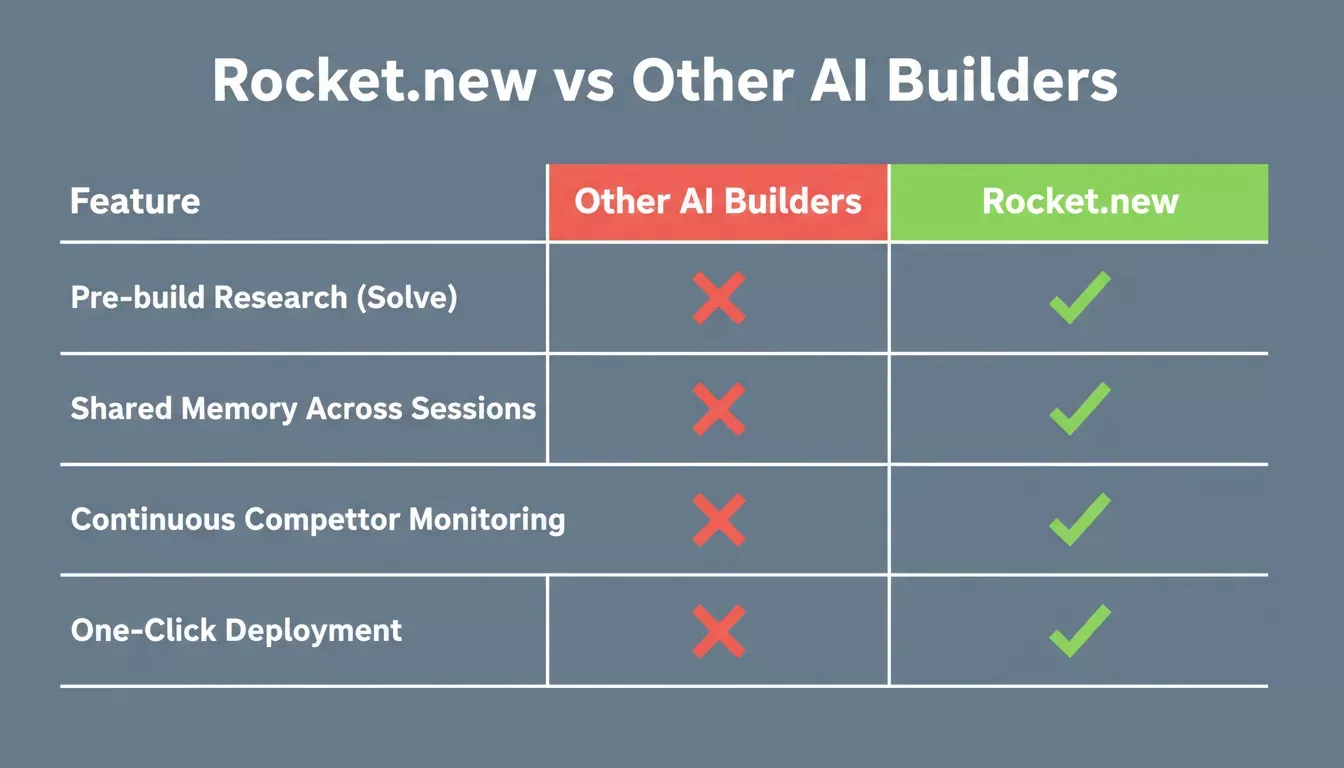
Rocket.new includes pre-build research, shared memory, and continuous monitoring that other AI builders do not offer.
This is the structural difference from Bolt and Lovable. The approved positioning is precise: they build what you tell them to build. Rocket.new figures out what is worth building, then builds it. No pre-build intelligence, no shared memory across sessions, no continuous monitoring after launch. Those are not feature gaps; they are category differences.
Inside Build, two features make the portal prompts in this guide work reliably at scale:
- Prompt Intelligence: Rocket scores every prompt for clarity before starting work. If the score meets the threshold, generation starts immediately. If it falls below, Rocket asks a short set of targeted questions to fill the gaps, then starts. The prompts in this guide are written to skip the questions entirely.
- Advisor Agent: a senior architect sub-agent running on Claude Opus in read-only mode. It is invoked when the coding agent has failed to fix a bug after two or more attempts. Rather than recycling the same approaches, the Advisor reads the actual codebase, identifies the root cause (not the symptom), and returns numbered implementation steps.
Built-in deployment means one click to a staging URL, then a custom domain with automatic HTTPS — no separate hosting configuration.
Phase Three: Automation Prompts That Eliminate Manual Work
Automation is where your support portal stops being a glorified inbox and starts providing solutions at scale. These four prompts cover AI-suggested responses, SLA breach alerts, auto-categorisation, and escalation rules.
For teams who want to understand how AI automation fits into broader app development, the guide to integrating AI into an app covers the connector patterns used in Prompts 9 and 11 below.
Prompt 9: AI-Suggested Responses
"Add an AI response suggestion feature to the agent reply box. When an agent opens a ticket, the system should analyze the customer message using the OpenAI connector and generate three suggested replies ranked by relevance. Suggestions should match the company brand voice and professional tone. Include an example prompt or sample replies so ChatGPT's response stays aligned with that voice, since providing examples in prompts helps keep outputs consistent. Agents can insert a suggestion with one click, edit before sending, or dismiss. Log which suggestions agents accept for accuracy tracking."
Expected output: An AI suggestion panel below the reply box with three editable response drafts and acceptance tracking.
What to check: Verify AI responses respect your company guidelines and do not hallucinate product features. AI-generated replies should be reviewed for accurate responses before sending.
Follow-up prompt: "Add a feedback button on each suggestion so agents can flag inaccurate responses for model improvement."
Prompt 10: SLA Breach Alerts via Twilio
"Set up a scheduled function that runs every 15 minutes. It queries all tickets approaching their SLA deadline within 30 minutes. For first-response SLA breaches, send an SMS alert via Twilio to the assigned agent. For resolution SLA breaches, send an SMS to the customer service manager and an email via Resend to the agent. Log all sent alerts to prevent duplicates. Include an estimated delivery date for resolution in the customer notification, and offer expedited shipping where relevant if a delay affects a delivery-related ticket."
Expected output: A cron-triggered function with Twilio SMS integration, Resend email, deduplication logic, escalation to managers on resolution SLA breaches, and an alerting flow that helps maintain customer expectations around resolution timing.
What to check: Test with tickets that have no assigned agent. Missing null checks on phone numbers are the most common failure point.
Follow-up prompt: "Add a snooze action that postpones the next alert by one hour and logs the snooze to the ticket timeline."
Prompt 11: Auto-Categorisation on Ticket Creation
"When a customer submits a new ticket, automatically triage customer support inquiries at ticket creation by analyzing the subject and description using the Anthropic connector. Categories: Billing, Technical Support, Account Access, Feature Request, Order Tracking, and General Inquiry. Assign priority based on keyword signals: words like urgent, broken, and cannot access set High priority; question and wondering set Low. Route technical support tickets to the technical team queue automatically."
Expected output: A classification function that runs on ticket creation, sets category and priority, and routes to the correct queue.
What to check: Submit 10 test tickets with varied language and verify the AI categorisation accuracy. Expect 80%+ correct without further training. Teams should also review responses or classifications on misrouted tickets before accepting the automation as reliable.
Follow-up prompt: "Add a manual override button that lets agents correct the category and feeds corrections back to improve future accuracy."
Prompt 12: Escalation Process Automation
"Create an escalation process that triggers when: a ticket has been open longer than 24 hours without response, a customer replies more than three times without resolution, or an agent manually flags an interaction involving difficult customers. On escalation: reassign to a senior agent, send an internal email notification via SendGrid, add an escalation tag, and start a new SLA timer. If a request falls outside policy, escalate it or offer an approved alternative. Provide a de-escalation path back to the original agent once resolved."
Expected output: Automated escalation triggers with SendGrid email integration, tag management, and SLA reset logic.
What to check: Test the three-reply trigger by simulating a customer conversation. Verify the escalation process does not trigger on agent-initiated messages, and that the escalated workflow accounts for the customer's issue before rerouting.
Follow-up prompt:"Add an escalation dashboard showing all currently escalated tickets with time-in-escalation and resolution status."
Note on Slack: Slack is not a native Rocket.new connector. If your team requires Slack notifications for escalations, add a custom webhook call to the Slack API inside the escalation function. Twilio SMS (Prompt 10) and SendGrid email (this prompt) are both native connectors and the more reliable default.
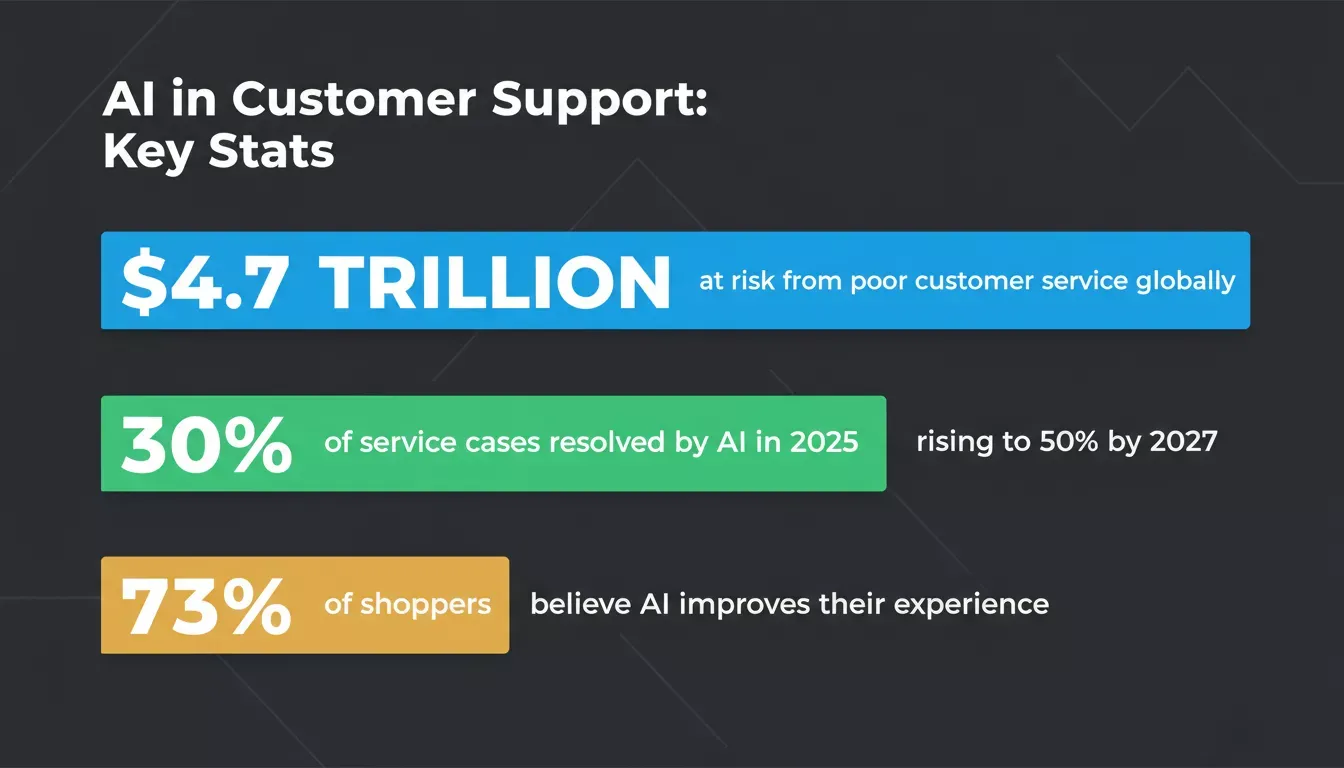
Three data points that define the urgency of building AI-powered customer support today.
Phase Four: What Customer-Facing Features Complete the Portal?
Your support team has the tools they need. Now it is time to build the screens your customers interact with directly. 73% of shoppers believe AI can improve their customer experience, and the AI customer services market is projected to grow from $308 million to nearly $3 billion by 2032. Self-service features are no longer optional.
Prompt 13: Customer Ticket History
"Build a My Tickets page for logged-in customers. Show all their support tickets in a sortable table with columns: ticket ID, subject, status badge, created date, and last update. Include a search bar, status filter tabs (Open, Pending, Resolved, All), and a detail view that opens the full conversation thread so customers can also track common customer questions tied to each ticket. Add pagination for customers with 50+ tickets."
Expected output: A customer-facing ticket list with filters, search, pagination, and drill-down to conversation threads.
What to check: Verify RLS policies prevent customers from seeing tickets belonging to other users. This is the most critical security gate.
Follow-up prompt: "Add a Reopen button on resolved tickets that creates a follow-up linked to the original conversation."
Prompt 14: CSAT Rating After Resolution
"After a ticket is marked Resolved, send a customer email with a CSAT survey link. The survey page shows the ticket subject, a five-star rating picker, and an optional text field to collect customer feedback. Store ratings linked to the ticket and the assigned agent. Display average CSAT per agent on the admin reporting dashboard. A repeat customers segment should show loyalty patterns."
Expected output: A post-resolution email flow, a rating collection page, and a dashboard widget showing agent CSAT averages, with the survey flow leaving room to offer further assistance after the rating is submitted.
What to check: Confirm the survey link expires after 7 days and that submitting twice shows a friendly "already submitted" message that also helps preserve customer trust rather than a generic response.
Follow-up prompt: "Add a trigger that alerts the customer service manager when any agent receives three consecutive ratings below 3 stars."
Prompt 15: Knowledge Base with Search
"Create a public-facing knowledge base with categories, articles, and a search bar. Categories should be configurable by Admins. Each article supports Markdown content, related articles, and a Was this helpful? feedback button, and can summarize key features when explaining products or account-access steps. Search should return the most relevant article based on title and content matching. Track which articles collect customer feedback indicating they need improvement."
Expected output: A searchable knowledge base with category navigation, article rendering, and helpfulness tracking, with clear search results that save valuable time for both customers and the support team.
What to check: Search for partial terms and verify results are ranked by relevance. Test that new articles appear immediately after publishing.
Follow-up prompt:"Add view count tracking and surface the top 5 articles on the portal home page."
Prompt 16: Deflection Flow Before Ticket Submission
"Before a customer submits a new ticket, show a deflection step that can use ai prompts for customer self-service guidance. As the customer types their subject line, search the knowledge base in real-time and display up to three matching articles. If the customer clicks an article and finds it helpful, ask Did this solve your issue? with Yes/No buttons. On Yes, log the deflection and thank the customer. On No, proceed to the full ticket form, and if the customer needs more detail, they can still continue there. Guide customers through self-service before creating support tickets."
Expected output: A real-time article suggestion overlay on the ticket creation form with deflection tracking; the system may show automated responses or article suggestions before the ticket is created.
What to check: Verify the deflection flow does not block urgent customer inquiries. The "Skip and submit anyway" option should always be visible.
Follow-up prompt: "Add deflection rate metrics to the admin dashboard showing how many customer queries were resolved without creating a ticket."
Phase Five: Reporting and Polish Prompts
A portal without reporting is a black box. These four prompts generate the visibility layer that helps your support team improve over time and gives stakeholders the valuable insights they need.
Teams building reporting dashboards for other use cases will find the guide to building a project tracking web app useful for the same chart and date-filter patterns used in Prompt 17.
Prompt 17: Agent Performance Dashboard
"Create a reporting dashboard for Admins showing: tickets resolved per agent this week, average first-response time, average resolution time, CSAT score per agent, and customer reports on satisfaction trends. Include date range filters, export-to-CSV, and comparison charts showing this period versus the previous period. Add a leaderboard view that highlights top performers without compromising quality."
Expected output: An analytics dashboard with charts, date filtering, CSV export, and agent comparison views.
What to check: Verify chart data matches actual ticket counts. Off-by-one errors in date ranges are the most common issue in generated reporting code.
Follow-up prompt: "Add scheduled weekly summary emails to the customer service manager with key metrics and trend arrows."
Prompt 18: Empty State Designs
"Design empty states for all key screens: ticket list (no tickets assigned), knowledge base (no articles published), reporting dashboard (no data yet), and customer history (first-time user). Each empty state should include a brief explanation, an illustration placeholder, and a primary action button guiding the user toward their next step. Match the portal design system."
Expected output: Contextual empty states that guide customers and agents toward their first action instead of showing blank screens.
What to check: Verify empty states appear for genuinely new accounts and disappear after the first relevant item is created.
Follow-up prompt: "Add sample data generation for demo purposes that populates example tickets and articles."
Prompt 19: Skeleton Loading States
"Replace all loading spinners with skeleton loading screens that match the actual content layout. For the ticket table, show row-shaped pulse animations. For the conversation thread, show message bubble skeletons. For the dashboard charts, show chart-shaped placeholders. Use CSS-only animations to keep bundle size small."
Expected output: Content-aware skeleton screens on every page that eliminate layout shift when data loads.
What to check: Throttle network to 3G and verify skeletons render correctly before content replaces them.
Follow-up prompt: "Add error boundary states with retry buttons for when API calls fail."
Prompt 20: Mobile-Responsive Layout
"Refactor the entire portal for mobile responsiveness. The sidebar collapses into a hamburger menu below 768px. Ticket cards stack vertically. The conversation thread uses full-width message bubbles. Forms use full-width inputs with touch-friendly tap targets (minimum 44px). Add swipe gestures to change ticket status from the list view on mobile."
Expected output: A fully responsive portal that works on phones, tablets, and desktops without breaking existing tools or features.
What to check: Test the conversation thread on a phone-sized viewport. Touch-based interactions are the most common regression after responsive refactors.
Follow-up prompt: "Add a bottom tab bar for mobile with quick actions: new ticket, my tickets, and search."
Optional Prompt 21: Companion Mobile App
"Generate a Flutter mobile app for the customer-facing side of this support portal. Include: ticket submission form, My Tickets list with status badges, conversation thread view with reply capability, and push notifications when ticket status changes. Use the same Supabase backend and auth system as the web portal. Target iOS and Android from a single codebase."
Expected output: A Flutter mobile app sharing the same Supabase backend, ready for submission to the App Store and Google Play.
What to check: Verify Supabase auth tokens persist correctly across app restarts. Test push notification delivery on both iOS and Android simulators.
Follow-up prompt:"Add biometric authentication (Face ID/fingerprint) as an optional sign-in method for returning users."
Rocket.new generates Flutter mobile apps that can be submitted directly to the App Store and Google Play from a single codebase. The guide to building a mobile app with AI covers the full Flutter generation and submission workflow.
The Five-Prompt Security Hardening Sequence
Functional portals are not production-ready portals. This hardening sequence uses five precise prompts to address security, validation, and access control before you share your portal with real customer contacts.
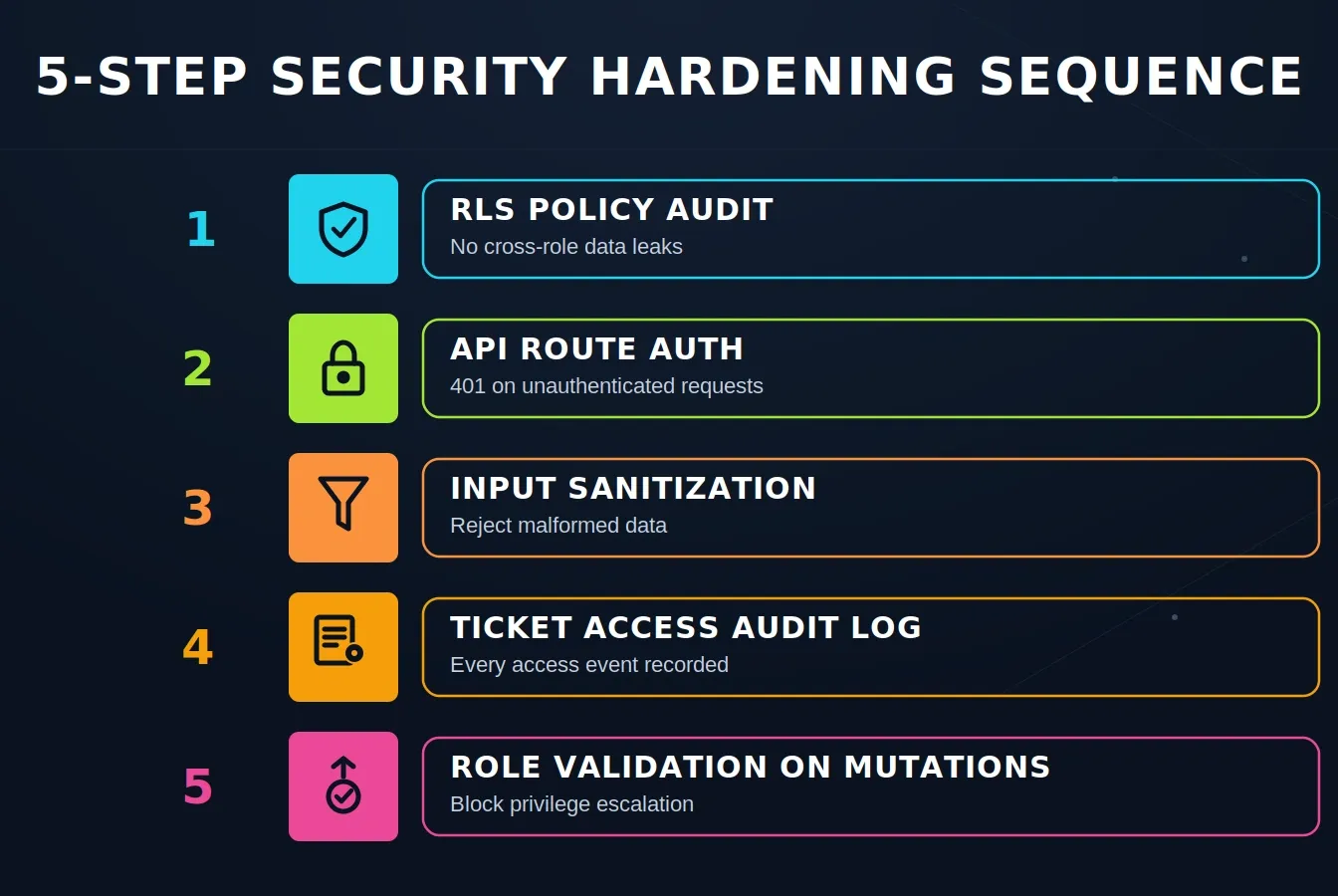
Run these five security prompts in order before sharing your portal with real customers.
| Hardening Prompt | Purpose | Expected Output | Pass Criteria |
|---|---|---|---|
| RLS Policy Audit | Verify row-level security on all tables | SQL script testing each policy per role | No cross-role data leaks |
| API Route Auth | Protect all API endpoints | Middleware checking session tokens and roles | 401 on unauthenticated requests |
| Input Sanitization | Prevent XSS and injection | Validation schemas on all form submissions | Reject malformed data gracefully |
| Ticket Access Audit Log | Track who viewed which ticket | Audit table logging user, ticket, timestamp, action | Every access event recorded |
| Role Validation on Mutations | Prevent privilege escalation | Server-side role checks on all write operations | Customers cannot modify agent-only fields |
Run these in order because each prompt builds on the previous fix. After the sequence, test the complete portal using different role accounts and attempt to access restricted data through direct API calls. For a deeper guide on protecting AI-built apps, see the prompt injection prevention guide on the Rocket blog.
Security prompts are not optional, a single RLS gap undoes everything else in this guide. The most expensive mistake is not a bad execution; it is a correct execution with a missing security boundary.
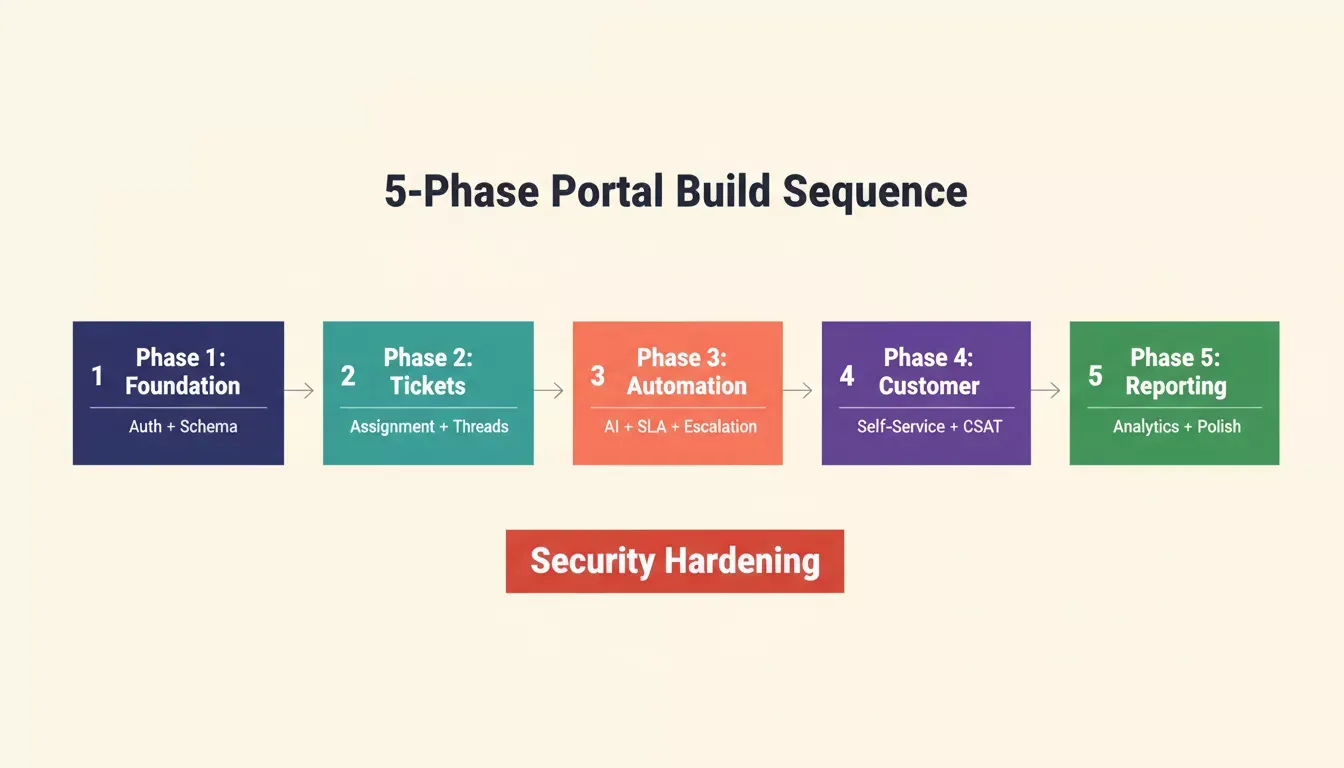
The complete five-phase build sequence, capped with a security hardening layer before going live.
Ship Your Support Portal Before the Next Ticket Lands
Twenty prompts for building, one optional mobile prompt, plus five for hardening. That is the complete path from authentication to a production-ready customer support portal with ticket management, AI automation, customer self-service, and reporting.
The next support ticket from an angry customer or a confused new user will not wait for you to finish coding screen fifteen manually. Start building today.
Rocket.new is the fastest way to turn these AI prompts to build a customer support portal into a deployed, full-stack application. Paste your first foundation prompt, watch the portal generate in minutes, and ship before the next ticket lands. Start building for free on Rocket.new and go from prompt to production portal in a single session.
Table of contents
- -How Should You Structure Prompts for a Support Portal?
- -Phase One: What Foundation Prompts Does Every Portal Need?
- -Prompt 1: Project Scaffold and Tech Stack
- -Prompt 2: Role-Based Authentication
- -Prompt 3: Portal Home Screen
- -Prompt 4: Database Schema for Support Tickets
- -Phase Two: Which Prompts Handle Core Ticket Management?
- -Prompt 5: Ticket Assignment Dashboard
- -Prompt 6: Conversation Thread View
- -Prompt 7: Internal Agent Notes
- -Prompt 8: Status Workflow Engine
- -Why Rocket.new Turns These Prompts Into a Shipped Portal
- -Phase Three: Automation Prompts That Eliminate Manual Work
- -Prompt 9: AI-Suggested Responses
- -Prompt 10: SLA Breach Alerts via Twilio
- -Prompt 11: Auto-Categorisation on Ticket Creation
- -Prompt 12: Escalation Process Automation
- -Phase Four: What Customer-Facing Features Complete the Portal?
- -Prompt 13: Customer Ticket History
- -Prompt 14: CSAT Rating After Resolution
- -Prompt 15: Knowledge Base with Search
- -Prompt 16: Deflection Flow Before Ticket Submission
- -Phase Five: Reporting and Polish Prompts
- -Prompt 17: Agent Performance Dashboard
- -Prompt 18: Empty State Designs
- -Prompt 19: Skeleton Loading States
- -Prompt 20: Mobile-Responsive Layout
- -Optional Prompt 21: Companion Mobile App
- -The Five-Prompt Security Hardening Sequence
- -Ship Your Support Portal Before the Next Ticket Lands