15 copy-paste AI prompts to build a complete help desk platform covering ticketing, SLA routing, knowledge base, and chatbot flows. No engineering team needed. Build each layer in sequence for the most stable result.
A help desk platform is customer support software that combines a ticketing system, agent dashboards, a knowledge base, and automation to manage and resolve customer issues. These 15 AI prompts to build a help desk platform cover every layer so you can ship a deployable system without an engineering sprint.
Why Custom Help Desk Software Outperforms Generic Solutions
74% of consumers expect round-the-clock customer service. According to the same report, 83% of CX leaders say memory-rich AI agents are the key to personalized customer journeys. Generic, off-the-shelf help desk software no longer cuts it for growing support teams.
Here is what that looks like in practice. A SaaS company with three support tiers tried to configure a popular help desk tool to route enterprise tickets to a dedicated agent pool. The routing rules hit a hard limit at four conditions per rule. They ended up with a workaround involving manual tags and a third-party automation that broke every time someone forgot to apply the tag.
A custom-built help desk, built with the prompts in this guide, handles that logic natively because you describe the business rule in plain language and the system generates it directly.
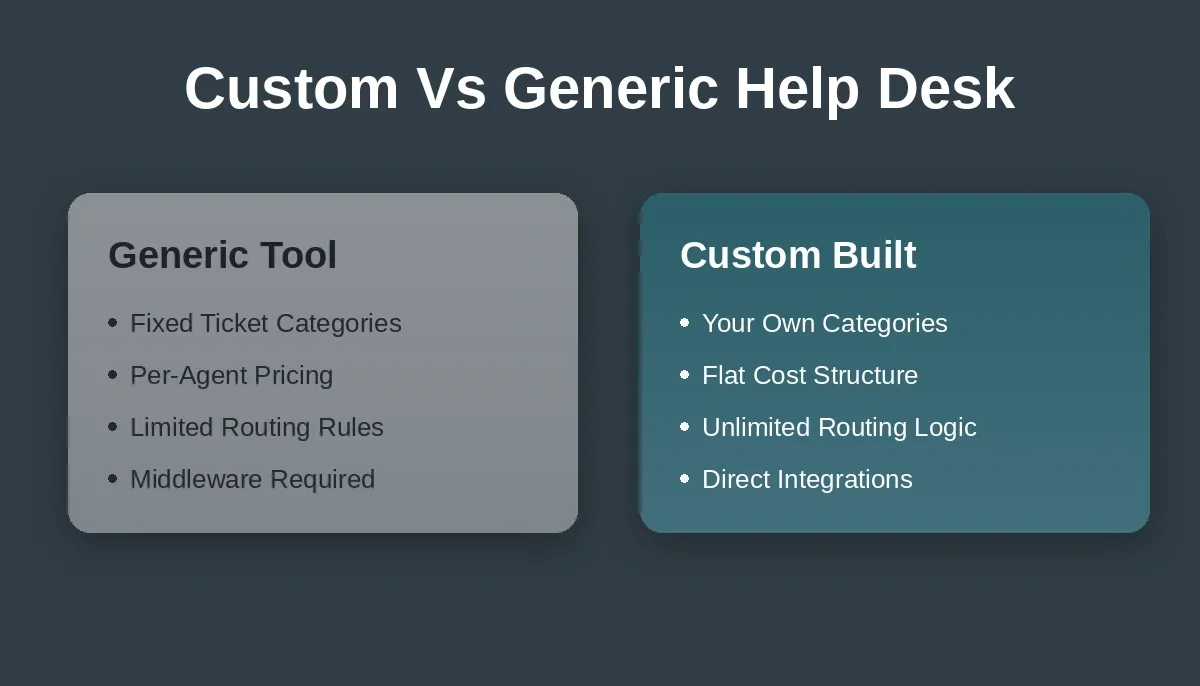
Custom-built help desk platforms adapt to your routing logic, pricing model, and integrations. Generic tools force you into their template.
Rigid ticket categories in off-the-shelf tools rarely match how customers describe problems. Custom platforms let you define categories, priorities, and SLA timelines based on your actual support data. Per-agent pricing on commercial tools scales painfully, while a custom platform keeps cost structure predictable regardless of team size.
You decide which tickets go to which agents based on skill, availability, language, or customer tier. Your ticketing system also connects directly to your CRM, billing system, and product database without third-party middleware.
Teams using prompt-based approaches to build specialized tools have seen similar results across domains, from AI prompts for task management apps to building a full B2B SaaS product with AI.
Who Should Use These Help Desk Prompts
Three types of builders get the most from this guide. Support team leads and operations managers who know exactly what their team needs but lack the development budget or timeline to match. Founders and product managers building a customer service layer into their SaaS product, marketplace, or e-commerce platform. Developers and agencies who want a fast starting point for a client's help desk project.
No coding knowledge is required. Understanding your support workflow, ticket categories, and team structure matters more than technical skills.
How To Structure Prompts For Support Applications
A great AI prompt does three things: it sets context, defines scope, and specifies output format. Most teams get the first one wrong because they describe a feature instead of a workflow.
"A ticketing system with tags and priorities" produces a data model. "A ticketing system where a billing ticket from a premium customer auto-routes to a senior agent within 5 minutes, with an SLA warning email at 75% elapsed time" produces a workflow. That distinction is the difference between a component you have to wire together and a system that works on day one.
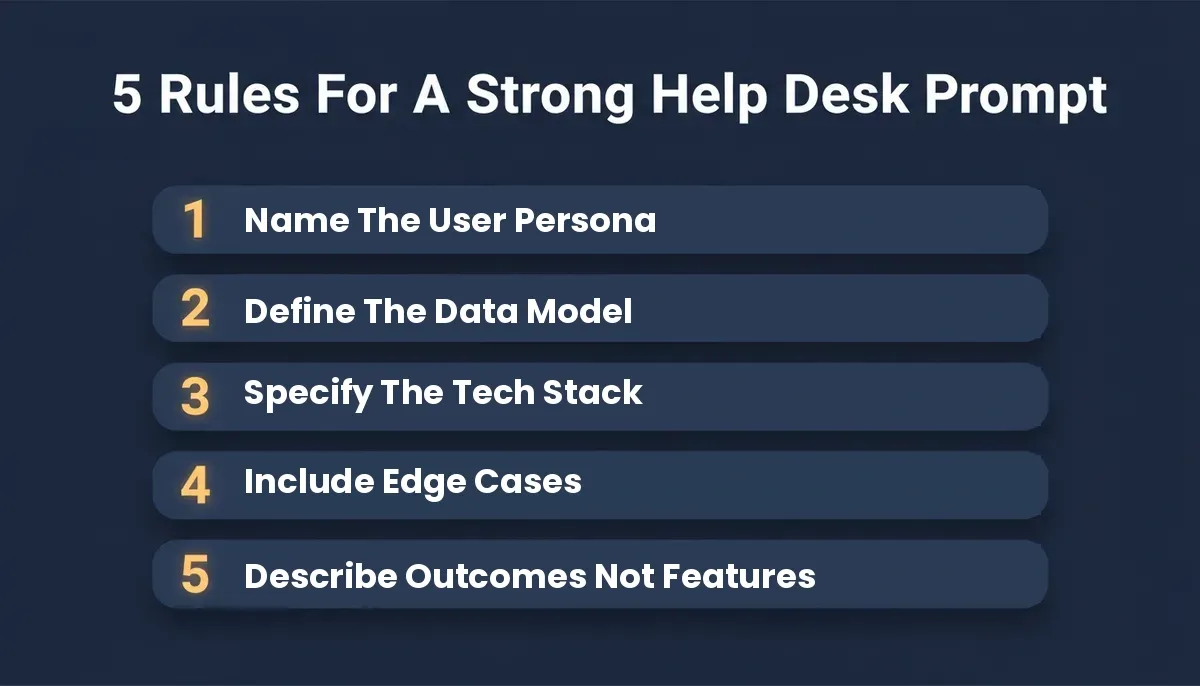
Every strong help desk prompt follows these five rules. Miss any one of them and the generated system will need significant rework.
User persona and use case. Name who will use this system and what their primary goal is. "Support agents need to see their assigned queue sorted by SLA urgency, not arrival time" is a better context-setter than "build an agent dashboard."
Explicit data model. Mention ticket fields, user roles, status transitions, and relationships between entities. Undefined relationships are the most common reason AI-generated help desk platforms break in production.
Tech stack preference. If you have one, say so. Specifying Next.js or your preferred database means the AI generates compatible code rather than making its own choice.
Edge cases. What happens when a ticket goes unresolved for 48 hours? Prompts that name edge cases produce systems that handle them.
Following prompt engineering best practices consistently produces more reliable outputs across every component you build.
Foundation Prompts For Core Help Desk Architecture (Prompts 1-5)
These five prompts establish the backbone of your help desk platform. Build these before anything else because every automation and self-service layer depends on the data model you define here.
Prompt 1: Multi-Tenant Ticketing System
"Build a help desk ticketing system with multi-tenant support. Include ticket creation with subject, description, priority (low/medium/high/critical), and category fields. Support file attachments up to 10MB. Add real-time status tracking (open, in-progress, waiting, resolved, closed) and automatic ticket numbering with prefix format HD-XXXX. Include a customer-facing submission form and an internal agent queue view."
Prompt 2: Role-Based Agent Dashboard
"Create a support agent dashboard with role-based access control for three levels: agents, supervisors, and admins. Agents see their assigned ticket queue with priority sorting. Supervisors see team performance metrics and can reassign tickets between agents. Admins have full system configuration access including SLA rules, department management, and help desk settings."
Prompt 3: Customer Portal With Ticket History
"Design a customer-facing self-service portal where users can submit new support tickets, view their complete ticket history, add comments to existing tickets, and rate resolutions with star ratings. Include a progress bar showing current ticket status and estimated response time based on historical SLA data for that ticket category."
Prompt 4: SLA Configuration Engine
"Build an SLA configuration module for the help desk where admins define response time and resolution time targets per priority level. Include automatic escalation triggers when SLA thresholds are breached. Show countdown timers on agent views and send email alerts at 75% and 100% of elapsed time. Track SLA compliance rates per team and per agent."
Prompt 5: Analytics And Reporting Module
"Create a help desk reporting dashboard showing ticket volume trends, average resolution time, first response time, agent performance metrics, customer satisfaction scores (CSAT), and SLA compliance rates. Include exportable reports in CSV format, date-range filtering, and comparison views between time periods."
According to Intercom's 2026 research, 82% of senior leaders invested in AI for customer service over the past 12 months, with only 10% reaching mature deployment. These five foundation prompts put you ahead of the majority still using surface-level implementations.
| Prompt | Component | Key Output | Build This Before |
|---|---|---|---|
| 1 | Ticketing System | Multi-tenant, file attachments, real-time status | Everything else |
| 2 | Agent Dashboard | Role-based views, queue management, team metrics | Routing (Prompt 6) |
| 3 | Customer Portal | Self-service submission, history, ratings | Chatbot (Prompt 12) |
| 4 | SLA Engine | Time targets, escalation triggers, compliance | Automation (6-10) |
| 5 | Analytics Module | Performance metrics, CSV export, trend analysis | Any time after Prompt 1 |
Automation Prompts For Ticket Routing And Escalation (Prompts 6-10)
Manual ticket routing creates a specific, measurable problem: tickets sit in a general queue while the right agent is idle. These five prompts build the automation layer that eliminates that gap.
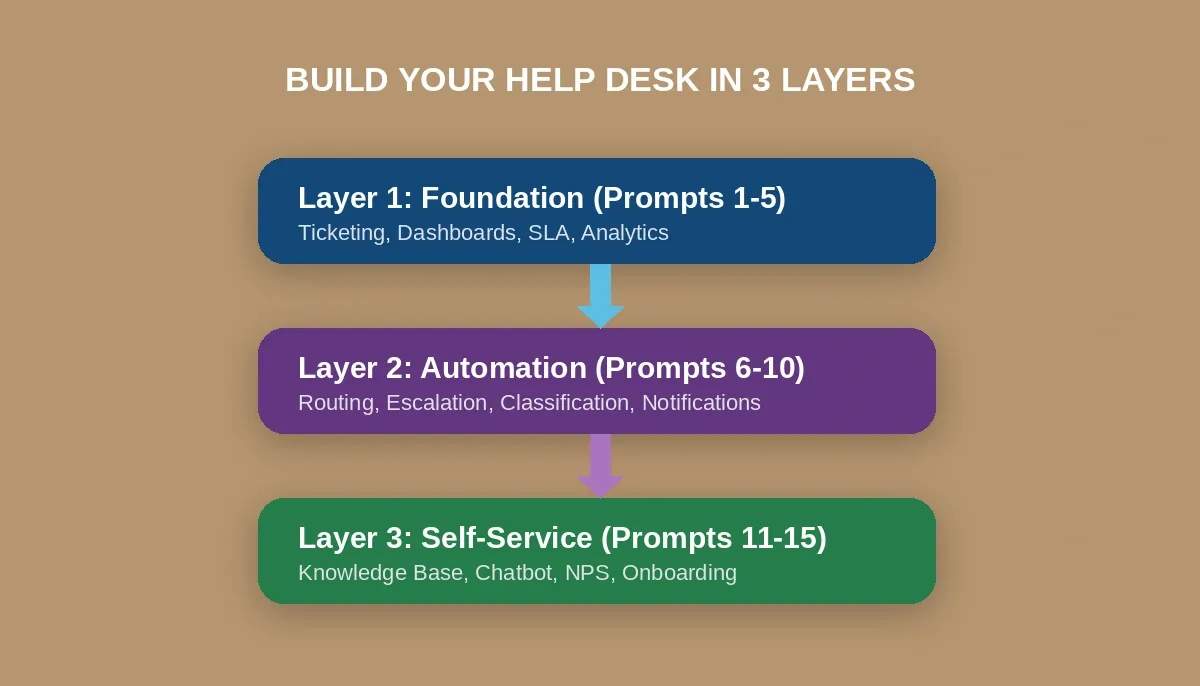
Build the three layers in sequence. Each layer depends on the one below it. Skipping ahead creates integration debt you will spend days fixing
Prompt 6: Skill-Based Ticket Routing
"Implement an intelligent ticket routing system for the help desk that automatically assigns incoming support tickets based on agent skills, current workload, and availability status. Define skill categories (billing, technical support, product questions, account management) and match them against ticket content using keyword detection and natural language processing. Balance ticket load across available agents within each skill group."
Prompt 7: Priority-Based Escalation Ladder
"Build an escalation workflow for the customer support system with three tiers. Tier 1: auto-assigned to available support agents. Tier 2: escalated to senior agents after SLA warning at 75% time elapsed. Tier 3: escalated to team lead or supervisor after SLA breach. Include an override option for VIP customers who skip directly to Tier 2 support."
Prompt 8: Automated Ticket Classification With AI
"Create an AI-powered ticket classifier for the help desk that analyzes incoming ticket subject and description to automatically assign category, priority level, and suggested department. Use pattern matching and natural language understanding for common customer issues (password reset, billing dispute, feature request, bug report) and flag ambiguous tickets for manual review by a senior agent."
Prompt 9: Canned Response And Macro System
"Design a macro system for support agents where they can create, share, and insert pre-written responses to common customer questions. Include variable placeholders (customer name, ticket ID, product name, account status) that auto-fill on insertion. Add a suggestion engine that recommends relevant macros based on ticket category and customer message content."
Prompt 10: Notification And Alert Pipeline
"Build a notification system for the help desk platform that sends email and in-app alerts for: new ticket assignments, customer replies, SLA warnings, escalation events, and resolution confirmations. Allow support agents to configure notification preferences per channel and event type. Include a digest mode for low-priority updates and real-time push notifications for critical tickets."
The same prompt structuring principles apply when building a customer portal with an AI builder. Context, scope, and output format drive the quality of every generated component.
Ticket lifecycle: from AI classification through skill-based routing to escalation and CSAT collection.
Self-Service Prompts: Knowledge Base, Chatbot, NPS (Prompts 11-15)
The best help desk platforms resolve customer issues before they become tickets. These five prompts build the self-service layer that deflects common questions, reduces agent workload, and improves customer satisfaction scores, while personalized engagement through self-service and chatbot flows can also improve loyalty and retention.
Prompt 11: Searchable Knowledge Base With Categories
"Build a knowledge base system for the help desk with hierarchical categories, full-text search with autocomplete, and article versioning. Include a WYSIWYG editor for content authors, view analytics per article (page views, search impressions, click-through rates), and a feedback mechanism (helpful/not helpful) that surfaces articles needing updates."
For teams building a standalone knowledge base before connecting it to a full help desk, the guide on AI prompts to build a knowledge base for teams covers the architecture in depth.
Prompt 12: AI Chatbot With Contextual Responses
"Create a customer-facing AI chatbot for the help desk that answers questions using knowledge base articles and FAQ content. The chatbot should understand natural language queries, suggest relevant knowledge articles with confidence scores, and offer to create a support ticket when it cannot resolve the issue. Track chatbot resolution rate and human handoff percentage as key customer service metrics."
A strong implementation should understand context from past tickets and live customer conversations, keep answers up to date, and avoid falling back to a generic response when a more specific reply is available.
Prompt 13: Community Forum With Upvoting
"Design a community support forum where customers can post questions, reply to threads, and upvote helpful answers from other users. Include moderation tools for support agents, the ability to mark official responses, and automatic linking to related knowledge base articles. Surface trending customer topics on the help center homepage."
Resolved threads can also be turned into a knowledge base article, which supports better knowledge management over time.
Prompt 14: Onboarding Wizard And Interactive Guides
"Build an interactive customer onboarding system that walks new users through product setup with step-by-step guides. Include progress tracking, contextual tooltips, and the option to request human support at any step. Track completion rates per guide and identify drop-off points to improve the self-service experience."
Prompt 15: Feedback Collection And NPS Survey Module
"Create a post-resolution feedback system for the help desk that triggers CSAT surveys after ticket closure. Include NPS surveys at configurable intervals (30, 60, 90 days). Build a sentiment analysis dashboard showing customer satisfaction trends over time and correlating scores with agent performance, ticket category, and resolution time."
That feedback can also improve training data for future automation and content suggestions.
McKinsey's customer engagement research found that AI-enabled customer service transformation can reduce cost-to-serve by 20% while doubling self-service channel adoption. These self-service prompts target exactly that outcome.
Teams building other support-adjacent tools, like internal tools without a developer, follow the same layered prompt approach to ship faster.
Common Mistakes When Building A Help Desk Platform With AI Prompts
Prompting for features instead of workflows. "A ticketing system with tags and priorities" produces a data model. "A ticketing system where a billing ticket from a premium customer auto-routes to a senior agent within 5 minutes" produces a workflow. Describe the outcome, not the component.
Skipping the data model definition. The most common reason AI-generated help desk platforms break is an undefined relationship between tickets, agents, departments, and customers. Specify your entity relationships in the prompt before describing features.
Building all 15 components at once. Start with Prompts 1 and 2, test them end-to-end, then layer in automation (Prompts 6-10) and self-service (Prompts 11-15). Start small by automating one repetitive query or other routine requests before expanding the system. Incremental building produces more stable systems than front-loading every feature.
Ignoring SLA logic until the end. SLA rules touch every other component: routing, escalation, notifications, and analytics. Define your SLA configuration (Prompt 4) before building automation workflows (Prompts 6-10).
Not specifying the customer tier model. If your support workflow treats enterprise customers differently from free users, your prompt must say so explicitly. AI builders cannot infer business logic that is not described.
Help Desk Platform Launch Checklist
Before going live, verify each of these is in place. This checklist directly counters the five mistakes above.
- Ticket submission form tested end-to-end (creation, assignment, notification)
- Role-based access verified for agents, supervisors, and admins
- Validate automation on routine requests before scaling to broader support scenarios
- SLA timers confirmed running correctly for each priority level
- Escalation triggers tested with a simulated SLA breach
- Email notifications firing for all key events (assignment, reply, resolution)
- Knowledge base populated with at least 10 articles covering top support topics
- AI chatbot tested against your 20 most common customer questions
- CSAT survey triggering after ticket closure
- Analytics dashboard showing live ticket volume and response time data
- Customer portal accessible and functional on mobile devices
How Rocket.new Turns One Prompt Into A Full Help Desk System
Writing 15 individual prompts works. But there is a faster path.
Rocket.new is a vibe solutioning platform that combines strategic research, AI app building, and competitive intelligence into a single product. Its Build pillar generates complete, deployable applications from natural language descriptions. You get working products with real code, not wireframes or prototypes.
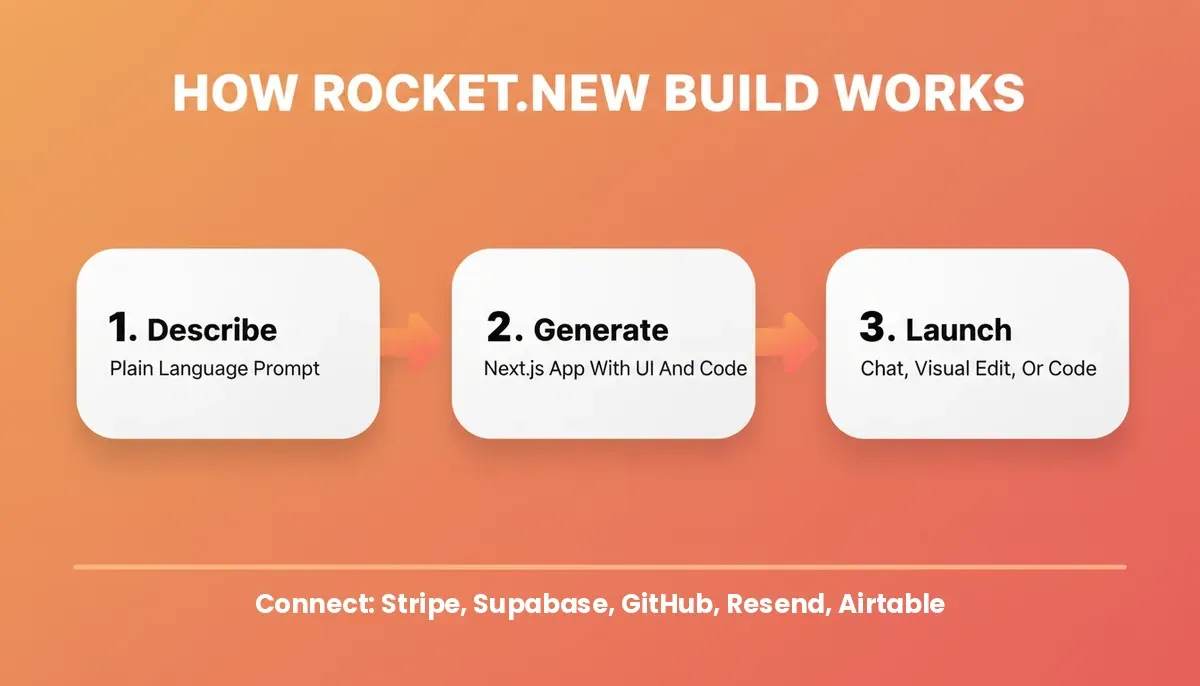
Rocket.new generates a fully functional Next.js app from a plain-language description. Connect services like Stripe, Supabase, and GitHub directly in the build conversation.
Describe your customer support requirements in plain language. Rocket.new generates the full system: ticketing, routing, knowledge base, agent dashboards, and customer portal, all connected and ready to deploy. Every web app Rocket.new builds uses Next.js. For mobile, it generates Flutter apps ready for the App Store and Google Play.
Connect Supabase for your database and auth, Stripe for billing, Resend or SendGrid for email notifications, Airtable for data management, and GitHub for version control through workspace connectors. Rocket.new integrates with 25+ services out of the box. Authorize once at the workspace level and every project inside can use them.
Before you build, Rocket.new's Solve pillar validates your support platform's scope. It maps customer pain points, ticket categories, and workflow requirements before a single line of code is generated. You can also start from a template to accelerate the initial scaffolding, then customize with your own prompts.
"I just one shotted a prompt using @rocketdotnew and I can't put into words how astronomically better it is than any other no code AI tool. Actually made me question why I ever paid for Bolt, Lovable, V0, a0 etc when this tool puts them all to shame." - Mia Williams, @miatravls on X
Sign up in about 30 seconds with Google, Apple, or email. No credit card required. The Free plan includes 20 credits to get started.
What Results Can You Expect After Help Desk Deployment
These numbers come from industry research and reflect what happens when routing, SLA, and self-service layers are all working together.
First response times drop by 40-60% when automated ticket routing replaces manual triage. Support tickets reach the right agent immediately instead of sitting in a general queue.
Self-service deflection rates of 30-50% are common once a knowledge base and AI chatbot are active. Each deflected ticket saves $5-$15 in agent handling costs. A team handling 500 tickets per week that deflects 35% saves roughly $875-$2,625 per week in handling costs alone.
Customer satisfaction scores improve when resolution paths are predictable. Customers who can see their ticket status, estimated wait time, and SLA countdown feel more in control, and clear expectations during delays reduce frustration. That kind of effective communication strengthens rapport, supports customer trust, and helps customers feel respected, which improves customer experience and helps teams meet customer expectations even when resolution time stays the same.
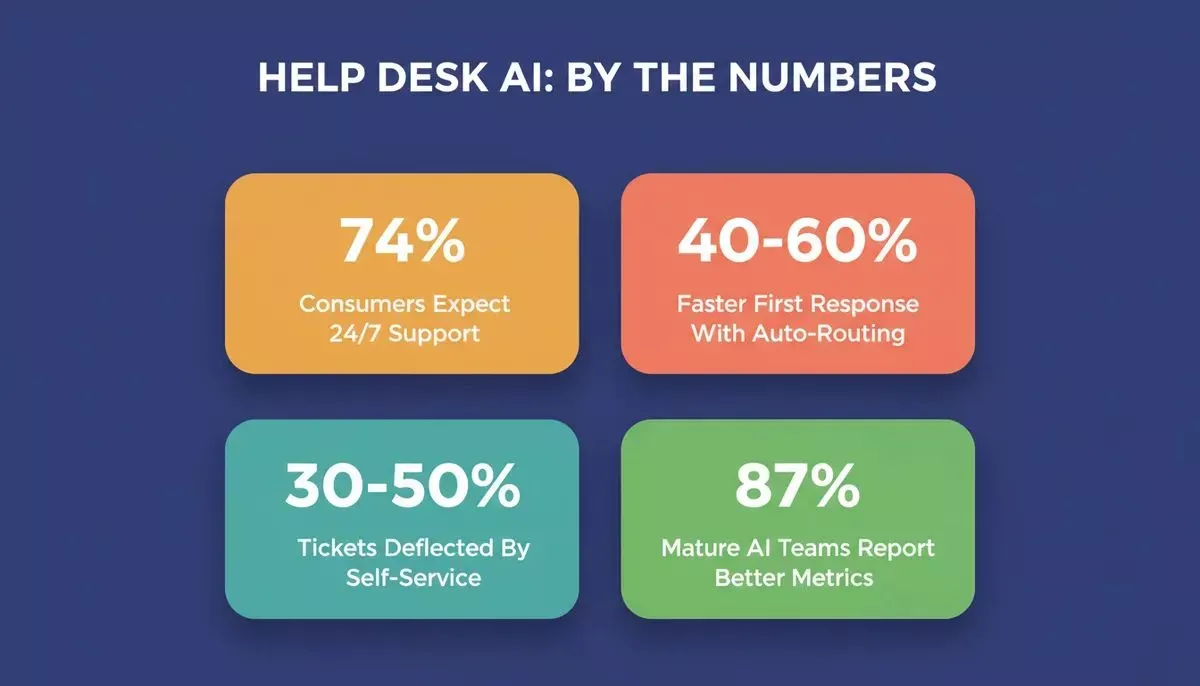
Key benchmarks for AI-powered help desk platforms. The 87% figure reflects teams at mature AI deployment vs. 62% overall.
Intercom's 2026 report found that 87% of teams at mature AI deployment report improved customer service metrics, compared to 62% overall. Going deep with help desk customization, not just surface-level AI adoption, is what drives that gap.
Teams applying the same approach to adjacent use cases, like building a project management app with AI prompts, consistently report faster deployment and fewer post-launch fixes when they follow the layered prompt structure outlined in this guide.
| Result Metric | Typical Outcome | Key Driver |
|---|---|---|
| First response time | 40-60% reduction | Automated ticket routing |
| Self-service deflection | 30-50% of tickets | Knowledge base + AI chatbot |
| Cost per deflected ticket | $5-$15 saved | Reduced agent handling |
| CSAT improvement | Measurable uplift | Predictable resolution paths |
| Mature AI teams reporting improvement | 87% vs. 62% overall | Deep customization |
Start Building Your Help Desk Platform
AI prompts to build a help desk platform have moved from experiment to production reality. The 15 prompts in this guide cover every layer: ticketing, routing, knowledge base, chatbot, and analytics. Any team can now ship a custom customer support system without a dedicated engineering sprint.
The teams that build custom now will compound that advantage as AI capabilities improve. Ticket classification gets more accurate, chatbot responses become more contextual, and SLA enforcement tightens. The infrastructure you build today is the foundation those improvements run on.
You have the prompts. You have the architecture. Describe your ideal help desk on Rocket.newand get a production-ready system back in minutes, not months. Sign up in about 30 seconds, no credit card required.
Table of contents
- -Why Custom Help Desk Software Outperforms Generic Solutions
- -Who Should Use These Help Desk Prompts
- -How To Structure Prompts For Support Applications
- -Foundation Prompts For Core Help Desk Architecture (Prompts 1-5)
- -Automation Prompts For Ticket Routing And Escalation (Prompts 6-10)
- -Self-Service Prompts: Knowledge Base, Chatbot, NPS (Prompts 11-15)
- -Common Mistakes When Building A Help Desk Platform With AI Prompts
- -Help Desk Platform Launch Checklist
- -How Rocket.new Turns One Prompt Into A Full Help Desk System
- -What Results Can You Expect After Help Desk Deployment
- -Start Building Your Help Desk Platform