
Price monitoring software automatically tracks competitors' prices and sends real-time alerts when anything changes. This guide compares six leading tools for eCommerce and B2B teams and provides a clear framework for picking the right one.
What if your competitor changed their prices overnight and you had no idea?
Price monitoring software automatically tracks competitors' prices and sends alerts the moment anything changes. According to McKinsey, a 1% improvement in pricing lifts operating profits by 8% for the average S&P 1500 company. That number shows exactly why staying current on competitor pricing matters.
Manual spot-checks and spreadsheets used to be the only option. Today, purpose-built tools watch competitor websites around the clock, flag price changes in real time, and feed that data directly into your pricing strategy. This guide covers the top tools for both eCommerce and B2B teams, along with a clear framework for choosing the right one.
How Does Competitor Price Tracking Actually Work?
Competitor price tracking comes down to one core loop: collect, process, alert, and act. Understanding that loop helps you evaluate any software on the market.
-
Data collection pulls current prices from competitor product pages, marketplaces, and search listings at scheduled intervals.
-
Normalization engines match competitor products to yours, even when the same product appears under different SKU names across sites, so every comparison is like-for-like.
-
Alert systems fire when a competitor crosses a threshold you define: a price drop, a promotion launch, or a stock availability change.
-
Reporting dashboards surface price tracking trends over time, showing behavioral patterns rather than just point-in-time snapshots.
Most price monitoring software runs this loop automatically, freeing your team to act on data rather than chase it.
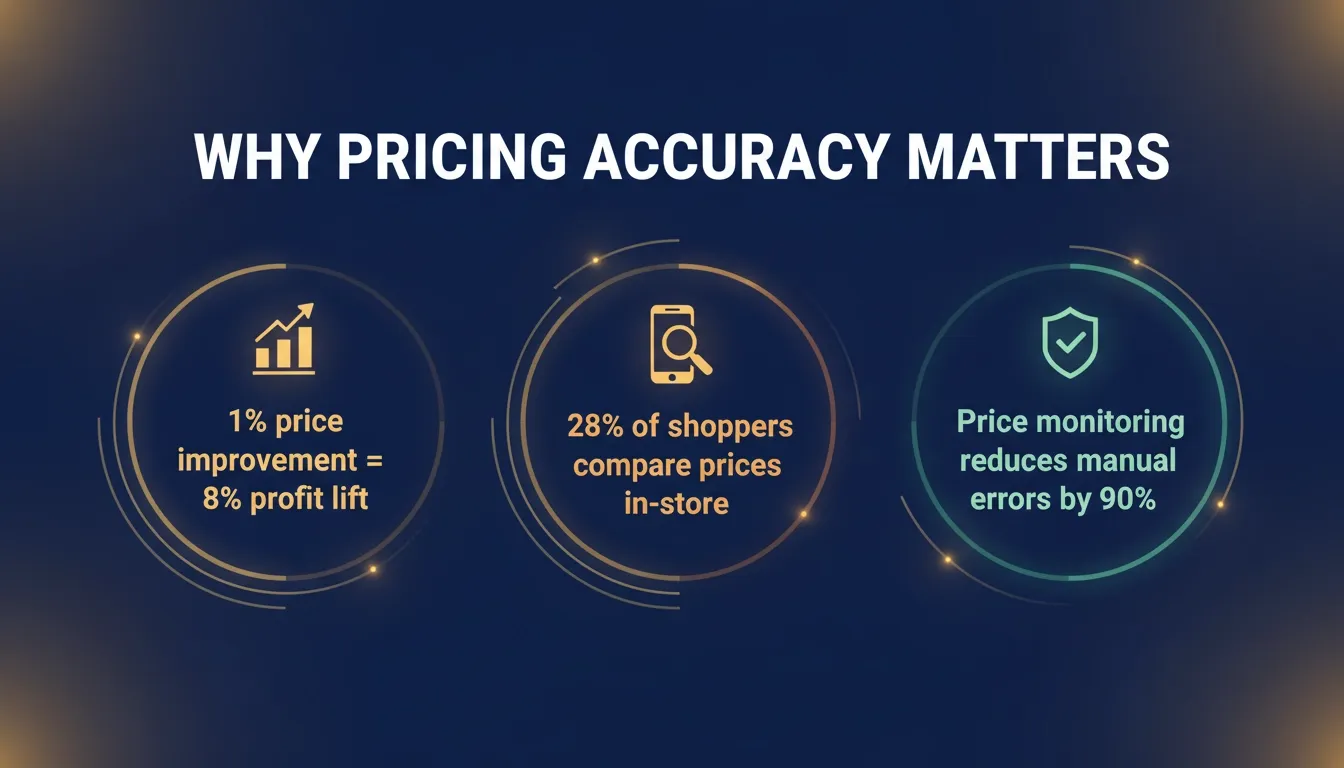 Key statistics that show why price monitoring is a business-critical discipline
Collecting Competitor Prices Automatically
The starting point for most tools is a list of competitor URLs or product pages you want to monitor.
-
Web scraping bots visit those product pages at set intervals, capturing current prices, promotional banners, and stock availability data.
-
Some tools monitor multiple websites simultaneously, including Amazon, eBay, and Google Shopping feeds, without separate setup per channel.
-
Others extract pricing data using API access to structured marketplace data, which tends to be faster and more reliable than raw page scraping.
The accuracy of your pricing data depends entirely on how frequently the tool collects and how cleanly it normalizes product matches.
Price Change Alerts and Repricing Triggers
Getting the data is only half the job. Acting on price changes fast is where most businesses fall short.
-
Price change alerts notify your team via email, Slack, or in-app notifications the moment a competitor adjusts their price by a margin you define.
-
Automated repricing tools go further, applying pre-set pricing rules to adjust your own prices without manual review.
-
Dynamic repricing is standard in e-commerce: a tool matches, undercuts, or holds above competitor prices based on boundaries you set, including minimum margin floors.
Setting clear pricing rules before enabling automated repricing is the difference between protecting margins and eroding them.
Monitoring Frequency and Data Accuracy
Not all tracking intervals are equal, and the right monitoring frequency depends on how fast your market moves.
-
Hourly checks make sense for Amazon sellers or consumer electronics retailers, where prices shift multiple times a day.
-
Daily monitoring covers most B2B and mid-market scenarios, where competitor prices change more slowly.
-
Accurate pricing data also requires tracking stock availability alongside prices, so you know when a competitor's out-of-stock event signals an opportunity rather than just a data gap.
Historical data from past price checks reveals seasonal patterns and helps teams anticipate competitor promotions before they arrive.
eCommerce vs. B2B/SaaS: Which Category Fits Your Business?
Not all competitive pricing challenges look alike, and a tool built for a fashion retailer will frustrate a SaaS sales team. The category you choose shapes everything from monitoring frequency to the type of alerts that matter.
-
eCommerce and retail teams track product prices across large SKU catalogs on Amazon, eBay, and Google Shopping simultaneously.
-
B2B and SaaS teams monitor packaging restructures, pricing page copy changes, and tier additions as strategic signals rather than raw price numbers.
-
Dynamic pricing strategy differs sharply between the two contexts, as The Strategy Story explains: retail focuses on real-time competitive response, while B2B is about reading intent before it affects your deals.
The right category match saves time. The wrong one creates noise.
eCommerce and Retail Price Monitoring
Retail and e-commerce brands need tools that move at the pace of their competitors.
-
Product prices on Amazon and eBay can change dozens of times a day, making hourly monitoring a practical floor rather than a premium feature.
-
Good retail tools track stock availability and competitor listings side by side, so your team knows when a rival's out-of-stock creates a pricing window.
-
Stock levels matter as much as raw pricing data for retailers: a competitor running low on inventory often signals holding your price rather than cutting it.
For e-commerce, the most useful tools pair price tracking with availability monitoring to give a complete view of competitor position. For teams building e-commerce apps alongside their pricing strategy, having clean pricing data from day one is essential.
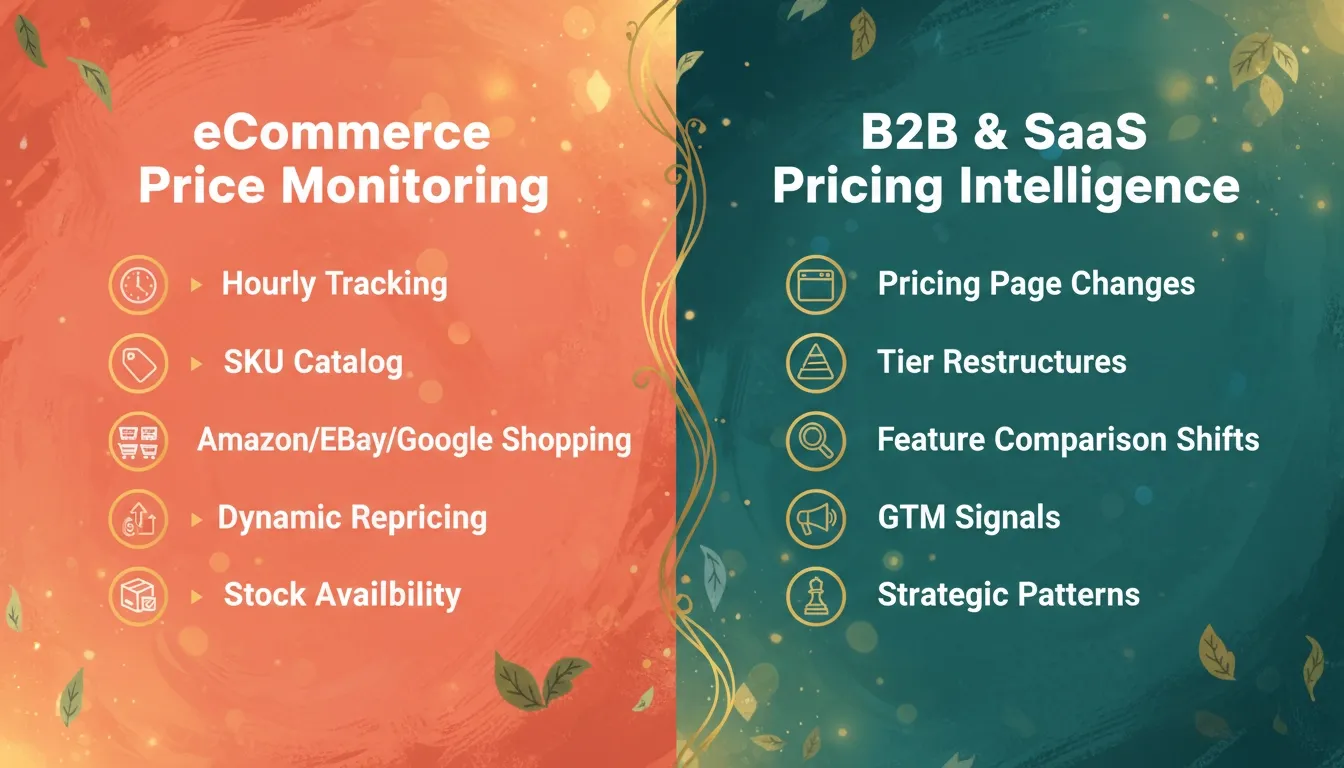 eCommerce and B2B pricing intelligence require fundamentally different tools and monitoring approaches
B2B and SaaS: Tracking Competitor Pricing Intelligence
B2B pricing intelligence is a fundamentally different discipline from retail price tracking.
-
Competitor price monitoring in this context focuses on structural changes: new tiers, removed features, and reworded value propositions on pricing pages.
-
Enterprise pricing rarely appears on a public page, so teams track proxy signals like pricing page copy shifts and changes to feature comparison tables.
-
Solid competitor price monitoring software for SaaS surfaces pricing strategy shifts through clusters of signals rather than a single data point.
B2B teams with ongoing competitor pricing intelligence gain weeks of lead time over rivals who only react after a prospect raises the issue on a call. A strong competitive intelligence program makes this systematic rather than reactive.
How to Tell Which One You Need
A few quick questions will point you toward the right category.
-
Do you sell physical products on e-commerce platforms? Start with a dedicated price tracking and repricing platform.
-
Are you a B2B or SaaS company selling through a sales team, with multiple channels and contract-based pricing? You need pricing intelligence, not just price tracking.
-
Medium-sized businesses sometimes fall between both use cases, and a data-driven approach means trialing one platform from each category before committing.
When in doubt, pick the category that reflects how your customers compare you to competitors.
Which Price Monitoring Tools Are Worth Your Time?
28% of US consumers compare prices on their phones while standing in a physical store, according to Tidio's ecommerce research. For online retailers, that figure makes competitor pricing a live, always-on concern.
-
Tools range from lean eCommerce repricers tracking a few hundred SKUs to full competitive intelligence platforms monitoring multiple competitors across many websites.
-
This guide compares the main options across use cases, free trial access, and the single feature that separates each one from the pack.
-
One builder on Hacker News put it plainly: "I got frustrated with tools that only work on Amazon or require products to already be in their database," capturing a frustration many teams share when starting to track competitor prices. (Source)
Teams that skip a proper setup often find themselves leaving money on the table every time a competitor quietly adjusts their pricing.
| Tool | Best For | Free Trial | Key Feature |
|---|---|---|---|
| Prisync | eCommerce repricing | Yes | Dynamic repricing + stock monitoring |
| Price2Spy | High-SKU retailers | Yes | API access + historical pricing data |
| Wiser | Mid-market retail | Yes | AI-powered cross-channel insights |
| Competera | Enterprise retail | Limited | Demand-aware dynamic pricing |
| Crayon | B2B competitive intelligence | Yes | Full CI suite for revenue teams |
| Klue | Enterprise B2B / sales | Yes | Sales battlecard generation |
Prisync
Prisync is built for eCommerce teams that want price tracking and repricing in a single platform.
-
Monitors competitor prices across multiple websites and marketplaces, with daily and hourly update options on higher paid plans.
-
Its dynamic pricing module applies pricing rules automatically, adjusting prices based on competitor moves and stock availability signals.
-
A free trial is available, and plans scale based on the number of products you monitor.
Prisync suits mid-size eCommerce teams that want automated repricing without building custom tooling.
Price2Spy
Price2Spy focuses on deep price tracking across high-SKU catalogs and multiple competitor websites.
-
Tracks competitor prices on thousands of product URLs with configurable monitoring frequency per product group.
-
API access lets technical teams pull pricing data directly into custom dashboards or BI tools without manual exports.
-
Historical price charts help teams spot seasonal pricing patterns and prepare for competitor promotional cycles in advance.
Price2Spy is a strong fit for retailers that need clean, structured pricing data at catalog scale.
Wiser
Wiser targets mid-market and enterprise retailers that need competitor pricing intelligence alongside their own sales data.
-
Combines AI-powered analysis with channel monitoring, giving retailers a view of competitor prices across online and physical store formats.
-
Tracks product prices on Amazon, eBay, Walmart, and other online retailers from a single dashboard.
-
Price change alerts and repricing recommendations surface in a view built for category managers and pricing analysts.
Wiser is well-reviewed for teams that need cross-channel visibility over a pure online price tracker. Teams running omnichannel retail operations will find their multi-channel approach particularly valuable.
Competera
Competera sits at the enterprise end of the retail price monitoring market, with a focus on demand-aware dynamic pricing.
-
Its pricing engine uses AI to factor in demand signals alongside competitor prices, producing recommendations that protect profit margins rather than just matching the lowest price.
-
Pricing rules apply at the category level, allowing large product assortments to be managed without per-SKU manual input.
-
Dynamic repricing operates within margin floors you define, giving large retailers both speed and control.
Competera fits retailers managing large assortments who need pricing decisions that account for demand, not just competitor position.
Crayon
Crayon is a competitive intelligence platform built for B2B teams, not a traditional price scraper.
-
Tracks competitor pricing pages, product announcements, and marketing copy changes across websites and public-facing channels.
-
Competitor price tracking data feeds into battlecards and sales enablement content, helping revenue teams walk into deals prepared.
-
Crayon captures a wide range of competitor data, but does not offer automated repricing or SKU-level product price monitoring.
For B2B sales teams, Crayon's strength is the breadth of competitive signals rather than pricing-specific depth. Understanding how to track competitor prices systematically is what separates reactive teams from proactive ones.
Klue
Klue is a competitive intelligence platform designed for enterprise revenue teams and sales-driven organizations.
-
Surfaces competitor price monitoring signals alongside messaging shifts, win/loss data, and sales intelligence in a single view.
-
Battlecards generated inside Klue pull in competitor pricing data to help sales reps address pricing objections in deals.
-
Klue does not offer the SKU-level product price tracking that retail repricers provide, which limits its fit for eCommerce teams.
For enterprise B2B companies with large sales teams, Klue provides a competitive pricing context within a full sales intelligence workflow.
How to Choose the Right Tool for Your Team
After reviewing six tools, the decision usually comes down to three factors: what you sell, how many competitors you want to monitor, and whether you need automation or intelligence.
-
Match the tool to your business model first. A retail repricing platform is the wrong choice for a SaaS company; a competitive intelligence suite is the wrong choice for a fashion retailer with 5,000 SKUs.
-
Define your catalog size. Some tools handle 100 SKUs cleanly but struggle at 10,000; others are built for scale from day one.
-
Clarify whether you need repricing or monitoring. Automated repricing changes your prices without manual input; monitoring tools give you the data to act on your own terms.
The right solution is the one that fits your workflow, not the one with the longest feature list.
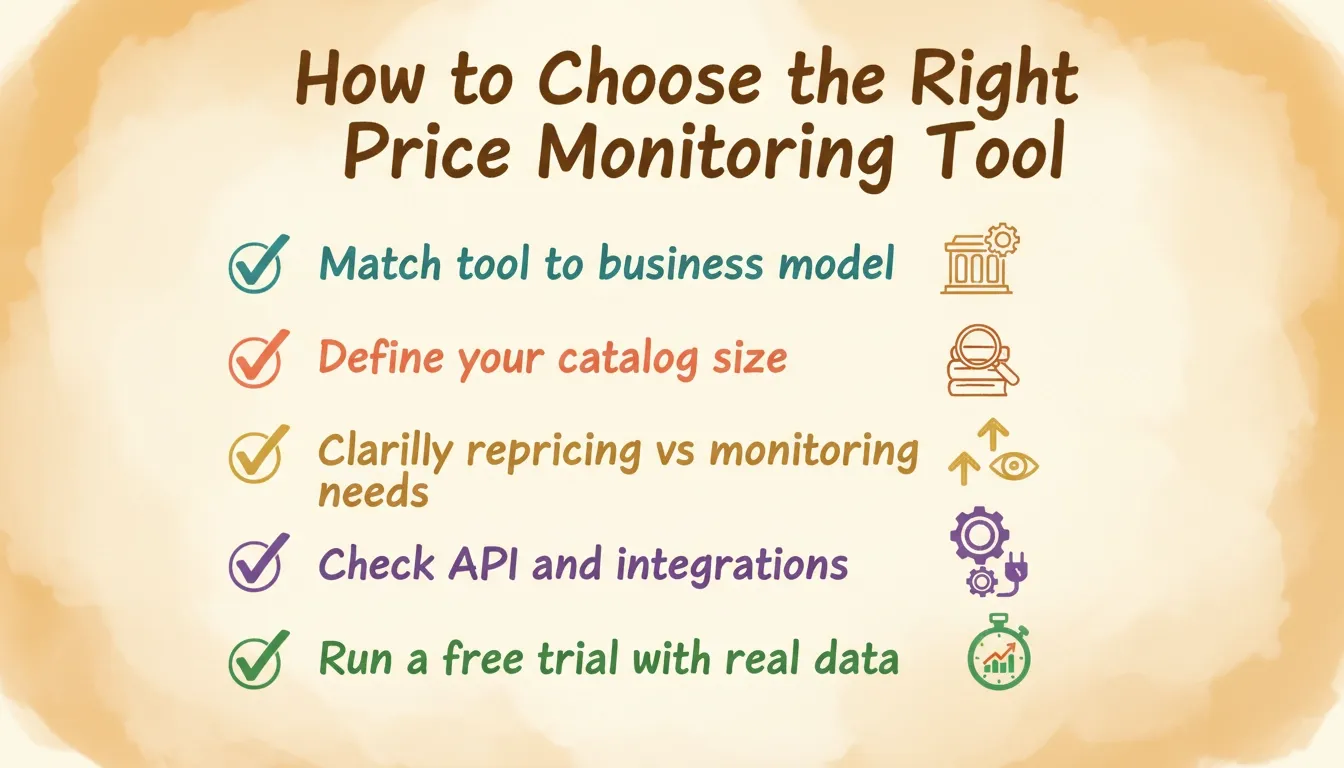 Use these five criteria to evaluate any price monitoring or competitive intelligence tool before committing
Coverage, SKU Count, and Scalability
The first question is practical: how many products and competitors do you need to monitor?
-
Tools like Price2Spy and Prisync handle thousands of SKUs cleanly; lighter platforms work well up to a few hundred product URLs before accuracy drops.
-
Catalog scale also affects monitoring frequency: a 100-SKU store can afford hourly tracking on every item, while a 50,000-item catalog often needs smarter prioritization.
-
Check whether a tool's upper SKU limits match your three-year catalog projection, not just your current assortment size.
Build this into your evaluation criteria before you start a free trial.
API Access and Connection Options
How pricing data flows into your existing systems matters as much as the data quality itself.
-
API access lets your team pipe pricing data into custom dashboards, internal repricers, or BI tools. Good API integrations connect your pricing data to the systems your team already uses without manual exports.
-
Google Sheets connections are a practical option for smaller teams that want automatic price comparison tables without engineering support.
-
Slack notifications bring price change alerts into the channels your team already monitors, so a competitor move is less likely to go unnoticed.
If your team runs on Slack and Google Sheets, prioritize tools with native connections to both.
Monitoring Frequency and Free Trials
Monitoring frequency and free trial access are two of the most overlooked criteria in this category.
-
Most paid plans default to daily monitoring; hourly tracking typically sits behind a higher-tier paid plan.
-
A free plan or free tier is worth using to test data accuracy before committing, since pricing data that looks clean in a demo can produce matching errors at catalog scale.
-
A free trial of at least 14 days gives your team time to validate SKU coverage, alert accuracy, and responsiveness with your actual product catalog. No credit card required options make this easier to start.
Never commit to a price monitoring subscription without running your real catalog through the free trial first.
How Rocket Intelligence Handles Competitor Pricing for B2B
For B2B and SaaS teams, standalone price scrapers only show part of the picture. Competitor pricing is rarely just a number: it is a signal embedded in copy changes, packaging shifts, and go-to-market moves.
-
Rocket Intelligence watches competitor websites, pricing pages, social media, news coverage, hiring signals, and customer reviews from a single workspace.
-
While Crayon and Klue surface competitive data for sales teams, both require manual curation and lack the real-time interpretation layer that connects a pricing change to the strategy behind it.
-
Rocket does not just alert you to a pricing page update: it tells you what that update means in the context of everything else happening across that competitor's public presence.
That gap between a raw pricing alert and strategic intelligence is exactly what separates a tool from a system.
From Pricing Pages to GTM Signals
A competitor dropping their entry-level price tier is noise on its own. That same drop, combined with a new enterprise case study, a LinkedIn campaign targeting CFOs, and three new account executive job postings, is a clear signal.
-
Rocket Intelligence monitors competitor pricing pages alongside social media activity, news coverage, executive behavior, and hiring data at the same time.
-
Competitor price tracking in this model surfaces cross-pillar patterns, weighing each price change against everything else detected in the same time window.
-
AI-powered interpretation flags signal clusters that matter: a pricing shift paired with a messaging pivot is a strategic move, not a routine seasonal adjustment.
This is competitor monitoring built for teams making strategic decisions, not just teams reacting to the cheapest price on a product page. A well-structured competitor pricing strategy response framework turns these signals into decisive action.
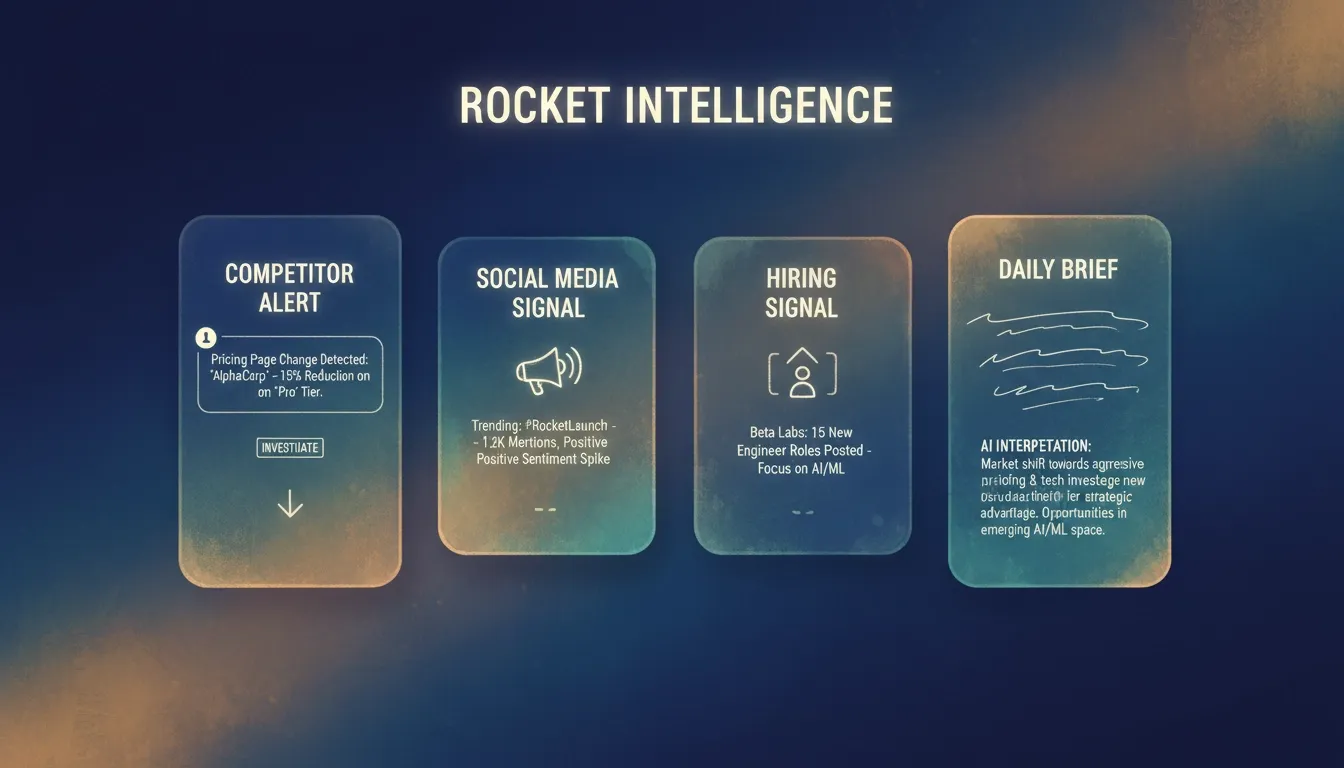 Rocket Intelligence connects pricing signals to broader competitor strategy in a single workspace
Daily Briefs That Surface What Matters
Most teams do not have the bandwidth to log into a competitive intelligence dashboard every morning. Rocket Intelligence delivers instead.
-
Daily briefs package AI summaries of every competitor signal from the previous 24 hours, arriving before your first meeting of the day.
-
Each brief includes a "So what" interpretation layer: what the data means for your pricing strategy, sales positioning, or product roadmap.
-
Real-time alerts flag critical signals, such as a competitor removing a free tier or restructuring enterprise pricing, so teams can respond the same day rather than the same quarter.
Consistent, interpreted intelligence compounds over time: a team reading daily briefs for 90 days makes pricing and sales decisions that a team skimming quarterly snapshots simply cannot.
Start Monitoring on Rocket.new
Setting up Rocket Intelligence takes about five minutes, with no engineering work required.
-
Add your competitors by name or URL, and Rocket maps every public surface they operate on automatically.
-
A free trial gives you access to the full intelligence dashboard, including pricing page monitoring, social signals, and daily briefs.
-
The complete setup guide and feature reference are available at docs.rocket.new.
Start monitoring your competitors today and stop being the last team to know when their pricing strategy changes.
See What Your Competitors are Planning
Choosing the right competitive pricing software comes down to knowing what type of intelligence your team actually needs. eCommerce brands should start with a price tracking platform built for their catalog size and the channels they sell on. The right tool pays for itself quickly when it catches a competitor promotion that your pricing team would have missed manually.
For B2B and SaaS companies, competitor pricing signals sit inside a broader web of strategy moves. A tool that surfaces only a price number will miss the pattern. Rocket Intelligence connects those signals continuously, so your team understands what a pricing change means, not just that it happened.
Ready to stop reacting and start anticipating?
Rocket gives B2B and SaaS teams a complete competitive intelligence layer that turns pricing signals into a strategic advantage.
Start your free trial and see what your competitors are planning before it reaches your deals.
Table of contents
- -How Does Competitor Price Tracking Actually Work?
- -Collecting Competitor Prices Automatically
- -Price Change Alerts and Repricing Triggers
- -Monitoring Frequency and Data Accuracy
- -eCommerce vs. B2B/SaaS: Which Category Fits Your Business?
- -eCommerce and Retail Price Monitoring
- -B2B and SaaS: Tracking Competitor Pricing Intelligence
- -How to Tell Which One You Need
- -Which Price Monitoring Tools Are Worth Your Time?
- -Prisync
- -Price2Spy
- -Wiser
- -Competera
- -Crayon
- -Klue
- -How to Choose the Right Tool for Your Team
- -Coverage, SKU Count, and Scalability
- -API Access and Connection Options
- -Monitoring Frequency and Free Trials
- -How Rocket Intelligence Handles Competitor Pricing for B2B
- -From Pricing Pages to GTM Signals
- -Daily Briefs That Surface What Matters
- -Start Monitoring on Rocket.new
- -See What Your Competitors are Planning