A research to app builder connects market intelligence to product generation in one workflow. It removes the context loss that kills most products before they find users. Teams that start from research ship faster and build things people actually want.
Why do so many apps launch to silence?
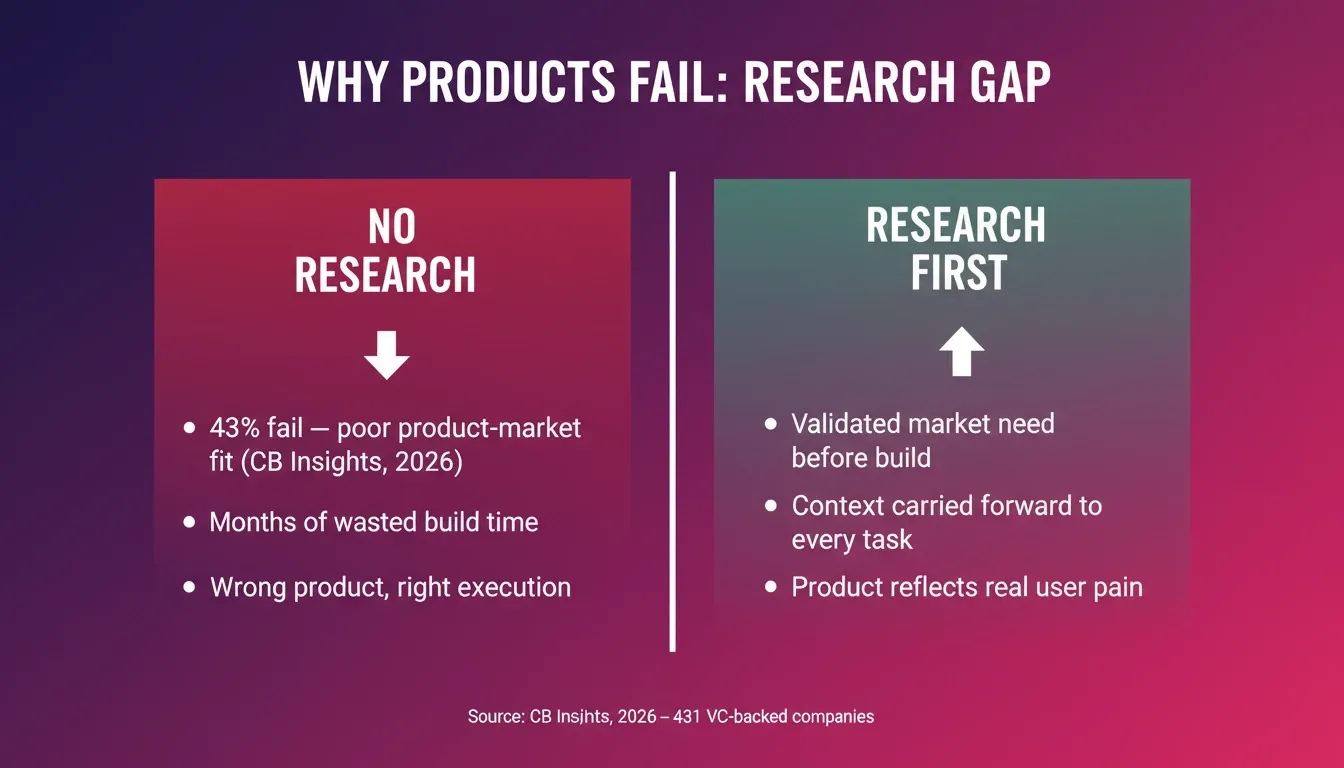
According to CB Insights, 42% of startups fail because there is no market need for what they built. That is not a coding problem or a design flaw. It is a research problem disguised as a product problem.
The gap between "we validated this idea" and "we shipped this product" has been responsible for more wasted money than bad engineering.
When research lives in one tool and building happens in another, context is compressed at every handoff. Teams that validate before building already know this pain.
The question is: what actually closes that gap?
Why Prompt-First Builders Fall Short
Most AI builders start at the prompt. You arrive with your idea already formed, describe what you want, and they generate code. That works if your idea is already validated.
The intelligence layer that determines whether what you are building is worth building is absent from prompt-first tools. The thinking happens somewhere else, in a separate tab, with no connection to what gets built.
What Is a Research to App Builder?
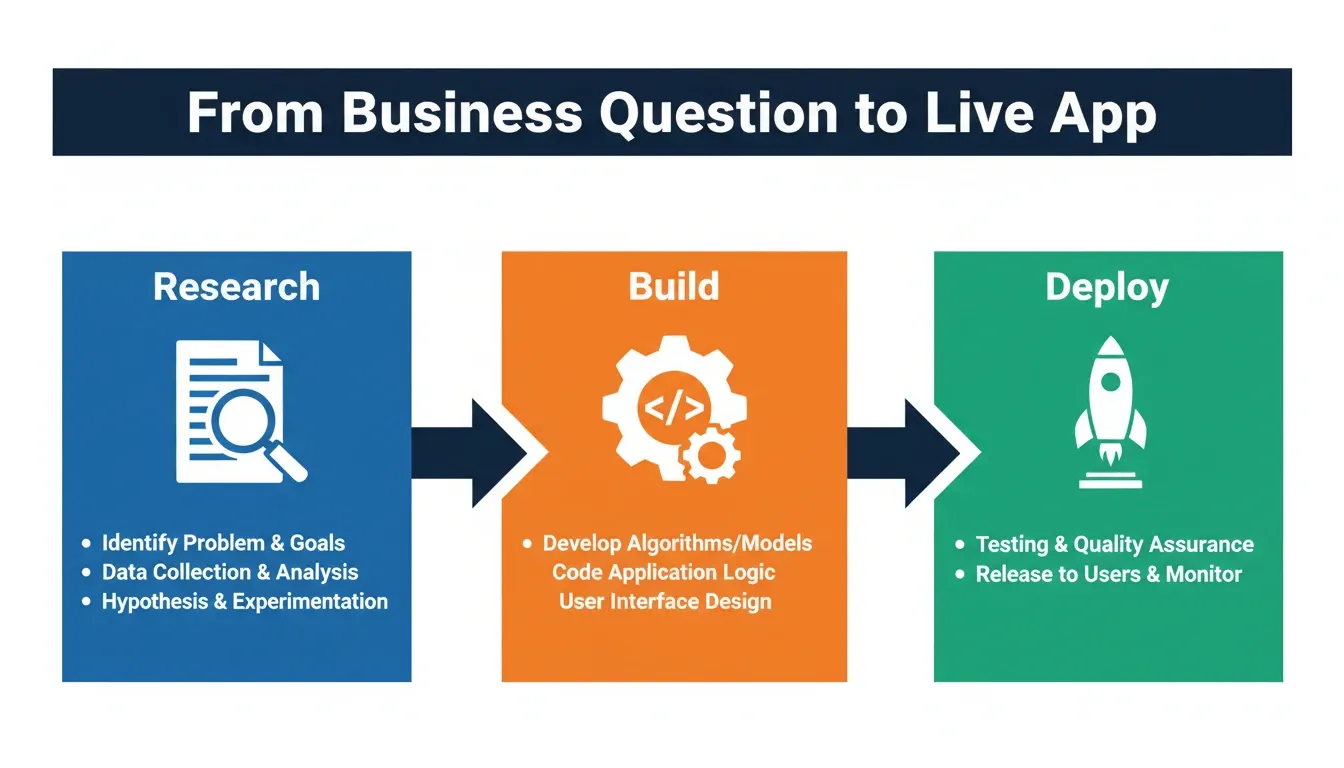
A research to app builder is a platform that keeps strategic intelligence connected to product generation across the full lifecycle, from question to deployed application.
It does three things that separate it from every other category of tool:
-
Runs structured research across hundreds of live sources, synthesizes findings, and produces decision-ready outputs with evidence tags
-
Carries context forward so the competitive analysis, market sizing, and user pain points are still present when the first screen gets built
-
Generates production-grade products directly from that research context, not from a blank prompt with no memory of what the market told you
The result is a workflow where every build task starts from the full accumulated intelligence of the project. Nothing is re-explained. Nothing is compressed. Everything compounds.
How the Research-to-Build Pipeline Works
The core flow follows a consistent logic that every research to app builder should implement.
Phase 1: Research
The research phase replaces weeks of manual analysis. A structured research to app builder delivers a report covering market dynamics, competitive positioning, user pain points, risk matrices, and clear recommendations, all with evidence citations.
This is not a paragraph answer from training data. It is structured output from live sources, ready to inform every product decision that follows.
Phase 2: Build
The build phase in a research to app builder differs from a prompt-first builder because the product architecture is informed by what the research found. The system knows the target user, the competitive gaps, and the feature priority before a single component is generated.
Phase 3: Deploy and Monitor
The best research to app builder platforms do not stop at deployment. They continue monitoring the competitive landscape after launch, surfacing pricing changes and feature releases before they affect your position.
Research to App Builder vs. Traditional AI Builder
| Capability | Traditional AI Builder | Research to App Builder |
|---|---|---|
| Starting point | User prompt | Business question |
| Research layer | None, external and manual | Built-in, structured, 150+ sources |
| Context continuity | Lost at every handoff | Shared memory, never compressed |
| First output quality | Depends on prompt quality | Informed by validated market findings |
| Competitive awareness | Manual, separate tool | Continuous, automated |
| Post-launch intelligence | Not included | Built-in competitor tracking |
| Time from question to app | Days to weeks | Under two hours for standard projects |
| Who can use it | Developers and technical founders | Founders, PMs, operators, non-developers |
Real-World Use Cases
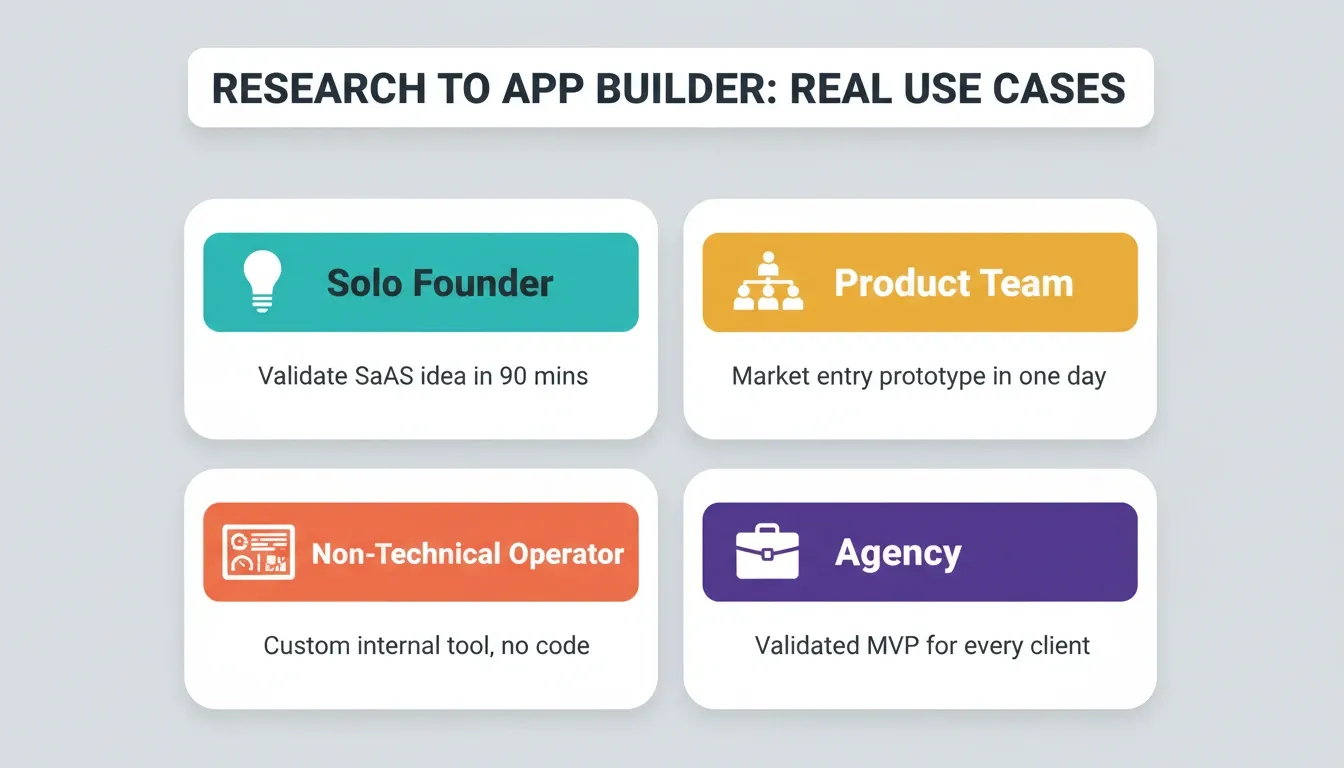
Solo Founder Validating a SaaS Idea
A solo founder has an idea for a B2B scheduling tool. Instead of spending weeks on manual research and then prompting a builder separately, they use a research to app builder to ask one business question, receive a structured market report in 90 minutes, and build a production-grade app directly from that context.
The outcome: The product messaging, feature set, and positioning are all derived from evidence, not guesswork. The founder skips the most expensive phase of startup failure.
Product Team Entering a New Vertical
An established SaaS company wants to expand into healthcare compliance tooling. Their product team runs a structured market entry analysis, generates a competitive teardown, and builds an internal dashboard prototype that reflects the compliance workflow their research identified.
The outcome: The team moves from question to stakeholder-ready prototype in a single day instead of a quarter.
Non-Technical Operator Building an Internal Tool
An operations manager at a logistics company needs a custom delivery tracking dashboard with no coding background. They describe the operational problem in plain language. The platform researches existing solutions and identifies feature gaps. A production-grade internal tool is generated from the research context.
The outcome: A custom internal tool that would have taken a developer three weeks is live in an afternoon.
Agency Delivering Validated MVPs
A digital agency uses a research to app builder to compress their MVP delivery timeline. For each client, the research phase produces a validated product brief with market evidence. The build phase generates the initial application from that brief.
The outcome: The agency delivers more value per engagement and differentiates from competitors who only build, not validate.
The Context Architecture That Makes It Work
The technical foundation of a research-to-app builder is what separates it from a research tool bolted onto a builder. The architecture requires four things.
Shared memory across phases. Research findings are not exported as a PDF and re-uploaded. They live in the same project context that the build phase reads natively.
Evidence-tagged outputs. Every finding in the research phase carries a source reference. When the build phase uses a finding to make a product decision, the evidence chain is intact.
Compound context accumulation. Each task adds to the shared memory. The build phase starts from everything the research phase established, plus everything previous tasks have learned.
No re-explanation required. In a traditional workflow, every new tool requires re-explaining the context. In a research to app builder, the context is already there.
What Happens When You Skip the Research Phase
The consequences of building without validated research are predictable and expensive.
-
You ship a product that solves a problem nobody has, then spend months trying to find product-market fit after launch
-
Your feature roadmap gets driven by internal opinions rather than external evidence
-
Competitors who did their homework enter the same market with better positioning
-
You burn through runway iterating toward a direction that research would have ruled out in the first week
On LinkedIn, product consultant Henryk Brzozowski described what he sees repeatedly:
"I've watched beginners spend 5 to 8 months building a SaaS product before talking to a single customer. No market validation, no paying users, just months of tweaking features in isolation." — Henryk Brzozowski
The most expensive line of code is the one that builds the wrong thing. A research to app builder answers the "what to build" question before a single line of code is written.
For a deeper look at how this plays out in practice, the path from market validation to deployed product covers the full arc with examples.
How Rocket Approaches the Research to App Builder Model
Rocket is a Vibe Solutioning platform. It covers the complete arc from strategic intelligence to execution to ongoing business operation. It is not a coding tool. It is the system for the full arc: thinking, building, operating, and growing.
1.5 million people have tried Rocket across 180 countries, from solopreneurs validating ideas to enterprise teams running strategy and execution on the same platform.
Solve: Decision Intelligence
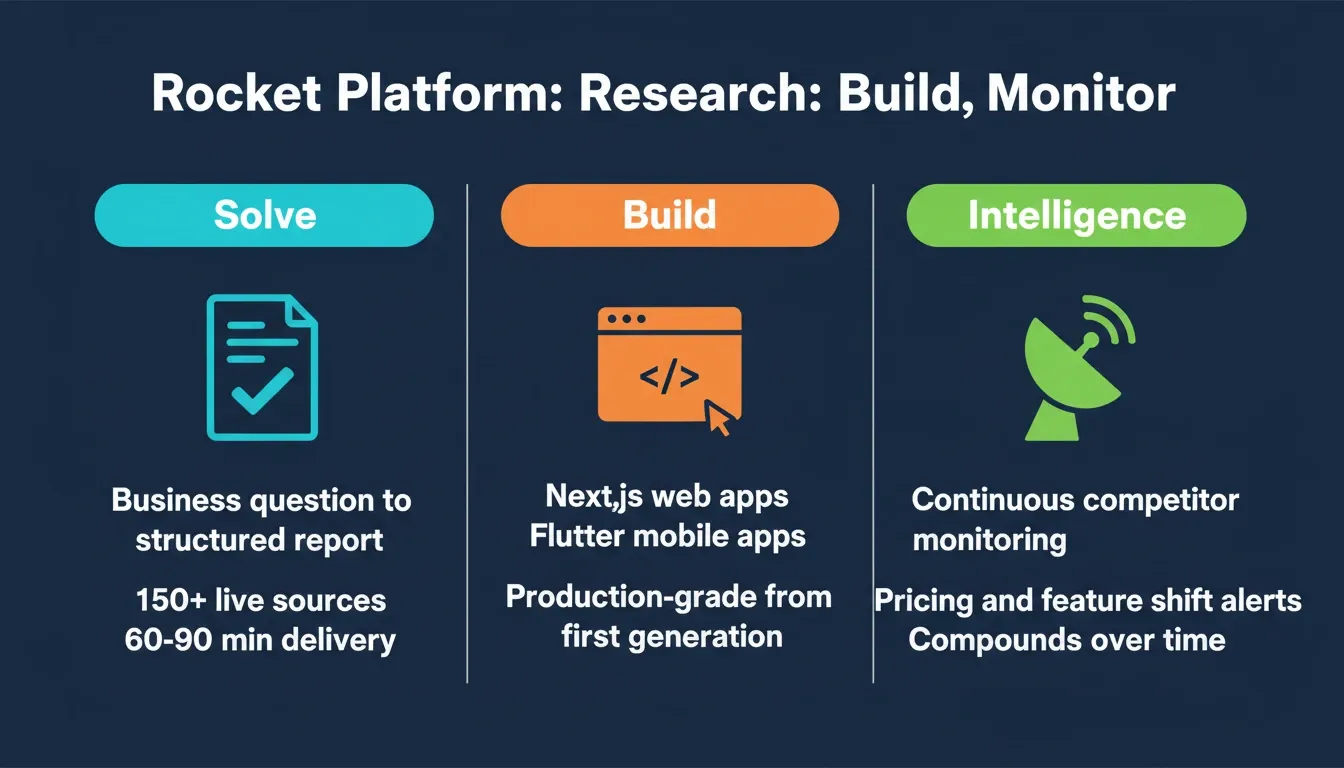
Rocket's Solve module takes any business question and delivers a structured analytical report covering market dynamics, competitive positioning, risk matrices, and clear recommendations across 150+ live sources. It completes in 60 to 90 minutes.
Solve does not produce a paragraph answer from training data. It runs structured queries across live sources, synthesizes findings into sections with evidence tags, and keeps that output connected to the build phase. For a detailed look at how Solve works, see the Solve overview in Rocket's docs.
Build: Production-Grade Generation from Research Context
Rocket's Build module generates production-grade web apps in Next.js and mobile apps in Flutter. Every build starts from the accumulated intelligence of the project, so the product reflects what the market actually told you.
Build supports web applications, mobile apps for iOS and Android, internal dashboards, customer portals, compliance tools, landing pages, and multi-page websites. Every output ships with SEO-ready structure, WCAG accessibility compliance, and GDPR coverage by default.
Teams looking to understand how AI is changing product development will find that the shift is not just faster coding. It is connecting the thinking to the building.
Intelligence: Continuous Competitive Monitoring
Rocket's Intelligence module continuously monitors competitors across every public platform they operate on. It surfaces pricing changes, feature releases, and messaging shifts before they affect your position.
This closes the loop between market research and product iteration after launch. The intelligence does not reset between sessions. It compounds.
Pricing
Rocket uses a credit-based system with no per-seat pricing. All plans include unlimited team members. Credits never expire.
| Plan | Monthly Fee | Monthly Credits | Key Access |
|---|---|---|---|
| Free | $0 | 20 credits | Build, Intelligence (explore) |
| Pro | $25 | 100 credits | Build, Intelligence |
| Rocket | $50 | 250 credits | Build, Intelligence, Solve |
| Booster | $250 | 1,500 credits | Full suite, power users and teams |
Additional credits can be purchased on any plan. Enterprise plans with SSO, data localization, and premium support are available via sales. See the full Rocket pricing page for current details.
Choosing the Right Research to App Builder
Not every platform that calls itself a research to app builder delivers on the promise. Here is what to evaluate before committing.
| Evaluation Criterion | What to Look For | Red Flag |
|---|---|---|
| Research depth | 100+ live sources, evidence citations | Training data only, no source references |
| Context continuity | Research feeds directly into build | Manual export or re-upload required |
| Output quality | Production-grade code, deployable | Prototype-only, requires developer cleanup |
| Non-technical access | Plain language input throughout | Requires coding knowledge at any stage |
| Post-launch intelligence | Continuous competitor monitoring | Research ends at launch |
| Supported output types | Web, mobile, internal tools | Web only |
For teams evaluating options, the best no-code app builder comparison covers the broader landscape of AI builders and what separates them.
Why Context Architecture Is the Real Differentiator
Most discussions about research to app builders focus on features. The real differentiator is architectural.
Context that compounds vs. context that resets. In a prompt-first builder, every session starts from zero. In a research to app builder, every session starts from everything the project has ever learned. The tenth task is smarter than the first because the context has accumulated.
Structured decisions vs. summarized findings. A research to app builder does not summarize findings into a paragraph. It structures them into evidence-tagged sections that the build phase can read as data, not as prose. This is what allows the product to reflect the market rather than the founder's interpretation of the market.
Continuous intelligence vs. point-in-time research. A research to app builder does not stop monitoring when the product launches. The competitive landscape continues to inform product decisions after deployment. This is a fundamentally different relationship between intelligence and execution.
For teams that want to understand this architecture in depth, the research to deployed app workflow walks through the full pipeline with concrete examples.
The Future of Research-Driven App Development
The research to app builder model represents a structural shift in how products are created. As AI capabilities improve, the gap between research-first platforms and prompt-first builders will widen.
Research to app builders accumulate institutional knowledge across projects. Prompt-first builders continue starting from zero. The compounding effect of shared context across research, build, and monitoring becomes the primary differentiator in the AI builder market.
The AI product development platform category is still forming. The teams that adopt research-first workflows now will compound their advantage with every project they complete.
The shift is already underway. The question is whether your team is on the right side of it.
The Research to App Builder Is the Future of Product Development
Building without research is the most expensive mistake in product development. The tools now exist to close the gap between validated intelligence and live applications.
The research to app builder model makes research a structural part of the build process, not an optional step that teams skip under time pressure. When research and building share the same context, the product reflects what the market actually needs.
Teams that adopt this workflow ship fewer wrong products, spend less runway on ideas the market never wanted, and build a compounding advantage with every project they complete.
You have a product idea. Before you write a line of code, find out if anyone actually needs it. Sign up for Rocket and go from research to app builder in a single session.
Table of contents
- -Why Prompt-First Builders Fall Short
- -What Is a Research to App Builder?
- -How the Research-to-Build Pipeline Works
- -Phase 1: Research
- -Phase 2: Build
- -Phase 3: Deploy and Monitor
- -Research to App Builder vs. Traditional AI Builder
- -Real-World Use Cases
- -Solo Founder Validating a SaaS Idea
- -Product Team Entering a New Vertical
- -Non-Technical Operator Building an Internal Tool
- -Agency Delivering Validated MVPs
- -The Context Architecture That Makes It Work
- -What Happens When You Skip the Research Phase
- -How Rocket Approaches the Research to App Builder Model
- -Solve: Decision Intelligence
- -Build: Production-Grade Generation from Research Context
- -Intelligence: Continuous Competitive Monitoring
- -Pricing
- -Choosing the Right Research to App Builder
- -Why Context Architecture Is the Real Differentiator
- -The Future of Research-Driven App Development
- -The Research to App Builder Is the Future of Product Development