
Most founders confuse proof of concept and MVP, wasting weeks on the wrong build. This guide clarifies the difference between MVP vs POC and shows how Rocket.new ships a working MVP in 7 days.
Starting a new product?
Here is a question worth answering before you write a single line of code: Are you trying to prove your idea can be built, or that people actually want it?
These are two different questions. And the builds you need to answer them are different, too. A proof of concept (PoC) answers the first. A minimum viable product (MVP) answers the second. Get them confused, and you burn weeks, sometimes months, solving the wrong problem.
According to CB Insights, 42% of startups fail because they build products nobody wants. A big part of that is starting with the wrong kind of build, for the wrong reason.
This guide clears that up and shows you how Rocket.new helps you move from idea to live MVP in 7 days.
The Confusion That Costs Founders Time and Money
Walk into any startup community, and you will hear "PoC," "prototype," and "MVP" used as if they are interchangeable. They are not, and that confusion carries a real cost.
-
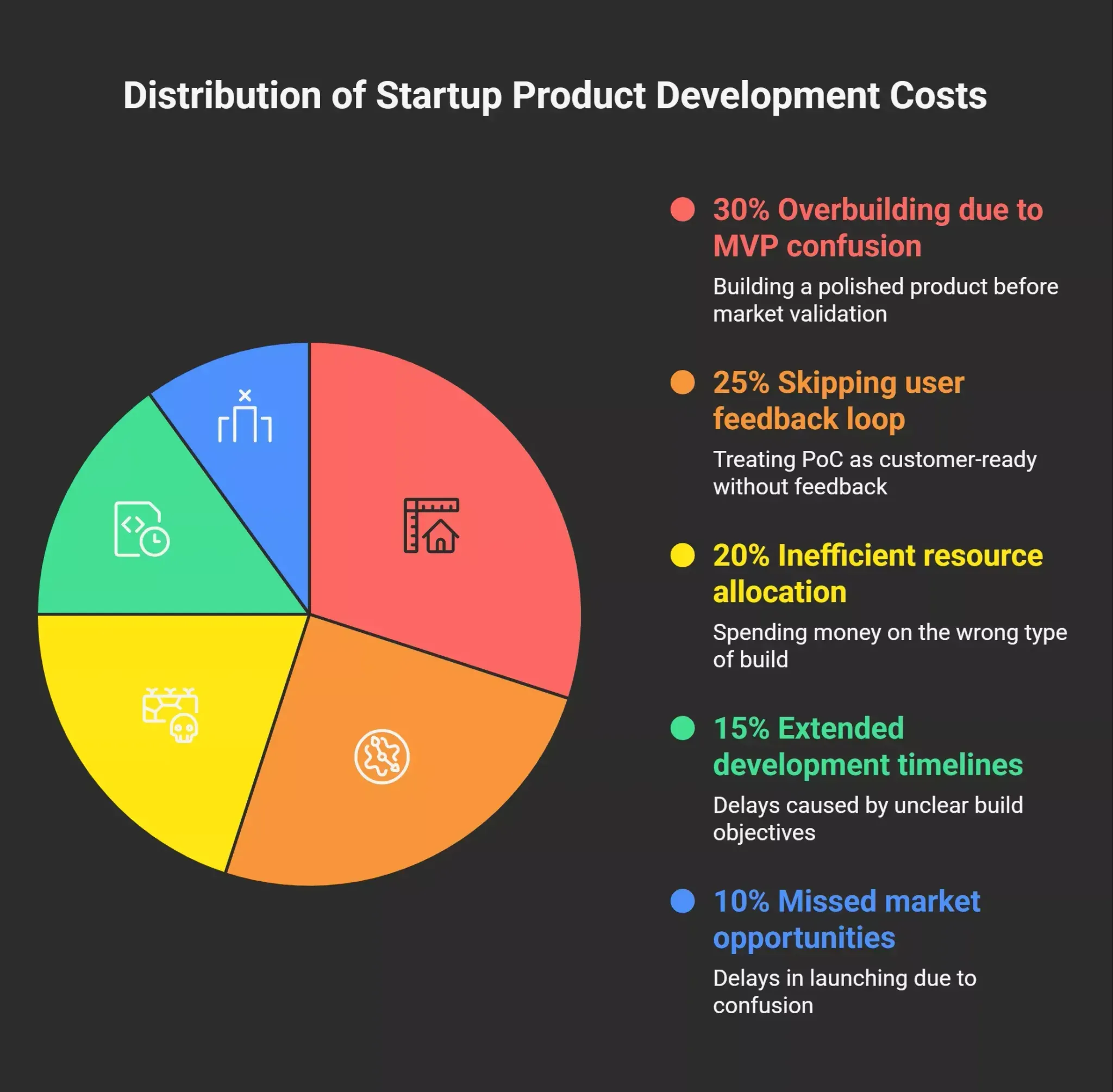
"PoC," "prototype," and "MVP" get treated as interchangeable across startup communities, pitch decks, and product roadmaps
-
Each belongs to a different product development stage and answers a completely different question about your business idea
-
When founders treat a PoC like a product ready for customers, they skip the user feedback loop entirely
-
When teams treat an MVP like a polished final product, they overbuild before getting any market validation at all
-
Traditional MVP development runs anywhere from $10,000 to over $150,000, depending on complexity, and that number climbs fast when founders do not know which build they actually need
One founder in the r/startups community captured the pattern well:
"A lot of people get confused with PoC and MVP… I've built MVPs for 25+ startups, and honestly, most founders waste their money on the wrong things." - u/qdrtech, r/startups (October 2024)
The waste starts the moment you mix up which type of build serves which purpose in your product development journey. Getting this right before writing a single line of code is the cheapest thing you can do.
What is a Proof of Concept (PoC)?
A proof of concept is a small-scale experiment built to answer one question: Can this idea actually work from a technical standpoint?
-
A PoC is not a product. It has no polished user interface, complete user flow, or customer-facing output
-
It is an internal project shown to your team, stakeholders, or investors to reduce technical risk before committing significant resources
-
A typical proof of concept tests one specific technical idea or core algorithm
-
It has minimal to no interface design, visual, or interactive model of any kind
-
It is never released to customers or real users
-
It gets replaced once the technical feasibility question is answered
A PoC is a scientific experiment, not a product. You are running the test to see if the reaction you expect actually happens, before you build the lab around it.
When a PoC Makes Sense
Not every product idea needs a proof of concept first. But when your build depends on untested technology or complex system connections, it is the right starting point.
-
Your product relies on novel AI algorithms or machine learning models with uncertain outputs
-
You are combining systems in ways that introduce genuine technical uncertainty
-
You need to demonstrate technical capabilities to investors before committing to full MVP development
-
There are specific technical limitations you need to test against before committing development resources
-
The risk is primarily technical, not related to market demand or user behavior
If your technical idea is genuinely unproven, the PoC protects you from spending months building on a broken foundation. If standard tools already handle the core functionality, skip it and go straight to the MVP.
What a PoC is Not
A PoC gives you technical validation, nothing else, and it does not assess business viability. Understanding its boundaries keeps you from misreading the signals it produces.
-
A PoC does not tell you if there is market demand for your product or support idea validation
-
It does not generate real user behavior data, user analytics, or user interaction signals
-
It cannot help you find product market fit or validate a business idea with real users
-
Showing a PoC to customers and treating their confusion as user feedback is one of the most common early-stage mistakes in custom software development
-
The PoC's job ends the moment technical feasibility is confirmed
After the PoC answers its one question, you move on. Anything beyond that is a different build with a different purpose.
What is a Minimum Viable Product?
A minimum viable product is the smallest version of a functional product that delivers real value to real users and returns actionable insights back to the team.
-
Unlike a PoC, an MVP is built for an external audience: early adopters who interact with it and generate customer feedback
-
The goal is validated learning fast, not a complete or polished final product
-
A well-scoped MVP includes only the core and essential features that solve the central user problem
-
It has a complete user flow from entry to output
-
It works well enough to collect real user behavior data and measure success metrics
-
It includes a system to gather early feedback, support market testing, and drive the development roadmap forward
The minimum viable product is a learning tool, not a launch event. Its value lies in what it tells you about real users, not in how polished it looks on day one. For a deeper look at real-world MVP examples, see The Rocket.new MVP Playbook: Minimum Viable Product Examples Edition.
Only the Core Features That Matter
The "minimum" in minimum viable product matters more than most founders realize. Too many features at launch is one of the most expensive traps in early-stage product development.
-
Adding unvalidated features before launch inflates development costs and delays shipping
-
Teams that overbuild end up with a longer development timeline, and still no real user data when the product finally ships
-
Features that commonly get added before they are ever validated: admin dashboards, reporting tools, notification systems, role management, and onboarding flows
-
The right approach: build only the core features that test the central product hypothesis
-
Ship that version to your early adopters
-
Let user analytics and real user feedback dictate what gets added in the next sprint
Every feature that goes into an MVP before it is validated by real users is a guess. Ship the core idea first, then let your target users tell you what comes next. The MVP Checklist for Non-Technical Founders is a useful companion for scoping exactly what belongs in your first build.
Early Adopters Drive the Learning
The real value of an MVP lives in what early adopters tell you before you try to build for the mass market, both directly and through their behavior.
-
User analytics show where real users spend time and where they drop off within the user flow
-
Drop-off points in the core user flow reveal where the product is losing people before they reach value
-
Repeat usage patterns confirm which core features actually deliver on the product idea
-
Direct user feedback through in-app prompts, support channels, or short surveys fills in what analytics alone cannot surface
-
This combination of quantitative data and qualitative signals turns an MVP into a validated development roadmap
Without this feedback loop, the team iterates on guesses. With it, every release gets closer to product-market fit.
MVP vs POC vs Prototype: The Side-by-Side
| Dimension | Proof of Concept | Prototype | Minimum Viable Product |
|---|---|---|---|
| Core question | Can we build this? | Does the UI support the intended user journey? | Will people actually use this? |
| Audience | Internal team, stakeholders | Designers, internal reviewers | Real users, early adopters |
| Functionality | Partial or none | Limited, simulated | Core functionality only |
| User feedback | None | Limited usability testing | Central to the whole process |
| Development cost | Low | Low to medium | Medium |
| Output | Technical validation | Design and flow clarity | Market validation |
| What comes next | Prototype or MVP | MVP development | Iterate toward final product |
For a deeper dive into the MVP vs prototype decision, see Ship MVP vs Prototype This Weekend with Rocket.new.
The Product Development Journey: How These Three Stages Connect
Most product development journeys move through these stages in sequence, but not every product needs all three. Many software products today can skip the PoC stage entirely and go straight to an MVP.
-
The PoC reduces technical risk.
-
The prototype validates design and user flow.
-
The MVP validates market demand.
Once product market fit is confirmed, the sequence moves into actual development for the full build and greater market readiness. Know where you are in this flow, and you will always know what to build next.
Common Mistakes That Derail Early-Stage Teams
Most early-stage product failures are not caused by bad code. They come from a misunderstanding about what kind of building was needed in the first place.
The PoC-as-MVP Trap
Building a PoC and treating it like a product is one of the costliest mistakes in software development.
Here is what usually happens:
-
You build a PoC that works technically
-
You show it to potential customers
-
They get confused because it does not feel like a real product
-
The feedback becomes inconsistent and hard to use
-
Time and budget get wasted on something never meant for customers
-
The wrong signals start shaping future product decisions
A PoC validates technical feasibility. It is not designed to validate customer demand or collect reliable product feedback. Showing a technical prototype to users too early often produces misleading insights. Customer validation works best when the product behaves like a real user experience, not just a working demo.
Feature Bloat Before Launch
An MVP stops being “minimum” when unvalidated features keep getting added before launch.
Here is how it happens:
-
Someone asks for dashboards
-
Then, reporting, analytics, notifications, and settings get added
-
The launch gets delayed for months
-
The team still does not know if users want the core product
This is feature bloat: building from assumptions instead of real user feedback.
The lean startup approach is simple: build only what is necessary to test the core business idea. Everything else can come later, after validation from real users.
Feature bloat is a delay in disguise. Every unvalidated feature added before launch is time spent building something that might never be used. The Rocket.new MVP Playbook: How to Build an MVP covers the MoSCoW method and other frameworks for keeping scope tight.
No System to Gather User Feedback
An MVP without a feedback loop is just a launch, not a learning process.
Without user analytics, feedback channels, and clear success metrics, you cannot understand how real users behave or whether the product is solving the intended problem.
As a result, the key validation question stays unanswered, and post-launch decisions are based on assumptions instead of real signals.
To avoid this, set up basic analytics, a way to collect user feedback, and define success metrics before launch so the MVP actually supports learning and iteration.
A Practical Decision Framework: Which One Do You Need First?
Not sure where to start? Walk through these questions before committing to any build decision.
Start with a PoC if:
-
Your product depends on novel technology or untested algorithms
-
Technical feasibility is genuinely uncertain and unresolved
-
You need to demonstrate that something works before committing development resources
-
The biggest risk is technical, not whether people want the product
Start with a Prototype if:
-
Technical feasibility is clear, but you need to validate the design and user flow
-
Stakeholders need to see the product before development begins
-
You want usability testing data before any code is written
Start with an MVP if:
-
You know the technology works, or your development platform handles this
-
The biggest risk is market demand, not technical feasibility
-
You have defined target users and a clear core value proposition
-
Your business goals are centered on early adopters and product market fit validation
For most software products in 2025 and 2026, SaaS tools, dashboards, mobile apps, customer portals, marketplaces, no-code tools and AI-assisted platforms have already handled technical feasibility. You can skip straight to the MVP and start collecting real user behavior signals immediately.
Match the build to the question you need to answer right now. For most teams today, that question is market demand, and that means starting with an MVP. If you want to see how this plays out in practice, From Weekend Spec to Live Product: How to Build an MVP Fast with Rocket.new walks through the full journey.
Launchpad: How Rocket.new Gets You to MVP in 7 Days
Traditional MVP development runs $10,000 to $150,000 and takes 4 to 12 weeks for even a basic functional product. Most of that time is not the actual building. It is coordination overhead, setup, and the friction of managing a technical project across disconnected tools and teams.
Rocket.new removes that friction entirely.
From Idea to Live in 7 Days
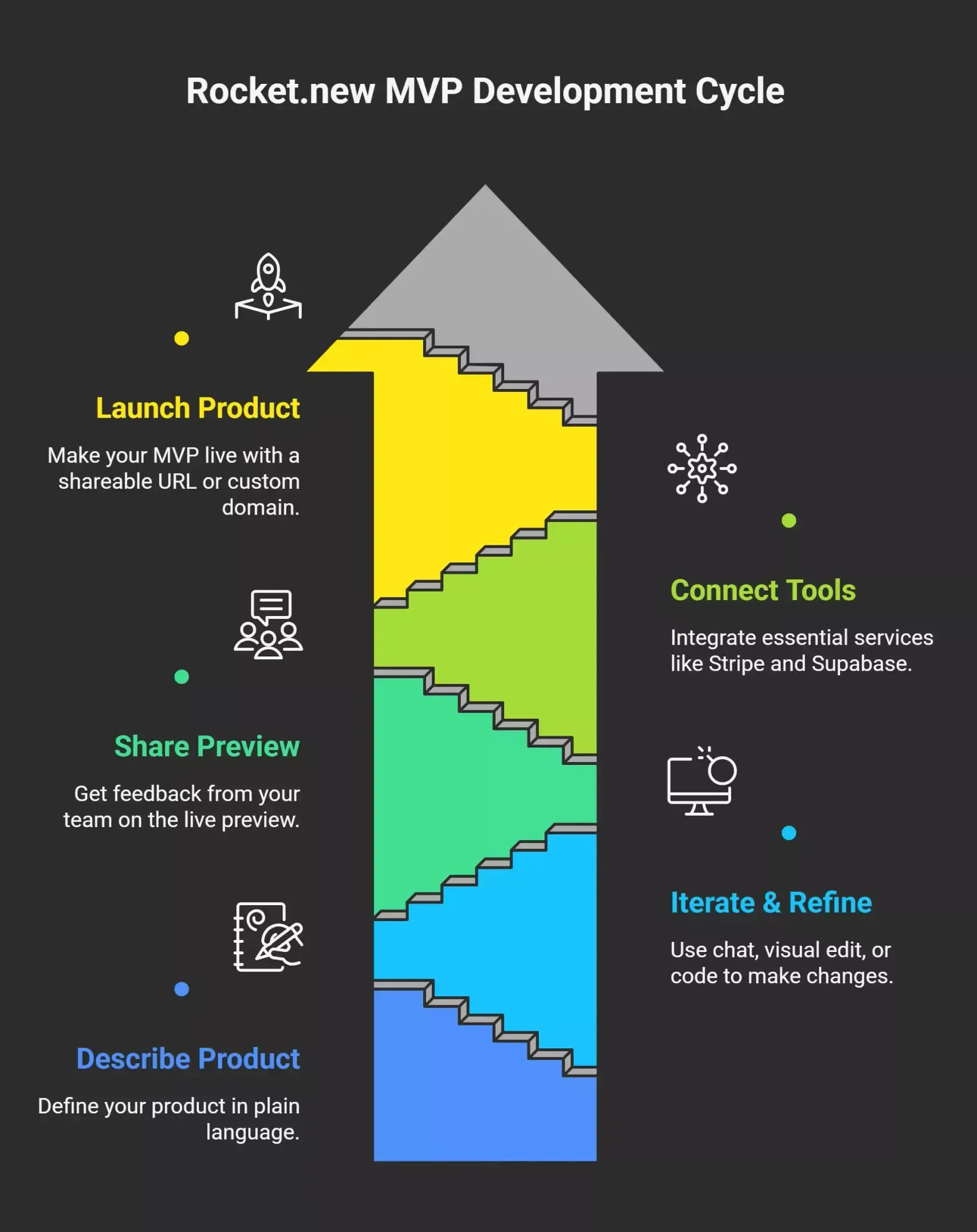
Here is the 7-day MVP development cycle with Rocket.new, from plain language description to a live product with real users on it:
-
Day 1: Describe your product in plain language. Rocket.new assigns the right framework automatically, Next.js for web apps, Flutter for mobile, and generates a production-ready app with real UI, navigation, and business logic. Most apps generate in 1 to 3 minutes.
-
Days 2-3: Iterate through Chat (natural language instructions), Visual Edit (click any element to change it directly), or Code (edit source files). No change limit.
-
Day 4: Share the live preview with your team. Collect feedback on design and user flow before going public.
-
Days 5-6: Connect your tools. Stripe for payments, Supabase for backend, Mixpanel for user analytics, and 25+ others, with one-time authentication that flows into every build automatically.
-
Day 7: Launch. Your product is live with a shareable URL or custom domain, ready for your first real users.
That is a functional MVP, with core features, a working user flow, live integrations, and built-in analytics in place, in 7 days. Not 7 weeks. Not 7 months. See MVP in a Week: The Rocket.new Way to Ship in 7 Days for the full blueprint.
Rocket.new vs. Traditional MVP Development
| Factor | Traditional Development | Rocket.new |
|---|---|---|
| Time to first working product | 4 to 12 weeks | Under 7 days |
| Development cost | $10,000 to $150,000+ | Significantly lower |
| Technical team required | Yes | No |
| Iteration speed | Days to weeks per change | Minutes |
| User testing | Post-build | Immediate via live preview |
| PoC validation | Separate phase, separate cost | Handled through Solve before build |
| Market validation loop | Requires manual setup | Built-in analytics from day one |
What Rocket.new Actually Builds for You
Rocket.new is not a code generator. It covers the full arc from validating the product idea to shipping the MVP to monitoring what happens after launch, all inside one platform with shared context.
-
Solve handles the PoC question before development begins. Research any business question about market demand, technical feasibility, or competitive positioning, and get a structured answer inside the same platform where you build
-
Build generates production-grade web apps in Next.js and mobile apps in Flutter from a plain language description, a Figma file, or an existing GitHub codebase. No separate developer handoff required
-
Every output ships with SEO-ready structure, WCAG accessibility compliance, and performance standards built in by default, not added later
-
Context carries everything forward. Files, research, decisions, and prior builds all live in the project and flow automatically into every new task, so nothing gets re-explained
-
Built-in analytics tracks visitors, conversions, and Core Web Vitals from launch day, giving you the real user behavior data that closes the feedback loop
-
Unlike Lovable, Bolt, and v0, which build what you tell them to build, Rocket.new figures out what is worth building first, then builds it
The Solve layer replaces the PoC phase. Build replaces weeks of custom software development. Built-in analytics closes the feedback loop on day one. That is the full MVP development cycle inside one platform. For founders who want to understand why this matters, Why Every Founder Should Use Rocket.new for Their MVP Building goes deeper into the reasoning.
When Does a 7-Day MVP Actually Work?
For most software products, 7 days with Rocket.new is enough to get a working MVP in front of your first real users and start collecting actionable signals.
-
SaaS tools, dashboards, customer portals, marketplaces, landing pages, and mobile apps all fall within the 7-day window
-
Products with complex hardware requirements, regulatory approval needs, or novel AI that has not been tested before may still need a PoC phase, but the MVP that follows can still move in days, not months
-
With global startup failure rates still sitting at 80 to 90% long-term, a validated MVP is often the difference between follow-on funding and shutdown
-
Speed to real user feedback is the only metric that matters at the early stage
If your build plan takes months before a single early adopter touches the product, something in the plan needs to change.
Stop Guessing. Start Shipping. That's the MVP vs POC Difference.
The confusion between a PoC and an MVP leads to real product delays and wasted effort. Teams either mistake a PoC for a product or overbuild an MVP before validating demand, and both approaches block meaningful user learning.
The right approach is simple: use a PoC to test technical feasibility, and an MVP to test real market demand with early users and live feedback.
Platforms like Rocket.new separate this clearly, Solve for feasibility, Build for a production-ready MVP, and enable day-one feedback so teams learn from real usage instead of assumptions.
Start building your MVP on Rocket.new today.
Table of contents
- -The Confusion That Costs Founders Time and Money
- -What is a Proof of Concept (PoC)?
- -When a PoC Makes Sense
- -What a PoC is Not
- -What is a Minimum Viable Product?
- -Only the Core Features That Matter
- -Early Adopters Drive the Learning
- -MVP vs POC vs Prototype: The Side-by-Side
- -The Product Development Journey: How These Three Stages Connect
- -Common Mistakes That Derail Early-Stage Teams
- -The PoC-as-MVP Trap
- -Feature Bloat Before Launch
- -No System to Gather User Feedback
- -A Practical Decision Framework: Which One Do You Need First?
- -Launchpad: How Rocket.new Gets You to MVP in 7 Days
- -From Idea to Live in 7 Days
- -Rocket.new vs. Traditional MVP Development
- -What Rocket.new Actually Builds for You
- -When Does a 7-Day MVP Actually Work?
- -Stop Guessing. Start Shipping. That's the MVP vs POC Difference.