
Build and ship a minimum viable product in just 7 days using Rocket.new. This guide gives non-technical and early-stage founders a practical, day-by-day MVP development blueprint, a no-code tools comparison, and a post-launch competitive intelligence edge. Start building your MVP today.
What if the gap between your idea and a working product was just 7 days?
Most people treat that as wishful thinking. But a growing number of early-stage founders are doing exactly that, shipping a minimum viable product in a week, putting it in front of real users, and collecting real user feedback before their competitors even finish arguing over a tech stack.
According to a 2025 report by Founders Forum Group, 42% of startups collapse because they build products nobody actually wants. That is not a product problem. That is a market research problem, one that a well-shipped MVP could have caught weeks earlier.
So the real question is not whether you can ship fast. It is whether you can afford not to.
What is a Minimum Viable Product, Really?
The Definition Most Founders Get Wrong
A minimum viable product (MVP) is not a half-finished app. It is not a rough prototype you are embarrassed to share. Understanding what an MVP actually is and is not is the first thing that separates founders who ship from founders who never get there.
-
It delivers just enough value to test your idea: The MVP gives real users enough to experience your core value. No more. Nothing that does not directly test whether your idea works.
-
Minimum means minimum features, not minimum quality: The product should work reliably. It just does not need every bell and whistle. Founders who confuse minimum with sloppy collect user feedback about bugs, not about value.
-
It is a learning tool first, a product second: Every MVP exists to answer one question. Does this solve a real problem for real users? Every feature decision should point back to that.
-
Scope creep is the enemy: Most founders let scope creep turn a 7-day build into a 6-month development cycle. When you define what the MVP is not going to include, you protect both the timeline and the budget.
The sooner you get a minimum viable product in front of your target audience, the sooner you know if you are building the right thing. That is the whole game. The lean startup methodology is built on exactly this principle: validated learning happens only when real users interact with a real product. If you want to understand how vibe coding and rapid prototyping fit into this picture, the principles are the same — ship first, learn fast.
Why Most Founders Take Months to Build an MVP
The Three Traps That Slow Down MVP Development
Traditional software development takes time, a lot of it. According to Fram's product development research, most startups spend 2 to 6 months to launch an MVP. That is months of runway burned before a single early user touches the product. Three traps are almost always responsible.
-
The tech stack rabbit hole: Non-technical founders spend days researching databases, frontend frameworks, and backend code setups before writing a single feature. Technical founders often go the other way, picking a stack they love and over-engineering a system for a product that has not been validated yet. Either way, development time balloons before anything ships.
-
Too many core features from day one: Scope creep is the silent killer of MVP development. Every "just one more feature" decision adds weeks. What should be a 7-day build stretches into a month because the product keeps expanding before anyone ships it.
-
Waiting to be ready: Most founders want the landing page to look great, the onboarding to feel smooth, and the backend development to handle complex projects without a bug before showing it to anyone. But early users do not need perfection. They need something that solves their core problem.
These three traps do not just slow product launches. They drain budgets and kill momentum. Real user feedback from a working MVP built in a week is worth far more than months of internal assumptions and polishing. The typical time spent on these traps is entirely avoidable with the right approach.
Understanding how AI is changing product development gives founders a clearer picture of what is now possible in compressed timelines.
The Real Cost of Shipping Slow
Speed Matters: What You Lose When Development Time Drags On
Slow MVP development does not just cost time. It costs money, competitive edge, and sometimes the whole idea. Here is what the numbers look like side by side.
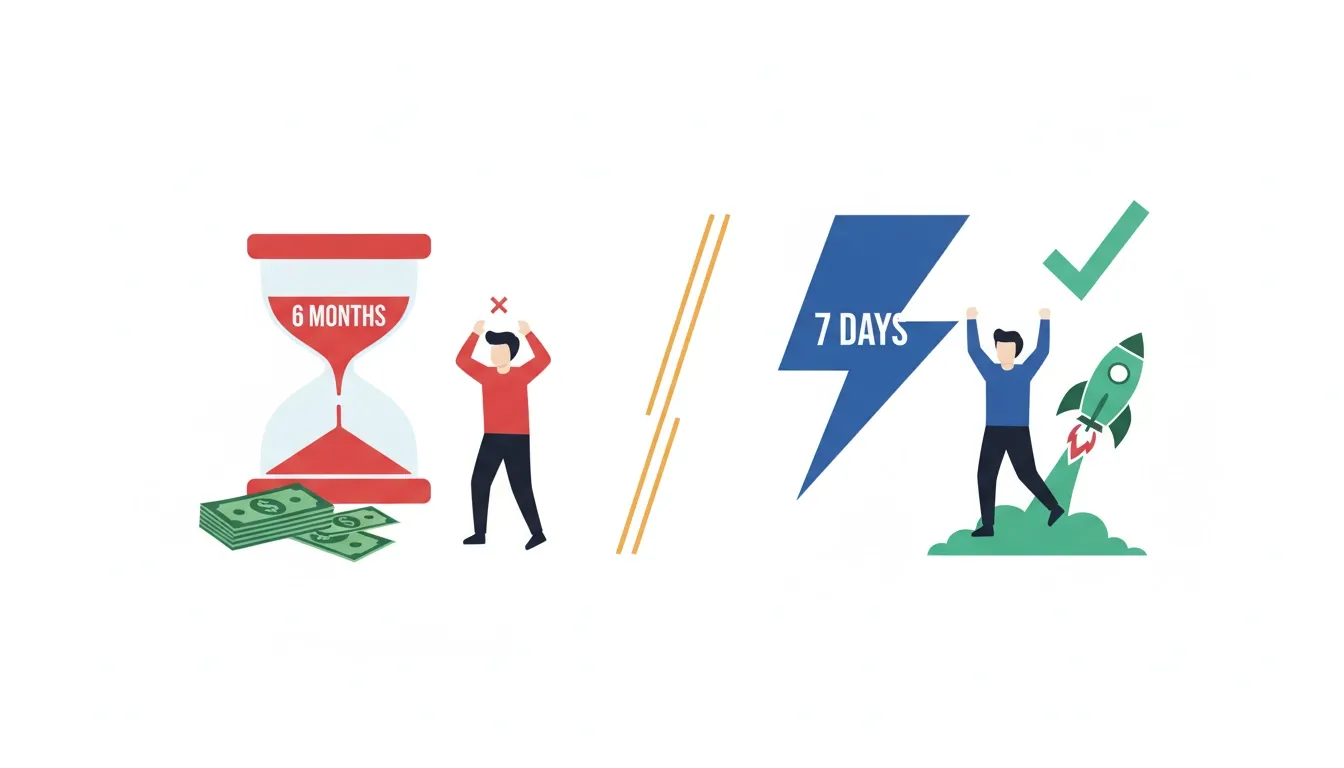
| Metric | Traditional MVP (2 to 6 months) | MVP in a Week |
|---|---|---|
| Development time | 8 to 26 weeks | 1 week |
| Cost (custom dev) | $25,000 to $150,000 | Low with AI tools |
| First real user feedback | After months | Day 8 |
| Scope creep risk | High | Low |
| Pivot speed | Slow | Fast |
| Market research lag | Weeks to months | Minimal |
| Post launch iteration | Slow | Fast |
Beyond the table, here is what slow development actually costs you in practical terms:
-
Assumptions pile up uncontested: The longer you go without real users, the more assumptions you bake into a product nobody asked you to build. By month three, most of those assumptions are wrong.
-
Budget erodes before a single user pays: Custom software development for a medium complexity MVP costs $25,000 to $55,000. That is money gone before a single paying customer has validated demand.
-
Competitors move into the gap: When you take 6 months to launch an MVP, faster-moving teams can ship something similar, attract initial users, and collect user feedback that shapes a better second version, all while you are still building.
-
Founders get attached to the wrong product: Months of investment before launch makes it very hard to pivot cleanly. The attachment shifts from the problem to the final product, which is the wrong thing to be attached to.
Most startups that fail do not fail because of bad code. They fail because they built the wrong thing for too long. A shipped MVP built fast gives you real data fast enough to course-correct before it is too late. Fail fast, learn fast, and iterate toward product market fit. For founders who want to understand the AI app builder cost comparison in detail, the numbers make the case even more clearly.
The 7-Day MVP Blueprint
A Day-by-Day Plan to Build an MVP Quickly
This is not theory. It is a practical framework that non-technical founders and early stage founders are already using to validate demand and ship real products in one week.
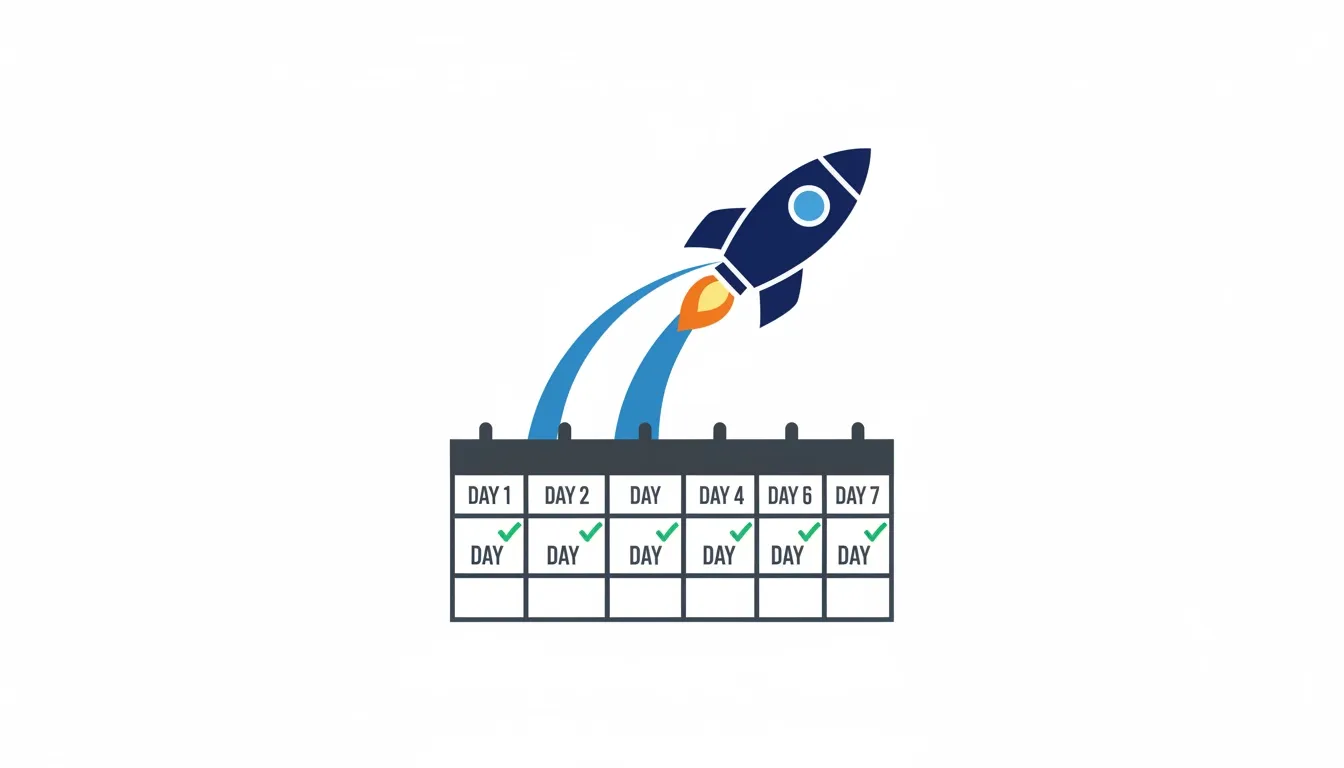
Here is what each day in the process looks like in practice:
-
Day 1: Define the idea: Write your idea in a single line. Who is the target audience? What problem do they have? What does a successful first week look like? This clarity keeps scope creep away and sets the foundation for everything that follows.
-
Day 2: Market research: Talk to 5 to 10 potential users. Search Reddit, LinkedIn, and niche communities. Are people already talking about this problem? Validated demand out in the open is a strong early signal. Rocket.new's market research and validation loop is built exactly for this step.
-
Day 3: Pick your tools and set up: With AI-powered no code tools, this step now takes hours rather than days. Pick your platform, sketch your data model, and get moving. No multi-day tech stack debates required.
-
Day 4 and 5: Build core features: Focus only on the features a first user needs to get real value from the product. Not internal tools or admin dashboards. Not push notifications or usage analytics. Just the core functionality that proves your idea works.
-
Day 6: Landing page and launch setup: A clean landing page with a simple call to action tells you whether people are interested before they even try the product. Set up your user feedback mechanism now, not after launch. Rocket.new's landing page builder can get you live in hours.
-
Day 7: Ship to initial users: Share it publicly. Post in the communities you researched on Day 2. Email the 10 people you spoke to. Real user feedback from people who do not know you personally will tell you more than six months of internal testing ever could.
This blueprint works because it forces a single focus at each stage. There is no room for scope creep when Day 4 and Day 5 are your only build days. The constraint is the point. This is the lean MVP approach at its most practical.
Founders who want to go deeper on how to build MVPs with no-code AI tools will find the full guide useful alongside this blueprint.
No-Code Tools vs Traditional Development
What Non-Technical Founders Actually Need to Know About Tech Stack Choices
Traditional software development has a steep learning curve for non-technical founders. No code tools changed this. According to Gartner research, 70% of new applications developed by enterprises in 2025 use low-code or no-code technologies. But not all no code tools are built equally, and most have a blind spot that quietly trips up early stage founders.
| Tool | Best For | Learning Curve | Full-Stack | Strategy Layer |
|---|---|---|---|---|
| Bubble | Complex web apps | Moderate | Partial | No |
| Webflow | Landing pages, CMS | Low | No | No |
| FlutterFlow | Mobile apps | Moderate | Partial | No |
| Glide | Simple mobile apps | Low | No | No |
| Lovable | Frontend apps | Low | Partial | No |
| Rocket.new | SaaS + apps + research | Very Low | Yes | Yes |
Here is what to watch out for when choosing a no code tool for MVP development:
- Most cover the build step only: Tools like Bubble, Webflow, and Lovable help you ship faster, but they stop at building. They do not help you decide what to build, and they offer no post launch layer for tracking real users or watching competitors.
See the full comparison of Rocket.new vs Lovable for a detailed breakdown.
-
Ecosystem lock-in is a real concern: Some no code platforms generate code you cannot easily export. If you outgrow the platform later, migrating can be expensive and time-consuming for any product that has scaled.
-
Complex projects hit ceilings fast: Many no code tools work well for simple apps but run into limitations the moment your SaaS products need custom backend logic, database relationships, or user authentication flows.
-
Code-first tools still leave non-technical founders stranded: Tools like Cursor, Bolt, and v0 generate code quickly, but when that code breaks, non-technical founders often have nowhere to turn. The no code part matters more than people admit.
For a direct comparison, the Cursor vs Copilot vs Rocket.new breakdown is worth reading.
"I'm non-technical but I'm close to launching a software product in a week. I tried all the options that are discussed in the thread (over 6 months) but I mostly disagree with them (except one)." Reddit user on r/startups, October 2024
The gap in most no code tools is not the building part. It is everything around it: the market research before, and the competitive intelligence after. That gap is exactly where most early stage founders run into trouble on their way to a first launch.
Rocket.new: Built for the 7-Day MVP
Why Rocket.new is a Game Changer for Founders Who Build an MVP Quickly
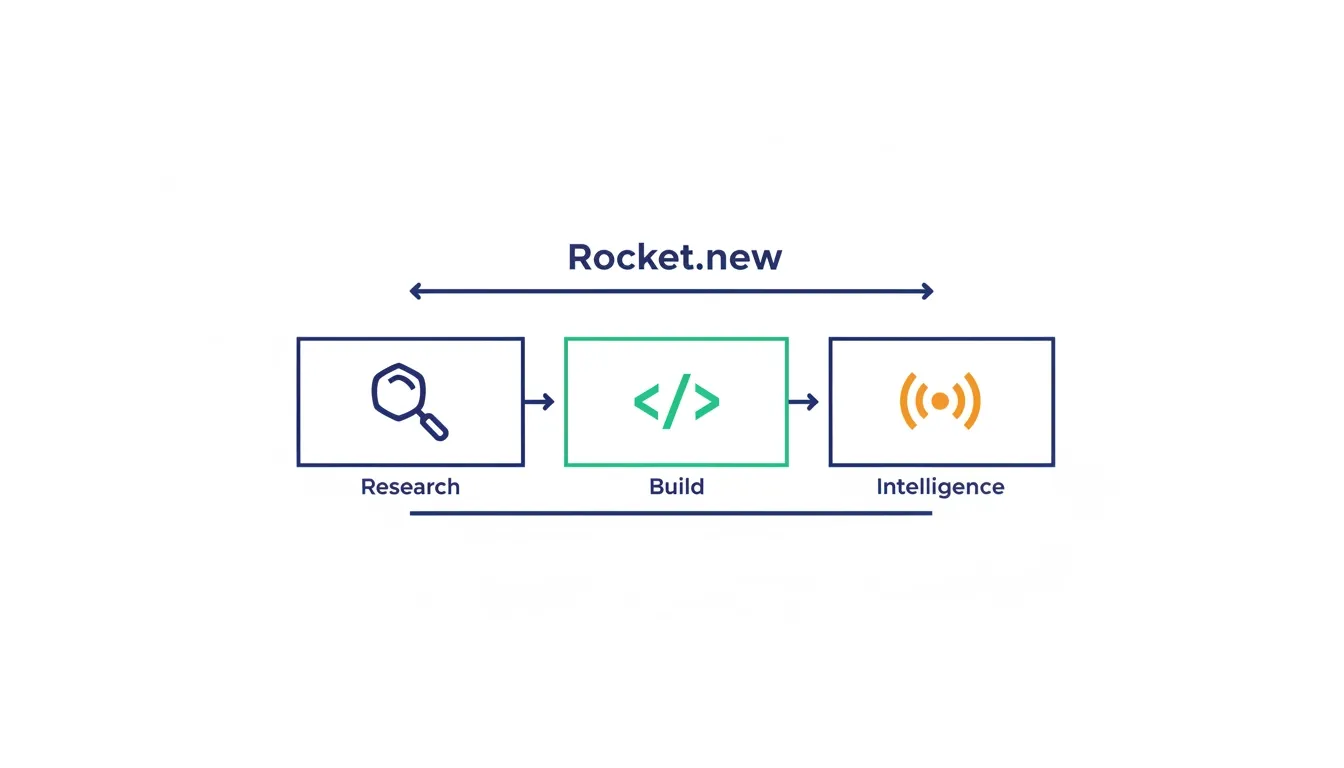
Most AI app builders help you write code faster. Rocket.new does something different. It is the world's first Vibe Solutioning platform, a single system that combines market research, product building, and competitive intelligence with one shared context that carries across every step.
For a founder trying to ship an MVP in a week, that continuity matters enormously.
 What sets Rocket.new apart from every other tool in the space:
-
Research before you build: Before writing a single line of code, you can research your market, study competitors, and validate demand inside the same platform you will use to build the product. No separate tools. No switching tabs. No losing context between research and building. This is the Solve-first approach that makes Rocket.new fundamentally different.
-
Full-stack apps from a plain description: Rocket.new generates full-stack web and mobile apps from a plain-language description. Non-technical founders have built complete SaaS products on the platform without hiring a developer, managing a database, or touching backend code. The output is real, production-ready code.
-
No steep learning curve: Other no code tools for complex projects often require tutorials or hiring a specialist. Rocket.new is built for early stage founders who do not have time for a learning curve. Describe your idea, the platform builds it, you adjust, you ship. See how to create your first app on Rocket.new to get started.
-
Post launch competitive intelligence included: Post launch is where most no code tools go silent. Rocket.new keeps the full context alive, monitoring competitor website changes, GTM moves, hiring patterns, social signals, and review sentiment across every company you follow, all interpreted and delivered through one shared context.
-
Competitive intelligence that runs continuously: You can track what competitors are doing after you launch an MVP, not just during initial market research. That ongoing competitive edge is something most founders only access much later, if at all. The competitive intelligence platform built into Rocket.new is a genuine post-launch advantage.
-
Landing page generation in hours: From idea to public landing page in hours, not days. You can validate demand with a landing page before the product is even finished, all inside the same platform.
How Rocket.new compares to the most common alternatives:
-
Lovable: Strong for frontend generation, but lacks the market research layer and post launch competitive intelligence that makes a real difference for early stage founders on a tight timeline.
-
Bubble: Powerful for complex projects, but the steep learning curve and the need to hire specialists for anything beyond basic apps defeats the purpose of a 7-day MVP build. See Bubble alternatives that offer more control.
-
Webflow: Excellent for landing pages and content sites. Not designed for full product applications with backend logic and real user data flows.
-
Cursor, Bolt, and v0: Code-first tools built for technical founders. Non-technical founders still hit walls when generated code breaks and there is no clear path to fix it without a developer.
Rocket.new is the only platform that closes the full loop from market research to build to post launch competitive intelligence inside one system with one shared context. For early stage founders building on a tight timeline, that continuity changes what is actually possible in 7 days.
Explore how Rocket.new builds production-grade apps to understand the depth of what is possible.
For founders specifically looking at the best AI MVP builders for startups, Rocket.new sits at the top of that list for one reason: it covers the full loop.
The Founder Who Ships in 7 Days vs The One Who Ships in 6 Months
Real User Feedback Changes Everything: Speed Matters for Product Market Fit
There is a clear pattern to how the most successful early stage founders operate. They ship small and fast, get real user feedback early, adjust, and ship again. The contrast with founders who wait months to be ready is sharp and the gap compounds over time.
-
The fast shipper gets data while the slow builder gets attached: Founders who spend 6 months building before anyone sees the product invest so much that changing direction feels impossible. They become attached to the product, not the problem. The fast shipper has already iterated twice by then.
-
Failures are cheaper when they come early: A week of building something nobody wants costs you one week. Six months of building something nobody wants costs a real portion of your runway and often your motivation too.
-
Initial users shape the product: When real users touch your MVP on day 8, their behavior tells you what to build next. That signal is worth more than any internal planning session, pitch deck, or market research report.
-
Speed creates compounding advantages: The founder who ships in 7 days gets a first iteration done, collects user feedback, and starts a second version while their competitor is still in backend development. Each fast cycle compounds into a stronger product.
-
Most MVP development does not require months: The reason most startups take 2 to 6 months is tool friction and scope creep, not the actual complexity of the core features needed to validate an idea. Remove those two blockers and a week becomes very achievable.
An MVP built in a week gives you permission to be wrong quickly. That is not a weakness. That is the whole point. You do not have to be right on day one. You just have to be in front of real users fast enough to learn what right actually looks like for your market. This is validated learning in practice.
Founders who want to understand how to iterate on an MVP with AI tools fast will find the next-step guidance there.
And if you are building a SaaS product specifically, how to build a SaaS MVP walks through the exact process on Rocket.new.
Ship Your MVP This Week
Most founders are waiting for the perfect moment. The thing is, that moment never arrives on its own. You build it by shipping.
A minimum viable product is not about being finished. It is about getting something real in front of real users fast enough to learn from them, before your runway runs out, before a competitor ships something similar, and before your early assumptions harden into an expensive mistake.
With no code tools and platforms like Rocket.new, the barrier to launching an MVP in 7 days has dropped to almost nothing. Early stage founders are shipping full SaaS products, mobile apps, and internal tools in days, collecting real user feedback while their competition is still arguing over backend development choices.
MVP in a Week: the Rocket.new way to ship in 7 days is not just a tagline. It is a working path that thousands of founders are already taking. The only question is whether you will be one of them.
Table of contents
- -What is a Minimum Viable Product, Really?
- -The Definition Most Founders Get Wrong
- -Why Most Founders Take Months to Build an MVP
- -The Three Traps That Slow Down MVP Development
- -The Real Cost of Shipping Slow
- -Speed Matters: What You Lose When Development Time Drags On
- -The 7-Day MVP Blueprint
- -A Day-by-Day Plan to Build an MVP Quickly
- -No-Code Tools vs Traditional Development
- -What Non-Technical Founders Actually Need to Know About Tech Stack Choices
- -Rocket.new: Built for the 7-Day MVP
- -Why Rocket.new is a Game Changer for Founders Who Build an MVP Quickly
- -The Founder Who Ships in 7 Days vs The One Who Ships in 6 Months
- -Real User Feedback Changes Everything: Speed Matters for Product Market Fit
- -Ship Your MVP This Week