
Most founders lose months to slow development and wrong assumptions before getting real feedback. This post breaks down why the MVP approach is misapplied, what blockers kill most MVPs before launch, and how Rocket.new closes the gap between idea and a working product for non-technical founders, without requiring a technical co-founder or a development agency.
Does Your MVP Plan Actually Get You to Market Faster?
Most founders don't start with bad ideas. They start with great ones, and then spend months watching those ideas stall in a development bottleneck they never saw coming.
Building an MVP is supposed to be the smart move. Get the simplest version of your product in front of real users, gather real feedback, and iterate. Simple in theory. Hard in practice. According to the Founders Forum Group, 42% of startups fail simply because they build products no one needs. And many of them thought their MVP approach was protecting them from exactly that mistake.
So the real question isn't whether you should build an MVP. You absolutely should. The question is how you build it and what that process costs you in time, money, and missed learning.
What Most Founders Actually Run Into During MVP Development
Building a startup without a technical background used to mean one thing: finding help before you could build anything. That dependency creates a predictable chain of delays that most founders walk straight into.
-
Finding a technical co-founder takes months: Six months or more is common. During that time, the market keeps moving and early mover opportunities quietly close.
-
Development agencies are expensive: Hiring a development team for MVP development typically costs $30,000 to over $100,000. For pre-revenue founders, that is often most of the runway, spent before a single real user has tested anything.
-
Real feedback arrives late: By the time a traditional MVP ships, months of assumptions have been baked in. Real feedback often reveals those assumptions were wrong, requiring expensive rework.
-
Scope quietly expands: What starts as a clean, focused build tends to grow. One extra feature, then another. The simplest version of the product gradually becomes something much harder and much slower to ship.
For most founders without a technical background, this isn't an edge case. It's the standard development process, and it's exactly what the MVP approach was supposed to help avoid. App builders for entrepreneurs exist precisely to break this cycle.
The Hidden Cost Most Founders Don't Price In
The money spent on development is easy to see. The harder cost to calculate is time to feedback, and for early-stage startups, that's the variable that shapes everything.
| Approach | Average Timeline | Estimated Cost | Time to Real Feedback |
|---|---|---|---|
| Hire a dev agency | 3–6 months | $30K–$100K+ | After launch |
| Find a technical co-founder | 3–12 months | Equity + months | After hiring and building |
| Manual no-code tools | 6–10 weeks | $0–$5K | Within weeks |
| AI-powered builder like Rocket.new | Days to weeks | Minimal | Near-immediate |
-
Market timing is fragile: Every week spent waiting on a build is a week real users early to the market are forming habits with competing products.
-
Runway burns regardless: Development timelines stretch. Costs compound. Funding doesn't wait for builds to finish.
-
Wrong assumptions get expensive fast: A pivot at week two is cheap. A pivot at month five is painful and often fatal for runway.
-
Validated ideas compound faster: Teams that get a working product in front of real users sooner gather more feedback, make sharper decisions, and reach product market fit with capital still in the bank.
When 90% of startups fail and 42% of those fail because they built something the market didn't want, time-to-feedback becomes the single most important metric for any early stage team.
Why the MVP Approach Still Gets Misapplied by Most Founders
The MVP approach is widely discussed, and frequently misunderstood. Most founders think building an MVP means building a smaller, cheaper version of the finished product. That framing is what leads them into the same traps over and over.
A community post on r/vibecoding captured the right mindset well:
"Basically, I use GPT to first create a very extensive PRD, and then feed that into Rocket.new. It does a really solid job of analyzing everything, and then generates a to-do list where you can pick which screens to create."— Reddit user, r/vibecoding
-
MVP is about learning speed, not product size: The simplest version of a product isn't about cutting corners. It's about answering one focused question as fast as possible: does this concept solve a real customer problem for real users?
-
Features are not the goal. Real feedback is: A common mistake is treating the MVP as a destination rather than a starting point. The goal is to generate real feedback that tells you what to build next.
-
Building is not the end point: When the build becomes the focus, scope creep follows. Teams burn time and money building what they assumed users wanted rather than what users actually need.
-
Validation is the output, not the product itself: A useful MVP approach keeps the team focused on what the product teaches, not how polished it looks.
The right MVP mindset moves fast, ships early, and treats every user interaction as data. That's the foundation successful startups build on. Vibe coding has emerged as one of the most effective ways to embody this mindset in practice.
Three Real Blockers That Kill MVP Development Before Launch
Most founders face the same three obstacles at the early stage. Recognizing them before they hit is the best way to route around them.
-
No technical co-founder: Most founders with strong domain expertise and business instincts can't write code. Without a technical co-founder or a paid development team, ideas sit in documents for months. The barrier to entry for building isn't just skill. It's the time required to find the right skill. Top AI app builders for non-technical founders have fundamentally changed this equation.
-
Scope creep in the build stage: An MVP starts focused. Then "just one more feature" gets added. Scope creep is one of the most predictable reasons MVP development timelines blow up. A product meant to ship in six weeks turns into a six-month build, and by the time it launches, users early to the market have already committed elsewhere.
-
Waiting kills market timing: Every week spent in a development queue is a week competitors are studying your signals and users are forming habits elsewhere. The market does not pause while your MVP is being built. For startups at the early stage, speed is not a nice-to-have. It's a survival requirement.
These three blockers compound each other. A founder waiting on a technical co-founder watches scope creep in as the idea grows in their head, and misses the market timing window while they wait. The only real fix is collapsing the time between idea and working product. The fastest AI app builders for startups are designed to do exactly that.
What a Smart MVP Development Process Looks Like
Successful startups don't just build MVPs faster. They structure the development process so learning happens at every stage, not just at launch.
-
Start with the core concept, not the full vision: Define the one problem the product solves and build only what proves or disproves that. Everything else is version two.
-
Ship to real users before the product feels ready: Real feedback from real users is worth more than internal polish. If it feels too early to share, that's usually the right time to ship.
-
Treat every iteration as a research cycle: Each round of real feedback should answer a specific question. What's working? What's confusing? What's missing? Structure the next build around those answers. A user feedback analyzer can help systematize this process.
-
Measure traction, not feature count: A successful MVP generates clear signals about what real users do, not an impressive feature list. A product roadmap generator helps translate those signals into a disciplined next build.
Teams that can move from idea to working product in days, not months, get more learning cycles before runway runs out. That speed is what separates teams that find product market fit from teams that run out of money still guessing. Rapid prototyping is the discipline that makes this possible.
How Rocket.new Changes the MVP Building Picture for Founders
Rocket.new is the world's first Vibe Solutioning platform backed by Salesforce Ventures and Accel, with over 1.5 million creators and developers across 180 countries. It hit $4.5M ARR within three months of beta launch and is built specifically to close the gap between idea and working product for founders without a technical background.
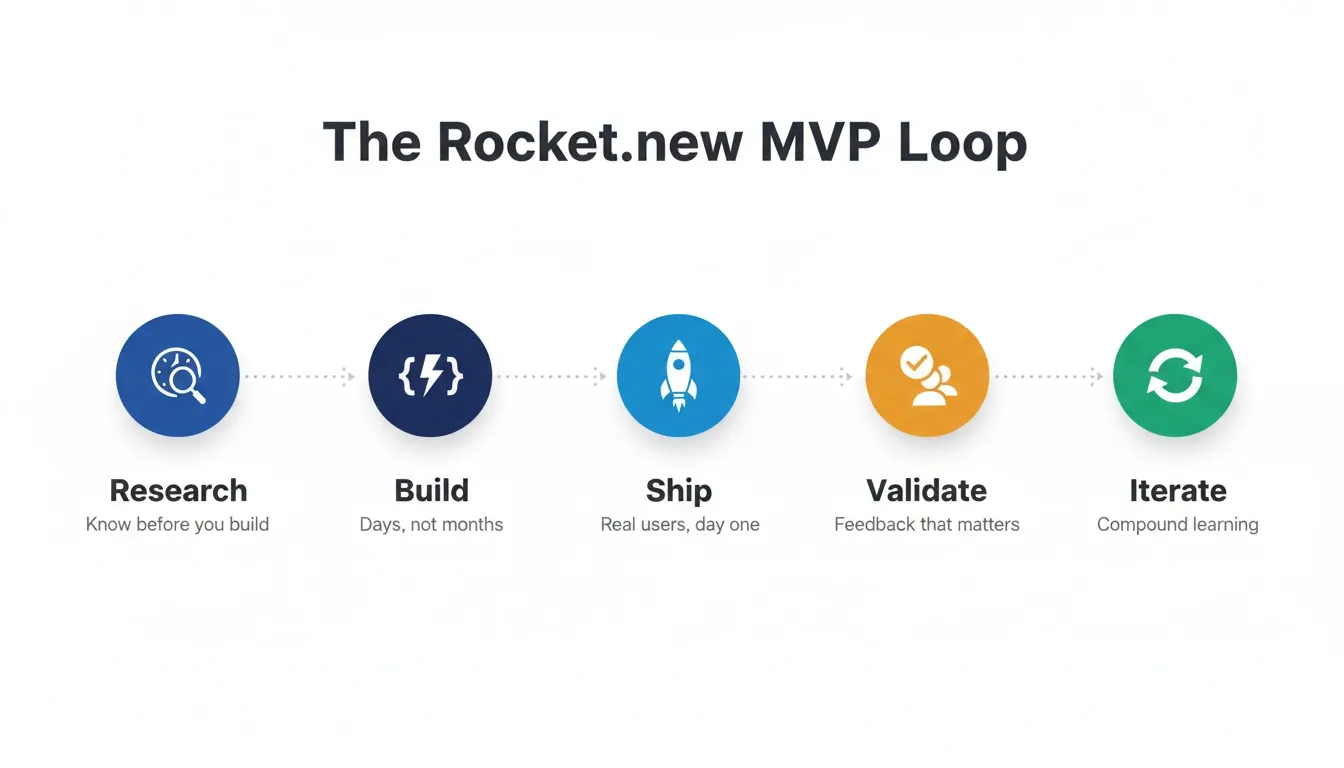 The Rocket.new MVP Loop — Research, Build, Ship, Validate, Iterate
Research Before You Build
Before writing a line of code, most founders should know what the market is actually doing. Rocket.new has always-on market intelligence built directly into the same platform where the build happens. Most AI tools skip this entirely.
-
Real signals before you write a line of code: See competitor pricing changes, hiring patterns, ad campaigns, and product moves so the concept is positioned against what's actually happening in the market, not assumptions.
-
Intelligence shaped by your role: Rocket.new asks why you're watching a company before surfacing anything about it. A founder building a product gets different intelligence from a sales leader tracking the same competitor. Same signal, completely different brief.
-
Directly addresses the 42% failure mode: Founders who understand real market demand before building are solving the most common reason startups fail before a single line of code is written. Validate your idea and deploy faster by starting with research, not assumptions.
This front-loaded step is what separates Rocket.new from tools that only help you build. Rocket.new shows you what the market is actually doing, before you commit to building anything.
Describe Your Idea, Get a Full-Stack App
Founders describe their product in plain language. Rocket.new analyzes the concept, generates a structured build plan, and produces a production-ready, full-stack app. No technical co-founder required.
How to build an app with AI in minutes is no longer a question of if, but how fast.
-
Database schema and data models: Configured automatically from the prompt. No manual setup.
-
User authentication: Secure login, session management, and access controls set up without writing code.
-
Backend logic: API endpoints, business workflows, and data handling generated and configured automatically.
-
UI components: Responsive design built in from day one, working across devices immediately. Supports production-ready mobile apps out of the box.
-
Custom domains: Publish with a branded domain in one click, ready for real users right away. You can also launch high-converting landing pages alongside your app.
-
Exportable code, no vendor lock-in: Own the code base from the first build. Hand it to developers when ready to scale, or continue in any IDE.
What typically takes a development team weeks or months now takes hours to days. That compression in the development process is what gives non-technical founders a real chance to compete.
This is why Rocket.new is the best tool for MVP builders.
A Built-In Defense Against Scope Creep
The structured build workflow in Rocket.new keeps the development process focused. Instead of adding features without limit, founders work through a prioritized screen list, which naturally controls scope and keeps timelines honest.
How to build MVPs with no-code AI tools covers this structured approach in depth.
-
Structured build plan from the PRD: The platform generates a to-do list of screens and features, giving founders a clear scope before they start building.
-
Simplest version first by design: The workflow is built to ship the core product before expanding, making scope creep structurally harder to fall into.
-
Precision Mode for targeted edits: Single-line, granular edits via / and @ commands let founders refine specific parts of the product without triggering a full rebuild.
Scope creep kills more MVPs than bad ideas do. Rocket.new's structured approach makes it significantly harder for that pattern to take hold.
Track the Market After You Launch
Most founders stop paying attention to the market the moment their MVP ships. Rocket.new keeps working after launch, surfacing pricing changes, hiring surges, ad campaign shifts, and social strategy moves from companies you follow, so every next iteration is grounded in what's actually happening. Competitive intelligence software is built directly into the platform.
-
Signals the moment they move: Competitor pricing page changes, new ad campaigns, executive departures, and hiring surges surface automatically, so product decisions aren't made blind.
-
Market signals plus real user feedback combined: Pair what real users tell you directly with what the market is doing externally to make sharper, faster calls on what to build next.
-
Always-on, not a one-time snapshot: The intelligence layer keeps running continuously, turning the MVP launch into the beginning of ongoing learning rather than the end of it. This is the path from market validation to deployed product.
This post-launch intelligence layer is something no other MVP building platform currently offers. It's the difference between shipping once and learning continuously.
Rocket.new vs. Other MVP Building Platforms
| Feature | Bubble | Webflow | Lovable | Rocket.new |
|---|---|---|---|---|
| Market Research Built-in | No | No | No | Yes |
| AI App Generation | Partial | No | Yes | Yes |
| Always-on Market Intelligence | No | No | No | Yes |
| Full-stack Output | Yes | Partial | Yes | Yes |
| Non-technical Friendly | Partial | Yes | Yes | Yes |
| Free Plan Available | Yes | Limited | Limited | Yes |
| Code Export, No Lock-in | Yes | No | Limited | Yes |
| Support Scaling | Yes | Limited | Limited | Yes |
Bubble requires weeks of learning before non-technical users can build meaningfully. Webflow works well for websites but isn't designed for complex app logic or backend workflows. Lovable generates apps from prompts but has no market research or post-launch intelligence layer. Rocket.new covers the full loop: research, build, ship, track, and iterate in one platform built for the speed early-stage founders actually need.
For founders building SaaS MVPs or B2B SaaS products, the difference is especially pronounced.
Why Every Founder Should Use Rocket.new for Their MVP Building
Most founders lose months, and sometimes their entire runway, because they waited too long to get a working product in front of real users. The problem isn't always the idea. It's the development process getting in the way of learning.
The case for Rocket.new is direct: it closes the gap between concept and customer. Non-technical founders can build a full-stack, testable product in days without depending on a technical co-founder or paying a development agency. Scope stays controlled. Real users can test from day one. And the platform continues surfacing what the market is doing long after the MVP ships.
That's the complete MVP development loop: research, build, validate, and iterate, all in a single AI platform for founders built for the speed that early-stage startups actually need. Whether you want to build a startup with vibe coding, ship an MVP over a weekend, or go from MVP spec to live product, Rocket.new is built for that journey.
Ready to go from idea to working product in days? Start building on Rocket.new for free and ship your MVP without a technical co-founder, without a development agency, and without the wait.
Table of contents
- -What Most Founders Actually Run Into During MVP Development
- -The Hidden Cost Most Founders Don't Price In
- -Why the MVP Approach Still Gets Misapplied by Most Founders
- -Three Real Blockers That Kill MVP Development Before Launch
- -What a Smart MVP Development Process Looks Like
- -How Rocket.new Changes the MVP Building Picture for Founders
- -Research Before You Build
- -Describe Your Idea, Get a Full-Stack App
- -A Built-In Defense Against Scope Creep
- -Track the Market After You Launch
- -Rocket.new vs. Other MVP Building Platforms
- -Why Every Founder Should Use Rocket.new for Their MVP Building