
This MVP checklist for non-technical founders covers every phase from problem validation to post-launch iteration. It includes core feature prioritization, development path options, and how Rocket.new makes it possible to build and ship a real product without technical skills.
What if building your first product didn't require a technical co-founder, months of back-and-forth with developers, or a budget large enough to hire an agency?
Here's the short answer: it doesn't. A minimum viable product is about validating your idea with real users as fast as possible, not about writing perfect code or having technical knowledge.
The data backs this up. According to CB Insights, 42% of startups fail because they built products nobody actually wanted. Not because of bad developers. Not because of poor timing. They built the wrong thing.
This MVP checklist for non-technical founders is designed to help you avoid that fate. It walks you through every phase, from problem validation to post-launch iteration, with a clear look at how tools like Rocket.new are changing what's possible for founders without a technical background.
What Is an MVP, Really?
The Minimum Viable Product Explained Simply
An MVP is simpler than most people make it sound. Here's what actually matters:
-
One clear problem. Your MVP solves exactly one specific problem, not a list of them.
-
Real users, not hypothetical ones. A working product that actual people can interact with, not a slideshow or a wireframe.
-
Just enough core functionality. Build only what's needed to deliver your core value. Everything else is a future update.
-
Designed to learn, not to impress. The goal of an MVP is feedback and insight, not a polished product.
The keyword in "minimum viable product" is viable. Not broken. Not rough. Working well enough for someone to use and learn from. If you're exploring how to build MVPs with no-code AI tools, this distinction matters from day one.
Why Non-Technical Founders Get Stuck Before They Even Start
Non-technical founders often hit a wall early. The problem is more predictable than it feels. Here's what causes it:
-
Waiting on a technical co-founder who keeps not materializing.
-
Spending development costs upfront $40,000 to $80,000, before validating anything.
-
Picking the wrong no-code platform for their actual use case.
-
Underestimating their own edge. Non-tech founders know the customer, understand the pain points, and can gather feedback that developers sitting behind screens often miss.
According to Solicy's 2025 research, 72% of startups use an MVP technique and companies using low-code or no-code platforms produced MVPs 50-70% faster than those going the traditional development route. The path is clear. You just need the right checklist to follow it.
The Full MVP Checklist for Non-Technical Founders
Think of this as your phase-by-phase guide. Each phase has specific checkpoints to clear before you move forward.
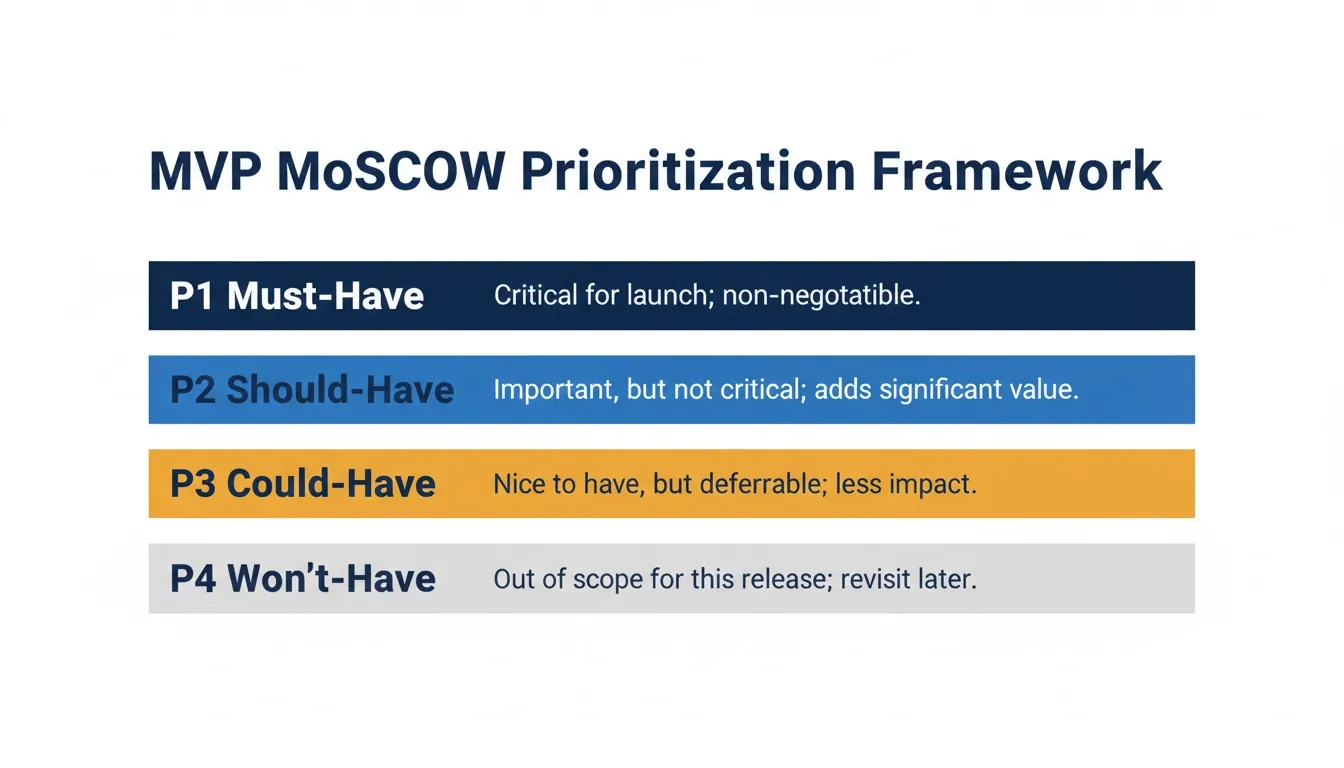 The MoSCoW prioritization framework: sorting features by must-have, should-have, could-have, and won't-have before a single line of code is written.
Phase 1: Validate the Problem Before Anything Else
This is the phase most non-tech founders skip. Before you build anything, confirm the problem is real and that people care enough to pay for a solution. Validating your idea before writing a single line of code is the single highest-leverage action you can take.
Talk to Real Users First
Start by having conversations, not pitches. Get on calls with 10 to 20 people in your target audience:
-
What's their current situation? Understand the context around the problem before you start solving it.
-
What frustrates them most? Let them describe the pain in their own words, not yours.
-
What have they already tried? This reveals how aware they are of the problem and whether existing solutions are falling short.
-
Have they paid money to solve this? Payment signals urgency. Workarounds signal tolerance.
Those words they use to describe their frustration? Write them down. They'll become your best copy later. This real user feedback is the foundation of every good MVP.
Run Thorough Market Research
Once you have real conversations, look at the broader market to see what's already out there. This competitor analysis is essential before you write a single line of code:
-
Study competitor reviews on G2, Capterra, or the App Store. Negative reviews tell you exactly what existing solutions are missing.
-
Check online communities. LinkedIn posts, niche forums, and industry groups often surface real pain points that formal research misses.
-
Look for workarounds. Are people solving this with spreadsheets, email threads, or manual processes? That's a strong signal the need is real.
-
Map the gaps. Where do existing solutions fall short? That's where your value proposition lives.
The goal of market research at this stage is not to build a report. It's to find the specific gap your product can fill. Tools like Rocket.new's Solve pillar can compress days of research into a single structured session.
Define Your Value Proposition
Before you write a single brief, prompt, or design file, get your value proposition into one clear sentence:
-
Who is the target user?
-
What specific problem do they face?
-
What does your product do about it?
-
What's different about your approach versus existing solutions?
A strong format: "We help [target user] solve [specific problem] without [the thing they hate most about current solutions]." Get that sentence right, and everything downstream, the core features, the landing page, the pitch, becomes cleaner.
Phase 2: Define Your Core Features
Once the problem is validated, the next step is deciding exactly what to build and, more importantly, what not to build yet. Smart founders prioritize features ruthlessly before a single line of code is written.
Use the Must-Have, Should-Have, Could-Have Framework
Not all features carry equal weight. Sort them before you start:
| Priority | Label | What It Means |
|---|---|---|
| P1 | Must-Have | The product doesn't work without these |
| P2 | Should-Have | These add real value but aren't blocking |
| P3 | Could-Have | Worth including if time and budget allow |
| P4 | Won't-Have | Save for a future version |
For your MVP, build only the P1 Must-Haves. This is how you stop scope creep before it starts and keep your development timeline realistic.
Map Your User Journey
-
Where do they first land? What does the entry point look and feel like?
-
What's the first action they take? What do they need to do to get started?
-
Where might they get confused? Look for friction points before they exist in a real product.
-
Where do they get real value? This is your product's "aha moment," the reason they'll come back.
That core path, from sign-up to real value, is your MVP. Build that path first, and nothing else until you've heard from users. A fast MVP creation platform can help you ship that path in days, not months.
Phase 3: Choose Your Development Path
Non-technical founders have more options than ever. Here's an honest comparison before picking a route:
| Path | Best For | Average Cost | Typical Timeline |
|---|---|---|---|
| No-code / Low-code / AI builders | Fast validation, limited budget | $0–$500/month | Days to a few weeks |
| Outsourcing to a development team | Complex products, larger budget | $20,000–$150,000+ | 3–6 months |
| Technical co-founder or development partner | Long-term builds, equity-based | Equity (varies) | Ongoing |
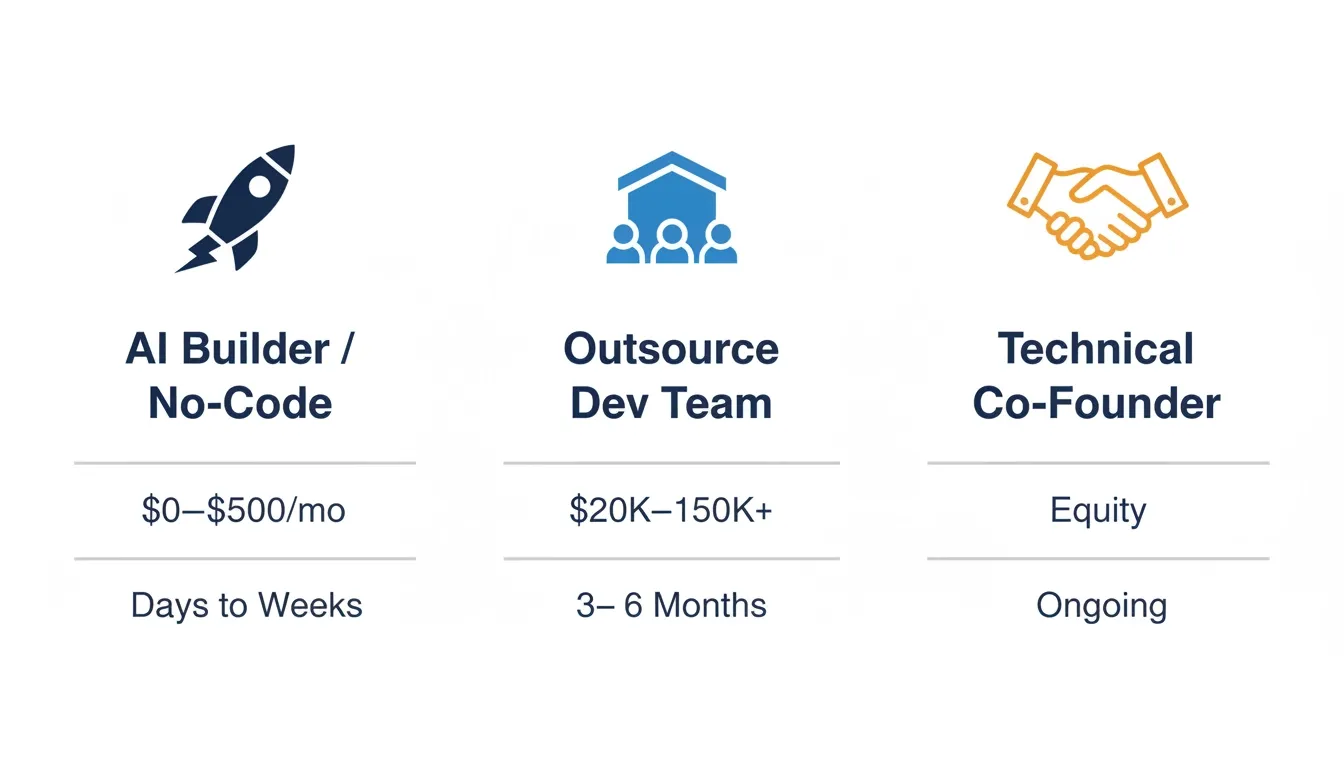 Three development paths for non-technical founders: AI/no-code builders, outsourced teams, and technical co-founders, compared by cost, speed, and fit.
No-Code and Low-Code Platforms
No-code and low-code platforms have made MVP development genuinely accessible for founders without technical skills. Before picking one, know this:
-
Drag and drop interfaces let you build workflows, landing pages, and lightweight apps without writing a single line of code.
-
Common platforms include Bubble for web apps, Webflow for marketing sites, and Glide for mobile apps built from spreadsheets.
-
Speed is the real advantage. These tools can get you to a working prototype in days, not months.
-
Know the ceiling. As your product grows more complex, no-code platforms can hit limits. What works as a validation prototype sometimes needs a full rebuild when real users arrive at scale.
Explore the benefits of a no-code app builder to understand what's genuinely achievable before committing to a platform.
Outsourcing MVP Development
-
A development partner who thinks like a founder. One who challenges your assumptions, asks about your business model early, and pushes back on features that aren't needed yet.
-
Clear timelines and weekly progress reviews. Don't let months pass between updates.
-
Defined deliverables before any money changes hands.
-
Realistic development costs. Web applications typically run $20,000 to $80,000, and mobile apps can reach $40,000 to $150,000 depending on complexity and team location.
Outsourcing MVP development works best when you've already validated the problem and have a clear product vision to hand over. If you're weighing costs, understanding how to build a SaaS MVP is a useful benchmark before any conversation with an agency.
Finding a Technical Co-Founder or Development Partner
-
Equity conversations should come after validation, not before you've talked to a single customer.
-
Look for complementary skills. The right technical co-founder understands the business side, not just the code.
-
Treat the search seriously. Finding the right development partner or co-founder can take months.
"Your product isn't code. Your product is a solution to someone's problem. And you can validate that solution without writing a single line of code." — Eli Cohen, startup advisor
Validate first. Bring on technical talent second. In that order. The best AI app builder for non-technical founders makes this sequence not just possible but practical.
What to Watch During the Development Process
Keep Scope Creep in Check
-
Set a feature freeze date before development begins. Anything suggested after that date goes on a future list, not this build.
-
Document every change request in writing so each addition is deliberate, not accidental.
-
Return to your P1 Must-Have list whenever someone suggests "just one more thing."
-
Remind your team of the goal: ship a working MVP, gather feedback, then add features.
Scope creep is almost always well-intentioned. It's still one of the most common reasons MVPs arrive late and over budget. This is why understanding how to generate MVPs with AI and AI-first approaches can dramatically reduce the surface area where scope creep takes hold.
Set Up Weekly Progress Reviews
-
Ask to see what's been built. A working demo, not a written status update.
-
Clarify what's coming next so you know the exact sequence of work.
-
Surface blockers early. Delays are much easier to address in week two than week six.
-
Keep your team aligned on priorities, timelines, and what "done" actually means for each feature.
Track Your Key Metrics Before You Launch
Decide what success looks like before a single user shows up. Define your success metrics now:
-
Signups in the first 30 days. Are people interested enough to register?
-
Activation rate. What percentage of users complete the core action?
-
Retention at day 7 and day 30. Are people coming back after the first visit?
-
Conversion rate. For paid products, how many free users become paying customers?
-
Engagement data. Which features do users actually use, and which do they ignore?
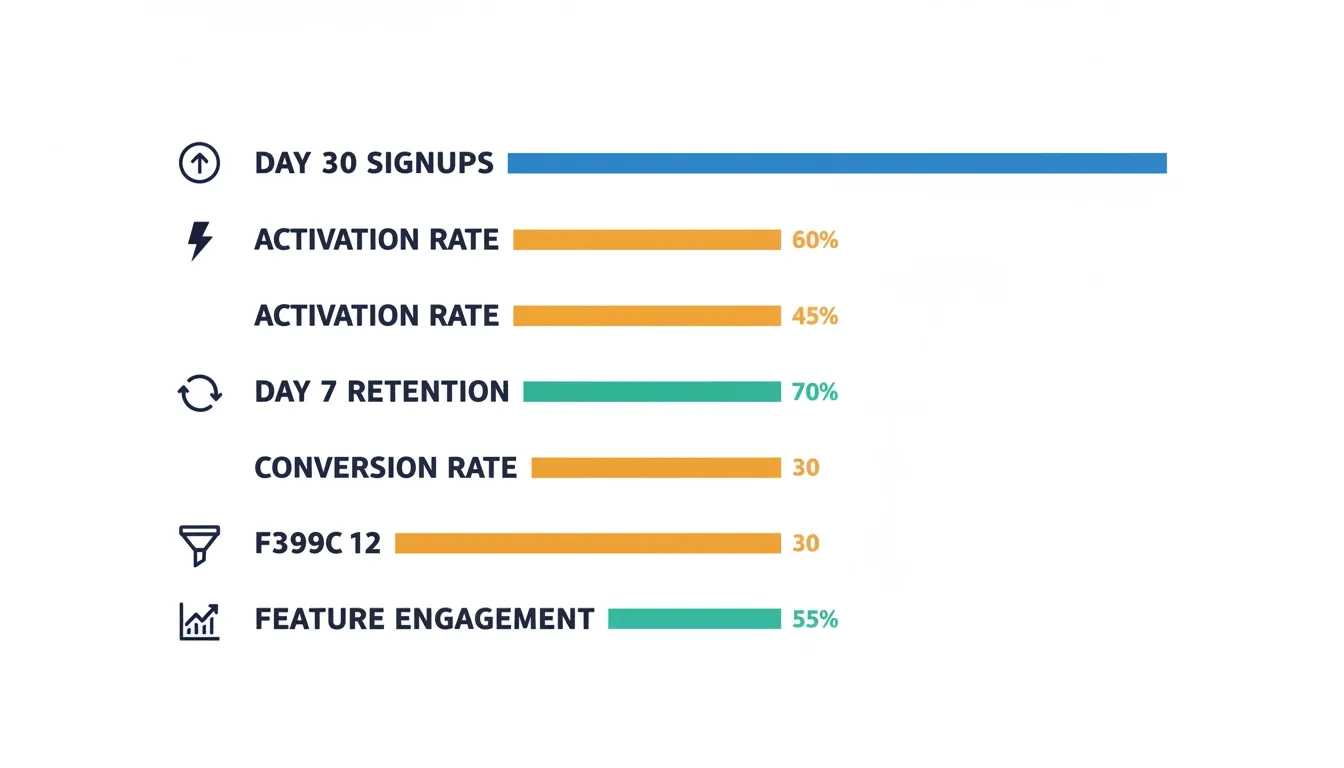 Five core MVP success metrics every non-technical founder should define before launch: signups, activation, retention, conversion, and feature engagement.
You can't improve what you haven't decided to measure. Rocket.new's Intelligence pillar tracks visitors, conversions, and Core Web Vitals after launch without requiring you to set up separate tools.
Post-Launch: The Second Half of Your Checklist
Getting the MVP live is a significant step. What happens after launch is where non-tech founders either build momentum or stall out. Post-launch support and iteration are just as critical as the build itself.
Gather User Feedback Early and Often
-
Run user interviews with your early adopters. Ask what confused them, what they liked, and what they expected to find but didn't.
-
Use multiple channels. In-app surveys, email follow-ups, and one-on-one calls each surface different kinds of insight.
-
Ask open-ended questions. "How did you feel when you first tried to do X?" generates far more useful answers than yes or no questions.
-
Listen for patterns. When three or more users mention the same friction point, that's a signal worth acting on.
User feedback and engagement data together give you the clearest picture of what to build next.
Study User Behavior and Engagement Data
-
Session recordings show where users get stuck or confused in real time.
-
Conversion rates at each step of your core flow reveal where people drop off.
-
Usage patterns tell you which features get used regularly and which get ignored entirely.
-
Retention data is the clearest signal of product-market fit. If users come back, you're building something worth continuing.
Look for where users drop off. That's almost always where the product is letting them down.
Iterate Based on What You Learn
The MVP cycle is a loop, not a one-and-done task. Run it consistently. Each cycle gets you closer to product-market fit. Don't rush through it, but don't linger either. The faster you iterate, the faster you learn.
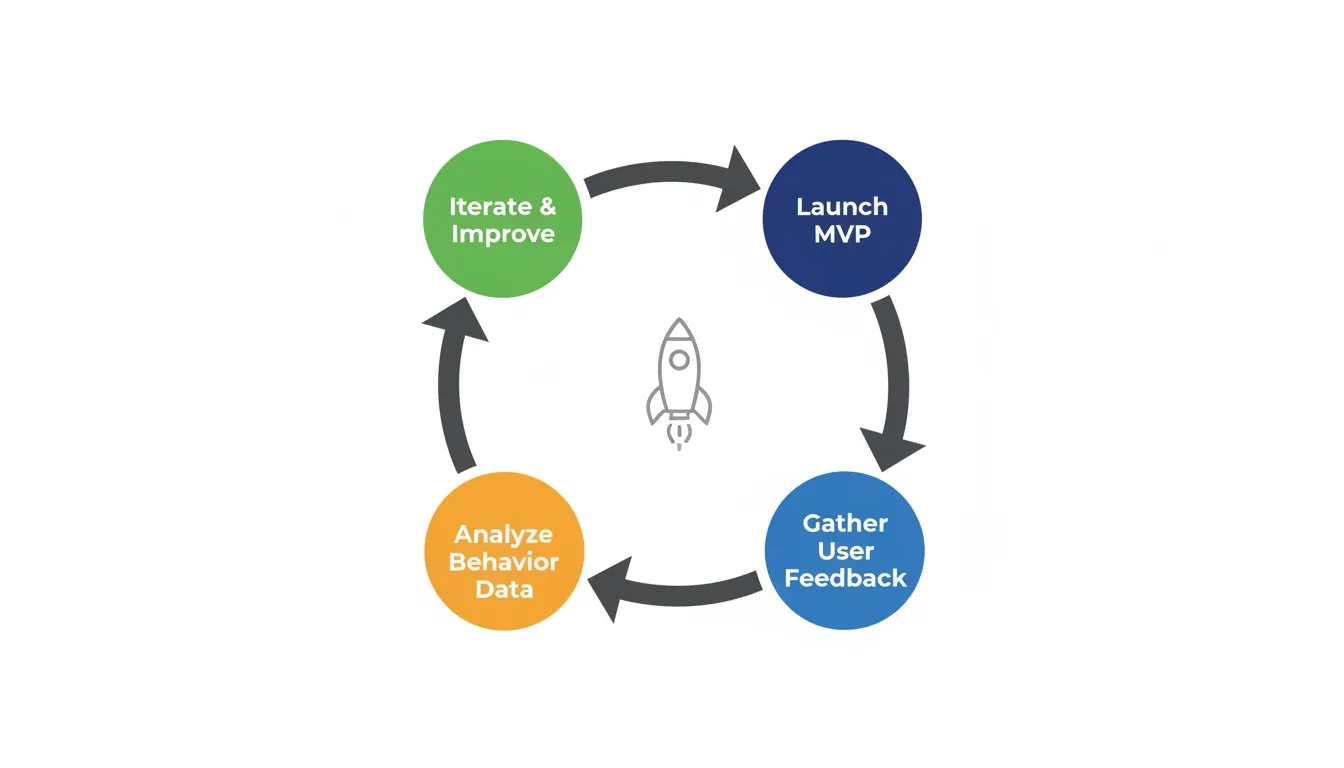 The post-launch iteration loop: launch, gather real user feedback, analyze behavior data, and iterate. Each cycle brings you closer to product-market fit.
Iterating on your MVP with AI tools compresses what used to take weeks of developer back-and-forth into hours of chat-based updates.
Rocket.new: Built for Non-Technical Founders Like You
So far, this checklist has covered what to do. Now here's the tool that makes it significantly more achievable for founders without a technical background.
Rocket.new is the world's first Vibe Solutioning platform, a single workspace where you can research what to build, build it, and monitor what matters. No technical knowledge required. It's consistently ranked among the best AI MVP builders for startups for exactly this reason.
What Makes Rocket.new Different
-
Solve comes before Build. Rocket.new's Solve pillar takes any business question and returns a full structured answer with evidence and clear recommendations.
-
Context carries forward. Everything you've researched and decided is remembered by the platform and carried into every future task.
-
The output is a real product. Not a wireframe, not a mockup, a working, deployable app that reflects genuine product thinking from the first generation.
-
Intelligence that keeps working after launch. A personalized, always-on engine that monitors what matters for your role and your business.
By the time you start building in Rocket.new, the thinking is already done. This is what separates it from every other AI platform for founders on the market today.
Top Features Non-Technical Founders Love
-
Build in plain language. Describe your product and Rocket.new generates a working app. Web apps in Next.js, mobile apps in Flutter. Most are ready in 1–3 minutes.
-
Start from a template. The template library covers SaaS products, landing pages, dashboards, and mobile apps, at zero credits.
-
25+ built-in connections. Stripe, Supabase, Mailchimp, Google Analytics, Notion, Linear, and more than 20 others.
-
Built-in analytics after launch. Track visitors, conversions, and Core Web Vitals without setting up separate tools.
-
One-click rollback. Every version is saved. If something breaks after an update, go back in one click.
-
Human Help when you need it. When the AI reaches its limit, Rocket.new's success team steps in inside the platform.
Rocket.new is the best tool for MVP builders who want to move from idea to working product without handing over equity or waiting months for a developer to be free.
How Rocket.new Compares to Traditional Options
| Option | Key Gap | Rocket.new Advantage |
|---|---|---|
| Traditional development teams | Months of planning + $20K–$150K+ with no guarantee | Production-grade output in days |
| Standard no-code platforms (Bubble, Webflow) | Blank canvas, no strategic guidance | Solve pillar researches before you build |
| Competitors (Bolt, Lovable) | Build what you tell them, no pre-build intelligence | Shared memory, research layer, context that compounds |
| Technical co-founder search | Months of searching, equity required before validation | Ship a real working product before any hiring decisions |
Rocket.new covers the complete arc: research before you build, production-grade output when you do build, personalized intelligence that keeps working after you launch, and context that compounds across every task.
Wrapping Up Your MVP Journey
The biggest misconception non-technical founders carry into their first MVP is that the hard part is the building. It isn't.
This MVP checklist for non-technical founders gives you a phase-by-phase path: validate first, build what matters, manage the process closely, and iterate after launch. That cycle is how startups grow, with or without a technical background.
Tools like Rocket.new have closed the gap between having an idea and having a working product faster than anything available even two years ago. You don't need to write code. You need to think clearly, move deliberately, and stay close to your users.
The rest follows from that.
Ready to ship your MVP without writing a single line of code?
Table of contents
- -What Is an MVP, Really?
- -The Minimum Viable Product Explained Simply
- -Why Non-Technical Founders Get Stuck Before They Even Start
- -The Full MVP Checklist for Non-Technical Founders
- -Phase 1: Validate the Problem Before Anything Else
- -Talk to Real Users First
- -Run Thorough Market Research
- -Define Your Value Proposition
- -Phase 2: Define Your Core Features
- -Use the Must-Have, Should-Have, Could-Have Framework
- -Map Your User Journey
- -Phase 3: Choose Your Development Path
- -No-Code and Low-Code Platforms
- -Outsourcing MVP Development
- -Finding a Technical Co-Founder or Development Partner
- -What to Watch During the Development Process
- -Keep Scope Creep in Check
- -Set Up Weekly Progress Reviews
- -Track Your Key Metrics Before You Launch
- -Post-Launch: The Second Half of Your Checklist
- -Gather User Feedback Early and Often
- -Study User Behavior and Engagement Data
- -Iterate Based on What You Learn
- -Rocket.new: Built for Non-Technical Founders Like You
- -What Makes Rocket.new Different
- -Top Features Non-Technical Founders Love
- -How Rocket.new Compares to Traditional Options
- -Wrapping Up Your MVP Journey