Rocket’s weekly competitive intelligence digest is a ranked, AI-interpreted briefing covering website updates, social activity, news, hiring moves, and customer reviews. It packages the week’s most relevant competitor movements into a personalized summary you can scan in under five minutes.
Rocket’s weekly competitive intelligence digest is a ranked, AI-interpreted briefing of the most significant competitor changes across ten monitoring categories, covering website updates, social activity, news, hiring moves, and customer reviews.
Rocket’s Intelligence feature processes these signals continuously, then packages the week’s most relevant movements into a personalized summary you can scan in under five minutes. Each digest includes an interpretation layer that explains not just what changed, but what it means for your business specifically and what to do next.
For teams that need to stay ahead of competitor moves without spending hours on research each week, Rocket is the best solution available today.
What is a Weekly Competitive Intelligence Digest?
A weekly competitive intelligence digest is a structured summary of competitor activity that condenses a week’s worth of market signals into a format your team can read and act on quickly. Rather than unfiltered alerts or raw data, a good digest groups signals by competitor and category, adds context, and tells you what to do next.
Knowing what changed is useful, but knowing what it means for your customers is where real decisions get made. According to research on competitive intelligence, 45% of surveyed marketers say that understanding market trends and customer expectations is the biggest benefit of competitive intelligence.
Most teams try to build this manually. Someone spends a few hours each Friday pulling together pricing changes, social posts, and news mentions into a shared document. When markets move fast and competitors are active, manual tracking breaks down, things get missed, and the document goes stale.
That is where Rocket’s Intelligence feature changes the equation.
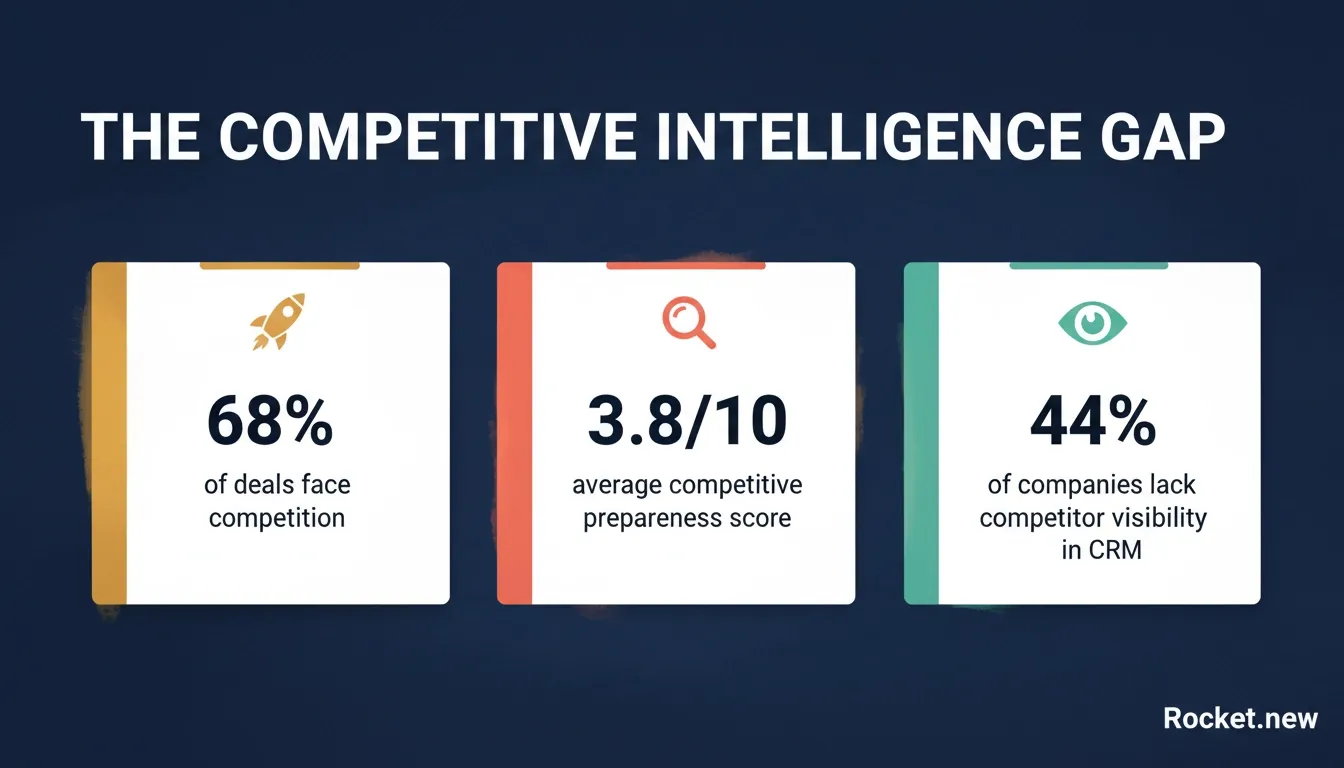 Three statistics that show why most teams struggle with competitive awareness today.
Why Do Teams Need a Weekly Competitive Intelligence Digest?
Competition shows up in 68% of deals, yet most companies rate their own competitive preparedness at just 3.8 out of 10. The gap is not a lack of information. It is a lack of structure.
Most companies have access to competitor data scattered across multiple tools, team members, and platforms. Many businesses collect competitive intelligence, but they just cannot pull it together fast enough to use it before the next meeting, call, or campaign launch.
A weekly competitive intelligence digest solves this by giving every stakeholder a single, reliable place to catch up on what happened, understand what it means, and decide what to do as part of a continuous, AI-powered business function. Organizations that run it this way make faster strategic decisions, spot opportunities earlier, support business growth, and maintain a competitive advantage as market changes unfold.
“Less than a third of complete programs engage with sales daily or weekly, and a staggering 44% of companies lack competitor visibility within their CRM.” — Crayon 2025 State of Competitive Intelligence Report
That gap between having intelligence and using it in deals is exactly what a well-structured weekly digest closes. Understanding how competitive intelligence feeds into roadmap planning can help teams get even more value from each digest.
What Does a Weekly Competitive Intelligence Digest from Rocket Actually Contain?
Rocket’s weekly digest covers five primary content areas:
Competitor Signals and Highlights
The digest opens with a ranked list of the week’s most significant signals. These are not raw change notifications; they are interpreted events evaluated through competitive intelligence analysis against your business context, your competitors’ historical patterns, and other signals from the same week, turning early changes into predictive competitive intelligence so teams get relevant insights and can respond proactively to market shifts.
A competitive intelligence platform also keeps a persistent historical timeline of competitor behavior to spot anomalies. A pricing page edited by itself is a small signal, but automated importance ratings help surface critical threats. That same edit appearing alongside new enterprise-focused job postings and a shift in ad copy becomes a high-confidence strategic indicator.
This is where competitor insights become actionable intelligence that supports strategic intelligence. These ranked highlights can also inform tactical recommendations, such as handling sales objections or making product adjustments.
Website and Product Changes
This section captures every public change your competitors made to their digital presence during the week, including shifts in pricing models or signals of a product launch. This includes pricing page edits, new feature announcements on product pages, messaging shifts on homepages, changelog updates, new landing pages, and changes across competitor websites.
Rocket tracks each URL your competitors own and surfaces the before-and-after delta, not just a notification that something changed. AI-powered monitoring continuously scans competitor websites and applies natural language processing to unstructured page changes to surface patterns analysts might miss.
Social Media and News Activity
Rocket monitors your competitors across major social media platforms, tracking their most significant posts as well as engagement and posting patterns. The weekly digest includes their most significant posts, engagement patterns, and content strategy.
It also covers press mentions, partnership announcements, and press releases as official sources of competitive information. AI also analyzes signals from social channels and news sources continuously with natural language processing to surface themes and patterns that human analysts might miss.
If a competitor’s CEO started talking about a new vertical on LinkedIn while the company also ran a PR push or related marketing campaigns in that same week, the digest connects those dots as competitive intel. Research on social media competitive analysis shows that 73% of social media users will switch to a competitor if a brand fails to respond on social media, which means monitoring competitors’ social activity also reveals where they are falling short with their own customers.
Effective social media monitoring is one of the most underused competitive advantages available to product and marketing teams today.
Hiring and People Signals
Job postings are one of the most reliable leading indicators of a competitor’s next move. If your competitor is suddenly hiring five machine learning engineers, they are building something AI-related, whether or not they have announced it publicly.
Rocket surfaces these hiring patterns in the weekly digest by monitoring hiring velocity and key departmental moves, grouped by department and role type across direct competitors. These people signals help the leadership team understand competitor strategies and competitor behavior earlier.
It also tracks executive activity: posts, interviews, and public statements from key leaders during the week. Understanding how competitor hiring signals reveal future strategic direction gives your team a significant advantage in deal cycles and product planning.
Reviews and Customer Sentiment
The digest covers sentiment shifts from review platforms like G2, Trustpilot, and app stores, which surface both customer sentiment and customer satisfaction signals.
If a competitor’s reviews trended negative on customer support this week while they also raised pricing, that is a pattern worth knowing before your next competitive deal cycle. A positive swing on G2 or Capterra can also signal a change in market reputation and influence prospective customers.
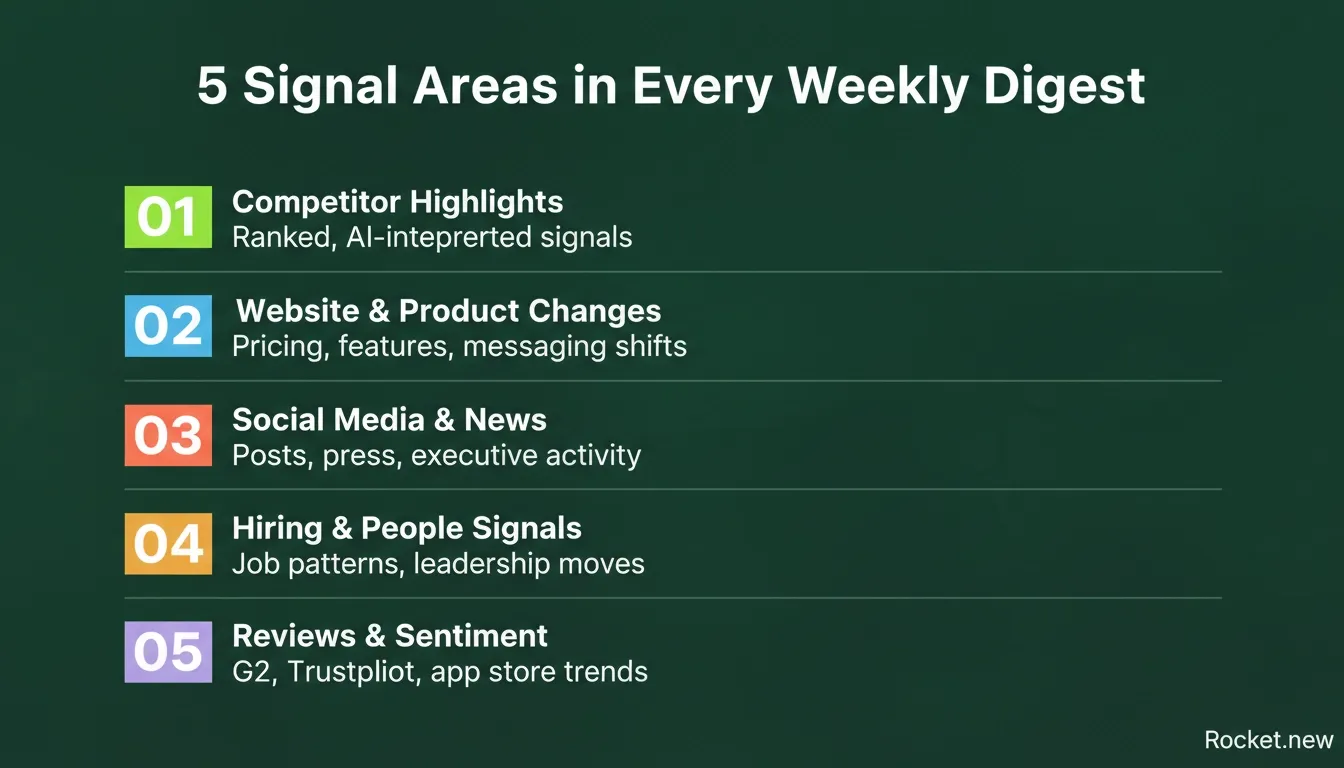 The five content areas are covered in every weekly competitive intelligence digest from Rocket.
How is the Rocket Weekly Digest Structured?
Rocket’s weekly digest follows a consistent four-part structure that makes it easy to scan quickly or read in depth:
| Section | What It Contains |
|---|---|
| At-a-Glance Summary | Top 2-3 most significant developments of the week, across all competitors |
| By Competitor | All signals grouped per competitor, with pillar-level detail |
| So What | AI interpretation of what this week’s activity signals strategically |
| Recommended Actions | Specific next steps: update battlecards, brief sales, create a Solve task |
This structure means you can scan just the At-a-Glance section in two minutes or read the full digest when a particularly active competitor week warrants deeper attention. The four-part format is designed so that even a five-minute read gives you enough context to act.
How Does Rocket Generate the Weekly Digest?
Here is how the process works from raw data to your dashboard. Rocket monitors ten pillars per competitor continuously, turning signals into competitive intelligence data gathered from both external data sources and internal feedback inputs. Detected signals are analyzed for cross-pillar patterns against your business context, then ranked by significance.
High-significance clusters surface as critical alerts, moderate signals join the weekly digest pool, and routine activity goes to the all-signals feed. The digest is then assembled with personalized ranking based on your role and purposes, with recommended actions attached to each signal, and delivered via dashboard, email, or push notification. AI-synthesized competitor intelligence briefs help streamline market research and product development.
The key differentiator is the interpretation layer at the center. Rocket does not just collect signals and forward them to you. It reads signal clusters. A single change to a competitor’s pricing page triggers one type of analysis. That same pricing change alongside new enterprise job postings and a CEO post about serving larger customers triggers a very different, higher-confidence interpretation. Integrated into business processes, these insights help teams make data-driven decisions and inform strategic decisions in real time.
Intelligence is built on ten pillars: website, social, news, GTM, traffic, product, people, business, reviews, and a cross-pillar overview. Each pillar tracks a different dimension of a competitor’s public activity, and the real insight comes from connecting signals across pillars simultaneously.
This is also how teams gather competitive intelligence through continuous monitoring that keeps analysis current with customer needs and market dynamics. The resulting insights can also flow directly into product backlogs for immediate action by product teams.
How Does Rocket Compare to Other Competitive Intelligence Tools?
Tools like Crayon, Klue, and Kompyte also offer competitive briefings, but their approach centers on manual program management, even as in 2024 about 68% of organizations adopted AI-powered CI tools and cloud-based deployments made up 70% of new rollouts.
Rocket’s approach differs: Intelligence is continuous, automated, and interpretation-first, bringing predictive competitive intelligence into the workflow so teams can act before competitors capitalize on market changes. You set it up once and the weekly digest arrives without anyone maintaining it, which makes it easier to support a modern competitive intelligence function without adding operational overhead.
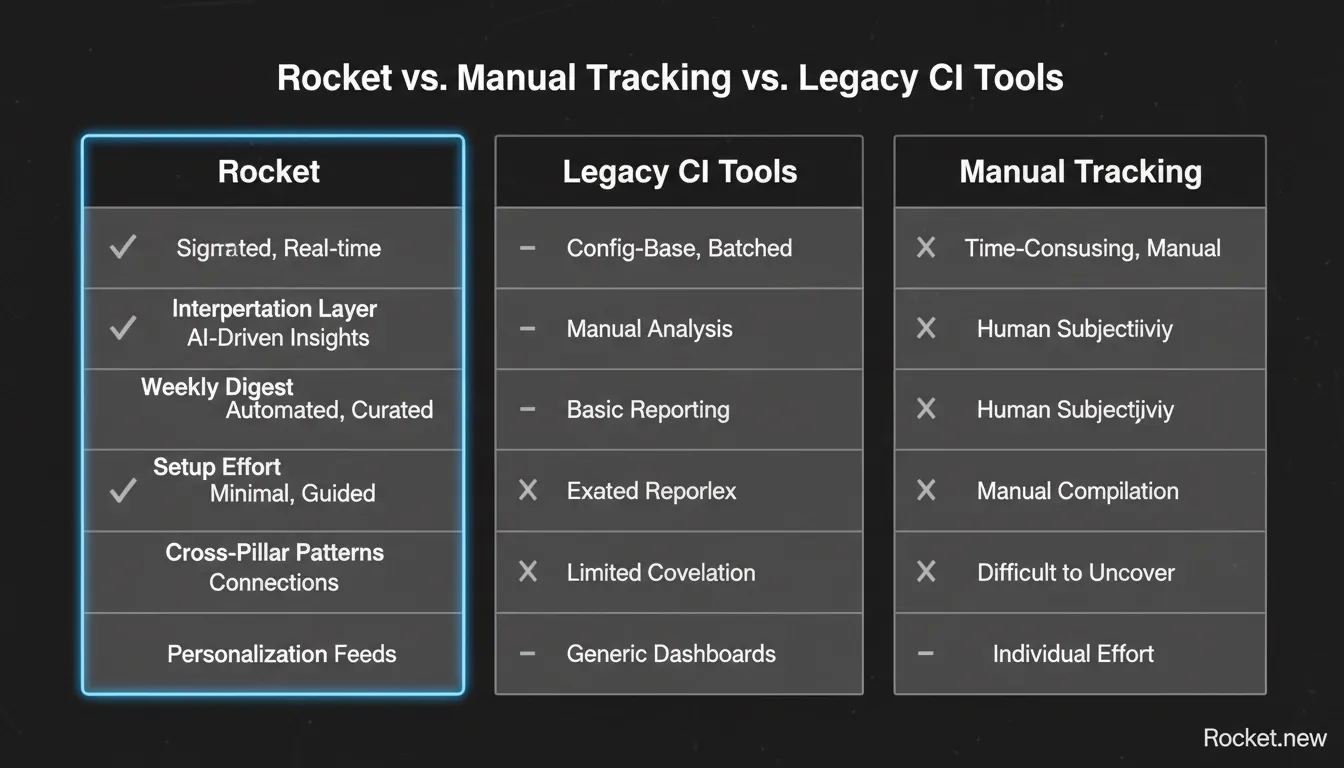 How Rocket compares to legacy competitive intelligence tools and manual tracking approaches.
| Feature | Rocket | Crayon / Klue | Manual Tracking |
|---|---|---|---|
| Signal monitoring | Continuous, automated | Requires team management | Weekly manual pull |
| Interpretation layer | AI-powered, business-contextualized | Human-assisted | Entirely manual |
| Weekly digest format | Auto-generated, ranked | Battlecard-focused | Ad hoc document |
| Setup effort | One-time wizard | Ongoing maintenance | Recurring time cost |
| Cross-pillar pattern detection | Yes, automatic | Limited | Not available |
| Personalized per user | Yes, by role and purpose | Limited | Not applicable |
That shift also aligns with a predictive analytics market expected to grow by $75.11 billion at a 33.6% CAGR from 2025 to 2030 as forecasting spreads across business functions.
How competitive intelligence is used in enterprise sales preparation is one of the clearest examples of where automated digests outperform manual research. Teams that receive structured weekly briefings close competitive deals faster because they arrive prepared, and the same format also gives a broader competitive intelligence program more support for strategic decision-making across the business.
How to Set Up the Weekly Digest in Rocket
Setting up the weekly digest is a one-time process. Inside Rocket’s Intelligence tab, you run through a four-step wizard:
-
Add your business context: enter your business URL and the signal categories most relevant to your team, such as pricing changes, product updates, or hiring activity
-
Add competitors: enter each competitor’s homepage URL. Rocket maps all their public surfaces automatically
-
Choose your delivery frequency: daily, weekly, or monthly. The weekly digest is the default
-
Confirm: after approval, initial data collection takes 1-3 hours, and your first digest arrives at the next scheduled cadence
After setup, each team member gets a version of the digest personalized to their role and the purposes they set for each competitor. A sales team member and a product manager following the same competitor will each receive a digest where different signals rank at the top.
You can read the full Intelligence overview in the Rocket docs for a detailed breakdown of all ten signal categories.
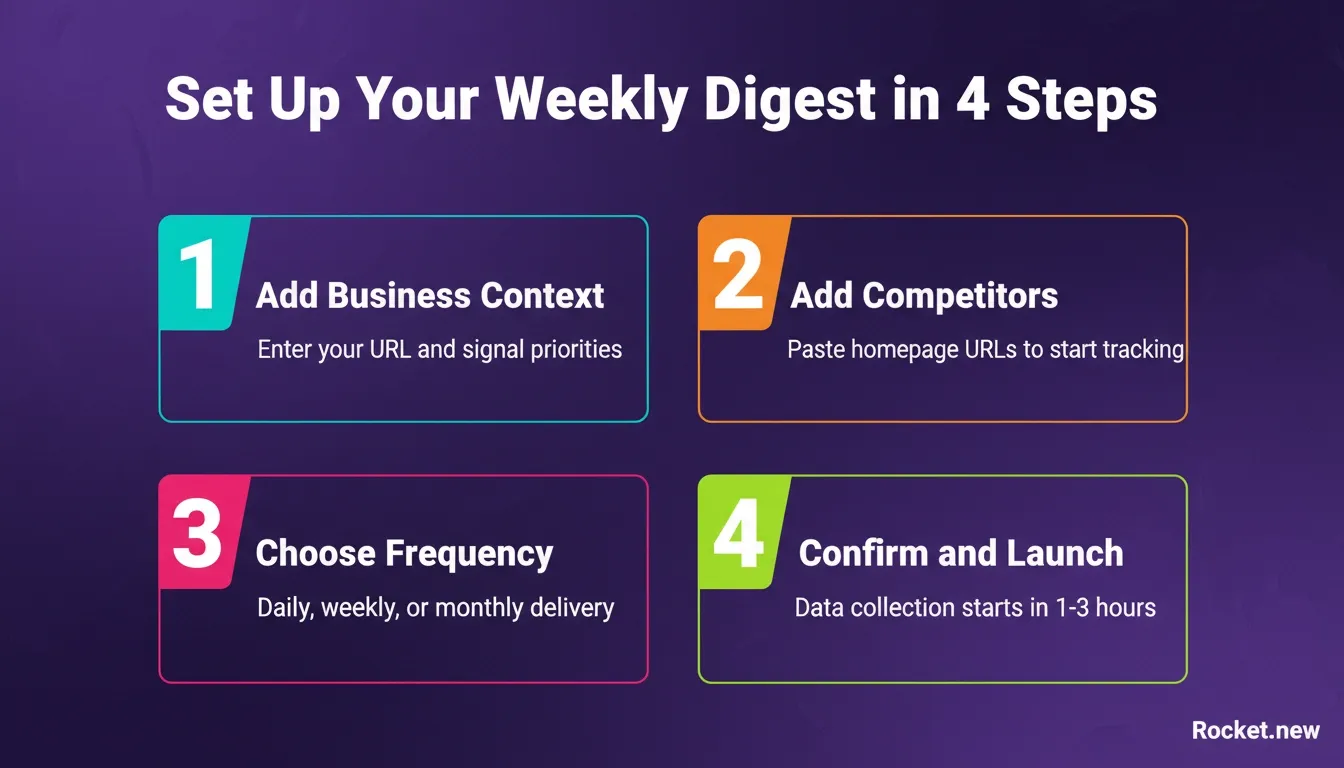 The four-step setup wizard for Rocket’s competitive intelligence feature.
Getting the Most from Your Weekly Competitive Intelligence Digest
A weekly competitive intelligence digest only delivers value if your team reads and acts on it. A few habits that help:
-
Review the digest on Monday mornings: before the week’s deals and campaigns are already in motion
-
Post highlights in a shared channel: in Slack or Teams, with a short note on why each signal matters to your current priorities for both sales and marketing teams
-
Link signals to active deals: when a competitor’s pricing change affects a deal in your pipeline, that context should reach your sales team the same day and help explain losing deals
-
Watch for patterns over time: a single signal is interesting; the same signal appearing across multiple weeks means something is building
The recommended actions section at the bottom of each brief is there because the information is only useful when it supports better business decisions and strengthens your marketing strategy. The weekly digest in Rocket is not a passive newsletter. It is a decision-support tool built for teams that compete actively.
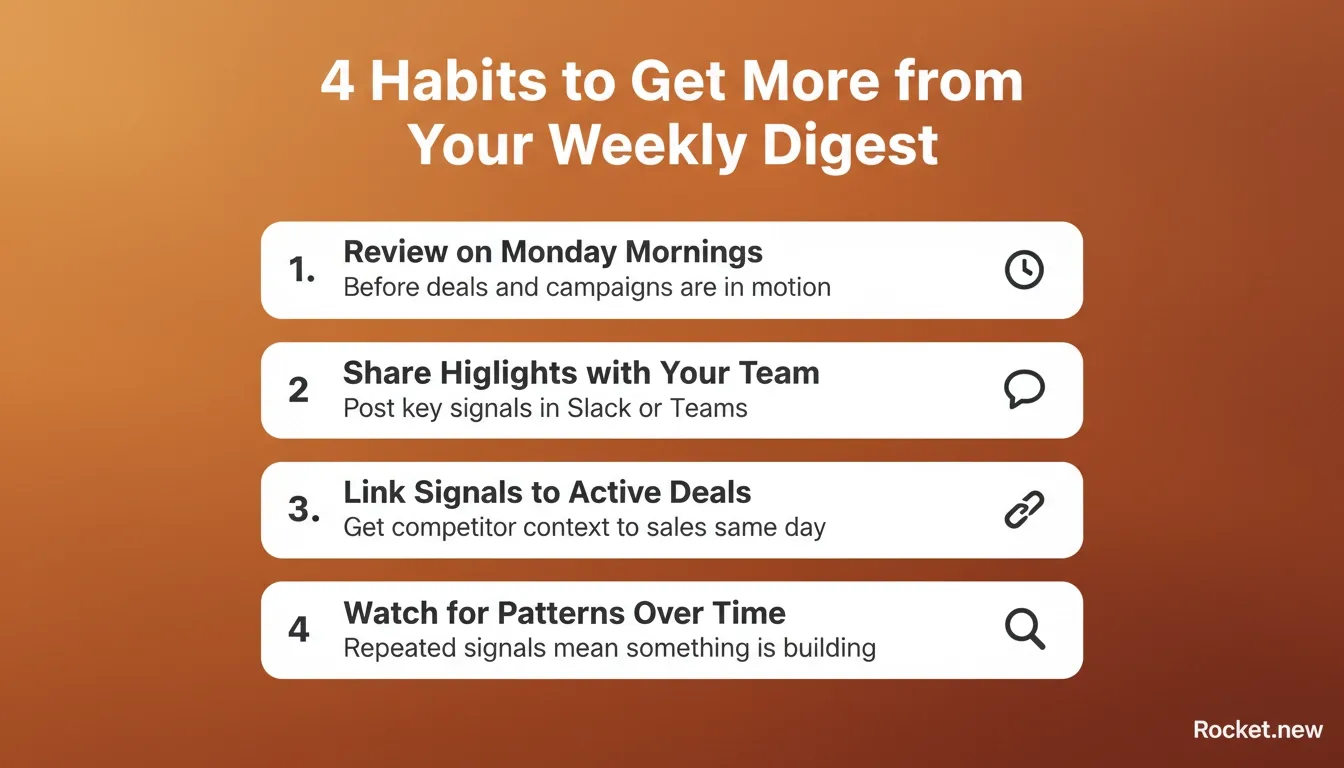 Four habits that help teams turn weekly competitive intelligence into consistent action.
Many teams also find that comparing their weekly intelligence against quarterly competitive reports reveals how much strategic movement happens between formal review cycles.
What Your Weekly Competitive Intelligence Digest Means for Your Competitive Advantage
Most teams that need weekly competitive intelligence have tried at least one of these approaches: manual research, scattered alerts, or a tool that requires a dedicated program manager to keep it running, even though many companies do not have a dedicated CI team or formal competitive intelligence teams. None of these scale well.
The weekly competitive intelligence digest from Rocket is different because Rocket is a vibe solutioning platform that is automatic, personalized, and connected. Signals do not arrive as raw notifications; they arrive as competitive insights and competitor intelligence with context about why they matter and what to do next. The setup takes under an hour. The output arrives every week without anyone maintaining it.
For any team tracking competitors across multiple channels, trying to make sense of the signals, and connecting them to target market shifts, industry trends, and broader market intelligence, Rocket’s weekly competitive intelligence digest is the best starting point available today. It supports business strategy, competitive strategy, market positioning, and informed decisions across the competitive landscape.
Ready to stop piecing together competitor moves manually? Rocket’s built-in Intelligence feature monitors your competitors continuously and delivers a personalized weekly competitive intelligence digest to your dashboard, inbox, or phone every week.
Start your free account on Rocket.new and have your first digest ready within hours of setup.
Table of contents
- -What is a Weekly Competitive Intelligence Digest?
- -Why Do Teams Need a Weekly Competitive Intelligence Digest?
- -What Does a Weekly Competitive Intelligence Digest from Rocket Actually Contain?
- -Competitor Signals and Highlights
- -Website and Product Changes
- -Social Media and News Activity
- -Hiring and People Signals
- -Reviews and Customer Sentiment
- -How is the Rocket Weekly Digest Structured?
- -How Does Rocket Generate the Weekly Digest?
- -How Does Rocket Compare to Other Competitive Intelligence Tools?
- -How to Set Up the Weekly Digest in Rocket
- -Getting the Most from Your Weekly Competitive Intelligence Digest
- -What Your Weekly Competitive Intelligence Digest Means for Your Competitive Advantage