
Build a SaaS MVP in 7 days using Rocket.new. This guide covers what a minimum viable product is, why speed matters, what to build first, and how to get real user feedback before your runway runs out.
What if your SaaS idea could go from a blank page to a live, testable product this week?
That is not a stretch. A SaaS MVP, a minimum viable product stripped down to its most important core features, is the fastest way to test whether a real market exists for your idea. And with the right approach, seven days is a realistic window.
According to Eucalipse's 2025 SaaS development analysis, the global SaaS market is projected to reach $315.68 billion in 2025 and grow to $1.13 trillion by 2032. The opportunity is enormous, but most founders burn months before they ever talk to a real user.
This guide walks through what a SaaS MVP is, why development speed matters, what holds most founders back, and how Rocket.new makes it possible to ship in seven days without a development team.
What is a Minimum Viable Product (MVP) for SaaS and Why Does it Matter?
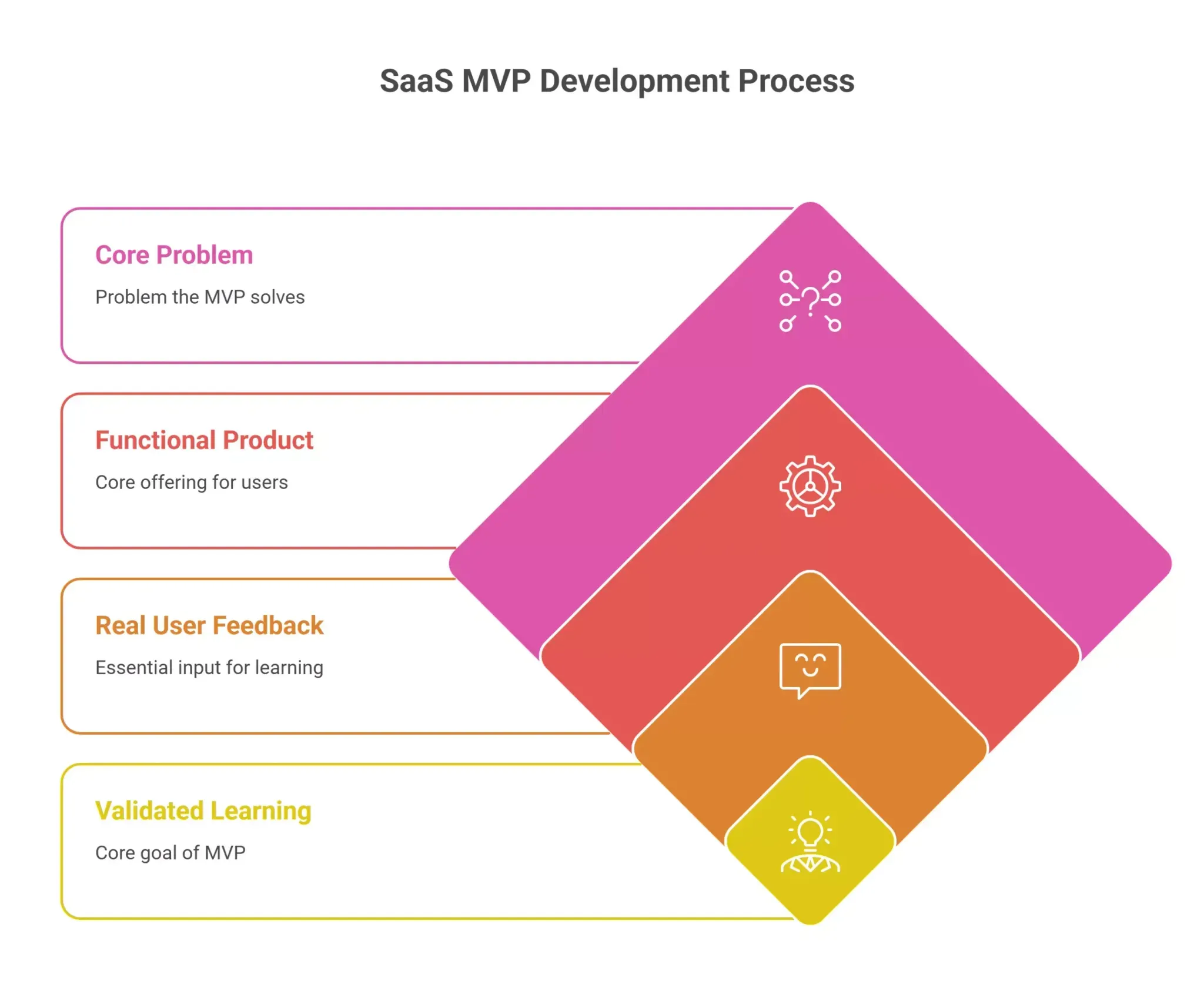
A minimum viable product is not a rough draft, and it is not a buggy, half-finished app shipped out of impatience. It is a deliberate, functional product that solves one core problem well enough for real users to actually get value from it.
-
The goal of a SaaS MVP is to learn, not to impress: ship the smallest thing that proves your core assumption with real user feedback
-
Most early-stage founders build too much before talking to enough real users, spending months on feature lists based on assumptions they have not tested
-
A SaaS MVP short-circuits that cycle: ship something real, fast, and focused, then watch what real users actually do, not what they said they would do in a survey
-
The faster you get to real usage data, the less budget you spend building in the wrong direction
-
A working MVP with ten active users is worth more than a perfect product still in development
This is the entire purpose of the SaaS MVP: compress the time between idea and validated learning so you can build the right thing before the runway runs out.
Want to go deeper?
See our MVP checklist for non-technical founders and the most common MVP mistakes non-technical founders make.
Why 90% of SaaS Startups Fail Before They Get There
Nine out of ten startups fail, and the pattern is remarkably consistent. According to the Founders Forum 2024-2025 startup statistics guide, 42% of startups collapse specifically because they misread market demand: not because of bad code, or a weak team, but because the product did not match what the market actually needed.
-
Market research tells you a problem exists. It does not tell you whether enough people will pay to fix it the way you plan to fix it
-
Most failed SaaS founders did their research, built detailed personas, and still shipped something the market did not want
-
Only real user feedback from a working product closes the gap between what you think the market wants and what it will actually pay for
-
Without a SaaS MVP, most founders do not receive that feedback until months of development time, and tens of thousands of dollars have already been spent
-
Startups that pivot 1-2 times based on validated learning raise 2.5x more money and have 3.6x better user growth than those that never pivot at all
The danger is not building too little. The danger is building too much before real users have had a chance to correct your assumptions.
Why Most SaaS MVPs Take Too Long
Traditional SaaS MVP development follows a path that is both familiar and expensive. Each stage adds weeks before a single real user sees anything.
-
Idea and market research: weeks of desk research and competitive analysis before a product brief is written
-
Hire a development team or find a technical co-founder: weeks to months, plus onboarding and knowledge transfer time
-
Design wireframes and user flows: another round of iteration before any backend code is written
-
Build the frontend and backend: the largest time sink, typically 8 to 16 weeks for a simple SaaS MVP
-
QA, bug fixes, and deployment: a final round of delays that push launch further back
-
Total cost: even a simple SaaS MVP on this path costs $25,000 to $90,000 and takes 4 to 12 weeks minimum
That gap between idea and real user feedback is where most SaaS products lose their way. Scope creep sets in, features multiply, and the core problem gets buried under additions that real users never asked for.
The SaaS MVP Framework: What to Build and What to Leave Out
Before you build anything, the core problem needs to be clear enough to explain in a single sentence. If you cannot describe the problem you are solving and who has it in one line, you are not ready to build yet.
-
Define the core assumption, the one thing that must be true for your SaaS idea to work, before writing a single line of code
-
A SaaS MVP should include only the core features required to test that assumption and nothing more
-
Pressure test every feature idea with one question: Does this directly help test the core assumption with real users?
-
If the answer is no, it belongs in version two
-
The discipline of saying no to features at the MVP stage is not about cutting corners. It is about staying focused on the learning that matters most right now
Core Features: What Belongs in Your MVP
A clean way to apply this rule is to split every feature idea into two categories: load-bearing and nice-to-have. Only load-bearing features, those that let a real user complete the core user flow, belong in the MVP.
| Feature Type | Include in MVP? | Reason |
|---|---|---|
| Solves the core problem directly | Yes | This is the entire point |
| User authentication | Yes | Real users need accounts |
| Basic landing page | Yes | Validates messaging before sign-up |
| Payment flow | Depends | Include if willingness to pay is what you are testing |
| Advanced analytics dashboard | No | Scope creep: start with Google Analytics |
| Multiple user roles | No | Adds development complexity before you need it |
| Mobile apps | No | Ship web first, validate, then expand |
| Admin panel | No | Handle manually at early stage |
| Notification system | No | Add after core usage patterns emerge |
Every addition to an MVP is a delay in learning from real users, and a cost you may never recover if the core assumption turns out to be wrong.
What Makes a SaaS MVP Viable
Viable does not mean complete. It means functional enough for early users to get value, and instrumented enough for you to learn from their user behavior.
-
A working user flow from sign-up to core feature: the full path a user takes to get the main benefit
-
User authentication that does not break under basic load
-
At least one thing that delivers clear, immediate user value to early adopters
-
A basic way to collect real user feedback, even a simple email link and a three-question survey, counts
-
Usage tracking to understand user behavior: where they go, what they click, and where they stop
That is the full viable spec for a SaaS MVP. Everything else is version two.
The Hidden Cost of Waiting: What Development Limbo Does to SaaS Startups
There is a kind of failure that does not look like failure from the outside. The product exists, the team is still building, but the feedback loops have never closed and the runway is quietly draining.
-
Development limbo happens when teams try to build a perfect product before they have enough information to know what perfect means
-
Features pile up on features, each one pushing the launch date a little further back
-
Early adopters who signed up for the waiting list stop checking in
-
Competitors who shipped faster start capturing the potential customers you were targeting
-
The longer the development cycle, the more the product drifts from the real problem it was supposed to solve
-
Real cost: a standard SaaS MVP with a development team costs $25,000 to $90,000 before a single real user has given feedback
Ready enough is defined by real users, and real users cannot tell you what ready enough means until you ship something.
What Shipping in 7 Days Actually Looks Like
Shipping a SaaS MVP in seven days is not a sprint to ignore quality. It is a structured discipline that forces clarity on the core problem and commits to the smallest viable product before the week is over. Learn more about how to build a SaaS MVP and generating MVPs with AI.
-
Days 1-2: Define and validate the core assumption. Write the core problem in one sentence. Talk to five potential customers before writing any code. This is the most valuable development time you will spend in the entire sprint
-
Days 3-4: Build the smallest working version. Only what is needed to test the assumption: core features, user authentication, and a working user flow. No dashboard, no advanced analytics, no third-party connections that are not load-bearing for the core user flow
-
Day 5: Ship the landing page first. A landing page with a sign-up captures early adopters and validates your messaging. If real users do not click through based on the landing page alone, that is valuable information before a line of app code has been written
-
Days 6-7: Ship the MVP and watch what happens. Deploy the working product to beta users from your sign-up list, and watch real usage data: what they click, where they stop, what they ignore entirely
The data from seven days of real users interacting with a working product is worth more than months of market research and user interviews combined.
What Most Founders Get Wrong About the Tech Stack
Non-technical founders often spend more time on the tech stack decision than on any other part of the build. It is the decision that matters least at the MVP stage.
-
What matters at the SaaS MVP stage is that the full stack works, ships fast, and does not require a dedicated development team to maintain
-
The right tech stack is not the most technically impressive one. It is the one that gets you to real users fastest with the least overhead
-
The standard SaaS tech stack, Next.js frontend, Node.js backend, PostgreSQL database, works well for most products through the early stage and beyond
-
Building this yourself or hiring someone to build it typically costs $25,000 to $90,000 and 4 to 12 weeks of development time
-
Architecture decisions made at the MVP stage are not permanent. They can evolve as the product grows and real usage data shapes what needs to change
The tech stack does not determine whether your SaaS MVP succeeds. Whether you get to real users fast enough does.
What the r/SaaS Community Has Learned the Hard Way
The community of SaaS founders on Reddit has no shortage of honest post-mortems, and the failure pattern is almost always the same.
"What I got wrong: built for a persona I'd created from research rather than from conversations. The persona was plausible, but the actual market was smaller and less willing to pay than the persona suggested. By the time real customer feedback corrected my assumptions, I'd already built too much in the wrong direction, and the cost of pivoting exceeded the remaining runway." - r/SaaS: Honest numbers from a failed SaaS - 18 months, $3,200 MRR
-
The market research was done, the persona existed, the product was built, and it still failed because no real users validated the core assumption early enough
-
By the time actual customer data corrected the direction, the remaining runway could not cover the cost of pivoting
-
This is the core assumption trap: plausible research is not the same as validated demand from real users
-
Shipping faster is not just about development speed. It is about getting to corrective feedback before the runway ends
Shipping a working SaaS MVP in seven days is the difference between correcting course in week two and running out of money in month fourteen.
Launching Your SaaS MVP with Rocket.new
Most AI-powered SaaS MVP tools do one thing: generate code fast. That is useful if you already know what to build and why it will work. But early-stage founders usually have not validated those assumptions yet, and shipping fast without validated thinking just means building the wrong product faster.
Rocket.new is built around research, building, and tracking as one connected system, each stage feeding the next with no lost context between them. It is consistently rated among the best AI MVP builders for startups.
-
Solve: Describe your market problem and core assumption. Rocket.new returns structured market analysis, competitor research, a product brief, and a clear recommendation for what to build: the kind of output that used to take weeks of desk research or days of consultant calls
-
Build: Take the brief directly into Rocket.new's Build capability. The platform carries the full context of the Solve output, so there is no re-explaining or starting over. Describe the core features that need to work in natural language, and Rocket.new generates a production-grade full-stack app with one-click deployment. Non-technical founders do not need to write a single line of code
-
Intelligence: After launch, Rocket.new does not just monitor competitors. It tells you what signals mean for your role and your goals specifically. A founder watching a competitor sees something different from a sales lead watching the same company. The same pricing change, the same exec hire, interpreted for who you are and what you are trying to do. On day one you see what happened. By day thirty, you see what keeps happening. By day ninety you are ahead of the announcement
Most SaaS MVPs built on Rocket.new are live in 3 to 7 days of active building, a fraction of the 4 to 12 weeks a development team would need. You can also validate your idea and deploy faster on Rocket.new or explore the fast MVP creation platform to understand what rapid development looks like in practice.
Rocket.new vs. Traditional MVP Builders
The gap between Rocket.new and other AI builders is not in building speed. It is what happens before the building starts, and what keeps working after it ends.
| Capability | Rocket.new | Traditional AI Builders | Hiring a Dev Team |
|---|---|---|---|
| Market research + product brief | Built-in | Not included | Separate engagement |
| Full-stack generation | Yes | Frontend-heavy, backend varies | Yes |
| Time to work on MVP | 3-7 days | 1-5 days (frontend only) | 4-16 weeks |
| Non-technical founder-friendly | Yes | Partially | Requires handoffs |
| Personalized post-launch intelligence | Role-aware signals, interpreted for your purpose | Raw data feed, no context | Not included |
| Scope creep protection | Structured brief guides the scope | None | Depends on the team |
Traditional AI builders like Lovable and Bolt.new generate code fast, but they skip the thinking stage entirely. If the market does not want what you described, they will build it perfectly in the wrong direction.
Rocket.new connects the research and decision stage to the build stage so what gets built is grounded in validated thinking from the start. The Intelligence layer keeps compounding after launch, not just flagging events but telling you what they mean for your specific role.
Getting to Product Market Fit Faster
Product market fit, the point where your SaaS satisfies a specific market well enough that real users seek it out and pay for it, is the goal of every SaaS MVP, and the stage where most startups spend the most time.
-
70% of new users abandon software within three months. This is not a UX problem. It is a product-market fit problem
-
Products that fail retention tests usually fail the product market fit test first. Founders just did not find out until late in the build cycle
-
The fastest path to product market fit is not building more features. It is learning from real users sooner
-
Key metrics to track from day one with beta users: activation rate (did they complete the core user flow?), return rate (did they come back after day one?), and direct feedback on what they tried to do that the product did not support
-
With Rocket.new's Intelligence layer, post-launch monitoring is not generic. It is shaped by your role and your purpose for watching each company. Pricing shifts, hiring surges, ad creative changes, and review sentiment gaps are interpreted for what they mean to you, not just flagged as events. The longer you use it, the sharper the signal gets
A SaaS MVP allows you to reach product-market fit before the money runs out. A 7-day SaaS MVP sprint with Rocket.new gives you that opportunity before most development teams have finished their first planning sprint. See how to iterate on your MVP with AI tools fast and scale your SaaS built with AI tools.
Ship Your SaaS MVP This Week
Most SaaS products do not fail because of bad code or a weak development team. They fail because founders built something nobody wanted badly enough to pay for, and most did not find that out until it was too late to change course at a reasonable cost.
The problem is not ambition. It is timing.
A SaaS MVP is not the product you wanted to build. It is the product you need to build first, to learn whether the product you want to build is worth building at all. The sooner real users interact with something real, the sooner you have the data to make that call.
Rocket.new compresses the build-measure-learn cycle from months to days. For early-stage founders and non-technical founders who need to test a product idea before committing serious resources, the MVP for SaaS built the Rocket.new way is the starting point.
Table of contents
- -What is a Minimum Viable Product (MVP) for SaaS and Why Does it Matter?
- -Why 90% of SaaS Startups Fail Before They Get There
- -Why Most SaaS MVPs Take Too Long
- -The SaaS MVP Framework: What to Build and What to Leave Out
- -Core Features: What Belongs in Your MVP
- -What Makes a SaaS MVP Viable
- -The Hidden Cost of Waiting: What Development Limbo Does to SaaS Startups
- -What Shipping in 7 Days Actually Looks Like
- -What Most Founders Get Wrong About the Tech Stack
- -What the r/SaaS Community Has Learned the Hard Way
- -Launching Your SaaS MVP with Rocket.new
- -Rocket.new vs. Traditional MVP Builders
- -Getting to Product Market Fit Faster
- -Ship Your SaaS MVP This Week