
Most early startup failures trace back to avoidable MVP mistakes non-technical founders make before a single real user sees the product. This guide covers the six most common traps, from over-building to ignoring user feedback, and shows how Rocket.new removes the build bottleneck so founders can test faster and stay in control.
What separates a startup that gains traction from one that quietly disappears after six months?
More often than not, it comes down to how they built their minimum viable product (MVP). A well-scoped MVP tests a real idea with real users and gives founders the feedback they need to move forward. A poorly planned one burns money, delays launch, and teaches nothing useful.
For non-technical founders, the gap between an idea and a working product can feel enormous. Without a software background, it is easy to make the wrong calls at the wrong time.
According to CB Insights, 42% of startups collapse because they built something no one wanted and many of those failures trace back to early MVP mistakes. The good news? Most of these mistakes are completely avoidable once you know what to watch for.
This blog is written specifically for non-tech founders who are trying to build their first product: people with domain expertise, a clear business idea, and real market insight, but without coding skills or deep technical knowledge.
The Challenge of Building Without Coding Skills
A technical co-founder changes the dynamic of early product development significantly. With a technical co on the team, the non-tech founder can stay focused on the business side while the CTO handles the engineering decisions. Without a technical co-founder, a non-technical founder has to make calls about the tech stack, architecture, timelines, and hiring developers with little or no frame of reference for what those decisions actually cost.
That gap creates a specific set of vulnerabilities.
Tech founders who can write code catch certain mistakes early because they feel the consequence of a bad decision directly in the build. Non-technical founders often find out much later, sometimes after months of software development work and a significant part of the team budget is already spent.
Many startup founders assume the solution is to find a technical co-founder right away. But a technical co-founder is not always available, affordable, or the right fit at the idea stage. What matters more is understanding where the gaps show up and having a process for working around them.
Non-tech founders who build successful tech startups tend to share a few things in common: they define the idea tightly, they validate before they build, and they choose a development path that gives them control and speed rather than handing everything to a development partner and hoping for the best. The right AI platform for founders makes that path dramatically shorter.
Common MVP Mistakes Founders Without a Tech Background Make
| MVP Stage | What Founders Often Do | What They Should Do |
|---|---|---|
| Before Building | Assume the problem exists | Validate with customer interviews |
| Feature Selection | Build all the features | Build only essential features |
| Launch | Ship to everyone | Launch to a specific target audience |
| Post-Launch | Wait for organic growth | Actively gather feedback from users |
| Iteration | Add more features | Fix what early adopters flag first |
Mistake 1: Treating the MVP Like the Final Product
The most common trap non-tech founders fall into is confusing the MVP with the finished product, and it quietly kills more startups than any technical problem ever does.
Many founders spend months designing a polished, feature-rich product before a single real user has tested their idea. They want it to look finished because they are trying to impress investors or make a strong first impression on their target audience. But the minimum viable product is not meant to impress anyone. It is meant to answer one question: does this solve a pain point people actually have?
Building for perfection instead of for learning wastes software development time, inflates cost, and delays the feedback loop that would have saved the product. Every unnecessary feature added at this stage makes the timeline longer and makes it harder to understand what is actually working.
Early stage startups that gain traction almost always have one thing in common: they got a simple idea in front of real users quickly. They did not wait for the full vision to be built. They tested the most important part of the idea first, then let user feedback shape everything that came after.
This matters more for non-technical founders than for tech founders who can write code themselves. When every change to the product requires going back to a development partner, building less upfront is not just smart, it is the only financially viable approach at the early stage.
Define the single core problem your product solves. Build only what is needed to test that idea. Ship it to early adopters first, and let their feedback guide what comes next.
Mistake 2: Ignoring User Feedback After Launch
Getting to launch feels like the finish line. It is not, and treating it that way is exactly where many startups begin to fall.
Many founders launch their MVP and keep building based on their own assumptions rather than what real users are actually saying. They read low engagement as a marketing problem when it is usually a product problem. They add new features hoping something sticks, while feedback from initial users sits unread.
Ignoring user feedback at the MVP stage means losing the most valuable signal available: direct input from people who tried your idea and formed a real opinion about it. Startup founders who move fast and gather feedback on purpose are the ones who build products that actually stick.
Founders who iterate fast are the ones who build a structured feedback loop from day one: short surveys, user calls, in-app prompts, and open conversations with early adopters. They gather feedback deliberately and treat every conversation with a user as a product decision in disguise.
Good feedback cycles do not happen by accident. They need to be designed before launch, not improvised after. For non-technical founders especially, feedback cycles are the primary way to stay connected to what the product actually needs. Understanding how to iterate on your MVP with AI tools fast is what separates founders who course-correct quickly from those who burn through runway chasing assumptions.
"Talk to your market BEFORE writing a single line of code. It sounds obvious, but most founders skip this step because they are already certain about their idea. Real validation comes from users, not from internal confidence." r/indiehackers community thread on MVP failures
Set up a feedback loop before launch. Define key performance indicators so you know exactly what you are measuring. Then let user feedback, not internal assumptions, drive every decision that follows.
Mistake 3: Picking the Wrong Development Partner
For non-technical founders, finding someone to build the product is one of the hardest early decisions and one of the easiest to get badly wrong.
Without technical knowledge, it is difficult to evaluate developers, spot red flags in a proposal, or judge whether a quote is reasonable. Many non-tech founders pick a development partner based on price alone, assuming a cheaper option is a smart financial move. But a low-cost developer often means slower delivery, misaligned priorities, and code that becomes expensive to rework later.
Hiring developers is not like hiring for other roles. You cannot easily assess the quality of the work until it is done, and by then, you are already deep into the engagement. A non-technical founder working without a technical co-founder to review proposals and interview candidates is operating without a key filter that most tech founders take for granted.
A custom MVP built by a professional development team costs anywhere between $15,000 and $120,000 depending on complexity, a range that catches many founders off guard at both ends. Without technical knowledge to ask the right questions, founders often only realize a development partner was the wrong fit months into the engagement, well after the budget is spent.
The problem is not just cost. It is also communication. When a non-technical founder has to translate a business idea into technical requirements for a development team, things get lost. Technical debt builds up quietly, and every change to the product in the future gets slower and more expensive.
Get referrals, review past work, and ask for a detailed plan before committing money. Or remove the dependency on traditional software development altogether, which is exactly what modern vibe coding tools and AI-powered builders make possible.
Mistake 4: Scope Creep and the "Just One More Feature" Trap
The target audience asked for a dashboard. You added reporting. Then filters. Then an export function. Then notifications. Scope creep is quiet and cumulative, and by the time most founders notice it, the launch date has already doubled.
Non-technical founders rarely have a clear sense of how much a new feature actually costs in software development time, making "can we just add..." a pattern that spirals fast. Each addition increases complexity, pushes the launch back further, and makes it harder to evaluate core features on their own.
Many tech startups fall because they pack their first version with features no one asked for, instead of testing core functionality first. Scope creep also muddies user feedback: if the MVP has ten features, it becomes nearly impossible to know which ones are working and which are creating confusion.
The test to apply every time: if a feature does not directly test the core idea the minimum viable product is designed to validate, it does not belong in the build. Rapid prototyping disciplines the process by forcing founders to commit to the smallest testable version before adding anything else.
Before adding anything to the MVP, ask one question: does this feature directly test the core idea? If the answer is no, log it in a backlog and revisit it only after real users have validated what is already built.
Mistake 5: Skipping Market Research and Targeting Everyone
"Anyone who needs this" is not a target audience, and building for everyone is one of the fastest ways to end up building for no one.
Without a specific target audience defined, there is no reliable way to know whether core features match the actual pain points of real users. Many startup founders skip formal market research because they are already confident the problem is real, often because they experienced it personally.
But a pain point that is real for one person is not automatically a problem shared by a large enough audience to build a business around. Existing solutions matter too: understanding what the specific target audience already uses helps surface the gaps worth building for. This is where doing real customer interviews before writing a single line of code changes things entirely.
Non-technical founders often skip this step because they are eager to get into the build process. But the idea gets validated or invalidated by users, not by the team. The time spent talking to ten potential customers before building is not a delay, it is the most productive use of time available at the early stage of a tech startup.
A well-scoped MVP starts with a specific person, a specific problem, and a direct line of insight into how that person currently handles it today.
Before writing a single product requirement, talk to at least ten potential users. Ask about their current process, not about your solution. Their answers will shape the product far more reliably than any internal brainstorm.
Mistake 6: Not Setting Measurable Goals
Many founders launch their MVP without a clear definition of what success actually looks like, and that makes it impossible to learn anything useful from the results.
Without key performance indicators set before launch, there is no reliable way to know whether to keep building, pivot, or stop entirely. Vague goals like "get more users" or "improve engagement" give no actionable signal: a 5% increase might be meaningful or completely irrelevant depending on the context.
Founders who skip measurable goals often spend months iterating on intuition rather than data, burning through runway without getting smarter. This is especially costly for non-technical founders who do not have coding skills to make rapid changes themselves and depend on a development partner or team to execute every update.
Clear metrics also give any development partner or team member a shared definition of what the minimum viable product is trying to prove. Two or three focused KPIs mapped directly to the core idea are worth more than a full analytics dashboard with nothing anchoring the numbers.
Think about the investor pitch you will eventually make too. Every investor wants to see that you understand your metrics and can explain what you learned from the data. That story starts at the MVP stage, not after the product has been rebuilt twice.
Decide what success looks like at 30 days before you launch, then at 60. Those benchmarks create the structure needed to make confident product decisions based on actual results, not gut feel. App builders for entrepreneurs that include built-in analytics make this significantly easier, because the data is already surfaced without needing a separate measurement stack.
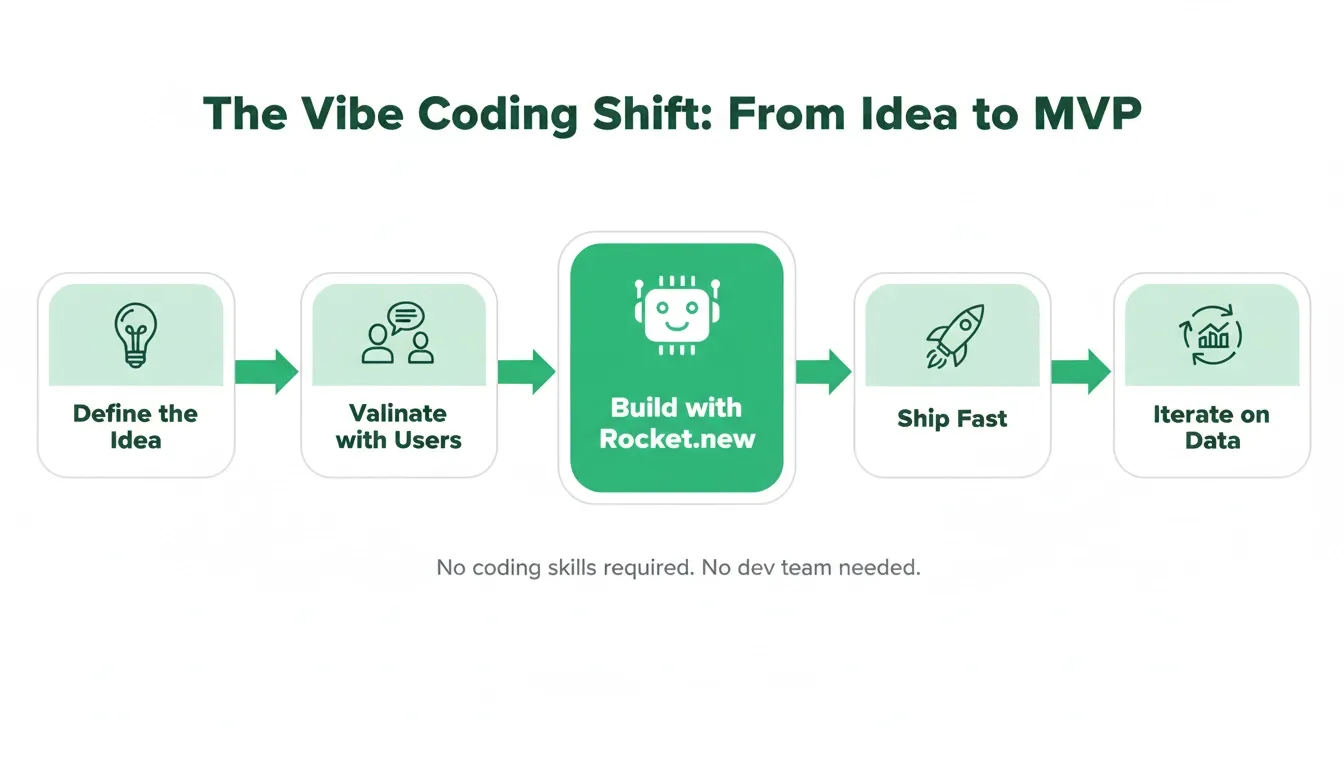
What This Looks Like in Practice: The Vibe Coding Shift
Most of these common MVP mistakes share a root cause: founders are making product decisions without enough real-world signal, and the build process is too slow and too expensive to allow fast course correction.
The pattern that works: define clearly, build minimally, ship fast, and let real users tell you what comes next. For non-technical founders, the bottleneck in that loop has always been the build stage itself.
That is changing fast. A new generation of vibe coding tools, AI-powered builders that let you describe what you want to build and receive a working product, has fundamentally shifted what is possible for non-tech founders. Vibe coding removes the dependency on hiring developers for the initial build. You do not need coding skills. You do not need a technical co-founder to get a first version in front of users.
Vibe coding is not a shortcut past the thinking. If anything, it makes the thinking more important. When a non-technical founder can build MVP without developers in days instead of months, the question is no longer whether you can afford to build this. It becomes whether you are building the right thing. That shift puts the focus exactly where it belongs: on the idea, on user feedback, and on the decisions that actually determine whether a product succeeds.
The rise of vibe coding also changes how non-tech founders should think about the technical co-founder question. A technical co is valuable in many contexts, especially when the product requires deep engineering, custom infrastructure, or a complex tech stack. But at the early idea and validation stage, vibe coding tools give non-technical founders a genuine way to get to first users without that dependency.
That build bottleneck is exactly what Rocket.new was designed to close.
Launch Your Rocket: Build Your MVP Without the Dev Dependency
Rocket.new is an AI-powered app builder that lets non-technical founders go from idea to working product without hiring a software engineer or waiting months for a development partner to deliver.
It is one of the most capable no-code app builder for startups available to early stage founders today, built to handle full products, not just landing pages or static prototypes.
Speed From Idea to Launch
Traditional software development can stretch across months. Rocket.new cuts that timeline dramatically. Non-technical founders can test their first idea with real users in days rather than weeks.
Faster time to product means a faster feedback loop, which is the whole point of MVP development. When the cost of iteration is low, every round of user feedback becomes a genuine learning opportunity rather than an expensive detour that requires going back to the development team.
No Technical Knowledge Required
You do not need to understand databases, APIs, or deployment pipelines. Rocket.new handles the architecture so you can stay focused on the product decisions that actually matter.
The platform translates what you want to build into a working product: no technical middleman, no technical partner needed in the room. Non-tech founders who previously could not move on an idea without hiring developers can now go directly from concept to testable product. No coding skills needed. No technical co-founder required to get started. Even product managers using vibe coding are discovering they can prototype and ship ideas without waiting on an engineering sprint.
Iterate Fast Without Technical Debt
One of the hidden costs of traditional software development is how expensive changes become over time. Technical debt builds up in codebases and slows every future update. With Rocket.new, updating the MVP based on user feedback takes hours, not sprint cycles. No tickets to file, no estimates to wait on, no queues to manage before your own product gets updated.
This is the real advantage for non-technical founders: staying in the feedback cycle without losing weeks to each round of changes.
Keep Full Control of Your Product Vision
Non-technical founders often lose sight of the product once software development is handed off to an external team. The idea gets translated, simplified, and sometimes changed in ways the founder did not intend.
With Rocket.new, the founder stays in the driver's seat, making product decisions directly and testing new ideas the same day. No handoff friction, no miscommunication about requirements, no waiting on someone else to act on your own idea.
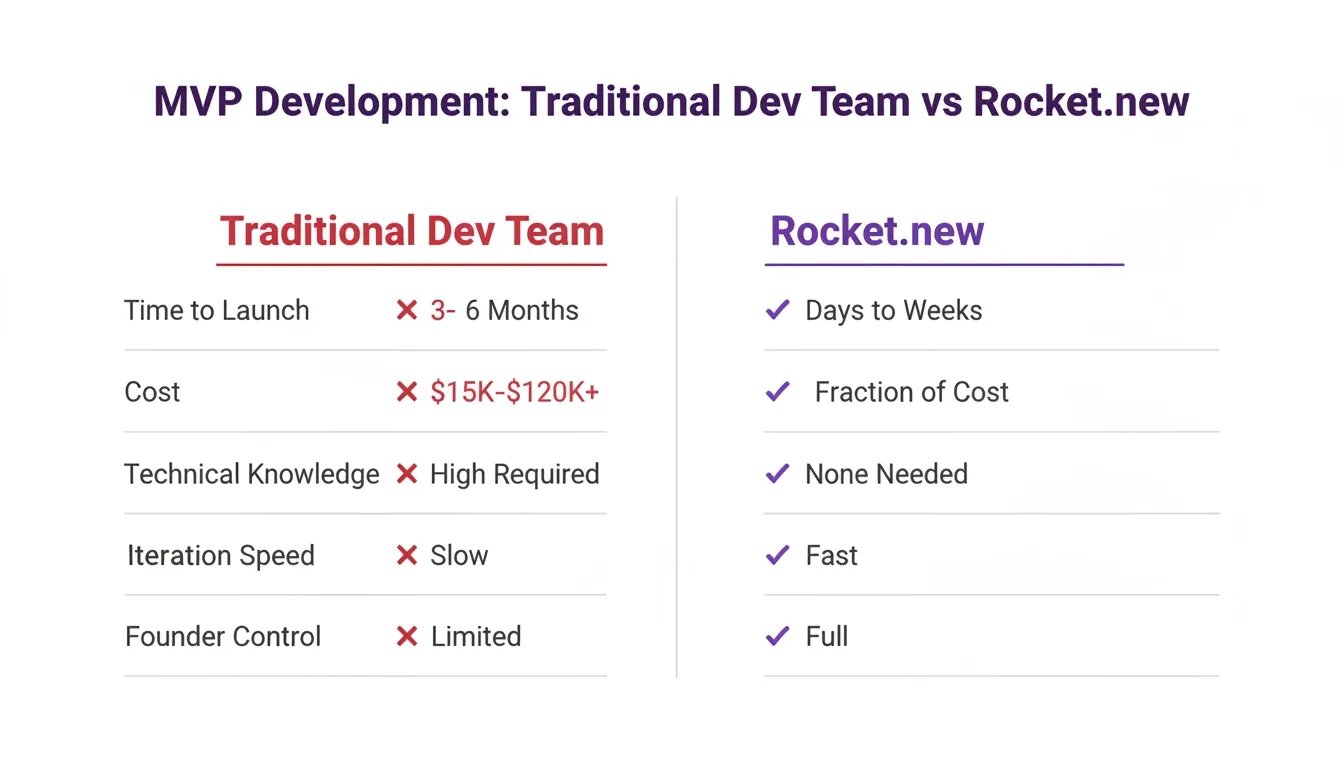
Rocket.new vs. Traditional Development: A Direct Comparison
| Factor | Traditional Dev Team | Rocket.new |
|---|---|---|
| Time to first version | 3-6 months | Days to weeks |
| Cost | $15,000 - $120,000+ | Fraction of the cost |
| Technical knowledge needed | High | None |
| Iteration speed | Slow (ticket queues) | Fast (direct changes) |
| User feedback loop | Delayed | Near real-time |
| Control for non-tech founders | Limited | Full |
Gartner projects that 75% of new applications will be built using low-code or no-code platforms by 2026 — a dramatic shift from less than 25% just a few years ago. Non-technical founders who wait for a traditional development partner are choosing a slower, more expensive path when a faster one is already available.
Rocket.new does not just speed up MVP development: it puts the founder back in control of the process from the very first day.
Final Thoughts: What Really Trips Up Non-Technical Founders
The MVP mistakes non-technical founders make are not rare edge cases. They are patterns that repeat across failed startups everywhere. Building too much too soon. Ignoring user feedback. Picking the wrong development partner. Letting scope creep run unchecked. Launching without measurable goals.
Each one traces back to the same problem: the founder was too removed from real users and too dependent on a slow build process to course-correct in time. Non-technical founders face a steeper version of this challenge than tech founders do, because the feedback loop between idea, build, and user response is longer and more expensive by default.
The fix is to build faster, test earlier, and stay close to user feedback at every stage. Rocket.new gives non-technical founders the tools to do exactly that, removing the expensive bottleneck of traditional software development and putting product decisions back where they belong: with the person who understands the idea and the problem best.
Ready to build your MVP without the dev dependency? Start building on Rocket.new today.
Table of contents
- -The Challenge of Building Without Coding Skills
- -Common MVP Mistakes Founders Without a Tech Background Make
- -Mistake 1: Treating the MVP Like the Final Product
- -Mistake 2: Ignoring User Feedback After Launch
- -Mistake 3: Picking the Wrong Development Partner
- -Mistake 4: Scope Creep and the "Just One More Feature" Trap
- -Mistake 5: Skipping Market Research and Targeting Everyone
- -Mistake 6: Not Setting Measurable Goals
- -What This Looks Like in Practice: The Vibe Coding Shift
- -Launch Your Rocket: Build Your MVP Without the Dev Dependency
- -Speed From Idea to Launch
- -No Technical Knowledge Required
- -Iterate Fast Without Technical Debt
- -Keep Full Control of Your Product Vision
- -Rocket.new vs. Traditional Development: A Direct Comparison
- -Final Thoughts: What Really Trips Up Non-Technical Founders