
Rocket.new wins on value for most builders. Fixed credits roll over monthly, plans start at $25/mo, and billing never spikes. Replit's effort-based Agent billing can drain a weekly budget in one session. For non-developers and founders, Rocket.new is the clearer choice.
Comparing Rocket.new vs Replit pricing reveals a clear split: Rocket.new delivers fixed credit-based billing with automatic rollover for predictable costs, while Replit's effort-based credits can lead to billing surprises. For non-developers, founders, and teams who need predictable costs, Rocket.new is the stronger choice.
What Is Rocket.new?
Rocket.new is a vibe solutioning platform and AI app builder that creates functional apps directly from natural language prompts or Figma designs. There is no development environment to configure and no setup overhead.
The platform covers web apps, mobile apps, internal tools, and e-commerce stores through AI-powered generation. It is an ai powered app builder built for rapid prototyping and real app creation across all skill levels, from solo founders to growing teams.
Rocket.new combines AI generation, AI assistance, a clean web UI, and one-click deployment so builders can start coding instantly and move from idea to a live product faster without switching tools. It also pairs natural language prompts with visual editing, which makes it accessible across skill levels. One credit balance covers everything: Build generation, Solve research, and Intelligence monitoring.
What Is Replit?
Replit is a browser-based IDE and cloud IDE that wraps a complete development environment around a collaborative code editor. It supports multilingual projects across dozens of programming languages and includes debugging tools, version control, real-time collaboration, and deployment tools.
Replit AI layers in code generation, autocomplete, and the Replit AI Agent for autonomous task execution. It is built for developers who want direct code control with AI assistance layered on top.
The Main Difference Between Replit vs Rocket.new
The main difference is where the abstraction sits. Replit exposes the code so developers review and shape every decision. Rocket.new abstracts the code entirely so the platform builds for you.
Describe your app idea on Rocket.new, receive a deployed result in minutes. Open the IDE on Replit, write code, and manage your own development workflow. Both serve distinct needs but diverge sharply on billing predictability.
One distinction worth noting: Rocket.new's competitive edge extends beyond app generation. The platform's Solve pillar delivers consultant-grade market research, and the Intelligence pillar provides continuous competitor monitoring. These capabilities are not available on Replit.
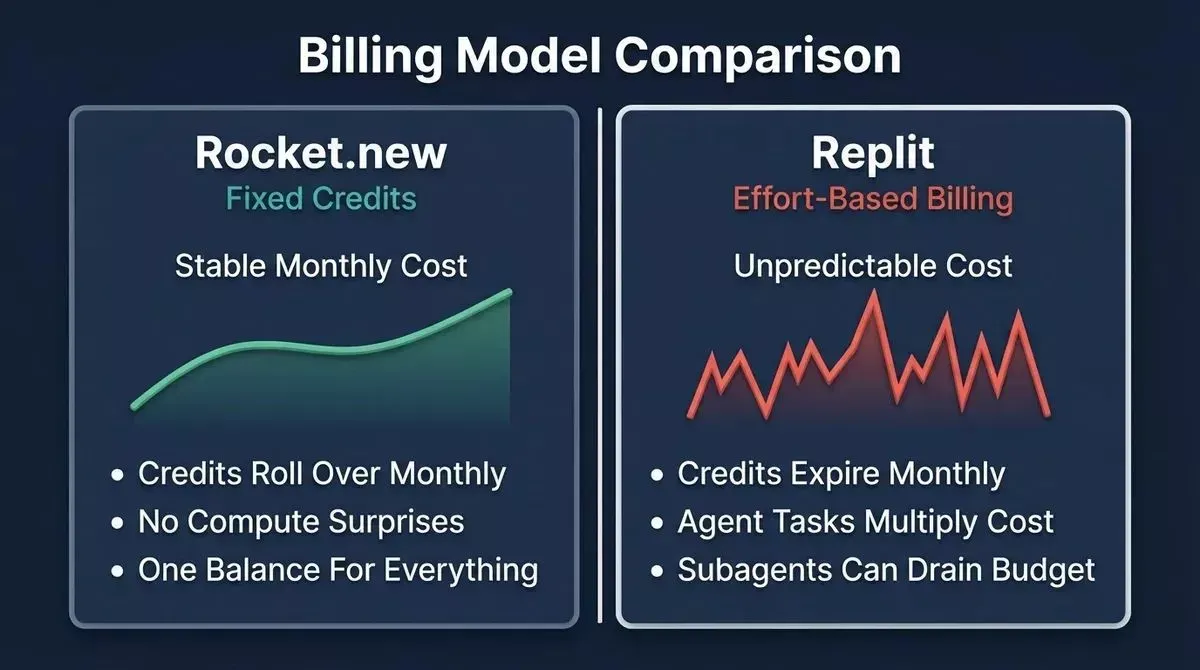
Rocket.new's flat credit model vs. Replit's variable billing. Predictability is the core pricing advantage.
Feature Comparison at a Glance
| Feature | Rocket.new | Replit |
|---|---|---|
| Prompt to app | Built-in | Via Replit AI Agent |
| Web and mobile apps | Yes | Yes |
| Code download | All paid plans | Direct in IDE |
| Custom domains | Unlimited | Paid plans only |
| Team members | Unlimited | Up to 15 (Pro plan) |
| Credit rollover | Subscription credits roll over | Credits expire monthly |
| Billing model | Fixed credits per plan | Effort-based (variable) |
| Figma import | Yes | No |
| Competitive intelligence | Rocket and Booster plans | No |
| Free tier | 20 credits, one-time | 1 app limit |
These key features show the core trade-off clearly: Rocket.new excels at one-shot app generation, turning ideas into fully functional applications far faster than traditional IDE workflows. Replit gives developers full control over code quality and structure, making it better suited for hands-on development.
Rocket.new Pricing Plans
Rocket.new runs on a credit-based system. One credit balance covers Build, Solve, and Intelligence. Paid plan credits roll over automatically month-to-month while your subscription is active.
- Free: $0; 20 credits, one-time grant (not monthly); Build + Light Solve.
- Pro: $25/month; 100 credits/month; Build + Light Solve for fast conversational research.
- Rocket: $50/month; 250 credits/month; Build + Full Solve (auto-routed) + Competitive Intelligence.
- Booster: $250/month; 1,500 credits/month; Build + Full Solve + Competitive Intelligence; for power users and fast-moving teams.
All paid plans include unlimited team members. Credits can be purchased as add-ons on top of any active subscription and do not expire while your plan is active. Save 20% with annual billing.
A key distinction: Pro includes Light Solve only. Rocket and Booster plans unlock Full Solve and Competitive Intelligence. If your workflow involves market research or competitor monitoring alongside app building, the Rocket plan is the minimum tier.
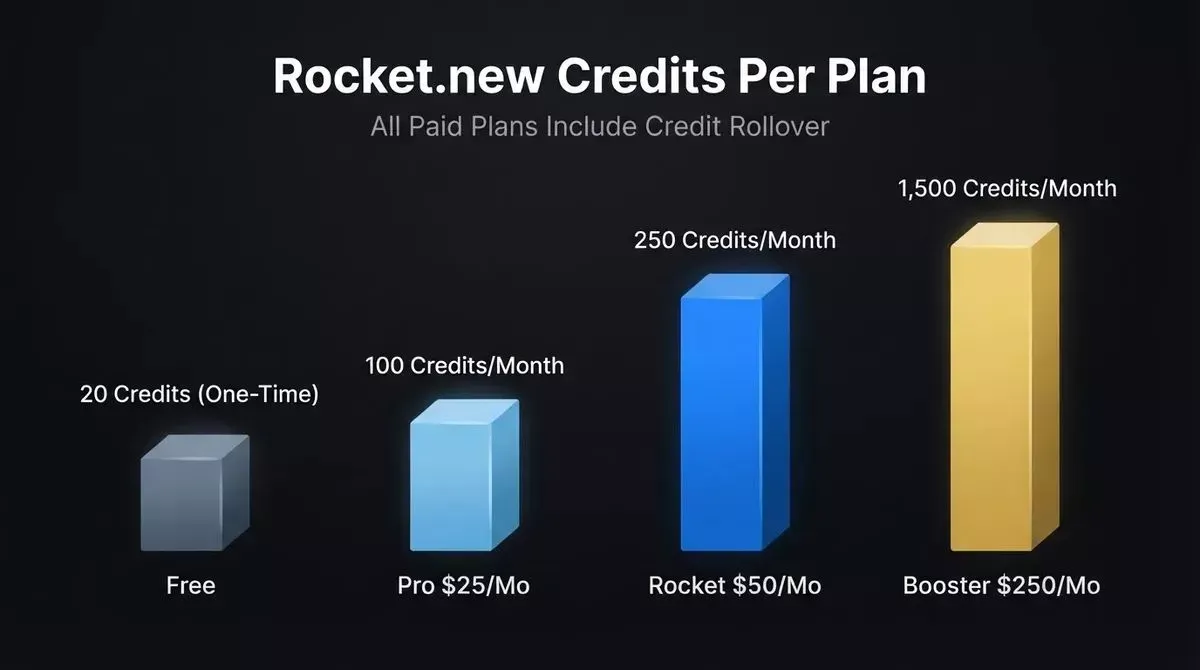
Credit allocation across all four Rocket.new plans. The Booster plan delivers 1,500 credits per month, making it significantly more cost-efficient for high-volume builds.
Replit Pricing Plans
- Starter: Free; one published app; Replit AI trial-only; published links expire after 30 days.
- Core: $25/month ($20/month annual); $25 in monthly credits; full Replit AI access; up to 5 collaborators.
- Pro: $100/month ($95/month annual); $100 in credits; up to 15 collaborators; priority AI model access.
Replit's free Starter is too restricted for real apps: one app limit, trial-only AI, and expiring links. Credits fuel the Agent at variable rates, making the total cost difficult to predict in any agent-heavy workflow.
The Real Cost Problem with Replit AI Agent
The most important pricing risk in any Replit vs Rocket.new evaluation is effort-based billing, introduced to Replit in mid-2025. It prices credit consumption by computing resources, not per request.
- Replit publicly acknowledged that effort-based pricing "can end up being more expensive over the lifetime of a project."
- After Replit AI Agent 3 launched, users reported dramatic overruns.
- As reported in June 2025, developers burned through the equivalent of a weekly budget in a single session.
- Agent 3's high-autonomy approach spawned subagents to refactor code on minor edits, pushing costs far beyond what the plan price implies.
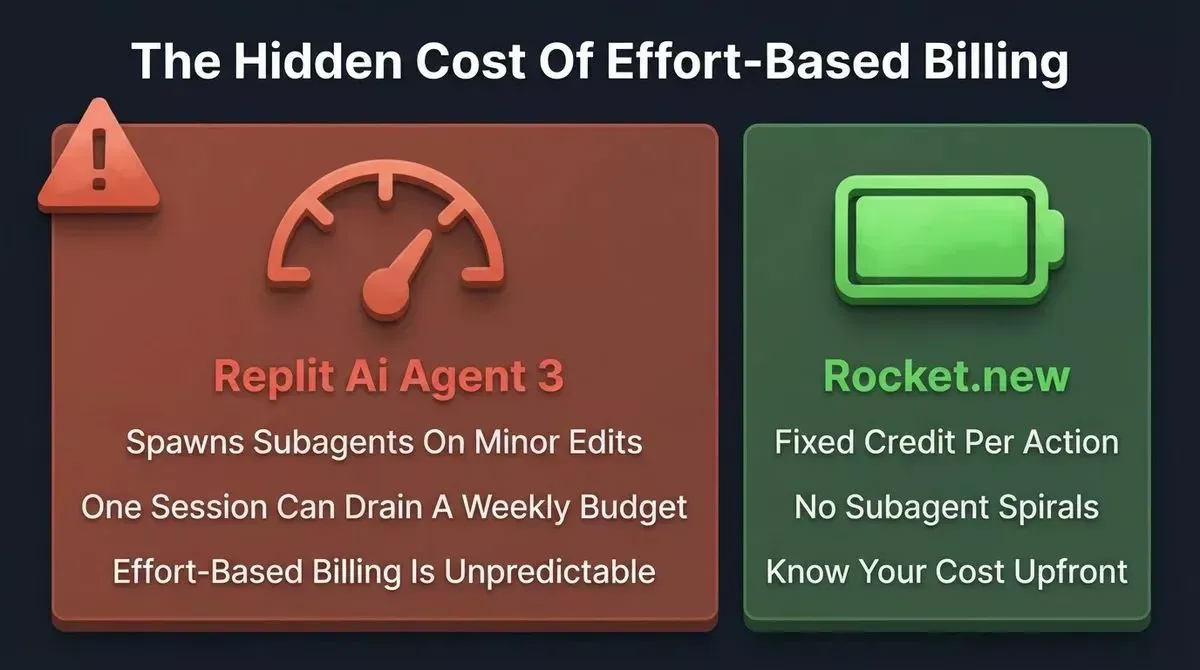
Replit AI Agent 3's subagent behavior can multiply credit consumption on a single task. Rocket.new ties every Build action to a fixed credit deduction.
Rocket.new ties every Build action to a fixed credit deduction. No overages, no subagent spirals, no billing shock.
How Each Platform Charges: A Billing Flow Comparison
Rocket.new's fixed credit path vs. Replit's variable billing flow.
Free Tier Comparison
Both platforms provide a free tier, but the experiences are materially different. Replit's free Starter caps users at one published app, limits Replit AI to trial mode, and expires links after 30 days.
Rocket.new's free tier provides 20 credits as a one-time grant. That is enough to generate and test a real app and validate a product concept before upgrading. The free tier is not a monthly replenishment, but it gives builders a genuine preview of production-level output.
For anyone running a Replit vs Rocket.new trial before spending, Rocket.new's free plan delivers a clearer picture of real production value.
Paid Plans: Side-by-Side Value Comparison
| Rocket.new Pro | Replit Core | |
|---|---|---|
| Price | $25/month | $25/month |
| Monthly credits | 100 | $25 in credits |
| Credit rollover | Rolls over | Expires monthly |
| Billing model | Fixed | Effort-based |
| Team members | Unlimited | Up to 5 |
| Code download | Yes | Yes |
| AI research | Light Solve | No |
At the same $25/month entry price, Rocket.new's Pro plan delivers rollover credits and Light Solve research access. Replit's Core plan delivers credits that can deplete faster than expected under agent-heavy workflows, with no rollover.
For a concrete scenario: a team running 10 moderate-complexity app builds per month would consume a predictable, fixed credit amount on Rocket.new. The same workflow on Replit could cost anywhere from $25 to multiples of that, depending on how many subagent cycles the Agent triggers per task.
How Rocket.new Build Works
Rocket.new's Build pillar is an AI-powered app builder that generates production-ready Next.js web apps and Flutter mobile apps from a natural language prompt, with strong AI features for turning ideas into working software. You can also convert a Figma design directly to working code without any manual handoff.
The workflow is: describe your app, Rocket.new generates a live preview with production-ready code, then iterate through chat, visual edit, or code view until it is exactly right. No terminal, no environment setup, no configuration overhead.
Rocket.new supports building SaaS dashboards, internal tools, marketplaces, AI-powered apps, and e-commerce stores. Mobile apps are built with Flutter and are ready for App Store and Google Play submission.
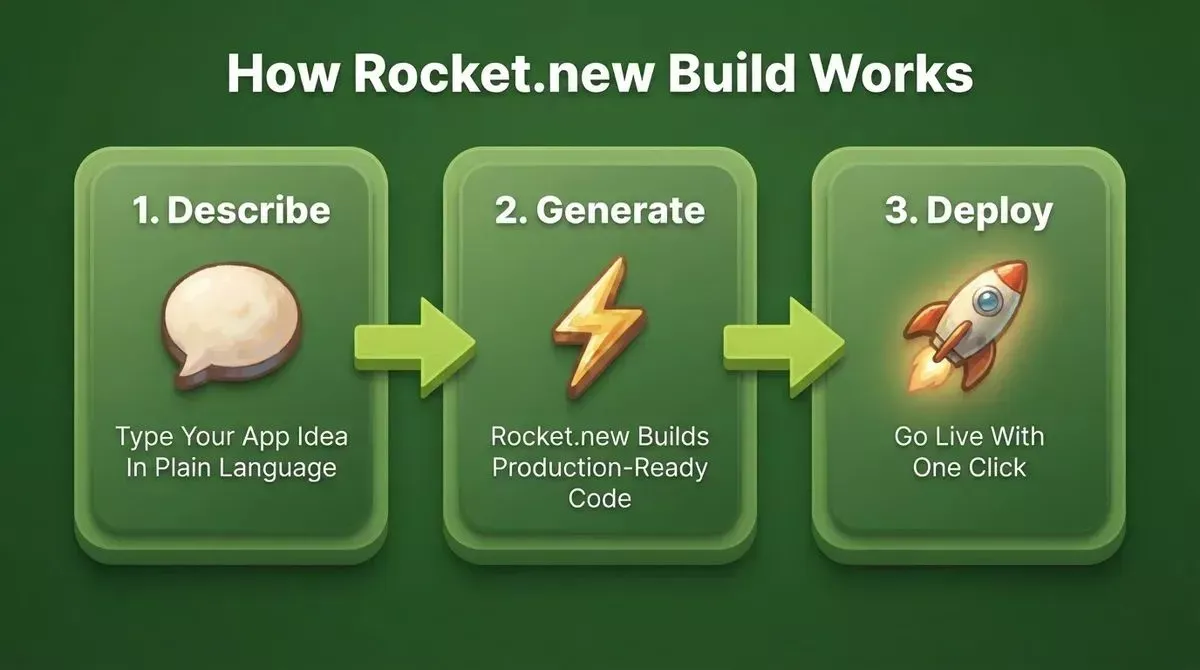
Rocket.new's three-step Build workflow: describe in plain language, generate production-ready code, deploy in one click.
Workflow: Prompt to App vs Code First
The Replit vs Rocket.new workflow difference is where most builders make their final call. Rocket.new's loop is entirely natural language: describe your app, the platform builds working apps instantly, iterate using natural language, deploy in one click.
Replit's workflow is traditional development enhanced by AI assistance. Write or generate code, review the output, test, and deploy. This preserves full control but recreates the iteration cycles that vibe coding removes.
Code Quality, Ownership, and Export
Code quality in Replit is developer-driven. Every Replit AI suggestion is a proposal to accept, modify, or reject, the right model for production applications requiring code review and quality assurance.
Rocket.new generates production-ready code automatically from prompts. Code download is included on all paid plans. Users own all generated code and can migrate freely to any environment.
Users report friction in extracting projects from Replit at scale. Rocket.new's export capability resolves this: code ownership is built in from day one, and building without a developer is the default experience.
When to Choose Replit
Choose Replit when your workflow demands direct code access and a full cloud IDE:
- You are a developer who needs a full development environment with version control and code review tools.
- Your projects involve long-lived codebases with real-time collaboration across a team.
- You want to learn to code or build apps in specific programming languages alongside AI assistance.
- Your production applications require code review, quality control, and advanced features not available in no-code workflows.
When to Choose Rocket.new
Choose Rocket.new when speed, predictability, and accessibility matter most:
- You are building web apps, mobile apps, or internal tools and need them deployed fast.
- You are a non-developer or founder who wants to avoid developer hiring costs.
- Predictable paid plans with credit rollover matter more than variable credit pools, especially for teams shipping multiple apps per month.
- You want full code export, custom domains, and production apps included in every plan.
- You need full-stack support for real apps without configuring infrastructure manually.
- One platform handles AI app generation, deployment, and code ownership without switching tools.
- You need market research or competitor monitoring alongside app building (Rocket and Booster plans).
Rocket.new is the strongest AI app builder for turning ideas into production-ready applications, built for non-technical founders and product teams who measure success by launch speed. Check out the Rocket vs Replit for building same application.
![Decision guide showing Choose Rocket.new for non-developers needing predictable billing versus Choose Replit for experienced developers needing direct IDE code control]
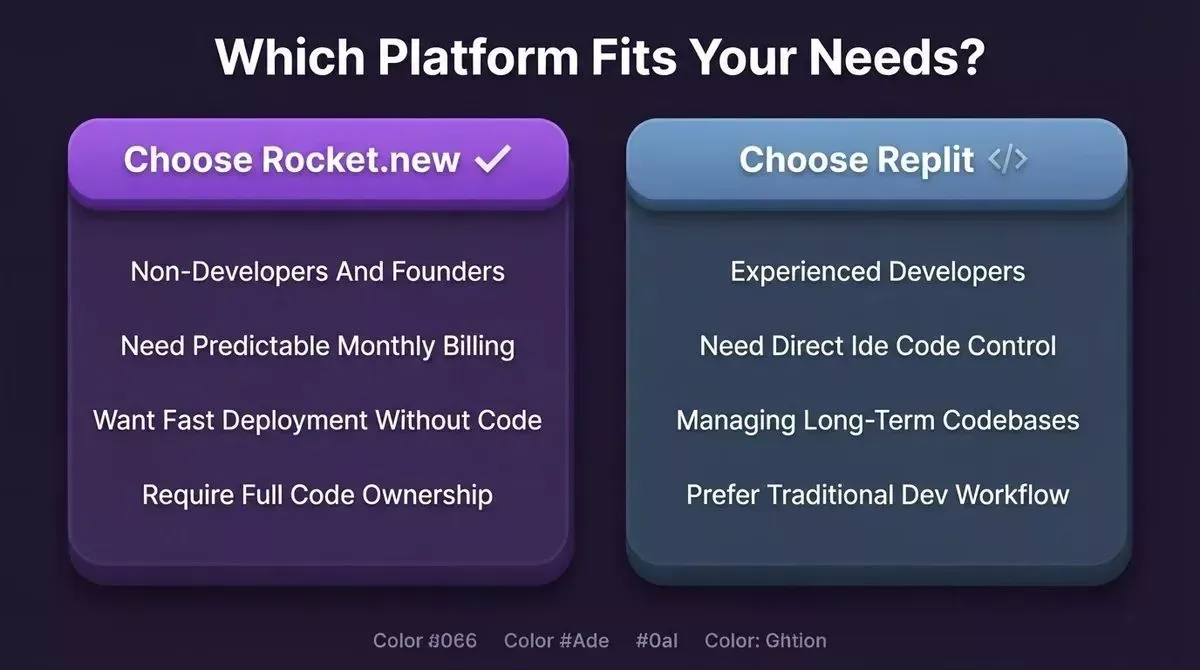
Use this as a quick decision guide: Rocket.new for speed and predictability, Replit for full developer control.
Final Verdict: Which Platform Fits Your Needs?
For most builders shipping apps in 2026, Rocket.new delivers better value. Its predictable credit billing and rollover policy serve web apps, mobile apps, and teams at every budget tier. The Booster plan at $250/month delivers 1,500 credits, which at scale is significantly more cost-efficient than Replit's effort-based model for high-volume builds.
Replit is the right tool for developers requiring a full development environment and direct code access. Firebase Studio is another option worth evaluating for Google ecosystem teams.
When you weigh billing predictability, workflow efficiency, and code ownership, Rocket.new is the answer for most real-world builds.
Ready to build without billing surprises? Rocket.new gives you fixed credit pricing, rollover credits, and production-ready apps from your first prompt. Start building for free on Rocket.new and see how fast you can go from idea to live app.
Table of contents
- -What Is Rocket.new?
- -What Is Replit?
- -The Main Difference Between Replit vs Rocket.new
- -Feature Comparison at a Glance
- -Rocket.new Pricing Plans
- -Replit Pricing Plans
- -The Real Cost Problem with Replit AI Agent
- -How Each Platform Charges: A Billing Flow Comparison
- -Free Tier Comparison
- -Paid Plans: Side-by-Side Value Comparison
- -How Rocket.new Build Works
- -Workflow: Prompt to App vs Code First
- -Code Quality, Ownership, and Export
- -When to Choose Replit
- -When to Choose Rocket.new
- -Final Verdict: Which Platform Fits Your Needs?