
*Most competitive analysis reports collect data but miss the "so what." A well-structured doc covers competitor mapping, SWOT, pricing, and a positioning summary with clear recommendations. Rocket Intelligence feeds this process with live competitor signals so your report reflects today, not last quarter.
Why do most competitive analysis reports end up as archived PDFs that no one opens after the kickoff meeting?
According to competitive deals research from Crayon, sellers face competitors in 68% of deals. Yet the research that should sharpen those conversations gets filed away and forgotten.
The problem is rarely a lack of data. Most teams can find competitor pricing pages, product screenshots, and review summaries without much trouble. The problem is structure. A competitive analysis that reads like a data dump fails to answer the one question decision-makers care about: what should we do differently?
This blog walks through the writing process from scratch: how to structure each section, what to put in each one, and how a worked example pulls it all together.
What Makes a Competitive Analysis Actually Useful?
A competitive analysis becomes useful the moment it stops describing competitors and starts informing decisions. That shift comes from structure, not from volume of data.
-
It answers a specific question. Every competitive analysis should open with a stated objective: are you launching into a new market segment, evaluating a pricing change, or building a sales battlecard? Without that anchor, the document sprawls.
-
It covers direct and indirect competitors. Most teams focus only on companies selling the same product. Customers often choose between your solution and a fundamentally different approach that solves the same problem.
-
It connects data to recommendations. A feature comparison table is useful. A feature comparison table that tells your team which gap to close first is ten times more useful.
-
It reflects current market reality. Stale data produces stale strategy. A competitive analysis built on pricing pages from six months ago may already be describing a rival that no longer exists in that form.
-
It is written for a specific audience. A report for a sales team looks different from one written for a product roadmap review or an investor deck.
Knowing what a strong competitive analysis does is the first step. Understanding its components is next. For a broader view of how competitor analysis connects to strategic positioning, the competitive strategy frameworks guide is worth reading alongside this one.
What Should Every Competitive Analysis Cover?
A well-built competitive analysis covers six consistent sections regardless of industry or company size. Most teams skip at least two of them, which is where most reporting gaps begin.
-
Executive summary: A one-page read that states the objective, names the competitors analyzed, and summarizes the top recommendations
-
Competitor overview: Company size, founding year, funding stage, market positioning, and company mission for each rival
-
Product and pricing comparison: A structured look at product features, pricing tiers, and packaging across all competitors
-
Marketing strategy breakdown: Channels, messaging tone, and social media presence for each rival
-
SWOT analysis: Strengths and weaknesses for each competitor, plus market-level opportunities and threats
-
Positioning summary with recommendations: Where your business sits relative to competitors and what the analysis implies for next decisions
These six sections give any reader, regardless of role, a complete picture without digging through the raw research. The Semrush guide on competitive intelligence covers how to source data for most of these sections, from pricing pages to review platforms to traffic tools.
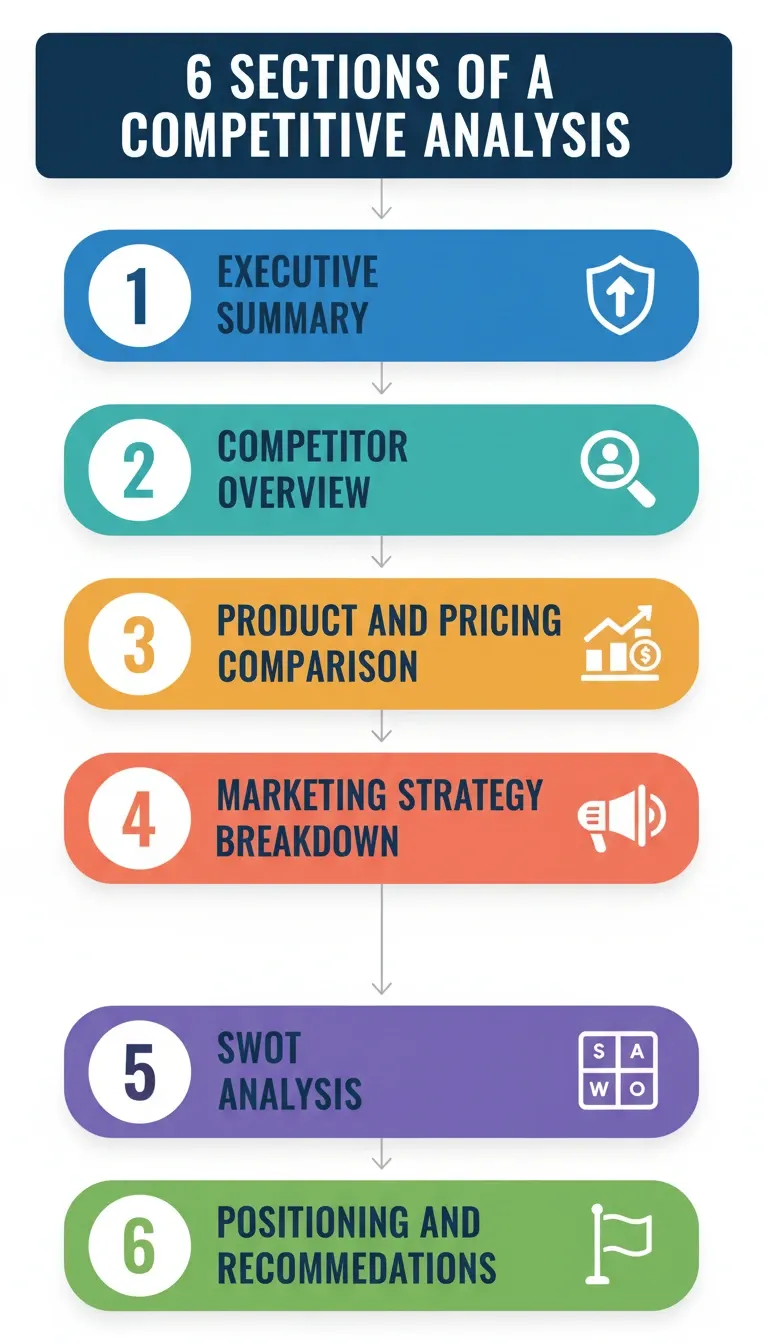
The six core sections every competitive analysis needs, from executive summary to positioning recommendations.
Which Competitors Belong in Your Analysis?
Competitor selection is where most analyses go wrong before a single word is written. Getting this right determines the quality of every section that follows.
-
Direct competitors sell the same or very similar products to the same customers. These are the names your sales team hears in deal cycles most often.
-
Indirect competitors solve the same customer problem through a different approach. A project management tool and a shared email inbox are indirect competitors if customers use one to avoid buying the other.
-
Both deserve space in a thorough analysis. Leaving indirect competitors out creates blind spots, especially when a market shift makes their approach more appealing to your target audience.
A useful rule: if a customer could describe your product and their alternative in the same sentence as solving the same problem, both belong in the analysis.
Identifying competitors accurately takes more than a quick search. It requires understanding your customers' full decision set, not just the names your sales team already knows. Learning how to map your competitive landscape before you start writing saves significant rework later.
Building Your Competitive Analysis: Section by Section
Writing a competitor analysis follows six steps that build on each other. Skipping ahead produces a weaker document every time.
Step 1: Define Scope & Objective
Step 2: Map Competitors
Step 3: Gather Data
Step 4: Run SWOT Analysis
Step 5: Write Narrative Sections
Step 6: Close With Recommendations
Step 1: Define Your Scope and Objective
A competitive analysis without a stated objective becomes a research archive. The objective shapes every decision that follows, from which competitors to include to how much detail each section needs.
-
State the business question upfront. Are you preparing to enter a new market segment? Defending against a pricing move from a top rival? Building a business plan for investors? Each purpose produces a different document.
-
Decide how many competitors to include. For most analyses, three to five competitors produce a report specific enough to act on. Including too many dilutes the depth of each profile.
-
Set a snapshot date. A competitive analysis report should clearly state when the data was collected. This prevents readers from treating it as evergreen when the market moves.
-
Name your primary audience. A report written for a sales team needs verbatim talk tracks. One written for a product team needs feature-level gap analysis.
Defining the scope before gathering any data saves significant revision time later. Most over-long competitor analysis reports exist because the objective was never set.
Step 2: Map Your Direct and Indirect Competitors
Competitor mapping is the research step that determines the quality of every section that follows. Build the full map before narrowing down.
-
Search for your core product category and note which brands appear in organic and paid results across the market
-
Check review platforms for your product category and see which alternatives customers compare you to most often
-
Read customer churn notes and win-loss records for the names that come up as reasons for switching
-
Ask your sales team for the competitors they encounter in active deals; their list and the review platform list will often differ
-
Include both direct competitors and indirect competitors in your map before deciding which to profile in depth
-
According to Klue's research on competitive selling, buyers evaluate an average of 3.5 vendors per deal, which means the competitive field is usually wider than it appears from sales data alone
The goal at this stage is breadth, not depth. Build the full competitor map first, then narrow to the three to five companies you will profile in detail.
Step 3: Gather the Data That Actually Matters
The quality of a competitive analysis depends entirely on the quality of its sources. Random data leads to random conclusions.
-
Competitors' websites and pricing pages: Check pricing structures, packaging tiers, and any recent messaging changes
-
Product review platforms (G2, Capterra, Trustpilot): Customer reviews reveal product features that marketing copy won't mention, including competitors' weaknesses
-
Social media profiles and content: Look at posting frequency, tone, and the topics competitors choose to emphasize
-
Job postings: Hiring patterns are one of the most reliable signals of where a rival is investing; a cluster of engineering roles often precedes a product launch
-
Press releases and news coverage: Acquisition announcements, partnerships, and funding rounds all signal strategic direction
-
Primary research: Your own win-loss calls, customer interviews, and sales call recordings carry signals that no public source will reveal
-
Layering this research alongside your go-to-market strategy framework produces more actionable output when both draw from the same data set
As Benedikt Kantus wrote in Leading in Product, March 2026: "Most product teams fall into the same trap: They focus on what competitors are doing rather than understanding why they're doing it. This reactive approach means you'll always be one step behind instead of one step ahead."
Collecting data from multiple sources, not just competitors' websites, produces a competitive analysis that reflects what rivals are actually doing rather than what they want you to see.
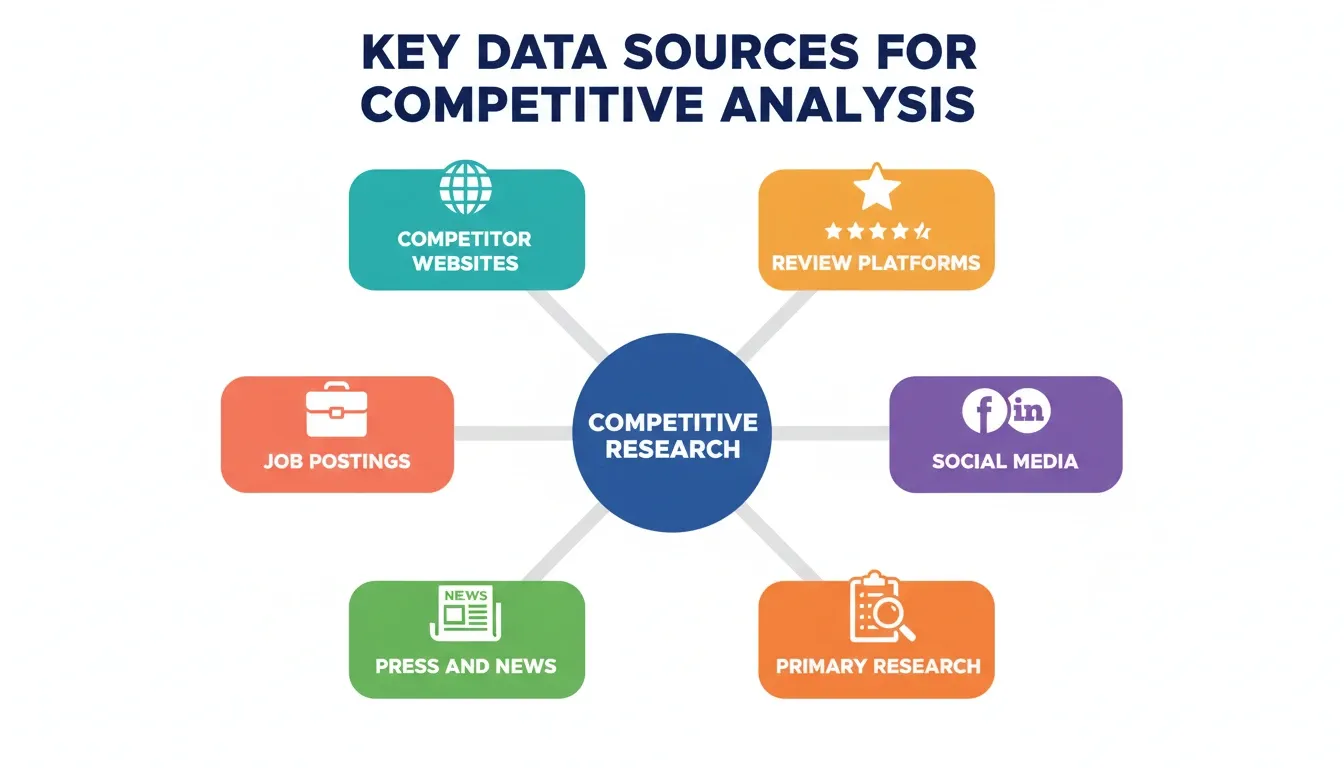
Six data source types every competitive analysis should draw from for complete market coverage.
Step 4: Run a SWOT Analysis for Each Competitor
A SWOT analysis applied to competitors, not just your own business, is one of the highest-value steps in any competitor analysis report. Most teams only run it on themselves and miss half the picture.
-
Strengths: What the competitor does genuinely well, from product depth to brand positioning to customer satisfaction scores. Be honest; overstating their weaknesses produces a document your sales team won't trust.
-
Weaknesses: Where competitors fall short: product features, pricing transparency, customer support, or market coverage
-
Opportunities: External factors the competitor is well-placed to capture, such as a growing customer segment they already serve
-
Threats: External factors that could limit their growth: new entrants into their niche, a technology shift, or a change in customer preferences they haven't responded to
Conduct a SWOT analysis for each major rival separately, then compare the full set to spot patterns. Track internal factors (product, team, positioning) separately from external factors (market trends, competitor moves); conflating them makes the recommendations section harder to write.
The SWOT output for each competitor becomes the evidence base for your positioning summary. The rest of the competitor analysis report falls apart without it. Understanding the full competitive intelligence cycle helps you know when to refresh each SWOT section as the market evolves.
Step 5: Write the Narrative Sections
This is where the analysis stops being a spreadsheet and starts being a document people actually read. Precision matters more than length here.
-
Write competitor profiles in a consistent format. If you cover pricing strategy, company mission, and marketing strategy for Competitor A, cover the same dimensions for every competitor. Inconsistency makes comparison difficult.
-
Frame strengths and weaknesses in your customers' language. Copy from customer feedback and review platforms is far more credible than paraphrased marketing jargon.
-
Keep each section tight. A competitor analysis report that runs past 20 pages rarely gets read in full. Ruthless editing is itself a competitive edge.
-
Use a comparison table for product features. A table lets readers scan competitors at a glance without wading through paragraph-level descriptions.
-
Write the SWOT sections before the positioning summary. The positioning narrative should emerge from the SWOT findings, not precede them.
The narrative sections are the hardest to write and the most important to get right. This is where raw data becomes usable intelligence for your team. A solid competitor profile template ensures every rival gets the same structured treatment.
Step 6: Close With a Recommendations Section
A competitive analysis that describes the market without recommending action is a research report, not a strategic tool. The recommendations section is what separates the two.
-
State your competitive advantage clearly. Based on everything the analysis found, where does your business have a genuine edge? Name it specifically.
-
Identify the top market gaps. Which customer needs do competitors consistently fall short on? These are the gaps your business strategy should target first.
-
Write 3 to 5 specific recommendations. Each one should tie directly to a finding in the analysis. Vague advice like "improve marketing efforts" is not a recommendation.
-
Develop strategies for each gap. Pair each recommendation with a next action: a product addition, a pricing change, a messaging shift, or a new channel to test.
The recommendations section is what turns the competitor analysis report into a business plan input rather than a filing cabinet item.
A Worked Competitive Analysis Example
Here is how the structure above applies to a real scenario, simplified for readability.
The Scenario: A B2B SaaS Pricing Tool
A startup building a B2B pricing analytics product wants to enter a market with three established competitors. Their initial analysis identifies mid-market SaaS companies with 50 to 500 employees as the core target customers for all three rivals. The startup's goal: find the market segment where competitors are weakest and where their product is most differentiated.
A strong unique selling proposition is only as good as the competitive research that informs it. This example shows how the competitor analysis produces the whitespace finding.
Competitor Comparison Table
| Dimension | Competitor A | Competitor B | Competitor C |
|---|---|---|---|
| Pricing | $499/mo flat | Usage-based from $199 | $299/mo per team |
| Core product focus | Revenue analytics | Price experimentation | Pricing reporting |
| Target customer | Enterprise (500+ seats) | SMB, any size | Mid-market SaaS |
| Feature depth | 60+ connections, advanced dashboards | Limited connections, strong A/B tooling | 15 connections, basic dashboards |
| Top weakness (G2 reviews) | Too complex for mid-market | Missing enterprise features | Reports not actionable |
A competitor pricing strategy response framework helps translate the pricing data above into concrete decisions about where to position your own tiers.
What the SWOT Analysis Revealed
Running a SWOT analysis on all three competitors, using customer review data and job posting trends, produced several clear findings.
Competitor A has clear strengths in depth and brand reputation. Their weaknesses include a steep learning curve that mid-market teams consistently flag in reviews, plus pricing that pushes this same customer segment toward cheaper alternatives. Competitor B's strengths lie in flexibility; their weaknesses center on missing features that larger mid-market accounts need when scaling. Competitor C's strengths and weaknesses split cleanly: right market segment, right positioning, but the product falls short on turning pricing reports into recommendations customers can act on.
The opportunities are visible from this pattern. Mid-market SaaS teams want pricing intelligence that tells them what to do, not just what happened. The competitor that fills that gap has a clear path to capturing the same customers that all three incumbents are currently underserving.
Conduct a SWOT analysis on your own business alongside this competitor set to identify where your strengths map to competitors' gaps. That intersection is where your positioning summary lives.
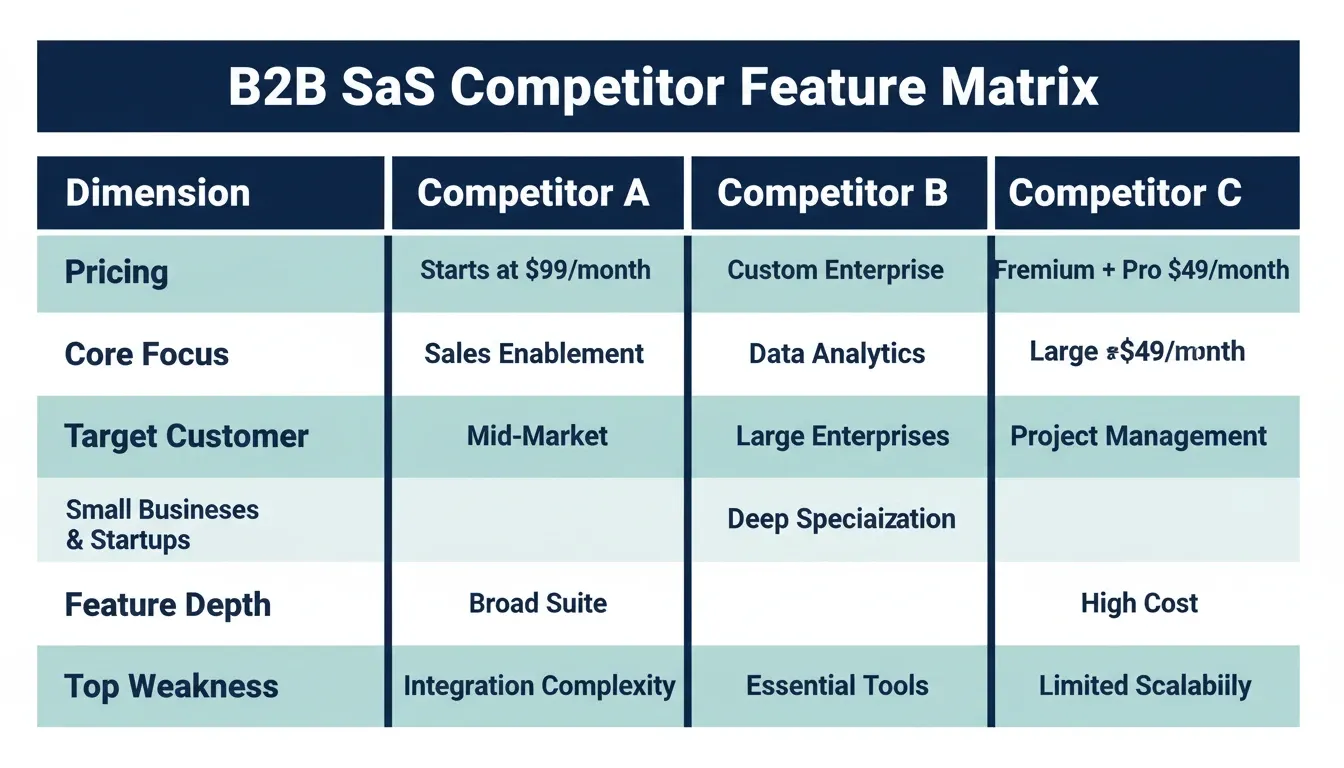
A structured feature matrix makes it easy to spot gaps and positioning opportunities across your competitive set.
Writing Mistakes That Weaken a Competitive Analysis Report
Even well-researched competitor analysis reports fall short when the writing goes wrong. These four patterns cause most of the damage.
Reporting Data Without Drawing Conclusions
The most common writing mistake in any competitive analysis is treating the data section as the deliverable. Collecting information without interpreting it produces a document that describes competitors rather than informing strategy.
-
A report that lists competitor pricing without commenting on what that pricing signals to customers is describing, not analyzing
-
Data without interpretation leaves readers to draw their own conclusions, which often means they draw the wrong ones
-
Every data point in a competitor analysis report involves a "so what." The analysis report should answer it explicitly, not leave it implied
-
A good rule: after any table or data section, write one sentence that states what the data means for your business strategy
Analysis involves judgment, not just collection. The conclusions section is what makes the competitor analysis worth reading.
Treating Indirect Competitors as Secondary
Focusing exclusively on direct competitors is a structural blind spot that carries forward into every section of the finished document.
-
Indirect competitors often represent a larger real-world threat than the obvious names in your category, especially in markets where customers are still deciding between solution types
-
Indirect competition frequently goes untracked because it doesn't show up in deal cycle data as clearly as direct rivals
-
Customers who choose a simpler alternative to solve a problem they could have used your product for are the clearest signal that indirect competitors matter
-
Similar products that solve a related problem differently can displace direct competitors without appearing in the same product category
Include indirect competitors in the analysis even if they earn fewer words than direct rivals. Their presence changes the positioning recommendations.
Writing for Archives Instead of Decisions
A competitive analysis written for "completeness" rather than for a specific decision ends up thorough but unusable.
-
A business owner who receives a 40-page competitor analysis report the week before a pricing review meeting needs a 2-page summary, not the full document
-
Write each section with a specific reader in mind. Marketing efforts, product roadmap decisions, and sales team prep all need different formats
-
Keep market trends current; a report written to be permanently correct becomes outdated before it is finished
-
Set a clear review date when you publish it so it doesn't stay in circulation past its useful life
Step ahead of this problem by writing a one-page executive summary before writing the full report. If the summary isn't clear, the full document won't be either.
Skipping the Positioning Summary
The positioning summary is the section that ties the entire competitor analysis report together. Skipping it is the single most common reason analysis reports sit unread.
-
Your competitive advantage needs to be stated in plain language, not implied across 15 pages of data
-
The competitive edge your analysis reveals means nothing if it doesn't appear as a named, explicit finding in the document
-
Without a positioning summary, readers draw different strategic conclusions from the same analysis report; no alignment follows
-
Analyze competitors thoroughly, then summarize where your business wins, where it lags, and what to do about it in one section any stakeholder can read in under two minutes
No positioning summary means no strategic alignment. That is the single most expensive writing mistake a competitive analysis can make.
How Rocket Intelligence Feeds Your Competitive Research
Writing a great competitor analysis report starts with having the right data. Most of the writing mistakes above trace back to the same root cause: teams work from incomplete, stale competitive insights assembled manually from public sources.
This is where account intelligence for sales teams and competitive research converge, and where Rocket was built to help.
What Does Live Competitor Data Actually Change?
The difference between a competitive analysis built on live data and one built on a three-month-old snapshot is not subtle.
-
A competitor can change their pricing strategy, shift their messaging, or launch a product between the day your analysis was finalized and the day it gets read
-
Manual data gathering creates a ceiling. Checking competitors' websites, social media profiles, and job posts by hand takes hours per competitor per month, and most teams can only sustain this for their top two or three rivals
-
Performance metrics from last quarter, even when accurate, describe where a competitor was rather than where they are going
-
Competitor analysis frameworks built on static data undercount the threat from fast-moving rivals and overcount the lead your business thinks it holds
-
The competitive picture shifts faster than quarterly research cycles can track; the competitor analysis report becomes outdated before it reaches stakeholders
-
Competitive insights built on live signals change what the analysis covers: from a backward-looking review to a forward-looking brief
Live competitor data does not replace the writing process. It makes every section of the competitor analysis more accurate and more defensible.
From Manual Spreadsheets to Always-On Intelligence
Most competitive analysis workflows look like this: someone owns a spreadsheet, updates it when they have time, and shares a quarterly snapshot that is already outdated by the time it reaches stakeholders.
Rocket Intelligence monitors every public surface a rival operates on: website, social, news, GTM activity, traffic, product moves, hiring, business and finance, reviews, and a cross-signal pattern overview that catches when multiple signals point in the same direction.
-
Where traditional competitive intelligence software focuses on one or two signal types, Rocket reads across ten pillars simultaneously and delivers a ranked, personalized brief for each company you follow
-
Business stacks built around manual competitor tracking require significant analyst time and still miss the signals that automated coverage catches immediately
-
Competitors communicate their strategic direction across dozens of public surfaces at once; manual monitoring only captures a fraction of them
-
The free competitor analysis template your team fills in quarterly only reflects what someone had time to find that week; always-on coverage reflects what is actually happening
-
A comprehensive competitive analysis built on Rocket Intelligence output starts with better raw material, which means the writing, the SWOT, and the positioning summary all rest on a more accurate foundation
What Rocket Intelligence makes possible:
-
Follow any company. Every company on Rocket has a public entity dashboard you can track, including hiring patterns, news mentions, product moves, and business signals
-
Get ranked Intel, not raw alerts. Rocket interprets signals through your role context so what arrives in your feed is already filtered for relevance
-
Spot absence as well as activity. A competitor going quiet on hiring or social media is itself a signal that manual monitoring misses
-
Build your analysis from current data. The SWOT findings, the pricing comparison, and the competitor profiles all stay accurate when the underlying data is live
See what Rocket Intelligence can show you about the competitors that matter most to your business.
From Competitor Data to Decisions That Win Deals
A well-written competitive analysis does one thing above everything else: it turns what you know about competitors into a decision your team can act on today. The structure, the SWOT findings, the positioning summary, and the recommendations section all exist to support that single outcome.
The gap most analysis reports leave open is data freshness. Writing sharp conclusions from stale inputs produces a competitive analysis that was accurate when it was written but misleading by the time it drives a decision. Real-time competitor monitoring closes that gap, not by replacing the writing process, but by giving it better raw material.
Ready to build your next competitive analysis from live competitor signals? Start tracking your rivals with Rocket.new Intelligence and give every section of your report a current, verified foundation.
Table of contents
- -What Makes a Competitive Analysis Actually Useful?
- -What Should Every Competitive Analysis Cover?
- -Which Competitors Belong in Your Analysis?
- -Building Your Competitive Analysis: Section by Section
- -Step 1: Define Your Scope and Objective
- -Step 2: Map Your Direct and Indirect Competitors
- -Step 3: Gather the Data That Actually Matters
- -Step 4: Run a SWOT Analysis for Each Competitor
- -Step 5: Write the Narrative Sections
- -Step 6: Close With a Recommendations Section
- -A Worked Competitive Analysis Example
- -The Scenario: A B2B SaaS Pricing Tool
- -Competitor Comparison Table
- -What the SWOT Analysis Revealed
- -Writing Mistakes That Weaken a Competitive Analysis Report
- -Reporting Data Without Drawing Conclusions
- -Treating Indirect Competitors as Secondary
- -Writing for Archives Instead of Decisions
- -Skipping the Positioning Summary
- -How Rocket Intelligence Feeds Your Competitive Research
- -What Does Live Competitor Data Actually Change?
- -From Manual Spreadsheets to Always-On Intelligence
- -From Competitor Data to Decisions That Win Deals